India commercial property due diligence has no state-guaranteed title - Indian title is based on a chain of documents going back 30+ years, not a constitutive registry. The result: title search depth and chain of title quality are the most critical variables in Indian CRE diligence. Add state-specific stamp duty (4-8% depending on state), FEMA restrictions on foreign direct ownership, and state-by-state variance in land records and you have a market that rewards preparation.
India stamp duty varies by state - some indicative 2026 ranges: Maharashtra (Mumbai): 5% plus 1% metro cess plus 1% surcharge above INR 30M = up to 7% effective for high-value Mumbai commercial; Tamil Nadu (Chennai): 7% stamp duty + 1% registration fee = approximately 8%; Telangana (Hyderabad): approximately 4-6% combined (stamp duty + transfer duty + registration fee); Karnataka (Bengaluru): 5% for properties above INR 4.5M plus 1% registration fee; Delhi NCT: 4-6% plus registration fees; these are approximate rates - confirm current rates with Indian counsel for the specific state and transaction type. Stamp duty is paid on the higher of the stated consideration and the circle rate (government-notified minimum values).
India's title system is not constitutive registration - the Registration Act 1908 requires registration of property documents at the Sub-Registrar's Office (SRO) but registration does not guarantee title; it creates a public record and priority against unregistered instruments; actual title quality depends on the chain of title documents (deeds, mortgages, releases, etc.) going back typically 30 years; an Encumbrance Certificate (EC) from the SRO is the central search tool showing all registered transactions on the property for the searched period; the EC shows mortgages, sales, leases, and other charges registered against the property; a clean EC covering 30 years is a necessary but not sufficient condition for clean title.
Set up a data room before advisors engage. Load title documents (sale deeds, mother deed chain), Encumbrance Certificate, building plans and Occupancy Certificate, RERA registration, land records (Pahani/7-12/Revenue Record), and lease files.
Where India property deals actually go wrong
Not every check carries the same weight. The table below sorts them by deal impact - dealbreakers first, then what moves the price, then basic hygiene - so your Indian attorney and advisor know what to clear first.
| Area | Documents to pull | India red flag | Matters most for | Tier | |
|---|---|---|---|---|---|
| Title chain search (30+ years) | Title chain search (30+ years) | Original title documents: mother deed (earliest document establishing original title), all subsequent registered sale deeds, gift deeds, inheritance records, partition deeds; Encumbrance Certificate (EC) from Sub-Registrar's Office for minimum 30 years | India has no Torrens-style state-guaranteed title; title depends on establishing an unbroken chain of valid transfers going back 30+ years (some practitioners recommend 60 years for older properties); the chain must show: original acquisition (from government, prior private owner, or development authority), all subsequent transfers with registered sale deeds, any mortgages and their discharge, any partition, inheritance or gift deeds affecting title; request the Encumbrance Certificate (EC) from the SRO for a 30-year period; the EC shows all registered instruments affecting the property during that period; a clean EC showing no encumbrances is necessary but title opinion still requires document review; gaps in the chain of title (missing deeds, unregistered transfers, periods without explanation) are red flags; for commercial property sold by developers: request the original government allotment letter or land acquisition proceedings and all subsequent transfers | All buyers - foundational check | Dealbreaker |
| Agricultural land conversion | Agricultural land conversion | Revenue/land records (7-12 extract in Maharashtra; Pahani in Telangana/AP; equivalent in other states) showing land use classification, conversion order (change of land use/CLU) from agricultural to non-agricultural use | Under Indian land laws (which vary by state), agricultural land can generally only be sold to agriculturalists and cannot be developed for commercial or industrial use without a formal conversion (change of land use/CLU) order from the state revenue authority (Collector/Tahsildar); a significant portion of land in India, including land on the periphery of major cities, is classified as agricultural in revenue records even if it has been used commercially for years; using agricultural land for commercial purposes without CLU is an unauthorized use that can result in demolition orders, prosecution, and title defects; for any commercial acquisition outside established urban areas, or on the periphery of cities (peri-urban zones in Bengaluru, Hyderabad, Pune, Chennai outskirts): check the land classification in revenue records; confirm CLU or non-agricultural (NA) order has been obtained; many Indian industrial and commercial parks outside city limits have addressed this through development authority approvals or special economic zone (SEZ) notifications | Commercial outside city limits; industrial; logistics in peri-urban zones | Dealbreaker |
| Foreign ownership - FEMA restrictions | Foreign ownership - FEMA restrictions | FEMA (Foreign Exchange Management Act 1999) compliance opinion from Indian counsel, RBI circular compliance analysis, FDI route assessment for the proposed investment structure | FEMA and RBI regulations restrict foreign investment in Indian real estate; foreign nationals (non-NRIs) generally cannot directly purchase immovable property in India; FDI in construction development projects is permitted through the automatic route under consolidated FDI policy but with conditions on minimum capitalization, area development requirements, and exit timelines; for foreign institutional investors seeking income-producing commercial real estate: the primary regulated routes are: (1) acquisition of equity in an Indian company that owns/develops commercial real estate (FDI in the Indian company); (2) investment in listed India REITs (Embassy REIT, Mindspace REIT, Brookfield REIT - all listed on NSE); (3) alternative investment fund (AIF) structures with Indian sponsorship; direct acquisition of completed commercial office buildings by foreign companies is generally not permitted as a pure real estate acquisition; NRIs (Non-Resident Indians holding Indian passports or OCI cards) are unrestricted in purchasing commercial and residential property in India; confirm FEMA compliance structure with Indian legal and tax counsel before any commitment | All non-NRI foreign buyers of India commercial | Dealbreaker |
| Mortgages and encumbrances | Mortgages and encumbrances | Encumbrance Certificate (EC) from SRO for 30 years, original mortgage deeds and discharge certificates, CERSAI (Central Registry of Securitisation Asset Reconstruction and Security Interest) search for registered charges | Mortgages and charges on Indian commercial property appear in the EC and are registered with CERSAI (Central Registry of Securitisation Asset Reconstruction and Security Interest of India) for security interests under SARFAESI; request the EC from SRO for 30 years and separately search CERSAI (cersai.org.in) for any registered security interest under the Securitisation and Reconstruction of Financial Assets and Enforcement of Security Interest Act (SARFAESI); a CERSAI registration by a lender is the most authoritative record of a mortgage; confirm all registered mortgages will be discharged; also check if there are any court orders or attachments (attachment before judgment or in execution proceedings) on the property through a search at the relevant civil court registry; development authority or government demands (dues, betterment charges, development charges) can also constitute charges on the property | All buyers | Dealbreaker |
| Building approvals and Occupancy Certificate | Building approvals and Occupancy Certificate | Approved building plan from local authority (BBMP/BDA, MCGM, NDMC, GHMC, etc.), building permit/commencement certificate, Occupancy Certificate (OC) or Completion Certificate (CC) from development authority or municipal corporation | Building plan approval and Occupancy Certificate are mandatory prerequisites for lawful commercial occupation; approved building plan from the local planning authority or development authority (e.g., BBMP in Bengaluru, MCGM in Mumbai, NDMC in Delhi, GHMC in Hyderabad) must match the as-built structure; the Occupancy Certificate (OC) or Completion Certificate (CC) issued after completion inspection confirms the building was completed in compliance with approved plans; buildings without OC are technically in unauthorized use; for commercial buildings: confirm OC covers the full area and all floors; also confirm RERA registration if the property was sold by a developer (RERA Act 2016 requires developers to register projects and obtain RERA certificate before marketing or selling); many commercial buildings in India have partial OCs or incomplete documentation - confirm specifically with the local authority; fire NOC from the state fire department is a separate compliance item increasingly scrutinized post-fire incidents | All India commercial buildings | Price-adjuster |
| Stamp duty and circle rate | Stamp duty and circle rate | State stamp duty rate for commercial property (confirm with Indian counsel for current rates), circle rate (government-notified ready reckoner rate) for the specific area/sub-registrar zone | Stamp duty in India is state-level: payable on the higher of the transaction consideration and the circle rate (government-notified minimum value for the area, also called ready reckoner rate); if the agreed transaction price is below the circle rate for the area, stamp duty is payable on the circle rate; also if the seller receives consideration less than the circle rate: the difference may be deemed income for the seller and taxable; for high-value commercial: confirm the area's circle rate before agreeing the deal price; any transaction at below-circle-rate consideration creates tax exposure for both buyer and seller; registration fee (0.5-1%) is payable in addition to stamp duty; total stamp duty + registration fee for Maharashtra can reach 7-8% for high-value Mumbai commercial; this is a material transaction cost that moves deal economics | All India commercial; especially Mumbai and Chennai | Price-adjuster |
| Leases and tenancies | Leases and tenancies | All commercial leases (registered for terms above 12 months), rent roll, leave and license agreements (Mumbai practice), WAULT calculation | Indian commercial leases must be registered at the SRO for terms exceeding 12 months (Transfer of Property Act); unregistered long-term leases are not valid in Indian courts for enforcement; some Indian commercial markets use 'Leave and License' agreements rather than leases (particularly in Mumbai) - these are not subject to the same tenant protection laws as leases under the Rent Control Acts and are easier to terminate; confirm the legal characterization of each occupancy agreement; for IT/ITES commercial in Bengaluru and Hyderabad: standard 5-year registered leases with lock-in periods are the norm; review lock-in and break provisions; rental escalation (typically 15% every 3 years or annual 5% in Grade A office); confirm security deposits are in hand; also check whether any existing tenant has rent control protection (older buildings in Mumbai, Delhi can have protected tenants who cannot be evicted at market rates) | Tenanted India commercial; Grade A office (Bengaluru, Hyderabad, Mumbai) | Price-adjuster |
| Development authority and government dues | Development authority and government dues | Property tax payment receipts from municipal corporation, development authority dues (betterment charges, development charges), No Objection Certificates (NOCs) from utility providers | Indian commercial properties can have outstanding dues to development authorities and municipal corporations: property tax arrears, betterment charges (levied when development authority provides infrastructure improvements to an area), development charges (levied by planning authorities for new construction), and utility connection charges; these dues can accrue over years and can constitute charges on the property enforceable against the buyer; request property tax payment receipts for the last 5 years; request a no-dues certificate from the relevant development authority (e.g., BDA in Bengaluru, MHADA in Maharashtra); request NOCs from electricity distribution company (Discom), water authority, and other utility providers; outstanding dues to the development authority can block registration and can be discovered late in the process | All India commercial | Standard check |
| Environmental clearance | Environmental clearance | Environmental Clearance (EC) from MoEFCC or SEIAA, environment impact assessment report, Consent to Establish and Consent to Operate from State Pollution Control Board (SPCB) | India's Environment Protection Act and EIA Notification 2006 (as amended) require Environmental Clearance (EC) for commercial projects above specified thresholds (typically buildings above 20,000 sqm built-up area, or townships above certain sizes); EC is obtained from MoEFCC (for certain project categories) or from the State Level Environment Impact Assessment Authority (SEIAA); for industrial commercial: Consent to Establish (CTE) and Consent to Operate (CTO) from the relevant State Pollution Control Board (SPCB, e.g., KSPCB in Karnataka, MPCB in Maharashtra, TSPCB in Telangana) are required for operations producing effluent or air emissions; for M&A of industrial companies: confirm valid CTE, CTO, and any environmental NOCs are in place; for commercial buildings: confirm EC if above applicable thresholds | Large commercial buildings, industrial M&A, manufacturing commercial | Standard check |
| Seller KYC and AML | Seller KYC and AML | Ministry of Corporate Affairs (MCA) company search, PAN verification, CKYC or KYC through authorized intermediary, OFAC/UN sanctions screens | India's Prevention of Money Laundering Act (PMLA) covers real estate transactions; real estate agents and certain other parties are reporting entities under PMLA; confirm seller entity at MCA21 (Ministry of Corporate Affairs online portal, mca.gov.in) for corporate sellers; verify PAN (Permanent Account Number); TDS deduction by buyer is required from seller proceeds (1% for resident sellers above INR 5M; 20% for non-resident/foreign sellers for LTCG); confirm TDS deduction and remittance obligations with Indian tax counsel; for non-resident sellers: TDS certificates (Form 16A) are issued by the buyer post-remittance; run OFAC and UN sanctions screens | All deals; non-resident sellers especially | Standard check |
Due diligence on an India property?
Set up your Ellty data room before diligence starts.
Start free 14-day trialIndia commercial property due diligence checklist
The table ranked risks by severity. This is the full checklist to work through, grouped by area.
Title chain search and Encumbrance Certificate
- Day one: request the Encumbrance Certificate (EC) from the Sub-Registrar's Office (SRO) for the property for a minimum 30-year period; the EC lists all registered transactions (sales, mortgages, releases, leases) affecting the property during the period; a clean EC is a necessary starting point but not a sufficient title confirmation
- Assemble the title document chain: the mother deed (original acquisition document establishing first private title - this could be a government grant, development authority allotment, or original sale), all subsequent registered sale deeds in the chain, any gift/inheritance/partition deeds, and all mortgage deeds and their discharge certificates; each transfer must be accounted for; gaps in the chain (periods without a registered instrument) require explanation and investigation
- For company sellers: confirm the seller company's acquisition of the property is properly documented (board resolutions authorizing the purchase, if applicable) and that the property was validly acquired by the company from the prior seller
- Search CERSAI (cersai.org.in) for any registered security interests under SARFAESI; a registered mortgage at CERSAI that does not appear in the SRO EC requires investigation; CERSAI is separate from SRO registration and is a critical additional search
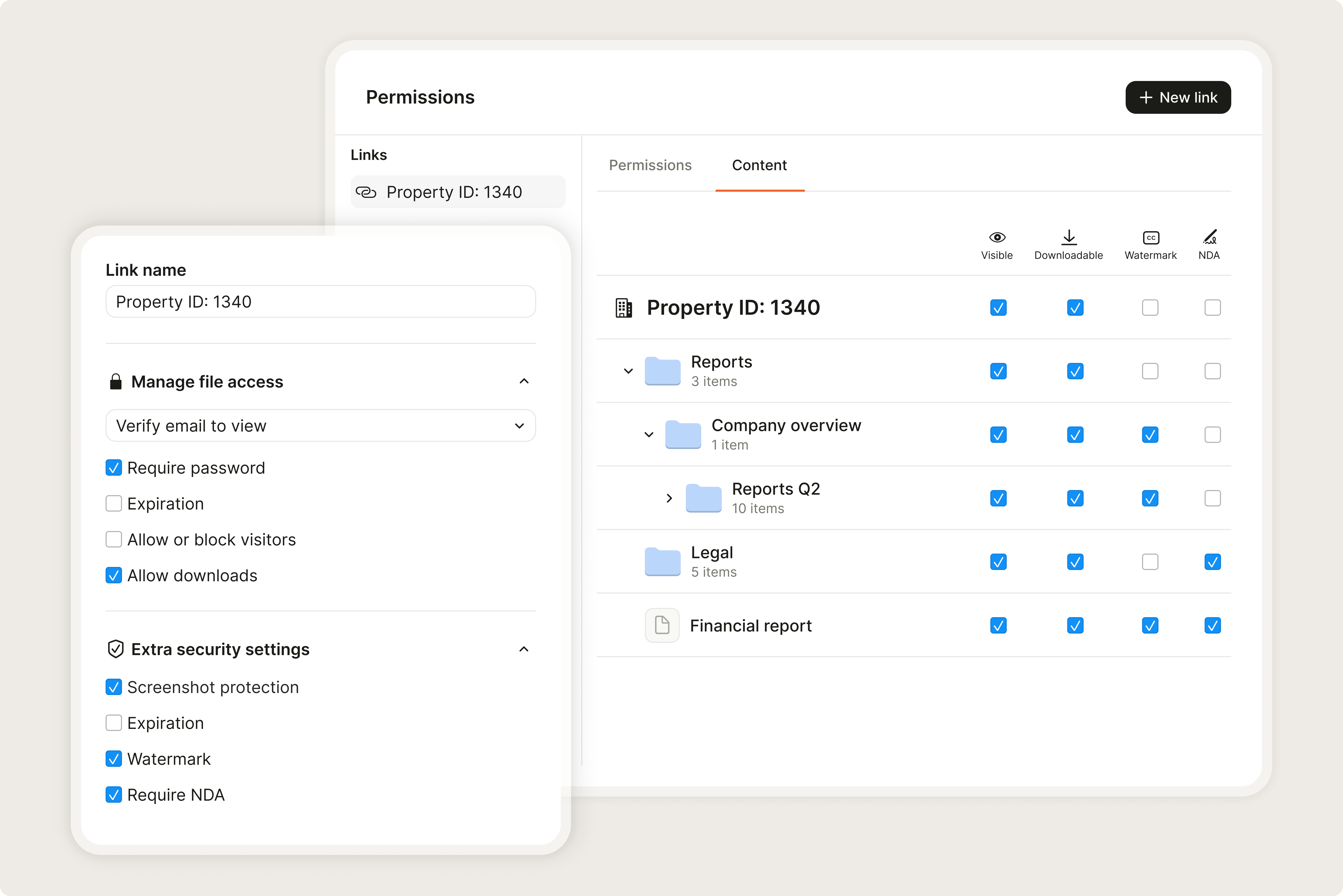
Give each advisor a scoped link in Ellty. Indian attorney sees full title document chain, EC, CERSAI search, and all approvals. Building inspector sees building plans and OC. Environmental consultant sees EC and SPCB compliance records. Tax counsel sees stamp duty analysis and TDS obligations. Lender sees full title, valuation, and lease pack.
Agricultural land and conversion check
- Extract the revenue record (7-12 extract in Maharashtra; Pahani/Record of Rights in Telangana, Andhra Pradesh; Khata extract in Karnataka; Khatian in West Bengal) from the state Revenue Department for the survey number(s) comprising the property
- Confirm the land use classification in the revenue record: if classified as agricultural (Khet, Sheti, Krishi bhumi, or equivalent): confirm a valid Change of Land Use (CLU) or Non-Agricultural Use (NA) order has been obtained from the Collector/competent authority converting the land to non-agricultural commercial or industrial use; without CLU, commercial use of agricultural land is unauthorized
- For Special Economic Zones (SEZs): confirm SEZ notification under the SEZ Act 2005 covers the land; SEZ land is governed by SEZ regulations and has specific customs and tax benefits but also specific compliance requirements; for private industrial parks: confirm development authority notification or approval covers the land for industrial use
- Confirm Mutation: the revenue record should reflect the current owner's name after each transfer; if mutation is pending (common in India), the revenue record shows a prior owner's name while the property has been legally transferred by registered deed; confirm mutation status and initiate if pending
Load all files into Ellty before advisors engage. Indian attorney sees title chain, EC, revenue records, and CLU order. Building inspector sees building plans, commencement certificate, and OC. Track which advisor has reviewed the revenue records and CLU - these drive the most deal-critical questions in Indian CRE.
Building approvals and RERA compliance
- Request all building plan approvals from the relevant development authority or municipal corporation (BDA, BBMP, MCGM, NDMC, GHMC, etc.); confirm approved plans match as-built structure; any deviations from approved plans constitute unauthorized construction
- Request the Commencement Certificate (CC, authorization to start construction) and the Occupancy Certificate (OC) or Completion Certificate issued by the building authority after inspection; confirm OC covers all floors and areas of the building
- For commercial properties sold by developers (new or recent construction): confirm RERA registration number on www.rera.karnataka.gov.in (Karnataka), maharera.mahaonline.gov.in (Maharashtra), or the respective state RERA portal; RERA registration is mandatory for developers; RERA project page shows completion status, legal title status, and encumbrances declared by the developer; also useful for confirming if there are any buyer complaints or disputes filed against the developer
- Fire NOC from the state fire department is a separate mandatory compliance item for commercial buildings; fire incidents at commercial buildings without valid fire NOC have led to criminal liability for building owners; confirm validity of fire NOC
Compare Singapore's commercial property due diligence process for Asian portfolio context. India and Singapore are both Commonwealth common law system countries but diverge sharply on real estate investment structure: Singapore (state-land system with 99-year leaseholds and freehold, reliable SLA title system, open to foreign purchase of most commercial property) vs. India (document-based title, state-by-state variance, FEMA restrictions on direct foreign commercial ownership, but the largest and fastest-growing office and logistics markets in Asia by volume in 2025-2026).
How due diligence works in India
Step 1 - Title chain and FEMA structure
Day one: EC from SRO for 30 years. CERSAI search. Assemble title document chain for attorney review. Revenue record and agricultural land classification check. For foreign buyers: FEMA compliance structure determination before any commitment.
For Mumbai commercial: confirm circle rate and budget stamp duty of up to 7-8%; this affects deal economics significantly.
Step 2 - Building approvals and environmental
Request building plan approvals, CC, and OC from seller. Verify against development authority records. Confirm RERA registration (if developer-sold). Fire NOC status. Environmental Clearance from MoEFCC or SEIAA (for large commercial). SPCB consent (for industrial M&A).
Confirm revenue record mutation is complete or initiate.
Step 3 - Leases, dues, and AML
Abstract all commercial leases; confirm all long-term leases are registered at SRO. Check rent control exposure for older tenanted buildings. Request 5 years property tax receipts and development authority no-dues certificate. Confirm MCA entity details for corporate seller. Run TDS obligation analysis with tax counsel. OFAC and UN sanctions screens.
Step 4 - Registration and stamp duty
Indian commercial property transfer: sale deed executed before the Sub-Registrar; stamp duty and registration fee paid before or at registration; the registered sale deed constitutes transfer and priority against third parties; for commercial above certain values: stamp duty is the primary transaction cost and must be budgeted before signing the Sale and Purchase Agreement.
Load all closing documents into Ellty before the SRO registration appointment. Indian attorney sees all title documents, approved sale deed, and payment receipts. Lender sees registered sale deed confirming buyer as registered owner.
How to set up your India data room in Ellty.
India commercial deals involve the full title document chain, Encumbrance Certificate (30 years), CERSAI search, revenue records, building plan approvals, OC, RERA certificate, environmental clearance, property tax receipts, development authority no-dues, and all commercial leases.
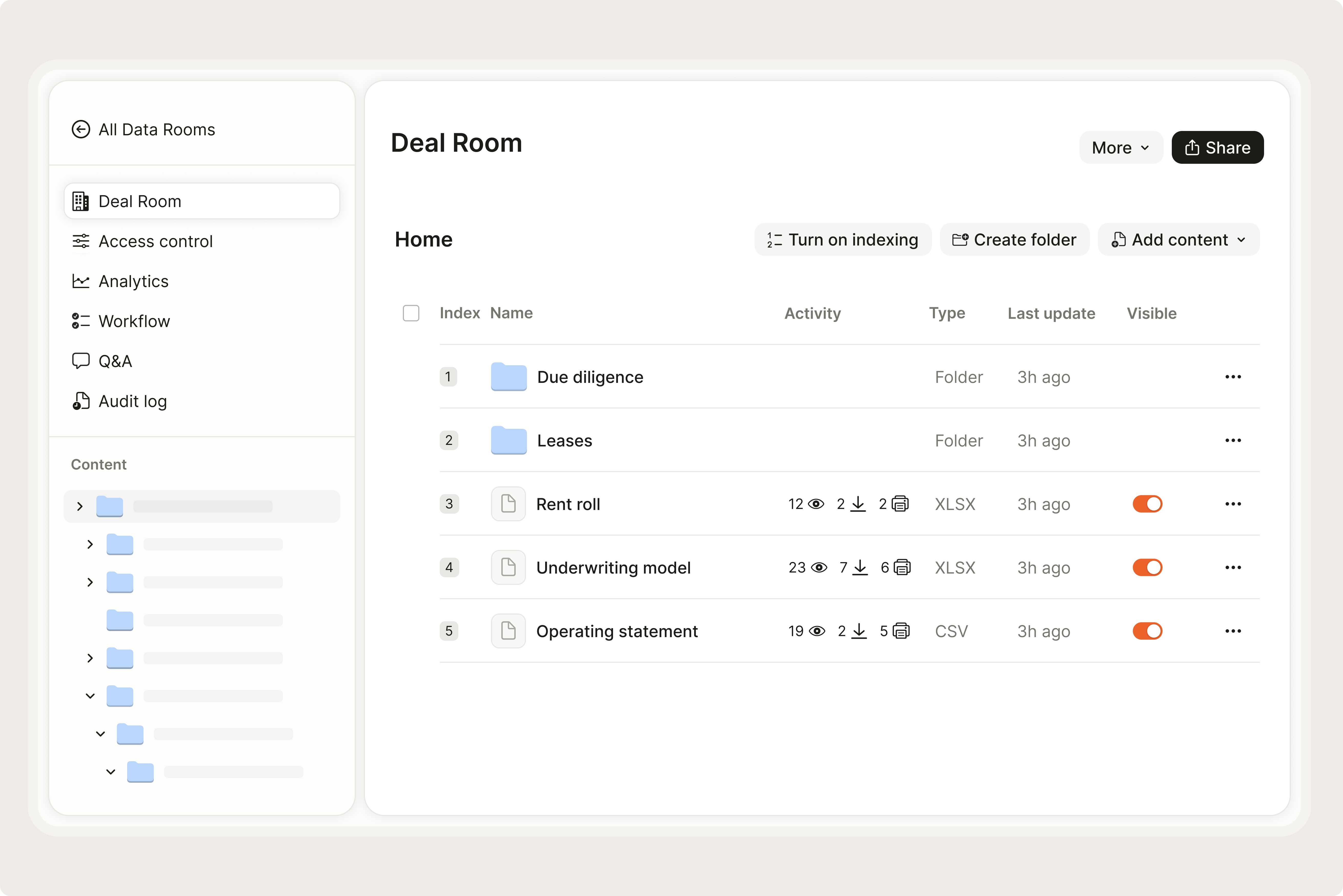
- 1.Upload India property files to a secure roomDrop title deed chain (mother deed + all subsequent sale deeds), Encumbrance Certificate (30 years), CERSAI search, revenue record extract, CLU/NA order (if applicable), building plan approvals, Commencement Certificate, Occupancy Certificate, RERA registration certificate, fire NOC, environmental clearance, property tax receipts, development authority no-dues, and commercial lease pack into Ellty.
- 2.Give each advisor a scoped, tracked linkIndian attorney sees title chain, EC, CERSAI, and revenue records. Building inspector sees building plans, CC, and OC. Environmental consultant sees EC and SPCB records. Tax counsel sees stamp duty analysis and TDS obligations. Lender sees full title, valuation, and leases. Each party sees only their files.
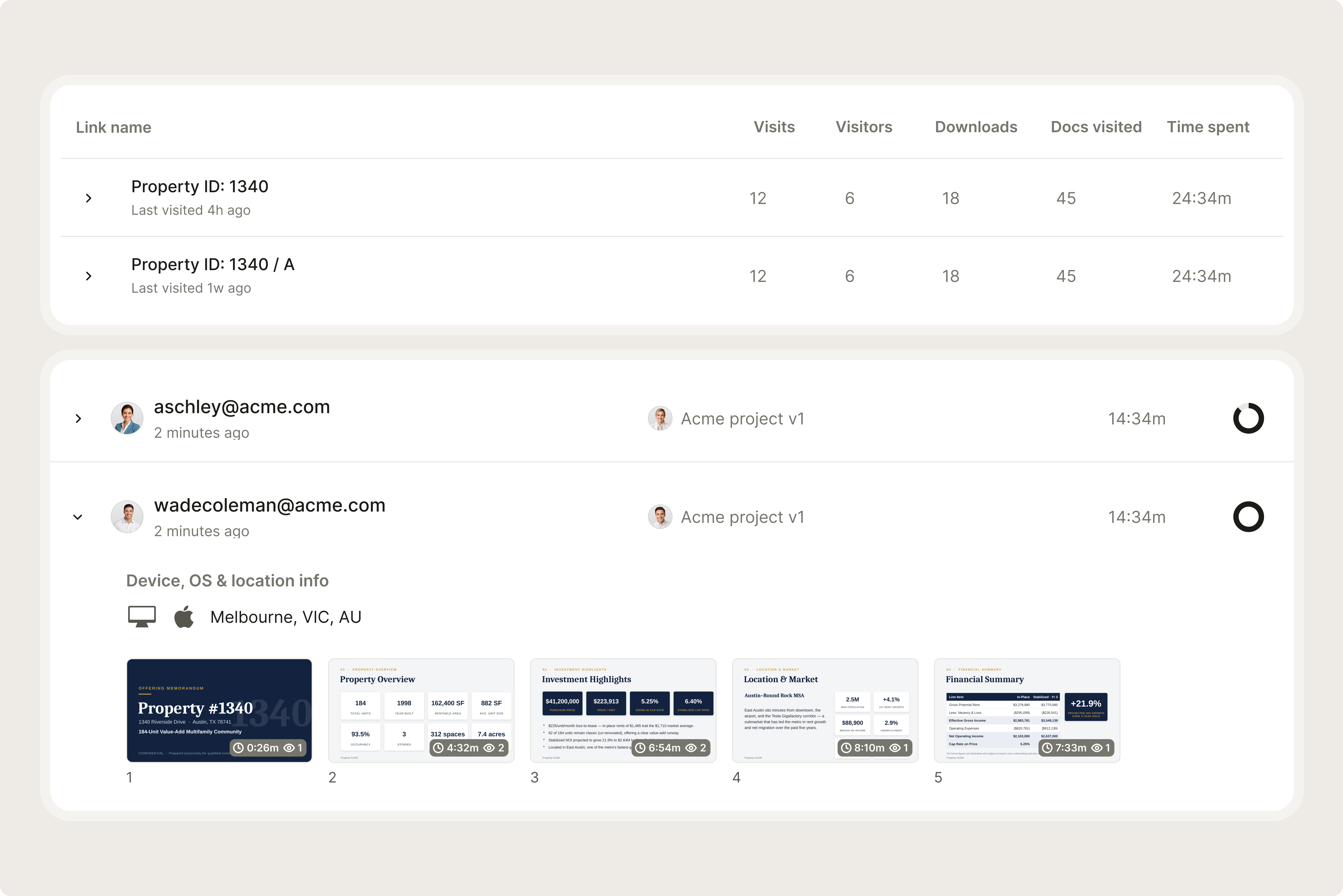
- 3.Monitor who reviews which documentsSee exactly which files each advisor opened and when. Catch title chain gaps or agricultural land classification issues before they stall deal pricing or closing.
What makes India different
India is one of the world's largest commercial real estate markets by floor space and development pipeline, but it operates without a state-guaranteed title system - and this shapes every aspect of commercial property due diligence in a way that investors from Germany, Singapore, or Australia don't expect. Unlike Torrens-system countries where the land register entry is itself the guarantee of title, Indian title quality depends on the completeness and consistency of a chain of documents going back 30 or more years. An Indian property with a clean 30-year chain of registered sale deeds, no gaps, no disputed transfers, and a clean Encumbrance Certificate is as good as any title in any market. But establishing that chain requires document-intensive legal work that has no equivalent in Germany or Singapore due diligence processes. The practical consequence: Indian real estate legal fees are lower in absolute terms than German or UK fees, but the Indian attorney's title review workload is proportionately much higher - particularly for older properties in city centers, properties that changed hands multiple times through inheritance or partition, and properties in states with less reliable registration records. For commercial buyers: budget significant Indian attorney time for the title chain review and specifically ask for a title opinion that addresses the completeness of the chain and the quality of each individual transfer instrument. A title opinion that says only "we have reviewed the documents provided by the seller" without confirming the chain is not adequate diligence.
The variance in stamp duty rates across Indian states is not a minor footnote - it is a material deal cost that moves transaction economics in ways that surprise first-time India investors. Maharashtra (Mumbai) has historically had some of the highest effective stamp duty rates: a high-value Mumbai commercial transaction can face combined stamp duty (including metro cess and surcharges) of up to 7% of the transaction value plus a 1% registration fee, for a total of 8%. On a USD 50 million Mumbai commercial deal, that's USD 4 million in state taxes before any professional fees. Tamil Nadu (Chennai) has an 8% combined rate. Bengaluru (Karnataka) runs 5% stamp duty plus 1% registration. Hyderabad (Telangana) is in the 4-6% range combined. For portfolio strategies covering multiple Indian markets: the stamp duty differential between states is a significant factor in total cost of acquisition modeling. Also: stamp duty in India is assessed on the higher of the contract consideration and the government-notified "circle rate" (also called "ready reckoner rate" or "guideline value" depending on the state) for the area; a buyer cannot simply agree a below-market deal price to save stamp duty, because the tax authority will assess on the circle rate floor regardless.
India's Grade A commercial office market - concentrated in Bengaluru (India's tech capital), Hyderabad (fastest-growing major tech market), Mumbai (financial capital), and Delhi NCR (Gurgaon/Gurugram) - has attracted significant global institutional capital since approximately 2013, culminating in the launch of India's first commercial office REITs in 2019. Embassy REIT, Mindspace REIT, and Brookfield REIT provided a listed, SEBI-regulated investment vehicle for domestic and foreign institutional investors to access India Grade A office income, with quarterly distributions and transparent reporting. For direct investors (not going through REITs): the Bengaluru and Hyderabad markets have deepened considerably since 2015 with institutional-quality Grade A buildings, professional property management, global tenant rosters (major US tech and financial services firms), USD-linked rents (though Indian leases are in INR, many Grade A leases effectively track USD/INR through escalation mechanisms), and institutional sellers (private equity funds, developers). The diligence process in these markets for Grade A multi-tenanted office has become more standardized; the title chain, revenue records, and building approvals are typically well-organized by experienced Grade A sellers; it's the mid-market, older stock, and strata commercial where diligence complexity and risk concentration are higher.
Section 17 of the Registration Act 1908 provides that documents effecting the transfer, assignment, limitation, or extinguishment of rights in immovable property worth INR 100 or more must be registered at the Sub-Registrar's Office of the district in which the property is situated. Section 49 of the Act provides that no document required by Section 17 to be registered shall affect any immovable property, or confer any power to adopt, or be received as evidence of any transaction affecting such property or conferring such power, unless it has been registered. Priority of registered documents is determined by the date and order of registration, as against unregistered or subsequently registered instruments of the same nature.
Timeline and cost in India
Weeks 1-2 cover kickoff: Encumbrance Certificate from SRO (30 years), CERSAI search, initial title document review with Indian attorney, revenue record extraction (7-12, Pahani, Khata, or equivalent by state), agricultural land classification check, FEMA compliance structure determination for foreign buyers, building plan approvals and OC verification with local authority, RERA registration check on state RERA portal, fire NOC status, property tax payment receipts request, development authority no-dues request, MCA company search for corporate seller, OFAC and UN sanctions screens, lease abstraction, stamp duty calculation for the specific state. Indian attorney fees in this phase: INR 500,000-2,500,000 (approx. USD 6,000-30,000) depending on state and deal complexity.
Load all files into Ellty before advisors engage. Standard India Grade A commercial: 60-90 days. Older/non-Grade-A commercial with complex title: 90-180 days. Agricultural land CLU conversion process: 3-12 months additional if not yet obtained. FEMA compliance structure for foreign buyers: 4-8 weeks additional.
Weeks 2-6 cover deep review: full 30-year title chain analysis and title opinion, CERSAI mortgage status and discharge plan, building plan vs. OC vs. as-built comparison, RERA project page analysis, environmental clearance review, SPCB consents (industrial M&A), lease registration confirmation and rent control exposure analysis, development authority dues investigation, stamp duty and circle rate confirmation, TDS deduction obligation analysis.
Weeks 6-12 handle resolution: mortgage discharge, CLU order (if pending), mutation initiation, building plan deviation resolution, OC coverage gap resolution, sale deed preparation, stamp duty payment at SRO, SRO registration.
India total buyer-side transaction costs: stamp duty (4-8% of higher of consideration and circle rate, state-specific); registration fee (0.5-1%); Indian attorney fees (0.5-1.5% of transaction value); technical and environmental advisory fees; TDS withholding from seller (separate issue - seller's tax withheld by buyer and remitted to government). Total effective buyer cost excluding TDS: 5-10% of transaction value depending on state.
Running an India property deal from one room
Hold title deeds, EC, OC, RERA certificate, and lease files in one secure, tracked Ellty data room.
Start free 14-day trialCommon questions about due diligence on India commercial property
- India uses a document-based title system under the Registration Act 1908, not a Torrens-system state-guaranteed title registry. Registration at the Sub-Registrar's Office creates a public record and establishes priority between registered instruments, but it does not guarantee that the registered deed reflects a valid chain of title. The seller could have had a defective title, the property could be subject to unregistered prior claims, or revenue records could show a different owner. Indian title diligence therefore requires constructing and verifying a chain of title documents going back 30+ years, not just searching a guaranteed registry.
- The Encumbrance Certificate (EC) is issued by the Sub-Registrar's Office (SRO) and lists all registered transactions affecting a specific property for a specified period. For a 30-year EC: it shows all registered sale deeds, mortgage deeds, lease registrations, releases, and other instruments registered against the property at that SRO during those 30 years. A clean EC shows no registered encumbrances. However, the EC only shows registered instruments - unregistered mortgages, court attachments, or instruments registered at a different SRO will not appear. Always supplement with a CERSAI search and court record search.
- Direct purchase of completed commercial real estate by foreign companies is generally not permitted under FEMA. Foreign investors access Indian commercial real estate through: (1) FDI in an Indian company that owns/develops commercial real estate, subject to conditions; (2) investment in listed India REITs (Embassy REIT, Mindspace REIT, Brookfield REIT) which are open to FPI investment; (3) AIF structures with Indian sponsorship. NRIs (Non-Resident Indians with Indian passports or OCI cards) can purchase both commercial and residential property without restriction. Confirm FEMA compliance with Indian legal counsel before any commitment.
- Stamp duty in India varies by state and is paid on the higher of the transaction consideration and the government circle rate. Approximate ranges: Maharashtra (Mumbai): up to 7% effective for high-value commercial including metro cess and surcharges; Tamil Nadu (Chennai): approximately 7% stamp duty + 1% registration = 8% total; Karnataka (Bengaluru): 5% stamp duty + 1% registration; Telangana (Hyderabad): approximately 4-6% combined; Delhi NCT: 4-6% plus registration fee. Confirm current rates with Indian counsel for the specific state and transaction type before budgeting.
- RERA (Real Estate Regulation and Development Act 2016) requires real estate developers to register projects with the state RERA authority before advertising or selling. Each RERA-registered project has a RERA certificate with a registration number. For commercial properties sold by developers: confirm RERA registration on the relevant state RERA portal; the portal shows the developer's declared project details, completion timeline, land title status, encumbrances, and any buyer complaints filed. RERA registration is mandatory for developers selling commercial and residential projects above specified thresholds. Missing RERA registration is a red flag.
- Standard India Grade A commercial (Bengaluru, Hyderabad, Mumbai): 60-90 days. Older or non-Grade-A commercial with complex title: 90-180 days. Agricultural land CLU conversion (if not yet obtained): 3-12 months additional. FEMA compliance structure for foreign buyers: 4-8 weeks. CERSAI and SRO search: 1-2 weeks. Building authority OC verification: 2-4 weeks. RERA portal check: immediate. SRO registration after stamp duty payment: typically 1-5 business days.