Hungary commercial property due diligence uses a constitutive land register (Ingatlan-nyilvántartás) maintained by District Land Offices; title passes on registration, not on signing. The main transaction costs are a 4% property transfer tax and VAT at 27% (the EU's highest rate) on new commercial - both payable by the buyer. For logistics and industrial: Hungary's EV battery manufacturing boom has transformed the sector since 2021.
Hungary property transfer tax (Visszterhes vagyonátruházási illeték): 4% of the higher of the market value and the declared purchase price for commercial property transactions; assessed by the Hungarian Tax and Customs Administration (NAV - Nemzeti Adó- és Vámhivatal) after the deed of sale is submitted; the buyer pays within 30 days of the NAV assessment; commercial deals structured as share deals (acquisition of a Hungarian holding company that owns the property) rather than asset deals avoid the property transfer tax - share deal structuring is common in Hungarian institutional commercial precisely to avoid the 4% illeték; VAT (ÁFA) at 27% applies to new commercial buildings (first supply within 2 years of completion) where the seller is a VAT payer; Hungary's 27% VAT is the highest standard rate in the EU; VAT-registered buyers recover as input VAT.
Hungary's Land Register (Ingatlan-nyilvántartás) is maintained by District Land Offices (Járási Földhivatal) under the National Land Administration Office (Nemzeti Földügyi Központ, NFK); the land register is publicly accessible at takarnet.hu (professional subscribers) and through government customer service points (Kormányablak); each property has a parcel number (helyrajzi szám, hrsz.); the full property sheet (Teljes tulajdoni lap) shows: Part I (property description - location, area, land use category), Part II (ownership - full ownership/teljes tulajdonjog or partial/shares), Part III (encumbrances - mortgages/jelzálogjog, easements/szolgalom, usufructs/haszonélvezeti jog, options/elővásárlási jog, and any pending registrations/széljegy); title passes in Hungary only upon registration in the land register, not on signing the sale agreement.
Set up a real-estate data room before advisors engage. Load land register full property sheets, building permit, occupation certificate, HÉSZ planning extract, and all lease files.
Where Hungary property deals actually go wrong
Not every check carries the same weight. The table below sorts them by deal impact - dealbreakers first, then what moves the price, then basic hygiene - so your Hungarian attorney and advisor know what to clear first.
| Area | Documents to pull | Hungary red flag | Matters most for | Tier | |
|---|---|---|---|---|---|
| Land register (Ingatlan-nyilvántartás) search | Land register (Ingatlan-nyilvántartás) search | Teljes tulajdoni lap (full property sheet) from the District Land Office (Járási Földhivatal), all parts I, II, III | Request the Teljes tulajdoni lap (full property sheet) from the relevant Járási Földhivatal for the parcel number (hrsz.); Part I confirms property identification (address, area, land use category); Part II confirms the registered owner(s) and any co-ownership shares; Part III lists all encumbrances - mortgages (jelzálogjog), easements (szolgalom), usufructs (haszonélvezeti jog), pre-emption rights (elővásárlási jog), options (vételi jog), and any pending registrations (széljegy); a széljegy (margin note) in the property sheet indicates a pending application to register a new encumbrance or transfer that has not yet been processed; any wide széljegy or mortgage notation requires investigation; title only passes upon successful land register registration; also confirm the land use category (művelési ág or besorolás) in Part I matches the intended commercial use | All buyers - foundational check | Dealbreaker |
| Asset deal vs. share deal structure | Asset deal vs. share deal structure | Hungarian tax counsel structuring opinion, Hungarian holding company corporate documentation (Kft. or Zrt.), NAV tax registration and liability history of the holding company | Hungarian institutional commercial transactions are commonly structured as share deals (acquisition of the Hungarian holding company that owns the property) rather than asset deals (direct purchase of the real estate); the primary driver is tax: an asset deal triggers the 4% property transfer tax (illeték); a share deal does not trigger the illeték; however, a share deal requires full corporate due diligence on the holding company (including its historic tax position, statutory accounts, any liabilities, employment obligations, and any pending litigation); the Hungarian Tax and Customs Administration (NAV) has authority to reassess transactions and challenge the economic substance of share deals that have no purpose other than to avoid the illeték; confirm the optimal deal structure with Hungarian tax counsel before signing any term sheet or heads of terms; for deals where the seller holds the property in a standalone Kft. with no other business and no tax liabilities: share deal structuring is straightforward; for complex group structures: asset deal may be simpler despite the illeték cost | All institutional commercial acquisitions; especially above HUF 1 billion | Dealbreaker |
| Mortgages and Part III encumbrances | Mortgages and Part III encumbrances | Teljes tulajdoni lap Part III, mortgage holder (jelzálogjogosult) discharge confirmation, pre-emption right (elővásárlási jog) holder confirmation | All mortgages (jelzálogjog) in Part III must be discharged (törlése) before a clean title transfer; confirm mortgage holders will issue discharge (törlési engedély) at or concurrent with closing; also review Part III for registered pre-emption rights (elővásárlási jog): these give the right holder (e.g., the state, municipality, or a contractual third party) the right to purchase the property at the offered price before the sale completes; if a registered pre-emption right exists, the right holder must be formally offered the property on the agreed terms and must waive or fail to exercise within the statutory period before the transaction can close; registered options (vételi jog) in Part III give specific parties the right to purchase at a predetermined price - if in force, these require waiver before closing; also check for registered usufructs (haszonélvezeti jog) which grant a person the right to use and enjoy the property during their lifetime and cannot be terminated unilaterally | All buyers | Dealbreaker |
| Foreign ownership restrictions | Foreign ownership restrictions | Buyer's nationality and domicile confirmation, Hungarian counsel foreign ownership opinion for the specific property and buyer type | EU nationals and EU-incorporated companies can own Hungarian commercial real estate freely since EU accession in 2004; non-EU nationals and non-EU companies generally need a special permit from the regional court (Törvényszék) to purchase Hungarian real estate; for commercial property (non-agricultural): the permit requirement for non-EU buyers applies but is generally available for legitimate commercial investment purposes; Hungary's agricultural land restrictions are stricter - non-EU and some EU buyers cannot own Hungarian agricultural land; confirm the property's land use classification (if any agricultural use or category appears in Part I of the land register); for complex deals involving non-EU buyers of commercial property near the border or in security-sensitive areas: additional review may be required; in practice: many international institutional commercial deals into Hungary use a Hungarian Kft. holding company (no restriction) regardless of the buyer's nationality, which also solves the share deal tax structuring | Non-EU buyers of Hungarian commercial | Price-adjuster |
| Building permit and occupation certificate | Building permit and occupation certificate | Building permit (Építési engedély), occupation certificate (Fennmaradási engedély or Használatbavételi engedély or notification of completion), building record at ÉTDR system | Hungarian construction law (Épített környezet alakításáról és védelméről szóló 1997. évi LXXVIII. törvény, ÉTV) requires a building permit (Építési engedély) for commercial construction; after completion, the building must receive an occupation certificate (Használatbavételi engedély) or a notification acceptance (Használatbavétel bejelentése, simplified procedure for smaller developments) before it can lawfully be occupied; check the ÉTDR (Építésügyi Tárügyeleti és Döntéstámogató Rendszer) system for building permit and occupation certificate history; for buildings with a Fennmaradási engedély (retrospective occupation permission for buildings that were built without permits or with permit deviations): this indicates historical building compliance issues that have been retroactively addressed - confirm the scope and extent of any deviations; for any renovation or extension after original construction: confirm separate permit obtained | All Hungary commercial buildings | Price-adjuster |
| Zoning and planning (HÉSZ) | Zoning and planning (HÉSZ) | Local Building Regulation (Helyi Építési Szabályzat, HÉSZ) and Regulatory Plan (Szabályozási terv) from the relevant municipality, planning extract (Építésügyi hatósági bizonyítvány) confirming zone classification and development parameters | Hungarian planning is governed at the municipality level; each settlement has a Local Building Regulation (HÉSZ) and Regulatory Plan (Szabályozási terv) that specify: zone classification (övezeti besorolás), maximum FAR (beépítési hányad), minimum green area, building height limits, and setbacks; confirm the parcel's zone classification permits the intended commercial use; zone types include: Lk (residential, low density), Lt (residential, high density), Vk (commercial, center), Vi (commercial, industry), Gip (industrial), Üdü (recreation); for development: confirm FAR and height limits under the current HÉSZ; Budapest's HÉSZ has been under revision and the current state of the Fővárosi Építési Keretszabályzat (FÉK, Budapest Metropolitan Building Regulation) is relevant for Budapest commercial development | All Hungary commercial; development sites | Price-adjuster |
| VAT on commercial transaction | VAT on commercial transaction | Seller's VAT registration status, first occupation date or completion date for the building, Hungarian tax counsel ÁFA opinion on the transaction | Hungarian VAT (ÁFA, Általános Forgalmi Adó) at 27% applies to sales of new commercial buildings where the seller is a VAT payer and the property is classified as new (within 2 years of completion); Hungary's 27% rate is the EU's highest; for older commercial (more than 2 years from completion): VAT exemption applies by default, but the seller can opt for VAT if the buyer is a VAT payer (ÁFA-alany); a VAT-registered buyer using the property for taxable business activities recovers the 27% as input VAT; the net cost is zero for full VAT recovery buyers; but for VAT-exempt businesses (financial institutions, some healthcare/education uses) the 27% is an irrecoverable cost and dramatically affects deal economics; confirm VAT treatment with Hungarian tax counsel before structuring | New commercial; VAT-exempt buyers especially impacted | Price-adjuster |
| Leases and tenancies | Leases and tenancies | All commercial leases, rent roll, registered leases or usufructs in Part III of land register, WAULT and lease expiry profile | Hungarian commercial leases are governed by the Civil Code (2013. évi V. törvény, Ptk.); longer-term commercial leases that create significant rights may be registered in the land register (Part III as bérleti jog - lease right) - check Part III for any registered lease rights; review all leases for: term, break options (rendes felmondás/rendkívüli felmondás), rent review (typically EUR-denominated and HICP/CPI-indexed for institutional Budapest commercial), maintenance obligations (tenant vs. landlord split); service charge structure; deposit instruments (kaució, bank guarantee); Budapest prime commercial leases are typically EUR-denominated despite HUF currency, similar to Czech Republic, Romania, and Poland office markets; for logistics commercial associated with the EV battery manufacturing supply chain (Samsung SDI, SK On, CATL Hungarian facilities): review lease terms for battery manufacturing supply-chain customer concentration risk | Tenanted Hungary commercial; Budapest office; logistics | Price-adjuster |
| Environmental - communist-era and 2010 red sludge | Environmental - communist-era and 2010 red sludge | Hungarian Environmental and Nature Conservation Inspectorate (OKFÜ, Országos Környezetvédelmi és Természetvédelmi Főfelügyelőség) contaminated sites records, Phase I ESA from licensed Hungarian environmental consultant | Hungary's communist-era industrial legacy created contamination particularly in: Miskolc and Diósgyőr (steel - Lenin Metallurgical Works site, a major brownfield rehabilitation challenge), Ózd (steel), Pécs (uranium mining legacy from the Mecsek Ore Mining Company/MÉMÜ operation), Ajka (alumina refinery and the 2010 red sludge disaster), Győr industrial zone, and Budapest's industrial periphery (Csepel Island heavy industry, north Buda industrial zones); the 2010 Ajka alumina plant failure (October 4, 2010) released approximately 1 million cubic meters of toxic red sludge (vörösiszap) flooding the towns of Kolontár and Devecser; it was the largest environmental disaster in Hungarian history; for any commercial in Fejér County or the Bakony-Balaton region near Ajka: environmental contamination assessment is essential; Hungary's OKFÜ maintains contaminated site records; Phase I ESA with OKFÜ and local government records search is standard for any brownfield or former industrial commercial | Former industrial commercial; Miskolc, Ózd, Pécs, Ajka area commercial and industrial | Standard check |
| Seller KYC and AML | Seller KYC and AML | Hungarian Company Registry (Cégbíróság/Cégnyilvántartás at e-cegjegyzek.im.gov.hu) entity confirmation, UBO register confirmation, OFAC/EU sanctions screens | Hungary implements EU AML directives; confirm seller entity at the Hungarian Company Registry (Cégnyilvántartás, accessible at e-cegjegyzek.im.gov.hu); Hungarian attorneys handling real estate transactions are AML-obligated persons; identify UBOs and confirm at the Hungarian UBO Register (Tényleges Tulajdonosi Nyilvántartás); run OFAC and EU sanctions screens on all principals; for NAV (tax authority) tax liability check: the Hungarian Tax and Customs Administration publishes lists of NAV tax debtors above certain thresholds; also check NAV's published lists before closing | All deals; corporate sellers | Standard check |
Due diligence on a Hungary property?
Set up your Ellty data room before diligence starts.
Start free 14-day trialHungary commercial property due diligence checklist
The table ranked risks by severity. This is the full checklist to work through, grouped by area.
Land register search and title
- Day one: obtain the Teljes tulajdoni lap (full property sheet) from the District Land Office (Járási Földhivatal) for the property's parcel number (hrsz.); this can be done through the TakarNet system (professional access) or at a Kormányablak government service point; request an official certified copy (hiteles másolat) rather than just an information copy
- Part I review: confirm property identification (address, area, land use category); any agricultural land use category (szántó, rét, legelő, kert etc.) in Part I creates potential ownership restrictions and use limitation issues for commercial purposes
- Part II review: confirm the registered owner matches the seller; review the basis of ownership (acquisition title); for company sellers: confirm the company name and registration number exactly matches
- Part III review: list all mortgages (jelzálogjog) with holders and amounts; list all pre-emption rights (elővásárlási jog) with right holders; list all options (vételi jog); list all usufructs (haszonélvezeti jog); list all registered leases; list any széljegy (pending registration margin notes); any encumbrance in Part III must be addressed before closing
Give each advisor a scoped link in Ellty. Hungarian attorney sees land register full property sheets and building permit. Building inspector sees occupation certificate and building plans. Environmental consultant sees OKFÜ records and Phase I ESA. Tax counsel sees deal structure memo and ÁFA opinion. Lender sees property sheet, valuation, and lease pack. Each party sees only their files.
Asset vs. share deal structuring
- Determine deal structure at heads of terms stage: asset deal (direct purchase of real estate, triggers 4% illeték) vs. share deal (acquisition of the Hungarian company owning the property, no illeték); the 4% illeték saving on a EUR 50M deal is EUR 2M - significant; this structuring decision affects the entire deal structure and must be resolved early
- For share deal: commission full corporate due diligence on the Hungarian holding company; review: statutory company documents from Cégbíróság, historic NAV tax position (3 years back), financial statements (at least 2 years audited), any pending litigation, employment contracts, regulatory licenses, any historic contracts the company is party to; confirm no hidden liabilities beyond the property
- For share deal: confirm the Hungarian holding company has no VAT recapture obligations (ÁFA korrekció) from prior input VAT recovery on the property that would trigger on a share deal exit; this is a specific Hungarian VAT risk that must be modeled by Hungarian tax counsel
- For asset deal: confirm current ownership in land register; confirm 4% illeték calculation basis (market value or purchase price, whichever is higher); budget for NAV assessment timing in the deal schedule
Load all files into Ellty. Hungarian attorney sees land register and corporate documents. Tax counsel sees deal structure memo, ÁFA analysis, and illeték calculation. Track which files each advisor has reviewed.
Building permit and HÉSZ compliance
- Request building permit (Építési engedély) from seller; verify against ÉTDR system records; the ÉTDR building authority information system maintains permit records for all commercial construction; confirm permit scope matches the as-built building
- Request occupation certificate (Használatbavételi engedély or Fennmaradási engedély for retrospective occupation) from seller; verify against ÉTDR; buildings without an occupation certificate are in unlawful use status; for buildings with a Fennmaradási engedély: review what deviations from the original permit were retrospectively approved and assess any ongoing compliance obligations
- Request HÉSZ planning extract from the relevant municipality; confirm the zone classification permits commercial use; confirm FAR and height limits under the current HÉSZ; for Budapest commercial: confirm compliance with both the district HÉSZ and the metropolitan framework (FÉK); for any extension or renovation: confirm the planned works comply with the current HÉSZ and that permits will be obtainable
Compare Czech Republic's commercial property due diligence process for Central European portfolio strategy. Hungary and Czech Republic are neighboring CEE markets with significant institutional investor overlap (German funds, Austrian investors, regional funds active in both); key structural differences: Hungary (HUF not in Eurozone, 4% illeték on asset deals driving share deal structuring, 27% VAT vs. Czech 21%, EV battery sector logistics boom) vs. Czech Republic (CZK not in Eurozone, no RETT since 2020 making asset deals straightforward, church restitution risk for some assets, Prague-dominated market); Budapest cap rates for Grade A office have historically traded wider than Prague reflecting higher country risk perceptions.
How due diligence works in Hungary
Step 1 - Land register and deal structure
Day one: pull Teljes tulajdoni lap from District Land Office. Part II: confirm owner. Part III: map all encumbrances. Determine asset vs. share deal structure with Hungarian tax counsel.
For share deal: start corporate due diligence on the Kft. immediately in parallel with property diligence.
Step 2 - Building permits and zoning
Request building permit and occupation certificate from seller. Verify against ÉTDR. Request HÉSZ planning extract from municipality. For brownfield or former industrial: commission Phase I ESA with OKFÜ search.
Confirm Part III pre-emption right holders and initiate formal pre-emption right offer process if required.
Step 3 - Leases, VAT, and AML
Abstract all commercial leases. Confirm EUR vs. HUF denomination and HICP indexation. Confirm ÁFA (VAT) treatment with Hungarian tax counsel. Confirm seller at Cégnyilvántartás. Check UBO at Tényleges Tulajdonosi Nyilvántartás. Run OFAC and EU sanctions screens.
Step 4 - Deed of sale and land register registration
Hungarian commercial property transfer: the deed of sale (adásvételi szerződés) must be drawn up by a Hungarian attorney or notary (ügyvéd or közjegyző); it is then submitted to the competent District Land Office (Járási Földhivatal) for registration; the registration is effected within 30 days of submission in standard cases (or within 60 days in complex cases); a priority note (széljegy) is entered upon submission protecting the buyer's position pending full registration; NAV is notified of the transaction and assesses the illeték; the buyer pays within 30 days of the NAV assessment.
Load all closing documents into Ellty before the deed of sale signing. Hungarian attorney sees all signed documents and land office submission. Tax counsel confirms illeték assessment and payment. Lender sees post-registration property sheet with buyer in Part II.
How to set up your Hungary data room in Ellty.
Hungary commercial deals involve land register full property sheets (teljes tulajdoni lap), building permit, occupation certificate, HÉSZ planning extract, corporate documents (for share deals), OKFÜ environmental records, and all commercial leases.
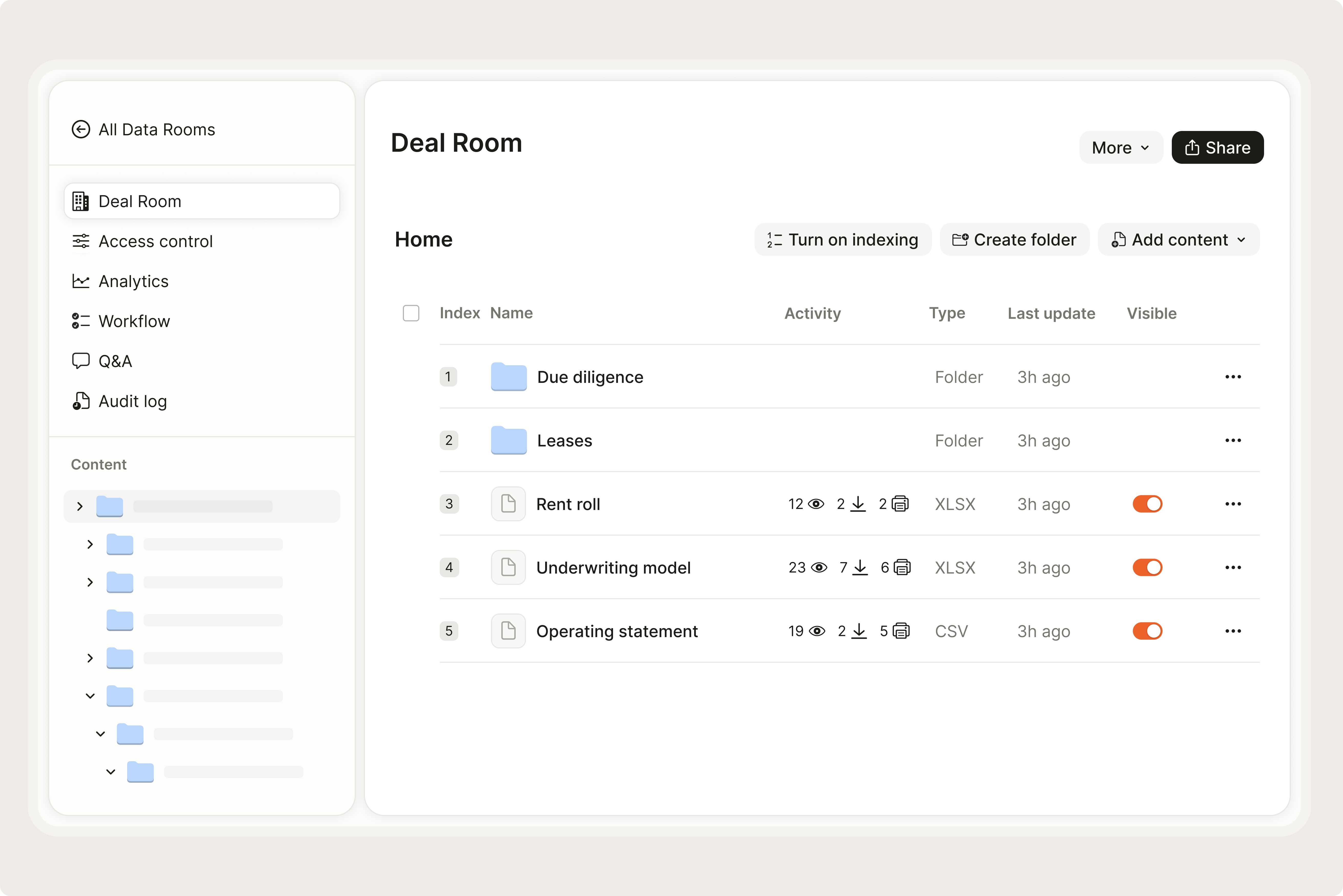
- 1.Upload Hungary property files to a secure roomDrop Teljes tulajdoni lap (all parts), building permit (Építési engedély), occupation certificate (Használatbavételi engedély), HÉSZ planning extract, corporate documents for the Hungarian holding Kft. (if share deal), OKFÜ environmental records, Phase I ESA if applicable, and commercial lease pack into Ellty.
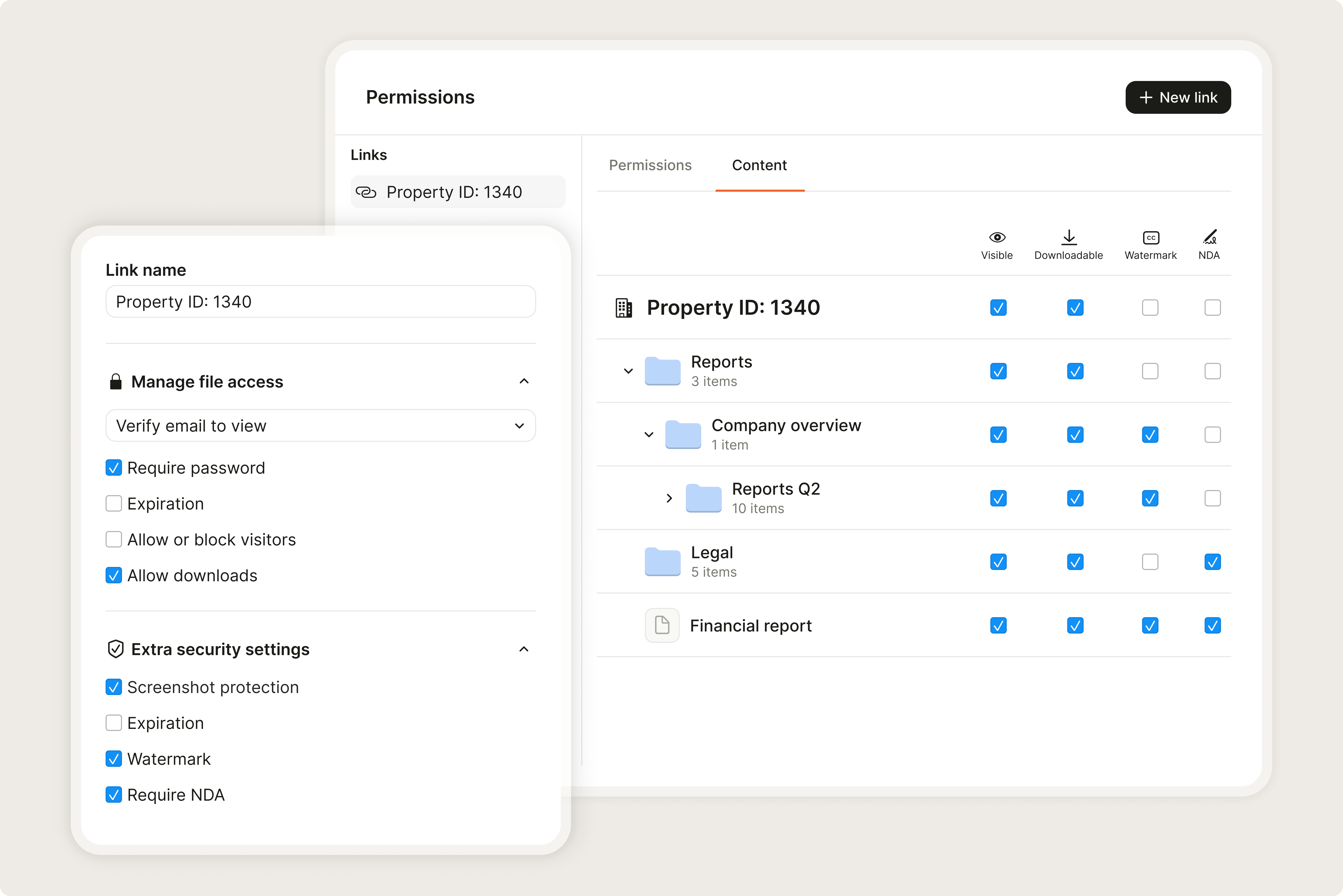
- 2.Give each advisor a scoped, tracked linkHungarian attorney sees land register and sale documents. Tax counsel sees deal structure memo, ÁFA opinion, and illeték calculation. Building inspector sees building permit and occupation certificate. Environmental consultant sees OKFÜ records. Lender sees property sheet, valuation, and leases.
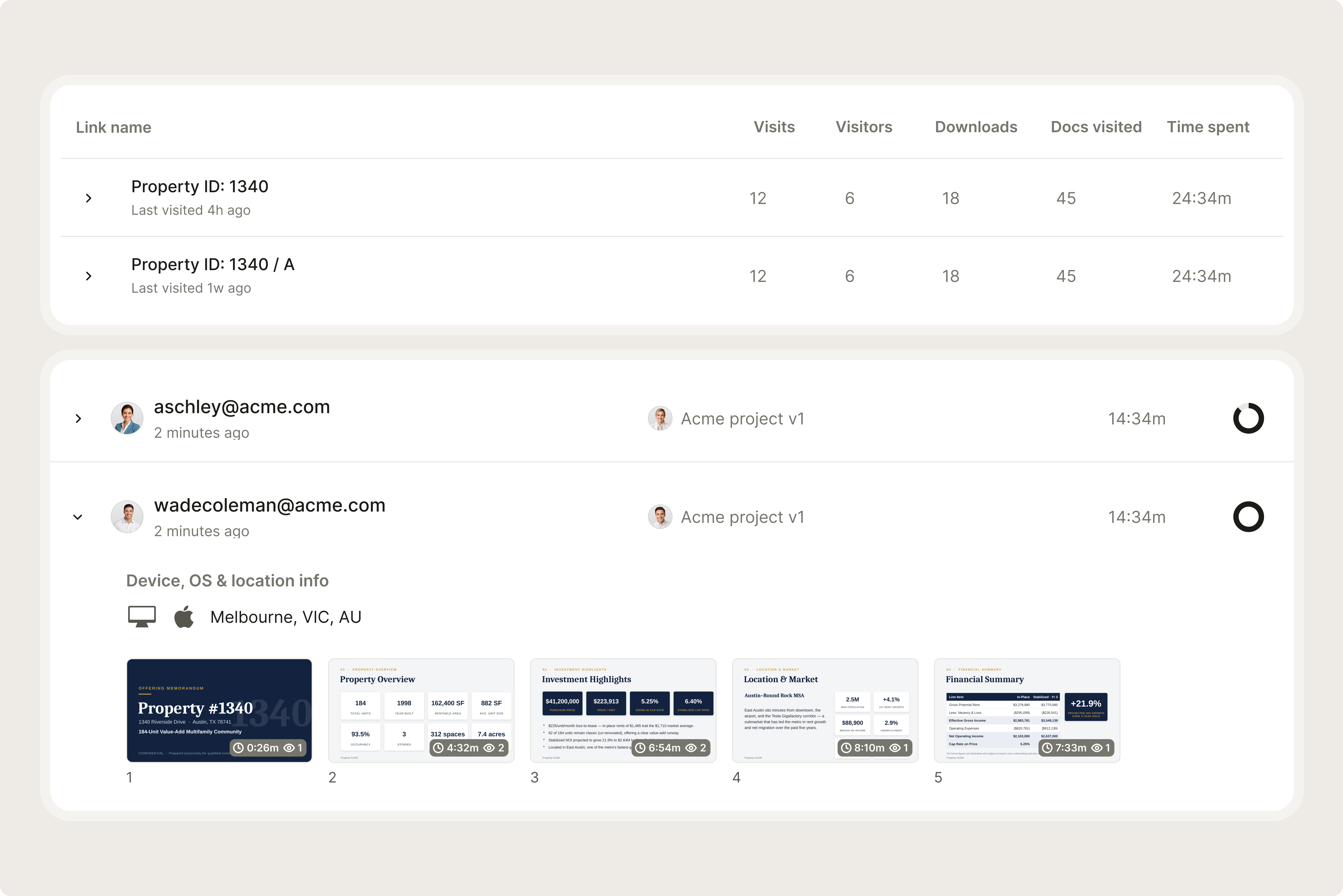
- 3.Monitor who reviews which documentsSee exactly which files each advisor opened and when. Catch pre-emption right issues or ÁFA structuring questions before they stall deal economics or closing.
What makes Hungary different
The asset deal vs. share deal structuring decision in Hungarian commercial real estate is more consequential than in most other CEE markets because the combination of a 4% illeték on asset deals and a relatively clean path to share deal execution (through a standard Hungarian Kft. holding company structure) makes the tax saving calculation straightforward. On a EUR 50 million commercial acquisition, the 4% illeték amounts to EUR 2 million - a material sum that institutional buyers and their tax advisors will immediately seek to avoid. The share deal alternative acquires the Hungarian Kft. that owns the property rather than the property directly; no land transfer occurs (the property remains in the Kft.), so no illeték is triggered. The cost and complexity added by share deal structuring - full corporate due diligence on the Kft., review of historic NAV tax position, confirmation of ÁFA recapture obligations, and any historic contracts or liabilities of the Kft. - is typically less than EUR 50,000-200,000 in professional fees, which is well within the 4% illeték saving on most mid-size or larger commercial deals. Hungarian institutional commercial market convention has consequently evolved toward share deal dominance for institutional-scale acquisitions, with asset deals retained for smaller transactions where the illeték saving doesn't justify the added complexity, or where the property's holding structure is too entangled with other assets to permit a clean share deal. Foreign buyers new to Hungary should discuss this structuring question with Hungarian tax counsel as the first substantive step in any commercial transaction - the answer affects the entire legal and commercial documentation package.
Hungary's logistics and industrial commercial market has been transformed since 2021 by the country's emergence as Europe's leading EV battery manufacturing hub. Samsung SDI (Göd facility), SK On (Iváncsa facility, one of the largest EV battery plants in Europe when complete), CATL (Debrecen, their largest overseas factory), and multiple supply chain manufacturers have committed tens of billions of euros to Hungarian EV battery production capacity. The logistics consequences are significant: industrial and logistics park demand in the proximity of these facilities (Göd/Dunakeszi corridor north of Budapest for Samsung SDI; Pest County/Iváncsa for SK On; Debrecen and its industrial zone for CATL) has been strong; speculative and built-to-suit logistics development has expanded accordingly. For logistics and industrial CRE diligence in Hungary: confirm whether tenant demand is EV battery supply chain related and model customer concentration risk from a single macro-sector (EV battery) that is itself subject to EV adoption rate uncertainty; also confirm whether any tenant has contractual links to specific EV battery manufacturers that could create shared fate risk if EV manufacturing demand slows; Hungary's EV bet has attracted institutional logistics capital from Germany, Austria, and globally, but the concentration on a single value chain creates sector-specific risk that is unusual even by logistics market standards.
Hungary's 27% VAT rate - the EU's highest standard rate - creates specific diligence and structuring issues for commercial real estate transactions that don't arise in markets with lower VAT rates. For new commercial buildings (first supply within 2 years of completion), VAT at 27% applies when the seller is a VAT payer. For a full VAT-registered buyer using the property for taxable business: the 27% input VAT is recoverable and the net cost is zero. But the absolute amount of VAT on a large transaction is significant even if recoverable: on a EUR 50M new commercial building, 27% VAT represents EUR 13.5M that the buyer must finance from the acquisition date until VAT recovery (which takes at least one tax period and potentially longer if NAV scrutinizes the recovery). Cash flow modeling must include the VAT financing gap for new commercial acquisitions, not just the net post-recovery position. For VAT-exempt buyers (certain financial institutions, healthcare companies, educational entities) who acquire commercial property for VAT-exempt activities: the 27% VAT is permanently irrecoverable and directly affects the acquisition cost; the 27% premium on a new building makes acquisition for VAT-exempt use extremely expensive compared to acquiring older stock (where VAT exemption applies by default) or to markets with lower VAT rates.
Act LXXVIII of 1997 on the Formation and Protection of the Built Environment (Épített környezet alakításáról és védelméről szóló 1997. évi LXXVIII. törvény, ÉTV) provides that the building authority (Építésügyi Hatóság) shall issue an occupation certificate (Használatbavételi engedély) upon confirmation that the constructed building complies with the conditions of the building permit and with the technical requirements specified by law. A building or part of a building shall not be occupied for its designated purpose until the occupation certificate has been obtained or, in cases where notification of completion is permitted, until the prescribed notification period has elapsed without a prohibition by the building authority. The use of a building without an occupation certificate or without compliance with the notification procedure constitutes an administrative violation subject to building authority enforcement.
Timeline and cost in Hungary
Weeks 1-2 cover kickoff: Teljes tulajdoni lap from District Land Office, asset vs. share deal structuring decision with Hungarian tax counsel, Cégnyilvántartás company search (for share deal: full corporate due diligence commission), building permit and occupation certificate request from seller and ÉTDR verification, HÉSZ planning extract from municipality, OKFÜ environmental contamination records search, Phase I ESA commission for brownfield or former industrial, lease abstraction, ÁFA position analysis, Part III pre-emption right holder identification, UBO check at Tényleges Tulajdonosi Nyilvántartás, OFAC and EU sanctions screens. Hungarian attorney fees in this phase: HUF 2M-10M (approx. EUR 5,000-25,000).
Load all files into Ellty before advisors engage. Standard Hungary commercial: 45-90 days. Share deal corporate DD: 2-4 weeks additional. Phase I ESA: 3-6 weeks. Pre-emption right offer process: typically 60 days statutory period for the right holder to exercise or waive.
Weeks 2-6 cover deep review: land register Part III clearance plan, mortgage discharge plan, pre-emption right waiver process, occupation certificate vs. current use comparison, HÉSZ compliance analysis, Phase I ESA delivery, lease EUR denomination and indexation review, ÁFA recapture analysis (share deal), NAV tax liability position (share deal), share deal corporate DD completion. Costs: HUF 3M-20M (approx. EUR 7,500-50,000).
Weeks 6-12 handle resolution: mortgage discharge, pre-emption right waiver receipt, deal structure finalization (asset or share), adásvételi szerződés preparation, land office submission (asset deal) or share purchase agreement signing (share deal), NAV illeték assessment and payment, and post-registration land register confirmation.
Hungary total buyer-side transaction costs: 4% illeték on asset deals (avoidable via share deal); ÁFA 27% on new commercial (recoverable for VAT-registered buyers; significant cash flow impact even if recoverable); Hungarian attorney fees (0.3-1% of transaction value); land office registration fees (nominal); for share deals: due diligence costs higher but illeték saved. Total effective buyer cost on asset deals: 4-6% of transaction value; on share deals: 1-3% of transaction value (illeték saving offset by higher advisory costs).
Running a Hungary property deal from one room
Hold land register extracts, building permits, deal structure docs, and lease files in one secure, tracked Ellty data room.
Start free 14-day trialCommon questions about due diligence on Hungary commercial property
- Hungary's property transfer tax (Visszterhes vagyonátruházási illeték, illeték) is 4% of the higher of the market value and the declared purchase price for commercial real estate asset deals. The tax is assessed by NAV (Nemzeti Adó- és Vámhivatal) after the deed of sale is submitted. Institutional commercial acquisitions are frequently structured as share deals (acquisition of the Hungarian holding Kft.) to avoid the 4% illeték. On a EUR 50M deal, the 4% illeték saving is EUR 2M - justifying the additional corporate due diligence cost of a share deal in most cases.
- The Hungarian Ingatlan-nyilvántartás (Land Register) is maintained by District Land Offices (Járási Földhivatal). Each property has a parcel number (hrsz.) and a three-part property sheet (Teljes tulajdoni lap): Part I (property description), Part II (ownership), Part III (encumbrances and other rights). Title passes only upon registration in the land register, not on signing the deed of sale. A priority note (széljegy) is entered upon submission protecting the buyer during the registration period. Standard registration takes 30 days; complex cases up to 60 days.
- Hungarian VAT (ÁFA) at 27% applies to sales of new commercial buildings where the seller is a VAT payer and the building is within 2 years of first occupation or completion. Hungary's 27% rate is the EU's highest. For buildings more than 2 years from completion: default VAT exemption, with seller option to apply VAT. Full VAT-registered buyers using the property for taxable activities recover the 27% as input VAT. VAT-exempt buyers (certain financial institutions, healthcare, education) bear the 27% permanently, making new commercial acquisitions for VAT-exempt use significantly more expensive than older stock.
- Share deals (acquiring the Hungarian Kft. that owns the property) are common because they avoid Hungary's 4% property transfer tax (illeték) which applies only to direct real estate (asset deal) transfers. The illeték saving on a mid-size commercial deal (EUR 20-50M) is EUR 800K-2M, which typically exceeds the cost of the additional corporate due diligence required for a share deal. For a standard standalone property-holding Kft. with no trading history and no tax liabilities: share deal due diligence is relatively straightforward. The main risks to validate in a share deal: historic NAV tax position (3 years), any ÁFA recapture obligations, and any non-property liabilities of the Kft.
- Communist-era industrial contamination affects: Miskolc (Diósgyőr steel plant legacy - one of Central Europe's largest brownfield challenges), Ózd (steel), Pécs (uranium mining from the Mecsek Ore Mining Company), and Budapest's industrial periphery (Csepel Island, north Buda industrial zones). The 2010 Ajka alumina plant red sludge disaster released approximately 1 million cubic meters of toxic material flooding Kolontár and Devecser; this area requires specific environmental assessment. OKFÜ maintains contaminated site records. Phase I ESA is standard for any brownfield or former industrial commercial in Hungary.
- Standard Hungary commercial: 45-90 days for property due diligence. Share deal corporate due diligence adds 2-4 weeks. Land register Teljes tulajdoni lap: 1-3 days (online or certified). Building permit and occupation certificate ÉTDR verification: 1-2 weeks. Pre-emption right offer and waiver: typically 60-day statutory period. Phase I ESA: 3-6 weeks. Land office registration after deed of sale submission: 30 days (standard), up to 60 days (complex cases). NAV illeték assessment and payment: typically 30-60 days after submission.