Czech Republic commercial property due diligence is structurally clean by Central European standards: no real estate transfer tax since 2020, unrestricted foreign ownership, and a reliable public Land Registry (Katastr nemovitostí). The traps are in the details - unregistered easements, co-ownership preemption rights, church restitution claims on some properties, and VAT at 21% on new commercial.
Czech Republic transfer tax situation: the 4% real estate transfer tax (Daň z nabytí nemovitých věcí) was abolished in October 2020 for transactions completing after February 2020; no RETT applies to Czech commercial acquisitions as of 2026. This was a material change from the prior regime and is now priced into Czech commercial market valuations. VAT at 21% applies to sales of new commercial buildings (within 5 years of first occupation) by VAT-registered sellers; the buyer recovers as input VAT if VAT-registered for taxable business. Corporate income tax (CIT) at 19% applies to net gains from commercial property sales by Czech or foreign companies.
The Czech Land Registry (Katastr nemovitostí) is maintained by the Czech Office for Surveying, Mapping and Cadastre (ČÚZK) and is publicly searchable at cuzk.cz. Each property is identified by a cadastral parcel number (parcelní číslo) within a cadastral area (katastrální území). The Land Registry shows: registered owner, title history, all easements (věcná břemena), mortgages (zástavní právo), liens, and any special annotations (poznámky) indicating pending legal proceedings; a Poznámka about pending insolvency or execution proceedings is a critical flag requiring immediate investigation before any deposit.
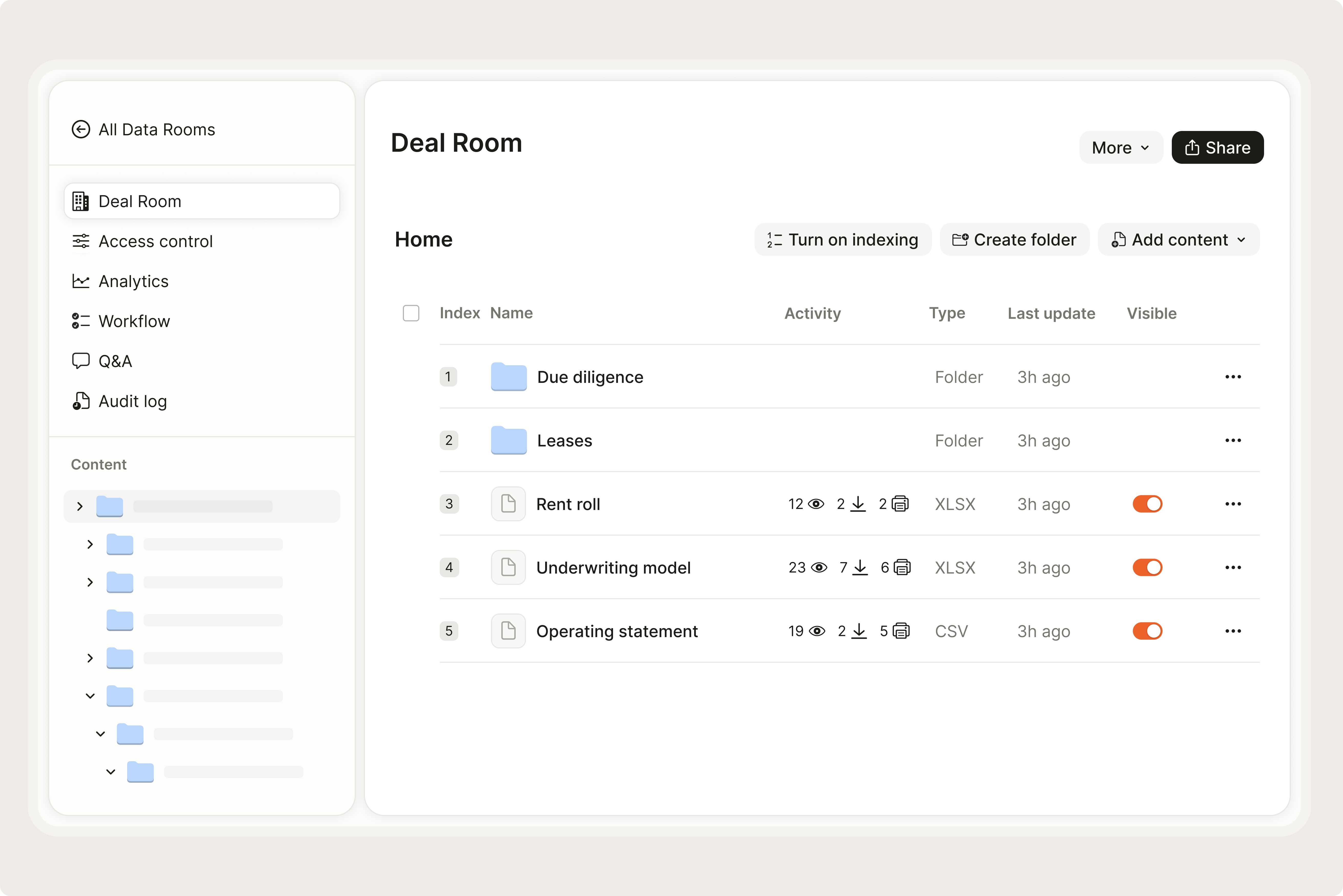
Set up a data room before advisors engage. Load Land Registry extracts, cadastral map, building permit, occupancy certificate, energy performance certificate, easement documentation, and lease files.
Where Czech property deals actually go wrong
Not every check carries the same weight. The table below sorts them by deal impact - dealbreakers first, then what moves the price, then basic hygiene - so your Czech attorney and advisor know what to clear first.
| Area | Documents to pull | Czech red flag | Matters most for | Tier | |
|---|---|---|---|---|---|
| Land Registry (Katastr nemovitostí) search | Land Registry (Katastr nemovitostí) search | Land Registry extract (výpis z katastru nemovitostí) from ČÚZK for all cadastral parcels comprising the property, cadastral map (katastrální mapa), title deed chain | The Katastr nemovitostí is publicly searchable at nahlizeni.cuzk.cz; for due diligence: obtain certified extracts (úředně ověřený výpis) from ČÚZK rather than online information-only extracts; the extract shows: parcel and building identification, registered owner (vlastník), all encumbrances (zástavní práva/mortgages, věcná břemena/easements), and all annotations (poznámky); a Poznámka indicating pending insolvency (insolvenční řízení) or execution proceedings (exekuce) blocks a clean transfer; confirm all registered encumbrances; confirm the parcel boundary in the cadastral map matches the physical property boundaries; confirm buildings are registered in the Land Registry (not all Czech buildings are properly registered - particularly older structures and extensions) | All buyers - foundational check | Dealbreaker |
| Easements (Věcná břemena) | Easements (Věcná břemena) | Land Registry extract (encumbrance section), utility easement documentation (right-of-way agreements with utility providers), service agreements with neighboring land owners | Czech commercial properties frequently have registered easements (věcná břemena) for utility crossings (electricity, gas, water, sewage, telecom), right-of-way over the parcel, and other uses; these appear in the Land Registry but not all utility easements are registered - some may exist on the basis of public law regulations and may not appear in the Land Registry extracts; review the utility easement map (pasport sítí or similar) against the cadastral map to identify infrastructure crossing the parcel that may not be listed in the Land Registry; also check for personal easements (věcná břemena osobní) - e.g. a lifetime right of use granted to a prior resident of the building - which can prevent full commercial use | All commercial, especially development sites | Dealbreaker |
| Church restitution risk | Church restitution risk | Church restitution registry (Výpis z Rejstříku náhradních pozemků under Act 428/2012), church property claim notifications from Czech church restitution authority, title history back to pre-1948 | Act 428/2012 (Zákon o majetkovém vyrovnání s církvemi a náboženskými společnostmi) created a framework for restitution of property taken from Czech churches under communist rule (1948-1989); the process is still being implemented - churches are actively receiving their historical property back including forests, agricultural land, and some urban properties; some Czech commercial properties (particularly in areas that historically had significant church-owned property) may be subject to church restitution claims; the church restitution registry allows title searches; commercial property owners near or connected to historically church-owned land should confirm no pending church restitution claims; unlike Romania's Law 10/2001 which is largely litigation-driven, Czech church restitution is administratively managed but transfers are still completing | Commercial on historically church-owned land, rural or semi-urban commercial | Dealbreaker |
| Co-ownership and preemption rights | Co-ownership and preemption rights | Land Registry owner section (all co-owners and their share sizes), co-ownership agreement (smlouva o spoluvlastnictví) or house rules (prohlášení vlastníka) | Czech Civil Code (zákon č. 89/2012 Sb.) grants co-owners (spoluvlastníci) a statutory right of first refusal (předkupní právo) when one co-owner sells to a third party; this applies to all co-ownership arrangements unless the co-ownership is arising from inheritance; for a commercial property owned by multiple entities with fractional shares: confirm all co-owners have waived their preemption right or that the sale complies with Czech preemption right procedures; failure to comply with statutory preemption rights can result in the sale being challenged; also check for any contractual preemption rights (smluvní předkupní právo) registered in the Land Registry in favor of third parties such as prior buyers or option holders | Properties with multiple land owners, office building unit ownership | Dealbreaker |
| Building permit and occupancy certificate | Building permit and occupancy certificate | Building permit (Stavební povolení or under 2024 Act: integrované povolení), occupancy certificate (Kolaudační souhlas or Kolaudační rozhodnutí), energy performance certificate (PENB - Průkaz energetické náročnosti budovy) | Czech building law reform: a new Building Act (zákon č. 283/2021 Sb.) came into force on July 1, 2024, replacing the previous Building Act (zákon č. 183/2006 Sb.); the 2024 Act introduced an integrated permit (integrované povolení) combining building permit and environmental permit into a single procedure; for buildings built or permitted before July 1, 2024: the prior Stavební povolení and Kolaudační souhlas/rozhodnutí system applies; confirm the building permit was issued by the competent stavební úřad (building authority); confirm the occupancy certificate (Kolaudační souhlas or Kolaudační rozhodnutí) exists and covers the current commercial use; for buildings without an occupancy certificate: Czech law prohibits lawful commercial use and enforcement risk exists; the energy performance certificate (PENB) is mandatory for sales and long-term leases; Czech commercial buildings often have poor energy class (typically C to E) which creates EU Energy Performance of Buildings Directive (EPBD) compliance pressure for major renovations | All Czech commercial buildings | Price-adjuster |
| Zoning and planning (územní plán) | Zoning and planning (územní plán) | Municipal land use plan (územní plán), zoning extract from local planning authority (stavební úřad), spatial planning information (územně plánovací informace, ÚPI) | Czech commercial zoning: each municipality adopts a land use plan (územní plán) setting permitted uses by zone; for Prague: the current Metropolitan Plan (Metropolitní plán Prahy) has been in development for years and replaces the older Prague Strategic Plan; confirm the current applicable plan and the zoning category (funkční plocha) for the parcel; key categories: mixed-use urban (SV - smíšené území všeobecné), commercial (OK - plochy komerčního využití), industrial (VP - výrobní a skladovací plochy); for development commercial: confirm development feasibility under the current plan; Prague's planning environment has been complex with long processing times and pending plan updates | All Czech commercial, development sites especially Prague | Price-adjuster |
| VAT on commercial transaction | VAT on commercial transaction | Seller's VAT registration status, first occupation date or substantial renovation date for the property, Czech tax counsel VAT opinion | Czech VAT Act (zákon č. 235/2004 Sb.): commercial property transactions are subject to VAT at 21% if: (1) the property is supplied within 5 years of first occupation or substantial renovation; and (2) the seller is a VAT payer; after 5 years from first occupation: default is VAT exemption, but the seller may opt to apply VAT if the buyer is a VAT payer; for Czech commercial sales by institutional sellers (investment funds, developers): confirm VAT treatment before signing; a Czech real estate holding company (SRO or AS) selling Czech commercial property may have additional VAT considerations depending on its specific structure and prior input VAT recovery | All commercial buyers; especially non-VAT or VAT-exempt buyers | Price-adjuster |
| Leases and tenancies | Leases and tenancies | All commercial leases, rent roll, Czech Civil Code tenant provisions, WAULT (weighted average unexpired lease term) calculation | Czech commercial leases: governed by the Czech Civil Code (zákon č. 89/2012 Sb.); commercial leases (nájemní smlouvy na nebytové prostory) are generally freely negotiable with fewer statutory protections than residential; review all leases for: term and break options (výpověď), rent review and indexation (typically CPI or HICP indexed; Prague Grade A office is typically EUR-denominated), maintenance obligations (tenant vs. landlord split), service charge structure (správní poplatky), and any tenant options to purchase (kupní opce); Czech office leases in Prague's institutional market are typically EUR-denominated despite CZK being Czech currency; review rent and service charge payment history; confirm deposits (kauce, bankovní záruka) are in place | Tenanted Czech commercial | Price-adjuster |
| Environmental - communist-era contamination | Environmental - communist-era contamination | Czech Environmental Inspectorate (ČIŽP) contaminated sites database (SEKM - Systém evidence kontaminovaných míst at sekm.mzp.cz), Phase I ESA from licensed environmental assessor | Czech Republic's communist-era industrial legacy created contaminated sites particularly in: Ostrava-Karviná (coal mining, coke production, heavy industry - among Central Europe's most contaminated industrial zones), Ústí nad Labem (chemicals), Kladno (steel), northern Bohemia (lignite mining), and former military areas; the Ministry of the Environment maintains SEKM (Systém evidence kontaminovaných míst) which is the national contaminated sites register; any former industrial or brownfield commercial should be checked against SEKM before Phase I ESA is commissioned; Ostrava commercial in particular: Phase I ESA is standard practice for any brownfield acquisition given the density of historical contamination in the region | Former industrial commercial; Ostrava-Karviná region; northern Bohemia | Standard check |
| Seller KYC and AML | Seller KYC and AML | Czech Business Register (Obchodní rejstřík at or.justice.cz) entity confirmation, Czech Beneficial Owner Register (Evidence skutečných majitelů, ESM) UBO confirmation, OFAC/EU sanctions screens | Czech Republic implements EU AML directives; the Czech Beneficial Owner Register (Evidence skutečných majitelů, ESM) is publicly searchable and shows UBOs for all Czech legal entities; Czech attorneys conducting property transactions are AML-regulated; confirm seller entity at the Business Register (Obchodní rejstřík); check ESM for UBO disclosure and confirm no beneficial owner appears on OFAC or EU sanctions lists; also review the Czech financial administration's VAT payer register (ARES) for seller's VAT registration status | All deals; corporate sellers | Standard check |
Due diligence on a Czech Republic property?
Set up your Ellty data room before diligence starts.
Start free 14-day trialCzech Republic property due diligence checklist
The table ranked risks by severity. This is the full checklist to work through, grouped by area.
Land Registry search and title confirmation
- Day one: request certified Land Registry extracts (úředně ověřený výpis) from ČÚZK for all cadastral parcels comprising the property; access via nahlizeni.cuzk.cz for initial information-only search, then obtain certified copies for the file; identify all cadastral parcel numbers (parcelní čísla) and cadastral area (katastrální území)
- Confirm registered owner matches the seller in every respect; review the title acquisition basis shown in Part B - inherited title, purchased from state, privatization acquisition, or commercial purchase; title acquired from the state in early 1990s privatizations: confirm against church restitution register
- Review all Poznámky (special annotations) in the Land Registry; any Poznámka indicating insolvency proceedings (insolvenční řízení at insolvenční rejstřík.justice.cz), execution proceedings (exekuce), or pending litigation requires full investigation before proceeding; a Poznámka spornosti (notation of dispute) is a significant warning
- Review the cadastral map (katastrální mapa) for boundary accuracy; confirm that all buildings shown on the cadastral map are registered in the Land Registry; Czech law distinguishes between parcel ownership and building ownership (the historical "superficies solo non cedit" exception was abolished by the Civil Code from 2014 - buildings and parcels are now unified in ownership, but older buildings may still have registration gaps)
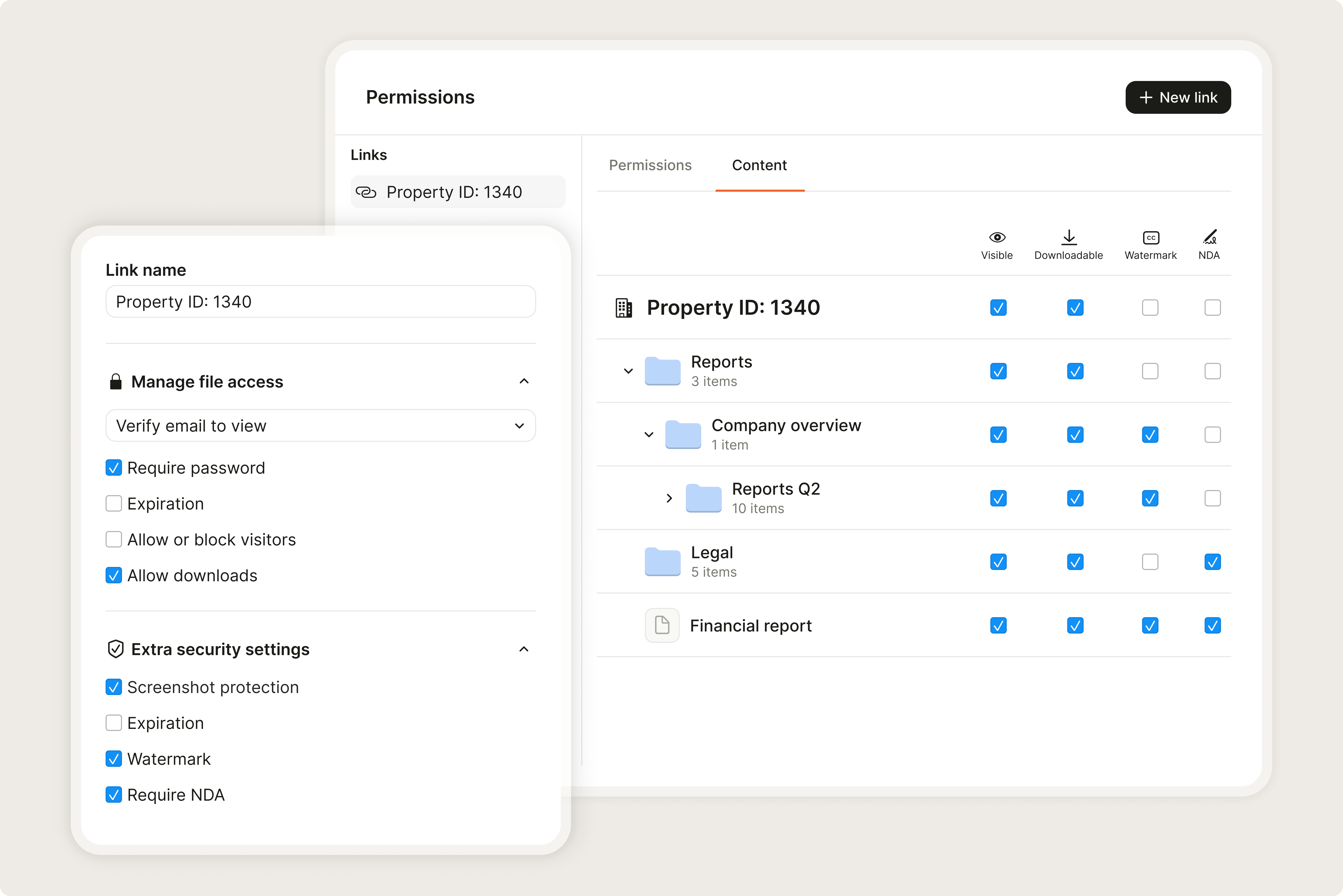
Give each advisor a scoped link in Ellty. Czech attorney sees Land Registry extracts, cadastral map, and church restitution search results. Building inspector sees building permit and occupancy certificate. Environmental consultant sees SEKM search results and Phase I ESA. Lender sees Land Registry extract, valuation, and lease pack. Each party sees only their files.
Easement and encumbrance mapping
- Print the cadastral map and overlay all registered easements (věcná břemena) from the Land Registry extracts; for each registered easement: identify the burdened parcel (pozemek povinný), the type of easement, and the holder (subjekt oprávněný)
- Request utility easement documentation from the seller and cross-reference against the Land Registry; also cross-reference against utility network maps (pasporty sítí) from each utility provider (electricity: ČEZ, gas: RWE or E.ON successor entities, water/sewage: local water authority); utility infrastructure crossing a parcel that is not registered as an easement is still a real constraint
- For personal easements (věcná břemena osobní) such as rights of residence or use registered in favor of individuals: confirm these will be extinguished before closing or confirm the commercial impact is manageable; a personal right of use registered in favor of a former resident cannot be unilaterally terminated
- Check for any pre-emptive rights (předkupní právo) registered in the Land Registry; these may be in favor of co-owners (statutory, under Civil Code) or third parties (contractual); confirm all pre-emptive right holders have waived their right in writing before signing a binding agreement
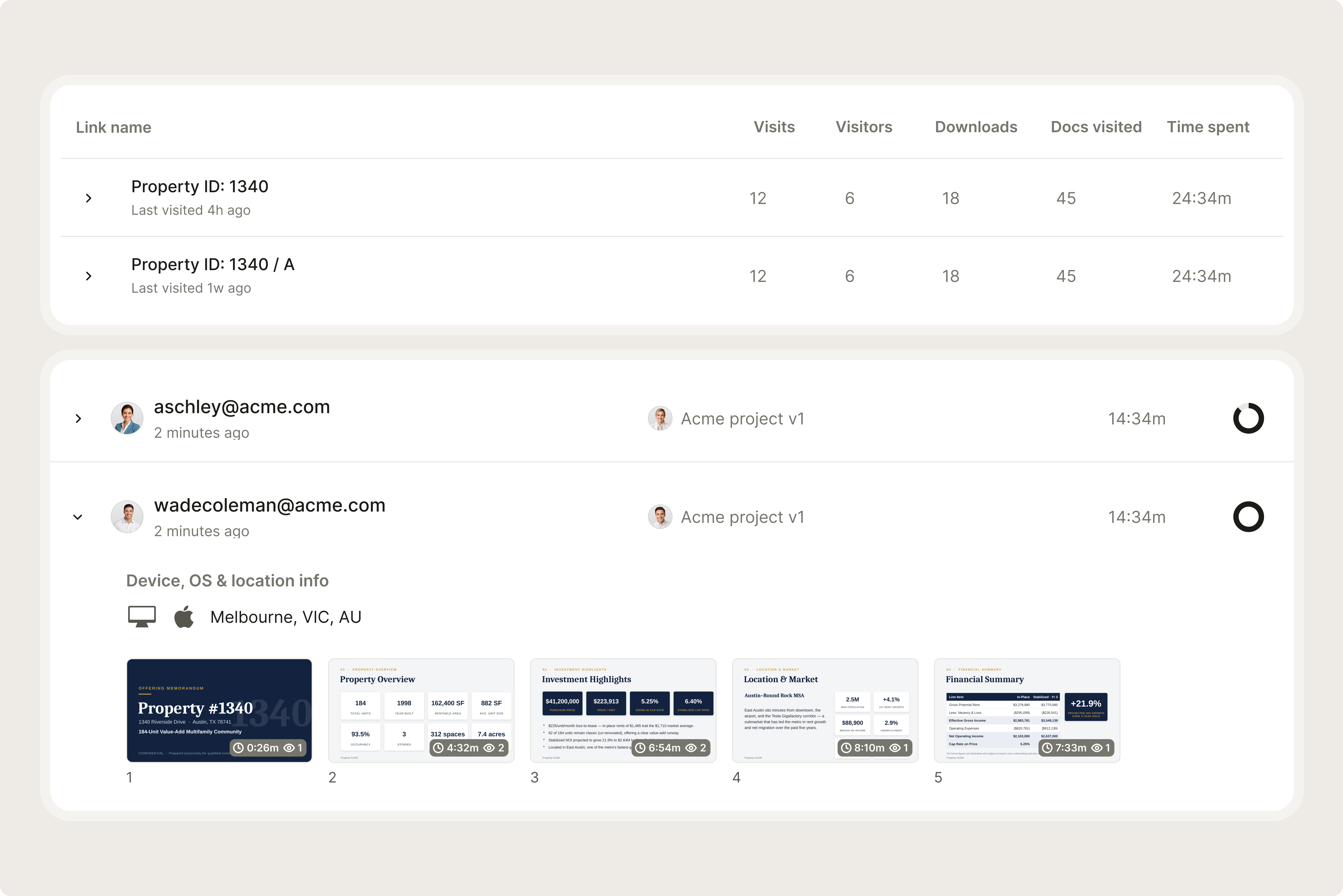
Load files into Ellty. Czech attorney sees full easement and encumbrance analysis. Track which advisor has reviewed each document - easement analysis and occupancy certificate are often where deal questions concentrate.
Building permit, occupancy, and 2024 Building Act
- Request building permit (Stavební povolení) from seller and verify with the local building authority (stavební úřad); for buildings permitted or modified after July 1, 2024: the new Act's integrated permit (integrované povolení) system applies; for older buildings: confirm the prior-law Stavební povolení covers the current scope
- Request occupancy certificate (Kolaudační souhlas or Kolaudační rozhodnutí) from seller; verify with the stavební úřad; for buildings that changed use after the original occupancy certificate: a change-of-use occupancy certificate (Kolaudační souhlas pro změnu v užívání stavby) is required; mismatch between registered use in Land Registry and actual current use is a common finding in Czech CRE diligence
- Request energy performance certificate (PENB) from seller; the PENB is required for all sales and long-term leases; EU EPBD requirements are creating increasing pressure for Czech commercial landlords to renovate buildings with poor energy class (D, E, F, G) - model renovation CAPEX for poor-class buildings
- For older commercial buildings (pre-1990 especially): check for asbestos-containing materials (azbestová vlákna), PCBs in transformers, and other historical construction materials; Czech communist-era commercial construction commonly used asbestos insulation and panels
Compare Germany's commercial property due diligence process for Central European portfolio context. Czech Republic and Germany are neighboring markets with active institutional cross-border investment flows (German open-ended funds have been among the largest institutional owners of Prague commercial real estate); key differences: no Czech RETT vs. Germany's 3.5-6.5% RETT; Czech Land Registry (Katastr) vs. German Land Register (Grundbuch) - both constitutive registries; Czech CIT at 19% vs. German CIT; and Prague Grade A office rental levels substantially below Munich, Frankfurt, or Berlin.
How due diligence works in the Czech Republic
Step 1 - Land Registry and title
Day one: pull Land Registry extracts from ČÚZK for all cadastral parcels. Review Part owner section, all easements, and Poznámky. Check insolvency register and execution register against seller name.
For properties with historical church connection: search church restitution register before any deposit.
Step 2 - Easements and building compliance
Map all registered easements against the cadastral map and utility network plans. Commission Phase I ESA for former industrial or brownfield sites (mandatory for Ostrava-Karviná region).
Request building permit and occupancy certificate. Verify with local stavební úřad. Check registered use vs. actual current use.
Step 3 - Leases, VAT, and AML
Abstract all commercial leases. Review EUR vs. CZK denomination, indexation terms, tenant break options, and deposit structure. Confirm VAT treatment with Czech tax counsel. Check UBO at Evidenci skutečných majitelů (ESM). Confirm seller at Obchodní rejstřík. Run OFAC and EU sanctions screens.
Step 4 - Transfer and registration
Czech commercial property transfer: the purchase contract (kupní smlouva) is signed by both parties (no notarial authentication requirement for transfers between companies, unlike some EU states; a written contract with certified signatures is sufficient for Land Registry submission); the contract is submitted to ČÚZK for registration; title passes on Land Registry registration (not on signing); ČÚZK processes transfers typically in 3-10 business days; a blocking annotation (poznámka) is placed by ČÚZK at submission which protects the buyer's position pending registration.
Load closing files into Ellty before signing. Czech attorney sees signed kupní smlouva and Land Registry submission confirmation. Lender sees post-closing Land Registry extract with buyer registered as owner.
How to set up your Czech Republic data room in Ellty.
Czech commercial deals involve Land Registry extracts for all cadastral parcels, cadastral map, building permit, occupancy certificate, energy performance certificate (PENB), easement documentation, utility network plans, SEKM environmental records, and all commercial leases.
- 1.Upload Czech property files to a secure roomDrop Land Registry extracts (all parts), cadastral map, building permit, Kolaudační souhlas/rozhodnutí, PENB energy certificate, registered easement documentation, utility network plans, SEKM environmental records, Phase I ESA if applicable, and commercial lease pack into Ellty.
- 2.Give each advisor a scoped, tracked linkCzech attorney sees Land Registry extracts and easement analysis. Building inspector sees building permit and occupancy certificate. Environmental consultant sees SEKM records and Phase I ESA. Lender sees Land Registry extract, valuation, and leases. Each party sees only their files.
- 3.Monitor who reviews which documentsSee exactly which files each advisor opened and when. Catch easement issues or occupancy certificate gaps before they stall deal pricing or closing.
What makes Czech Republic different
The abolition of the Czech real estate transfer tax in October 2020 was a significant structural change that fundamentally altered Czech commercial deal economics. Prior to 2020, the 4% RETT (Daň z nabytí nemovitých věcí) was a real cost in Czech commercial acquisitions - buyer-paid, applied to the higher of the purchase price and the assessed value (cena zjištěná), creating a floor cost of roughly 4% of transaction value. Its abolition was initially temporary during COVID-19 but was made permanent. Czech commercial is now substantially cheaper to acquire from a tax transaction cost perspective than Austria (3.5% Grunderwerbsteuer), Germany (3.5-6.5% RETT depending on state), or Hungary (4% real property transfer tax). This cost advantage relative to neighboring markets is one of the reasons Prague Grade A commercial has attracted consistent German institutional capital since the early 2000s - the combination of no RETT, a reliable title registration system, a functional EU-standard legal framework, and EUR-denominated lease income (which removes CZK currency risk for EUR-based investors at the income level) makes Czech institutional commercial unusually accessible for Western European investors.
Prague's commercial real estate market has an unusual structural characteristic: EUR-denominated leases are the near-universal standard for Grade A and Grade B office, retail, and modern logistics commercial, even though Czech Republic uses the Czech Koruna (CZK) and has not joined the Eurozone. This convention was established in the 1990s when early institutional investors (primarily German and Austrian funds) structured Prague leases in EUR as the natural currency for cross-border investment, and it has persisted. The practical result for due diligence is that income underwriting is largely in EUR (which simplifies analysis for EUR-based investors), but Czech tenants in domestic businesses earn revenues in CZK and pay rent in EUR, creating tenant-side currency risk during periods of CZK weakness. Also: Czech tax, employment, and property cost obligations are in CZK, creating a cost-income currency mismatch at the property level. Investors should review both EUR-denominated income and CZK-denominated operating costs when modeling Czech commercial.
The Czech easement system (věcná břemena) creates a specific due diligence workstream that is particularly important for urban commercial in Prague and other Czech cities where utility infrastructure density is high. Unlike some Central European systems, Czech utility easements are sometimes created by public law provisions rather than by registration in the Land Registry - meaning infrastructure crossing a parcel may not appear in the Land Registry extracts at all. The practical consequence is that a clean Land Registry for easements does not guarantee the absence of utility crossings that constrain the site. Standard practice for any Czech commercial acquisition involving development potential or site reconfiguration is to commission a utility network survey (pasport sítí inquiry to ČEZ, RWE successor entities, water/sewage authority, and telecom providers) in addition to the Land Registry search, and to physically mark utility infrastructure locations on the cadastral map. For built commercial where no site reconfiguration is planned, the risk is lower but still relevant for underground utility access or maintenance obligations.
The Czech Land Registry (Katastr nemovitostí) under the Cadastral Act (zákon č. 256/2013 Sb., o katastru nemovitostí) constitutes a public register in which real property rights, restrictions, and encumbrances are recorded. Title to real property passes upon registration in the Land Registry; an agreement to transfer ownership of real property does not itself transfer title until the relevant entry is made in the Register. The cadastre records, in addition to ownership, all real encumbrances (věcná břemena), mortgages (zástavní práva), and annotations (poznámky) affecting registered real property. Data entered in the Land Registry is presumed to be accurate and complete; a person who acquires real property rights in good faith relying on the Land Registry is protected under the principle of good faith reliance (princip dobré víry) established by the Civil Code.
Timeline and cost in the Czech Republic
Weeks 1-2 cover kickoff: Land Registry extract search for all cadastral parcels (ČÚZK), insolvency register check (insolvenční rejstřík), execution register check (centrální evidence exekucí), church restitution register search if relevant, stavební úřad building permit and occupancy certificate verification, easement mapping including utility network plans, SEKM environmental database check, Phase I ESA commission for brownfield or former industrial, lease abstraction, VAT position analysis with Czech tax counsel, UBO check at ESM, Obchodní rejstřík entity confirmation, OFAC/EU sanctions screens. Czech attorney fees in this phase: CZK 100,000-400,000 (approx. EUR 4,000-16,000).
Load all files into Ellty before advisors engage. Standard Czech commercial: 30-60 days. Phase I ESA (Ostrava or brownfield): 4-6 weeks. Prague development site planning: 3-6 months (planning confirmation alone can extend timelines significantly).
Weeks 2-4 cover deep review: Land Registry encumbrance clearance plan, utility easement survey results, occupancy certificate vs. current use comparison, PENB energy class assessment, Phase I ESA delivery, lease currency and WAULT analysis, VAT treatment confirmation, service charge audit, seller's insolvency status reconfirmation, pre-contractual negotiations on representations and warranties. Costs: CZK 200,000-800,000 (approx. EUR 8,000-32,000).
Weeks 4-8 handle resolution: mortgage discharge, easement extinguishment (where possible), occupancy certificate use-change (if needed), lease deposit verification, kupní smlouva preparation, Land Registry registration submission, and post-closing Land Registry extract confirming buyer ownership.
Czech total buyer-side transaction costs: no RETT (since 2020); VAT 21% if applicable on new commercial (recoverable as input VAT for VAT-registered buyers); no notarial authentication requirement for company-to-company transfers (lower notary fee exposure than some EU states); ČÚZK registration fees (relatively small - typically CZK 1,000-10,000 depending on complexity); Czech attorney fees (typically 0.3-1% of transaction value); advisor and due diligence costs. Total effective buyer cost excluding VAT: 1-3% of transaction value - among the lowest in Central Europe.
Running a Czech Republic property deal from one room
Hold Land Registry extracts, easement maps, building permits, and lease files in one secure, tracked Ellty data room.
Start free 14-day trialCommon questions about due diligence on Czech Republic commercial property
- No. Czech Republic abolished its 4% real estate transfer tax (Daň z nabytí nemovitých věcí) in October 2020 for transactions completing after February 2020. No RETT applies to Czech commercial acquisitions as of 2026. VAT at 21% applies to sales of new commercial buildings (within 5 years of first occupation) by VAT-registered sellers. Total buyer-side acquisition costs excluding VAT are among the lowest in Central Europe at approximately 1-3% of transaction value.
- The Katastr nemovitostí is maintained by ČÚZK and is publicly searchable at nahlizeni.cuzk.cz. It records: registered owner, all encumbrances (mortgages/zástavní práva, easements/věcná břemena), restrictions, and Poznámky (special annotations indicating pending insolvency, execution, or litigation). Title to Czech commercial property passes on registration, not on signing the purchase contract. ČÚZK processes transfer registrations typically in 3-10 business days. A Poznámka for insolvency or execution proceedings must be resolved before any transfer can complete.
- The main risks beyond standard title and lease review are: (1) easements - Czech utility easements can exist by public law without Land Registry registration, requiring utility network surveys in addition to Registry searches; (2) co-ownership preemption rights - multiple-owner properties require all co-owners to waive statutory preemption rights before a valid third-party sale; (3) church restitution claims under Act 428/2012 for properties historically connected to church-owned land; (4) occupancy certificate vs. actual use mismatch - common in older Czech commercial buildings that have changed use; (5) communist-era contamination in Ostrava-Karviná and other industrial regions.
- Czech VAT at 21% applies to commercial property sales when: (1) the property is sold within 5 years of first occupation or substantial renovation; and (2) the seller is a Czech VAT payer. After 5 years from first occupation: default is VAT exemption, but the seller may opt to apply VAT if the buyer is a VAT payer. VAT-registered buyers using the property for taxable business can recover VAT as input VAT. Buyers using the property for VAT-exempt activities bear irrecoverable VAT. Confirm with Czech tax counsel.
- Yes. Czech Republic allows unrestricted ownership of real property by both EU and non-EU nationals and companies. There are no foreign ownership restrictions on commercial property. Czech Republic liberalized foreign property ownership at EU accession in 2004. No special permits or authorizations are required for non-Czech or non-EU buyers to acquire Czech commercial real estate.
- Standard Czech commercial deals take 30-60 days. Land Registry search: immediate online, certified extracts 1-3 days. Utility easement network survey: 2-4 weeks. Building permit and occupancy certificate verification with stavební úřad: 1-3 weeks. Phase I ESA (Ostrava brownfield): 4-6 weeks. ČÚZK Land Registry transfer registration after closing: 3-10 business days. Prague development sites requiring planning confirmation: add 3-6 months for planning certainty.