Singapore commercial property has two issues that move deal math faster than anything else: the 99-year leasehold countdown (remaining tenure directly affects both valuation and bank financing) and the Development Charge triggered by change of use - even without any physical construction.
Singapore does not restrict foreign ownership of commercial property. No Additional Buyer's Stamp Duty (ABSD) applies to commercial purchases - ABSD is residential only. This makes Singapore commercial property straightforwardly accessible to non-Singaporean buyers in a way that residential is not.
BSD (Buyer's Stamp Duty) applies to all commercial property purchases: 1-3% on the first SGD 1.5M and 5% on the remainder above that threshold. Confirm the exact BSD calculation with your Singapore lawyer before signing; rates were revised in Budget 2023.
Singapore's land title system uses the Torrens model. All searches run through the SLA (Singapore Land Authority) Land Titles Registry via INLIS. A caveat is lodged at LTSA to protect the buyer's interest between signing and completion.
Set up an Ellty data room before diligence opens. Load SLA title documents, URA Master Plan extracts, lease agreements, and BCA building certifications before advisors arrive. Each advisor gets a scoped link from day one.
Where Singapore deals go wrong
Not every check carries the same weight. The table below sorts risks by deal impact - dealbreakers first, then what moves the price, then basic hygiene - so your Singapore solicitor and technical advisor know what to clear first.
| Area | Documents to pull | Singapore red flag | Matters most for | Tier | |
|---|---|---|---|---|---|
| 99-year leasehold tenure | 99-year leasehold tenure | SLA title search, lease commencement date, remaining tenure calculation | Most Singapore commercial property is 99-year leasehold; remaining tenure affects valuation and banks typically won't finance properties with less than 30 years remaining | All leasehold assets | Dealbreaker |
| JTC industrial lease consent | JTC industrial lease consent | JTC lease agreement, JTC assignment policy, JTC in-principle approval | JTC Corporation (state industrial landlord) must consent to any assignment of a JTC lease; without JTC approval, the industrial property cannot transfer | Industrial assets | Dealbreaker |
| Development Charge on change of use | Development Charge on change of use | URA Master Plan zoning, current approved use, DC table rate, DC calculation | Singapore's Development Charge (DC) is triggered by any enhancement in land use or plot ratio - even by change of use without construction | Repositioning, change of use | Dealbreaker |
| SLA title and encumbrances | SLA title and encumbrances | INLIS title search, registered encumbrances, caveats, mortgages, easements | All encumbrances, mortgages, and caveats register with SLA; an unreleased caveat or unregistered charge can block title transfer | All buyers | Dealbreaker |
| GST and BSD structure | GST and BSD structure | IRAS BSD calculation, GST registration status, going concern analysis, stamp duty receipts | If the seller is GST-registered, 9% Singapore GST applies on the commercial sale; confirm if going concern transfer is available to zero-rate the GST | All deals | Price-adjuster |
| Leases and stamp duty compliance | Leases and stamp duty compliance | All lease agreements, IRAS stamp duty receipts for leases, tenancy roll | Singapore leases must be stamped within 14 days of execution; unstamped leases are not admissible in court without payment of duty plus penalty | Income-producing assets | Price-adjuster |
| URA planning and Master Plan | URA planning and Master Plan | URA Master Plan extract, Written Permission, plot ratio, height controls, land use zoning | Singapore's URA Master Plan is updated every 5 years; a rezoning between Master Plan reviews can significantly change the permitted use | All assets | Price-adjuster |
| BCA building compliance | BCA building compliance | Certificate of Statutory Completion (CSC), Temporary Occupation Permit (TOP), fire safety certificate | Singapore's BCA requires a valid CSC for all completed buildings and a TOP for occupied but not yet completed structures; missing documents create compliance liability | All buildings | Price-adjuster |
| Environmental - industrial zones | Environmental - industrial zones | NEA contaminated sites register, site history review, Phase I ESA for Jurong and Tuas | Singapore's NEA maintains a contaminated sites register; Jurong and Tuas industrial areas carry legacy contamination from petrochemical and manufacturing activities | Industrial, logistics | Price-adjuster |
| Insurance and valuation | Insurance and valuation | Current policies, loss run, SISV appraisal, building structural inspection | Lenders in Singapore require an independent valuation from a SISV (Singapore Institute of Surveyors and Valuers) registered valuer | All | Standard check |
| Seller KYC and AML | Seller KYC and AML | ACRA corporate extract, UBO register, CLTPA AML obligations, sanctions check | Singapore's real estate sector is a designated sector under CLTPA; lawyers and estate agents must perform KYC and UBO checks on all property transactions | All deals | Standard check |
Due diligence on a Singapore property?
Set up your Ellty data room before diligence starts.
Start free 14-day trialSingapore CRE checklist
The table ranked risks by severity. This is the full list to work through, grouped by area.
99-year leasehold tenure
- Pull the SLA title on day one and confirm the leasehold start date and expiry year
- Calculate the remaining tenure; for a property with 60 years remaining, the countdown affects every aspect of valuation, exit modeling, and financing
- Singapore banks typically won't finance properties with less than 30 years remaining on the leasehold
- For 99-year leasehold: the value decay accelerates after 60 years remaining; model a resale scenario to confirm the exit is viable within your hold period
- Freehold commercial property in Singapore commands a significant premium; confirm whether the title is freehold or leasehold before any commercial discussion
- Some properties are 999-year leasehold (effectively freehold for most purposes); confirm the specific tenure on the SLA title
JTC industrial lease consent
- For any industrial property: confirm whether the title is a JTC Corporation lease or a private freehold/leasehold title
- JTC leases have specific assignment and sub-letting conditions; JTC must consent to any change of occupier or ownership
- Apply for JTC in-principle consent early; JTC processes applications based on the buyer's qualifying industrial activity and track record
- For multi-tenanted JTC buildings: confirm sub-letting approval from JTC for each existing sub-tenant arrangement
- JTC lease terms may restrict the permissible use; confirm the buyer's intended use falls within the approved JTC use class
Development Charge on change of use
- Pull the URA Master Plan extract for the property; note the current zoning, plot ratio, and approved building height
- If the buyer intends to change the current use or intensify the plot ratio: calculate the Development Charge (DC) before signing
- DC is calculated based on differential tables published by URA; it applies to the enhancement in land value from the proposed change
- A change from light industrial to commercial, or from office to retail, can trigger substantial DC
- URA Written Permission (WP): confirm that any existing WP matches the current use of the building; undisclosed use changes that lack WP create compliance liability
SLA title and encumbrances
- Run an INLIS title search via SLA; confirm registered owner, tenure, encumbrances, and caveats
- Check all registered mortgages, charges, and easements on the title
- Confirm there are no outstanding caveats from third parties claiming an interest in the property
- Confirm the title plan matches the physical property boundaries; any discrepancy requires a survey before transfer
- Your solicitor should lodge a buyer's caveat immediately upon signing the option; this protects the buyer's position during the conveyancing period
GST and BSD structure
- Calculate BSD on the full purchase price: tiered at 1-3% on the first SGD 1.5M and 5% above that for commercial property
- Confirm the seller's GST registration status; if GST-registered, 9% Singapore GST applies on the commercial sale
- Assess whether a going concern transfer is available: if the property is a tenant-occupied income-producing asset transferred as a going concern, the GST may be zero-rated
- Both parties must be GST-registered for going concern relief; confirm buyer's GST registration before structuring
- Confirm IRAS stamp duty receipts for all prior transfers in the title chain; underpaid stamp duty from a previous transfer can be pursued against the current owner
Give each advisor a scoped link in Ellty. Singapore tax advisors see BSD and GST analysis. The solicitor sees SLA title documents. Technical consultants see BCA certificates. No overlap, no access creep.
Leases and stamp duty compliance
- Collect all existing lease agreements and confirm each has a valid IRAS stamp duty receipt
- Leases must be stamped within 14 days of execution; unstamped leases are inadmissible in court proceedings without penalty payment
- Check lease terms: Singapore commercial leases typically have rent review, reinstatement, and repair obligations
- Confirm any existing rent-free periods are correctly reflected in the rent roll and lease documentation
- For co-working or flex-space operators: confirm the head lease terms permit sub-licensing arrangements
URA planning and Master Plan
- Pull the URA Master Plan extract; note the 2025 Master Plan designation for the site
- Confirm the current use of the building matches the permitted use under the Master Plan zoning
- Check for any pending URA Masterplan Review changes that may affect permissible use or plot ratio after transfer
- For properties near Jurong Lake District, Greater Southern Waterfront, or Paya Lebar: the 2025 Master Plan has specific uplift designations; confirm if these have DC implications
- Confirm the building height complies with aviation authority (CAAS) height restrictions if near Changi or Seletar airports
BCA building compliance
- Confirm the Certificate of Statutory Completion (CSC) from BCA for the building
- For buildings occupied before full completion: confirm the TOP (Temporary Occupation Permit) is current
- Check the fire safety certificate from SCDF (Singapore Civil Defence Force) is valid
- For older buildings: confirm the structural inspection history; Singapore's BCA requires periodic structural inspections for buildings above a certain age
- For Green Mark-rated buildings: the BCA Green Mark certification is increasingly expected by major tenants; confirm the current certification level
Environmental - industrial zones
- For Jurong and Tuas industrial assets: commission Phase I ESA using historical site maps from the National Archives and NEA records
- NEA maintains a contaminated sites register under the Environmental Protection and Management Act; search it for the property address
- For former shipyard sites around Jurong Island and the western coast: contamination from ship repair and heavy industry is common
- Phase II ESA (subsurface investigation) is warranted for any Jurong or Tuas site with pre-2000 industrial use history
Load all Phase I ESA, NEA search results, and BCA documents into Ellty. Environmental advisors, lenders, and technical consultants each get tracked, watermarked access from one secure link.
Insurance and valuation
- Commission a SISV-registered valuer for the independent appraisal; this is required for bank financing in Singapore
- Confirm current insurance coverage is adequate and transferable; Singapore commercial buildings are typically insured on a reinstatement basis
- Check the insurance loss run for the last 3 years; recurring claims from water ingress or building maintenance issues signal ongoing problems
Seller KYC and AML
- Pull an ACRA (Accounting and Corporate Regulatory Authority) business profile for the selling entity
- Confirm beneficial ownership under Singapore's UBO register (Companies Act requirement)
- Singapore lawyers are required to perform KYC under the Corruption, Drug Trafficking and Other Serious Crimes (Confiscation of Benefits) Act (CDSA); ensure your Singapore counsel is meeting this obligation
- Run OFAC, UN, EU, and MAS sanctions checks on all parties before any funds transfer
How due diligence in Singapore works
Step 1 - SLA title and leasehold tenure
Pull the INLIS title search and confirm the remaining leasehold tenure on day one. Singapore commercial real estate is predominantly 99-year leasehold; a property with 55 years remaining has a materially different value profile and exit option set than one with 85 years remaining.
Model the leasehold decay curve in your underwriting. Singapore buyers and valuers use well-understood models for leasehold value decline; if your hold period runs 10 years and the property will have less than 30 years remaining on exit, refinancing risk is significant.
Step 2 - URA Master Plan and DC
Pull the URA Master Plan designation and check against current use. If there's any change of use planned: calculate the Development Charge before signing. DC can run into millions of SGD on commercial assets in central Singapore zones.
Confirm JTC consent if the asset is an industrial property. The JTC approval process is well-defined but takes time; it should not be an afterthought scheduled for the last week before completion.
Step 3 - GST and BSD
Confirm BSD on the full consideration. Then check the seller's GST registration and assess whether the going concern exemption applies. On a SGD 30M commercial asset with a GST-registered seller, 9% GST is SGD 2.7M - recoverable if the buyer is GST-registered, but a cash-flow issue if not.
Compare Australia's commercial property diligence process when running APAC portfolio acquisitions. Both Singapore and Australia are common law markets with Torrens title systems, and both have stamp duty obligations that must be modeled at offer stage. The key difference is that Australia has no GST equivalent on most commercial property sales due to the going concern exemption being more broadly available.
Step 4 - Leases and BCA
Confirm all leases are stamped with IRAS and check the BCA certifications. Missing CSC or unstamped leases are fixable but slow the process if found late.
Track each advisor's document access in real time via Ellty. If the buyer's solicitor is reviewing the leases repeatedly, that's where the questions are. Know before the call.
Step 5 - Singapore conveyancing and completion
Singapore conveyancing uses a solicitor-managed completion process. The option to purchase (OTP) gives the buyer a 14-day exercise window; on exercise, a 10-week completion period typically follows (negotiable).
BSD must be paid to IRAS within 14 days of the date of signing the document that creates the sale. Late payment triggers penalties. Stamp duty for leases must also be paid within 14 days of lease execution. Your Singapore solicitor manages both.
How to set up your Singapore data room in Ellty.
Singapore CRE deals involve SLA title, JTC consent, URA planning, BCA certifications, IRAS stamp duty, and NEA environmental records across multiple weeks. Load files into Ellty before advisors arrive. Each advisor gets a scoped, tracked link from day one.
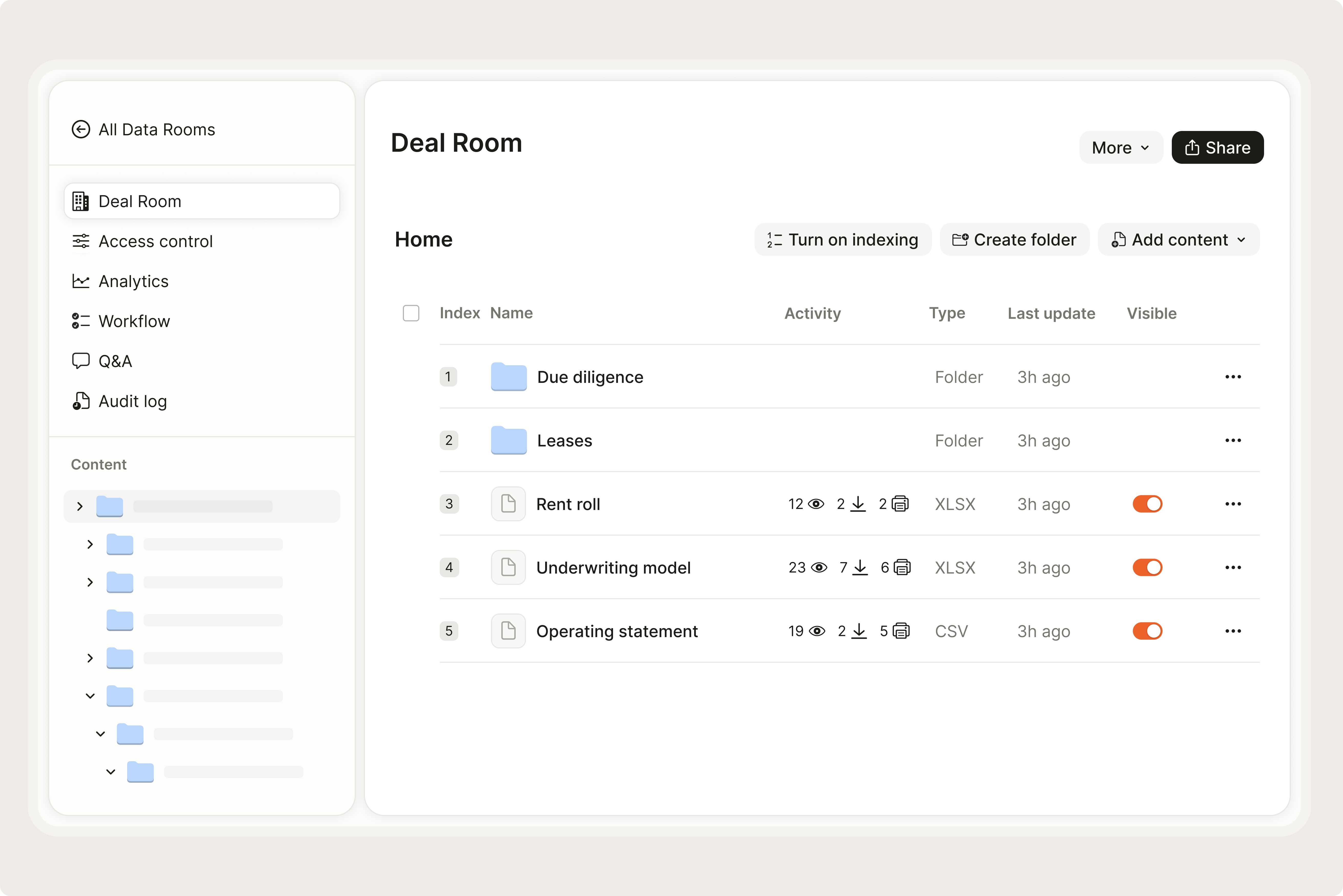
- 1.Upload Singapore property files to a secure roomDrop SLA title, URA Master Plan extract, JTC lease docs, BCA CSC, lease agreements, and BSD receipts into Ellty.
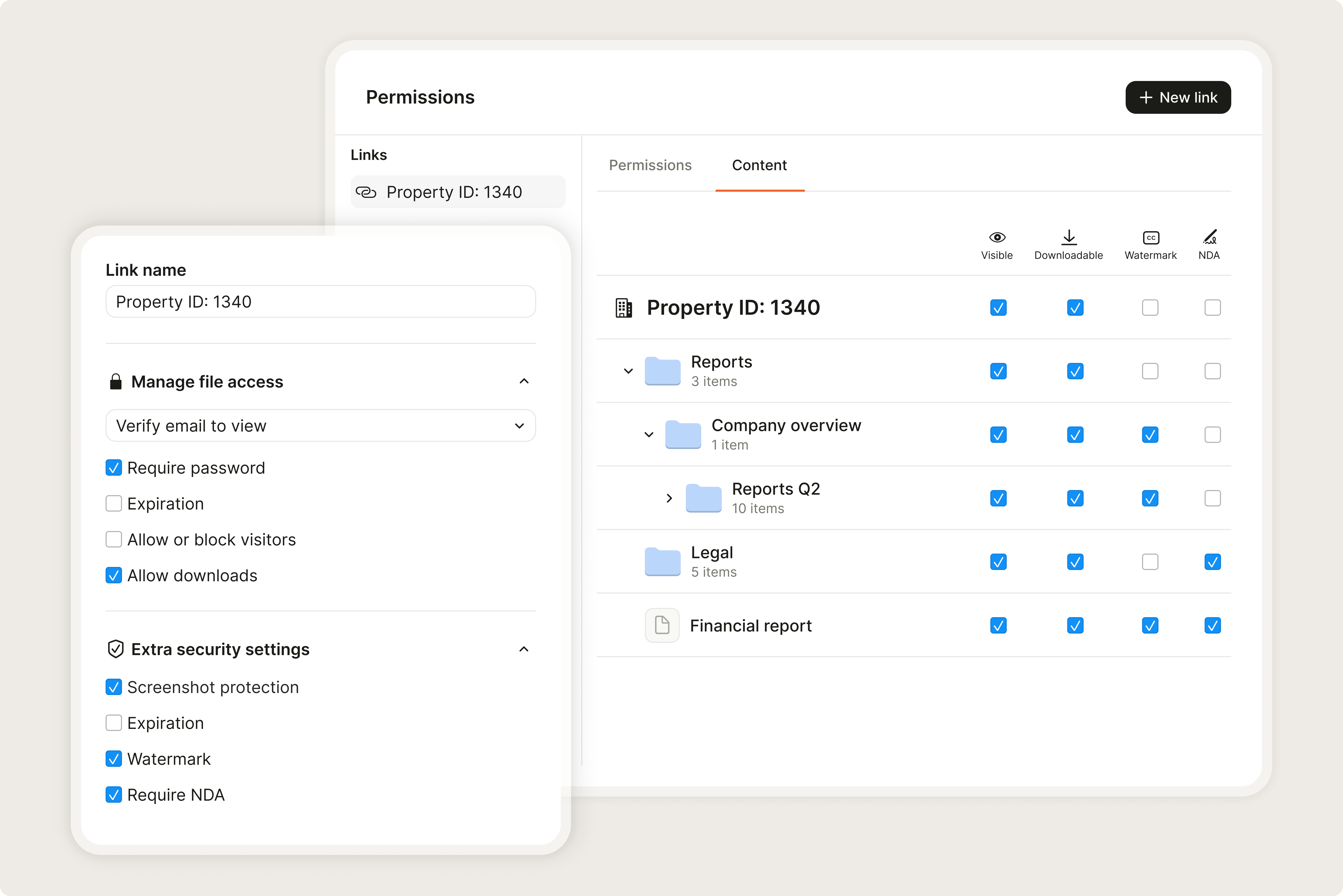
- 2.Give each advisor a scoped, tracked linkSolicitor sees SLA title and conveyancing docs. Tax advisors see BSD and GST analysis. Technical consultants see BCA certifications. Ellty enforces the scope.
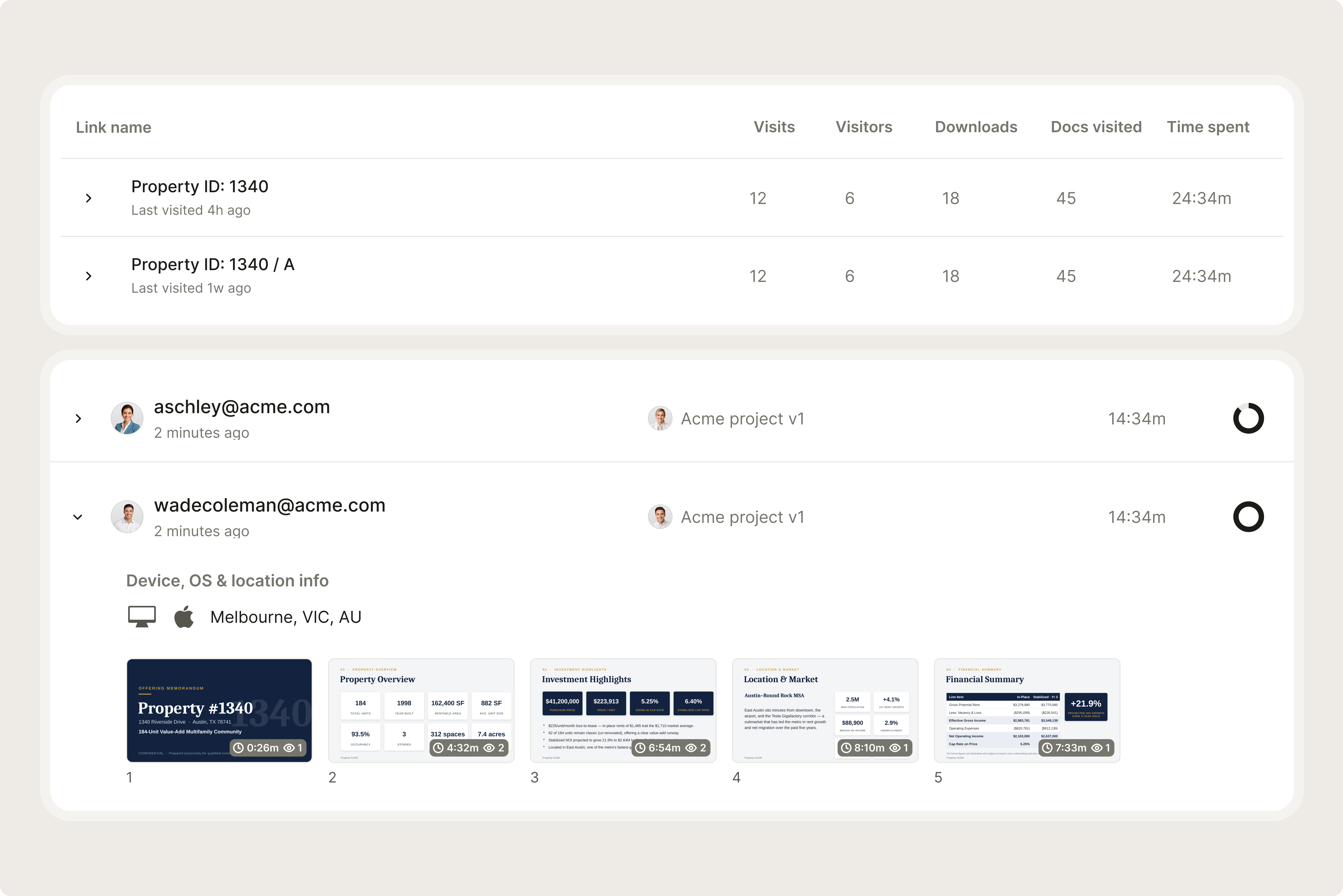
- 3.Monitor who reviews which documentsSee exactly which files each advisor opened and when. Catch delays before they affect the OTP exercise deadline or BSD payment date.
What makes Singapore different
The 99-year leasehold countdown is the issue that dominates Singapore commercial real estate. All land in Singapore is ultimately state-owned; private commercial property is held on state leases, typically 99 years from the date of grant. The remaining tenure determines valuation, financing availability, exit options, and tenant appetite for long leases. It must be quantified and modeled before any offer is made.
JTC Corporation is the landlord for a large part of Singapore's industrial and logistics real estate stock. JTC leases are government leases with specific assignment, use, and sub-letting conditions. Buying a JTC industrial building isn't like buying a private freehold commercial property; you're essentially taking over a government lease subject to JTC's approval and ongoing conditions. The JTC consent process is predictable but must be initiated early.
Development Charge is Singapore's most underappreciated acquisition cost item for buyers seeking to reposition or redevelop. The DC is calculated based on differential tables that URA publishes quarterly. Any enhancement in land use value - from changing a warehouse to office use, or increasing the gross floor area within an approved plot ratio - triggers DC payment to the state. Run the DC calculation before submitting any acquisition offers that assume a change of use.
Singapore's GST treatment of commercial property is more nuanced than it appears. If the seller is GST-registered, 9% GST applies to the sale unless the transaction qualifies as a going concern transfer. For a SGD 20M commercial property, that's a SGD 1.8M GST number that needs to be structured correctly at the term sheet stage.
Under Section 33 of the Land Titles Act, a registered proprietor of land holds that land subject to all interests notified on the land register and any overriding interests listed in the Act. A buyer takes a clean title subject only to entries on the SLA register and statutory overriding interests. Interests not registered with the SLA Land Titles Registry are generally not binding on a subsequent purchaser in good faith for valuable consideration, which is the core protection provided by Singapore's Torrens-model title registration system.
Timeline and cost in Singapore
Weeks 1-2 cover kickoff: SLA INLIS title search, leasehold tenure analysis, URA Master Plan extract, DC calculation if change of use is planned, JTC consent initiation for industrial, BSD and GST structure analysis, and BCA certificate confirmation. Budget SGD 15,000-40,000 for legal and advisory fees in this phase.
Load all files into Ellty before advisors start work. Scoped, tracked links for each party eliminate the document chase that adds 1-2 weeks to Singapore commercial diligence timelines.
Weeks 2-4 cover deep review: lease abstraction and stamp duty compliance check, structural inspection for older buildings, Phase I ESA for industrial or former industrial sites, and SISV valuation. Cost runs SGD 20,000-60,000 depending on complexity.
JTC consent process: run in parallel from week one; JTC approval typically takes 4-8 weeks depending on the buyer's profile and the complexity of the industrial use.
Weeks 4-8 handle resolution: OTP exercise, completion period, BSD payment to IRAS, SLA title transfer registration. Singapore conveyancing is efficient once all pre-conditions are met.
Singapore total acquisition cost: 3-5% BSD + 9% GST if applicable (recoverable for GST-registered buyers) + legal fees SGD 15,000-40,000 + SISV valuation + Phase I ESA if industrial. Total acquisition cost (excluding recoverable GST) on a Singapore commercial deal runs approximately 4-6% of purchase price. No annual property tax on income-producing commercial property at acquisition beyond annual property tax at 10% of annual value.
Running a Singapore property deal from one room
Hold SLA title docs, JTC correspondence, and lease files in one secure, tracked Ellty data room.
Start free 14-day trialCommon questions about due diligence on Singapore property
- Most Singapore CRE deals complete in 4-8 weeks. SLA title search is fast; JTC consent for industrial properties and URA planning confirmation for change-of-use scenarios are the typical lead-time items.
- Yes. Singapore has no restrictions on foreign ownership of commercial property. There is no Additional Buyer's Stamp Duty (ABSD) on commercial purchases. ABSD is residential-only. Foreign buyers can acquire Singapore commercial real estate freely, subject to standard BSD at 3-5%.
- Most Singapore commercial property is held on 99-year state leases. The remaining lease tenure directly affects the property's value, financing availability, and exit options. Banks typically won't finance properties with less than 30 years remaining. Always confirm the leasehold start date and model the remaining tenure against your planned hold period and exit scenario.
- The Development Charge (DC) is a payment to the Singapore state that is triggered when a property's use or plot ratio is enhanced - even if no physical construction occurs. A change from industrial to commercial use, or from low-rise to higher-density development, triggers a DC based on URA's differential tables. Calculate the DC before making any offer that assumes a change of use.
- Yes, if the seller is GST-registered, 9% Singapore GST applies to the commercial property sale. However, if the property is transferred as a going concern (an income-producing tenanted asset transferred as a business), the GST may be zero-rated. Both buyer and seller must be GST-registered for going concern treatment to apply.
- JTC Corporation is Singapore's government industrial landlord. A large portion of Singapore's industrial and logistics space is held on JTC leases. These are government leases with specific conditions on permitted use, sub-letting, and assignment. Any transfer of a JTC industrial property requires JTC's written consent. Apply for JTC in-principle consent early in the diligence process.