Thailand commercial property due diligence has one foundational constraint with no Western equivalent: foreigners cannot own land in Thailand under the Land Code. Commercial structures for foreign investors rely on long-term leasehold, Thai-majority company ownership (with nominee risk), or BOI promotion exceptions. Every diligence starts by confirming the structure is legally sound and then verifying the underlying land title is Chanote.
Thailand commercial property transfer costs for domestic ownership transfers: 2% transfer fee (assessed value, split by custom); 3.3% Specific Business Tax (SBT, if held under 5 years) or 0.5% stamp duty (if held over 5 years); plus withholding tax (1% of assessed value for corporate sellers, graduated for individuals). Total costs: 5-6% for short-hold transfers, 3-4% for long-hold transfers. For leasehold commercial (common for foreign-structured deals): lease registration fee is 1% of total lease consideration + 0.1% stamp duty.
All Thailand commercial title verification starts with confirming the category of land document. The highest and only commercially acceptable title document is a Chanote (Nor Sor 4 Jor) - GPS-surveyed with precisely defined boundaries, fully transferable and mortgageable. Nor Sor 3 Gor (confirmed certificate) is broadly acceptable but less precise. Nor Sor 3, Por Bor Tor 5, Sor Por Kor, and other lesser documents are NOT acceptable for commercial acquisition or as mortgage security; they are possession certificates, not ownership title.
Thailand Department of Lands (Krom Thi Din) maintains the official land register; title search and any transfer registration must be conducted at the Provincial Lands Office (Samnak Ngan Thi Din Changwat) in the province where the land is located. Bangkok commercial title is handled by the Bangkok Metropolitan Administration Lands Office and district-level offices.
Set up a real estate data room before advisors engage. Load Chanote title, lease agreement, BOI promotion documents, building permit, occupancy certificate, environmental records, and lease files before diligence opens.
Where Thailand property deals go wrong
Not every check carries the same weight. The table below sorts risks by deal impact - dealbreakers first, then what moves the price, then basic hygiene - so your Thai attorney and advisor know what to clear first.
| Area | Documents to pull | Thailand red flag | Matters most for | Tier | |
|---|---|---|---|---|---|
| Land title document - Chanote verification | Land title document - Chanote verification | Original Chanote (Nor Sor 4 Jor) land title document, Provincial Department of Lands title search, certified copy from Department of Lands confirming no encumbrances | Thailand land documents vary dramatically in legal weight; only Chanote (Nor Sor 4 Jor) and Nor Sor 3 Gor are commercially acceptable; all lesser documents (Nor Sor 3, Por Bor Tor 5, Sor Por Kor, Sor Kor 1) are possession certificates or usage rights, not full ownership title, and cannot be mortgaged; verify the title document category in person at the Provincial Lands Office - forgeries of Chanote documents have been documented; conduct an official title search at the Department of Lands on the day of or just before closing to confirm no last-minute encumbrances have been registered | All buyers - foundational check | Dealbreaker |
| Foreign ownership structure and nominee risk | Foreign ownership structure and nominee risk | Thai company shareholder register (DBD records), BOI promotion certificate (if applicable), long-term lease agreement (30-year registered lease and renewal options), lawyer opinion on structure legality | Foreigners cannot own Thai land under the Land Code; common structures used: (1) Thai majority company (51% Thai shareholders): legally valid only if Thai shareholders are genuine investors, not nominees holding shares for the foreign investor; Thai nominee shareholding is illegal under the Foreign Business Act and Land Code; the Department of Land and Department of Business Development (DBD) actively investigate nominee structures; (2) Long-term registered leasehold (30 years, renewable by contract): valid but the contractual renewal for second and third 30-year periods is not legally guaranteed under Thai law; (3) BOI promotion: grants some foreign land ownership rights for specific promoted business activities; each structure has different risks and must be reviewed by Thai counsel with a specific legal opinion | All foreign commercial buyers in Thailand | Dealbreaker |
| Encumbrances - mortgages and servitudes | Encumbrances - mortgages and servitudes | Department of Lands title search showing all registered encumbrances, mortgage holder confirmation, servitude records | All encumbrances on Thai land (mortgages, servitudes, superficies rights, usufruct) are registered on the Chanote at the Department of Lands; the back of the Chanote document shows registered encumbrances; always conduct an official search at the Provincial Lands Office to confirm current encumbrance status - the face of the Chanote document presented by the seller may be outdated if encumbrances were registered after the last copy was issued; all mortgages must be released before the transfer can be registered | All buyers | Dealbreaker |
| Building permit and occupancy certificate | Building permit and occupancy certificate | Building construction permit (bai anuyat ko sang), building occupancy/use certificate (bai ror bor), building inspection records from local authority (municipality or SAO) | All Thailand commercial buildings require a building construction permit from the local authority (municipality, SAO, or BMA for Bangkok) and a building occupancy/use certificate confirming the building is suitable for occupancy in its designated use category; buildings without a valid occupancy certificate are in irregular status; many Thai commercial buildings (particularly outside Bangkok) were constructed with permits but never received the occupancy certificate, or were expanded beyond permitted scope without permit amendment; verify both documents for each commercial building before closing | All Thailand commercial, especially outside Bangkok | Dealbreaker |
| Leasehold structure - registered lease terms | Leasehold structure - registered lease terms | Registered lease agreement (Department of Lands registered), lease registration confirmation from Provincial Lands Office, lease renewal option analysis from Thai counsel | Thailand civil law limits enforceable land lease terms to 30 years (renewable by agreement but the renewal right is not automatically enforceable as a property right); a registered 30-year commercial lease is valid and binding on subsequent purchasers of the freehold; unregistered leases over 3 years are not enforceable against third parties; for foreign-structured commercial relying on 30+30+30 year contractual renewal arrangements: Thai counsel legal opinion on enforceability of the renewal provisions is essential before any acquisition; renewal rights are contractual only and enforced as breach of contract remedies, not as property rights | Foreign-structured leasehold commercial in Thailand | Dealbreaker |
| Environmental - industrial estates and contamination | Environmental - industrial estates and contamination | Phase I ESA, Thailand Pollution Control Department (PCD) contaminated sites records, IEAT (Industrial Estate Authority of Thailand) records, Environmental Impact Assessment (EIA) approval | Thailand's Map Ta Phut Industrial Estate (Rayong) is one of Southeast Asia's largest petrochemical and industrial zones with documented soil and groundwater contamination; the EEC (Eastern Economic Corridor, Chonburi-Rayong-Chachoengsao) industrial expansion is creating new industrial commercial adjacent to agricultural and residential areas; for any commercial in or near Thai industrial zones: commission Phase I ESA with PCD and IEAT database review; large commercial developments in Thailand (typically over 10,000 sqm or hotels over 80 rooms) require an Environmental Impact Assessment (EIA) approval from the Office of Natural Resources and Environmental Policy and Planning (ONEP) | EEC industrial commercial, Map Ta Phut adjacent, large commercial developments | Price-adjuster |
| Transfer taxes and costs | Transfer taxes and costs | Thai Revenue Department SBT or stamp duty calculation, Department of Lands transfer fee assessment, withholding tax calculation | Thailand transfer costs: (1) Transfer fee 2% of Department of Lands assessed value (split 50/50 by custom, negotiable); (2) Specific Business Tax (SBT) 3.3% if seller has held under 5 years OR is a company selling; if SBT applies, no stamp duty; (3) Stamp duty 0.5% if SBT does not apply (individual held over 5 years); (4) Withholding tax: 1% of assessed value for corporate sellers; graduated rate for individual sellers based on assessed value and holding period; total seller-side cost can be 5-6% for company-to-company transfers; buyers share the transfer fee 50/50 by custom | All buyers - model full transaction cost stack | Price-adjuster |
| Leases and tenancies | Leases and tenancies | All commercial leases, rent roll, lease registration confirmation (for leases over 3 years), EE tenant confirmation | Thai commercial leases over 3 years must be registered at the Department of Lands to be binding on a buyer; unregistered leases over 3 years are not enforceable against a purchaser of the freehold; confirm which leases are registered; for unregistered commercial leases over 3 years: negotiate seller to register before closing or reflect in price; tenant quality in Bangkok and resort commercial varies significantly; confirm rent roll, payment history, and any rent-free periods in lease terms | Tenanted Thailand commercial | Price-adjuster |
| Zoning - city plan and land use | Zoning - city plan and land use | Bangkok City Plan (Phangphaen Phatthanakarn Krung Thep Maha Nakhon), applicable provincial spatial plan, land use zone certificate from local authority | Bangkok operates under a colour-coded city plan (revised every 5 years) designating each parcel's permitted uses, FAR (Floor Area Ratio), and BCR (Building Coverage Ratio); red zone = high-density commercial/mixed; yellow zone = low-density residential (limited commercial); orange, green zones have different restrictions; outside Bangkok: provincial city plans apply; rural and non-urban land has separate land use category controls under the Agricultural Land Reform Office (ALRO) for agricultural land; confirm zone designation and FAR/BCR limits before any commercial redevelopment bid | All Bangkok commercial, commercial redevelopment | Standard check |
| Building condition and flood risk | Building condition and flood risk | Building condition assessment, Bangkok Metropolitan Administration flood zone maps, Thailand Royal Irrigation Department flood risk records, 2011 Thai flood disaster records | The 2011 Thailand flooding (the most significant in 70 years) inundated approximately one-third of Thailand's provinces including extensive areas of Bangkok's suburbs and industrial estates (Rojana, Hi-Tech, Navanakorn industrial estates); Central Thailand, Ayutthaya, and the Chao Phraya River valley were severely impacted; Bangkok's flood protection relies on the ring dike system which protected inner Bangkok in 2011 but left suburban areas exposed; commercial properties in northern Bangkok suburbs, Pathum Thani, Nonthaburi, and Ayutthaya have documented 2011 flood history; confirm flood exposure before any Bangkok suburban or Central Thailand commercial acquisition | Bangkok suburbs, Chao Phraya corridor, Central Thailand industrial commercial | Standard check |
| Seller KYC and AML | Seller KYC and AML | Thai company registration (DBD - Department of Business Development), shareholder register review, OFAC screen, Bank of Thailand foreign exchange approval confirmation | Thailand's Anti-Money Laundering Office (AMLO) regulates real estate agents and some financial institutions in property transactions; for high-value Thailand commercial: confirm seller entity at DBD, review shareholder register for any suspicious nominee patterns, run OFAC and US/EU sanctions screens on all principals; for cross-border proceeds: Bank of Thailand foreign exchange controls require approval for repatriation of large capital amounts; confirm FX approval availability for any cross-border commercial transaction | All deals, especially cross-border foreign seller | Standard check |
Due diligence on a Thailand property?
Set up your Ellty data room before diligence starts.
Start free 14-day trialThailand commercial property due diligence checklist
The table ranked risks by severity. This is the full checklist to work through, grouped by area.
Title - Chanote verification and structure
- The first diligence task for any Thailand commercial acquisition is confirming the land title document category; request the original Chanote (Nor Sor 4 Jor) document from the seller and conduct an official title search at the competent Provincial Lands Office (Samnak Ngan Thi Din Changwat)
- Official title search: the back of the Chanote document shows registered encumbrances at the time the document was last issued; the current registered status (including any recently registered mortgages or encumbrances) can only be confirmed by a live search at the Provincial Lands Office; conduct this search as close to closing as possible - ideally on the same day
- Chanote authenticity: Thai Chanote document forgery has been documented; verify the document's authenticity through the Provincial Lands Office; the Department of Lands can confirm whether the Chanote number and details match their records
- Nor Sor 3 Gor confirmation: if the title is Nor Sor 3 Gor rather than Chanote, confirm from the Provincial Lands Office that upgrade to Chanote is not currently in process (which can affect boundaries) and that the boundaries have been formally confirmed with neighboring parcels; Nor Sor 3 Gor is generally bankable but confirm with the intended lender before proceeding
- No other title: Por Bor Tor 5, Sor Por Kor, Sor Kor 1, NS 2, and all other lesser documents are not acceptable for commercial acquisition; if the seller presents any of these, walk away or require upgrade to Chanote before closing
Give each advisor a scoped link in Ellty. Thai real estate attorney sees Chanote title, encumbrance search, and structure documents. BOI specialist sees promotion certificate. Building inspector sees building permit and occupancy certificate. Environmental consultant sees PCD and EIA records. Lender sees title, structure legal opinion, and valuation.
Foreign ownership structure - legal opinion required
- Every foreign-structured Thailand commercial acquisition requires a specific written legal opinion from Thai counsel on the proposed structure before any deposit; the opinion must address: (1) whether the structure complies with the Foreign Business Act, Land Code, and applicable regulations; (2) nominee shareholder risk and mitigation; (3) lease renewal enforceability
- Thai company structure: a Thai company with 51%+ Thai shareholders can hold land legally; the Thai shareholders must be genuine investors with financial capacity to have invested the stated capital; nominee arrangements where Thai shareholders hold shares for the benefit of a foreign investor are illegal and can result in land revocation; DBD and Department of Lands conduct periodic investigations; confirm from Thai counsel that the proposed structure is defensible and not nominee-based
- Long-term leasehold: a 30-year registered commercial lease is the safest foreign-accessible structure for commercial land use; contractual renewal clauses for additional 30-year periods provide contractual protection but are enforced as breach of contract remedies, not as property rights; for any leasehold commercial acquisition, confirm with Thai counsel the practical enforceability of the renewal provisions under current Thai court practice
- BOI promotion: if the seller holds BOI promotion that grants land ownership rights, confirm the promotion is still active, the promoted business activities still qualify, and whether the BOI promotion and associated land rights transfer to a buyer; BOI-promoted land rights are tied to the promoted business activity and may not be freely transferable
- Condominium units: foreigners can own condominium units (as opposed to land) in Thailand; confirm that foreign unit ownership does not exceed 49% of total floor area in the building as of the acquisition date; the condominium juristic person (niti buk kon of the condominium) can confirm current foreign ownership percentage
Building permit and occupancy certificate
- Request building construction permit (bai anuyat ko sang) and building occupancy certificate (bai ror bor, also called use certificate) from seller; if a multi-stage construction: request all stage-specific permits
- Bangkok Metropolitan Administration (BMA) for Bangkok; municipality (tesaban) or SAO (Ongkan Borihan Suan Tambon) for provincial locations
- Compare the building as-built against the building permit and occupancy certificate: any floor area, additional floors, or structural changes beyond the permit are unauthorized and can be ordered modified or demolished by the local building authority
- For large commercial developments (typically over 10,000 sqm, or hotels over 80 rooms, or condominiums over 8,000 sqm): confirm EIA (Environmental Impact Assessment) approval from ONEP was obtained before construction commenced; development without required EIA approval creates legal vulnerability
- Building age and seismic/structural: while Thailand is not in the same seismic category as Taiwan or Japan, northern Thailand (Chiang Mai, Chiang Rai, Mae Sot) has documented seismic activity; for commercial in northern Thailand: commission structural assessment
Load Chanote title, lease agreement, BOI promotion certificate, building permit, occupancy certificate, EIA approval, PCD/IEAT contamination records, and lease files into Ellty. Track which advisors review which documents. Monitor the Thai attorney's review of the structure legal opinion most closely.
Transfer taxes - SBT vs. stamp duty structure
- Confirm how long the seller has held the property and whether the seller is an individual or company; this determines whether SBT (3.3%) or stamp duty (0.5%) applies
- SBT applies if: (a) any corporate seller (regardless of holding period), or (b) any seller (individual or corporate) who has held less than 5 years; SBT rate is 3.0% of the higher of assessed or transaction value, plus 0.3% municipality tax = 3.3% total
- Stamp duty applies if: an individual seller who has held the property as registered owner for over 5 years and SBT does not apply; stamp duty 0.5% of assessed value
- Withholding tax on seller: 1% of assessed value for corporate sellers; for individual sellers, calculated on a graduated scale based on assessed value and number of years held (essentially a withholding on the deemed income from the sale); confirm this is the seller's obligation and is being factored into net price negotiations
- Transfer fee: 2% of the assessed value (assessed by Department of Lands, typically lower than market); by custom split 50/50 between buyer and seller, negotiable in commercial transactions
- Lease registration: for any commercial leasehold acquisition, the lease registration fee is 1% of total lease consideration + 0.1% stamp duty on the registered lease document
Compare UAE's commercial property due diligence process for emerging market commercial strategy. Thailand and the UAE share similar structures for foreign buyers - both limit land ownership to nationals/designated zones and both use leasehold structures for foreign commercial investment - but differ on transfer taxes (UAE has no national transfer tax, Dubai charges 4% DLD fee, vs. Thailand's 5-6% combined cost), legal system (UAE civil law plus DIFC common law vs. Thailand's mixed civil law system), and market maturity.
How due diligence works in Thailand
Step 1 - Chanote title and structure legal opinion
Day one: initiate official title search at Provincial Lands Office and commission Thai counsel legal opinion on the proposed foreign ownership structure (if buyer is foreign).
Don't pay any deposit before the Chanote is verified and the structure opinion is in hand. For BOI-structured deals: confirm BOI promotion status independently from the BOI authority.
Step 2 - Building permits, environmental, and flood
Request building permit and occupancy certificate from seller. For large commercial (over 10,000 sqm): confirm EIA approval. Commission Phase I ESA with PCD/IEAT review for any industrial-zone-adjacent commercial.
Confirm flood exposure for any Bangkok suburban, Chao Phraya corridor, or Central Thailand commercial - check 2011 flood inundation maps.
Step 3 - Leases, zoning, and AML
Abstract all commercial leases. Confirm which leases over 3 years are registered at the Department of Lands. Confirm Bangkok city plan zone and FAR/BCR limits.
Run AMLO-compliant AML/KYC on all principals. Run OFAC and sanctions screens. For cross-border transactions: confirm Bank of Thailand FX approval availability for repatriation.
Step 4 - Transfer costs and closing
Confirm SBT vs. stamp duty treatment. Calculate transfer fee allocation (2% of assessed value). Closing takes place at the Provincial Lands Office in Thailand; the Thai attorney and the parties must be physically present (or represented by power of attorney) for the transfer registration.
Load all files into Ellty before advisors engage. Thai attorney sees title and structure documents. BOI specialist sees promotion certificate. Lender sees legal opinion, title, and valuation.
How to set up your Thailand data room in Ellty.
Thailand commercial deals involve Chanote title, foreign structure documents, BOI promotion certificates, building permits, occupancy certificates, EIA approvals, PCD records, registered lease agreements, and tenant files.
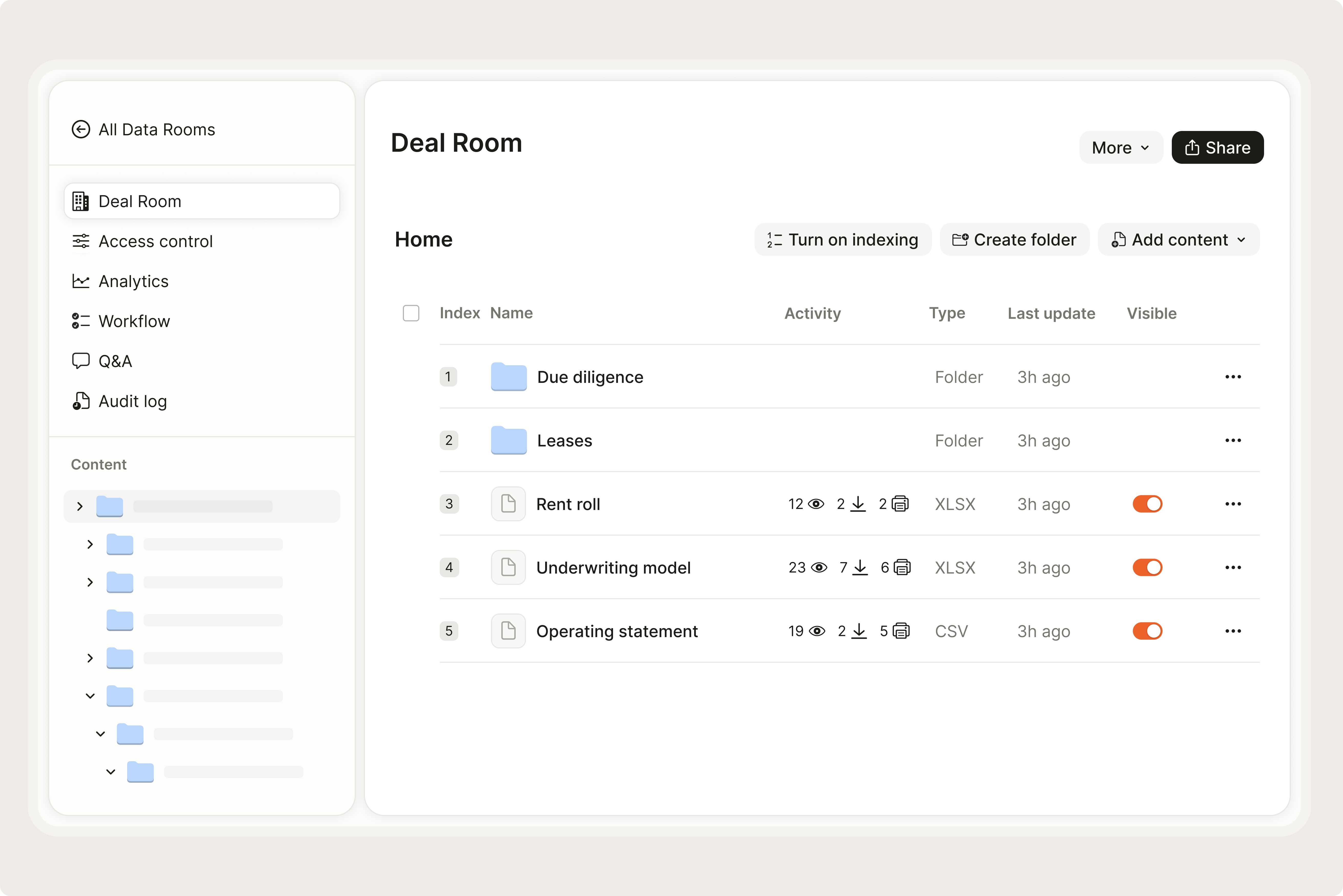
- 1.Upload Thailand property files to a secure roomDrop Chanote title document, Department of Lands title search, structure legal opinion, BOI promotion certificate, building permit, occupancy certificate, EIA approval, PCD contamination records, Phase I ESA, registered lease agreement, and commercial lease pack into Ellty.
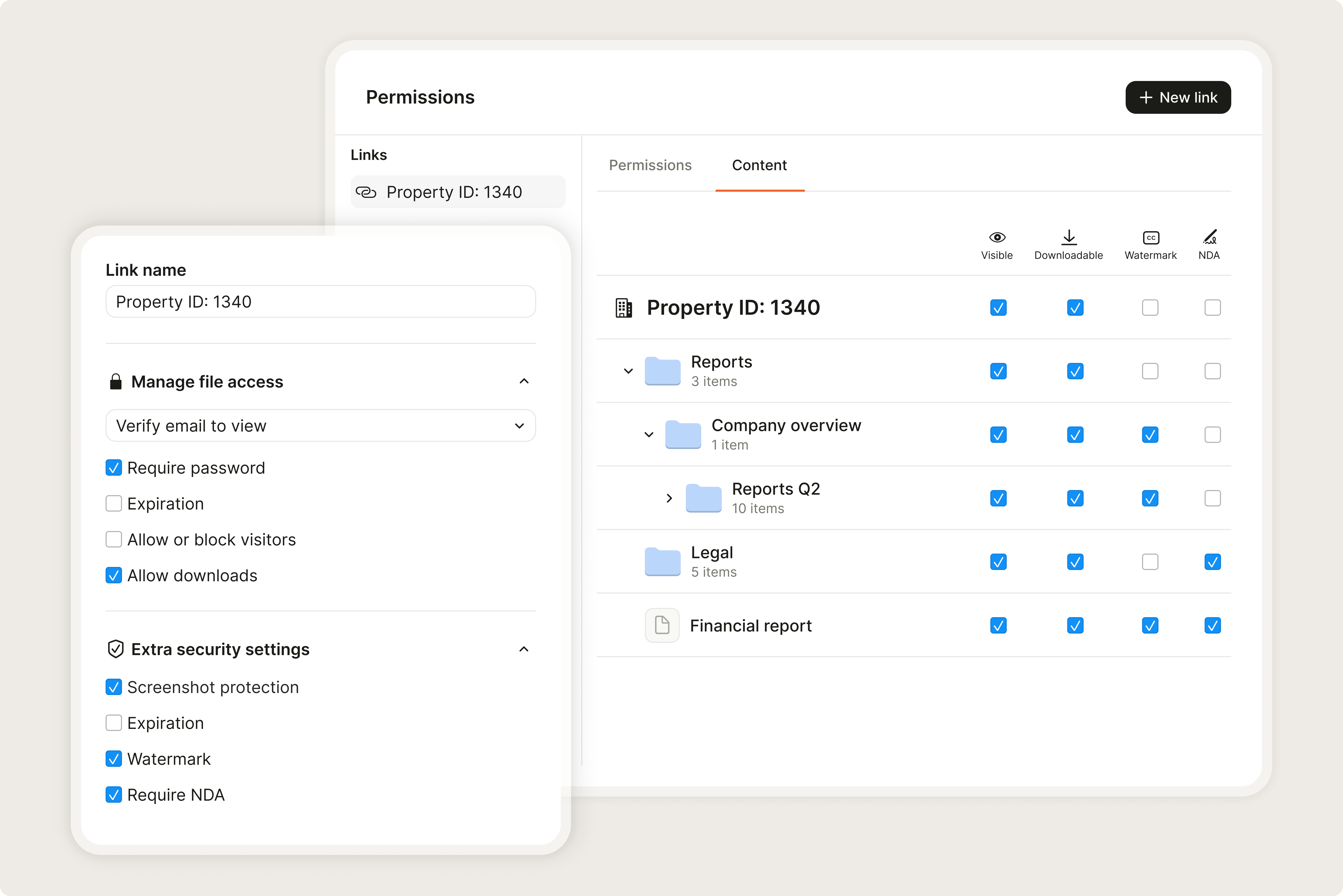
- 2.Give each advisor a scoped, tracked linkThai real estate attorney sees Chanote, encumbrance search, and structure documents. BOI specialist sees promotion certificate. Building inspector sees building permit and occupancy certificate. Environmental consultant sees PCD and EIA records. Lender sees title, structure legal opinion, and valuation.
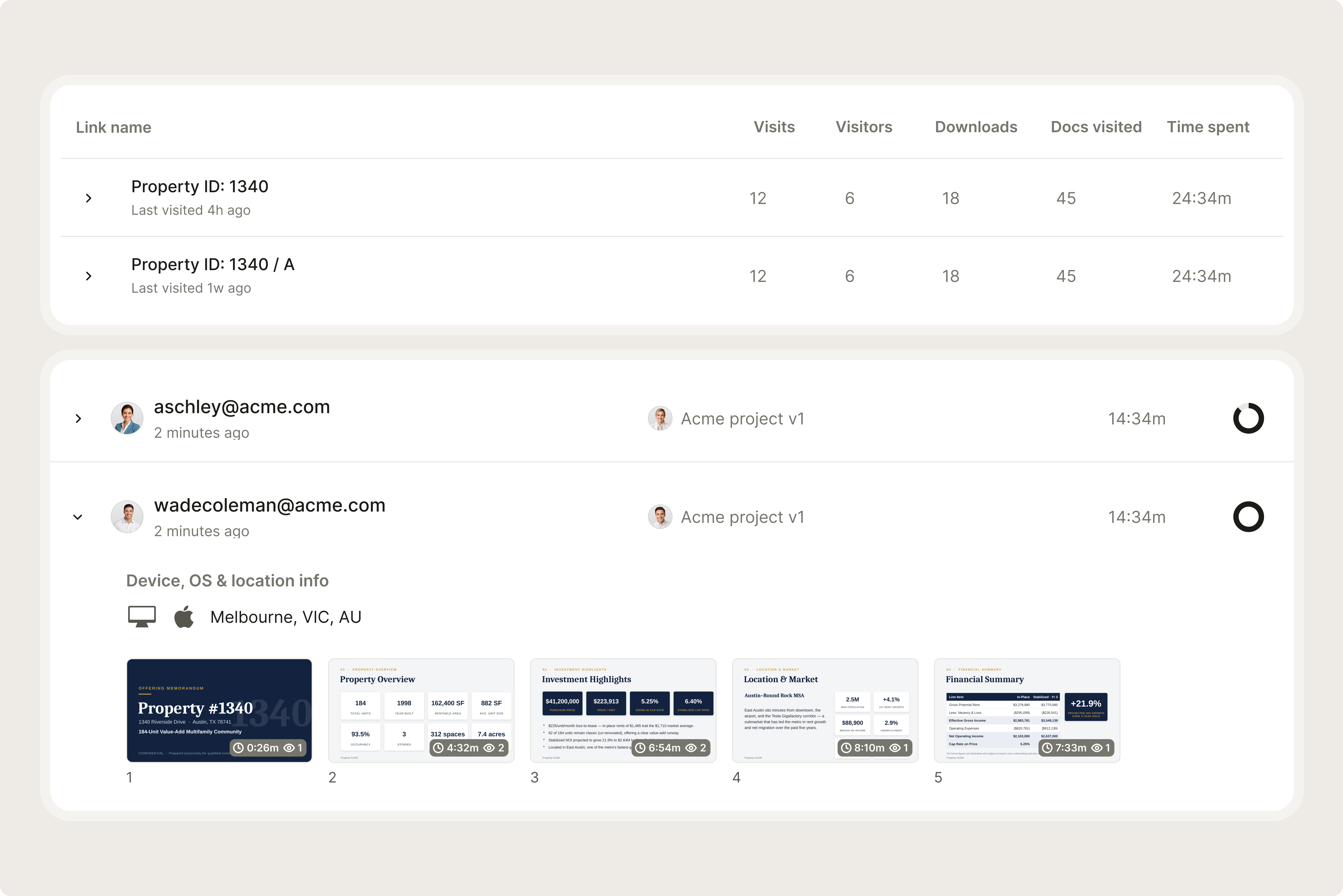
- 3.Monitor who reviews which documentsSee exactly which files each advisor opened and when. Catch structure legal issues or building permit gaps before they affect deal pricing or closing.
What makes Thailand different
Thailand's foreign land ownership prohibition under the Land Code is not a technical rule that can be easily worked around; it is a fundamental restriction that shapes every commercial real estate acquisition by a foreign investor in Thailand. The Thai majority company structure (51% Thai shareholders, 49% foreign) is legally permitted but operationally fragile: if the Thai shareholders are nominees (holding shares for the foreign investor's benefit with no genuine independent economic interest), the arrangement is illegal under both the Foreign Business Act and the Land Code, and both the Department of Land and the Department of Business Development actively investigate and dismantle nominee structures. A nominee structure that was established years ago and has operated without enforcement action is not a safe acquisition target - it remains illegal and the enforcement risk transfers to a buyer. Require a specific written legal opinion from independent Thai real estate counsel before completing any acquisition of land held through a Thai company structure; the opinion must address the specific Thai shareholders' circumstances, capital contribution records, and the overall structure's defensibility under current Thai enforcement practice.
The 2011 Thailand floods were the most extensive flooding event in Thailand in 70 years and the fourth costliest natural disaster in world history at the time. The flooding was triggered by unusually heavy monsoon rains that overwhelmed the Chao Phraya River catchment; approximately 13.6 million people were affected across 65 provinces; economic damage exceeded USD 45 billion. The flooding was particularly severe in the industrial estates of Ayutthaya, Pathum Thani, and Nonthaburi - major manufacturing zones where Japanese and other foreign manufacturers operated large facilities. Bangkok's inner core was largely protected by the ring dike system, but Bangkok's northern suburbs (Don Mueang, Lak Si, Bang Khen) and large areas of Pathum Thani province were inundated for weeks. Commercial buyers of Bangkok suburban, Central Thai, or Ayutthaya commercial property should specifically map the target parcel against 2011 flood inundation records from the Bangkok Metropolitan Administration and Royal Irrigation Department. Thailand's flood management infrastructure has been upgraded since 2011, but the underlying hydrology has not changed and flooding in the Chao Phraya basin remains an active CRE risk.
The Chanote verification process - checking the Chanote document authenticity at the Provincial Lands Office and conducting a same-day title search at closing - is a standard step in Thai real estate practice that has no equivalent in many developed markets. In most Western jurisdictions, title examination is done through a lawyer reviewing a government database weeks before closing, with title insurance as the backstop. In Thailand, the relevant authority is the Department of Lands office in the relevant province, and the official record of encumbrances is the back of the physical Chanote document that must be confirmed in real time at the Lands Office. Conducting the title search weeks before closing is insufficient; encumbrances can be registered at any time between the search and the transfer. Thai practice is to conduct the final search on the day of transfer and complete the transfer registration at the same Lands Office appointment. This same-day procedure is not a formality - it is the primary fraud and encumbrance protection mechanism in Thai property law.
Under Section 86 of the Thai Land Code (ประมวลกฎหมายที่ดิน, Pramual Kotmai Thi Din), aliens are generally prohibited from acquiring land in Thailand, with limited exceptions including acquisition through a valid last will as legatee and certain treaty rights. Section 97 of the Land Code further limits land ownership by Thai juristic persons (companies) in which foreigners hold majority shares. The Foreign Business Act B.E. 2542 (1999) separately restricts foreign participation in certain businesses including, in some interpretations, land-holding activities if used as a business mechanism. The Department of Land and the Department of Business Development conduct periodic reviews of company structures used to hold land to identify nominee arrangements where Thai shareholders hold shares for the benefit of foreign investors; such arrangements are subject to revocation orders and criminal prosecution. Board of Investment (BOI) promotional certificates under the Investment Promotion Act B.E. 2520 (1977) can grant foreign investors rights to own land for BOI-promoted business activities.
Timeline and cost in Thailand
Weeks 1-2 cover kickoff: initiate official title search at Provincial Lands Office, request Chanote document, commission Thai counsel legal opinion on ownership structure (if foreign buyer), building permit and occupancy certificate request, BOI promotion status confirmation (if applicable), Phase I ESA commission, PCD/IEAT database check, Bangkok city plan zone confirmation, lease abstraction, AML/KYC, and Bank of Thailand FX clearance assessment. Legal fees in this phase: USD 5,000-20,000.
Load all files into Ellty before advisors engage. Standard Thailand commercial: 45-90 days. BOI promotion clearance: 2-6 weeks. EIA approval confirmation: 2-4 weeks for existing developments.
Weeks 2-6 cover deep review: Chanote authenticity verification, full encumbrance search, structure legal opinion delivery, building permit vs. as-built comparison, occupancy certificate status, Phase I ESA delivery, PCD contamination records, flood exposure assessment, zone compliance confirmation, SBT/stamp duty analysis, lease registration status, withholding tax calculation, and lender pre-approval process. Costs in this phase: USD 10,000-30,000.
Weeks 6-12 handle resolution: structure remediation (if nominee issues identified), mortgage releases, lease registration (if required), EIA compliance confirmation, flood risk mitigation measures, transfer tax payment at Lands Office, and closing at Provincial Lands Office.
Thailand total transaction costs for commercial ownership transfer: 2% transfer fee (assessed value, typically split 50/50) + 3.3% SBT or 0.5% stamp duty + withholding tax (1% for corporate sellers). For a Thai company-to-Thai company transfer of commercial property assessed at 100 million THB, typical transaction tax burden: 2% + 3.3% + 1% = approximately 6.3% of assessed value (noting assessed value is typically 50-80% of market value). Thai attorney fees, due diligence, and advisory fees add 1-3% of transaction value.
Running a Thailand property deal from one room
Hold Chanote title, structure docs, BOI records, building permits, and lease files in one secure, tracked Ellty data room.
Start free 14-day trialCommon questions about due diligence on Thailand commercial property
- Standard Thailand commercial deals take 45-90 days. Thai counsel legal opinion on foreign ownership structure: 1-3 weeks. Chanote verification at Provincial Lands Office: 1-2 weeks for official title search. BOI promotion status confirmation: 2-6 weeks. EIA approval review (for large commercial): 2-4 weeks. Lease registration (if commercial lease needs to be registered): 1-2 weeks at Provincial Lands Office. Bank of Thailand FX approval assessment for cross-border: 2-4 weeks.
- Foreigners cannot own land in Thailand under the Land Code. Common structures: (1) Thai majority company (51% Thai shareholders): legal only if Thai shareholders are genuine investors, not nominees; nominee structures are illegal and investigated; (2) 30-year registered leasehold: valid and binding on future purchasers if registered at Department of Lands; contractual renewal for additional periods is not guaranteed as a property right; (3) BOI promotion: grants limited land ownership rights for specific promoted business activities. All foreign structures require a specific written legal opinion from Thai real estate counsel before any deposit. Condominium units can be owned freehold (up to 49% foreign in any one building).
- A Chanote (Nor Sor 4 Jor) is the highest category of Thai land title document - GPS-surveyed with precisely defined boundaries, fully transferable, and mortgageable. It is the only commercially acceptable title for a significant commercial acquisition or for securing bank financing. Lesser documents (Nor Sor 3 Gor, Nor Sor 3, Por Bor Tor 5, etc.) are possession certificates or less precisely defined usage rights. Always verify the Chanote's authenticity at the Provincial Lands Office and conduct an official encumbrance search at the Lands Office on the day of transfer - encumbrances can be registered between an early title search and the closing date.
- Thailand commercial property transfer costs: (1) Transfer fee: 2% of Lands Department assessed value, split 50/50 by custom; (2) Specific Business Tax (SBT): 3.3% of the higher of assessed or transaction value; applies if the seller is any company (regardless of holding period) or an individual who has held under 5 years; (3) Stamp duty: 0.5% of assessed value, applies only to individual sellers who have held over 5 years and SBT doesn't apply; (4) Withholding tax: 1% of assessed value for corporate sellers; graduated scale for individuals. Total: approximately 5-6% for company-to-company transfers; 3-4% for long-hold individual sellers.
- The 2011 Thailand floods were the most extensive in 70 years, inundating approximately one-third of Thailand's provinces, causing over USD 45 billion in economic damage, and severely affecting industrial estates in Ayutthaya, Pathum Thani, and northern Bangkok suburbs. Bangkok's inner core was protected by the ring dike system, but northern suburbs (Don Mueang, Lak Si, Bang Khen) and large areas of Pathum Thani flooded. For any Bangkok suburban, Central Thai, or Ayutthaya commercial: map the target parcel against 2011 flood inundation records from the Bangkok Metropolitan Administration and Royal Irrigation Department before finalizing the bid.
- Thailand requires an Environmental Impact Assessment (EIA) approved by the Office of Natural Resources and Environmental Policy and Planning (ONEP) before construction of: buildings over 10,000 sqm, hotels over 80 rooms, condominiums over 8,000 sqm, large retail complexes, industrial facilities, and other specified development categories. Development commenced without required EIA approval is illegal and can be ordered stopped or demolished. For any Thailand commercial acquisition: confirm EIA approval was obtained before construction commenced, that the EIA covers the as-built scope, and that any EIA compliance conditions have been met.