French deals require more process than most buyers expect. CSE consultation for companies above 50 staff, FDI authorization in strategic sectors, and SARL transfer tax each need planning before you send the request list.
France's company registry (Registre du Commerce et des Sociétés - RCS) gives you corporate basics via a Kbis extract in hours. What it doesn't give you is the CSE consultation status, the French tax audit history, or the FDI authorization requirement in regulated sectors.
A mid-market French deal generates 3,000-20,000 documents. Set up an Ellty data room before the request list arrives and advisors can start reviewing on day one.
The biggest French deal trap is timing. CSE works council consultation is mandatory before you announce - not after - and it adds 4-6 weeks to any deal schedule if the target has 50 or more employees.
The France due diligence checklist
Not every check carries the same weight. CSE consultation and FDI authorization are binary - miss either and the deal timeline or structure breaks.
Read the vendor due diligence guide to scope the seller-side workstreams before the request list goes out.
Load all workstreams into Ellty before you issue the request list. Each advisor gets a scoped link and starts the moment access opens.
| Area | Documents to pull | France red flag | Tier | |
|---|---|---|---|---|
| Corporate & legal | Corporate & legal | Kbis extract, statuts, shareholder agreements, board minutes, promises-to-sell | Undisclosed promesses de cession or SHA pre-emption rights blocking the deal | Dealbreaker |
| CSE consultation | CSE consultation | CSE information notice, consultation minutes, union correspondence | Deal announced before CSE informed - voids the process and risks legal challenge | Dealbreaker |
| Financial | Financial | 3y French GAAP accounts, management accounts, bank statements, PCG bridge | PCG deferred charges or provisions that mask recurring losses in French accounts | Dealbreaker |
| Tax | Tax | Corporate tax returns, vérification de comptabilité, transfer pricing docs | Open vérification de comptabilité or undocumented intercompany transactions | Dealbreaker |
| Employment & labor | Employment & labor | Employment contracts, collective agreements, URSSAF records, payroll audits | URSSAF underpayments or Inspection du Travail violations affecting key staff | Price-adjuster |
| FDI screening | FDI screening | DG Trésor sector mapping, FDI authorization filing, ownership chain docs | Target in defence, energy, or health - DG Trésor authorization required at 10%+ | Dealbreaker |
| IP | IP | INPI filings, patent and trade mark certificates, licence agreements | IP registered at INPI in founder's name rather than the company entity | Price-adjuster |
| Material contracts | Material contracts | Customer and supplier contracts, government cahiers des charges, change-of-control clauses | French public contracts with assignment restrictions requiring ministerial consent | Price-adjuster |
| Real estate & environmental | Real estate & environmental | Title deeds, bail commercial terms, ICPE licences, pollution site registers | ICPE classified industrial site with environmental remediation obligations | Standard check |
| Data protection & IT | Data protection & IT | GDPR ROPA, DPO appointment, breach register, CNIL correspondence | Undisclosed CNIL investigations or data incidents not reported within 72 hours | Standard check |
Running due diligence on a French target?
Set up your data room before the CSE consultation starts.
Start free 14-day trialThe full France due diligence checklist
Ten workstreams, ordered by risk. France-specific mechanics - CSE consultation, FDI authorization, SARL transfer tax, and PCG accounting - sit across multiple areas and must be scoped from day one.
Upload each document category to Ellty as you collect it. Parallel review across advisors compresses the overall timeline. See our due diligence documents guide for the full upload checklist.
Corporate & legal
- Pull the Kbis extract from the Registre du Commerce et des Sociétés (RCS) for the target and all material subsidiaries - confirms directors, registered capital, and registered pledges.
- Obtain the statuts (articles of association) and all amendments; French statuts frequently lag behind actual shareholder arrangements documented separately in a pacte d'actionnaires.
- Review the shareholder agreement (pacte d'actionnaires) and any promises-to-sell (promesses de cession) or pre-emption rights that could block or delay the deal.
- Confirm no judicial reorganisation (redressement judiciaire) or liquidation proceedings registered at the Tribunal de Commerce for the target.
- Check the beneficial owner register (Registre des bénéficiaires effectifs) for all parties holding more than 25% of capital or voting rights.
CSE consultation
- Map whether the target has an active Comité Social et Économique (CSE): mandatory for companies above 50 employees in France.
- If a CSE exists, the employer must inform and consult it before any public announcement of the acquisition - skipping this step invalidates the process under French labour law.
- Build 4-6 weeks for the CSE information and consultation process into the deal schedule before signing heads of terms.
- For asset deals or site closures, the Loi Florange requires a 2-month employee offer period if staff want to table a counter-bid for the business.
- Review all existing union agreements (accords collectifs) and confirm which ones survive a change of control.
Financial
- Pull 3 years of French GAAP accounts (comptes annuels under Plan Comptable Général) filed at the Greffe du Tribunal de Commerce; PCG allows deferred charge treatment that can mask recurring costs.
- Commission a quality of earnings report or an IFRS bridge for any deal above €5M - PCG-to-IFRS adjustments are often material and always buyer-unfavorable.
- Review management accounts for the most recent interim period and reconcile to the last statutory accounts.
- Map all intercompany loans and related-party transactions; French owner-managed companies frequently carry related-party balances at non-arm's-length terms.
- See our guide on commercial due diligence for how to complement financial review with market position analysis.
Tax
- Pull 3 years of corporate income tax returns (liasses fiscales) and all vérification de comptabilité correspondence from the Direction Générale des Finances Publiques (DGFiP).
- Confirm the applicable SARL transfer tax: 3% on the net consideration above the €23K annual deduction threshold, or 0.1% for SA/SAS share transfers.
- Review transfer pricing documentation for any intragroup transactions; French tax law requires annual TP declarations and documentation for cross-border dealings.
- Check for any open tax rectification proposals (proposition de rectification) or contested assessments; French tax audits can cover 3 years and open liabilities transfer in a share deal.
- Analyse the CVAE (phased out but partially remaining) and CFE business tax position for the target's operating sites.
Employment & labor
- Obtain a full headcount list with CDI (permanent) and CDD (fixed-term) contracts; French CDI contracts are difficult and costly to terminate post-acquisition.
- Pull URSSAF social contribution records for the last 3 years to confirm no underpayments or open recovery notices.
- Review any Inspection du Travail correspondence, health and safety violations, or open labour court (Conseil de Prud'hommes) claims.
- Confirm the applicable industry-level collective agreement (convention collective) and map company-level accords that add obligations beyond the branch agreement.
- Check for any profit-sharing plans (intéressement, participation) that create contingent liabilities triggered by a change of ownership.
Regulatory & licences
- Map all AMF (Autorité des marchés financiers) authorisations for financial services targets and confirm whether a change-of-control notification is required before closing.
- Review sector-specific licences - ARCEP for telecoms, CRE for energy, ARS for health - and confirm each survives a share deal or requires re-approval.
- Check for any open proceedings with the DGCCRF (competition and consumer protection) or sector regulators in the last 3 years.
- Confirm that public service delegation contracts (DSP) and government concessions are either assignable or survive a share deal without requiring additional approval.
FDI screening
- Assess whether the target falls under France's FDI screening regime (R151-2 et seq. of the French Monetary and Financial Code); the DG Trésor reviews foreign acquisitions in sensitive sectors.
- Key sensitive sectors requiring prior authorization: defence, dual-use technologies, healthcare products, food security, energy infrastructure, telecoms, and water management.
- Thresholds: 10% for acquisitions of listed companies; 25% for unlisted companies in sensitive sectors.
- Build 2-3 months for DG Trésor authorization into the deal schedule; the French government can impose conditions or block acquisitions in regulated sectors.
- Prepare a full beneficial ownership disclosure of the acquirer; DG Trésor requires the complete ownership chain to the ultimate beneficial owner.
IP
- Pull searches at the INPI (Institut National de la Propriété Industrielle) for all patents, trade marks, and registered designs in the target's name.
- Confirm all IP is owned by the company entity, not by founders, shareholders, or employees; assignment gaps are common in French startups and family businesses.
- Review software licence agreements for open source compliance and GPL licence obligations; recurring in French digital and SaaS businesses.
- Check for any INPI oppositions, IP cancellation proceedings, or infringement claims in the last 5 years.
Material contracts
- Pull the top 10 customer and supplier contracts and review for change-of-control clauses, assignment restrictions, and automatic termination rights triggered by the deal.
- Check any government concession contracts or cahiers des charges for public sector assignments; French public contracts require ministerial or agency consent before transfer.
- Review all bank financing agreements (conventions de crédit) for change-of-control triggers and lender consent requirements at closing.
- Confirm exclusivity arrangements, franchise agreements, and distribution contracts that are material to the business model survive a change of ownership.
Real estate & environmental
- Pull the bail commercial (commercial lease) for each operating site and confirm change-of-control provisions and landlord consent requirements.
- Review all ICPE (Installation Classée pour la Protection de l'Environnement) licences for industrial and manufacturing sites; classified site obligations transfer with the business.
- Check the BASOL and BASIAS databases for any pollution site history; French environmental liability can follow the operator of a classified installation.
- Confirm property tax (taxe foncière) payments are current and that no environmental remediation orders are registered against the target's sites.
Data protection & IT
- Obtain the target's GDPR compliance documentation: records of processing activities (registre de traitement), DPO appointment records, and data breach register.
- Review any CNIL correspondence, enforcement notices (mises en demeure), or open investigations in the last 3 years; CNIL fines under GDPR can reach €20M or 4% of global turnover.
- Confirm that data transfers outside the EU/EEA are covered by adequacy decisions or standard contractual clauses under GDPR Article 46.
- Review IT infrastructure for legacy systems, software licence compliance, and cybersecurity audit reports for the last 2 years.
How due diligence in France works
The due diligence timeline for a French deal is longer than buyers from common-law jurisdictions expect. CSE consultation adds a mandatory procedural track that runs alongside - and before - the commercial process.
Step 1: Scope
Define the workstream scope and confirm the CSE consultation obligation before any documents move. For targets with 50 or more employees in France, the CSE must be informed and consulted before any public announcement. Build this into the deal schedule from the start. Set up Ellty before the request list goes out.
Step 2: Request
Issue the request list within 48 hours of NDA signing. French sellers expect structured requests. Load Kbis extracts, liasses fiscales, and labour documents into Ellty before the list arrives. Give each workstream its own scoped link so advisors can start reviewing without waiting for batched uploads.
Step 3: Review
Legal, financial, and tax workstreams run in parallel. The CSE consultation track runs on its own timeline (typically 4-6 weeks) alongside the commercial review. Use Ellty's analytics to track which advisors have opened which documents so you know where review is lagging before it affects the deal schedule.
Step 4: Flag
All findings go into a risk register: dealbreaker, price-adjuster, or standard check. In French deals, PCG-to-IFRS adjustments, open vérification de comptabilité, and URSSAF underpayments cluster as price-adjusters. CSE compliance failures and FDI authorization requirements are binary dealbreakers or deal restructuring triggers.
Step 5: Resolve
French SPA negotiations use indemnities for identified tax liabilities, R&W insurance (well-developed in France through French and international brokers), and earn-out structures for valuation gaps. DG Trésor FDI authorization typically takes 2-3 months from a complete filing; build it into the schedule before signing.
France's CSE consultation requirement is not a formality. Announcing a deal before the works council is informed invalidates the process and exposes both parties to legal challenge.
What makes France DD different
CSE consultation is mandatory and comes first. French companies with 50 or more employees must have a Comité Social et Économique. Before any public announcement of an acquisition, the employer must inform and consult the CSE - failing to do so is a criminal offence and gives unions grounds to invalidate the announcement. Most French deals build 4-6 weeks of CSE process into the schedule before signing. Buyers from common-law jurisdictions consistently underestimate this.
PCG accounting masks real performance. French GAAP (Plan Comptable Général) allows companies to capitalise and amortise certain charges as deferred assets, creating a gap between reported results and economic reality. Book profits on a French target under PCG often look better than an IFRS or QoE analysis would show. Commission a PCG-to-IFRS bridge for any deal above €5M - it almost always adjusts the price.
FDI authorization in strategic sectors. France has one of the most active FDI screening regimes in Europe. The DG Trésor can review foreign acquisitions at 10% for listed companies and 25% for unlisted targets in sensitive sectors including defence, health, telecoms, energy, and food security. The regime was significantly extended in 2020 and further tightened in 2023. A deal closed without the required authorization can be unwound, with fines of up to 10% of the acquisition price.
SARL vs SA/SAS transfer tax. The entity structure determines the transfer tax cost. SARL shares attract 3% transfer tax on the net consideration (after the annual €23K deduction per seller). SA and SAS shares attract only 0.1% - a significant difference on deals above €1M that sometimes drives pre-deal reorganisation into a SAS structure. Confirm the structure early and factor it into the deal economics.
Who runs due diligence on France deals
French deals use French and international law firms, Big 4 advisory, and specialist French tax and labour counsel.
Legal counsel: Freshfields, Linklaters, and CMS lead on large French deals. French mid-market firms Gide, Darrois, and Jeantet cover €5M-€100M transactions well. Budget €80K-€350K for buy-side legal diligence depending on deal size and complexity.
Financial and tax advisory: Big 4 (EY, Deloitte, KPMG, PwC) cover QoE and tax. French mid-market advisory firms are often faster and cheaper for regional targets. Budget €50K-€180K combined for financial and tax diligence on a mid-market French deal.
Labour and CSE specialists: Any target with an active CSE needs dedicated French labour counsel. Budget €20K-€60K for CSE process management and employment due diligence.
Set up one shared Ellty data room and give each advisor a scoped link. No emails, no version confusion, and you can track exactly who has opened the URSSAF records, the liasse fiscale, and the CSE minutes before the management meeting. Our due diligence for investors guide covers how buy-side teams structure French deal risk.
How to set up your France data room in Ellty.
Load your France deal documents before review starts. Each advisor gets a scoped link with access only to what they need.
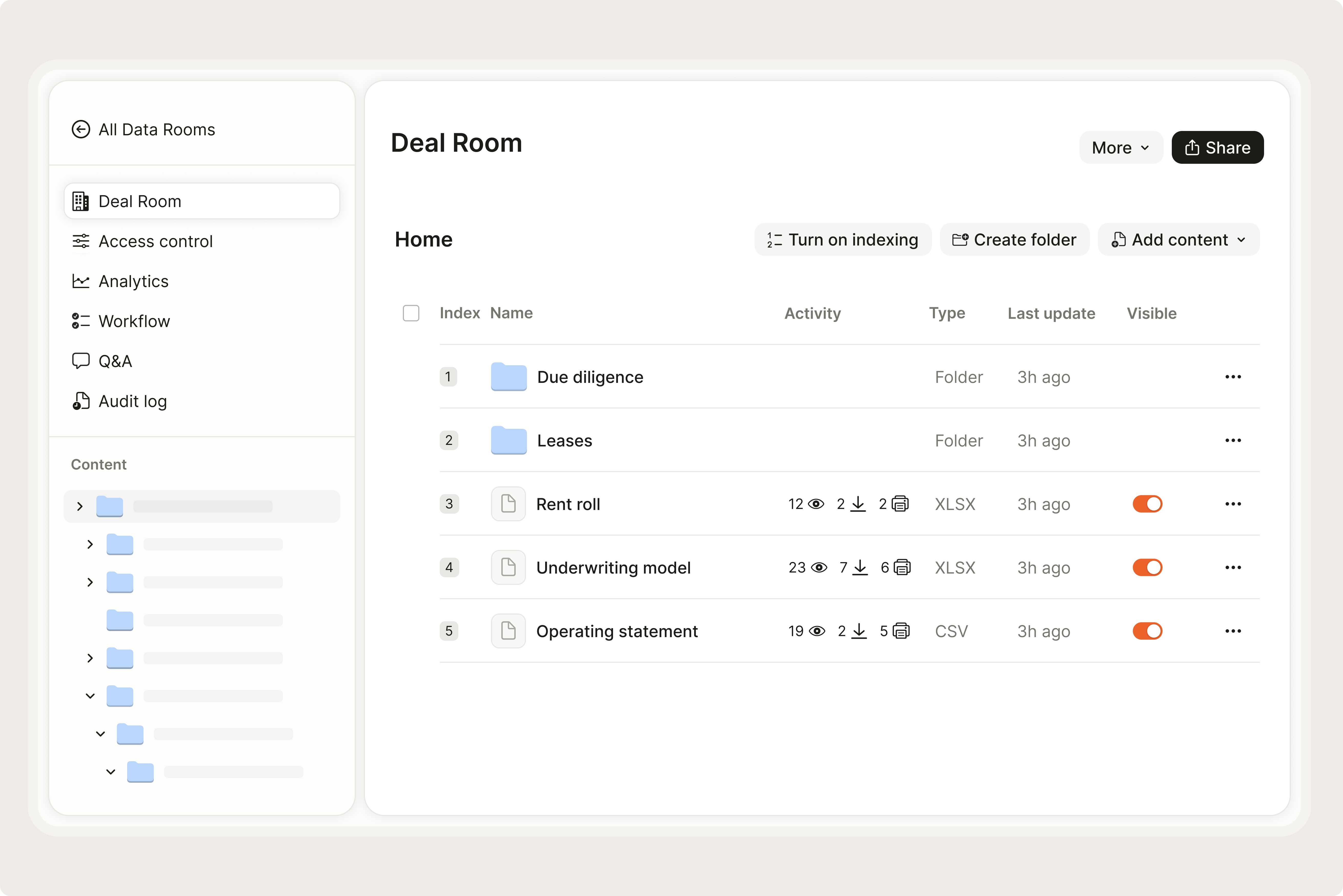
- 1.Create a data room and upload your deal docsUpload Kbis extracts, liasses fiscales, and labour docs. Organise by workstream so advisors find files fast.
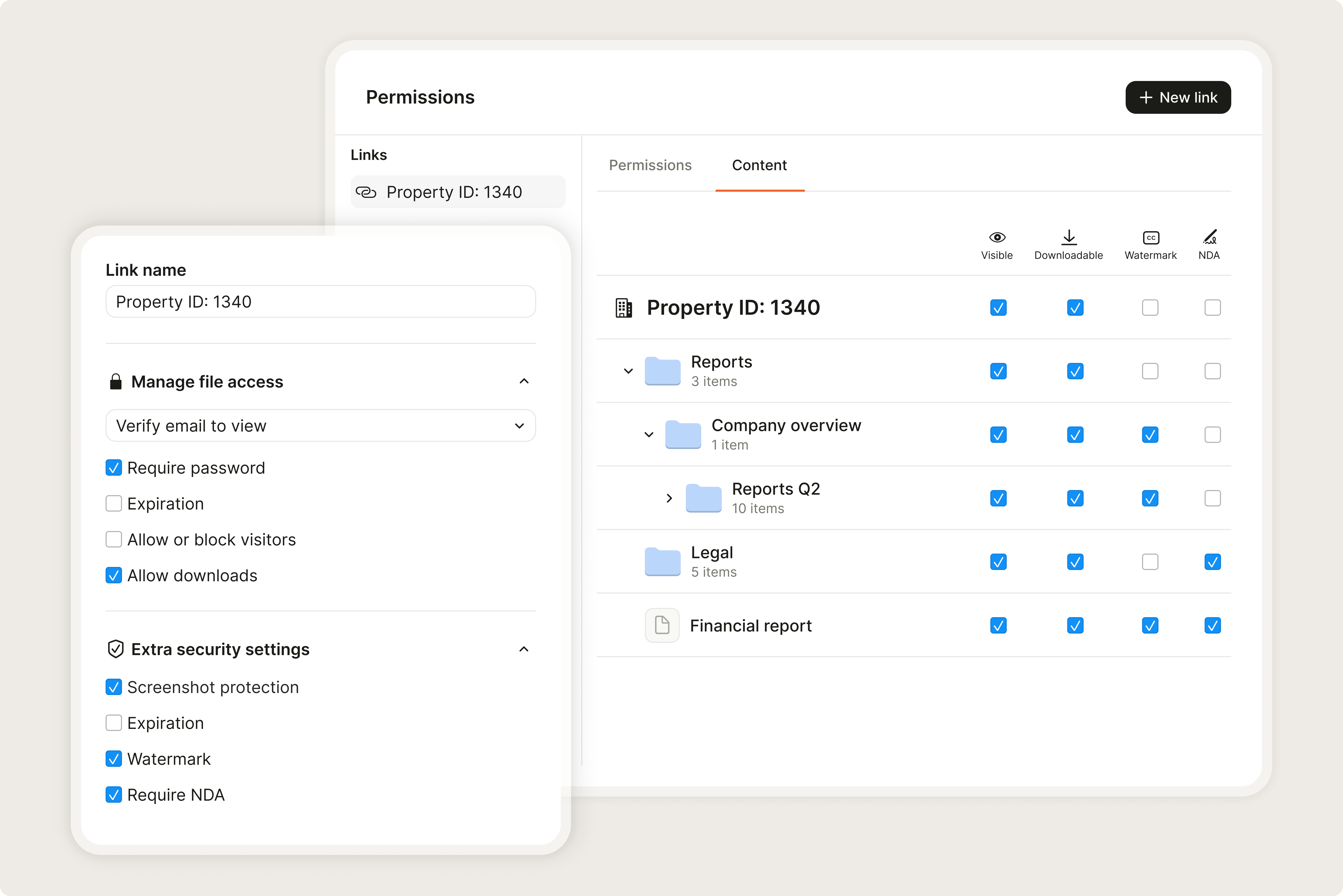
- 2.Give each workstream a scoped, secure linkLegal sees contracts and FDI docs in their own folder. Tax sees returns and PCG accounts only.
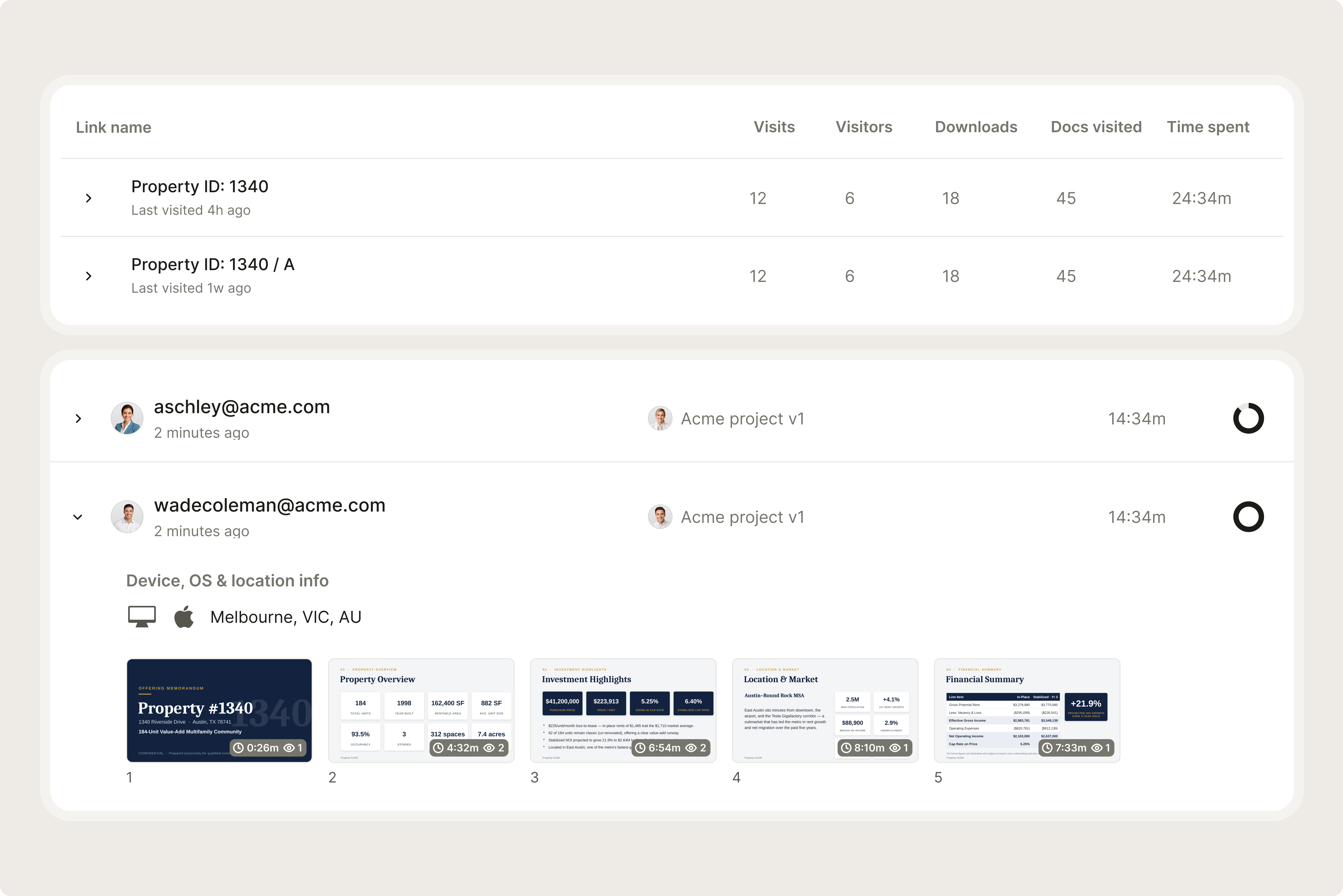
- 3.Track who reviews which documentsSee which advisor opened the CSE documentation six times. Follow up before it becomes a flag in the report.
Due diligence timeline for France deals
A standard French buy-side process runs 6-10 weeks from NDA to final report, plus 4-6 weeks for CSE consultation running in parallel from the start.
Weeks 1-2: NDA signed, Kbis extracts pulled, request list issued. CSE consultation initiated immediately. FDI authorization assessment completed. Ellty data room live with scoped advisor links by workstream.
Weeks 2-4: Financial, legal, and tax reviews run in parallel. URSSAF and labour compliance checks completed. PCG-to-IFRS bridge analysis started. CSE consultation continues on its own track.
Weeks 4-6: CSE delivers its opinion (typically at week 4-6). Preliminary findings memos circulated. FDI authorization filed with DG Trésor if required. Price-adjuster negotiations begin.
Weeks 6-8: Management Q&A sessions. SPA negotiation on representations, warranties, and indemnities. DG Trésor review runs in background (typically 2-3 months from complete filing).
Weeks 8-10: Final reports issued. R&W insurance bound if applicable. DG Trésor clearance awaited if FDI authorization required for closing.
What due diligence costs in France
Legal: €80K-€350K depending on deal size and firm tier.
Financial and tax: €50K-€180K for a mid-market target.
Labour and CSE specialists: €20K-€60K for CSE process management and employment review.
Environmental: €15K-€50K if ICPE classified sites are involved.
SARL transfer tax: 3% on net consideration above the €23K threshold; SA/SAS: 0.1% on consideration.
Total advisor spend on a €20M-€100M French deal lands between €200K and €550K before success fees. That's cheaper than discovering a €3M open vérification de comptabilité or a CSE procedural violation post-closing.
Run your France deal from one room
Hold financials, CSE docs and the SPA in one secure, tracked Ellty data room.
Start free 14-day trialCommon questions about due diligence in France
- Yes - for companies with 50 or more employees, the CSE must be informed and consulted before any public announcement. Skipping this is a criminal offence that can invalidate the deal announcement and expose both parties to legal challenge.
- SARL shares attract 3% transfer tax on the net consideration above the €23K annual deduction per seller. SA and SAS shares attract only 0.1% - the entity structure materially affects the cost of a French acquisition.
- DG Trésor authorization is required for foreign acquisitions above 10% in listed companies and above 25% in unlisted companies in sensitive sectors including defence, health, telecoms, energy, and food security. Filing is required before closing.
- Phase 1 review takes up to 25 working days from a complete filing. Phase 2 - triggered when Phase 1 is inconclusive - adds up to 65 working days. Build both phases into the deal schedule for any deal in a concentrated French market.
- Yes. Ellty is a virtual data room built for M&A diligence. Upload documents, create scoped links per advisor workstream, and track who reviews which files in real time - including CSE documents and FDI filings.