
When a company buys another business, invests in a startup, or signs a major licensing deal, one of the most overlooked parts of the process is checking the intellectual property. Not checking bank accounts, not reviewing contracts, but actually digging into the patents, trademarks, copyrights, and trade secrets that the business depends on.
This is what IP due diligence is about, and skipping it, or doing it poorly, can turn a promising deal into a costly mess.
In this guide, we will walk through what IP due diligence actually means, why it matters, what the process looks like step by step, and what risks you need to watch out for. We will also give you a practical checklist to use on your next deal and explain how a virtual data room like Ellty makes the whole process faster and more secure.
What is IP due diligence?
IP due diligence is the process of reviewing and verifying the intellectual property assets owned or used by a company, usually before a transaction like an acquisition, merger, investment, or licensing deal.
Think of it this way. If you are buying a bakery, you would want to check that the owner actually owns the building, the equipment, and the recipes. IP due diligence is essentially that same check, but for intangible assets: the patents that protect inventions, the trademarks that protect brand identity, the copyrights that protect creative works, and the trade secrets that keep competitive advantages private.
IP due diligence answers questions like:
- Does the company actually own the IP it claims to own?
- Is any of it at risk of being challenged or invalidated?
- Are there licenses or agreements that restrict how the IP can be used?
- Could any IP infringe on the rights of a third party?
Without this review, buyers, investors, and partners are essentially guessing. And in IP, guessing can be expensive.
Why IP due diligence is critical in transactions
In many industries today, a company's IP is its most valuable asset. A pharmaceutical company's entire value might sit in a handful of patents. A software company's worth may depend entirely on proprietary code. A consumer brand's strength is often tied to its trademarks.
When you enter a transaction involving one of these businesses, the IP position is not just a detail. It is the deal itself.
Here are some of the biggest reasons IP due diligence cannot be treated as an afterthought:
Hidden liabilities can surface after closing. If a patent is found to be unenforceable, or if a software product turns out to include unlicensed open-source code, the buyer inherits that problem. Post-closing surprises like these can lead to litigation, forced licensing fees, or product shutdowns.
Ownership is not always clean. Just because a company says it owns its IP does not make it true. Founders who built technology before forming the company, employees who signed unclear assignment agreements, contractors who never transferred rights, all of these create gaps in ownership that only a proper review can catch.
IP affects deal valuation. A patent portfolio that looks strong on the surface might be weak in practice if key patents are expiring, are being challenged, or are tied up in litigation. Understanding this changes what the IP is actually worth.
Regulatory and compliance issues. In some sectors, IP due diligence is not optional. Regulated industries like pharma, defense, and fintech often require documented IP reviews as part of compliance.


Goals of IP due diligence
Before you start reviewing documents, it helps to be clear on what you are trying to achieve. The goals of IP due diligence usually fall into these categories:
Verify ownership and title.
Confirm that the company legally owns the IP it claims to own, with proper assignments and registrations in place.
Assess scope and strength.
Understand what the IP actually covers, how broad or narrow it is, and how defensible it would be in a dispute.
Identify encumbrances and restrictions.
Check whether any IP is licensed out, pledged as collateral, subject to co-ownership, or otherwise restricted in ways that affect the deal.
Uncover third-party risks.
Find out if any IP could be infringing on someone else's rights, or if there are pending disputes or challenges.
Evaluate commercial value.
Understand whether the IP actually supports the business model and generates value, or whether it is sitting unused on paper.
Support deal negotiations.
The findings from IP due diligence directly inform deal terms, pricing, representations, warranties, and indemnification clauses.
Steps in the IP due diligence process
IP due diligence is not a single task. It is a structured process with several stages, each building on the last.
Step 1: Scope the review
Start by agreeing on the scope. What transaction are you doing? What types of IP are most relevant to the business? How deep does the review need to go? For a seed-stage investment, the review might be lighter. For a full acquisition of a technology company, it needs to be thorough.
Step 2: Request an IP inventory
Ask the company to produce a complete inventory of all IP assets. This should include registered IP (patents, trademarks, domain names, registered designs), unregistered IP (trade secrets, copyright works, know-how), and all agreements related to IP (licenses, assignments, co-development agreements, NDAs).
Step 3: Organize documents in a secure data room
Once you have an inventory, the actual documents need to be collected and made available for review. This is where a virtual data room becomes essential. Rather than emailing sensitive documents back and forth, a platform like Ellty lets you centralize everything in one place with full access controls, so only the right people can see the right files.


Step 4: Verify registrations and ownership records
Check public registries to confirm that registered IP (patents, trademarks) is actually in the company's name, is in good standing, and has no gaps in maintenance. Look for registered agents, renewal deadlines, and any recorded assignments or liens.
Step 5: Review IP agreements
Go through every agreement that touches the IP. Look for licenses that restrict what the company can do with its own IP, exclusivity provisions, change-of-control clauses (which can trigger termination on acquisition), revenue-sharing obligations, and field-of-use limitations.
Step 6: Assess ownership chain
Trace the IP back to its origin. Was it created by employees? Make sure assignment agreements are in place. Created by contractors? Same check. Did the company acquire it from a third party? Review the acquisition documents. If there are gaps, the ownership may be disputed.
Step 7: Check for third-party risks
Look for any signs of IP disputes, infringement claims, or freedom-to-operate issues. Review litigation history, demand letters, and any ongoing proceedings. In some cases, a freedom-to-operate analysis may be needed to confirm the company's products do not infringe third-party patents.
Step 8: Evaluate open-source exposure
For technology companies especially, check whether any products include open-source software with license obligations (such as copyleft licenses like GPL) that could affect the company's ability to keep its code proprietary.
Step 9: Summarize findings and flag issues
Compile your findings into a clear report. Highlight ownership gaps, encumbrances, expiry risks, disputes, and any IP that cannot be verified. Categorize issues by severity so the deal team can decide how to address them in negotiations.

IP due diligence checklist
Use this checklist to make sure you are not missing anything important.
Patents
- Full list of all patents and patent applications (granted and pending), by jurisdiction
- Copies of all patent certificates and prosecution files
- Confirmation that maintenance fees and annuities are current
- Assignment records showing clear ownership (especially for inventor assignments)
- Any patent licenses, both in-bound and out-bound
- Litigation history, inter parts reviews, or invalidity proceedings
- Patent expiry dates and any patent term extensions
Trademarks
- Full list of registered trademarks and service marks, by jurisdiction
- Confirmation of registration status and renewal deadlines
- Use-in-commerce evidence for each mark
- Any opposition, cancellation, or infringement proceedings
- Trademark license agreements and quality-control provisions
- Domain names and social media handles corresponding to key marks
Copyrights
- List of key copyright works (software, marketing materials, published content, proprietary databases)
- Employment and contractor agreements confirming work-for-hire status or assignment
- Open-source software inventory and applicable licenses
- Any content licenses (in-bound or out-bound)
- Evidence of original authorship or creation
Trade secrets and know-how
- Documentation of key trade secrets and confidential know-how
- NDAs and confidentiality agreements with employees, contractors, and partners
- Internal policies and security measures protecting trade secrets
- Any former employees who may have taken confidential information
IP agreements
- All license agreements (in-bound and out-bound)
- Co-development and joint ownership agreements
- Technology transfer agreements
- IP assignment agreements (especially from founders, employees, contractors)
- Change-of-control provisions in all IP agreements
- Government funding agreements (which may create march-in rights or IP restrictions)
General
- IP ownership confirmed in each jurisdiction where the business operates
- No undisclosed encumbrances, pledges, or liens on IP
- Freedom-to-operate assessment for key products
- Summary of IP-related litigation history
Virtual data rooms: the backbone of IP due diligence

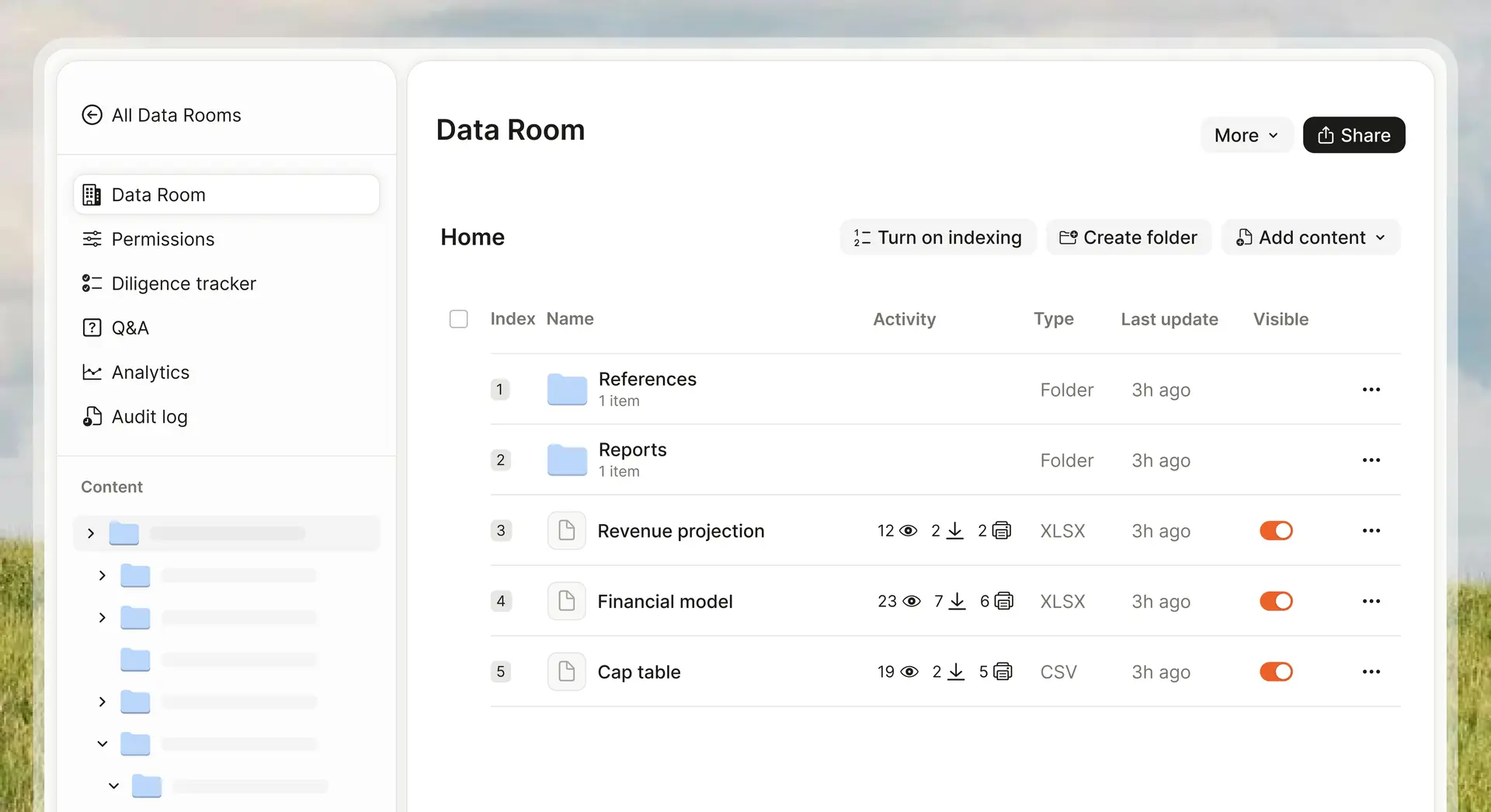
If there is one thing that makes IP due diligence harder than it needs to be, it is the document management. Patent files, trademark certificates, license agreements, employee IP assignments, NDA records, these are dozens or sometimes hundreds of documents, often pulled from different internal systems, covering multiple jurisdictions and time periods.
Without a proper system in place, this quickly becomes a mess of email attachments, shared drives, and version confusion. Sensitive documents end up in the wrong hands. Reviewers cannot track what they have already seen. Nobody has a clear view of what is still missing.
This is where a virtual data room (VDR) comes in, and specifically, where Ellty fits.
How Ellty supports IP due diligence
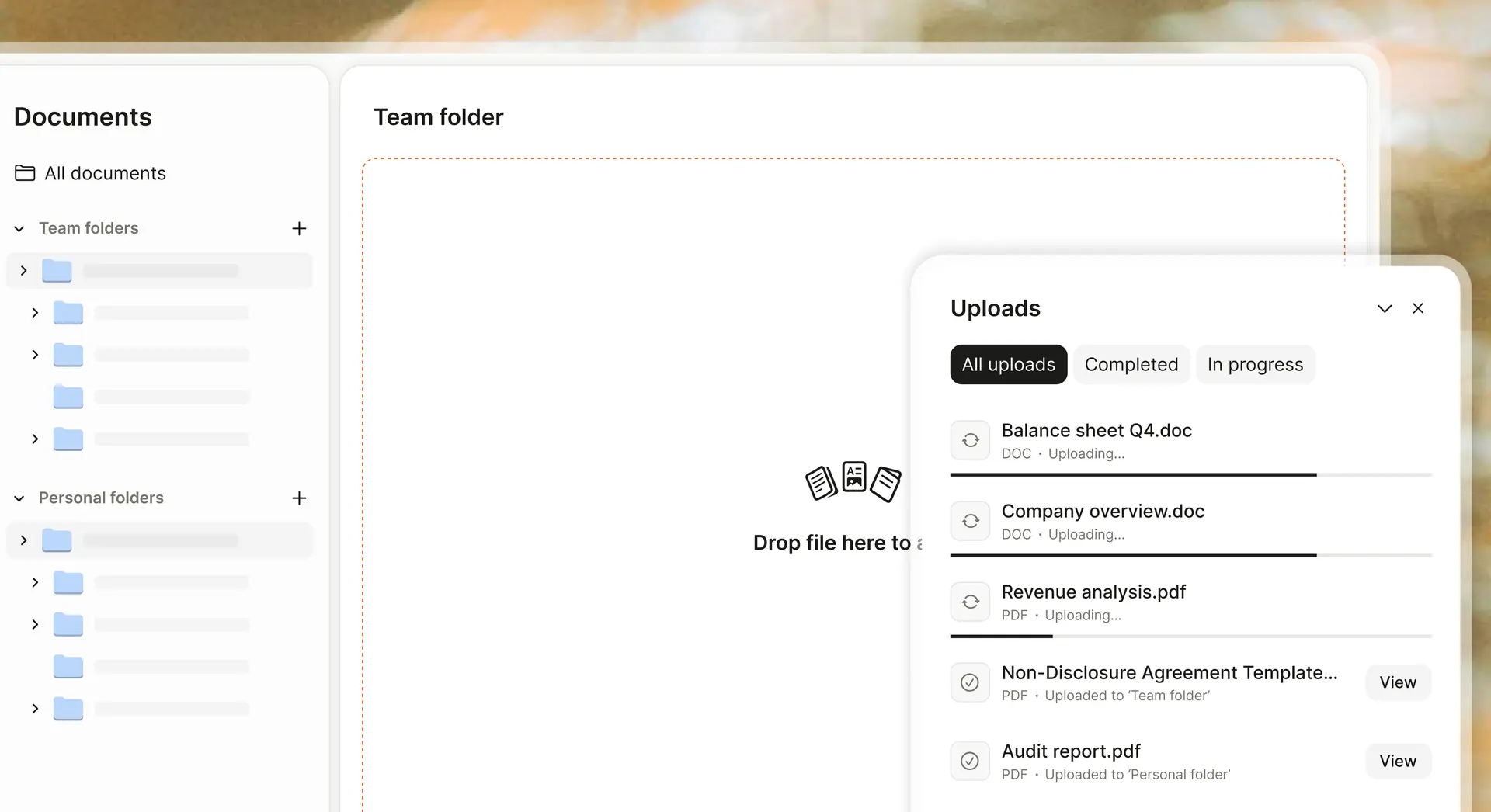
Organized, centralized document storage. With Ellty, you can structure your IP documents exactly how you want them: folders by IP type, by jurisdiction, by agreement category. Everyone on the review team sees the same organized structure, not a cluttered inbox.
Granular access controls. Not everyone reviewing a deal needs to see everything. Ellty lets you set permissions at the folder or document level, so your outside counsel sees the patent files, your finance team sees the license revenue data, and no one sees more than they need to.

NDA gating. Before any reviewer can access documents, you can require them to sign an NDA directly within the platform. This keeps your IP documents protected from the very first interaction.
Dynamic watermarking. Documents viewed in Ellty can be watermarked with the viewer's name and access details. If a document is shared outside the platform, you know exactly where it came from.
Real-time activity tracking. You can track exactly which documents each reviewer has opened, how long they spent on them, and whether they downloaded anything. During an IP review, this gives you a clear audit trail and helps you follow up on items that have not been reviewed.
Full audit logs. Every action in Ellty is logged. This creates a defensible record of the due diligence process, which matters in post-transaction disputes or regulatory reviews.
Flat, transparent pricing. Unlike legacy VDR platforms that charge per user or per page (which can make a large document review extremely expensive), Ellty uses flat monthly pricing. The Room plan at $149/month gives you granular permissions, NDA gating, dynamic watermarking, and restricted visitor access. The Room Plus plan at $349/month adds group permissions, full audit logs, and support for up to 4,000 assets per data room, built for heavier deals with multiple reviewer groups.
There are no per-user fees, no per-page charges, and no lengthy contract negotiations. You know exactly what you are paying.


Key risks to identify and avoid
IP due diligence is as much about finding what is wrong as it is about confirming what is right. Here are the most significant risks to watch for.
Ownership gaps
This is probably the most common issue. IP created by a co-founder before the company was incorporated, software written by a freelancer who never signed an assignment, a patent listed in the company's name but still technically owned by a university due to a prior research agreement. Any of these can mean the company does not cleanly own the IP.
Always trace the ownership chain to its origin. If there are gaps, they need to be resolved before or as part of the transaction.
Licenses that survive a change of control
Some license agreements include clauses that allow the licensor to terminate the agreement if the company is acquired. This is critical to catch early, because losing a key in-bound license after acquisition could disable core products or processes.
Review every agreement for change-of-control provisions and understand what happens if the deal closes.
Encumbered IP
IP can be pledged as collateral for loans or financing. If the company has used its patent portfolio to secure debt, the buyer could end up with IP that a lender has a claim on. Always search for recorded liens and security interests.
Open-source contamination
For technology companies, open-source risk is a major concern. If proprietary code was built using open-source components under copyleft licenses (like GPL), the company may be required to make its own code publicly available. This can seriously affect the value of the IP and needs to be identified and addressed before closing.
Expiring or expired IP
Patents expire. Trademarks need to be renewed. Domain names lapse. If a company's competitive advantage depends on IP that is about to expire, the valuation and deal terms should reflect that. Check maintenance status and upcoming expiry dates for everything.
Undisclosed disputes
Ask specifically about any disputes, claims, or cease-and-desist letters involving IP. These might not always appear in formal litigation records but can still represent serious liabilities. Include specific representations and warranties in the deal documents to cover this.
Inadequate trade secret protection
Unlike patents, trade secrets have no registration system. Their protection depends entirely on the company taking reasonable steps to keep the information confidential. If a company has not maintained proper NDAs, access controls, or internal policies, its trade secrets may not be protectable at all.
Best practices for effective IP due diligence
A few principles that experienced deal teams follow to make IP due diligence more reliable and efficient:
Start early. IP due diligence takes time, especially if ownership chains need to be traced or agreements need to be tracked down. Starting it in parallel with other due diligence streams saves time at the end of the deal timeline.
Use specialists where needed. Patent analysis, freedom-to-operate assessments, and IP valuation are specialist disciplines. Involve IP counsel or qualified professionals rather than relying on generalists for complex IP questions.
Get the full picture, not just what is offered. Do not just review what the company provides. Use public registries to verify registrations independently. Cross-check what you are told against what you can verify.
Document everything. Keep a record of every document reviewed, every question raised, and every finding noted. This is particularly important if issues emerge after the deal closes.
Use a secure data room from day one. Sending IP documents by email is not acceptable for any serious transaction. Set up a secure environment before requesting documents, and require all parties to use it.
Treat issues as negotiating points, not deal-breakers. Most IP due diligence findings are solvable. Gaps in ownership can be fixed with corrective assignments. Encumbrances can be released. License risks can be managed through representations and warranties. The goal is to understand the issues clearly enough to address them properly in the deal.
FAQs
What is the difference between IP due diligence and general commercial due diligence?
General commercial due diligence covers a wide range of areas: financials, operations, contracts, employees, and so on. IP due diligence is a focused subset that specifically reviews intellectual property assets. In many transactions, IP due diligence is conducted as a separate workstream by specialist IP counsel because it requires specific technical and legal expertise.
How long does IP due diligence take?
The time depends on the complexity of the IP portfolio and the type of transaction. For a small company with limited IP, a basic review might take one to two weeks. For a large technology company with a global patent portfolio, extensive licensing arrangements, and multiple product lines, it can take several months. Starting early and using a well-organized data room can significantly speed things up.
What happens if IP due diligence finds a serious problem?
Findings are addressed in deal negotiations. Depending on the severity, the buyer might request a price reduction, require the seller to resolve the issue before closing (for example, by obtaining missing IP assignments), include specific representations and warranties and indemnities in the purchase agreement, or in rare cases, walk away from the transaction.
Do I need IP due diligence for a minority investment, not just an acquisition?
Yes, though the depth may vary. Investors in a company need to understand what IP underpins the business model and whether that IP is secure. For early-stage investments, a lighter IP review is often appropriate. For later-stage or larger investments, a more thorough review is warranted.
What is a freedom-to-operate analysis and when is it needed?
A freedom-to-operate (FTO) analysis is a specific type of IP review that assesses whether a product or process infringes any third-party patents. It is most relevant in technology, pharmaceutical, and medical device transactions where third-party patents could block the company's ability to commercialize its products. FTO analysis is typically done by specialist patent attorneys.
How does a virtual data room help with IP due diligence?
A VDR provides a secure, organized environment for sharing and reviewing sensitive documents. For IP due diligence, this means access controls so only authorized reviewers can see documents, audit trails to track who has reviewed what, NDA gating to protect confidential information, and a single organized repository for all IP documents. Platforms like Ellty make this practical and affordable without enterprise contracts or per-user fees.
What should I do if an IP agreement has a change-of-control clause?
First, understand exactly what the clause requires: does it automatically terminate the agreement, or does it require consent from the other party? Then assess how critical that agreement is to the business. If it is essential, the deal team will need to negotiate consent from the licensor as a condition of closing, or find an alternative arrangement. Change-of-control provisions in key IP licenses are one of the most common reasons deals are restructured or face delays.
Final thoughts
IP due diligence is not a box to tick. It is one of the most substantive parts of any transaction involving a business that depends on its intellectual assets, which is most businesses today.
Done well, IP due diligence gives buyers and investors confidence that what they are acquiring is real, owned, and commercially defensible. Done poorly, or skipped entirely, it leaves the door open to post-closing surprises that can be difficult and expensive to fix.
The good news is that the process is manageable when you approach it with the right structure: a clear scope, a systematic review, the right specialists, and a secure place to organize and share documents.
That last point matters more than people often realize. The document management side of due diligence is not glamorous, but it directly affects how smoothly and securely the review runs. A virtual data room like Ellty is designed to handle exactly this, giving you organized document storage, granular access controls, NDA gating, watermarking, and a full audit trail, without the complexity or cost of legacy enterprise platforms.
Whether you are a law firm running a client's acquisition process, a startup preparing for investor due diligence, or a corporate M&A team managing an in-bound deal, having the right infrastructure in place makes every step faster and more defensible.
Start your free Ellty account and set up a secure IP due diligence data room today.
Ellty is a secure document sharing and analytics platform with full virtual data room functionality. It is built for anyone who needs to share sensitive documents in a controlled, trackable way, whether for a funding round, acquisition, property deal, or consulting engagement. Plans start at $0/month with no per-user fees and no surprise overages.
Author

Anika Tabassum Nionta is a Content Manager at Ellty, where she writes about secure document sharing, virtual data rooms, M&A, due diligence, fundraising, and sales enablement. With over 6 years of writing experience, she helps professionals understand how to share confidential documents securely, track engagement, and manage deals more effectively. Anika holds both a BA and MA in English from Dhaka University. Outside of work, she enjoys reading, exploring new cafes in Dhaka, and connecting with entrepreneurs and dealmakers in her community.

