German deals start at the notary. GmbH share transfers need a notarized deed, works councils need consultation, and RETT kicks in the moment you cross 90% ownership.
Germany's commercial registry (Handelsregister) is detailed and publicly searchable. But what you actually need - pension reserves, HGB hidden assets, trade tax positions - requires forensic work.
A mid-market German deal generates 3,000-20,000 documents. Set up an Ellty data room before the request list arrives. Advisors can start reviewing on day one.
The biggest German deal trap isn't the financials - it's the procedural layer. FCO merger control, RETT analysis, and works council rights each add weeks if you don't plan upfront.
The Germany due diligence checklist
Not every check carries the same weight. FCO and RETT are binary - miss either and the deal structure or timeline breaks.
Review the legal due diligence scope before the request list goes out to advisors.
Load all workstreams into Ellty before you issue the request list. Each advisor gets a scoped link and starts the moment access opens.
| Area | Documents to pull | Germany red flag | Tier | |
|---|---|---|---|---|
| Corporate & legal | Corporate & legal | Handelsregister extract, articles, SHA, pool agreements, board minutes | Undisclosed voting pool agreements or drag-along rights not in filed articles | Dealbreaker |
| Financial | Financial | 3y HGB accounts, management accounts, IFRS bridge, bank statements | Hidden reserves in HGB accounts or undisclosed book-reserve pension obligations | Dealbreaker |
| Tax | Tax | CT and trade tax assessments, Betriebsprüfung correspondence, TP docs | Open Betriebsprüfung audit or undocumented transfer pricing above €5M | Dealbreaker |
| Employment & labor | Employment & labor | Employment contracts, works council agreements, collective agreements | Active Betriebsrat with unresolved works agreements that survive a share deal | Price-adjuster |
| Regulatory & licences | Regulatory & licences | BaFin authorisations, sector permits, BNetzA licences, open proceedings | BaFin change-of-control approval needed before closing in regulated deals | Dealbreaker |
| FDI screening | FDI screening | AWW/AWV sector mapping, BAFA notification analysis, ownership chain docs | Target in defence, critical infrastructure, or AI - BAFA review at 25%+ | Dealbreaker |
| IP | IP | DPMA filings, patent assignments, trade mark register, licence agreements | IP registered in founder name rather than company entity is common in tech | Price-adjuster |
| Material contracts | Material contracts | Customer/supplier contracts, bank financing, change-of-control clauses | Bank loan change-of-control triggers requiring lender consent at closing | Price-adjuster |
| Real estate & environmental | Real estate & environmental | Grundbuch searches, RETT analysis, Phase I ESA, environmental notices | Share deal crossing 90% in property-owning GmbH triggers RETT at up to 6.5% | Price-adjuster |
| Data protection & IT | Data protection & IT | GDPR ROPA, DPO appointment, breach register, BfDI correspondence | Undisclosed data breaches or open BfDI enforcement actions | Standard check |
Running due diligence on a German target?
Set up your data room before the request list lands.
Start free 14-day trialThe full Germany due diligence checklist
Ten workstreams, ordered by risk. German-specific checks - RETT, pension reserves, and works council rights - sit across multiple areas and must be scoped from day one.
Upload each document category to your Ellty data room as you collect it. Parallel review compresses the overall timeline significantly.
Corporate & legal
- Pull the Handelsregister extract for the target and all subsidiaries from the local Amtsgericht; confirms directors, shareholders, registered capital, and outstanding charges.
- Obtain the shareholders' agreement (SHA) and any pool agreements (Stimmrechtspooling) - founder-owned German companies often carry undisclosed voting arrangements.
- Review the GmbH articles (Gesellschaftsvertrag) for consent requirements, pre-emption rights, and drag-along provisions before structuring the deal.
- Confirm no open insolvency proceedings (Insolvenzantrag) or creditor protection measures registered at the Amtsgericht.
- Check the beneficial owner register (Transparenzregister) for all entities with stakes above 25% - mandatory since 2020 and publicly searchable.
Financial
- Pull 3 years of HGB annual financial statements (Jahresabschluss) filed at the Bundesanzeiger; HGB allows hidden reserves that can understate assets or overstate liabilities.
- Commission an IFRS bridge or quality of earnings report for any deal above €5M - HGB to IFRS adjustments are often material and always buyer-unfavorable.
- Map all book-reserve pension obligations (Direktzusagen) - common in German companies and frequently represent millions in underfunded pension exposure transferred to the buyer.
- Review intercompany loans and related-party transactions for arm's length terms; owner-managed German companies often carry undocumented related-party balances.
- See our due diligence report guide for how to structure financial findings ahead of the SPA negotiation.
Tax
- Pull 3 years of corporate income tax (Körperschaftsteuer) and trade tax (Gewerbesteuer) assessments from the Finanzamt for all entities.
- Confirm the effective trade tax rate; combined corporate and trade tax in Germany runs 28-33% depending on the municipality where the target operates.
- Review transfer pricing documentation for any intragroup transactions; German law requires contemporaneous TP docs for transactions above €5M per year.
- Check for any open Betriebsprüfung (tax field audit) correspondence; German field audits cover 3-5 years and open assessments can be material price-adjusters.
- Analyse the share vs asset deal tax impact; asset deals allow a step-up in depreciable assets, reducing future tax for the buyer.
- See our tax due diligence guide for how to structure the German tax risk register.
Employment & labor
- Obtain a full headcount list with contract types, notice periods, and any change-of-control provisions in senior employee agreements.
- Map works council (Betriebsrat) status; if present, the employer must consult the works council before informing the market, particularly on asset deals under §613a BGB.
- Check co-determination status: companies above 500 employees must give staff one-third of supervisory board seats; above 2,000 employees, parity rules apply under MitbestG.
- Review all collective agreements (Tarifverträge) and works agreements (Betriebsvereinbarungen) for terms that survive a change of control and bind the buyer.
- Pull 3 years of social security contribution records to confirm no underpayments to the Deutsche Rentenversicherung or Krankenversicherung.
Regulatory & licences
- Map all BaFin authorisations for financial services targets and confirm whether change-of-control notification to BaFin is required before or after closing.
- Review sector-specific licences - BNetzA for telecoms and energy, Luftfahrtbundesamt for aviation, TÜV certificates for safety-critical industrial operations.
- Check for any open proceedings with the relevant Bundesbehörde or Landesbehörde that could affect the target's operating rights post-acquisition.
- Confirm that licences, permits, and public contracts are either directly assignable or survive a share deal without requiring re-application.
FDI screening
- Assess whether the target falls under Germany's Foreign Trade and Payments Act (AWG/AWV); BAFA reviews acquisitions above 25% of voting rights in critical sectors.
- Key mandatory notification sectors: critical infrastructure, defence and defence-adjacent, media, cloud computing, AI, and semiconductor supply chains.
- Build 4-5 months into the deal schedule if BAFA review is required; the Federal Ministry for Economic Affairs can prohibit or impose conditions on the acquisition.
- Prepare a full beneficial ownership disclosure of the acquirer; BAFA requires the complete ownership chain including all ultimate beneficial owners at every tier.
- Check for any existing Bundeswehr or public sector supply relationships that would trigger additional defence ministry scrutiny.
IP
- Pull IP searches at the DPMA (Deutsches Patent- und Markenamt) for all patents, trade marks, and registered designs in the target's name.
- Confirm all IP is owned by the company entity, not by founders or key employees; IP assignment gaps are common in German engineering and technology companies.
- Review software licence agreements for open source components and GPL licence compliance; a recurring issue in German software and industrial technology deals.
- Check for any DPMA oppositions, IP litigation, or IP licensing disputes in the last 5 years at the Bundespatentgericht.
- See our IP due diligence guide for how to structure IP searches in cross-border German transactions.
Material contracts
- Pull the top 10 customer and supplier contracts and review for change-of-control clauses, assignment restrictions, and termination rights triggered by a deal.
- Check all bank financing agreements for change-of-control triggers and cross-default provisions that require lender consent before or at closing.
- Review government and public sector contracts (Bundesbeschaffung, state procurement) separately; these require contracting authority consent before assignment.
- Confirm exclusivity arrangements, distribution agreements, and franchise deals that are material to business operations survive a change of ownership.
Real estate & environmental
- Confirm ownership or leasehold status of all properties via Grundbuch (land register) searches at the local Grundbuchamt; German land registration is reliable and complete.
- Analyse RETT exposure: share deals crossing 90% ownership in a GmbH holding German real estate trigger Grunderwerbsteuer at 3.5%-6.5% depending on the federal state.
- Commission a Phase I Environmental Site Assessment (Bodeninspektionsbericht) for any industrial or manufacturing properties; German environmental liability runs with the land.
- Review all commercial leases (Gewerbemietverträge) for change-of-control and landlord consent provisions that could slow the closing process.
Data protection & IT
- Obtain the target's GDPR compliance documentation: records of processing activities (ROPA), data protection officer (DSB) appointment records, and data breach register.
- Review any BfDI (federal) or Landesbeauftragter (state DPA) correspondence, enforcement notices, or open investigations in the last 3 years.
- Confirm that data transfers outside the EU/EEA are covered by adequacy decisions or appropriate standard contractual clauses under GDPR Article 46.
- Review IT infrastructure for legacy systems, software licence compliance, and cybersecurity audit reports covering the last 2 years.
How due diligence in Germany works
The due diligence process in Germany follows 5 stages - but each stage has procedural mechanics that add time and cost absent in other jurisdictions.
Step 1: Scope
Define the workstream scope before any documents move. Confirm upfront whether FCO notification is required and whether RETT applies to the proposed deal structure. A share deal crossing 90% ownership in a property-holding GmbH needs RETT analysis in the scope from day one - not added as an afterthought at week 6.
Step 2: Request
Issue the request list within 48 hours of signing the NDA. German sellers expect structured, thorough requests. A well-prepared seller loads Handelsregister extracts, HGB accounts, and pension documentation into Ellty before the list arrives - cutting advisor turnaround time by days and keeping the timeline on track.
Step 3: Review
Legal, financial, and tax workstreams run in parallel. Germany-specific tracks - works council consultation mapping, pension liability assessment, and RETT structure analysis - run alongside the standard review. Track reviewer activity through Ellty's analytics so you know where review is lagging before it becomes a timing issue.
Step 4: Flag
All findings go into a risk register: dealbreaker, price-adjuster, or standard check. In German deals, book-reserve pensions, HGB-to-IFRS adjustments, and open Betriebsprüfung assessments cluster as price-adjusters. FCO filing requirements and RETT exposure are binary dealbreakers or deal restructuring triggers.
Step 5: Resolve
German SPA negotiations use indemnities for identified tax liabilities, pension escrows for Direktzusagen shortfalls, and R&W insurance (increasingly available from German and international brokers). FCO Phase 1 review runs up to 25 working days from a complete filing; Phase 2 adds up to 5 more months for complex deals.
HGB accounting, book-reserve pensions, and RETT on share deals above 90% make German M&A structuring different from any other European market.
What makes Germany DD different
HGB hidden reserves and book-reserve pensions. German GAAP (HGB) allows companies to build hidden reserves through conservative asset valuation. A mid-market target can carry millions in understated asset values that only surface when you commission an IFRS bridge. Book-reserve pensions (Direktzusagen) add another layer: pension commitments to long-serving employees, carried as a balance sheet provision but often understated, that transfer fully to the buyer in a share deal.
RETT restructuring. Grunderwerbsteuer in Germany runs up to 6.5% in states like NRW, Brandenburg, and Schleswig-Holstein. Share deals that cross 90% ownership in a company holding German real estate trigger RETT on the property value - sometimes millions in additional tax. Buyers routinely structure around this: leaving a residual stake with the seller, using holding structures, or choosing an asset deal. That decision must be made early.
Works council and co-determination. German companies with active works councils (Betriebsrat) must navigate consultation rights before informing the market of a sale. For asset deals, §613a BGB requires individual employee notification and gives staff the right to object to the transfer of their employment. Both add process and timing risk that buyers from common-law jurisdictions consistently underestimate.
FCO two-stage review. The Bundeskartellamt's Phase 1 review takes up to 25 working days from a complete filing. Phase 2 - triggered when Phase 1 findings are inconclusive - adds another 5 months. For deals in concentrated markets, serial acquirers, or sector consolidation plays, FCO scrutiny has increased significantly since 2024.
Who runs due diligence on Germany deals
German deals use a mix of German and international law firms, Big 4 advisory, and specialist pension actuaries.
Legal counsel: Gleiss Lutz, Hengeler Mueller, and Freshfields lead on high-value German deals. Mid-market firms Noerr, Rödl & Partner, and Luther cover €5M-€100M transactions well. Budget €80K-€400K for buy-side legal diligence depending on deal size and complexity.
Financial and tax advisory: Big 4 (EY, PwC, KPMG, Deloitte) cover quality of earnings and tax. German mid-market specialists are often faster and cheaper for regional targets. Budget €60K-€200K combined for financial and tax diligence on a mid-market German deal.
Pension actuaries: Any target with Direktzusagen needs an independent actuarial report. Budget €15K-€50K for a pension valuation and liability report.
Set up one shared Ellty data room and give each advisor a scoped link. No emails, no version confusion, and you can track exactly who has seen the pension documents, the FCO overlap analysis, and the RETT legal opinion before the management meeting.
How to set up your Germany data room in Ellty.
Load your Germany deal documents before advisors start. Each team gets a scoped link with access only to what they need.
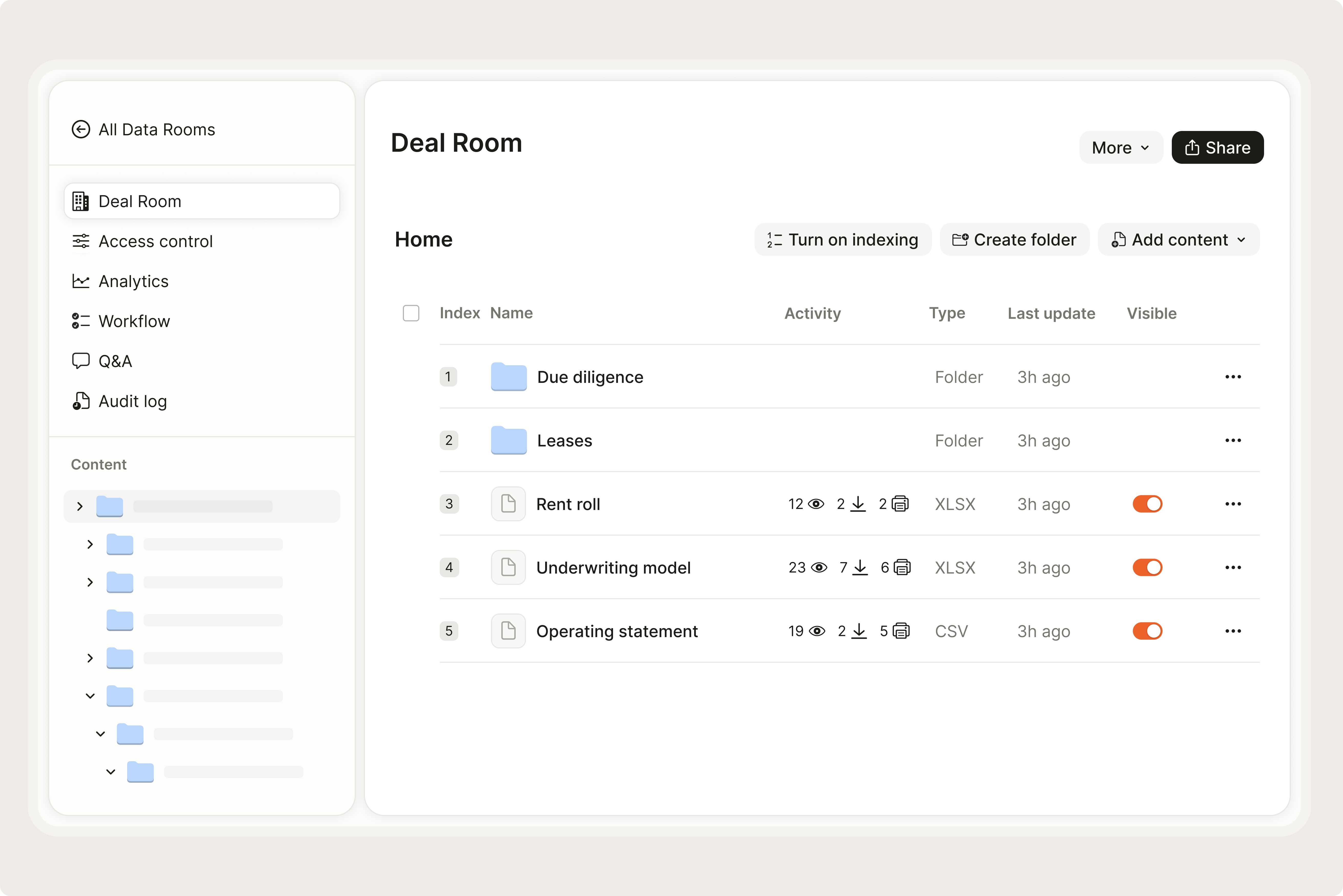
- 1.Create a data room and upload your deal docsUpload Handelsregister extracts, HGB accounts, and pension docs. Organise by workstream so advisors find files fast.
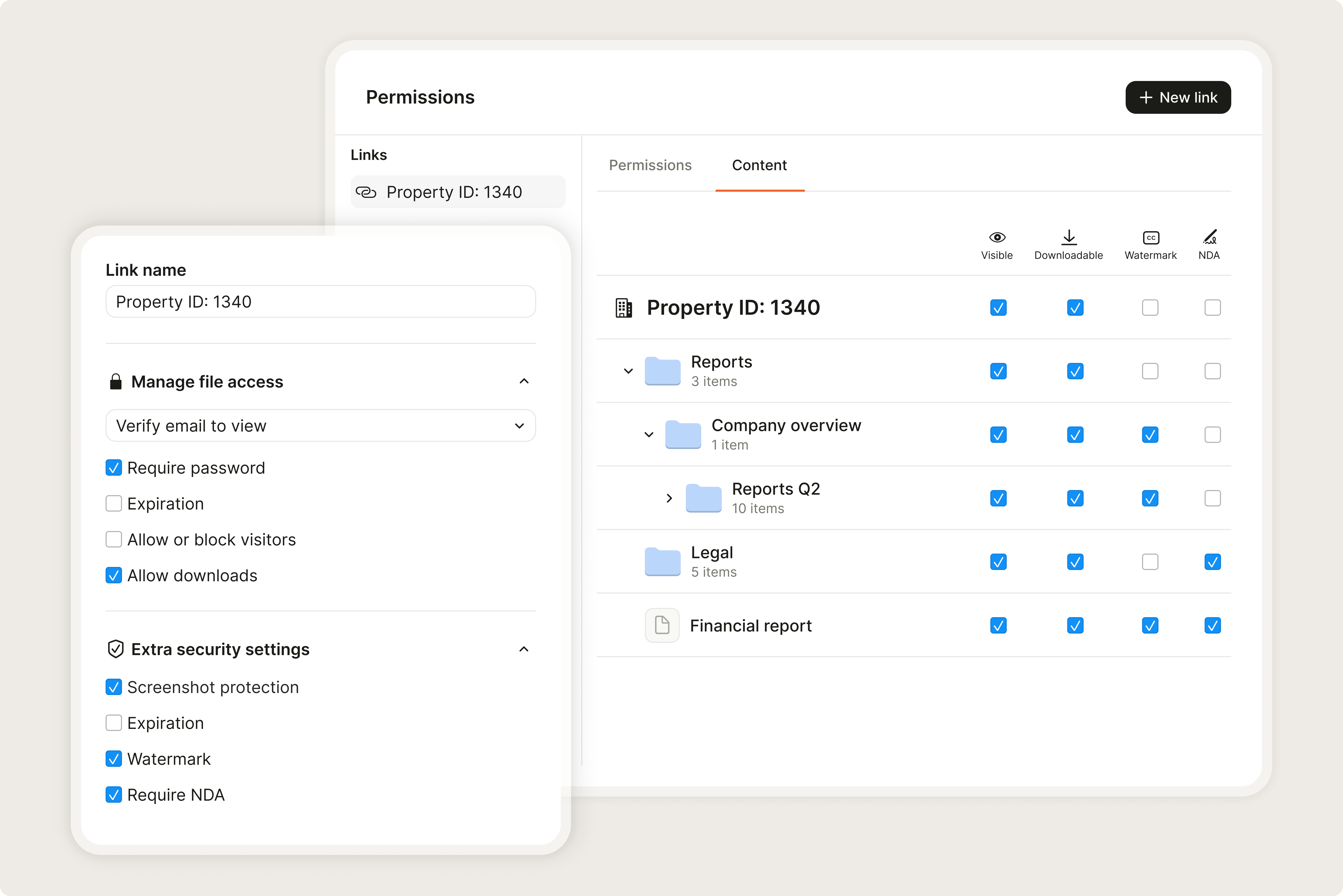
- 2.Give each workstream a scoped, secure linkLegal sees contracts. Tax sees returns and TP docs. FCO counsel sees sector mapping only.
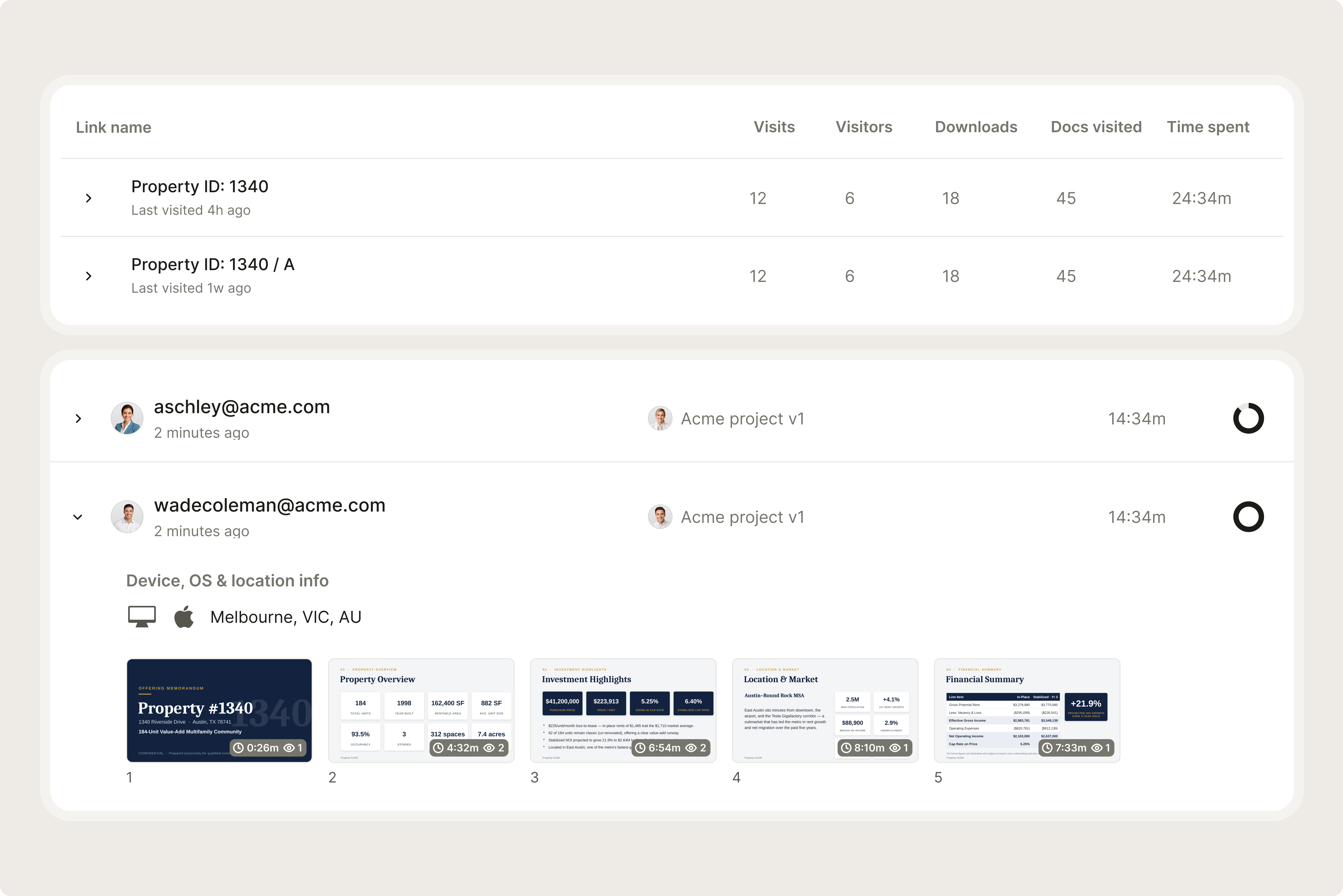
- 3.Track who reviews which documentsSee which advisor opened the pension docs six times. Follow up before it becomes a flag in the report.
Due diligence timeline for Germany deals
A standard German buy-side process runs 6-10 weeks from NDA to final report.
Weeks 1-2: NDA signed, Handelsregister extracts pulled, request list issued. FCO filing assessment completed. RETT structure analysis initiated. Ellty data room live with scoped advisor links by workstream.
Weeks 2-4: Financial, legal, and tax reviews run in parallel. Works council consultation scope mapped. HGB-to-IFRS adjustment analysis started. Pension actuaries engaged if Direktzusagen identified.
Weeks 4-6: Preliminary findings memos circulated. RETT deal structure decision made. FCO filing submitted if required. Pension valuation received. Price-adjuster negotiations begin in parallel.
Weeks 6-8: Management Q&A sessions. SPA warranty and indemnity negotiations initiated. FCO Phase 1 runs in background (up to 25 working days from the complete filing date).
Weeks 8-10: Final reports issued. Pension escrow mechanics agreed. FCO clearance received (if Phase 1 sufficient). Notary appointment scheduled for GmbH share transfer notarization.
What due diligence costs in Germany
Legal: €80K-€400K depending on deal size and firm tier.
Financial and tax: €60K-€200K for a mid-market target.
Pension actuaries: €15K-€50K for Direktzusagen valuation and liability quantification.
Environmental: €20K-€60K if industrial or manufacturing sites are involved.
RETT: 3.5%-6.5% on property value if the 90% ownership threshold is crossed in the deal structure.
Notary fees: 0.2%-0.5% of deal value for GmbH share transfer notarization under GNotKG.
Total advisor spend on a €20M-€100M German deal lands between €250K and €600K before success fees - expensive, but cheaper than discovering a €5M underfunded pension or a RETT bill post-completion.
Run your Germany deal from one room
Hold financials, pension docs and the SPA in one secure, tracked Ellty data room.
Start free 14-day trialCommon questions about due diligence in Germany
- FCO review is triggered when combined worldwide turnover tops €500M and both parties exceed €25M each in Germany. Filing is voluntary but advisable when combined market share exceeds 25% in any relevant German market.
- Yes - share deals crossing 90% ownership in a GmbH holding German real estate trigger RETT at 3.5%-6.5% depending on the federal state. Structure the deal early to manage or avoid this exposure.
- Yes - German law requires a notarized purchase agreement and share transfer deed for GmbH acquisitions. Budget at least one extra week for notary scheduling and add notary fees to your deal cost model.
- German companies above 500 employees must give staff one-third of supervisory board seats under DrittelbG. Above 2,000 employees, parity representation applies under MitbestG - factor post-close governance changes into the deal structure.
- Direktzusagen are direct pension commitments to employees carried on the balance sheet as a provision. They transfer fully to the buyer in a share deal and are often understated - always commission an actuarial valuation before pricing the deal.