
Managing investor relationships is not just about raising money. It's about keeping trust alive long after the wire transfer clears.
Most founders spend months trying to close a funding round. But once the round is done, the real work begins such as keeping investors informed, sharing updates, sending documents, and making sure the right people always have the right access to the right information.
That's where investor relations software comes in. The right tool can make this whole process feel smooth and professional. The wrong approach can quietly damage the trust you worked so hard to build, think scattered emails, random Dropbox links, and forgotten follow-ups.
In this guide, we'll walk you through what investor relations software actually does, what features matter, how to pick the right tool, and our top seven picks for 2026.
What Is Investor Relationship Management Software?
Investor relationship management (IRM) software is any tool that helps businesses communicate with, update, and manage their investors in an organized and professional way.
Think of it as a CRM, but built specifically for the investor side of your business. Instead of tracking sales leads, you're tracking investor updates, document sharing, due diligence requests, and communication history.
For early-stage founders, this might look like a simple secure portal where investors can log in, read your monthly updates, and access financial documents. For larger companies, it might involve full-blown data rooms, regulatory filings, and structured access controls across dozens of stakeholders.
At its core, good IRM software does a few things:
- Keeps all investor-related documents in one place
- Lets you control who sees what
- Tracks whether investors have opened your documents or updates
- Makes communication feel organized and professional, not like a shared Google Drive folder from 2019
Why Businesses Need Investor Relationship Management Software
You might be wondering: can't I just use email and a shared folder?
Technically, yes. Practically, it gets messy fast.
Here's why dedicated software matters:
Professionalism builds trust. When an investor receives a clean, branded portal with organized documents and clear access controls, it signals that you run a tight ship. First impressions don't stop at the pitch deck.
Security is non-negotiable. Sending financial documents over email creates real risk, especially sensitive ones like cap tables, term sheets, or due diligence materials. Investor relations tools give you NDA gating, watermarking, and audit trails so you always know who accessed what.
Investors are busy. The easier you make it for them to find information, the better the relationship. A well-organized investor portal saves everyone time.
You need to track engagement. Knowing whether an investor opened your board deck or investor update is genuinely useful. If they didn't, you can follow up. If they did and haven't replied, you have context for the next conversation.
Compliance and record-keeping matter. As your business grows, having a clean audit trail of who received what document and when becomes important, both for legal reasons and for your own sanity.
Key Features to Look For in Investor Management Software
Not every tool is built the same. Here are the features that actually matter when you're evaluating investor relations software:
Secure document sharing. The baseline. You need to be able to share sensitive documents without worrying about them being forwarded to the wrong person or leaked. Look for tools that support access controls, link expiry, and download restrictions.
Real-time activity tracking. Knowing when an investor opens a document, how long they spent on each page, and whether they forwarded it gives you valuable context before a call or follow-up.
NDA gating. Before a potential investor or partner can view certain documents, they should agree to an NDA. Good tools automate this so it's not a manual back-and-forth.
Granular permissions. Not everyone needs to see everything. The ability to give different access levels to different people is important, say, your lead investor sees more than a prospective LP.
eSignatures. Getting signatures on term sheets, NDAs, or shareholder agreements without printing and scanning things is a basic time-saver at this point.
Audit logs. A clear, timestamped record of every action taken in your data room or document portal. Useful for compliance and for resolving disputes.
Investor updates / CRM features. Some tools go beyond document management and let you send formatted investor updates, track replies, and maintain a contact database.
Clean, professional branding. Your investor portal should look like your company, not like a generic file-sharing app.
Transparent, predictable pricing. Per-user fees and per-page charges add up fast. Look for tools with flat pricing so you can scale your deal team without the bill climbing unexpectedly.
How to Choose the Best Investor Relationship Management Software
Before you pick a tool, think through a few questions:
Where are you in your fundraising journey?
If you're in early conversations, you might not need a full data room yet. A lighter tool with document tracking might be enough. If you're in active due diligence, you need proper VDR features such as granular permissions, NDA gating, audit logs.
How many investors or stakeholders are involved?
If you're managing relationships with 5 investors, the requirements are different from managing 50. Make sure the pricing model makes sense for your scale.
What types of documents are you sharing?
Financial models and cap tables need tighter controls than a pitch deck. Be honest about your security requirements.
Do you also need investor communication features?
Some tools are purely document-focused. Others include update newsletters, CRM features, or communication logs. Think about whether you need both in one place or if you're happy using a separate tool for updates.
What's your budget?
Enterprise VDR platforms can run into thousands of dollars a month. But for most startups and growing businesses, there are great options in the $0–$350/month range that cover everything you actually need.
7 Top Picks: Best Investor Relationship Management Software for 2026
1. Ellty - Best for Secure Document Sharing and Data Room Management

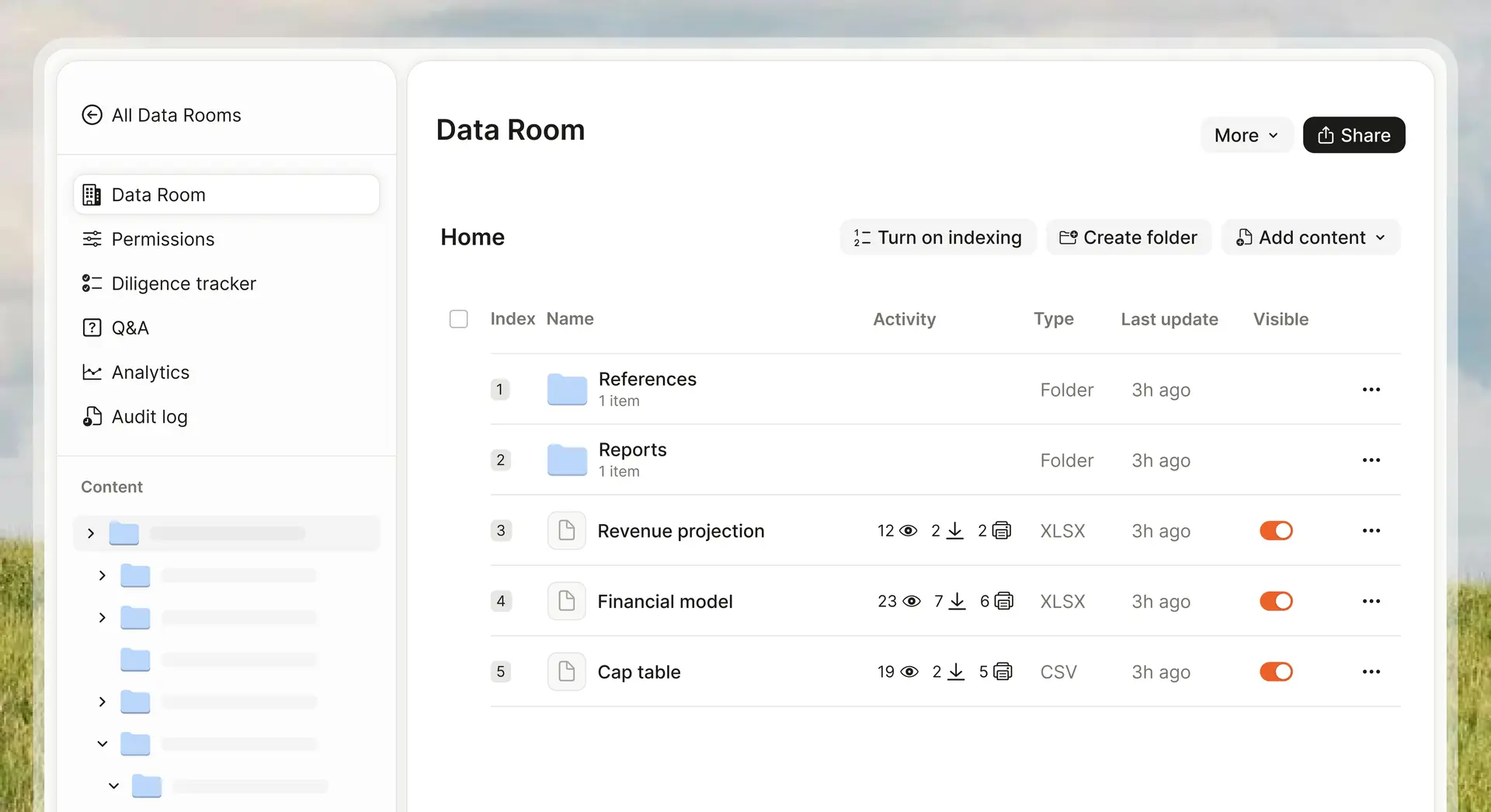
Best for: Founders, deal teams, and anyone who needs a professional data room without enterprise pricing.
Ellty is a secure document sharing and analytics platform with full data room functionality. It's built for anyone who needs to share sensitive documents in a controlled, trackable way, whether that's during a funding round, a property deal, a consulting engagement, or an acquisition process.
What makes Ellty stand out is the combination of serious VDR features and genuinely transparent pricing. There are no per-user fees, no per-page charges, and no surprise overages as your deal team grows.
Key features:
- Real-time document analytics (see who opened what and for how long)
- NDA gating before document access
- Granular permissions and restricted visitor access
- Dynamic watermarking
- eSignatures
- Full audit logs
- Custom branding


For any founder who needs a professional data room without negotiating an enterprise contract, Ellty is where to start.

2. Visible.vc - Best for Investor Updates and Portfolio Reporting

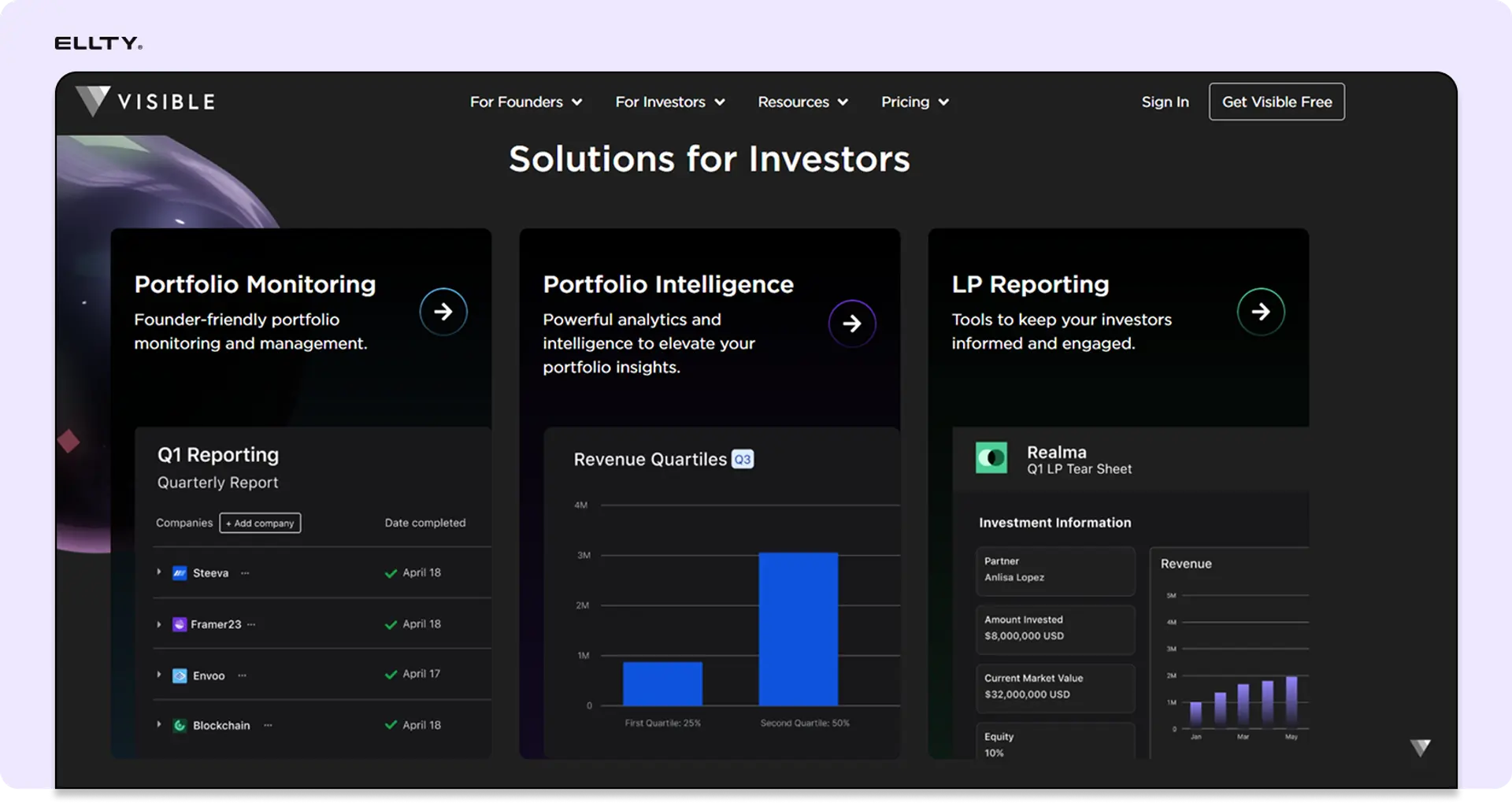
Best for: Founders who want to send polished investor updates and track engagement.
Visible is built specifically around the investor update workflow. It lets you create and send branded investor updates, track who opened them, and maintain a clear record of your communication history. It also has a lightweight CRM for managing your investor list and a simple data room for document storage.
If your main challenge is keeping investors in the loop with regular updates rather than running active due diligence, Visible is a strong fit. It's more communication-focused than document-security-focused.
Key features: Investor update templates, engagement tracking, basic data room, investor CRM, pipeline tracking.
Best used alongside a dedicated VDR like Ellty when you enter active due diligence.
3. Carta - Best for Cap Table Management and Equity Administration

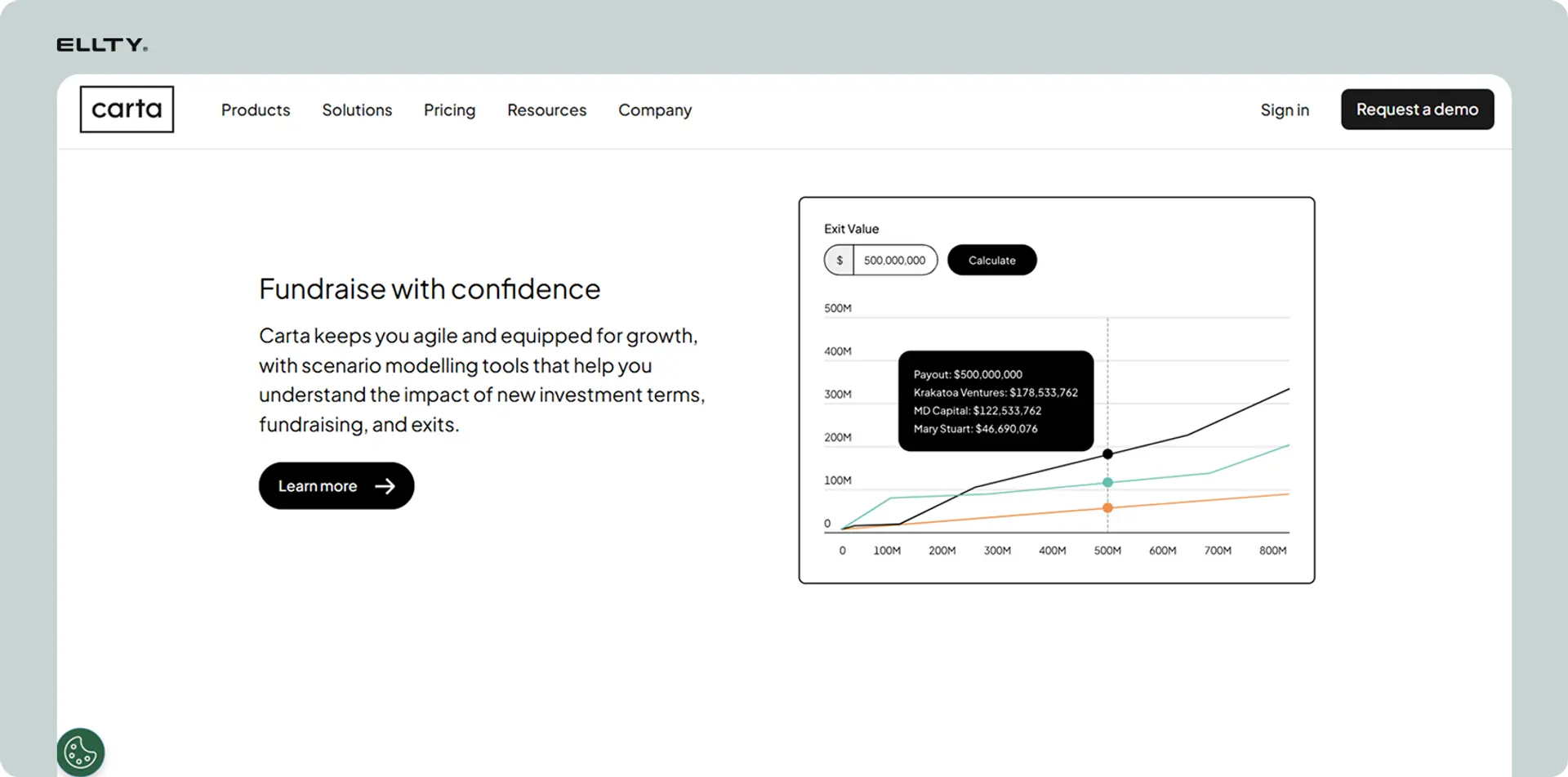
Best for: Startups that need to manage equity, option grants, and cap tables alongside investor relations.
Carta is primarily a cap table management platform, but it's become a central piece of investor relations infrastructure for many startups. Investors can log in to see their holdings, access documents, and stay informed about equity events.
If equity management is a core part of your investor relations workflow — which it often is — Carta is worth considering. It's not a pure IRM tool, but the investor-facing portal is polished and widely trusted.
Key features: Cap table management, 409A valuations, investor portal, document storage, fund administration.
Note: Pricing scales significantly with company complexity and assets under management.
4. Notion - Best for DIY Investor Portals on a Tight Budget


Best for: Early-stage founders who want a simple, organized investor portal without paying for dedicated software.
Notion doesn't market itself as investor relations software, but many founders use it that way. With the right setup, you can create a private investor workspace with meeting notes, monthly updates, financial summaries, and document links.
The obvious limitation is security, Notion isn't built for sensitive document control. You wouldn't run due diligence through Notion. But for light communication, organizing board materials, or keeping a shared knowledge base for your investor network, it works surprisingly well.
Key features: Flexible pages and databases, easy sharing via invite, clean formatting for updates, free to start.
Best used for early-stage investor communication, not for secure document sharing or due diligence.
5. DocSend - Best for Pitch Deck Tracking and Document Analytics
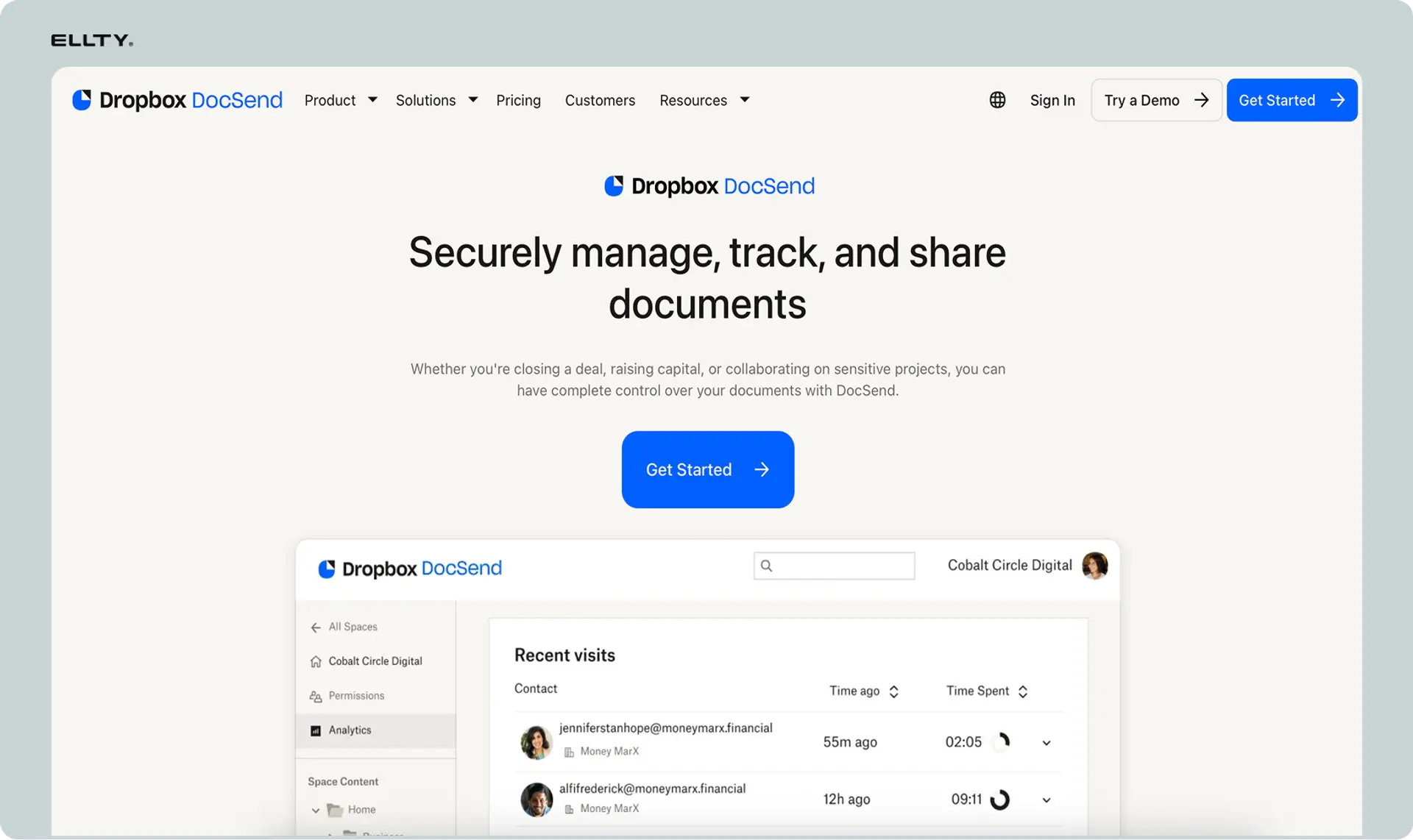
Best for: Founders who want to know exactly how investors are engaging with their pitch deck or other documents.
DocSend is a document sharing and tracking tool with a strong focus on analytics. You upload a document, share a link, and get detailed data on who viewed it, how long they spent on each slide, and when they stopped reading. It's widely used for fundraising.
DocSend also has a basic data room feature, though it's not as feature-rich as dedicated VDR platforms for complex due diligence.
Key features: Per-page analytics, link-based sharing, NDA requests, basic data room, eSignatures.
Note: Pricing is per-user, which can add up as your team grows.
6. Affinity - Best for Relationship Intelligence and Deal Tracking


Best for: Founders and investor relations teams who want a CRM with deep relationship context.
Affinity is a relationship intelligence CRM that automatically pulls in data from your email and calendar to build a picture of your network. It's popular with VC firms, but founders who are managing a large number of investor relationships can use it too.
It's less about document management and more about knowing who you've spoken to, when, and what was discussed. If you're managing a complex investor base with lots of ongoing conversations, Affinity brings order to the chaos.
Key features: Automatic relationship data from email/calendar, deal pipeline, notes and activity tracking, network visualization.
7. Salesforce (with investor relations configuration) - Best for Large Companies with Complex IR Needs


Best for: Later-stage or public companies with a dedicated IR team and complex stakeholder management needs.
Salesforce is a full enterprise CRM, and with the right configuration or third-party add-ons, it can serve as a robust investor relations management platform. It handles large contact databases, tracks all communications, integrates with email and reporting tools, and can be customized heavily.
The tradeoff is complexity and cost. Salesforce is powerful but expensive to implement properly, and it requires dedicated admin resources. For most early-stage founders, it's overkill. But for public companies or large private firms with a formal IR function, it's a proven enterprise option.
Key features: Full CRM, communication tracking, custom workflows, integrations with virtually everything.
Getting Started: Tips for Smooth Implementation
Picking the right tool is only half the job. Here's how to actually get it set up without creating more work for yourself:
Start with your current pain points.
Don't add software for the sake of it. If your biggest problem is that investors can't find documents, start with a document management tool. If your biggest problem is remembering to send updates, start with a communication tool.
Migrate documents before you invite anyone.
Before you send your investors a link to your new portal, make sure everything is organized and properly labeled. A messy data room is worse than no data room.
Set up permissions carefully.
Think about who needs access to what before you start inviting people. Changing permissions after the fact is doable but creates confusion.
Communicate the change to your investors.
Send a simple email letting them know where things now live and what they can find there. Don't assume they'll figure it out on their own.
Review your analytics regularly.
If you're using a tool with activity tracking, check it after you share anything important. Knowing who has and hasn't reviewed a document helps you follow up at the right time.
Don't over-engineer early.
If you're pre-seed, you don't need enterprise-grade software. Start simple and upgrade as your needs grow.
FAQs
What is the difference between a VDR and investor relations software?
A virtual data room (VDR) is a secure platform for sharing documents during due diligence or deal processes. Investor relations software is a broader category that includes communication tools, CRMs, update platforms, and document management. Some tools like Ellty, combine VDR functionality with broader investor relations features.
Do I need investor relations software before I raise my first round?
Not necessarily. In the very early stages, email and simple document sharing can work fine. But once you're in active conversations with investors and sharing sensitive documents, a proper tool, even a free tier, is worth setting up.
Is Ellty only for fundraising?
No. Ellty is built for anyone who needs to share sensitive documents in a controlled, trackable way. That includes fundraising, property deals, consulting engagements, acquisitions, and any other situation where you need secure document sharing with a clean audit trail.
Can I use multiple tools together?
Yes, and many founders do. A common setup is using something like Visible for investor updates, Carta for cap table management, and Ellty for secure document sharing and due diligence. These tools serve different parts of the investor relations workflow and work well alongside each other.
How important is activity tracking in investor relations software?
Very. Knowing whether an investor has opened your board deck, how long they spent on the financial projections, or whether they forwarded a document to someone else gives you real context before your next conversation. It turns a guessing game into an informed follow-up.
What should I look for in pricing when choosing a VDR or IRM tool?
Watch out for per-user fees, per-page fees, and usage caps that inflate the cost as your deal gets bigger. Flat-rate pricing, like Ellty offers, is more predictable and better suited for deal teams that grow during a process.
Is it safe to share sensitive financial documents through these platforms?
With the right tool, yes. Look for platforms with NDA gating, access controls, download restrictions, and audit logs. These features collectively make sure that only the right people see your documents and that you have a record of everything.
Final Thoughts
Investor relations software isn't just a nice-to-have. For any founder who's serious about building long-term relationships with their backers, it's a fundamental part of running a professional operation.
The tools in this list cover a wide range of needs, from simple investor updates to full-featured data rooms for complex due diligence. The right choice depends on where you are in your journey and what problem you're actually trying to solve.
If you need secure document sharing with real data room functionality and transparent, predictable pricing, Ellty is a strong place to start. You can get going on the free plan and upgrade as your needs grow, without getting locked into an enterprise contract or surprised by a bill that scales with your headcount.
The best investor relationship is one where your investors always feel informed, well-organized, and confident that their partner knows what they're doing. The right software helps you deliver exactly that.
Author

Anika Tabassum Nionta is a Content Manager at Ellty, where she writes about secure document sharing, virtual data rooms, M&A, due diligence, fundraising, and sales enablement. With over 6 years of writing experience, she helps professionals understand how to share confidential documents securely, track engagement, and manage deals more effectively. Anika holds both a BA and MA in English from Dhaka University. Outside of work, she enjoys reading, exploring new cafes in Dhaka, and connecting with entrepreneurs and dealmakers in her community.

