Toronto proptech investors are writing checks into property management software, construction tech, and real estate AI in 2025 and 2026. Alate Partners co-led Mave AI's $5M seed round in January 2026. These 13 investors are actively reviewing proptech deals right now.
Raising for a proptech company is harder than raising for generic SaaS, because most generalist VCs don't understand 12-18 month real estate sales cycles. They'll ask you to model ARR growth like a horizontal SaaS product and wonder why you don't have 50 enterprise customers. The 13 proptech investors in this article know the built environment and won't need a primer on why your deals take longer.
Toronto holds 45 percent of Canada's proptech startups, and that concentration works in your favor. Alate Partners, GroundBreak Ventures, and Relay Ventures all write proptech checks from downtown Toronto. That density creates more warm intro paths than any other Canadian city. Proptech VCs here expect your fundraising materials to be organized before your first call. The real estate Ellty use case is well-established, and investors will ask if you're using a trackable data room.
Canadian proptech secured $450 million CAD across 30 disclosed funding rounds in 2025. That's a tighter market than the peak years, but the investors still writing checks know exactly what they're looking for. A signed pilot from a real estate operator matters far more to them than a polished deck.
The categories drawing the most proptech capital right now are AI-powered platforms for realtors, construction workflow software, and multifamily property management tools. Housing affordability pressure in Toronto is pushing government money into the sector too. GroundBreak Ventures is directly involved in the federal Centre for Housing Innovation initiative, which gives portfolio companies a real policy-backed distribution story.
Before you reach out to any investor on this list, get your materials organized in advance. Toronto proptech VCs move quickly from first meeting to due diligence once they're interested. They'll ask for your ARR, signed customer list, data agreements, and go-to-market plan within days. Read through what investors look for in a data room first - proptech investors have specific requests that differ from B2B SaaS investors.
| Stage | Check | Sector | Contact | |
|---|---|---|---|---|
| Alate Partners | Seed, Series A | $500K-$5M | Proptech, real estate AI, construction tech | alatepartners.com |
| GroundBreak Ventures | Pre-seed, Seed, Series A | $250K-$3M | Proptech, construction tech, housing tech | groundbreakventures.com |
| Relay Ventures | Seed, Series A | $1M-$10M | Proptech, fintech, media, software | relay.vc |
| Fifth Wall | Series A, Series B | $5M-$50M | Proptech, smart buildings, real estate fintech | fifthwall.com |
| MetaProp | Pre-seed, Seed | $250K-$3M | Proptech, real estate software, smart buildings | metaprop.com |
| Camber Creek | Seed, Series A, Series B | $1M-$15M | Property management, smart buildings, leasing tech | cambercreek.com |
| BDC Capital | Seed to Series C | $1M-$20M | Proptech, construction tech, real estate software | bdc.ca |
| Inovia Capital | Seed to late | $1M-$50M | Proptech, SaaS, AI, enterprise software | inovia.vc |
| Golden Ventures | Seed | $500K-$3M | Proptech, real estate software, AI | golden.ventures |
| Panache Ventures | Pre-seed, Seed | $200K-$1M | Proptech, construction software, real estate tech | panache.ca |
| MaRS IAF | Seed, Series A | $500K-$2M | Proptech, construction tech, climate tech | marsdd.com |
| Staircase Ventures | Seed, Series A | $500K-$5M | Proptech, real estate AI, residential tech | staircaseventures.com |
| RET Ventures | Seed, Series A | $1M-$10M | Multifamily proptech, property management tech | retventures.com |
See who reads your proptech deck
Upload your deck to Ellty and send each investor a trackable link.
Start free 14-day trialWhat is a Toronto proptech investor?
A Toronto proptech investor backs companies building technology for the real estate and construction industries. That covers property management software, real estate transaction platforms, construction workflow tools, AI for brokers and agents, and residential tech. They differ from generalist VCs because they have direct relationships with REITs and developers who become your first enterprise customers.
The real value of a specialized proptech investor is not just the capital - it's the introductions. Getting a pilot agreement with a major Toronto developer requires a warm intro from someone that operator already knows and trusts. Alate Partners was founded as a joint venture between Dream Unlimited and Relay Ventures, giving them direct access to one of Canada's largest real estate operators as a distribution partner.
Toronto proptech VCs also differ in how they evaluate market size and regulatory tailwinds. They know Canada's housing crisis is real and that government-backed demand is accelerating technology adoption. GroundBreak Ventures is directly involved with the federal Centre for Housing Innovation and the CMHC Housing Supply Challenge. That policy and government network is genuinely useful for founders navigating Canada's proptech funding environment.
Check sizes at seed stage from Toronto proptech funds typically run $500K to $3M. At Series A, you're looking at $3M to $15M from local funds. US-based specialists like Fifth Wall and MetaProp can lead larger rounds for Canadian companies with clear international expansion plans. The best outcome is often a Canadian seed lead alongside a US proptech fund at Series A - you get local network value plus global distribution credibility.
In 2026, the Canadian proptech industry entered a more stable and mature era. Startups are focused on building lasting businesses with clear product-market fit and sustainable growth rather than rapid expansion.
13 top proptech investors in Toronto
1. Alate Partners
Toronto's most specialized proptech VC - founded as a partnership between Dream Unlimited and Relay Ventures, they bring direct real estate operator relationships that other funds simply don't have.
- Recent Deals: Co-led Mave AI $5M seed round (January 2026); led Uniti AI $4M seed (March 2025); previously backed VendorPM $20M Series A (August 2022); portfolio includes Altrio, Doormat, and Promise Robotics
- LinkedIn: Alate Partners LinkedIn
- Sector Focus: Proptech, real estate AI, construction tech, property management software
- Stage Focus: Seed, Series A
- Location: Toronto, ON
- Website: alatepartners.com
2. GroundBreak Ventures
Toronto's dedicated housing and construction tech fund - they're directly connected to federal housing initiatives and the Centre for Housing Innovation, giving portfolio companies a real policy-driven distribution path.
- Recent Deals: Led Crewscope pre-seed ($1M+, August 2025); backed CABN for net-zero prefab homes (August 2025); backed Chexy $3M (June 2024); invested in Local Logic $13M Series B alongside Investissement Quebec
- LinkedIn: GroundBreak Ventures LinkedIn
- Sector Focus: Proptech, construction tech, housing affordability, home tech, energy efficiency
- Stage Focus: Pre-seed, Seed, Series A
- Location: Toronto, ON
- Website: groundbreakventures.com
3. Relay Ventures
Toronto's thematic VC that co-founded Alate Partners alongside Dream Unlimited - they back proptech at seed and Series A with a strong record of co-investing alongside specialist proptech funds.
- Recent Deals: Participated in Mave AI $5M seed round (January 2026); backed Mave AI $2M pre-seed (October 2024); co-investor with Alate Partners across multiple proptech rounds; active at seed and Series A across Toronto
- LinkedIn: Relay Ventures LinkedIn
- Sector Focus: Proptech, fintech, media, software platforms
- Stage Focus: Seed, Series A
- Location: Toronto, ON
- Website: relay.vc
4. Fifth Wall
The world's largest proptech-focused VC with $866M closed in 2024 - they bring strategic LP relationships from major real estate companies that can become your first enterprise customers.
- Recent Deals: Closed $866M flagship fund in 2024; raised $123M REACT fund (December 2025); LPs include Federal Realty Investment Trust, Public Storage, Ryman Hospitality Properties; backed Opendoor, VTS, Blend, and Latch
- LinkedIn: Fifth Wall LinkedIn
- Sector Focus: Proptech, smart buildings, real estate fintech, sustainability tech
- Stage Focus: Series A, Series B
- Location: Los Angeles, CA (active in Canadian proptech deals)
- Website: fifthwall.com
5. MetaProp
New York's leading early-stage proptech VC with 175+ investments across the real estate value chain - they run the PropTech Accelerator at Columbia University and actively back Canadian founders.
- Recent Deals: Active at pre-seed and seed across North America; 175+ investments across real estate value chain; backed Bowery, Latch, Compass at early stages; runs MetaProp Accelerator at Columbia University
- LinkedIn: MetaProp LinkedIn
- Sector Focus: Proptech, real estate software, smart buildings, real estate marketplaces
- Stage Focus: Pre-seed, Seed
- Location: New York, NY (active in Canadian proptech deals)
- Website: metaprop.com
6. Camber Creek
Washington DC-based proptech VC with $1B+ AUM - their LP base includes real estate owners and operators managing billions of square feet, which they use to run pilots for portfolio companies.
- Recent Deals: Active at seed through Series B across North America; backed Latch and Measurabl; LPs own and operate real estate portfolios that serve as pilot environments; focus on property management and building tech
- LinkedIn: Camber Creek LinkedIn
- Sector Focus: Property management tech, smart buildings, leasing platforms, building operations
- Stage Focus: Seed, Series A, Series B
- Location: Washington, DC (active in Canadian proptech deals)
- Website: cambercreek.com
Organize your data room now
Set up an Ellty data room with your model and key docs before your first proptech VC meeting.
Start free 14-day trial7. BDC Capital
Canada's most active investor by deal count - they co-invest on most major Canadian proptech rounds and bring patient capital from seed through Series C with no pressure to exit on a typical VC timeline.
- Recent Deals: One of the most active investors in Canadian proptech by volume; launched $150M life sciences fund (April 2026); regular co-investor alongside Alate Partners and GroundBreak Ventures on Canadian property tech rounds
- LinkedIn: BDC Capital LinkedIn
- Sector Focus: Proptech, construction tech, real estate software, climate tech
- Stage Focus: Seed to Series C
- Location: Toronto, ON (national presence)
- Website: bdc.ca
8. Inovia Capital
Canada's full-stack VC with $2.2B+ AUM that backs founders from pre-seed to pre-IPO - relevant for proptech companies with enterprise SaaS ambitions and a clear path to scaling outside Ontario.
- Recent Deals: Backed Mave AI as part of broader real estate AI thesis; active across Toronto, Montreal, Calgary, and San Francisco; portfolio includes Lightspeed, Mejuri, and Hopper; Discovery Fund I celebrated 2 years in 2026
- LinkedIn: Inovia Capital LinkedIn
- Sector Focus: Proptech, SaaS, AI platforms, enterprise software
- Stage Focus: Pre-seed to pre-IPO
- Location: Toronto, ON / Montreal, QC / Calgary, AB
- Website: inovia.vc
9. Golden Ventures
Toronto's leading seed fund with 180+ companies backed - they'll look at proptech if you have strong technical founders and early traction with real estate customers.
- Recent Deals: Fund V closed at $100M+; backed swXtch.io (April 2026); active across consumer, AI, and real estate-adjacent software with a strong founder-first approach
- LinkedIn: Golden Ventures LinkedIn
- Sector Focus: Proptech, real estate software, AI, software platforms
- Stage Focus: Seed
- Location: Toronto, ON
- Website: golden.ventures
10. Panache Ventures
Canada's leading pre-seed fund with 130+ founders backed - they write first checks into proptech founders before most other institutional investors will move on a deal.
- Recent Deals: Active at pre-seed across Canada with 8+ investments in the past 12 months; national presence from Montreal with strong Toronto deal flow; hands-on support model helps founders navigate early product-market fit
- LinkedIn: Panache Ventures LinkedIn
- Sector Focus: Proptech, construction software, real estate tech, marketplace businesses
- Stage Focus: Pre-seed, Seed
- Location: Montreal, QC (active across Canada including Toronto)
- Website: panache.ca
11. MaRS Investment Accelerator Fund
Toronto's government-backed tech investor with 9+ investments in the past 12 months - useful for Ontario-based proptech founders who need a credible institutional first check before approaching larger funds.
- Recent Deals: 9 investments in the past 12 months across Ontario-based technology companies; active in proptech, construction tech, and climate tech; MaRS Discovery District provides access to pilot-ready real estate operators
- LinkedIn: MaRS Discovery District LinkedIn
- Sector Focus: Proptech, construction tech, climate tech, real estate software
- Stage Focus: Seed, Series A
- Location: Toronto, ON
- Website: marsdd.com
12. Staircase Ventures
Toronto-based seed and Series A fund led by Janet Bannister - they joined Mave AI's board as part of the January 2026 round and are one of the newer proptech-active funds in the Canadian market.
- Recent Deals: Led Mave AI $5M seed round (January 2026) with Janet Bannister joining the board; active at seed stage across Toronto; focus on founders building enterprise software with real distribution traction
- LinkedIn: Staircase Ventures LinkedIn
- Sector Focus: Proptech, real estate AI, residential tech, enterprise software
- Stage Focus: Seed, Series A
- Location: Toronto, ON
- Website: staircaseventures.com
13. RET Ventures
Salt Lake City-based proptech VC focused exclusively on multifamily real estate technology - they bring LP relationships from major apartment operators that fast-track your pilot pipeline.
- Recent Deals: Active at seed and Series A across North America in 2025; multifamily tech attracted steady capital in 2025 with operators committed to efficiency; LP base of apartment owners and operators who pilot portfolio products
- LinkedIn: RET Ventures LinkedIn
- Sector Focus: Multifamily proptech, property management software, leasing tech, resident experience
- Stage Focus: Seed, Series A
- Location: Salt Lake City, UT (active in Canadian proptech deals)
- Website: retventures.com
How proptech VCs evaluate real estate tech
Proptech investors run a different evaluation framework than generalist VCs, starting with distribution rather than your feature set. Getting your software into a real estate operator's workflow requires navigating procurement processes and IT security reviews. Investors want to see you've already started that process with at least one operator before they commit.
Your first signed pilot or paid contract is worth more than any ARR projection in a proptech pitch. A signed agreement with a Toronto-area REIT, developer, or property manager shows the investor you understand the sales process. Most proptech startups that close seed rounds in 2026 have at least one paying customer or a signed LOI before they approach investors. Without it, you're asking the VC to fund a go-to-market hypothesis they can't validate.
Data access is a specific risk that proptech investors always investigate. If your product depends on MLS data, property records, or building IoT feeds, investors will ask who controls that data and what happens if the agreement changes. Set up your virtual data room for real estate before your first meeting and include data licensing agreements as a separate folder. Investors who've backed failed proptech companies have almost always seen a data access issue kill the business mid-growth.
Integration complexity is the other thing proptech VCs probe hard during due diligence. Most real estate operators run legacy property management systems that haven't changed since the 1990s. If your product requires the operator to replace their core system, your sales cycle just doubled. Have a clear answer for "how do you integrate with Yardi, AppFolio, or MRI?" before any meeting. Toronto's proptech investors have heard every version of this question and will ask it within the first 20 minutes.
Where to find proptech investors in Toronto
The most efficient entry point into Toronto's proptech investor community is Proptech Collective. They run events, publish the annual Proptech in Canada report, and their network directly connects founders with Alate Partners, GroundBreak Ventures, and the broader investor base. Attending their events is worth the time - you'll meet the exact investors on this list in person. Use Ellty to send trackable links when you follow up after an event so you know who opens your materials within 24 hours.
The DMZ at Toronto Metropolitan University has a proptech track with strong investor connections and a federal mandate. They also manage the Centre for Housing Innovation with federal government backing, which connects founders to housing tech operators. If you're pre-seed and not yet ready for institutional investment, the DMZ provides credibility and warm intro paths to investors. Several GroundBreak Ventures portfolio companies came through the DMZ ecosystem.
Proptech-specific accelerators like REACH Canada are worth researching for early-stage founders. REACH is backed by Second Century Ventures and the National Association of Realtors, and program alumni have direct access to real estate operators who become pilot customers. Graduating from REACH gives you the customer validation that proptech investors want to see. Before you apply anywhere, read through the startup data room template so you know what documents any investor will request from you.
MaRS Discovery District is the third major entry point for Toronto proptech founders. They co-organize the annual Toronto Proptech Forum and their Investment Accelerator Fund directly invests in Ontario proptech companies at seed stage. Toronto's proptech investor community is small enough that two or three good relationships cover most of the relevant capital. The Toronto fintech investors list also overlaps with proptech for real estate finance and mortgage tech products.
What to prepare before your first proptech pitch
Before you walk into any investor meeting, you need a signed customer or a signed letter of intent from a real estate operator. That's not negotiable in 2026. The tight funding market means proptech investors are demanding earlier proof than they required in 2021. A pilot agreement with a credible operator - a REIT, a major developer, or a national property manager - is the minimum you need. Don't pitch without it.
Your unit economics need to reflect the reality of enterprise real estate sales cycles. A 14-month average deal is normal in proptech - don't pretend it's three months to look more like a SaaS company. Investors who've backed real proptech businesses will ask about your sales cycle length, average contract value, and how many stakeholders you need in a typical decision. Honest answers that show you understand your own business are worth more than optimistic projections.
Have your data agreements ready before your first investor meeting. If your product uses external data - MLS feeds, property records, satellite imagery, IoT sensor data - investors will ask about ownership and portability at term sheet stage. You want those questions answered before they slow down your close. Keep your data licensing agreements in a restricted folder in your Series A data room, separate from your general pitch materials.
Get your VC fundraising data room organized before your first meeting, not after an investor expresses interest. Toronto proptech VCs move fast when they like a deal, and you don't want to spend a week scrambling to compile your cap table and enterprise pipeline while a term sheet window is open. Have everything ready in a trackable Ellty data room and send a separate link to each investor. If an investor spends time on your pilot contracts page, follow up with a reference customer the same day.
How to pitch a proptech investor in Toronto
Specific steps for real estate tech founders raising from Toronto-based and global proptech VCs in 2026.
- 1.Lead with a signed operator pilot or LOIInvestors want proof that a real estate operator will pay for your product. Show a signed agreement before pitching - it's the fastest credibility signal in proptech.
- 2.Show your integration approach upfrontReal estate operators run legacy software. Explain how your product connects to Yardi, AppFolio, or MRI early in the pitch. This prevents the biggest objection from becoming a dealbreaker.
- 3.Have your data licensing agreements readyIf your product depends on external data, show clean agreements before investors ask. Data dependency risk is one of the most common reasons proptech deals fall apart at due diligence.
- 4.Model your sales cycle honestlyTwelve to eighteen months per enterprise deal is normal in proptech. Investors who know the sector will respect honest modeling more than SaaS-style projections that don't match reality.
- 5.Name your target operator expansion pathShow which REITs, developers, or property managers you plan to land after your first pilot. A clear expansion roadmap tells investors you understand the enterprise sales motion.
How Ellty helps you land a proptech investor
Now that you know the investors, prepare your documents before you reach out to any of them. Upload your pitch deck, signed contracts, and financial model to Ellty - then send each investor a separate trackable link.
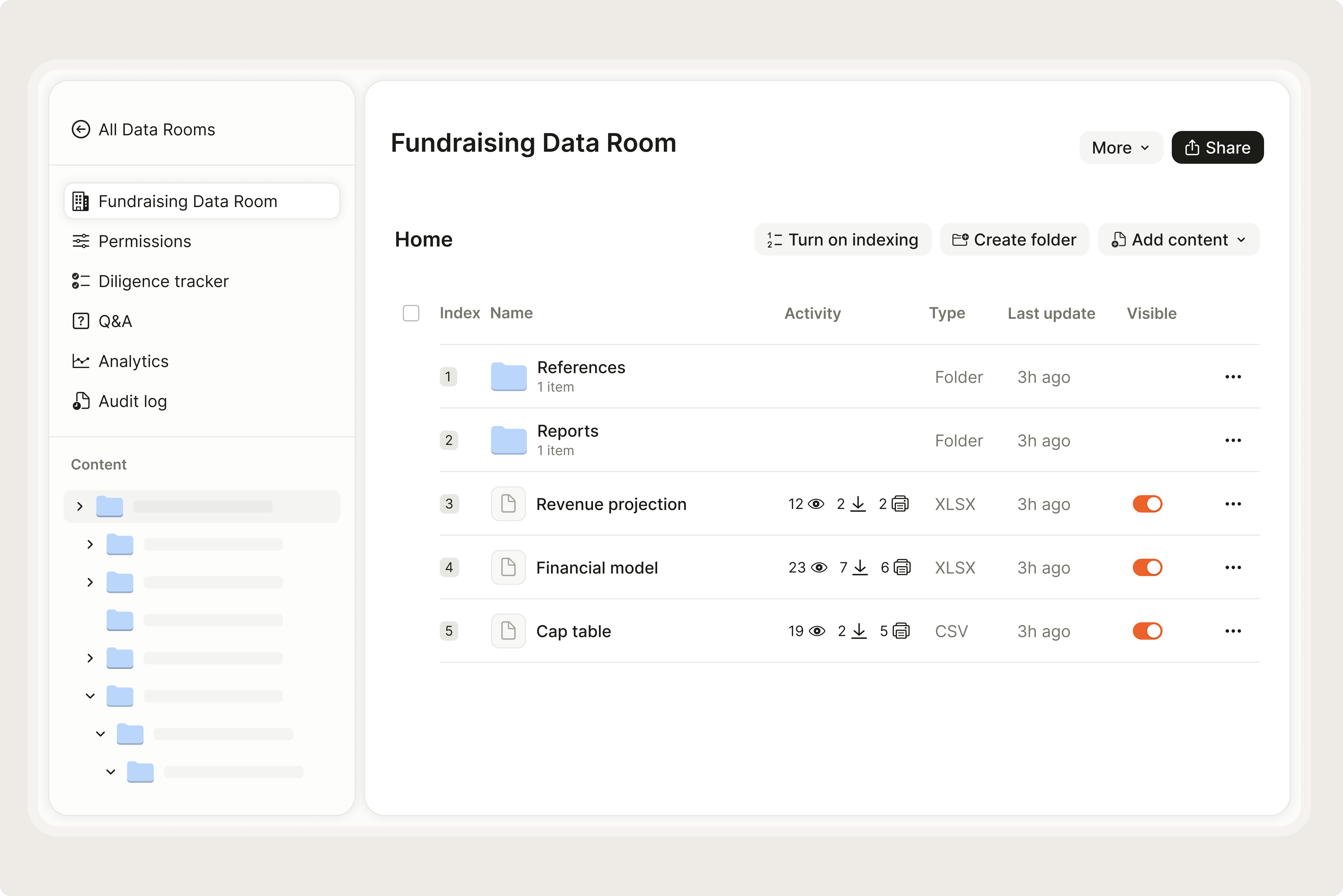
- 1.Load your proptech data room before any outreachCreate an Ellty data room and upload your pitch deck, pilot agreements, and ARR breakdown. Proptech VCs ask for these within 48 hours of a first call - have them organized in advance.
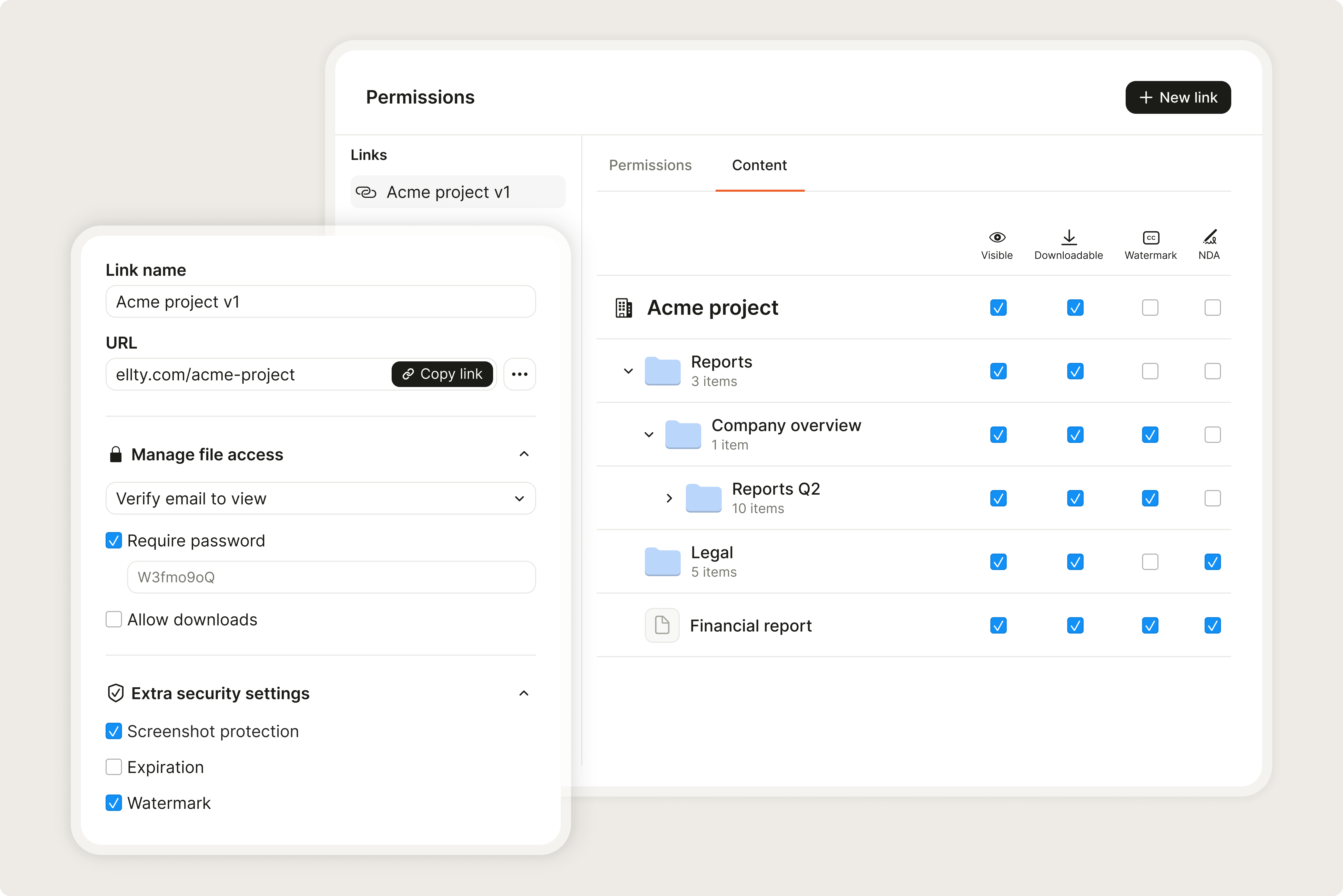
- 2.Configure link access for each investor you contactGenerate a unique trackable link per investor and require email verification before access. Keep your data licensing agreements and cap table separate from general pitch materials.
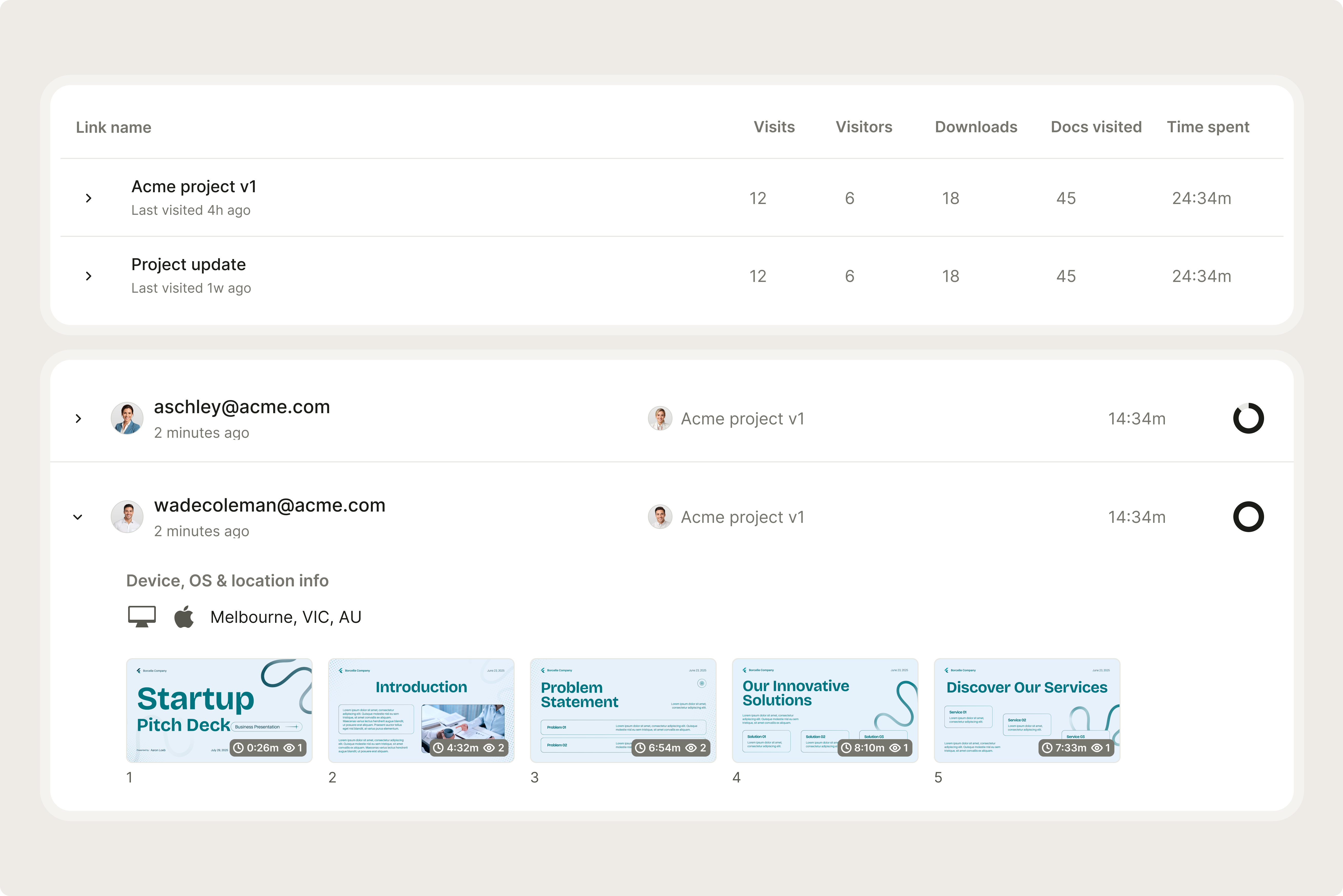
- 3.See exactly when investors review your documentsGet an instant notification when an investor opens your materials and which pages they spend time on. If they skip your enterprise pipeline slide, follow up with a reference customer the same day.
Common questions about proptech investors
- In 2026, almost always yes. A signed pilot or LOI from a credible operator changes your risk profile overnight. Without it, you're asking investors to fund a go-to-market hypothesis they can't verify.
- Alate Partners focuses on commercial, residential, and industrial real estate tech across the full built environment. GroundBreak Ventures focuses specifically on housing and construction innovation with direct government program connections.
- Start with Toronto-based investors like Alate or GroundBreak for seed. Use their backing and your Canadian traction to then approach US funds like Fifth Wall or MetaProp for Series A.
- Before you send your first outreach email. Proptech VCs move to due diligence quickly when they're interested, and they'll ask for your data agreements and customer contracts within days.
- Proptech Collective events, DMZ programming, and REACH Canada alumni are the three best intro paths. Portfolio founder referrals convert faster than any other channel - reach out to two founders who've raised from your target fund first.
- Construction tech gets evaluated on speed of deployment and productivity gains per job site. Property management tech gets evaluated on tenant retention rates and operator cost reduction. Both need a signed enterprise customer, but the metrics they track are completely different.