A list of 16 active Toronto fintech investors deploying capital in 2026. Covers dedicated fintech VCs, corporate venture arms, and growth equity funds - with recent deals, check sizes, sector focus, and LinkedIn profiles for each.
Toronto is the second-largest financial centre in North America. That's not a marketing claim - it's the structural reality that makes it one of the best cities in the world to raise a fintech round. You're surrounded by the actual buyers: six of the world's soundest banks, major insurers, asset managers, and payments networks all within a few kilometres of each other.
Canadian fintech VC stayed steady in 2025 at around US$1.2 billion across 82 deals, consistent with 2024 despite the drop in headline numbers. Wealthsimple raised CAD $750 million at a CAD $10 billion valuation in October 2025. That's the clearest signal of how deep the capital goes here.
The challenge isn't finding investors. Toronto has more fintech-focused VCs per capita than most North American cities. The challenge is finding the right one. Portage only does fintech. Information Venture Partners only does B2B SaaS for financial services. Intact Ventures only does insurtech and adjacent. Pitching the wrong fund is a waste of a referral you won't get twice.
Canada's open banking framework is expected to roll out in 2026. That's creating fresh deal flow in payments, data portability, and banking infrastructure. If your product is positioned around that shift, the timing is real - not manufactured urgency.
This list covers 16 investors who closed deals or raised new capital in the last 12 months. For each of them, having your startup data room ready before the first meeting is the minimum expectation.
Toronto fintech investors at a glance
| Stage | Check | Sectors | Contact | |
|---|---|---|---|---|
| Portage Ventures | Seed - Series C | $1M-$15M | Fintech, Insurtech, Wealthtech | portageinvest.com |
| Framework Venture Partners | Series A, Series B | $3M-$15M | Fintech, AI, Enterprise SaaS | framework.vc |
| Luge Capital | Seed, Series A | $500K-$5M | Fintech, AI in Finance | luge.vc |
| Information Venture Partners | Series A | $2M-$10M | B2B Fintech, Enterprise SaaS | informationvp.com |
| Intact Ventures | Seed - Series B | $1M-$10M | Insurtech, Fintech, Mobility | intactventures.com |
| OMERS Ventures | Series A, Series B | $5M-$25M | Fintech, Enterprise, AI Infra | omersventures.com |
| Diagram Ventures | Pre-seed, Seed | $500K-$5M | Fintech, Web3, ClimateTech | diagram.vc |
| Round13 Capital | Series A, Growth | $3M-$15M | SaaS, Fintech, Consumer | round13capital.com |
| Inovia Capital | Seed - Growth | $1M-$30M+ | Fintech, SaaS, AI | inovia.vc |
| Golden Ventures | Pre-seed, Seed | $250K-$2M | AI, Fintech, SaaS | golden.ventures |
| MaRS IAF | Seed | Up to $500K | Fintech, Health, B2B SaaS | marsiaf.com |
| Georgian | Growth, Series B+ | $10M-$50M | AI SaaS, Fintech Infra | georgian.io |
| Panache Ventures | Pre-seed, Seed | $250K-$1.5M | B2B SaaS, Fintech, AI | panache.vc |
| York Angel Investors | Angel, Pre-seed | $50K-$500K | Fintech, B2B SaaS | yorkangels.ca |
| BDC Capital | Pre-seed - Growth | $500K-$20M | Cross-sector, Fintech | bdc.ca |
| Canapi Ventures | Seed - Series B | $2M-$15M | Banking Tech, Fintech Infra | canapi.com |
Share your fintech deck with Toronto VCs
Upload documents, send trackable links, and see who actually opens your deck.
Start 14-day trialWhat makes Toronto fintech unique
Toronto fintech is different from other Canadian cities because the buyers are right there. Banks, insurers, pension funds, and enterprise payments networks all operate at scale in the city. A fintech founder here can land a pilot with a Big Six bank without flying anywhere. That compression between builder and buyer creates a distinct dynamic.
The investor pool splits into three clear buckets. First, dedicated fintech funds like Portage, Luge, and Information Venture Partners who only back financial technology and bring a CVC-adjacent network of banks and insurers as commercial co-investors. Second, sector-agnostic Toronto funds like OMERS Ventures, Inovia, and Golden Ventures who have fintech as a consistent thesis. Third, corporate venture arms like Intact Ventures and BDC Capital who bring strategic value beyond money.
Stage sequencing matters more here than in most markets. Portage and Diagram write seed cheques. Framework and Information VP are Series A specialists. Georgian and OMERS write growth cheques. Mixing up which fund to approach at which stage is a waste of your best introductions. Read their last 5 deals on Crunchbase before reaching out - it takes 15 minutes and avoids embarrassing misalignments.
The what investors look for in a data room conversation comes up early in Toronto fintech raises. Investors here do rigorous diligence - they're used to evaluating companies against production standards set by their bank LPs. Have your materials organized before any partner asks.
How to find Toronto fintech investors
Check BetaKit's funding coverage and the CVCA member list before any outreach. Toronto's fintech investor pool is more concentrated than the city's general VC market - the same 20 investors appear across most fintech rounds. Knowing the active ones from the inactive ones takes a few hours of research and saves weeks of dead-end outreach.
The Canada FinTech Symposium, Toronto Tech Week, and Payments Canada Summit are where real introductions happen in 2026. These aren't networking events - they're where GPs actually evaluate founders in a low-pressure setting before deciding to take a meeting. Show up, find a connection to a specific portfolio company, and use that as your first sentence.
Search LinkedIn for portfolio company founders from Portage, Luge, and Framework. Message the ones at companies in your adjacent space. Ask about response times, follow-through on intros, and whether the GP was helpful during a down quarter. Most Toronto fintech founders will tell you honestly.
Upload your deck to Ellty and send each investor a unique trackable link. If a Toronto fintech GP spends time on your unit economics slide but skips your market size section, that's your follow-up signal. Don't send a generic check-in - reference the section they actually engaged with. Read how to share your data room without losing control to keep your materials protected during the process.
| Channel | Best for | What to do | Effectiveness | |
|---|---|---|---|---|
| BetaKit / Crunchbase | Research | Fund activity verification | Check last 5 deals, fund vintage | High |
| Portfolio founder outreach | Warm intro path | Real feedback on GP behavior | LinkedIn message to adjacent portfolio | Very High |
| Canada FinTech Symposium | Meeting GPs in person | Relationship-first conversations | Attend, target 3 partners max | High |
| Cold LinkedIn / email | Last resort | Rarely leads to term sheets | Only after thorough personalization | Low |
| MaRS / York Angel events | Early-stage pre-seed | Angel capital access | Pitch events and demo days | Medium |
The investment appetite for Canadian fintechs will continue to grow in 2026, as investors prioritize quality, scale and strategic fit, signalling a market that is maturing and aligning more closely with long-term value creation.
16 top Toronto fintech investors in 2026
1. Portage Ventures
Canada's largest dedicated fintech fund with $5.7B AUM - the natural first call for any Canadian fintech founder because they bring a commercial network of banks, insurers, and credit unions as direct co-investors.
- Recent deals: Closed a $280M continuation vehicle with Goldman Sachs Alternatives (Jan 2026) to manage Point72 Ventures' fintech portfolio. Led $26.9M Series A in ZILO with State Street (2025). Conquest Planning Series B co-investor (Jun 2025)
- LinkedIn: Portage Ventures
- Sector focus: Payments, insurtech, wealthtech, lending, fintech infrastructure
- Stage focus: Seed, Series A, Series B, Series C
- Location: Toronto, ON (also Montreal)
- Website: portageinvest.com
2. Framework Venture Partners
Toronto's specialist Series A fund for fintech and AI companies applying ML to proprietary financial datasets - backed by BDC and Deloitte Ventures as LPs, which signals real institutional endorsement.
- Recent deals: Led $12M Series A in Quandri with Intact Ventures (2025). 50 portfolio companies with 5 new investments in the last 12 months. Active deployment from their fintech and integrated AI fund
- LinkedIn: Framework Venture Partners
- Sector focus: Fintech, integrated AI, enterprise software with proprietary datasets
- Stage focus: Series A, Series B
- Location: Toronto, ON
- Website: framework.vc
3. Luge Capital
The only Canadian VC with offices in both Montreal and Toronto dedicated exclusively to early-stage fintech and AI applied to financial services - known for backing founders who challenge incumbent financial institutions.
- Recent deals: Active deployment across seed and Series A fintech rounds in Canada and the US through 2025-2026. Portfolio focus on payments, lending, and AI-driven financial infrastructure
- LinkedIn: Luge Capital
- Sector focus: Fintech, AI in finance, payments, lending, insurtech
- Stage focus: Seed, Series A
- Location: Toronto, ON (also Montreal)
- Website: luge.vc
4. Information Venture Partners
Founded by former RBC executives - the most domain-specific B2B fintech fund in Canada, which means their LP introductions to financial services buyers actually close pilots.
- Recent deals: Investment in DealMaker (2025). Portfolio includes Arteria AI ($30M Series B led by GGV Capital), Coconut Software, BigID, and Verafin. 34 portfolio companies across financial services SaaS
- LinkedIn: Information Venture Partners
- Sector focus: B2B SaaS for financial services, fintech infrastructure, cybersecurity
- Stage focus: Series A
- Location: Toronto, ON
- Website: informationvp.com
5. Intact Ventures
The venture arm of Intact Financial, Canada's largest P&C insurer - writes cheques that come with direct access to one of the country's largest insurance distribution networks as a potential pilot partner.
- Recent deals: Quandri Series A ($12M, co-led with Framework, Jul 2025). 42 portfolio companies, 9 exits. Active investment focus on AI-enabled distribution and insurtech platforms
- LinkedIn: Intact Ventures
- Sector focus: Insurtech, fintech, mobility, AI-driven distribution, property tech
- Stage focus: Seed, Series A, Series B
- Location: Toronto, ON
- Website: intactventures.com
6. OMERS Ventures
Backed by one of Canada's largest pension plans with $133B+ AUM - refocused on Canada in 2025 and writes $5M-$25M tickets from Fund IV, with deep patience for long-cycle fintech bets.
- Recent deals: OneVest follow-on (2025), Octaura debt round (2025). 98 portfolio companies including fintech positions. Made 5 investments in 2025. 10 unicorns, 3 IPOs, 19 acquisitions in portfolio history
- LinkedIn: OMERS Ventures
- Sector focus: Fintech, enterprise applications, vertical SaaS, AI infrastructure
- Stage focus: Series A, Series B
- Location: Toronto, ON
- Website: omersventures.com
7. Diagram Ventures
Montreal-based but deeply active in Toronto fintech - a venture builder that co-founds companies with domain experts, the right call if you're an ex-bank operator who wants to build something new with institutional backing.
- Recent deals: Synctera raised $18.6M led by Lightspeed with Diagram participation (Mar 2025). Pre-seed in Trice (bank payments infrastructure, with RBC and JAM FINTOP). Coral Seed round (Feb 2025). $200M+ raised across 3 funds
- LinkedIn: Diagram Ventures
- Sector focus: Fintech, Web3, insurance, health, ClimateTech
- Stage focus: Pre-seed, Seed, Series A
- Location: Montreal, QC (active Toronto fintech investor)
- Website: diagram.vc
Organize your fintech due diligence materials
Set up a data room with your financials, cap table, and bank agreements. Share securely with any Toronto investor.
Start 14-day trial8. Round13 Capital
Toronto growth fund that backs Canadian vertical SaaS and fintech companies with $1M+ ARR - one of the few local funds that explicitly requires revenue before writing a cheque, which makes their bar clearer than most.
- Recent deals: Active deployment through 2025-2026 with portfolio including League, Wealthsimple (early position), and PointClickCare. Multi-stage fund with dedicated growth capital alongside early-stage positions
- LinkedIn: Round13 Capital
- Sector focus: Vertical SaaS, fintech, consumer brands, enterprise software
- Stage focus: Series A, Growth
- Location: Toronto, ON
- Website: round13capital.com
9. Inovia Capital
Canada's largest multi-stage VC with a consistent fintech thesis - has backed Wealthsimple and Lightspeed at early stages and has the follow-on capacity and US networks to actually help you scale beyond Canada.
- Recent deals: Co-led Cohere $500M Series C (Aug 2025). Active across seed through growth stages in Canadian fintech and AI. Maintains dedicated growth fund alongside early-stage vehicles
- LinkedIn: Inovia Capital
- Sector focus: Fintech, AI, SaaS, consumer tech
- Stage focus: Seed through Growth
- Location: Toronto, ON (also Montreal, Calgary, San Francisco)
- Website: inovia.vc
10. Golden Ventures
Toronto's most consistent pre-seed fund across sectors - has a track record in fintech-adjacent plays and brings strong Waterloo corridor connections alongside a downtown Toronto presence.
- Recent deals: Active pre-seed and seed deployment across Canada in 2025-2026. Backed by Deloitte Ventures as LP, which adds enterprise network value for B2B fintech founders targeting Canadian financial institutions
- LinkedIn: Golden Ventures
- Sector focus: AI, fintech, SaaS, sustainable tech
- Stage focus: Pre-seed, Seed
- Location: Toronto, ON
- Website: golden.ventures
11. MaRS Investment Accelerator Fund (IAF)
Canada's most active early-stage VC by deal count - writes cheques up to $500K for Ontario-based fintech, health, and B2B SaaS founders who need institutional validation before their Series A.
- Recent deals: MedReddie investment (Nov 2025). 150+ portfolio companies backed since 2008. Latest investments focused on B2B software, fintech, and digital health with regular deployment through 2025-2026
- LinkedIn: MaRS Investment Accelerator Fund
- Sector focus: B2B SaaS, fintech, digital health
- Stage focus: Seed
- Location: Toronto, ON (Ontario-focused mandate)
- Website: marsiaf.com
12. Georgian
Toronto's largest applied AI investment platform with $5.9B AUM - writes $10M-$50M growth cheques into software and fintech companies that have proven AI creates measurable business value, not just as a feature.
- Recent deals: Raising a fresh $1B fund in 2025-2026. Active portfolio management across $5.9B AUM with continued fintech infrastructure investments through the year
- LinkedIn: Georgian
- Sector focus: Applied AI, fintech infrastructure, enterprise SaaS
- Stage focus: Series B, Growth
- Location: Toronto, ON
- Website: georgian.io
13. Panache Ventures
Canada's most geographically distributed early-stage fund - active in Toronto but writes pan-Canadian pre-seed cheques, worth approaching if you're based outside Toronto but targeting the city's fintech market.
- Recent deals: Active deployment in 2025-2026 across B2B SaaS, fintech, and AI startups across Canada. Strong Western Canada presence combined with Ontario deal flow
- LinkedIn: Panache Ventures
- Sector focus: B2B SaaS, fintech, AI, deep tech
- Stage focus: Pre-seed, Seed
- Location: Toronto, ON (also Calgary, Vancouver, Ottawa)
- Website: panache.vc
14. York Angel Investors
Ontario's largest structured angel network focused specifically on B2B SaaS and fintech - a fast path to an angel round for early Toronto fintech founders before institutional VCs are ready to engage.
- Recent deals: Continued active deployment through 2025-2026 across Ontario-based fintech and B2B SaaS companies. Regular pitch competitions and structured investment process for early-stage companies
- LinkedIn: York Angel Investors
- Sector focus: Fintech, B2B SaaS, healthcare tech
- Stage focus: Angel, Pre-seed
- Location: Toronto, ON
- Website: yorkangels.ca
15. BDC Capital
Canada's national VC platform by deal count - co-invested in Wealthsimple's CAD $750M Series F (Oct 2025) and is an anchor LP across most of Toronto's active fintech funds, giving them visibility into the full deal stack.
- Recent deals: Co-investor in Wealthsimple CAD $750M Series F (Oct 2025, at CAD $10B valuation). Conquest Planning Series B co-investor (Jun 2025). Active across dedicated Women in Tech, IT, and growth funds in Toronto
- LinkedIn: BDC Capital
- Sector focus: Fintech, IT, cleantech, healthcare, cross-sector
- Stage focus: Pre-seed through Growth
- Location: Toronto, ON (also nationwide)
- Website: bdc.ca
16. Canapi Ventures
US-based but one of the most active cross-border fintech investors in Toronto deals - backed by a network of community and regional banks, making their introductions directly relevant if you're selling into North American banking.
- Recent deals: Co-investor in Conquest Planning Series B with Goldman Sachs (Jun 2025). Active in Canadian fintech infrastructure and banking technology deals through 2025-2026
- LinkedIn: Canapi Ventures
- Sector focus: Banking technology, fintech infrastructure, payments, compliance tech
- Stage focus: Seed, Series A, Series B
- Location: New York, NY (active Toronto fintech investor)
- Website: canapi.com
Closing Toronto fintech deals in 2026
Do your homework on the commercial angle before any pitch. Toronto fintech investors aren't just writing financial cheques - they're introducing you to Big Six banks, major insurers, and payment networks. Know which fund's LP base is most relevant to your distribution problem and lead with that. Portage has banks as LPs. Intact Ventures has Canada's largest P&C insurer behind it. Information VP came out of RBC. That context should drive your first paragraph.
Get to product-revenue proof faster than you think you need to. Investors here are used to evaluating against the standards of companies that actually run in production at Canadian financial institutions. "We're building the MVP" doesn't land with funds that have watched Wealthsimple and Borrowell scale. Show active users, pilot contracts, or signed LOIs with named financial institutions.
Upload your deck and financial model to Ellty and send a unique trackable link to each fund. When a Framework or Portage partner spends six minutes on your unit economics but skips your competitive landscape, that's your next email. Don't ask for feedback on the whole deck - reference the specific section they engaged with. You'll get a response.
The Canada FinTech Symposium in Toronto is where the right introductions happen in 2026. The Payments Canada Summit is where payments and open banking conversations actually start. Avoid smaller local pitch nights - the right partners from Portage, Luge, and Framework aren't there. Spend your time at the two or three events where your target GPs actually show up.
Set up an Ellty data room with your financial model, cap table, pilot contracts or bank agreements, and regulatory compliance documentation before anyone asks. Toronto fintech investors move fast once they're interested - having your materials organized and permission-controlled prevents the bottleneck that kills momentum in week three of diligence. See how fundraising data room mistakes can slow your raise before it even starts.
| Step | What to do | Why it matters | Tools | |
|---|---|---|---|---|
| Research | Check last 5 deals, fund vintage, LP base | Avoids stage and sector mismatches | Crunchbase, BetaKit | ✗ |
| Identify right entry point | Portage / Luge for seed, Framework / IVP for Series A | Protects your warm intro capital | CVCA member list | ✗ |
| Get a warm intro | Message portfolio founders on LinkedIn | Cold DMs rarely convert in Toronto | ✗ | |
| Share your deck | Trackable link per investor via Ellty | Know exactly who opened what and when | Ellty | ✗ |
| Organize diligence | Ellty data room with financials and bank agreements | Fintech investors move fast once interested | Ellty | ✗ |
How to pitch a Toronto fintech investor
Specific tactics that work for founders raising in Canada's financial capital.
- 1.Anchor your pitch in a real financial institution pain pointToronto VCs have watched dozens of fintech founders describe transforming how banks operate. The ones who close rounds show a specific, named problem they've validated with a Big Six bank, insurer, or credit union. A signed pilot LOI with TD, Sun Life, or Interac is worth more than any market-size slide. Name the institution and the problem on slide two.
- 2.Map your round to Canada's open banking timelineThe Canadian open banking framework is expected in 2026. If your product plays in data portability, account aggregation, payments rails, or financial data APIs, connect your roadmap to that regulatory shift explicitly. Investors like Portage and Information VP already have thesis documents on this. Showing you understand the policy context signals you've done the homework.
- 3.Show your compliance posture earlyToronto fintech investors know their bank and insurer LPs will ask about regulatory compliance before any pilot. Show your FINTRAC, OSFI, or PIPEDA awareness in the pitch - not as a risk item, but as a competitive advantage. Founders who've designed for compliance from day one sell into regulated buyers faster.
- 4.Use trackable links to personalize your follow-upSend each investor their own Ellty link. When a Portage partner reads your unit economics slide three times but skips your competitive moat section, your next email writes itself. Reference what they actually engaged with, not a generic follow-up on the whole deck. That precision converts more meetings than any pitch template.
- 5.Lead with your path to a Canadian bank as a reference customerThe exit question in Toronto fintech is almost always about US expansion. Investors want to know you can win in a regulated Canadian market first. A signed contract with a Canadian bank, credit union, or insurance company - even at pilot scale - is the clearest proof point that you can sell into a compliance-first buyer.
How Ellty helps you land a Toronto fintech investor
Now that you know the investors, here's how to get your materials ready. Toronto fintech investors run tight diligence cycles - when Portage or Framework is interested, they want your financial model, cap table, and bank agreements within 48 hours. A shared Google Drive with emailed PDFs is not the impression you want to make with funds that have seen 300 fintech pitches. Set up a proper data room before your first conversation and control exactly who sees what from day one.
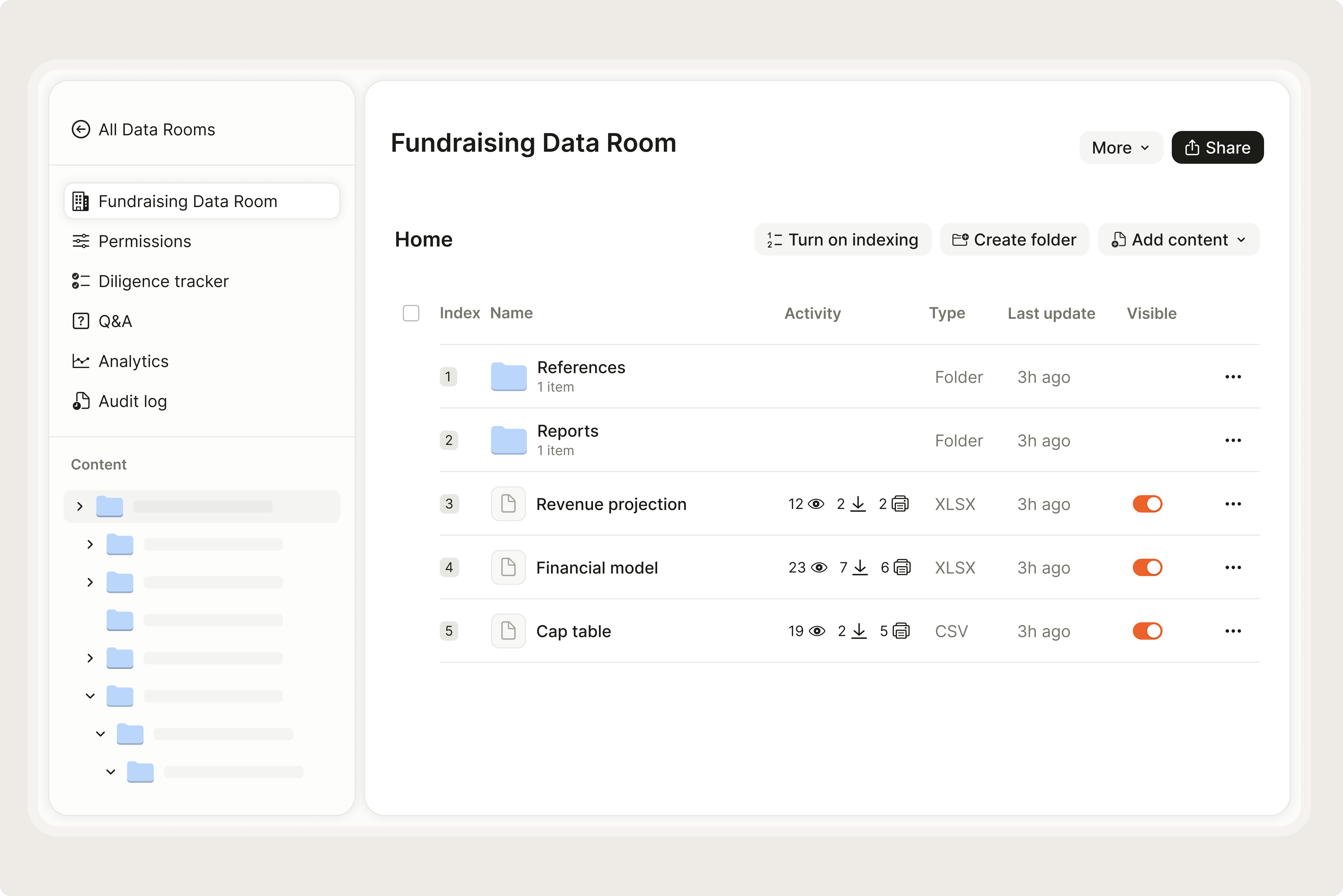
- 1.Build your fintech investor data room in one sessionCreate a free Ellty data room and upload your pitch deck, financial model, cap table, pilot contracts, and any compliance documentation. Organize into folders - financials, product, and legal. Toronto fintech VCs like Portage and IVP run structured diligence. Make it easy for them to find what they need without asking.
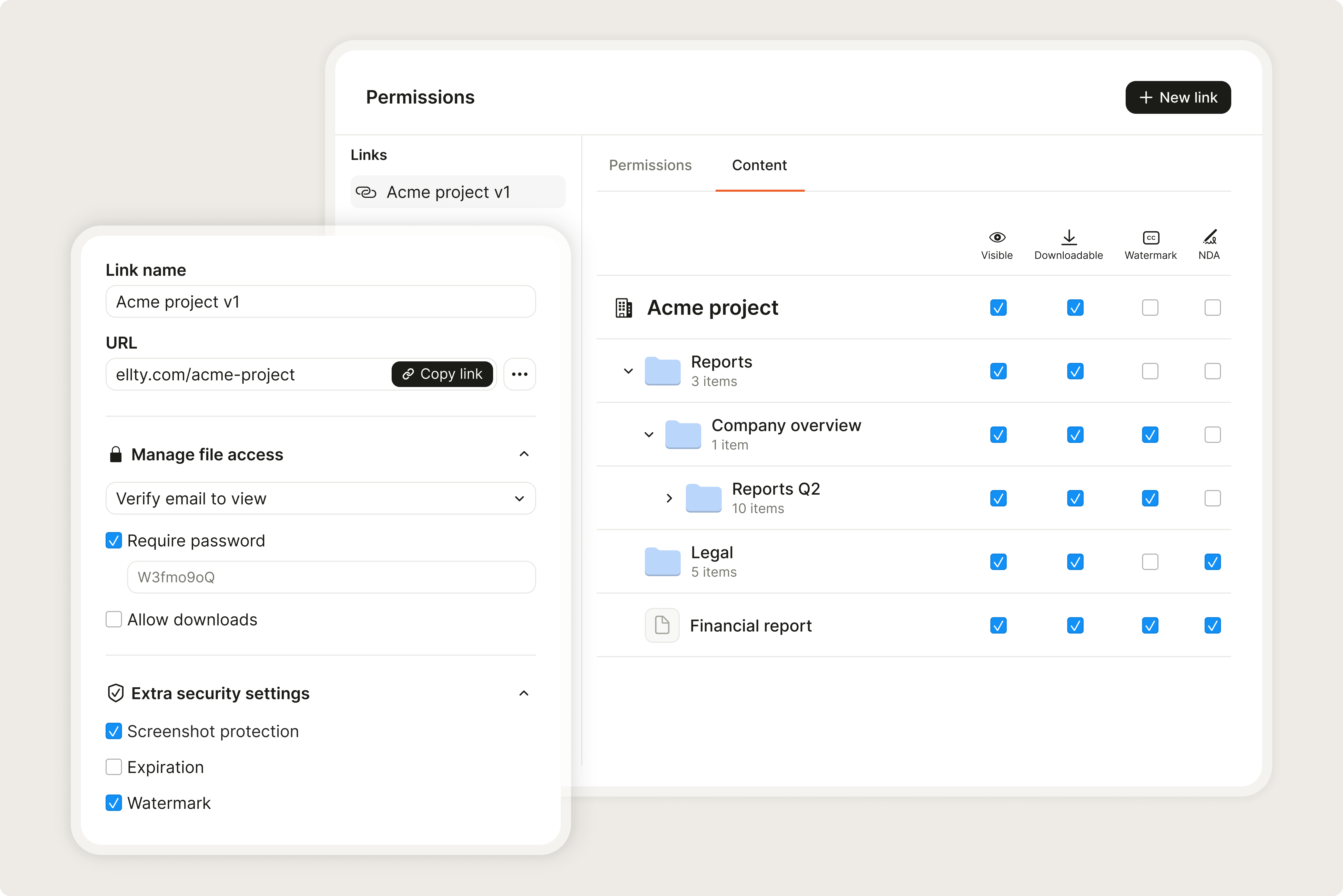
- 2.Send each fund a permission-controlled unique linkGenerate a separate trackable link for every investor - Portage, Framework, Luge, IVP, Intact. Require email verification before viewing. Turn on screenshot protection for your cap table and financial model. Know immediately when a partner shares your link with a colleague or co-investor at another Toronto fund.
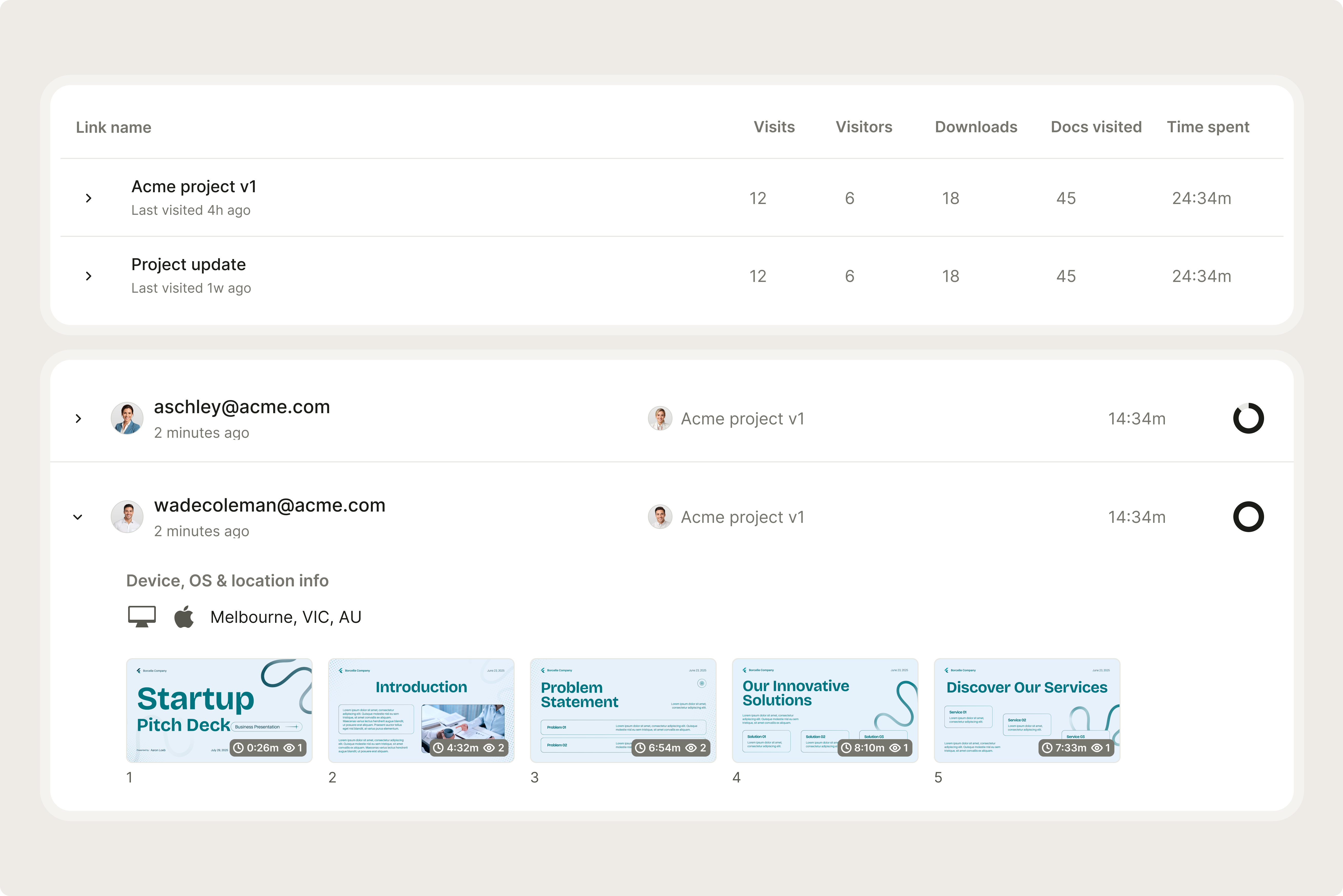
- 3.Get notified the moment a Toronto VC opens your materialsGet an instant alert when a GP opens your link. See which slides they spent the most time on and which ones they bounced past. If an Intact Ventures partner reads your insurtech GTM section twice, that's your follow-up angle. Reach out while you're still on their screen - that's when response rates are highest.
What founders ask about raising Toronto fintech
- Not always, but it helps. MaRS IAF has Ontario-based mandates. Portage, Framework, and Information VP will back companies based outside Toronto if the product is fintech-relevant and the team has Canadian market experience. OMERS Ventures has funded US-based companies with Canadian go-to-market plans.
- For seed, it's a named pilot or LOI with a financial institution. For Series A, it's net revenue retention above 110%, CAC payback under 18 months, and at least one bank, insurer, or credit union as a paying customer. Generic SaaS metrics don't cut it with domain-specific funds like IVP or Framework.
- It's creating real urgency in certain categories. If you're building in account aggregation, payment initiation, or financial data APIs, you can tie your roadmap to a regulatory catalyst. Portage and Luge both have portfolio companies positioned around open banking. Showing you understand the framework timeline is an easy differentiation from founders who haven't done the homework.
- No - lead with independent funds like Portage, Framework, or Luge first. Corporate VCs typically co-invest rather than lead. Intact Ventures and BDC add the most value as co-investors once you have a credible lead. Approaching them without a lead investor signals you haven't found real validation yet.
- Before your first investor meeting. Toronto fintech VCs move fast when interested - Portage and Framework can go from first meeting to term sheet in under four weeks if they like the company. Having your financial model, cap table, and any pilot agreements organized in an Ellty data room from day one prevents the scramble that kills momentum in diligence. See what to include with this guide on [what to include in a fundraising data room](/blog/what-include-in-fundraising-data-room).
- Toronto has the financial institution density that Montreal and Vancouver don't - banks, insurers, pension funds, and payments networks all within walking distance of each other. That means pilots happen faster and investors have a better-calibrated sense of what institutional sales cycles really look like. For comparison, see our lists of [Ontario investors](/investors/ontario-investors) and [Quebec investors](/investors/quebec-investors).