A verified list of 12 active Toronto real estate investors deploying capital in 2026. Covers private equity firms, institutional funds, proptech VCs, and development-focused investors — with recent deals, check sizes, sector focus, and LinkedIn profiles for each.
Toronto is one of the most capital-intensive real estate markets in North America.
The GTA benchmark home price sat at roughly $939K in February 2026, with cap rates ranging from 3.5% to 5.5% depending on asset class. That math doesn't work for most retail investors — which is why institutional and private equity capital dominates Toronto's real estate landscape.
The investor mix here is different from other Canadian cities. You have pension-backed giants like Oxford Properties ($87B AUM), Toronto-headquartered private equity firms like KingSett and Slate, and a growing proptech VC layer funding companies that digitize how real estate is bought, managed, and financed. Not all of them are looking for the same thing.
If you're raising capital for a real estate development, proptech startup, or real estate fund, you need to know who's actively deploying. Funds that raised in 2022 and went quiet won't tell you that directly. This list focuses on investors with verified 2025-2026 activity.
Toronto real estate investors: overview
| Stage | Check | Focus | Contact | |
|---|---|---|---|---|
| KingSett Capital | Growth, Institutional | $50M+ | All CRE asset classes | kingsettcapital.com |
| Oxford Properties | Growth, Core+ | $100M+ | Office, industrial, retail, residential | oxfordproperties.com |
| Crestpoint Real Estate | Core, Value-Add | $50M+ | Office, industrial, retail, multi-family | crestpoint.ca |
| Starlight Investments | Core, Growth | $30M+ | Multifamily, global real assets | starlightinvest.com |
| Greybrook Realty | Seed, Development | $5M-$50M | Residential development, value-add | greybrook.com |
| Hazelview Investments | Core, Value-Add | $20M+ | Multi-family, public/private REIT | hazelview.com |
| Fengate Asset Management | Core, Growth | $25M+ | Infra, private equity, real estate | fengate.com |
| Dream Unlimited | Development, Growth | $10M+ | Residential dev, income properties | dream.ca |
| Hazelview Ventures | Seed, Series A | $500K-$5M | PropTech, BuildTech, CleanTech | hazelview.com |
| Slate Asset Management | Core, Value-Add | $25M+ | Grocery retail, office, industrial | slateam.com |
| Walton Global | Pre-development, Land | $1M-$25M | Pre-development land, builder finance | walton.com |
| Round13 Capital | Series A, Growth | $3M-$15M | Real estate tech, proptech SaaS | round13capital.com |
Share your real estate deck with trackable links
Upload your pitch materials to Ellty and see which investors actually open your financials and pro formas.
Start free 14-day trialWhat is a Toronto real estate investor?
Toronto real estate investors are not a single category. You have pension-backed institutions managing tens of billions, private equity firms targeting specific asset classes, and proptech VCs writing $500K-$5M checks into technology companies reshaping how property is built and managed.
The distinction matters when you're raising capital. KingSett and Oxford write institutional checks for completed income-producing assets. Greybrook and Dream fund residential development at the project equity level. Hazelview Ventures and Round13 back proptech startups.
Most institutional Toronto real estate capital is patient and long-cycle. Private equity real estate funds here typically target 7-10 year hold periods with IRRs in the 12-18% range for value-add strategies. Core strategies accept lower returns in exchange for stability.
What they share is a preference for demonstrated Toronto market knowledge. Foreign founders pitching Toronto land plays or multifamily acquisitions without local comparables and zoning expertise rarely get past a first meeting. The real estate connection gives proptech-focused investors deal access and customer introductions — but they still want product-market fit.
Toronto real estate market: 4 facts
Canadian institutional investors and family offices are acquiring distressed assets and assembling land parcels in preparation for future growth opportunities.
12 Toronto real estate investors in 2026
1. KingSett Capital
Canada's most active private equity real estate firm — co-acquired First Capital REIT's portfolio alongside Choice Properties in the largest Canadian real estate deal of April 2026, valued at $5.2B total.
- Recent deals: Co-acquired First Capital REIT portfolio with Choice Properties ($5.2B deal, April 2026); West Square Toronto residential project first occupancy June 2026; Scotia Plaza O&B space opened September 2025; 130 Bloor Harry Rosen flagship opening 2026
- LinkedIn: KingSett Capital
- Sector focus: Office, industrial, retail, multi-family residential, real estate debt
- Stage focus: Core, Core+, Value-Add, Development
- Location: Toronto, ON
- Website: kingsettcapital.com
2. Oxford Properties Group
OMERS-owned global real estate manager with $87B AUM — one of the few Canadian real estate investors with genuine scale across office, industrial, retail, residential, life sciences, and hotel assets worldwide.
- Recent deals: Active development and asset management across Toronto's major office and industrial portfolio through 2025-2026; key development partnerships with major Canadian pension capital continue through 2026
- LinkedIn: Oxford Properties
- Sector focus: Office, industrial, retail, multi-family, life sciences, hotel
- Stage focus: Core, Core+, Development
- Location: EY Tower, Toronto, ON (also London, New York, Sydney)
- Website: oxfordproperties.com
3. Crestpoint Real Estate Investments
Part of Connor Clark & Lunn ($179B total AUM) — their Opportunistic Real Estate Strategy closed December 2025 and had already deployed 70%+ of committed equity by January 2026.
- Recent deals: Acquired 22-property retail and two office buildings from H&R REIT (January 2026); took Minto Apartment REIT private in $2.3B deal with Minto Group (January 2026); Opportunistic Real Estate Strategy fund closed December 19, 2025
- LinkedIn: Crestpoint Real Estate Investments
- Sector focus: Office, industrial, retail, multi-family residential
- Stage focus: Core, Core+, Value-Add, Opportunistic
- Location: Toronto, ON (also Vancouver, Ottawa)
- Website: crestpoint.ca
4. Starlight Investments
A $30B Toronto-based private real estate manager — launched the Starlight Canadian Core Multi-Family Fund in June 2025 with $415M in initial CIBC equity to acquire $750M in purpose-built rental apartments.
- Recent deals: Starlight Canadian Core Multi-Family Fund launch with $415M CIBC equity (June 2025); Global Real Assets Trust preferred unit offering at 6.85% yield (May 2026); ongoing multifamily acquisition and development pipeline across Canada
- LinkedIn: Starlight Investments
- Sector focus: Multifamily residential, global real assets, infrastructure
- Stage focus: Core, Value-Add, Development
- Location: Toronto, ON
- Website: starlightinvest.com
5. Greybrook Realty Partners
Toronto-based private equity real estate firm focused on residential development — invested equity in 115+ projects with an estimated completion value exceeding $45B across Canada and the US.
- Recent deals: $22.85M equity investment to acquire and develop Berwick Avenue land in Toronto (2025); $42M investment closed December 2025; hosted 2025 Perspectives & Insights event with BMO Chief Economist Doug Porter
- LinkedIn: Greybrook Realty Partners
- Sector focus: Residential development, mixed-use development, value-add real estate
- Stage focus: Pre-development, Development, Value-Add
- Location: Toronto, ON
- Website: greybrook.com
Before you send materials to any of these firms, get your due diligence package organized. Toronto institutional investors expect complete documentation before they engage seriously with any deal.
Organize your real estate due diligence documents
Set up an Ellty data room with your financial model, cap table, and deal terms before investors ask.
Start free 14-day trial6. Hazelview Investments
A global real estate investment manager with $10B+ AUM — completed a strategic combination with Presima in early 2026, and secured one of Canada's largest CMHC-insured MLI Select loans in 2025.
- Recent deals: Strategic combination with Presima (Slate's listed REIT arm) completed 2026; secured one of the largest CMHC MLI Select loans ever issued (2025); fee reduction on Alternative Real Estate Fund effective October 2025; 22,000+ multi-residential suites under management
- LinkedIn: Hazelview Investments
- Sector focus: Multi-family residential, public and private REITs, global real estate
- Stage focus: Core, Value-Add, Development
- Location: Toronto, ON (also global)
- Website: hazelview.com
7. Fengate Asset Management
50+ year-old alternative investment manager with $27B+ AUM and 275+ professionals — covers infrastructure, private equity, and real estate, with 2026 WiredScore Portfolio recognition for their commercial buildings.
- Recent deals: 2026 WiredScore Portfolio Cohort recognition for commercial real estate portfolio; Managing Director Rishi Bajaj speaking on capital flows at RealCapital Conference 2026; 50+ years of active Canadian real estate investment
- LinkedIn: Fengate Asset Management
- Sector focus: Real estate, infrastructure, private equity
- Stage focus: Core, Value-Add, Development
- Location: Toronto, ON (also across Canada and US)
- Website: fengate.com
8. Dream Unlimited Corp.
Toronto's most diversified real estate developer and asset manager — $28B AUM across three TSX-listed trusts, with active development in Western Canada master-planned communities and Toronto income properties.
- Recent deals: Dream Impact announces plan to focus on major Toronto projects (January 2026); active Q4 2025 deployment across residential and commercial portfolio; $28B total AUM across three TSX trusts as of December 31, 2025
- LinkedIn: Dream Unlimited
- Sector focus: Residential development, commercial income properties, affordable housing, renewable energy
- Stage focus: Development, Core, Value-Add
- Location: Toronto, ON
- Website: dream.ca
9. Hazelview Ventures
The proptech venture arm of Hazelview Investments — backs seed-to-Series A proptech, buildtech, and cleantech startups with direct access to Hazelview's 22,000+ suite residential portfolio for testing and piloting.
- Recent deals: Participated in Augmenta seed round alongside institutional investors (2025); active proptech and buildtech deployment from current fund; portfolio companies get direct integration access across Hazelview Properties' national portfolio
- LinkedIn: Hazelview Ventures
- Sector focus: PropTech, BuildTech, CleanTech, construction technology
- Stage focus: Seed, Series A
- Location: Toronto, ON
- Website: hazelview.com
Set up an Ellty data room before reaching out to proptech investors. Hazelview Ventures and Round13 move fast when they're interested — have your deck, metrics, and financials ready to share as a trackable link with analytics on who opened what.
10. Slate Asset Management
Toronto-based real estate investment and asset management firm focused on grocery-anchored retail and value-add assets — founded 2005, headquartered at 121 King St West in Toronto's financial core.
- Recent deals: Presima (Slate's listed REIT arm) combined with Hazelview Investments in strategic transaction (2026); active commercial real estate deployment across grocery-anchored retail, office, and industrial assets in Canada and Europe
- LinkedIn: Slate Asset Management
- Sector focus: Grocery-anchored retail, office, industrial, real estate debt
- Stage focus: Core, Value-Add, Opportunistic
- Location: 121 King St W, Toronto, ON
- Website: slateam.com
11. Walton Global
Pre-development land investment firm managing US $4.44B across 85,000+ acres in North America — connects 88,000+ global investors with land deals through structured vehicles and builder land financing.
- Recent deals: Acquired 30th property under Builder Land Finance Structure (2025); launched co-investment lot banking with GoldenTree Asset Management to expand Finished Lot Program (2025); successfully exited 300th property to date (2024)
- LinkedIn: Walton Global
- Sector focus: Pre-development land, builder land financing, build-to-rent, residential land
- Stage focus: Pre-development, Land Banking
- Location: Calgary, AB (Canadian HQ); active Ontario and GTA land pipeline
- Website: walton.com
12. Round13 Capital
Toronto's growth-stage VC with active proptech and real estate technology investments — backs companies with $1M+ ARR and was ranked among Canada's most active real estate technology investors by deal count.
- Recent deals: Active proptech SaaS and real estate tech deployment through 2025-2026; portfolio includes PointClickCare, League, and broader Canadian software companies; $100M+ deployed across current fund
- LinkedIn: Round13 Capital
- Sector focus: Proptech SaaS, real estate technology, AI-enabled vertical software
- Stage focus: Series A, Growth
- Location: Toronto, ON
- Website: round13capital.com
What Toronto real estate investors want
Toronto institutional investors evaluate deals through a lens of risk-adjusted returns, not just upside. KingSett, Crestpoint, and Oxford target core and core-plus assets with predictable cash flows. They want 95%+ occupancy, institutional-quality tenants, and transit-oriented locations.
Value-add players like Slate and Hazelview look for assets with repositioning potential — underrented leases, deferred maintenance, or zoning upside in established neighborhoods. They model specific return outcomes. If your pro forma relies on rent growth above CMHC forecasts, expect direct pushback.
Development-focused investors like Greybrook and Dream focus on the development yield spread. In Toronto's 2026 market — where construction costs remain elevated and condo presales have softened — that spread has compressed. Show them how your project still works on a risk-adjusted basis. See our real estate due diligence guide for what to have ready at each stage.
Proptech investors like Hazelview Ventures want product-market fit inside the real estate enterprise stack. Signed contracts with named property management companies will move them. Two pilot customers and a demo won't. Use a virtual data room for asset sales when sharing deal materials under NDA.
How to verify a fund is still deploying
The fastest way to lose an introduction is pitching a Toronto real estate fund that raised in 2021 and has been in harvest mode since. Before any outreach, check Crunchbase and RENX for their last five disclosed deals and when their most recent fund closed.
For institutional funds, check the CVCA active member directory and cross-reference deals against public announcements. Crestpoint's Opportunistic fund closed December 2025 and deployed 70%+ of equity in the first six weeks — that's a clear active signal. A fund last mentioned in a press release in 2023 is not.
For proptech VCs, check whether their portfolio companies are still operating and growing. Dead portfolio companies are a real flag in any investor check. Message two or three portfolio founders directly and ask whether the fund was responsive post-investment. Most will answer honestly.
Use Ellty to send trackable links when you do initial outreach to test fund responsiveness. A link that never gets opened after two weeks tells you something real about whether that fund is actively reviewing new deals right now.
How to approach Toronto real estate investors
The Toronto real estate community is relationship-dense. Warm introductions from portfolio founders, legal counsel, or institutional lenders move you past cold email every time. Most funds won't respond to cold LinkedIn outreach at the senior level — even more so for institutional capital than proptech VCs.
Start by identifying which funds are actively deploying in your specific asset class and stage. Greybrook won't write a proptech check. Hazelview Ventures won't fund a core office acquisition. Matching asset class to investor mandate is table stakes before any outreach.
When you do reach out, show you've done the work. Reference a specific deal they closed in 2025 or 2026. Mention a portfolio company or founder you know. Toronto real estate investors see hundreds of decks — show them you understand their actual mandate before asking for their time.
Use Ellty to share your pitch deck and deal materials as a trackable link before your first call. If a KingSett principal opens your financial model section twice but skips your market comparable slides, you know exactly what to reinforce in the first five minutes of your meeting. Set up your fundraising materials early and track every open.
How to pitch a Toronto real estate investor
Specific tactics for founders and deal sponsors raising from Canada's most capital-intensive real estate market.
- 1.Anchor every number to a Toronto-specific comparableToronto real estate investors know the comp set better than most founders expect. If you say your project is worth $500K per door at stabilization, name the exact buildings you're comparing to. Reference actual transaction data from RENX, Altus, or CBRE. If you can't defend your assumptions at the asset level, you won't get to a term sheet with the institutional players.
- 2.Build the warm introduction before you send anythingKingSett, Oxford, and Crestpoint rarely fund people they haven't met through intermediaries. Identify which lawyer, broker, or lender introduced the last three deals each fund closed. Request a warm intro through that channel. Cold email to a managing partner at a Toronto institutional real estate fund rarely leads anywhere.
- 3.Match your stage and asset type to the right investorRaising development equity for a residential project? Approach Greybrook, Dream, or Slate. Building a proptech SaaS company? Go to Hazelview Ventures or Round13. Raising for an income-producing asset? Approach Crestpoint or Fengate. Mismatched outreach burns your best introductions on the wrong people.
- 4.Show your base case, upside, and downside side by sideToronto real estate investors in 2026 are underwriting more conservatively after two years of rate volatility. Show base case, upside, and downside on exit cap rates and construction costs. Investors who only see the upside scenario assume the rest of the model doesn't hold up — because usually it doesn't.
- 5.Follow up based on actual engagement data, not a fixed scheduleUpload your deal summary to Ellty and send each investor a unique trackable link. Follow up within 24 hours of the link opening, not on a weekly calendar cadence. If a Greybrook partner reads your pro forma but skips the market section, you know what to open your follow-up with. Timing based on real engagement signals deal discipline.
How Ellty helps you land a Toronto real estate investor
Now that you know the investors, here's how to prepare your materials. Toronto real estate investors — from KingSett to Hazelview Ventures — want organized professional documentation from the first conversation. They have seen what a serious sponsor's data room looks like. A shared Google Drive with unlabelled PDFs is not it. Set up a secure, trackable data room before your first call and control exactly who sees what.
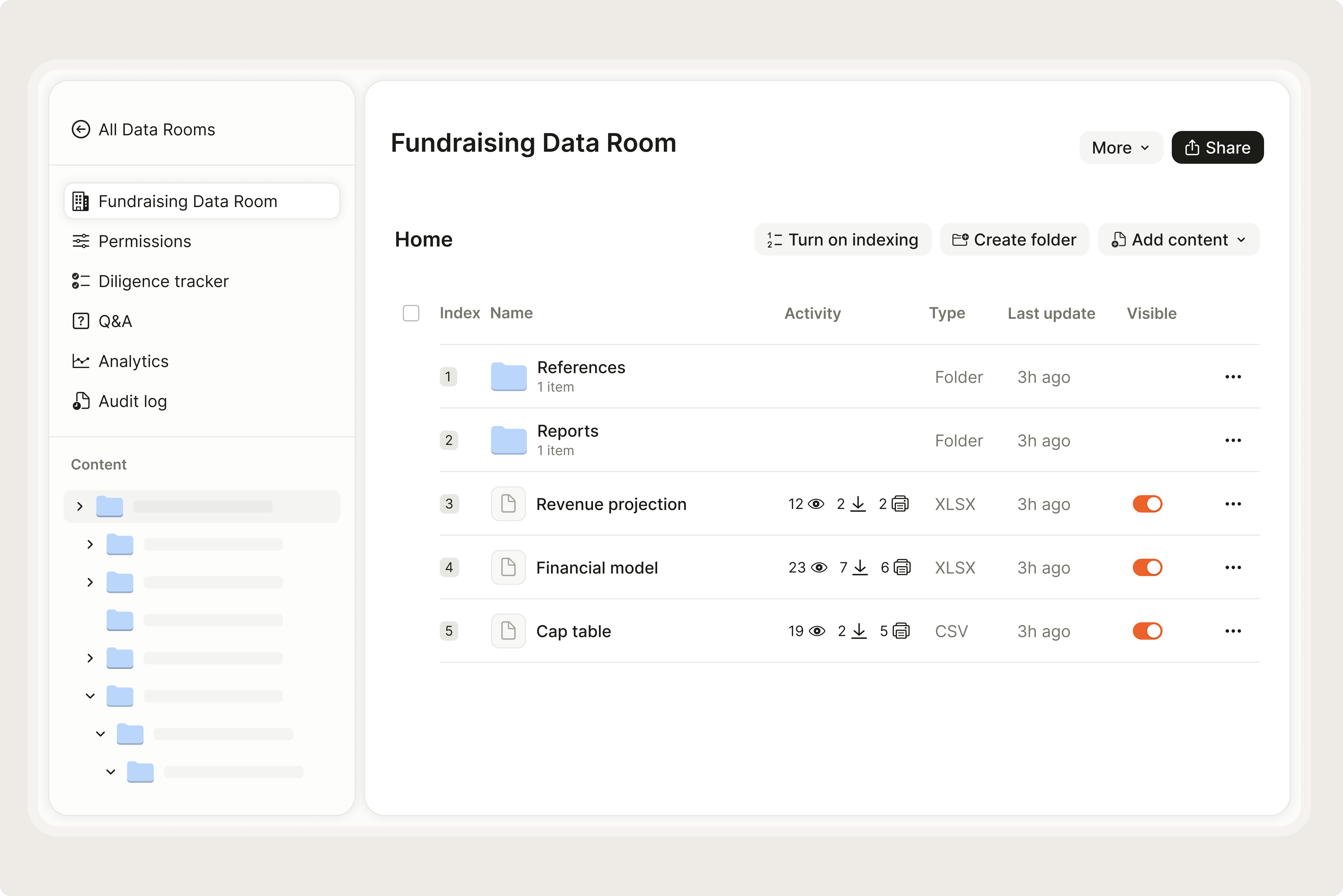
- 1.Build your deal room before the first investor meetingCreate an Ellty data room and upload your deal summary, financial model, pro forma, cap table, and comparable transaction data. Organize into clear folders — deal overview, financials, legal, and comparables. Toronto real estate investors like Crestpoint and KingSett review dozens of deals per month and immediately see when a sponsor has their documentation in order.
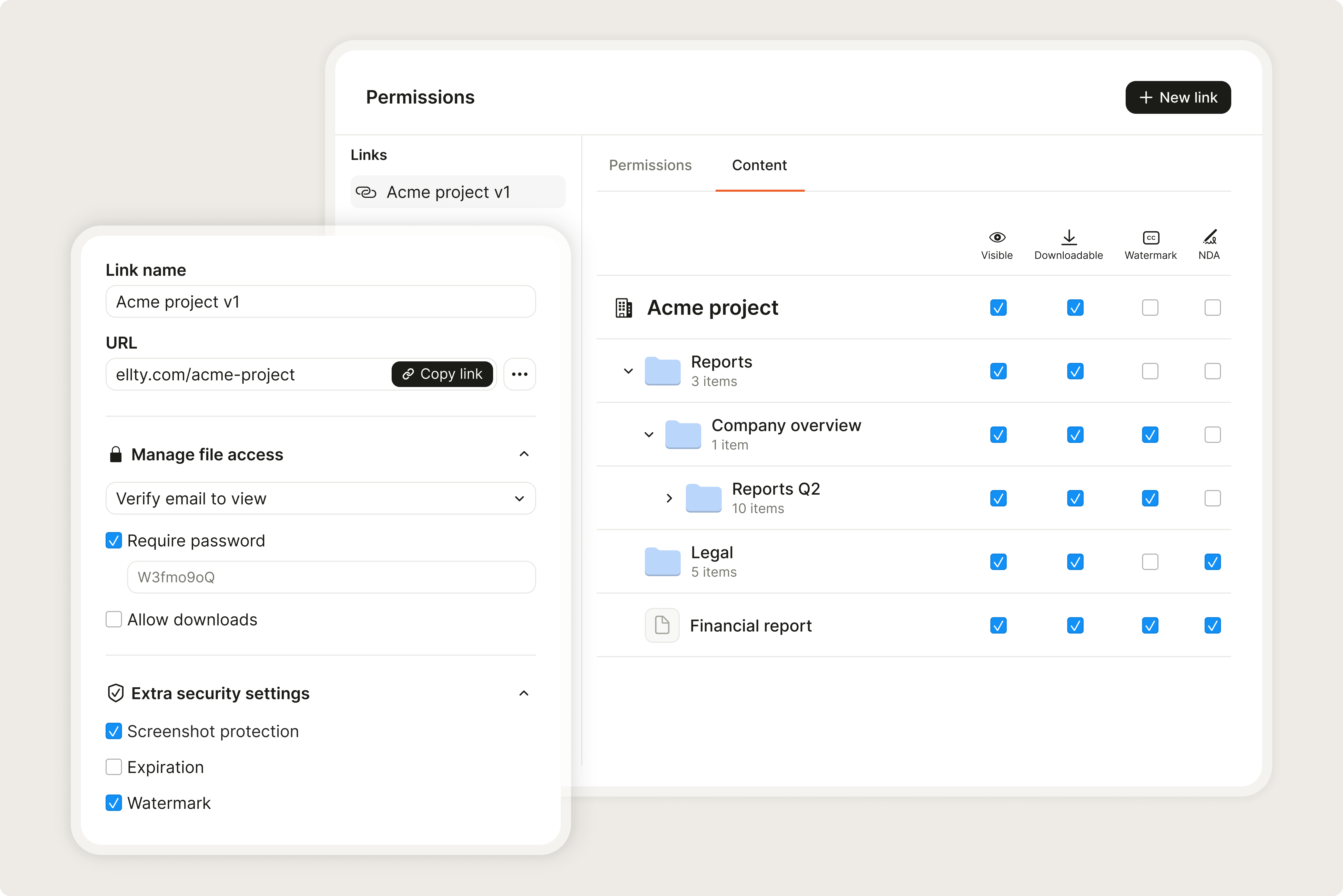
- 2.Create separate trackable links for each fundGenerate a separate trackable link for each investor — KingSett, Crestpoint, Greybrook, Hazelview. Require email verification before viewing. Enable screenshot protection on your financial model and cap table. Know immediately if a fund forwards your link to their legal or due diligence team, which is a strong signal of active interest.
- 3.Get instant alerts when investors open your deal materialsGet a real-time notification the moment a Toronto real estate investor opens your link. See which sections they spent the most time on and which they skipped. If a Greybrook principal reads your pro forma three times but barely looks at your team bio, lead with deal track record on the follow-up call.

Questions Toronto real estate founders ask before raising
- A real estate PE fund like KingSett or Crestpoint buys physical assets — buildings, land, development projects. They underwrite deals based on cap rates, NOI, and exit values. A proptech investor like Hazelview Ventures or Round13 backs technology companies that improve how real estate is built, managed, or transacted. If you're a software founder, you want the proptech layer. If you're a developer or asset sponsor, you want the PE funds.
- Before your first serious meeting with any institutional fund. KingSett, Crestpoint, and Oxford move from first call to letter of intent in weeks when they like a deal — and they'll ask for organized documentation immediately. Have your financial model, pro forma, comp data, and legal structure in a clean Ellty data room before you take that first meeting. Scrambling for documents after an LOI request kills momentum at the worst possible moment.
- Yes, and the bar is rising. KingSett, Oxford, and Fengate all have active sustainability programs. Fengate's commercial portfolio earned 2026 WiredScore recognition. Institutional investors with pension mandates increasingly screen against ESG criteria. Don't overstate your position, but if your project includes energy efficiency measures or transit-oriented density, mention it specifically with numbers attached.
- Rarely. Toronto's institutional real estate community is small and relationship-driven. The same lawyers, brokers, and lenders appear across most major deals. Your fastest path to a meeting with KingSett, Greybrook, or Hazelview is through a referral from a firm they already work with. A cold LinkedIn message to a managing partner at a Toronto institutional fund is almost never the path forward.
- Don't mass-email. Send a personalized pitch to 5-8 funds that genuinely match your asset class and stage. Toronto is a small community and fund partners talk to each other. If you're seen shopping a deal to every investor at once, it signals you can't close on your best relationship first. Work your strongest introduction before moving to the next fund.
- Deal summary, financial model with sensitivity analysis, pro forma, cap table, comparable transaction data, legal entity structure, any LOIs or signed agreements, and your team's track record on prior deals. Toronto institutional investors expect all of this to be organized and accessible before they engage in formal due diligence.