Delaware's 4% transfer tax is among the highest in the US, and its brownfield inventory makes environmental checks non-negotiable on most commercial deals.
Delaware commercial diligence runs 30-60 days for a clean deal. A typical mid-market transaction pulls 80-120 documents into the data room before you're done. The state runs a deed transfer tax of up to 4% of fair market value - split between state and county - which has to be modeled into your cost basis from day one.
Delaware uses a grantor-grantee index system managed at the county recorder of deeds office. Title chains on older industrial parcels in Wilmington and Newark can be messy. Missing deed references and unreleased liens from prior owners are more common than buyers expect.
Environmental risk is real here. Delaware has a large concentration of former chemical, refining, and manufacturing sites, especially in New Castle County. DNREC maintains an active brownfields program, and RECs on Phase I ESAs are frequent enough that you should budget Phase II time into your initial schedule.
Where Delaware deals actually go wrong
Delaware's transfer tax is the first place deals slip. The combined state and county rate can hit 4% of fair market value, split between buyer and seller by default. On a $5M deal, that's $200,000 in transfer taxes - a number that reshapes negotiations if it wasn't modeled early.
Environmental liability is the second trap. New Castle County has one of the highest concentrations of industrial brownfields on the East Coast. Phase I ESAs regularly surface RECs that push into Phase II - adding weeks and real cost. DNREC's voluntary cleanup program can help, but it's a multi-month commitment.
Title records in Delaware are maintained county by county: New Castle, Kent, and Sussex each run their own recorder of deeds office. Older parcels, especially former industrial or farm-to-commercial conversions, frequently have deed reference gaps. A current owner search isn't enough - you need a full chain-of-title going back at least 40 years.
| Area | Documents to pull | Delaware red flag | Matters most for | Tier | |
|---|---|---|---|---|---|
| Title and ownership | Title and ownership | Chain-of-title search, deed history, recorder of deeds records | Deed reference gaps and unreleased liens on older industrial parcels | All buyers | Dealbreaker |
| Environmental | Environmental | Phase I ESA, Phase II if RECs, DNREC brownfield records | High REC frequency in New Castle County industrial corridor | Industrial, retail, mixed-use | Dealbreaker |
| Transfer tax | Transfer tax | Transfer tax calculation, allocation agreement in PSA | Combined rate up to 4% can move deal math on mid-market assets | All deals | Dealbreaker |
| Zoning and permits | Zoning and permits | Zoning verification letter, C of O, variance and permit records | County and municipal zoning inconsistencies in suburban New Castle | Development, repositioning | Dealbreaker |
| Easements and encumbrances | Easements and encumbrances | Survey, easement docs, title commitment Schedule B | Utility corridor easements on former farm-to-commercial conversions | Retail, industrial, land | Dealbreaker |
| Leases and rent roll | Leases and rent roll | All leases, amendments, guarantees, rent roll, estoppels | Below-market leases with long renewal options in retail corridors | Multifamily, retail | Price-adjuster |
| Income and expenses | Income and expenses | 3 years P&L, property tax bills, utility statements | Property tax assessments can shift significantly after transfer | All income-producing assets | Price-adjuster |
| Survey and boundaries | Survey and boundaries | ALTA/NSPS survey, prior surveys, legal description check | Encroachments on older Wilmington-area parcels with narrow lots | All | Price-adjuster |
| Physical condition | Physical condition | PCA or inspection reports, roof and MEP records | Older Wilmington office stock with deferred MEP and envelope work | Office, industrial | Price-adjuster |
| Flood and coastal risk | Flood and coastal risk | FEMA flood maps, elevation certificate, NFIP status | Sussex County coastal assets face growing FEMA remapping exposure | Sussex County, Rehoboth, Lewes assets | Standard check |
| Property taxes | Property taxes | County assessment history, special assessments, tax bills | Assessments may reset after transfer in New Castle County | All | Standard check |
| Insurance | Insurance | Current policies, loss run history, flood policy if applicable | Coastal Sussex County exposure requires separate flood coverage | Coastal and waterfront assets | Standard check |
Running due diligence on a Delaware property?
Load your title docs, leases, and ESA reports into one data room before the request list lands.
Start free 14-day trialThe full Delaware property due diligence checklist
Before diligence opens, set up your Ellty data room and load each document category below. When the buyer's request list arrives, you're organized instead of chasing paperwork across three county offices.
Title and ownership
- Order a full chain-of-title search at the applicable county recorder of deeds
- Pull the current deed, all prior deeds, and every recorded easement or covenant
- Review Schedule B exceptions in the title commitment before inspection ends
- Confirm no unreleased mortgages, mechanic's liens, or judgment liens
- Verify the legal description matches the ALTA/NSPS survey exactly
Environmental
- Commission a Phase I ESA per ASTM E1527-21 standards
- Pull DNREC records for the site and adjacent parcels
- If RECs surface, budget Phase II immediately - don't wait for price agreement
- Check the Delaware brownfields registry for any certified brownfield status
- Confirm no underground storage tanks or spill incident reports on file
Zoning and permits
- Request a zoning verification letter from the municipality or county
- Confirm existing use is permitted and consistent with current zoning
- Review all variances, special use permits, and non-conforming use records
- Pull all building permits, certificates of occupancy, and open permit searches
- Verify ADA compliance documentation for older commercial buildings
Leases and tenancy
- Collect all leases, amendments, side letters, and personal guarantees
- Review rent roll and cross-reference against 3 months of actual receipts
- Check for below-market leases, unusual renewal options, or co-tenancy clauses
- Confirm tenant estoppel certificates are obtainable before close
- Identify any month-to-month tenancies or undocumented arrangements
Survey and physical condition
- Order an ALTA/NSPS survey and review for encroachments and easement locations
- Commission a Property Condition Assessment for systems over 15 years old
- Check roof, HVAC, electrical, plumbing, and ADA compliance status
- For Sussex County coastal assets, order an elevation certificate and FEMA flood check
- For retail and industrial: confirm parking ratios, loading access, and truck court clearances
Financial and tax
- Pull 3 years of operating statements and reconcile against actual bank receipts
- Review the last 3 years of county property tax bills and assessment history
- Model the combined realty transfer tax (up to 4% of fair market value) into closing costs
- Confirm no outstanding utility liens or municipal code violations
- Check for special improvement district assessments, especially in Wilmington
How property due diligence in Delaware works
Step 1 - Title search
Start at the relevant county recorder of deeds office. Delaware has three counties - New Castle, Kent, and Sussex - each with their own records system. For older parcels, request a full chain-of-title search going back at least 40 years. Don't rely on a current owner search alone.
Your title attorney should flag any gaps in the chain, missing deed references, or unreleased instruments. Order the title commitment and review Schedule B exceptions before the inspection period closes - exceptions become the buyer's obligation at closing.
Step 2 - Survey and inspection
An ALTA/NSPS survey is standard for Delaware commercial acquisitions. Order it early - Wilmington-area parcels with narrow lot lines frequently show encroachments that title searches don't catch. Pair the survey with a full Property Condition Assessment for assets with older MEP systems.
For Sussex County coastal assets, add an elevation certificate and FEMA flood zone check. Flood remapping has affected insurance availability and cost on waterfront assets in recent years.
Step 3 - Leases and income review
Delaware has no standard commercial lease form. Review every lease for renewal options, early termination provisions, and landlord work obligations. Cross-reference the rent roll against 3 months of bank statements to confirm actual collections. See the due diligence timeline guide for how to sequence this work efficiently.
Property tax assessments in New Castle County can reset after a transfer. Build that into your pro forma before you finalize the offer price - it's a line item that surprises buyers who underwrite on the seller's current tax bill.
Step 4 - Environmental
Commission a Phase I ESA early. New Castle County's industrial history means RECs are common, and Phase II testing adds 4-8 weeks plus $5,000-$20,000 in cost depending on scope. DNREC's brownfields program offers liability protection for qualifying sites, but enrollment takes time. For broader context on this step, see the environmental due diligence guide.
Check the DNREC brownfield registry before assuming a site is clean. A certified brownfield can also be an opportunity - DNREC offers grant funding for eligible cleanup costs.
Step 5 - Closing and registration
Delaware's realty transfer tax is due at closing. The combined state and county rate can reach 4% of fair market value, split equally between buyer and seller by default. On a $3M asset, that's $120,000 in transfer taxes - negotiate the split early in the PSA. Recording fees run approximately $75-$150 per instrument at the county recorder's office.
Attorney involvement in Delaware closings is standard. Expect $1,000-$2,000 for a straightforward commercial transaction. Allow 5-10 business days for instruments to be indexed after recording.
How to set up your Delaware data room in Ellty
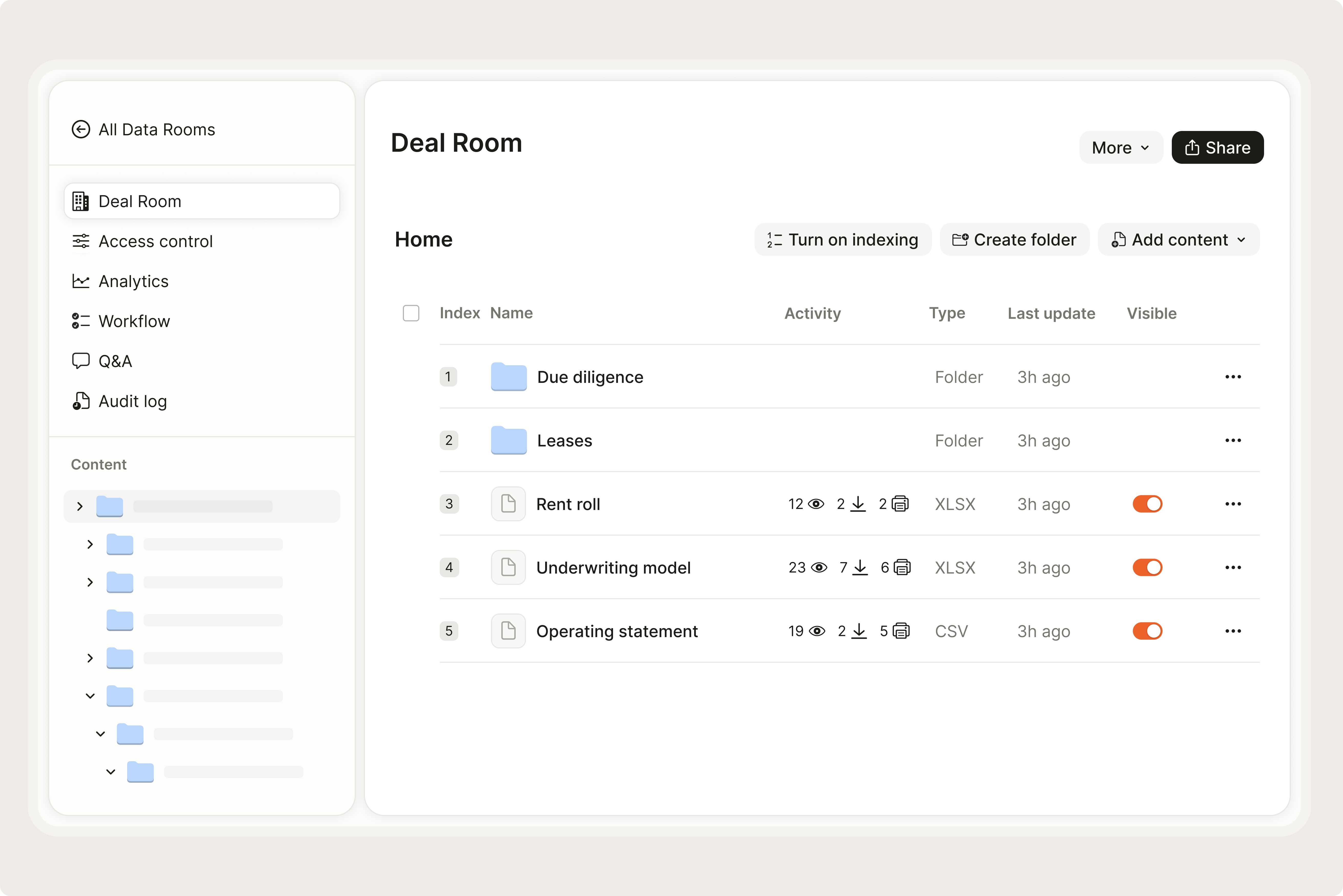
Load your Delaware deal documents before the request list lands. Give each advisor a scoped link so review starts the day diligence opens.
- 1.Upload all documents in bulkLoad title docs, ESA reports, leases, and permits into Ellty in one pass. Organize by diligence category so advisors find files without asking.
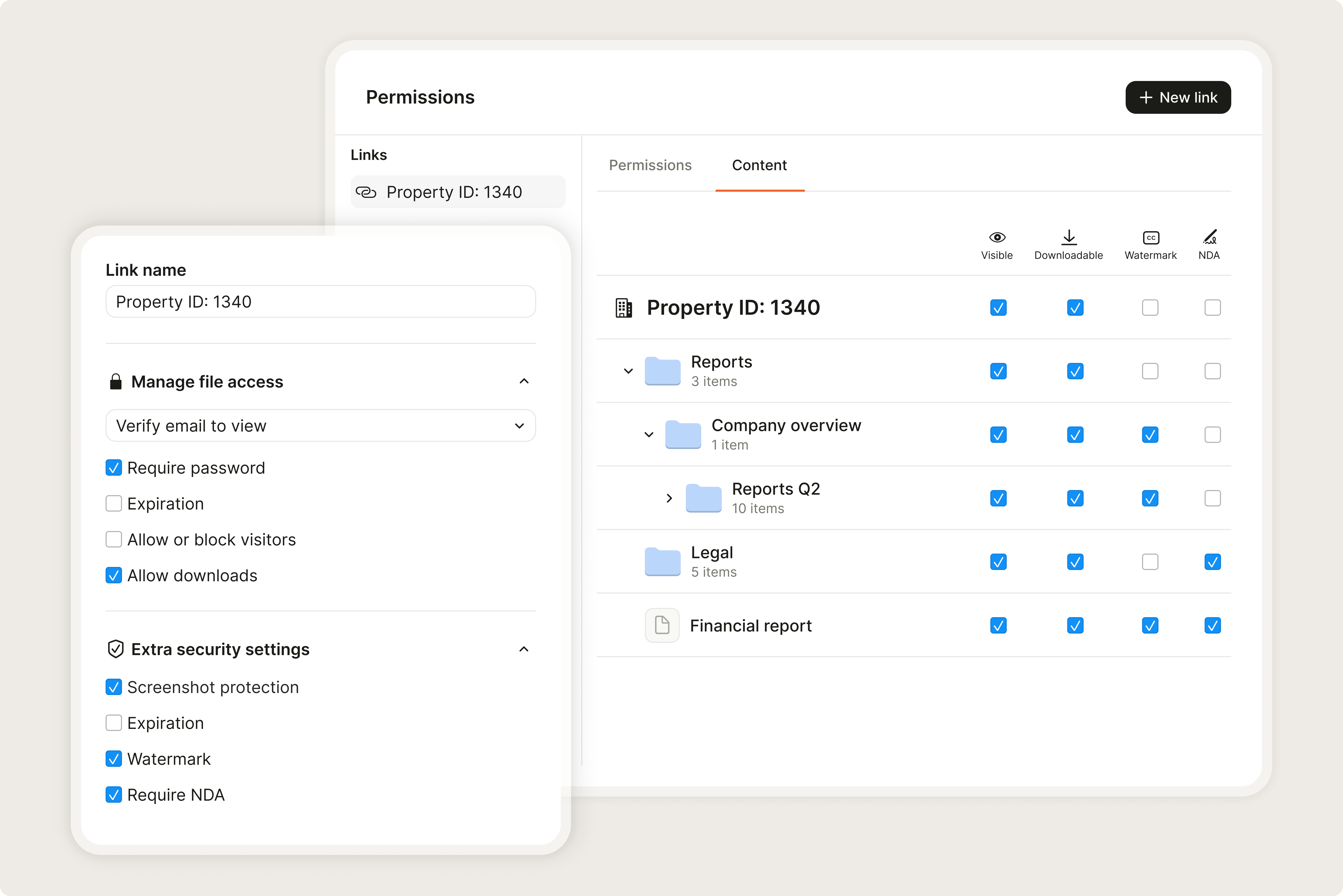
- 2.Set permissions per advisorSend the title attorney a link scoped to title docs only. The environmental consultant sees ESA files only. No one digs through folders they don't need.
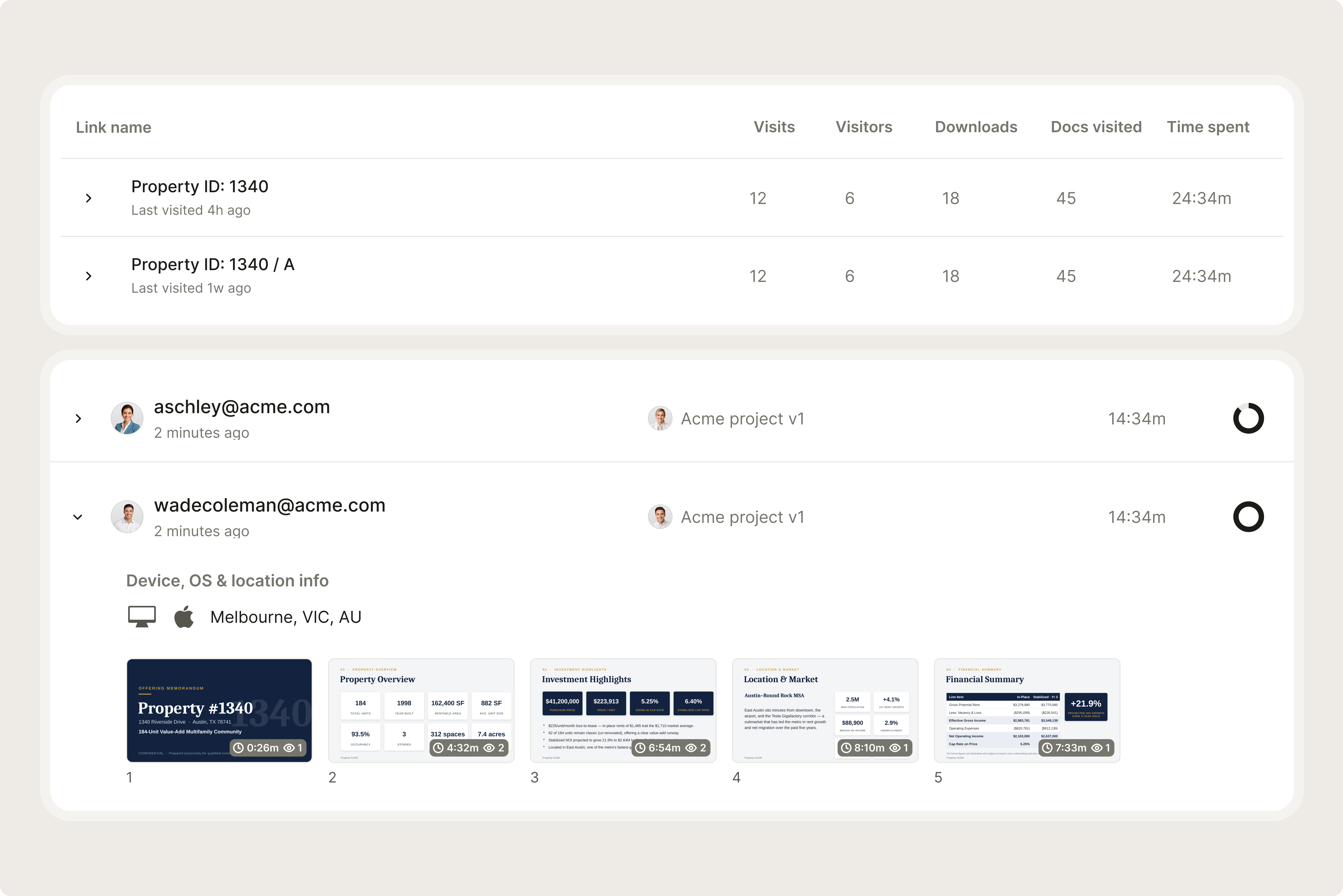
- 3.Track reviewer activitySee which documents each reviewer opened and when. Spot where questions are forming before they slow the closing timeline.
What makes due diligence in Delaware different
Delaware's realty transfer tax is the biggest structural surprise for buyers who haven't closed here before. Up to 4% of fair market value - split between buyer and seller - is a material closing cost. The split is negotiable in the PSA, but it needs to be addressed upfront. Deals that skip this conversation until late in the process often retrade. Understanding due diligence red flags helps identify where these issues surface earliest.
Environmental liability in New Castle County is the second distinguishing factor. Delaware's chemical and refining industry history left a dense brownfield inventory along the I-95 corridor and the Christina River waterfront. Phase I ESAs almost always surface something here. Budget Phase II time at the start, not as a contingency.
Sussex County adds a third dimension: coastal flood exposure. Properties near Rehoboth Beach, Lewes, and Bethany Beach face active FEMA remapping risk. Insurance costs and availability have shifted materially in recent years, and flood zone classification can directly affect lender terms. Run hard and soft due diligence in parallel rather than sequencing them to catch these issues before they stall the process.
"Delaware's combination of high transfer taxes and concentrated brownfield inventory means buyers need to model both environmental and tax costs before the offer is submitted, not after." - National Association of Environmental Risk Auditors, Commercial Property Due Diligence Guidelines
Timeline and cost in Delaware
Delaware commercial diligence typically runs in three phases. Weeks 1-2 cover initial review: title search order, Phase I ESA kickoff, ALTA survey order, and lease collection. Estimated cost: $5,000-$10,000 for title, survey, and initial legal review.
Weeks 2-4 cover deep review. Phase I ESA delivery, physical inspection and PCA, lease and financial review, tenant estoppel requests, and zoning verification. Estimated cost: $3,500-$8,000 for Phase I and PCA depending on asset size. Load all documents into an Ellty data room so every advisor has scoped access from day one.
Weeks 4-6 handle resolution. Phase II ESA if needed (add $5,000-$20,000 and 4-8 weeks), title exception negotiations, and repair credits from PCA findings. Total soft cost for a mid-market Delaware commercial deal: $15,000-$40,000. Factor in transfer taxes (up to 4% of FMV) and recording fees ($75-$150 per instrument) into your full closing cost model.
Close your Delaware deal without the surprises
Ellty keeps diligence documents organized, advisors scoped, and your timeline on track.
Start free 14-day trialCommon questions about property due diligence in Delaware
- The combined state and county rate reaches up to 4% of fair market value. Buyer and seller split it equally by default, but the allocation is negotiable in the purchase and sale agreement.
- Most deals run 30-60 days for clean assets. Environmental issues that trigger Phase II testing can extend the timeline to 90 days or more.
- Lenders require it. Even in cash deals, it's standard practice - especially in New Castle County where industrial brownfields are common.
- Title records are maintained at each county's recorder of deeds office. New Castle, Kent, and Sussex each run their own system. Older parcels require a full chain-of-title search, not just a current owner search.
- DNREC runs a voluntary cleanup program for contaminated commercial sites. Certified brownfields can qualify for grant funding and offer enrolled buyers liability protection from DNREC.
- Ellty lets you load all diligence documents into one secure data room, give each advisor a scoped trackable link, and monitor exactly who reviewed which files and when.