Dutch deals have two structural layers most buyers miss. The BV share transfer requires a notarial deed, and the Works Council must be consulted before you announce - not after.
The Netherlands is one of Europe's most deal-friendly jurisdictions - KVK registry searches are fast, courts are reliable, and Dutch advisors are used to international buyers. But STAK structures, Works Council rights, and real estate transfer tax on property-heavy targets add complexity that doesn't appear in the KVK extract.
A mid-market Dutch deal generates 3,000-20,000 documents. Set up an Ellty data room before your advisors send the request list. When it lands, you're ready.
The VIFO investment screening law (in force since June 2023) added mandatory government notification for acquisitions in sensitive sectors. Build the BTI review window into your deal schedule before you agree heads of terms.
The Netherlands due diligence checklist
Not every check carries the same weight. Works Council consultation and VIFO notification are binary - miss either and the deal timeline or legality breaks.
Read the financial due diligence guide to scope the numbers workstream before your request list goes out.
Load all workstreams into Ellty before you issue the request list. Each advisor gets a scoped link and starts the moment access opens.
| Area | Documents to pull | Netherlands red flag | Tier | |
|---|---|---|---|---|
| Corporate & legal | Corporate & legal | KVK extract, articles of association, SHA, board minutes, STAK deed | STAK structure separating economic and voting rights not disclosed upfront | Dealbreaker |
| Works Council | Works Council | OR advice request, consultation minutes, Enterprise Chamber correspondence | OR not consulted before announcement - voidable at Enterprise Chamber Amsterdam | Dealbreaker |
| Financial | Financial | 3y statutory accounts, management accounts, QoE, bank statements | Pension fund deficit in own pensioenfonds or underfunded defined-benefit scheme | Dealbreaker |
| Tax | Tax | Corporate tax returns, Belastingdienst correspondence, Innovation Box docs | Innovation Box revocation risk if qualifying IP conditions are not met | Price-adjuster |
| Employment & labor | Employment & labor | Employment contracts, collective labour agreement, UWV records, pension docs | CLA obligations that bind the buyer post-deal beyond what contracts show | Price-adjuster |
| FDI screening | FDI screening | VIFO sector mapping, BTI notification, ownership chain documentation | Target in vital infrastructure, sensitive tech, or dual-use - BTI review at 10%+ | Dealbreaker |
| IP | IP | BOIP and EPO filings, Innovation Box qualification docs, licence agreements | IP developed by contractors not formally assigned under Dutch copyright law | Price-adjuster |
| Material contracts | Material contracts | Customer and supplier contracts, government contracts, change-of-control clauses | Rijksoverheid or municipality contracts requiring government consent to assign | Price-adjuster |
| Real estate & environmental | Real estate & environmental | Title deeds, lease agreements, RETT analysis, soil contamination reports | Target qualifies as onroerendezaakrechtspersoon - RETT at 10.4% on property value | Price-adjuster |
| Data protection & IT | Data protection & IT | GDPR ROPA, DPO appointment, breach register, AP correspondence | Undisclosed AP enforcement or data incidents not reported within GDPR 72 hours | Standard check |
Running due diligence on a Dutch target?
Set up your data room before the Works Council consultation starts.
Start free 14-day trialThe full Netherlands due diligence checklist
Ten workstreams, ordered by risk. Dutch-specific mechanics - Works Council rights, STAK structures, Innovation Box qualification, and VIFO screening - span multiple areas and must be scoped from day one.
See our mergers and acquisitions guide for how to sequence buy-side workstreams across jurisdictions like the Netherlands.
Corporate & legal
- Pull the KVK (Kamer van Koophandel) Handelsregister extract for the target and all subsidiaries - confirms directors, shareholders, registered capital, and UBO registration.
- Review the articles of association (statuten) and all amendments; Dutch statuten set out voting rights, transfer restrictions, and pre-emption rights that govern the deal mechanics.
- Identify any STAK (Stichting Administratiekantoor) structure; Dutch family companies frequently use STAKs to separate economic rights (certificates) from voting rights (shares), which can complicate a clean acquisition.
- Obtain the shareholder register (aandeelhoudersregister) - mandatory for BVs and not publicly accessible; compare against KVK data and the statuten.
- Check the UBO register (Handelsregister UBO) for all beneficial owners above 25% and confirm no discrepancies with the shareholder register.
Works Council
- Confirm Works Council (Ondernemingsraad, OR) status: mandatory for Dutch companies with 50 or more employees under the Works Councils Act (WOR).
- Under Article 25 WOR, the OR must give a formal advice (advies) on major decisions including acquisitions before a decision is made public.
- Build 4-6 weeks for the OR information and advice process into the deal schedule - the OR has 30 days to respond from the formal advice request.
- If the OR gives a negative advice and the employer proceeds, the OR can challenge the decision at the Enterprise Chamber (Ondernemingskamer) of the Amsterdam Court of Appeal.
- Review all existing OR agreements (OR-akkoorden) and confirm which survive a change of control and bind the buyer.
Financial
- Pull 3 years of statutory Dutch accounts filed at the KVK; Dutch GAAP (RJ standards) can differ from IFRS, particularly on pension provisions and lease recognition.
- Commission a quality of earnings (QoE) report for any deal above €5M; Dutch mid-market targets often carry normalisation adjustments that are not visible in the statutory accounts.
- Map all pension arrangements; the Netherlands is transitioning from defined benefit to defined contribution under the Wet toekomst pensioenen (WTP) - identify targets with own pensioenfonds and check for deficits.
- Review intercompany loans and related-party transactions for arm's length terms; Dutch owner-managed businesses frequently carry undocumented related-party positions.
- Pull bank statements for all accounts and reconcile against reported turnover; Dutch businesses often use multiple entities for VAT or operational reasons that create intercompany complexity.
Tax
- Pull 3 years of corporate income tax returns (Vennootschapsbelasting) and all Belastingdienst correspondence for open audits or disputes.
- Review Innovation Box qualification documentation if the target claims the 9% effective tax rate on IP income; confirm the qualifying IP is correctly documented and the regime survives a change of ownership.
- Confirm VAT registration and returns across all Dutch entities; BTW compliance is closely monitored by the Belastingdienst for intercompany and cross-border transactions.
- Check for any open tax rulings (APA/ATR) from the Belastingdienst that may lapse or require renegotiation after a change of control.
- Analyse the RETT exposure: if the target is an onroerendezaakrechtspersoon (50%+ real estate assets), a share deal triggers 10.4% overdrachtsbelasting on the real property value.
Employment & labor
- Obtain a full headcount list with contract types, notice periods, and any change-of-control provisions in key employee agreements.
- Identify the applicable collective labour agreement (collectieve arbeidsovereenkomst, CAO) - Dutch sector-level CAOs bind the buyer and often include obligations beyond statutory minimums.
- Pull social security contribution records (UWV) for the last 3 years to confirm no underpayments or open recovery notices.
- Review key-person retention risk - Dutch employment law provides strong protections against termination and makes post-deal workforce restructuring costly.
- Check for any open labour court proceedings or pending collective disputes with trade unions that could affect the target post-acquisition.
Regulatory & licences
- Map all AFM (Autoriteit Financiële Markten) authorisations for financial services targets and confirm whether a change-of-control notification to AFM is required before closing.
- Review DNB (De Nederlandsche Bank) prudential licences for bank, insurance, and investment firm targets; DNB change-of-control approval typically takes 3-4 months.
- Check sector-specific licences - ACM for telecoms and energy, RVO for environmental permits - and confirm each survives a share deal without re-application.
- Confirm that public service contracts and government framework agreements are either directly assignable or survive a share deal without requiring additional ministerial consent.
FDI screening
- Assess whether the target falls under the VIFO Act (Wet veiligheidstoets investeringen, fusies en overnames) in force since June 2023.
- VIFO applies to acquisitions in vital infrastructure (ports, energy, telecoms, water) and sensitive technology companies; notification to the BTI (Bureau Toetsing Investeringen) is mandatory.
- Thresholds: 10% for acquisitions in vital process operators; 25% for sensitive technology companies.
- Build 8 weeks for BTI review into the deal schedule from notification; the Minister of Economic Affairs can impose conditions or prohibit the deal.
- Prepare a full ownership chain disclosure for the acquirer - BTI requires complete beneficial ownership information at every tier.
IP
- Pull IP searches at the BOIP (Benelux Office for Intellectual Property) for trade marks and designs, and at the EPO/national register for patents.
- Confirm all IP is owned by the company entity, not by founders or contractors; Dutch copyright law does not automatically assign contractor-developed IP to the commissioning company.
- Review Innovation Box qualifying IP documentation - confirm the IP is self-developed and that the 30% nexus requirement is met for the reduced 9% tax rate.
- Check for any BOIP oppositions, IP disputes, or infringement claims in the last 5 years; also check at the Rechtbank Den Haag, which handles IP disputes in the Netherlands.
Material contracts
- Pull the top 10 customer and supplier contracts and review for change-of-control clauses, assignment restrictions, and termination rights triggered by the deal.
- Check Rijksoverheid and municipality contracts separately; Dutch public contracts frequently require the contracting authority's consent before assignment or change of control.
- Review all bank financing agreements (kredietovereenkomsten) for change-of-control triggers and lender consent requirements at closing.
- Confirm exclusivity arrangements, distribution agreements, and SaaS licence deals that are material to the business model survive a change of ownership.
Real estate & environmental
- Pull title deeds (aktes van levering) and confirm ownership via the Kadaster (Dutch land registry) for all owned properties.
- Analyse RETT exposure: if the target is an onroerendezaakrechtspersoon, the 10.4% overdrachtsbelasting applies on commercial property value in a share deal.
- Commission a Phase I soil investigation (NEN 5725 desk study) for any industrial or manufacturing sites; Dutch soil contamination liability can follow the current operator.
- Review all commercial leases (huurovereenkomsten) for change-of-control and landlord consent provisions that could delay the closing timeline.
Data protection & IT
- Obtain the target's GDPR compliance documentation: records of processing activities (verwerkingsregister), DPO appointment, and breach register.
- Review any AP (Autoriteit Persoonsgegevens) correspondence, enforcement decisions, or open investigations in the last 3 years; AP fines under GDPR can reach €20M or 4% of global turnover.
- Confirm that data transfers outside the EEA are covered by adequacy decisions or standard contractual clauses and that no transfers rely on the now-invalid Privacy Shield.
- Review IT infrastructure for legacy systems, software licence compliance, and cybersecurity audit reports covering the last 2 years.
How due diligence in the Netherlands works
The sell-side due diligence guide covers how Dutch sellers prepare. Here is how the buy-side process runs from scope to signing.
Step 1: Scope
Define the workstream scope before any documents move. Confirm upfront whether VIFO notification is required, whether the Works Council must be consulted, and whether the target is an onroerendezaakrechtspersoon for RETT purposes. Build all three into the deal schedule before heads of terms are signed. Set up Ellty and populate the data room before the request list goes out.
Step 2: Request
Issue the request list within 48 hours of NDA signing. Dutch sellers expect structured, thorough requests. Load KVK extracts, statutory accounts, and pension documentation into Ellty before the list arrives. Give each workstream a scoped folder so advisors can start reviewing without waiting for batched uploads from the seller.
Step 3: Review
Legal, financial, and tax workstreams run in parallel. The Works Council track runs on its own 4-6 week timeline alongside the commercial review. Track reviewer activity through Ellty's analytics - if the buyer's pension advisor has opened the pensioenfonds documents six times, that's where the question is forming.
Step 4: Flag
All findings go into a risk register: dealbreaker, price-adjuster, or standard check. In Dutch deals, Innovation Box revocation risk, pension deficits, and STAK voting rights restrictions cluster as price-adjusters. VIFO notification requirements and Works Council non-compliance are binary dealbreakers or deal delay triggers.
Step 5: Resolve
Dutch SPA negotiations use indemnities for identified tax liabilities, escrow for pension shortfalls, and R&W insurance (well-developed in the Netherlands). VIFO BTI review takes up to 8 weeks from a complete notification; DNB change-of-control approval for regulated targets can run 3-4 months.
The Works Council's right of advice in the Netherlands is not advisory in the informal sense. A decision made without proper consultation can be voided by the Enterprise Chamber - a risk that survives the signing of the SPA.
What makes Netherlands DD different
Works Council rights have real teeth. Unlike many European countries where works councils are largely ceremonial, the Dutch OR has a statutory right to give advice before major decisions - and can challenge the employer at the Enterprise Chamber in Amsterdam if its advice is ignored. A deal that closes without proper OR consultation can be suspended or unwound. Most Dutch advisors build the OR process into the deal timeline from the start, not as an afterthought.
STAK structures require a full unwinding analysis. Dutch family and founder-owned companies frequently use a STAK - a foundation that holds the actual shares and issues depositary receipts (certificaten) to economic owners. Voting rights sit with the STAK board; economic rights sit with the certificate holders. A buyer acquiring certificates rather than shares gets economic exposure without voting control. Always check for a STAK in the statuten and KVK extract before you discuss deal structure.
Innovation Box is valuable but fragile. The Netherlands offers a 9% effective tax rate on qualifying IP income through the Innovation Box regime. Targets with Innovation Box status look more tax-efficient than they are. The qualification requirements are strict: IP must be self-developed, the 30% nexus fraction must be maintained, and the regime can be challenged by the Belastingdienst on audit. In a share deal, confirm the regime survives the change of ownership before pricing it in.
RETT on real estate companies. A Dutch target where more than 50% of assets consist of Dutch real estate qualifies as an onroerendezaakrechtspersoon. Share deals in such companies trigger 10.4% overdrachtsbelasting on the fair market value of the Dutch real estate - a material cost that must be modelled in the deal economics before committing to a share deal structure.
Who runs due diligence on Netherlands deals
Dutch deals use Dutch and international law firms, Big 4 advisory, and specialist Dutch pension actuaries.
Legal counsel: NautaDutilh, De Brauw Blackstone Westbroek, and Freshfields lead on large Dutch deals. Mid-market firms Loyens & Loeff, BarentsKrans, and Van Doorne cover €5M-€100M transactions well. Budget €80K-€350K for buy-side legal diligence depending on deal size.
Financial and tax advisory: Big 4 cover QoE and tax. Dutch mid-market specialists are often faster for regional targets. Budget €50K-€180K combined for financial and tax diligence on a mid-market Dutch deal.
Pension actuaries: Any target with an own pensioenfonds or underfunded DB scheme needs an independent actuarial report under the WTP transition. Budget €15K-€50K for a pension liability assessment.
Set up one shared Ellty data room and give each advisor a scoped link. Track who opens the STAK deed, the pensioenfonds documents, and the Innovation Box filing. Use our HR due diligence guide to scope the Works Council and employment workstream properly.
How to set up your Netherlands data room in Ellty.
Load your Netherlands deal documents before advisors start. Each team gets a scoped link with access only to what they need.
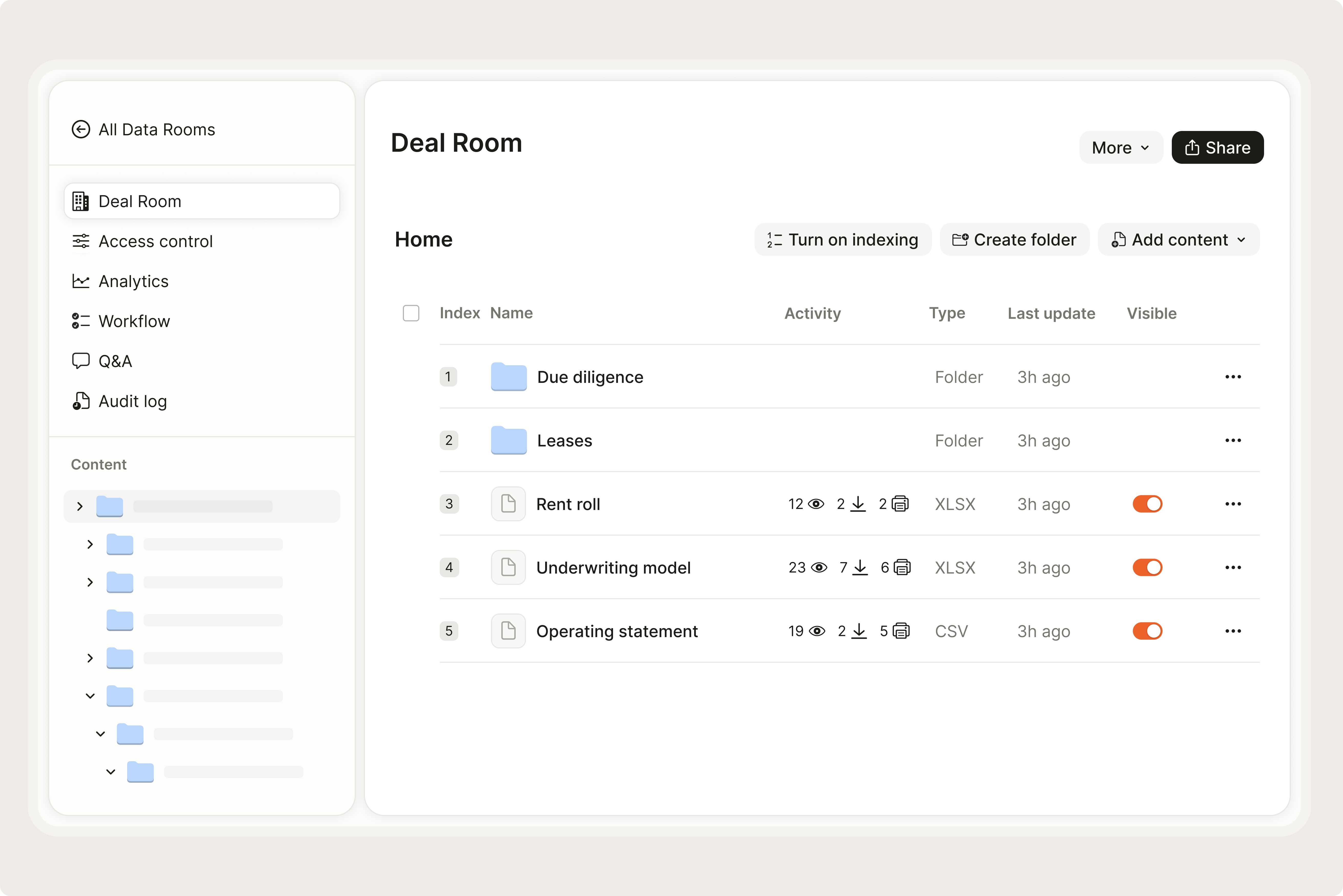
- 1.Create a data room and upload your deal docsUpload KVK extracts, Dutch accounts, and pension docs. Organise by workstream so advisors find files fast.
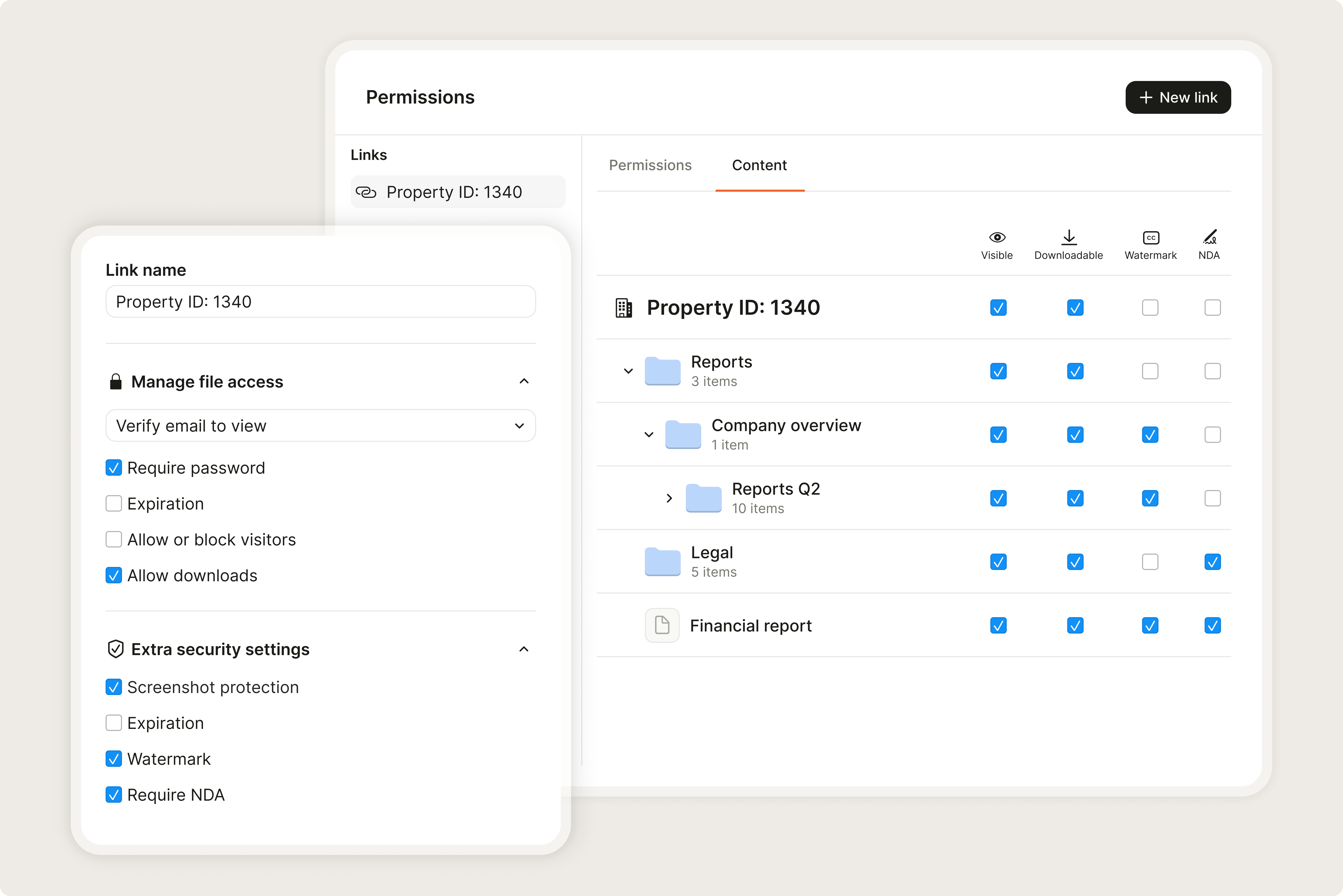
- 2.Give each workstream a scoped, secure linkLegal sees contracts and STAK docs in their own folder. Tax sees returns and Innovation Box files only.
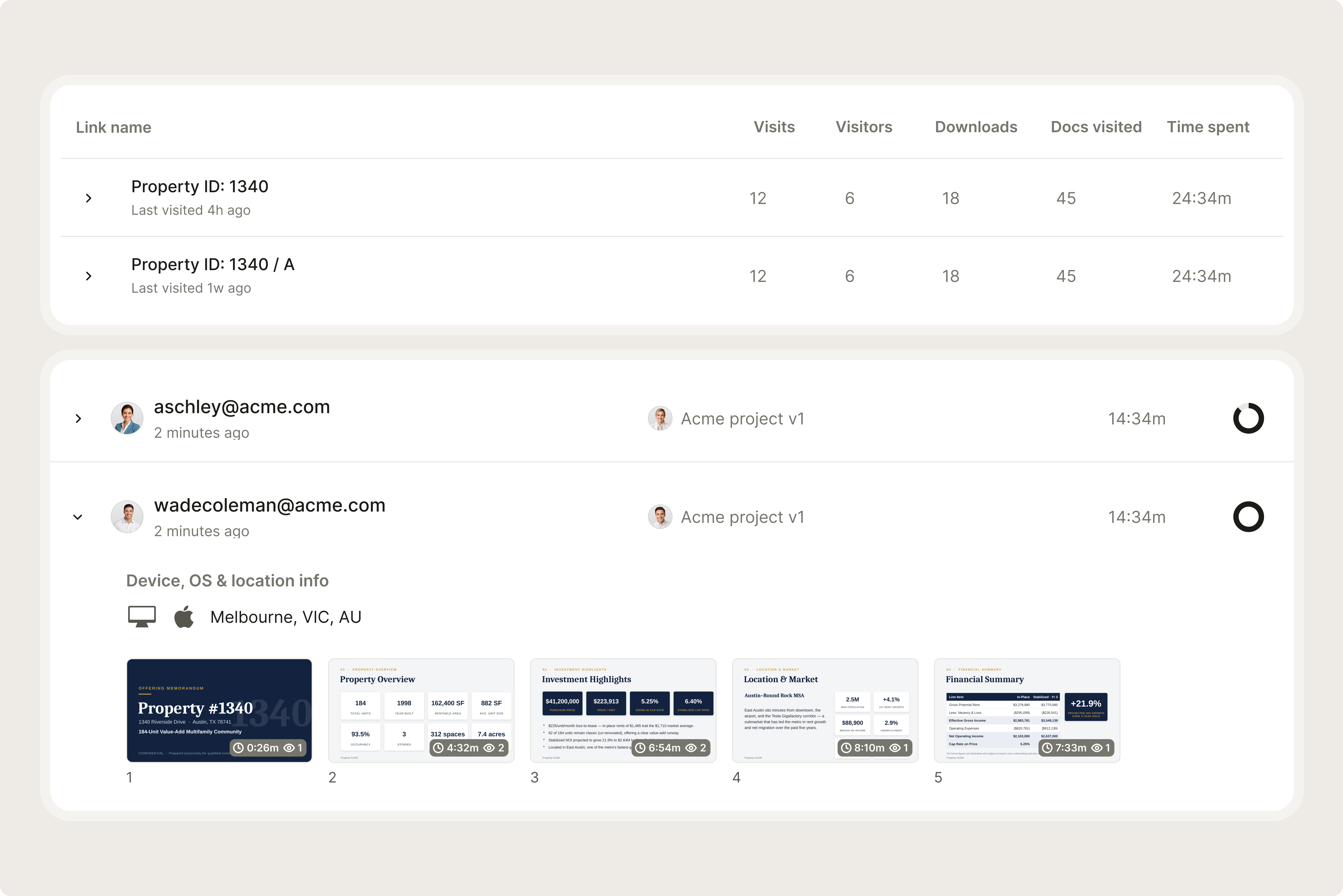
- 3.Track who reviews which documentsSee which advisor opened the pensioenfonds docs six times. Follow up before it becomes a flag in the report.
Due diligence timeline for Netherlands deals
A standard Dutch buy-side process runs 6-10 weeks from NDA to final report, with the Works Council track running in parallel from week one.
Weeks 1-2: NDA signed, KVK extracts pulled, request list issued. VIFO assessment completed. RETT onroerendezaakrechtspersoon analysis initiated. OR advice request formally issued if applicable. Ellty data room live with scoped advisor links.
Weeks 2-4: Financial, legal, and tax reviews run in parallel. Pension actuaries engaged for any pensioenfonds. Innovation Box qualification confirmed. OR consultation continues on its own 30-day track.
Weeks 4-6: OR delivers formal advice (typically at week 4-6 from advice request). Preliminary findings memos circulated. VIFO notification filed with BTI if required. Price-adjuster negotiations begin.
Weeks 6-8: Management Q&A sessions. SPA negotiation on representations and warranties. DNB change-of-control notification filed for regulated targets (if applicable, timeline 3-4 months).
Weeks 8-10: Final reports issued. R&W insurance bound if applicable. VIFO BTI clearance received (if filed at week 4). Notary appointment scheduled for BV share transfer deed.
What due diligence costs in the Netherlands
Legal: €80K-€350K depending on deal size and firm tier.
Financial and tax: €50K-€180K for a mid-market target.
Pension actuaries: €15K-€50K for pensioenfonds valuation under WTP transition rules.
Environmental: €15K-€40K if industrial or manufacturing sites are involved.
RETT: 10.4% of Dutch real property fair market value if the target qualifies as an onroerendezaakrechtspersoon.
Notary fees: 0.1%-0.3% of deal value for BV share transfer notarization.
Total advisor spend on a €20M-€100M Dutch deal lands between €200K and €550K before success fees.
Run your Netherlands deal from one room
Hold financials, Works Council docs and the SPA in one secure, tracked Ellty data room.
Start free 14-day trialCommon questions about due diligence in the Netherlands
- The OR must give formal advice before any major decision is made public - including an acquisition. Companies with 50 or more employees in the Netherlands must complete this process, typically taking 4-6 weeks from the formal advice request.
- A STAK (Stichting Administratiekantoor) holds shares and issues depositary receipts to economic owners, separating voting rights from economic rights. Buyers acquiring certificates rather than shares get no voting control - always check for a STAK in the statuten before agreeing deal structure.
- Yes - if the target is an onroerendezaakrechtspersoon (50%+ of assets are Dutch real estate), a share deal triggers 10.4% overdrachtsbelasting on the fair market value of the Dutch real property. Model this before committing to a share deal structure.
- The BTI review under the VIFO Act takes up to 8 weeks from a complete notification. The Minister of Economic Affairs can extend, impose conditions, or prohibit the deal. Build the review window into the schedule before signing heads of terms.
- The Innovation Box provides a 9% effective tax rate on qualifying IP income. In a share deal, the regime continues with the target company - but confirm the qualifying conditions are met and the Belastingdienst has not flagged any compliance issues before pricing it into the deal value.