The Toronto-Waterloo Corridor is one of North America's leading financial technology hubs. These 11 investors are actively backing Waterloo and Ontario fintech startups in 2026.
Waterloo sits one hour from Bay Street and less than 90 minutes from major US fintech markets. The University of Waterloo's Computing and Financial Management program - the only program of its kind in Canada - produces fintech-ready graduates who understand both the software and the financial systems they're disrupting. Canada's open banking framework is rolling out in 2026, which is creating fresh deal flow in payments, data portability, and banking infrastructure. Waterloo is positioned directly in that deal flow.
Canadian fintech VC stayed steady in 2025 at around US$1.2 billion across 82 deals. The Waterloo corridor specifically punches above its weight, with Garage Capital writing the fastest pre-seed checks ($200K-$750K) and Portage, Luge, and Information Venture Partners backing B2B fintech at Series A and beyond. Wealthsimple raised CAD $750M at a $10B valuation in October 2025 - the kind of outcome that keeps every Canadian fintech investor's thesis running hot.
What gets funded in Waterloo fintech in 2026: B2B payments infrastructure, open banking data tools, embedded finance platforms, insurtech with enterprise distribution, and CFO-software with clear financial services customers. Consumer fintech apps without a path to enterprise revenue are a harder sell to the funds on this list.
Before pitching any of these 11 investors, set up an Ellty data room with your ARR, unit economics, and customer list. Fintech investors ask for financial model details and churn data within 48 hours of a first call.
| Type | Check size | Sector focus | Website | |
|---|---|---|---|---|
| Portage Ventures | Dedicated fintech VC | Seed to growth | Fintech, financial services | portageinvest.com |
| Luge Capital | Dedicated fintech VC | Seed to Series A | Fintech, AI applied to fintech | luge.vc |
| Information Venture Partners | B2B fintech VC | Series A, B | B2B fintech, banking software | informationvp.com |
| OMERS Ventures | Growth VC | $5M to $25M | Fintech, enterprise software | omersventures.com |
| Georgian | Growth VC | $10M to $50M+ | AI-driven software, fintech | georgian.io |
| Garage Capital | Pre-seed VC | $200K to $750K | Pre-seed fintech, enterprise SaaS | garage.vc |
| MaRS IAF | Government VC | Seed to Series A | Fintech, AI, enterprise tech | marsdd.com |
| BDC Capital | Federal VC | Seed to Series B | Fintech, enterprise software | bdc.ca |
| Golden Ventures | Seed VC | Seed | B2B SaaS, fintech-adjacent | goldenventures.com |
| Panache Ventures | Pre-seed VC | Up to $1.5M | Pre-seed fintech, B2B SaaS | panache.vc |
| Communitech | Innovation hub | Network + introductions | Fintech, AI, enterprise tech | communitech.ca |
Know which fintech investors are reading your pitch
Build an Ellty data room. Share your ARR and unit economics with trackable links.
Start free 14-day trialWhat is a Waterloo fintech investor?
A Waterloo fintech investor backs companies building technology products for the banking, payments, insurance, or financial management sectors from the Kitchener-Waterloo corridor. They differ from generalist VCs because they understand financial services regulatory timelines, banking procurement cycles, and what it takes to get a financial institution as a paying customer versus a pilot partner.
Waterloo's fintech ecosystem is part of the Toronto-Waterloo Corridor, one of North America's leading financial technology hubs. Sunlife, Manulife, TD Bank, and major insurance companies have Waterloo-region operations. That concentration creates enterprise fintech customers within a 90-minute drive of every Waterloo founder. Investors like Portage, Luge, and Information Venture Partners specifically track this corridor because enterprise banking customers here are accessible in ways that no US city can match.
Typical check sizes range from $200K at pre-seed from Garage Capital to $50M+ at growth from Georgian. Dedicated fintech funds like Portage and Luge want a financial institution as a paying customer before leading a round. Read how to fundraise for a startup before your first call. Check toronto fintech investors to see how Toronto fintech capital differs from Waterloo's enterprise-heavy corridor.
The fintechs that will win in 2026 are the ones that have identified a specific pain point in financial services and built a product so deeply embedded in the workflow that switching is painful. Unit economics matter more than growth rate now.
11 Waterloo fintech investors
1. Portage Ventures
Toronto-based dedicated fintech VC with $5.7B+ AUM and 115+ portfolio companies. In 2025, Portage announced a $280M USD continuation vehicle with Goldman Sachs backing to manage Point72 Ventures' fintech assets. Made its latest investment in Cata (April 29, 2026) and previously backed Ansel Health in a $20M round. Their LPs include major Canadian banks and insurers with Waterloo region operations. For Waterloo fintech founders at seed to growth, Portage is the most well-capitalized dedicated fintech fund with the strongest financial institution co-selling network in Canada.
- Recent Deals: Cata seed (April 29, 2026); Ansel Health $20M; $280M Point72 continuation vehicle (2025); KidKare (Jan 2026); 115+ portfolio companies; $5.7B+ AUM
- LinkedIn: Portage LinkedIn
- Sector Focus: Fintech, open banking, embedded finance, insurtech, wealth management
- Stage Focus: Seed to growth
- Location: Toronto, ON (Waterloo corridor active)
- Website: portageinvest.com
2. Luge Capital
Dedicated early-stage fintech VC with $180M+ AUM across two funds. Made its latest investment in Velix (February 3, 2026, business/productivity software) and has 44 portfolio companies. Luge focuses on fintech and AI applied to fintech - the open banking and embedded finance categories that Waterloo's university-connected founders are best positioned to build in 2026. For Waterloo fintech founders at seed or Series A with early financial institution traction, Luge is the most accessible dedicated Canadian fintech fund with deep bank LP relationships.
- Recent Deals: Velix (Feb 3, 2026); 44 portfolio companies; $180M+ AUM across two funds; BDC LP backing
- LinkedIn: Luge Capital LinkedIn
- Sector Focus: Fintech, AI applied to fintech, open banking, embedded finance
- Stage Focus: Seed to Series A
- Location: Montreal, QC (Toronto-Waterloo corridor active)
- Website: luge.vc
3. Information Venture Partners
Toronto-based Series A specialist focused exclusively on B2B SaaS for financial services. Backed runQL alongside MaRS IAF and iNovia. Information VP funds companies building software for banking, security, embedded finance, and CFO workflows. For Waterloo fintech founders at Series A with a financial institution as a paying customer - not a pilot, a paying customer - Information VP is the most focused Canadian fund for enterprise B2B fintech. Use Ellty to prepare your data room with enterprise ARR and banking customer evidence before any Information VP meeting.
- Recent Deals: runQL $1.65M (with MaRS IAF and iNovia); active B2B fintech portfolio; Ontario mandate Series A focus
- LinkedIn: Information Venture Partners LinkedIn
- Sector Focus: B2B fintech, banking software, embedded finance, CFO tools
- Stage Focus: Series A, Series B
- Location: Toronto, ON (Waterloo active)
- Website: informationvp.com
4. OMERS Ventures
Refocused exclusively on Canada in 2025 with $5M-$25M tickets from Fund IV. Early backer of Wealthsimple, PointClickCare, and League. OMERS writes growth checks for fintech companies with enterprise ARR and a clear path to $100M+ revenue. For Waterloo fintech founders at Series A or later with strong financial institution retention and large TAM, OMERS is the most credible Canadian growth investor that can lead a round without requiring a US co-lead. Read how to prepare investor relations materials before approaching OMERS.
- Recent Deals: Fund IV Canada-only refocus (2025); Wealthsimple early position; PointClickCare, League portfolio; $5M-$25M per ticket
- LinkedIn: OMERS Ventures LinkedIn
- Sector Focus: Fintech, enterprise software, health benefits, payments
- Stage Focus: Series A, growth ($5M-$25M)
- Location: Toronto, ON (Waterloo active)
- Website: omersventures.com
5. Georgian
$5.9B AUM growth VC writing $10M-$50M+ checks for AI-driven software companies. Manages over $1B in new fund capital as of 2026. Georgian backs companies that use AI and data to improve their core product - which maps directly to the AI-driven fintech thesis of Waterloo's B2B software founders. For Waterloo fintech founders at growth stage with AI embedded in their credit, underwriting, or fraud detection products, Georgian writes the largest Canadian-led fintech growth checks on this list.
- Recent Deals: $5.9B AUM; $1B+ new fund capital (2026); AI-driven software and fintech portfolio; growth-stage focus
- LinkedIn: Georgian LinkedIn
- Sector Focus: AI-driven fintech, growth-stage B2B software, data-driven financial products
- Stage Focus: Growth ($10M-$50M+)
- Location: Toronto, ON (Waterloo active)
- Website: georgian.io
Share your fintech pitch with trackable links
Use Ellty to send your ARR and unit economics. Know which investors review it.
Start free 14-day trial6. Garage Capital
Waterloo Engineering-rooted pre-seed fund writes $200K-$750K checks for technical founders building B2B software. At pre-seed in fintech, Garage writes faster than any other Canadian fund and has a documented pipeline to Portage, Luge, and Information VP through their network. For Waterloo fintech founders at the idea stage or just post-MVP with a clear financial services use case, Garage Capital is the first call before any dedicated fintech fund approach.
- Recent Deals: Sygaldry (April 14, 2026); Upside Robotics $75M co-investor (Feb 2026); 134 portfolio companies; BDC LP; 6 new investments in 12 months
- LinkedIn: Garage Capital LinkedIn
- Sector Focus: Pre-seed fintech, B2B SaaS, enterprise software
- Stage Focus: Pre-seed ($200K to $750K)
- Location: Waterloo, ON
- Website: garage.vc
7. MaRS Investment Accelerator Fund
Ontario government-backed fund with 210+ portfolio companies and an Ontario mandate. Co-invested in runQL alongside iNovia and Mistral. MaRS IAF co-invests with Portage, Luge, BDC, and Garage on Waterloo fintech deals. For Waterloo fintech founders at pre-seed or seed raising in Ontario, MaRS IAF is the government anchor investor whose participation signals institutional validation - and reduces perceived risk for private co-investors. Use Ellty to organize your data room before any MaRS IAF application.
- Recent Deals: runQL $1.65M (with iNovia and Mistral); 210 portfolio companies; Ontario mandate; consistent fintech co-investment with Luge and Portage
- LinkedIn: MaRS IAF LinkedIn
- Sector Focus: Fintech, AI, enterprise tech, health tech - Ontario mandate
- Stage Focus: Pre-seed to Series A
- Location: Toronto, ON (Ontario mandate including Waterloo)
- Website: marsdd.com
8. BDC Capital
Canada-only federal VC with 700+ portfolio companies and LP positions in Luge Capital and Garage Capital. BDC has backed 44 Luge portfolio companies at follow-on and co-invests with Information VP at Series A. For Waterloo fintech founders raising seed or Series A with Ontario enterprise customers, BDC is the federal anchor investor that reduces perceived risk for private co-investors. Set up your Ellty data room with your financial model and customer data before any BDC call.
- Recent Deals: 700+ portfolio companies; Luge Capital LP; Garage Capital LP; active fintech portfolio; national mandate
- LinkedIn: BDC Capital LinkedIn
- Sector Focus: Fintech, enterprise SaaS, payments, banking software
- Stage Focus: Seed to Series B
- Location: Toronto, ON (national mandate, Waterloo active)
- Website: bdc.ca
9. Golden Ventures
Canada's most consistent seed-stage fund has backed B2B SaaS companies across fintech-adjacent verticals since 2014. Golden leads first rounds for Waterloo-rooted companies with early enterprise traction and a clear financial services customer profile. For Waterloo fintech founders raising a seed round post-Garage Capital with some enterprise ARR, Golden writes consistently without requiring the deep financial institution validation that Portage or Luge would expect at the same stage.
- Recent Deals: Active B2B SaaS and fintech-adjacent portfolio 2025-26; national mandate with Waterloo active; seed-stage focus
- LinkedIn: Golden Ventures LinkedIn
- Sector Focus: B2B fintech SaaS, enterprise software, fintech-adjacent products
- Stage Focus: Seed
- Location: Toronto, ON (Waterloo active)
- Website: goldenventures.com
10. Panache Ventures
Canada's highest-volume pre-seed fund writes 5+ checks per quarter at up to $1.5M. For Waterloo fintech founders at pre-seed who aren't UWaterloo alumni (and therefore not directly in Garage Capital's first-priority thesis), Panache is the fastest national alternative. They evaluate on founder-market fit and early traction rather than pedigree. Their 110+ portfolio companies include fintech-adjacent B2B software across Canadian cities. Check waterloo-ai-investors for how Waterloo's AI capital differs from fintech funding.
- Recent Deals: 5+ investments Q1 2026; 110+ portfolio companies; $100M Fund II; national mandate
- LinkedIn: Panache Ventures LinkedIn
- Sector Focus: Pre-seed fintech, B2B enterprise software, payments infrastructure
- Stage Focus: Pre-seed (up to $1.5M)
- Location: Montreal, QC (national mandate, Waterloo active)
- Website: panache.vc
11. Communitech
Kitchener-based innovation hub supporting 1,400+ companies, running the Accelerator Centre - named Canada's FinTech and AI Accelerator of the Year for two consecutive years. Communitech connects Waterloo fintech founders to Portage, Luge, BDC, and Information VP through structured programming and investor days. For Waterloo fintech founders who haven't yet built VC relationships, Communitech membership and Scale Up program participation is the fastest warm-introduction path to every dedicated fintech fund on this list.
- Recent Deals: 1,400+ companies supported; Accelerator Centre FinTech and AI Accelerator of the Year (two consecutive years); active 2026 Scale Up program; investor connection network
- LinkedIn: Communitech LinkedIn
- Sector Focus: Fintech, AI, enterprise tech - introductions and programs, not direct investment
- Stage Focus: All stages (investor introductions)
- Location: Kitchener, ON
- Website: communitech.ca
How to get a warm intro to Waterloo fintech investors
Communitech's Accelerator Centre Scale Up program is the most structured path to Portage, Luge, and Information VP introductions. The Centre has been named Canada's FinTech and AI Accelerator of the Year for two consecutive years. Companies that complete Scale Up receive introductions to investors who are specifically looking for Waterloo corridor deals.
Garage Capital alumni have a documented pattern of moving to Portage and Luge for follow-on funding. If you're at pre-seed with a Waterloo Engineering background, starting with Garage Capital instead of cold-approaching Portage will cut your fundraising timeline by 3-6 months. Garage's network is that direct.
Don't approach Portage or Information VP without a paying financial institution customer. Both funds are staffed by former banking and insurance executives who know instantly if you've been in sales conversations with their LP base. "We're talking to TD" is not the same as "TD is paying us."
What fintech investors expect at seed vs. Series A
At seed, Garage Capital and Golden Ventures want a founding team with financial services domain knowledge and a clear problem statement with early user evidence. They don't require enterprise ARR - they require proof you understand the regulatory and procurement environment your customer operates in. A founder who has worked inside a Canadian bank or insurance company converts faster than one who hasn't.
At Series A, Portage, Luge, and Information VP want a paying financial institution customer - not a letter of intent, not a pilot. A bank or insurer writing you a check signals they've completed procurement review, security review, and vendor onboarding. That takes 9-18 months for most enterprise financial services customers. Start sales conversations early and use Ellty to manage your due diligence materials through that process.
How fintech investors evaluate technical due diligence
Fintech investors ask harder technical questions than most other sectors. At seed, Portage and Luge want to understand your data architecture and how you handle financial data compliance - PCI DSS, PIPEDA, and OSFI guidelines are not optional. A founder who can't explain their data residency model in the first meeting signals a compliance problem that kills deals later.
At Series A, Information VP and OMERS want your security audit documentation, your data access logs, and your enterprise SLA performance data. Every financial institution customer will have run a security review on you before signing. Make sure those documents are organized and ready. Read what documents go in a data room before any enterprise fintech investor meeting.
How to pitch a Waterloo fintech investor
Four steps for fintech founders raising capital in Ontario in 2026.
- 1.Start sales with financial institutions before VCsA paying bank or insurer customer before Series A is the Waterloo fintech standard. Start enterprise sales 12-18 months early.
- 2.Get Communitech connected before cold outreachScale Up program introductions to Portage and Luge convert faster than cold LinkedIn messages to any fintech partner.
- 3.Lead with compliance architecture, not just productFintech investors ask about PCI DSS, PIPEDA, and OSFI guidelines in the first meeting. Know your data residency model cold.
- 4.Build a data room with financial model and security docsUpload your unit economics and security audit documentation to Ellty before any investor introduction. They ask fast.
How Ellty helps you land a Waterloo fintech investor
You know the 11 investors. Here's how to share your financial data securely through their due diligence process.
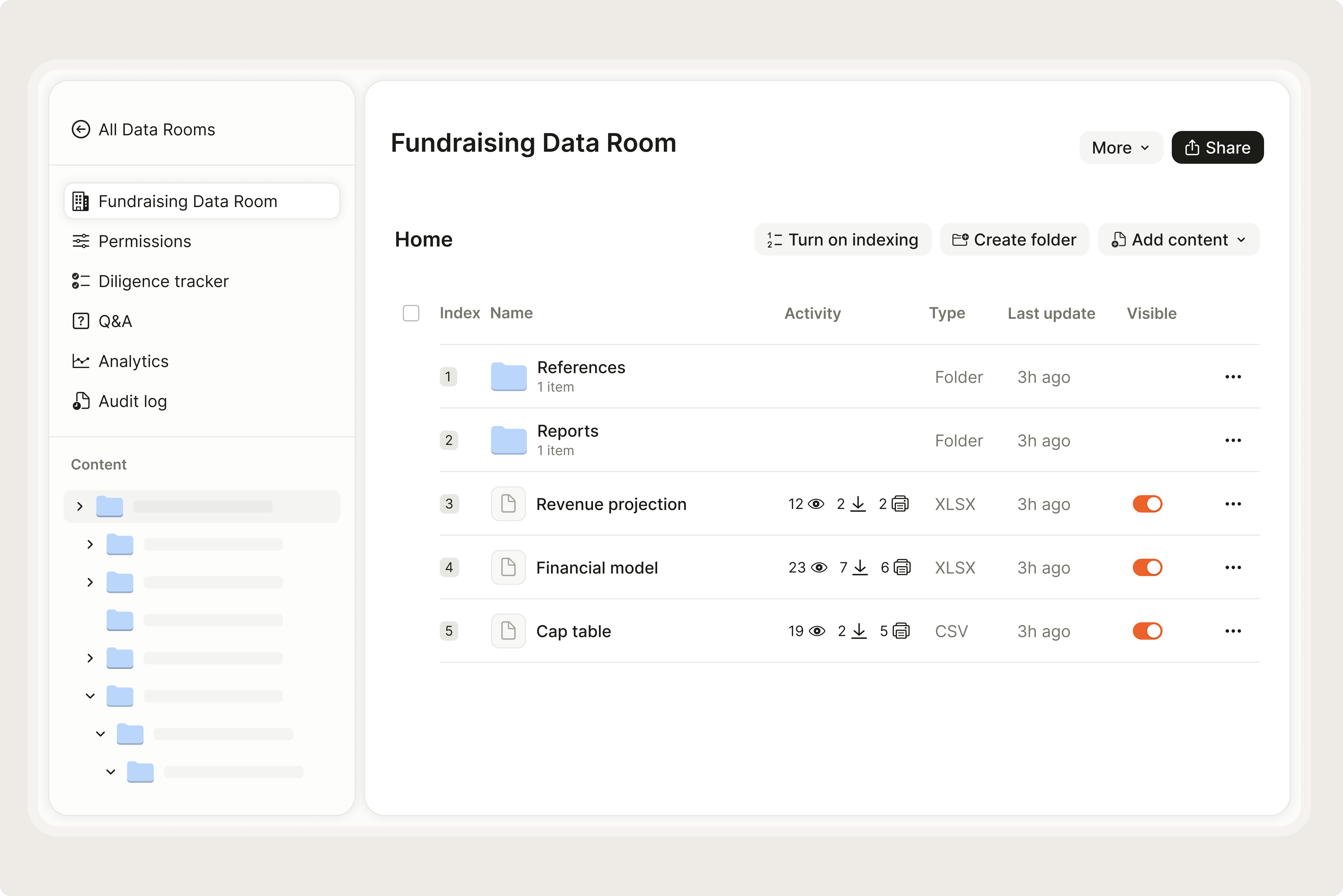
- 1.Build a data room with ARR and compliance documentationUpload your unit economics, security audit, and enterprise customer contracts. Fintech investors ask for these immediately.
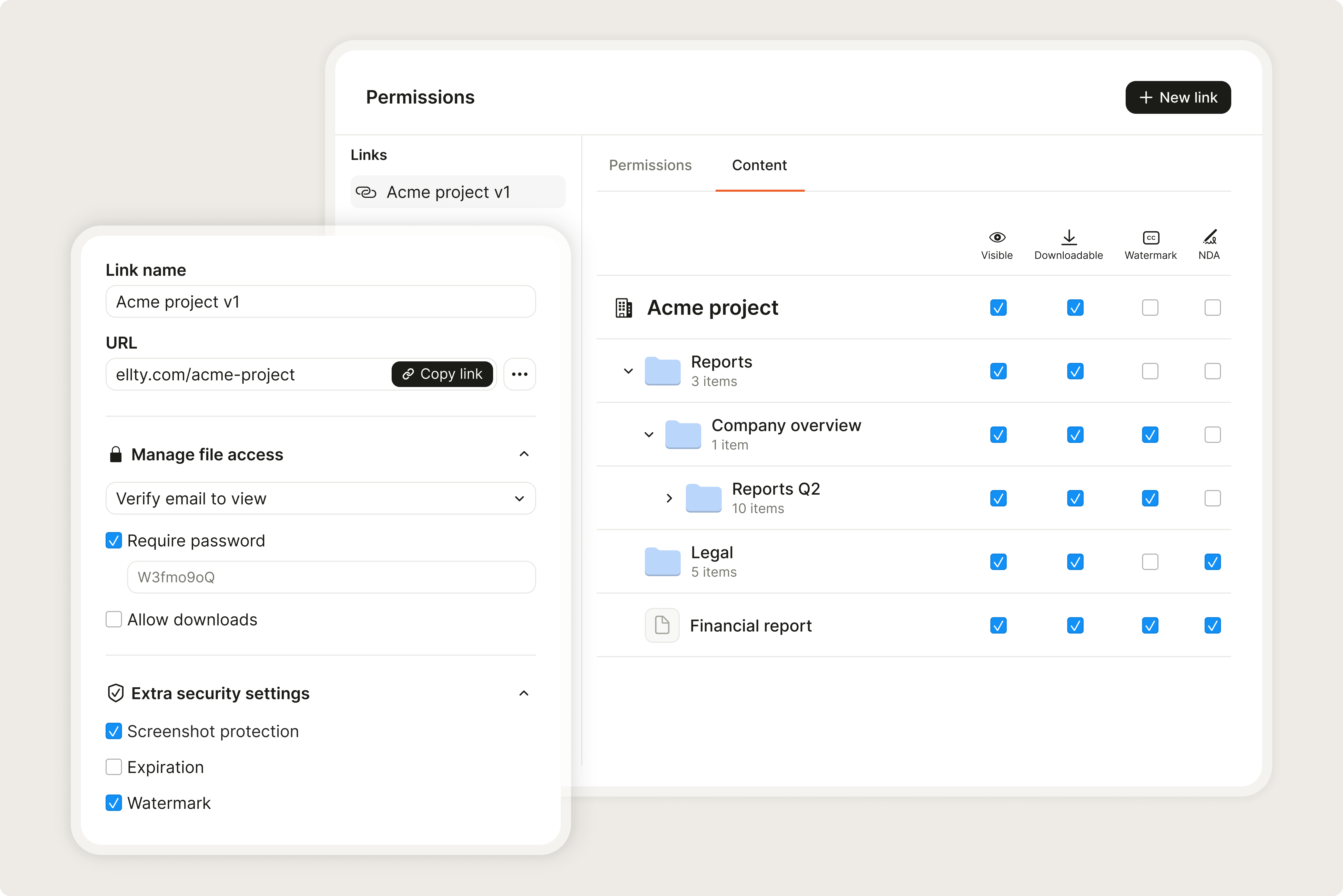
- 2.Set permissions before sharing sensitive financial dataRequire email verification before investors access your financial model. Enable screenshot protection for proprietary data.
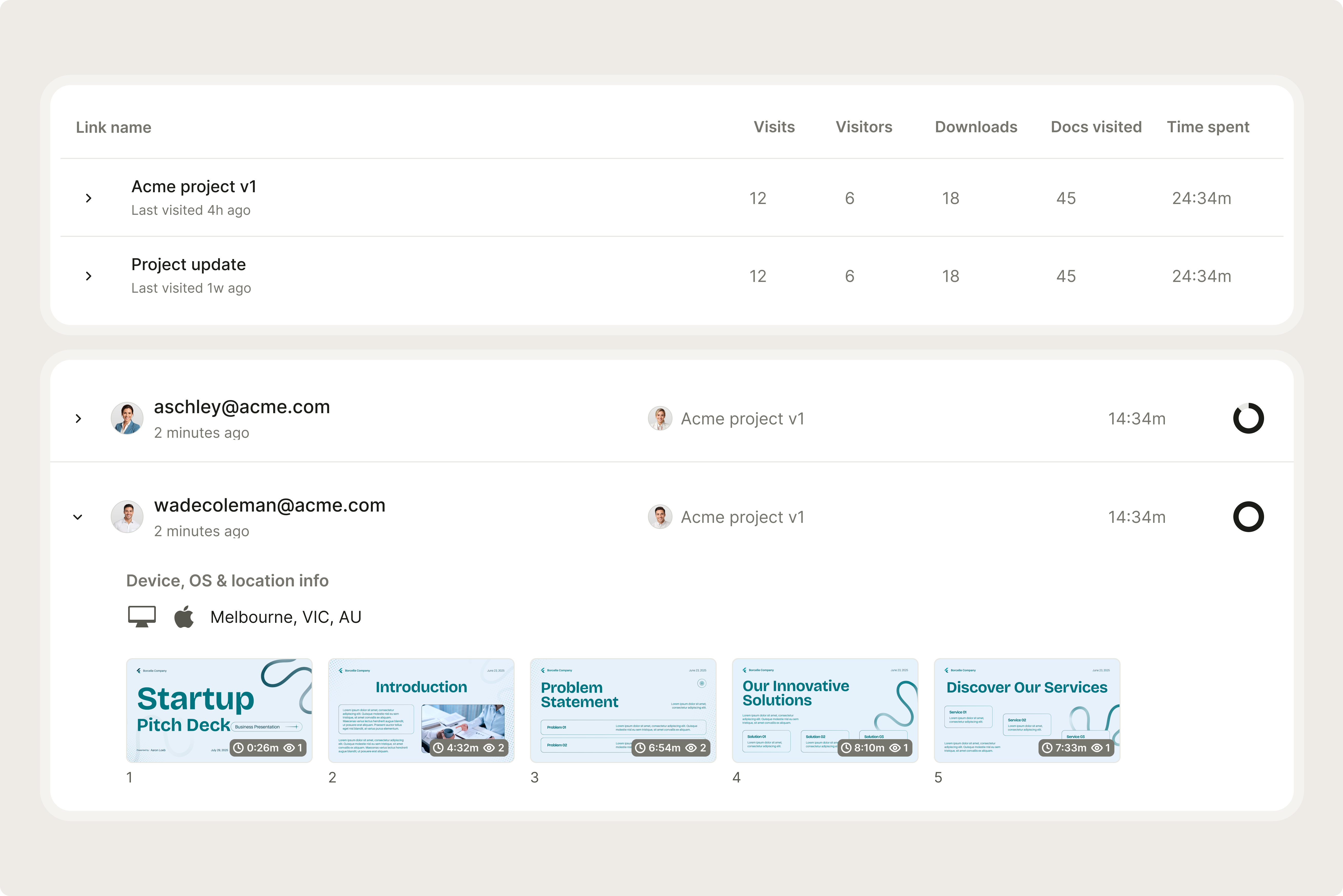
- 3.Track which investors review your unit economicsSee who spends time on your financial model and ARR data. Multiple opens before a call means they're evaluating seriously.
What Waterloo fintech founders ask before raising
- Yes, if you have Waterloo Engineering roots. Garage's network moves deals to Portage and Luge faster than any cold introduction. Start there and let the intro happen naturally.
- Portage writes larger checks across more fintech verticals with deeper bank LP relationships. Luge writes smaller early-stage checks with a specific AI-applied-to-fintech thesis. Both want paying financial institution customers.
- Garage, Golden, and Panache back pre-bank-customer teams with strong domain knowledge. Portage, Luge, and Information VP won't lead without at least one paying financial institution customer.
- Before you start enterprise sales conversations with financial institutions - not just before fundraising. Your compliance documentation and security audit will be requested by both banks and VCs.
- Yes. Portage, Luge, and Information VP are all actively tracking open banking deal flow. Payments infrastructure, data portability, and banking API platforms are the categories with fresh investor attention.
- Start with 4-5 matching your stage. Use Ellty to track who opens your financial model. When an investor reviews your unit economics multiple times before a call, follow up immediately.