
iDeals Virtual Data Room is one of the established players in the VDR space. It's built for M&A deals, due diligence, and complex transactions where security matters. Plenty of enterprises use it because it handles compliance requirements and has been around long enough to build trust.
We've been testing alternatives to iDeals for the past few months. Why? iDeals works well for large transactions, but many startups and smaller businesses find it overkill for their needs. The pricing isn't transparent on their website, and from what we've gathered through user reviews, it scales up quickly for enterprise features you might not need. If you're a founder sharing pitch decks or running a simpler fundraising process, you don't necessarily need the full enterprise VDR stack.
We personally tested 9 alternatives that handle different aspects of what iDeals does. Some focus on pitch deck analytics and fundraising. Others offer virtual data room features without the enterprise complexity. A few sit somewhere in between. Here's what we discovered after weeks of hands-on testing.
Key takeaways
The virtual data room market offers many iDeals alternatives, each with different strengths for fundraising, M&A workflows, or enterprise compliance.
Several alternatives offer better pricing transparency, faster setup, and features specifically built for startup fundraising compared to iDeals' enterprise focus.
Many modern solutions combine pitch deck analytics with virtual data rooms or add AI insights to provide more comprehensive deal management.
Why look for an iDeals VDR alternative?
iDeals Virtual Data Room handles enterprise M&A and due diligence well. The security certifications, granular permissions, and comprehensive audit trails meet strict compliance requirements. For large transactions where regulatory oversight matters, those features are essential. But iDeals isn't the only option, and it's not always the best fit for every team.
Better features for the price
Several alternatives offer comparable security with different feature sets at more transparent costs. Some focus specifically on fundraising workflows that iDeals doesn't emphasize. Others provide simpler interfaces that don't require extensive onboarding. We found tools offering flat-rate pricing instead of custom enterprise quotes, which makes budgeting easier for smaller teams.
Some alternatives include features like AI-powered deal insights or integrated e-signatures that iDeals doesn't prioritize. Others strip away enterprise complexity entirely and focus on fast setup for pitch deck sharing. The feature mix you actually need determines whether iDeals' comprehensive approach is worth the investment.
Different workflow needs
iDeals focuses on comprehensive enterprise data rooms with every possible security feature. That's great if you need SOC 2 compliance and detailed permission hierarchies. But if you're a founder sharing pitch decks with seed investors, or running a straightforward due diligence process, you might benefit from a more focused platform.
Some teams need simpler tools that work in minutes, not hours. Others need deal pipeline management alongside individual data rooms. Still others want AI help identifying missing documents. The right alternative depends on whether you're running complex M&A, early-stage fundraising, or something in between.
Cost considerations
iDeals' pricing isn't publicly listed - you need custom quotes, which typically land in enterprise territory. We found alternatives with transparent pricing that make more sense for smaller deals and growing teams. Per-user enterprise licensing means costs aren't predictable as your team size changes.
Feature access also matters. Some alternatives offer unlimited data rooms where iDeals prices by transaction size. For teams managing multiple deals simultaneously, or startups that need both pitch deck sharing and due diligence materials, flat-rate pricing with broad feature access makes budgeting simpler. The question becomes whether you're paying for enterprise features you'll actually use.
What are the best iDeals VDR alternatives?
The best iDeals VDR alternative depends on what you're actually trying to accomplish.
For startup fundraising: Ellty gives you pitch deck analytics and virtual data rooms without enterprise complexity. Upload your deck, create trackable links, see exactly who viewed what and when. Real-time notifications tell you when investors open your materials. No enterprise onboarding, no custom pricing quotes. Setup takes minutes, not hours.
For M&A workflow automation: Caplinked when you need task management built into your data room. Set up checklists, assign due diligence items, track completion across your team. Good for mid-market deals where you're coordinating multiple work streams. More modern interface than iDeals, similar security features, clearer pricing structure.
AI-powered deal intelligence: Ansarada if you want help identifying gaps in your due diligence materials. The AI suggests missing documents based on similar transactions and predicts deal likelihood. Takes longer to set up than simpler tools, costs enterprise rates, but the insights help teams new to complex deals avoid missing critical items.
Security and compliance focus: Firmex when regulatory requirements dictate your choice. HIPAA compliance, extensive audit trails, granular permission controls. Built for finance, legal, and healthcare deals where compliance isn't optional. Interface feels dated compared to newer platforms, but the certifications and security features meet strict requirements.
Document workflow and signatures: PandaDoc when you need e-signature collection alongside secure sharing. Create contracts, send for approval, track signatures, all in one workflow. Analytics show engagement before signing. Not a traditional VDR, but handles the document lifecycle for agreements and proposals better than pure data room platforms.
Already using it: Box if your team already relies on it for file storage and you just need enhanced security. Turn on watermarking, set expiration dates, control download permissions. Familiar interface, extensive integrations, collaboration features iDeals doesn't offer. Works when you need VDR-like security without adopting separate software.
Lightweight document tracking: Docracy when enterprise features are overkill. Upload documents, share links, see basic access analytics. Takes minutes to start using, costs $15/month instead of enterprise quotes. Perfect for small teams or simple due diligence that doesn't require full VDR infrastructure.
Multiple concurrent deals: DealRoom when you're managing deal pipeline alongside individual data rooms. Track multiple acquisitions in different stages, each with its own secure workspace. See your entire pipeline in one view. iDeals handles single transactions well, DealRoom handles portfolio management.
Different needs, not better or worse. iDeals works well for large enterprise M&A. These alternatives just handle different scenarios or priorities. Pick based on whether you need fundraising simplicity, workflow automation, compliance depth, or pipeline visibility.
Types of iDeals VDR alternatives
iDeals VDR alternatives fall into different categories based on what they actually do.
Fundraising-focused platforms - Built specifically for pitch decks and startup due diligence. Ellty and Docracy fit here. You're sharing decks with investors, tracking engagement, setting up lightweight data rooms for follow-up materials. Not designed for complex M&A workflows or enterprise compliance. Perfect when you're raising seed through Series B and need analytics on investor interest without enterprise VDR overhead.
M&A workflow platforms - Data rooms plus deal management tools. Caplinked and DealRoom focus here. You get the secure file storage iDeals offers, but also task lists, approval workflows, and pipeline tracking. Good when you're coordinating multiple stakeholders across due diligence phases. More than just document storage - you're managing the entire transaction process.
Compliance-heavy VDRs - When regulatory requirements drive your choice. Firmex specializes here. ISO certifications, HIPAA compliance, SOC 2 attestations, detailed audit logs. Setup is complex, costs are enterprise-level, but you meet strict industry requirements. Built for regulated industries where security and compliance documentation matter as much as the deal itself.
AI-enhanced data rooms - Traditional VDR features plus intelligence layer. Ansarada does this. Upload documents and the AI suggests what you're missing based on similar deals. Deal prediction scores estimate likelihood of completion. You're getting guidance alongside storage. Useful when your team lacks experience with complex transactions and needs help avoiding gaps.
Document workflow systems - Broader than pure data rooms. PandaDoc fits here. Create documents, manage approvals, collect signatures, track engagement. You're handling the full document lifecycle, not just secure storage. Analytics focus on workflow completion rather than due diligence activity. Good for teams where contracts and proposals matter as much as data room materials.
Enterprise file platforms - General storage with security features added. Box falls in this category. Not purpose-built for M&A, but offers permissions, watermarking, expiration dates, access controls. Everyone already knows how to use it, integrations are extensive. Works when you need VDR-level security on files without adopting specialized software.
Lightweight secure sharing - Stripped-down data rooms without enterprise complexity. Docracy exemplifies this. Upload files, set permissions, share links, basic analytics. No workflow automation, no AI insights, no complex user hierarchies. Answers simple questions: who accessed what and when? Setup takes minutes instead of requiring onboarding consultants.
Pipeline management VDRs - When you're running multiple deals simultaneously. DealRoom specializes here. Each deal gets its own data room, but you see the entire portfolio in one dashboard. Track which deals are progressing, which are stalled, where team attention goes. iDeals handles single large transactions well, pipeline platforms handle volume.
Different problems, different tools. iDeals sits in the enterprise M&A category with comprehensive features for complex deals. These alternatives either simplify for specific use cases (fundraising, lightweight sharing), add workflow layers (task management, pipelines), or focus on particular industries (compliance-heavy sectors). Pick based on whether you need transaction complexity, regulatory compliance, deal volume management, or just straightforward secure sharing.
iDeals VDR alternatives overview
Here are the best iDeals VDR alternatives in 2026 for any business (in our opinion)
- Ellty - Virtual data rooms with folder organization and granular permissions
- Digify - Document tracking with built-in NDA workflows
- Caplinked - M&A workflow automation
- Firmex - Enterprise security for compliance-heavy deals
- DealRoom - M&A pipeline tracking and deal management
- Docracy - Lightweight document sharing for quick deals
- PandaDoc - Document workflow with e-signature focus
- Ansarada - AI-powered due diligence for complex deals
- Box - Enterprise file sharing with collaboration focus
Quick comparison: iDeals VDR alternatives at a glance


We tested each of these tools ourselves. Below, we'll break down what we found - the good, the specific use cases, and who each one works best for.
1. Ellty - Secure document sharing, real-time analytics, and virtual data rooms for startups
Ratings and Reviews: Recently launched - early users highlight speed of setup and clean analytics interface


We tried Ellty early in our testing because we wanted something built specifically for pitch deck sharing and fundraising workflows. Ellty offers pitch deck analytics, trackable sharing links, and virtual data room features without the enterprise complexity. What we appreciated most was how fast we could get a deck uploaded and shared - it took about two minutes from signup to sending our first trackable link.
iDeals VDR vs Ellty


Why founders love it
When we tested this with a sample pitch deck, we uploaded a 15-slide presentation and created a trackable link in under three minutes. The analytics showed us which slides viewers spent the most time on, when they viewed the deck, and how many times they returned. For founders in active fundraising, this kind of feedback helps you understand which parts of your pitch resonate and where investors lose interest.
We found this particularly useful when you need something running quickly. No IT setup, no complex permissions, no sales calls. Upload your documents, get a trackable link, share with investors, and watch the analytics come in. Real-time notifications tell you the moment someone opens your materials — helpful when timing your follow-ups strategically.
Founders we spoke to mentioned choosing Ellty because they wanted reliable document tracking, eSignatures, and a clean data room for due diligence — without paying enterprise VDR prices for features they'd never use. The virtual data room works especially well once you're deeper in fundraising conversations, with NDA gating, granular permissions, and dynamic watermarking keeping sensitive materials secure.
Best for: Founders who need fast document sharing, real-time investor engagement analytics, eSignatures, and a full virtual data room — without enterprise complexity or cost.
Pricing: Free forever for core tracking and analytics; Standard from $69/month with unlimited documents, eSignatures, and data rooms; Data Room plan from $149/month for full due diligence functionality.
Support: Live chat (Monday–Friday) and priority email support on paid plans; documentation covers common setup questions.
"I needed to see who was actually looking at our deck. Ellty showed me exactly which VCs opened it and which slides they spent time on." — Startup Founder, Seed Stage, Early User Feedback
Try Ellty free if you need document tracking and analytics without overhead. Upgrade when you're ready for data rooms, eSignatures, and advanced due diligence features.
2. Digify - Document tracking with built-in NDA workflows
Ratings and Reviews: G2: 4.4/5 ⭐ | Capterra: 4.5/5 ⭐


Digify focuses on secure document sharing with tracking built in. What stood out when we tested it was the NDA management feature - you can require recipients to sign an NDA before accessing documents. This makes it useful for sensitive materials beyond just pitch decks.
iDeals VDR vs Digify


Why businesses use it
When we tested Digify with confidential documents, the NDA workflow worked smoothly. You upload a document, attach an NDA template, and recipients have to sign before they can view the file. The tracking shows you who viewed what, when, and for how long. We found this helpful for sensitive business documents where you need both protection and visibility.
The watermarking feature adds another layer - you can automatically add watermarks with recipient details to PDFs. In our testing, this took one click to enable. For businesses sharing financial documents or proprietary information, this deters unauthorized sharing.
Digify sits between simple file sharing and full enterprise VDRs. It's more robust than Dropbox but less complex than iDeals. Teams that need document security without managing a full data room find this balance useful.
Best For: Teams sharing confidential documents that need NDA protection and detailed tracking
Pricing: From $99/month for Pro plan; Business plan from $179/month
Support: Email support with response times typically within 24 hours; help center with setup guides
"The NDA feature saved us so much time. Recipients sign before viewing, and we get notifications the moment they open our documents." - Business Development Manager, Mid-size Company, G2
3. Caplinked - M&A workflow automation
Ratings and Reviews: G2: 4.6/5 ⭐ | Capterra: 4.5/5 ⭐
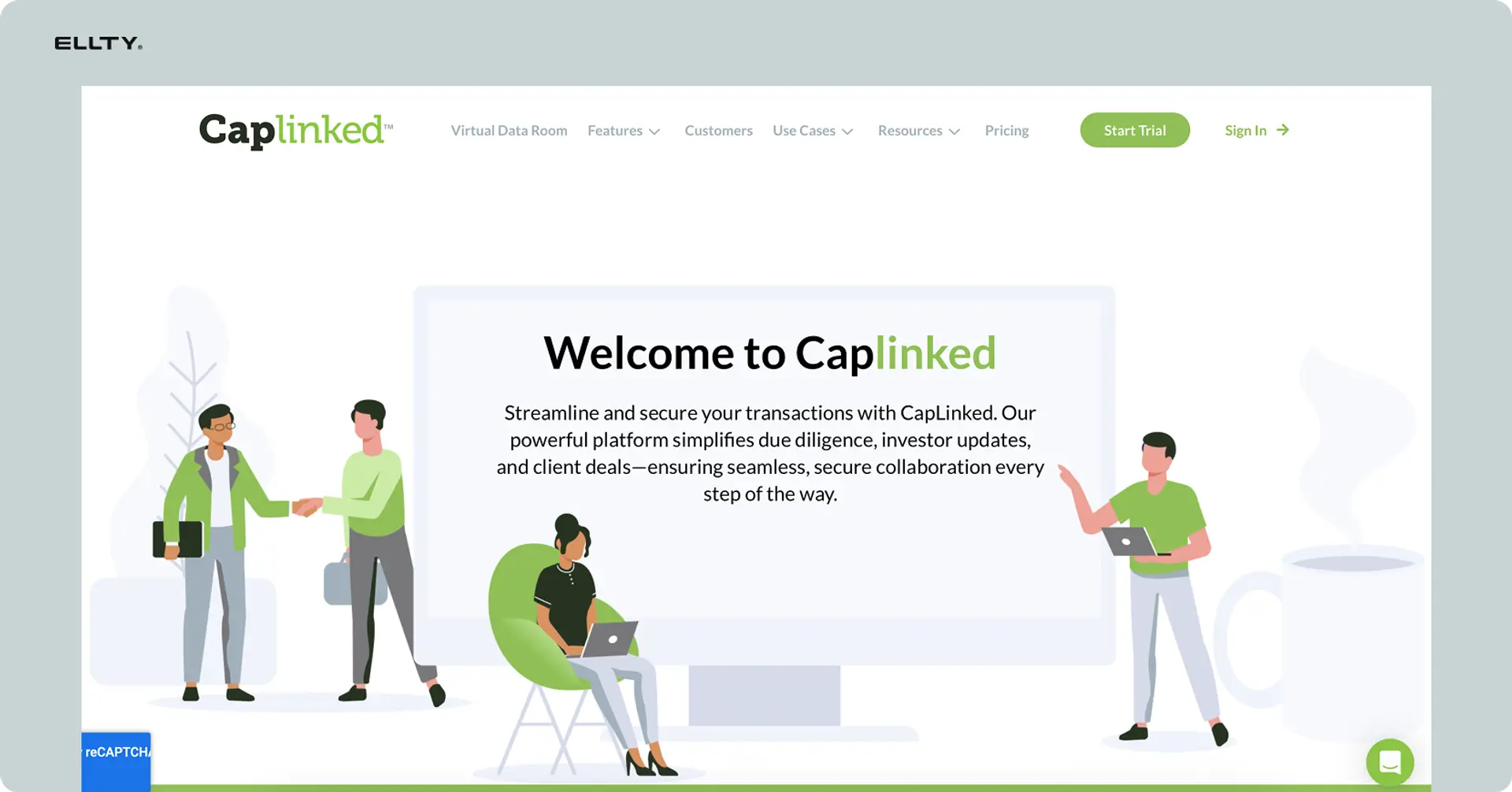
Caplinked is built specifically for M&A and corporate development teams. We tested it because it automates parts of the deal process that usually require manual tracking. The workflow features let you set up task lists, approvals, and document requests within the platform.
iDeals VDR vs Caplinked

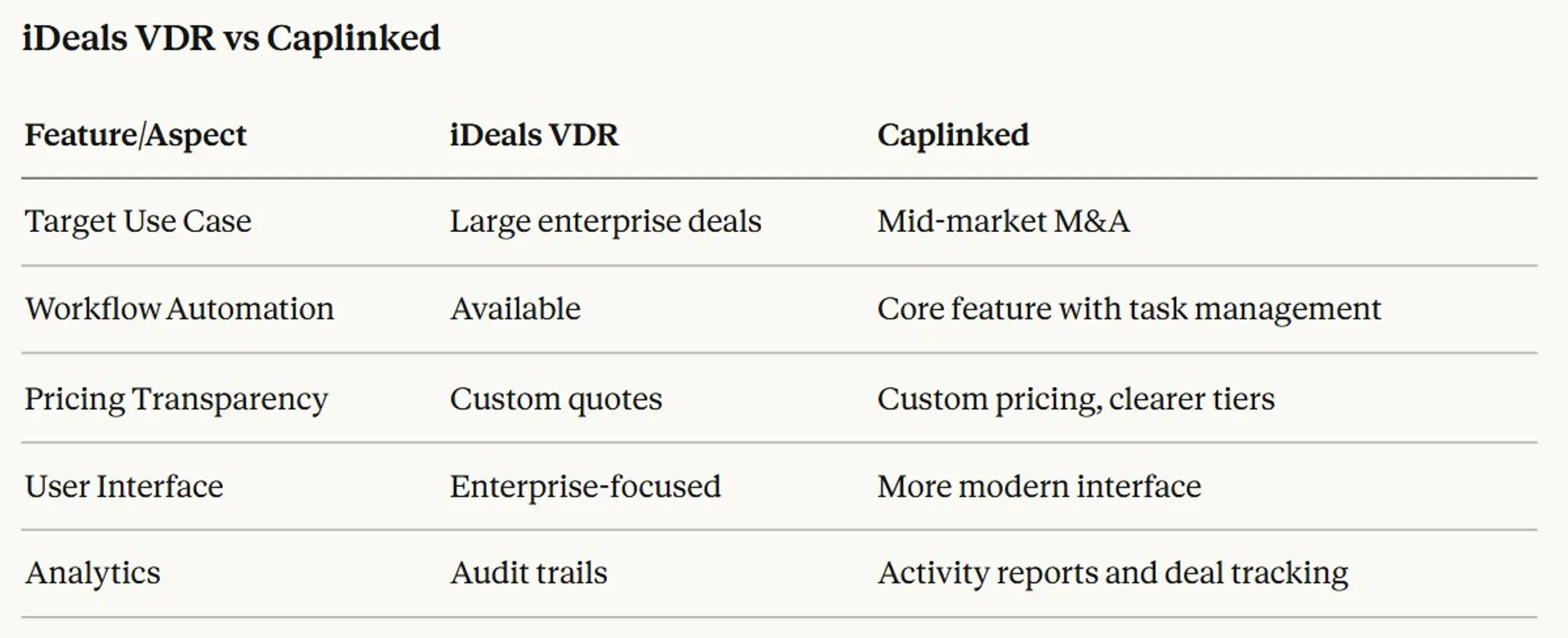
Why M&A teams use it
In our testing, we set up a mock deal workspace with document folders, task assignments, and approval workflows. Caplinked lets you create checklists for due diligence, assign tasks to team members, and track completion. This structure helps when you're managing multiple work streams in a transaction.
What we noticed was how the platform handles permissions. You can grant access to specific folders or documents based on user roles. During due diligence, this means external advisors see only what they need without accessing the entire data room. We found the granular controls useful but not overwhelming.
The Q&A feature stood out - buyers can ask questions directly in the platform, and sellers can respond with the conversation tied to relevant documents. This keeps communication organized instead of scattered across email threads.
Best For: M&A teams and corporate development groups managing mid-market transactions
Pricing: Custom pricing based on deal size and user count; starts around $500/month based on user reports
Support: Phone and email support; dedicated account management for larger deals
"Caplinked kept our entire M&A process organized. The workflow automation meant we didn't miss any due diligence items." - Corporate Development Director, Growth Company, Capterra
4. Firmex - Enterprise security for compliance-heavy deals
Ratings and Reviews: G2: 4.2/5 ⭐ | Capterra: 4.3/5 ⭐


Firmex focuses on security and compliance for industries like finance, legal, and healthcare. We tested it to see how it compares to iDeals on the enterprise security front. It's one of the more established VDR platforms, and that shows in the security features.
iDeals VDR vs Firmex


Why compliance-focused businesses use it
When we tested Firmex, the security settings were comprehensive. Two-factor authentication, IP restrictions, document expiration, and detailed audit logs are all standard. For industries where compliance matters - think healthcare M&A or legal document sharing - these features aren't optional.
We found the user interface a bit dated compared to newer platforms, but it's functional. The focus is clearly on security over aesthetics. Setting up a data room took us about 15 minutes, mostly spent configuring permission levels and security settings.
The customer support stood out in our testing. We contacted them with a question about permission inheritance, and they responded within an hour with a detailed explanation. For enterprise deals where downtime or confusion costs money, responsive support matters.
Best For: Regulated industries needing compliance-focused virtual data rooms with strong audit trails
Pricing: From $500/month for standard data rooms; custom pricing for enterprise features
Support: 24/7 phone and email support; dedicated account managers for larger accounts
"Firmex met all our HIPAA requirements for due diligence. The audit logs gave us complete visibility into document access." - Legal Director, Healthcare Company, G2
5. DealRoom - M&A pipeline tracking and deal management
Ratings and Reviews: G2: 4.6/5 ⭐ | Capterra: 4.7/5 ⭐


DealRoom takes a different approach - it combines VDR functionality with deal pipeline management. We tested it because it promises to handle both sourcing and execution in one platform. For corporate development teams running multiple deals simultaneously, this integration makes sense.
iDeals VDR vs DealRoom


Why corporate development teams use it
In our testing, we set up a pipeline with several mock deals at different stages. DealRoom lets you track deals from initial contact through due diligence to close. Each deal has its own data room, but you can see the entire pipeline in one view. This helps teams managing multiple acquisitions or investments.
What we found useful was the integration with communication tools. You can connect Slack or email, and DealRoom captures relevant messages tied to specific deals. This reduces the "where did we discuss this" problem that happens when conversations scatter across platforms.
The analytics show you deal velocity - how long deals spend in each stage, where bottlenecks happen, and team activity levels. We tested this with our mock pipeline and could see which deals were moving and which were stalled. For teams where deal flow matters as much as individual transactions, this visibility helps.
Best For: Corporate development and M&A teams managing multiple deals with pipeline visibility needs
Pricing: Custom pricing based on deal volume and user count; typically starts around $1,000/month
Support: Email and phone support; onboarding includes setup assistance and training
"DealRoom changed how we manage our acquisition pipeline. We can finally see all our deals in one place with their own secure data rooms." - VP Corporate Development, Tech Company, G2
6. Docracy - Lightweight document sharing for quick deals
Ratings and Reviews: G2: 4.1/5 ⭐ | Capterra: 4.0/5 ⭐


Docracy is much lighter than enterprise VDRs. We tested it because sometimes you don't need the full data room infrastructure - you just need to share documents securely and track who viewed them. Docracy handles this without the complexity.
iDeals VDR vs Docracy


Why small teams use it
When we tested Docracy, we had documents uploaded and shared in under five minutes. The interface is stripped down - upload files, organize them in folders, share links, and see basic analytics. That's it. For teams that find enterprise VDRs overwhelming, this simplicity works.
We found it particularly useful for sharing templates and standard documents. The platform includes a library of legal document templates you can customize. For early-stage startups or small businesses without legal teams, this saves time on basic agreements.
The tracking shows you who accessed documents and when. It's not as detailed as dedicated VDR analytics, but it answers the basic question: did they look at it? In our testing, notifications came through immediately when someone opened a shared document.
Best For: Small teams and startups needing simple document sharing without enterprise VDR overhead
Pricing: Free basic tier with limited storage; Pro from $15/month per user
Support: Email support; knowledge base covers common questions; response times vary
"We needed something simple for sharing NDAs and contracts. Docracy gave us tracking without the learning curve of bigger platforms." - Startup Founder, Pre-seed Stage, Capterra
7. PandaDoc - Document workflow with e-signature focus
Ratings and Reviews: G2: 4.7/5 ⭐ | Capterra: 4.5/5 ⭐

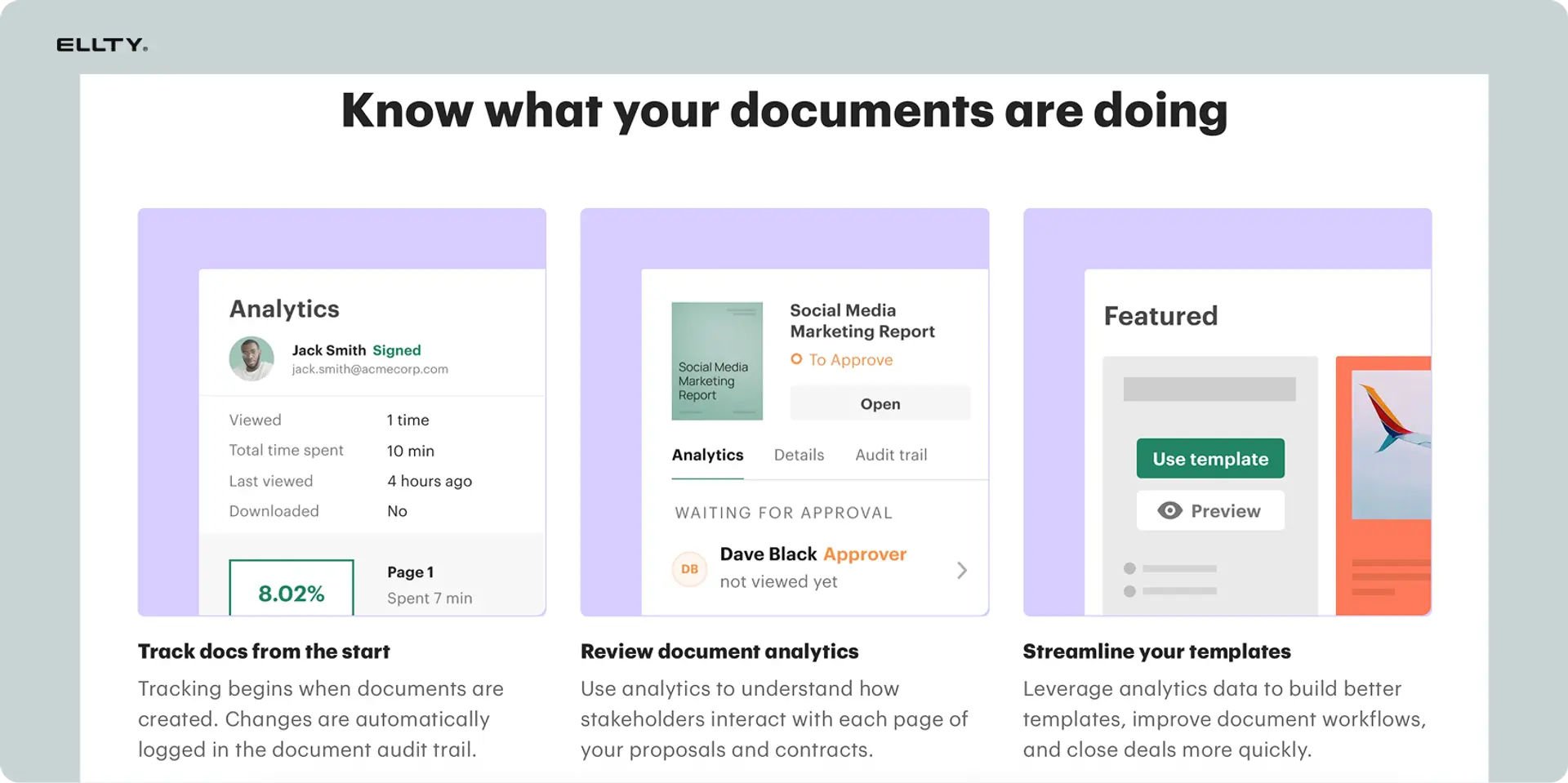
PandaDoc isn't a traditional VDR - it focuses on document workflow and e-signatures. We tested it because many teams need both secure sharing and signature collection. If your documents require approval or signatures, PandaDoc handles the entire workflow.
iDeals VDR vs PandaDoc


Why sales and legal teams use it
In our testing, we created a sample agreement and sent it for signature. PandaDoc tracked when the recipient opened it, how long they spent on each page, and when they signed. The workflow automation sent reminders to unsigned documents automatically, which reduced follow-up work.
What stood out was the template system. You can build proposals, quotes, and contracts with variables that auto-populate from your CRM. We tested this with a mock proposal, and the setup took about 15 minutes. Once the template was ready, generating new proposals took seconds.
The collaboration features let multiple team members edit documents simultaneously. We tested this with a contract that needed legal review - our mock legal team could comment and suggest changes without version control issues. For teams where documents go through multiple reviewers, this prevents the "final_final_v3" file naming problem.
Best For: Teams needing document workflow automation with e-signature and proposal management
Pricing: From $19/user/month for Essentials; Business plan from $49/user/month
Support: Email and chat support; phone support on higher tiers; extensive knowledge base
"PandaDoc cut our contract turnaround time in half. The tracking shows us exactly where deals are in the signature process." - Sales Operations Manager, SaaS Company, G2
8. Ansarada - AI-powered due diligence for complex deals
Ratings and Reviews: G2: 4.5/5 ⭐ | Capterra: 4.4/5 ⭐


Ansarada uses AI to help with deal preparation and due diligence. We tested it because the AI angle intrigued us - the platform promises to identify potential issues and suggest documents you might be missing. For complex deals, this could save time.
iDeals VDR vs Ansarada

Why deal teams use it
When we tested Ansarada, we set up a mock M&A data room. The AI analyzed our document structure and suggested additional files we should include based on similar deals. It flagged potential gaps in our due diligence materials. For teams new to complex transactions, this guidance helps avoid missing critical documents.
The material change notifications stood out in our testing. If you upload a new version of an important document, Ansarada flags this to relevant stakeholders automatically. We tested this by updating a financial statement, and the platform notified our mock buyer team within minutes.
The analytics include deal prediction scores - Ansarada's AI estimates the likelihood of deal completion based on activity patterns. We couldn't fully test this feature with mock data, but user reviews indicate it helps teams prioritize which deals to focus on when managing multiple transactions.
Best For: Teams managing complex M&A deals who want AI assistance with due diligence preparation
Pricing: Custom pricing based on deal size and features needed; typically enterprise-level costs
Support: 24/7 support with dedicated deal specialists; onboarding includes training sessions
"Ansarada's AI caught missing documents we would have overlooked. The deal prediction helped us focus on transactions most likely to close." - M&A Director, Private Equity Firm, G2
9. Box - Enterprise file sharing with collaboration focus
Ratings and Reviews: G2: 4.2/5 ⭐ | Capterra: 4.4/5 ⭐

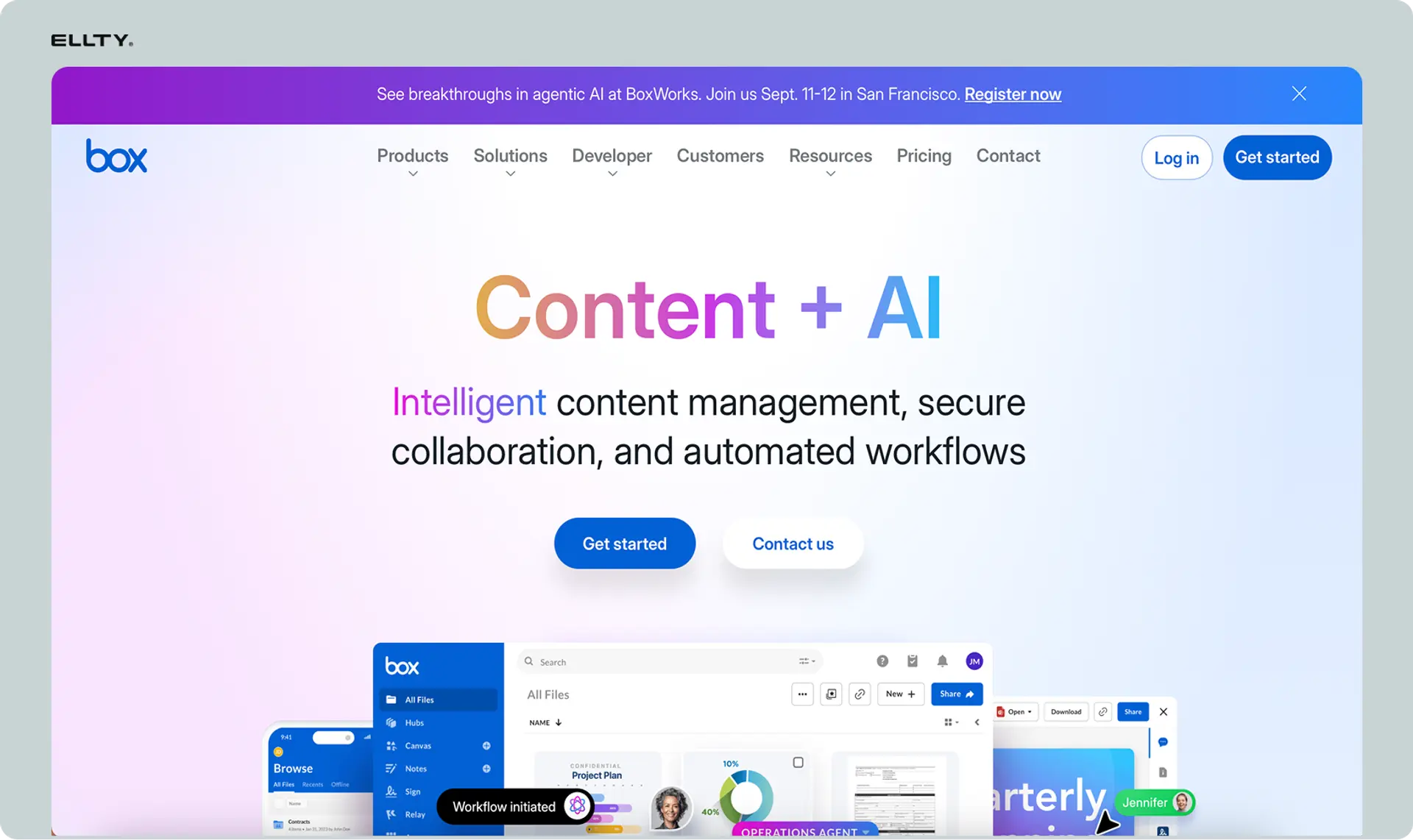
Box isn't a dedicated VDR, but many teams use it for secure file sharing and collaboration. We tested it because it's familiar to many organizations already using it for general file storage. The question was whether it could handle VDR-like use cases.
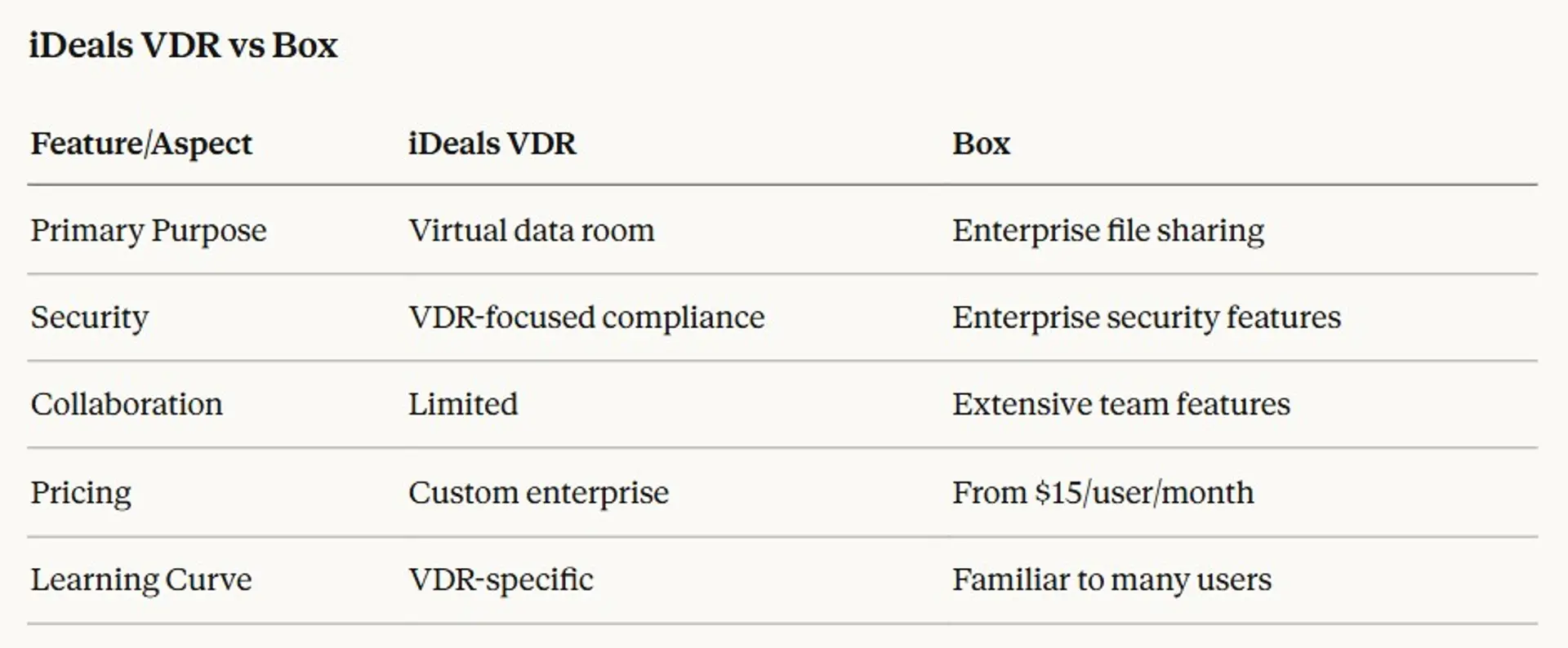
iDeals VDR vs Box

Why teams use it for secure sharing
In our testing, we set up a Box folder for sensitive documents and configured access permissions. Box offers detailed permission controls - you can grant view-only access, prevent downloads, set expiration dates, and require watermarks. For teams already using Box, these security features might be sufficient for fundraising or simpler due diligence.
What we appreciated was the collaboration side. Multiple team members can work on documents simultaneously, comment on files, and track version history. We tested this with a financial model that needed input from several people. Box handled the collaboration smoothly without the "who has the latest version" confusion.
The integration ecosystem is extensive. Box connects with hundreds of business tools, from CRMs to project management software. We tested the Slack integration, and file sharing notifications appeared in our channel immediately. For teams with established workflows, these integrations reduce friction.
Best For: Teams already using Box who need enhanced security for sensitive documents without adopting a separate VDR
Pricing: Business plan from $15/user/month; Enterprise plan with advanced security from $35/user/month
Support: Email and phone support; extensive documentation; premium support on enterprise plans
"We already had Box for file sharing. The security features let us use it for due diligence without paying for a separate VDR platform." - Finance Director, Mid-size Company, Capterra
Cheapest iDeals VDR alternatives
If you're watching costs carefully, several low-price alternatives offer solid document sharing and basic virtual data room features:
1. Ellty
With a free plan that never expires and paid plans starting at $69/month, Ellty is the most affordable full-featured fundraising platform we tested. You get real-time engagement analytics, page-by-page tracking, eSignatures, and complete virtual data room functionality - folder organization, granular permissions, NDA gating, and dynamic watermarking - all built specifically for startup fundraising rather than enterprise M&A.
The interface is straightforward by design. Upload your documents, organize due diligence materials into structured data rooms, create trackable links, and see exactly who viewed what and for how long. Setup takes minutes instead of requiring onboarding sessions or IT support.
If you need enterprise compliance certifications or highly complex permission hierarchies, you'll need more robust tools but for seed through Series B fundraising, Ellty covers every essential without the enterprise price tag.
2. Docracy
At $15/month for the Pro plan, Docracy offers basic secure document sharing with tracking. You get encrypted file storage, shareable links, and simple analytics showing who accessed documents and when. No advanced workflows, no AI insights, just straightforward sharing.
The platform includes legal document templates as a bonus - NDAs, service agreements, basic contracts you can customize. For early-stage startups that need both document sharing and standard legal templates, this saves time. The analytics aren't as detailed as dedicated VDR platforms, but you'll know if someone opened your files.
3. Google Drive
Free for basic use, Google Drive Business Standard at $12/user/month is hard to beat on price. The catch: you get almost no due diligence-specific features. You can share files securely and control permissions, but there's no page-by-page analytics, no viewer tracking beyond "who has access," and no audit trails suitable for M&A compliance.
Good enough for internal team collaboration or sharing documents with advisors you already trust. Not good enough for investor due diligence where you need to know if a VC actually reviewed your financial model or which sections of your data room got attention. The familiarity and integration ecosystem make it useful for general file management, just not purpose-built for fundraising or transactions.
How we chose which iDeals VDR alternative to recommend
After testing all these alternatives, here's what we'd consider if we were choosing for our own business:
Your use case matters most. Are you fundraising with pitch decks, running complex M&A due diligence, or just need secure document sharing? We found that tools built for specific purposes (like Ellty for pitch decks or Ansarada for complex deals) outperform general solutions for those exact use cases. If you're doing enterprise M&A, you probably need the features Firmex or Caplinked offer. If you're a founder sharing decks with investors, something simpler like Ellty or Docracy handles this without the overhead.
Budget and team size. Per-user pricing adds up fast when your team grows. We tested tools with both per-user and flat-rate pricing. For small teams (2-5 people), per-user pricing around $15-30/month is manageable. For larger teams, flat-rate options or tools with unlimited users make more financial sense. Enterprise VDRs like iDeals, Firmex, and Ansarada typically require custom quotes - these make sense when deal values justify the cost, but they're overkill for everyday document sharing.
Technical requirements. Do you need to integrate with your CRM, project management tools, or communication platforms? We found that tools like Box and DealRoom excel at integrations, while dedicated VDRs focus more on security and compliance. If you're in a regulated industry, compliance certifications (HIPAA, SOC 2, ISO 27001) aren't optional - Firmex and iDeals handle these well. For simpler needs, basic encryption and access controls suffice.
Analytics needs. If you're fundraising, analytics like page views, time spent, and return visits help you understand investor interest. We tested Ellty and Digify for this - both show detailed viewer behavior. For M&A due diligence, you need different analytics - audit trails, access logs, and activity reports. Ansarada and Caplinked provide these deal-focused insights.
Support and reliability. Response times matter when you're on a deadline. We tested support by reaching out with questions to each platform. Enterprise tools (Firmex, Ansarada) responded fastest with dedicated account managers. Lighter tools (Docracy, Box) had longer response times but still answered within 24 hours. Some tools took hours to set up (enterprise VDRs with complex permissions), while others (Ellty, Docracy) were running in minutes. Consider whether you have time for setup or need something working immediately.
Common questions about iDeals VDR alternatives (from our testing)
What is iDeals VDR best known for?
iDeals Virtual Data Room is known for enterprise-grade M&A transactions and due diligence. It's one of the established VDR platforms with strong security certifications and compliance features. Companies use it for large deals where audit trails, granular permissions, and regulatory compliance matter. It's built for complex transactions rather than everyday document sharing.
Why do businesses look for iDeals alternatives?
From our testing and conversations with users, the main reasons are cost and complexity. iDeals pricing isn't transparent on their website - you need to request custom quotes, which typically land in enterprise territory. Smaller businesses and startups find this pricing structure doesn't match their needs. The platform is also built for complex enterprise use cases, which means features and workflows that smaller teams don't need. Some teams want simpler tools focused on specific needs like pitch deck sharing or basic due diligence.
Are these alternatives cheaper than iDeals?
It depends on what you need. Tools like Docracy (from $15/month) and Ellty (from $69/month) are significantly cheaper for secure document sharing and data room features. Mid-range options like Digify (from $99/month) and Box (from $15/user/month) offer more features at transparent pricing. Enterprise alternatives like Firmex, Ansarada, and Caplinked have custom pricing similar to iDeals - you'll pay enterprise rates for enterprise features. We found that if you don't need the full VDR feature set, you can save substantially with focused alternatives.
Which alternative is best for early-stage startups?
For early-stage startups, we'd recommend Ellty or Docracy. Both offer low-cost entry points and focus on what startups need most - sharing pitch decks or basic documents with tracking. Ellty gives you pitch deck analytics that help with fundraising conversations. Docracy provides simple secure sharing without complexity. We tested both with startup use cases in mind, and the setup time was minimal. You don't need IT help or extensive training. As your needs grow into full due diligence, you can move to more robust platforms.
Do I need a virtual data room for fundraising?
It depends on your fundraising stage. For initial pitch deck sharing, you don't need a full VDR - tools like Ellty handle this with tracking and analytics. Once you're in serious due diligence (investors requesting financial documents, contracts, legal materials), a VDR becomes useful. We found that seed-stage founders often share pitch decks first, then set up data rooms later when investors request detailed materials. Series A and beyond typically require proper data rooms from the start because investors expect organized due diligence materials.
Can I switch from iDeals to another tool easily?
Switching depends on how you've organized your data room. We tested migration by exporting files from one platform and importing to another. The files themselves transfer easily - just download and re-upload. The challenge is recreating permission structures, folder organization, and audit history. Some platforms (Box, DealRoom) offer migration assistance. Others require manual setup. If you're mid-transaction, switching is risky because you lose activity tracking continuity. We'd recommend switching between deals rather than during active due diligence.
What's the difference between iDeals and Firmex?
Both are enterprise VDR platforms with similar security features and compliance certifications. From our testing, the main differences are subtle. iDeals has a more extensive feature set for complex deal workflows. Firmex focuses heavily on regulated industries and compliance documentation. The interfaces differ - iDeals feels more comprehensive, Firmex more focused. Pricing is custom for both, likely in similar ranges. For most use cases, they're comparable. Your choice comes down to specific feature needs and which vendor relationship you prefer.
How important are document analytics for due diligence?
Very important for understanding investor or buyer behavior. In our testing, we found that analytics showing which documents get attention (and which get ignored) help you prepare for questions and follow-ups. For pitch decks, analytics like page views and time spent indicate genuine interest. For due diligence, seeing which financial documents buyers review most helps you anticipate their concerns. Tools like Ellty, Digify, and Ansarada provide detailed analytics. Basic VDRs just show access logs without behavioral insights.
Our final thoughts on iDeals VDR alternatives
After weeks of testing these tools, we realized there's no single "best" alternative to iDeals. The right choice depends entirely on what you're actually trying to accomplish.
We found Ellty great for startup fundraising and data room sharing when you need fast setup and clear analytics. Firmex and Ansarada suited complex M&A deals where compliance and AI insights matter. PandaDoc handled document workflows and signatures better than pure VDRs. Box worked well for teams already using it who needed enhanced security.
The landscape has options for every use case and budget. Enterprise teams running multi-million dollar transactions need different tools than founders sharing pitch decks with angel investors. We tested everything from $15/month platforms to enterprise solutions requiring custom quotes.
Choose based on your actual needs, not what sounds impressive. We found that simpler tools often work better for straightforward tasks, while complex platforms shine when you genuinely need their advanced features. Whether you go with Ellty for quick data room analytics or Ansarada for AI-powered due diligence, pick what actually solves your problems rather than what has the most features you'll never use.
If you have questions about any of these tools or need help deciding, the documentation and trial periods let you test before committing. Most platforms we tested offer demos or free tiers - use them to see which interface and workflow match how your team actually works.
Disclaimer
Parties other than Ellty may provide products, services, recommendations, or views on this site ("Third Party Materials"). Ellty is not responsible for examining or evaluating such Third Party Materials, and does not provide any warranties relating to the Third Party Materials. Links to such Third Party Materials are for your convenience and does not constitute an endorsement of such Third Party Materials.
Author

Anika Tabassum Nionta is a Content Manager at Ellty, where she writes about secure document sharing, virtual data rooms, M&A, due diligence, fundraising, and sales enablement. With over 6 years of writing experience, she helps professionals understand how to share confidential documents securely, track engagement, and manage deals more effectively. Anika holds both a BA and MA in English from Dhaka University. Outside of work, she enjoys reading, exploring new cafes in Dhaka, and connecting with entrepreneurs and dealmakers in her community.

