AI and B2B software represent 28% of Vancouver's $1.4B in 2024 VC funding. These 11 investors - from Vancouver-native seed funds to national growth capital - are actively writing checks into BC SaaS companies right now.
Vancouver's SaaS funding is blunt about one thing in 2026: AI-native SaaS raises at premium valuations with oversubscribed rounds, while traditional SaaS faces a harder environment. Median Series B valuations for AI-powered SaaS hit $175M in Q3 2025, a 38% year-over-year increase. Plain-vanilla SaaS without an AI angle is getting half the multiple it got in 2021.
That doesn't mean traditional SaaS is dead. Rhino Ventures backed Thinkific all the way to a public listing. Version One backed Jobber and Ada. GTMfund backed companies with $1M ARR and a clear enterprise GTM motion. But the bar is higher. If you're selling software that a large language model could partially replace in 18 months, every investor on this list will ask you directly.
Vancouver has real SaaS exits. Thinkific is public. Jobber raised $370M+ and became a unicorn. ApplyBoard raised over $500M. The pattern is clear: B2B SaaS with a specific vertical niche, high NRR, and expansion revenue closes rounds faster than horizontal tools with wide positioning.
Before reaching out to these 11 investors, get your materials ready. Read how to organize your pitch deck sharing to understand what investors see when you send materials.
| Stage | Check size | Sector focus | Contact | |
|---|---|---|---|---|
| GTMfund | Pre-seed, Seed, Series A | $500K-$1.5M | B2B SaaS, go-to-market tools, revenue software | gtmfund.com |
| Rhino Ventures | Series A | $2M-$10M | B2B SaaS, enterprise software, vertical SaaS | rhinoventures.ca |
| Version One Ventures | Pre-seed, Seed | $250K-$2M | B2B SaaS, marketplace, AI software | versionone.vc |
| Pender Ventures | Series A, Series B | $2M-$15M | B2B SaaS, healthtech software, enterprise | penderventures.com |
| Garage Capital | Pre-seed, Seed | $250K-$1M | B2B SaaS, vertical software, marketplace | garage.vc |
| BDC Capital | Seed, Series A | $500K-$5M | Cross-sector B2B SaaS, enterprise software | bdc.ca |
| Yaletown Partners | Seed, Series A, Growth | $1M-$15M | Enterprise SaaS, industrial software, AI | yaletown.com |
| InBC Investment Corp. | Seed, Series A | $2M-$15M | BC SaaS, AI, deep tech software | inbcinvestment.com |
| Vanedge Capital | Seed, Series A, Series B | $1M-$15M | Enterprise software, AI infrastructure, analytics | vanedgecapital.com |
| TELUS Ventures | Series A, Series B, Series C | $5M-$100M | Vertical SaaS, enterprise platforms, IoT software | telus.com/en/ventures |
| VANTEC Angel Network | Pre-seed, Seed | $50K-$500K | BC SaaS, software, digital services | vantec.ca |
Track who opens your SaaS pitch
Upload your deck to Ellty and send trackable links. See which VCs open your materials and which slides they spend the most time on.
Start free 14-day trialWhat is a Vancouver SaaS investor?
A Vancouver SaaS investor backs founders building recurring-revenue software businesses with clear B2B sales motions, defensible product niches, and expansion revenue from existing customers. They differ from generalist VCs because they evaluate NRR, CAC payback period, and gross margin at first meeting — not just ARR growth.
Check sizes run from $50K angel checks at VANTEC to $100M+ at TELUS Ventures for growth-stage platforms. Most first institutional SaaS rounds in Vancouver land between $500K and $2M at seed. Getting to Series A typically requires $1M+ ARR, 110%+ NRR, and a clear enterprise expansion motion within your existing customer base.
Vancouver SaaS investors are not patient with horizontal positioning. The ones who've seen too many "platform plays" that can't win against Salesforce add-ons will ask your ICP directly in the first meeting. The more specific your buyer, the better your pitch lands in Vancouver's VC community.
For context on how to share your pitch materials effectively, read how to share a data room link. Use Ellty to send trackable links to your pitch deck — you'll see which investors open your product demo slides before your next conversation. For broader Canadian SaaS capital, check the Toronto SaaS investors list.
AI-native SaaS raises at premium valuations with oversubscribed rounds. Traditional SaaS faces a far more challenging environment.
11 best Vancouver SaaS investors
1. GTMfund
Vancouver's only dedicated B2B SaaS fund with an explicitly go-to-market thesis. Their $54M USD Fund II closed oversubscribed in February 2025. Their 300+ LP network of GTM leaders from Salesforce, DocuSign, Snowflake, and Okta is one of the most useful enterprise sales networks available to a seed-stage SaaS company in BC.
- Recent Deals: Fund II $78.83M CAD ($54M USD) closed February 2025, oversubscribed; plans to back ~40 startups at $500K-$1.5M; doubling Canada deployment vs Fund I; re-acquired Sales Hacker and relaunched as GTMnow; Inovia Capital as LP
- LinkedIn: GTMfund LinkedIn
- Sector Focus: B2B SaaS, revenue tools, sales enablement software, GTM platforms
- Stage Focus: Pre-seed, Seed, Series A
- Location: Vancouver, BC / Scottsdale, AZ
- Website: gtmfund.com
2. Rhino Ventures
Vancouver's high-conviction Series A fund with $120M Fund III. Rhino backed Thinkific through its entire journey from private to public - investing $50M over five years and retaining a 15% stake post-IPO secondary in June 2025. If you're a B2B SaaS founder with $1M+ ARR and strong NRR, Rhino is the most accessible Series A fund in BC.
- Recent Deals: ShopVision seed (September 2025); Ontopical acquisition by SOVRA (August 2025); Thinkific secondary sale June 2025 (retains ~15%); 27 portfolio companies with 2 IPOs and 8 acquisitions; $120M Fund III
- LinkedIn: Rhino Ventures LinkedIn
- Sector Focus: B2B SaaS, enterprise software, vertical software platforms
- Stage Focus: Series A
- Location: Vancouver, BC
- Website: rhinoventures.ca
3. Version One Ventures
Boris Wertz's Vancouver seed fund backed Jobber, Ada, and Dapper Labs. In 2025-2026, Version One explicitly shifted focus toward AI, robotics, and data companies alongside B2B SaaS. For SaaS founders with a technical AI angle, Version One's co-investor network — which includes Sequoia, a16z, and Bessemer on follow-on rounds — is one of the most powerful in BC.
- Recent Deals: 3 new investments in early 2026; Swoop investment (2026); 6 investments in 2025; 6 unicorns in portfolio including Jobber; $250M+ AUM; Fund VI actively deploying
- LinkedIn: Version One Ventures LinkedIn
- Sector Focus: B2B SaaS, AI software, marketplace, Web3
- Stage Focus: Pre-seed, Seed
- Location: Vancouver, BC
- Website: versionone.vc
4. Pender Ventures
Vancouver's Series A specialist with $150M AUM. Maria Pacella's fund backed DrugBank, Jane Software, and Engineered Intelligence. They focus on B2B software with strong gross margins and a clear expansion motion inside the customer base. Most recently invested in Science&Humans ($10M Series A, January 2026) and Engineered Intelligence (April 2026).
- Recent Deals: Science&Humans $10M Series A (January 2026); Engineered Intelligence Series A (April 2026); Veritree $6.5M Series A co-lead (May 2025); Catio $3M (March 2025); $150M AUM; InBC and Alberta Enterprise as LPs
- LinkedIn: Pender Ventures LinkedIn
- Sector Focus: B2B SaaS, healthtech software, enterprise platforms
- Stage Focus: Series A, Series B
- Location: Vancouver, BC
- Website: penderventures.com
5. Garage Capital
Active in Vancouver with 200+ portfolio companies and 10 unicorns including Substack. Garage co-invested with Pender Ventures on Veritree's Series A in May 2025. They write fast $250K-$1M checks at pre-seed and seed for B2B SaaS companies with a clear vertical niche and early revenue signal.
- Recent Deals: Veritree $6.5M Series A co-invest with Pender (May 2025); Substack unicorn (2025, 7 years post initial investment); 200+ portfolio companies; 10 unicorns; fast decision process; OpenPhone, Vendr, and Gecko Robotics in portfolio
- LinkedIn: Garage Capital LinkedIn
- Sector Focus: B2B SaaS, vertical software, fintech, marketplace
- Stage Focus: Pre-seed, Seed
- Location: Kitchener, ON (active Vancouver deal flow)
- Website: garage.vc
Send your SaaS pitch with trackable links
Set up an Ellty data room before your first investor meeting. Know exactly who opens your pitch and which slides they review.
Start free 14-day trial6. BDC Capital
Canada's most active co-investor. BDC writes $500K to $5M checks into Canadian SaaS companies and co-invests with most funds on this list. They won't lead a SaaS round, but they'll move fast on a co-investment alongside a credible lead. For Vancouver SaaS founders who need to close a round faster, BDC as a co-investor signals institutional validation.
- Recent Deals: Luge Capital Fund II LP; continuous deployment across BC SaaS and software; 384+ total investments; portfolio companies have raised $3.5B+ in additional capital; also LP in GTMfund and Garage Capital on previous rounds
- LinkedIn: BDC Capital LinkedIn
- Sector Focus: Cross-sector B2B SaaS, enterprise software, digital platforms
- Stage Focus: Seed, Series A (also pre-seed and growth)
- Location: Vancouver, BC (national mandate)
- Website: bdc.ca
7. Yaletown Partners
Vancouver's $600M AUM generalist fund with a specific Intelligent Industry thesis. Thinkific was a Yaletown portfolio company. They back enterprise software with data and AI components, and their $250M IGF III fund is currently in active deployment. For SaaS companies serving industrial or enterprise buyers, Yaletown is the right partner in BC.
- Recent Deals: GHGSat $47M Series C (September 2025); Nanoprecise $38M Series C lead (2025); IGF III $100M first close (July 2025) targeting $250M; 20+ exits including Thinkific
- LinkedIn: Yaletown Partners LinkedIn
- Sector Focus: Enterprise SaaS, industrial software, AI-enabled platforms
- Stage Focus: Seed, Series A, Growth
- Location: Vancouver, BC
- Website: yaletown.com
8. InBC Investment Corp.
BC's $500M provincial fund backs BC-based software companies as part of its digital tech and AI mandate. For SaaS founders with BC-based operations and Canadian IP, InBC is a realistic co-investor alongside a fund lead. They've backed Sanctuary AI, Novarc, and Amplitude Ventures - all enterprise software adjacent.
- Recent Deals: UBC Catalyst Ventures Fund co-anchor $10M (March 2026); Vanedge Fund IV $10M LP (March 2025); 38 BC companies in portfolio; $81M invested in FY 2024/25; explicitly seeks BC-owned software and AI deals
- LinkedIn: InBC Investment Corp. LinkedIn
- Sector Focus: BC SaaS, AI software, deep tech, enterprise platforms
- Stage Focus: Seed, Series A (also LP in VC funds)
- Location: Vancouver, BC
- Website: inbcinvestment.com
9. Vanedge Capital
Vancouver's most technical early-stage fund with deep enterprise software focus. They backed Electronic Arts, D-Wave, and NeuroBionics. For SaaS founders building AI infrastructure or enterprise analytics platforms, Vanedge is a realistic lead investor who goes deep on technical architecture during diligence.
- Recent Deals: NeuroBionics $10M seed co-lead (December 2025); Mojo Vision $75M Series B Prime (September 2025); Fund IV InBC $10M LP commitment (March 2025); $500M+ AUM across four funds
- LinkedIn: Vanedge Capital LinkedIn
- Sector Focus: Enterprise software, AI infrastructure, analytics, data platforms
- Stage Focus: Seed, Series A, Series B
- Location: Vancouver, BC
- Website: vanedgecapital.com
10. TELUS Ventures
TELUS's corporate VC arm is based in Vancouver with 57 portfolio companies. For vertical SaaS founders building platforms that can integrate with telecom infrastructure, enterprise networks, or IoT systems, TELUS can accelerate your enterprise sales motion through its own commercial network of B2B customers.
- Recent Deals: Waabi $750M Series C (January 2026); CubeWorks (November 2025); portfolio includes Taulia (acquired SAP) and Veracode; 57 total investments; 21 acquisitions across portfolio
- LinkedIn: TELUS Ventures LinkedIn
- Sector Focus: Vertical SaaS, enterprise platforms, IoT software, B2B technology
- Stage Focus: Series A, Series B, Series C
- Location: Vancouver, BC
- Website: telus.com/en/ventures
11. VANTEC Angel Network
BC's primary angel gateway for pre-seed SaaS capital. VANTEC's 300+ accredited investors include software executives, enterprise buyers, and SaaS founders who've exited. For SaaS founders pre-institutional who need $250K to $500K and domain-expert angels who can open enterprise doors, VANTEC is the most structured entry point in Vancouver.
- Recent Deals: Ongoing cohort-based investment rounds; 300+ accredited BC angel investors; regular SaaS and software company presentations; connects founders to local VCs after angel validation; intro pathway to Rhino, GTMfund, and Pender
- LinkedIn: VANTEC Angel Network LinkedIn
- Sector Focus: BC SaaS, enterprise software, digital platforms
- Stage Focus: Pre-seed, Seed
- Location: Vancouver, BC
- Website: vantec.ca
How SaaS investors evaluate unit economics in Vancouver
Every fund on this list asks the same first question: what's your NRR? 100% NRR means you're keeping all your customers. 110%+ NRR means your existing customers are growing. 130%+ NRR is what gets Vancouver SaaS founders into oversubscribed rounds.
The second question is CAC payback period. If it takes you more than 18 months to recover your customer acquisition cost, your economics don't work at scale. Most BC SaaS investors benchmark against the Thinkific and Jobber metrics from their peak growth years - if your numbers don't hold up to that comparison, they'll tell you.
Gross margin matters more than most SaaS founders in Vancouver realize. Below 70% gross margin, you're a services business with software sprinkled on top. Most institutional investors won't fund below 70%. At 80%+ gross margin, you're in the fundable range and conversations move faster. Upload your financial model to Ellty and send a trackable link with email gate — you'll know which investors opened your unit economics tab before your next call. Read how to organize documents in a data room to structure your financials clearly for diligence.
How to find SaaS investors in BC
The two most reliable entry points are the BC Tech Association's events and BetaKit's VC network. The BC Tech Association runs the annual BC Tech Summit, which brings together founders and investors for structured networking. BetaKit covers nearly every Vancouver SaaS funding announcement and runs a Slack community where investors actively participate.
Web Summit Vancouver brought 768 investors to the Convention Centre in May 2026. Several B2B SaaS companies from BC closed seed rounds from conversations that started at the event's networking sessions.
Use Ellty to share your pitch deck as a trackable link before any event or intro. Most investors at conferences take a deck link on the spot and review it that evening. Founders who can share a secure pitch deck link instantly - without a messy email thread - are easier to deal with. That matters when an investor reviews 20+ decks in a day.
What separates fundable SaaS from crowded markets
Vancouver SaaS investors in 2026 are pattern-matching against one thing: does this company have a niche defensible enough to win against a Salesforce add-on or a hyperscaler bundled feature? If the answer is unclear, the round doesn't close.
The clearest sign a SaaS company is fundable is a specific buyer with a specific workflow problem. Jobber owns home services. Thinkific owns online course creators. Ada owns enterprise customer service AI. Each of those companies won by going deep into one buyer segment before going wide. If your ICP is "any B2B company," you're pitching the wrong audience.
AI integration is now table stakes, not a differentiator. Every investor on this list will ask how your product uses AI and what happens when the underlying model gets commoditized. If your only AI moat is a GPT wrapper, that's not a moat. If you have proprietary training data or a workflow integration that creates switching costs, lead with that. Set up your Ellty data room with your product roadmap, NRR cohort data, and competitive analysis. Send a trackable link per investor so you see who reviews your moat section. Use venture capital resources to understand what defensibility means at each stage.
How to pitch a Vancouver SaaS investor
Five steps for founders raising from SaaS investors in Vancouver in 2026.
- 1.Lead with NRR and CAC payback, not ARROpen every pitch with your net revenue retention and payback period. Vancouver SaaS investors filter on unit economics first - total ARR is context, not the hook.
- 2.Name your specific ICP before anything elseState your exact buyer, their specific pain, and why no existing tool solves it. Broad positioning kills SaaS pitches in Vancouver faster than bad metrics.
- 3.Explain your AI moat specificallyEvery investor will ask about AI. If you have proprietary data or workflow integration, lead with it. If you're a wrapper, explain the switching cost that protects you.
- 4.Build your data room before BC Tech or Web Summit eventsUpload your NRR cohorts, financial model, and product roadmap to Ellty. SaaS investors request metrics immediately after any strong first conversation.
- 5.Send each investor a unique trackable linkUse Ellty's per-investor links to see who reviews your unit economics. If a GTMfund partner reads your NRR cohort slide twice, follow up on that specifically.
How Ellty helps you land a Vancouver SaaS investor
You've found the right 11 investors. Now get your materials in front of them before the conversation goes cold. Upload your SaaS pitch documents to Ellty and send a unique trackable link to each investor you contact.
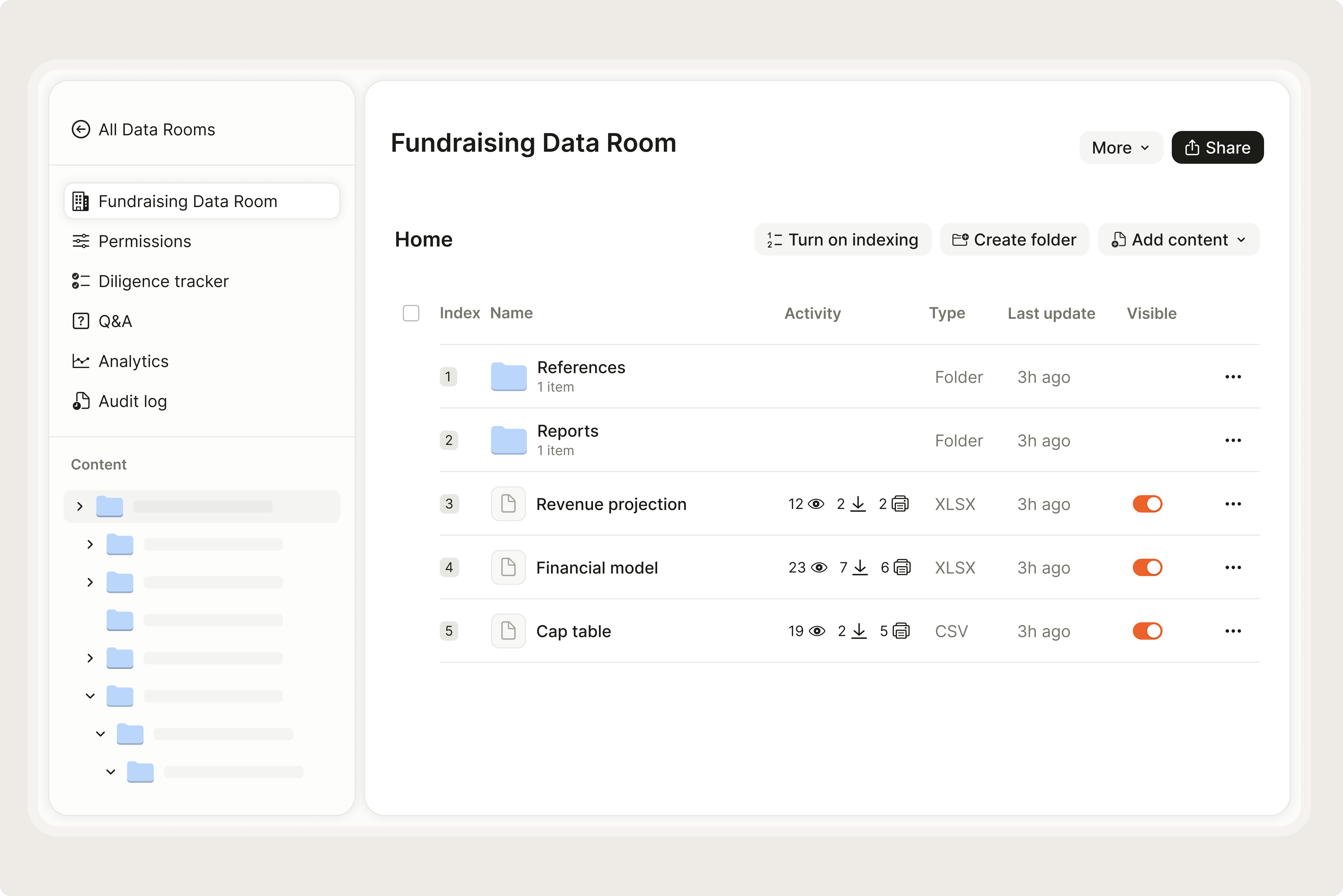
- 1.Build your SaaS data room with all key metricsCreate an Ellty data room and upload your pitch deck, NRR cohorts, and financial model. Vancouver SaaS investors request your metrics within hours of any promising first call.
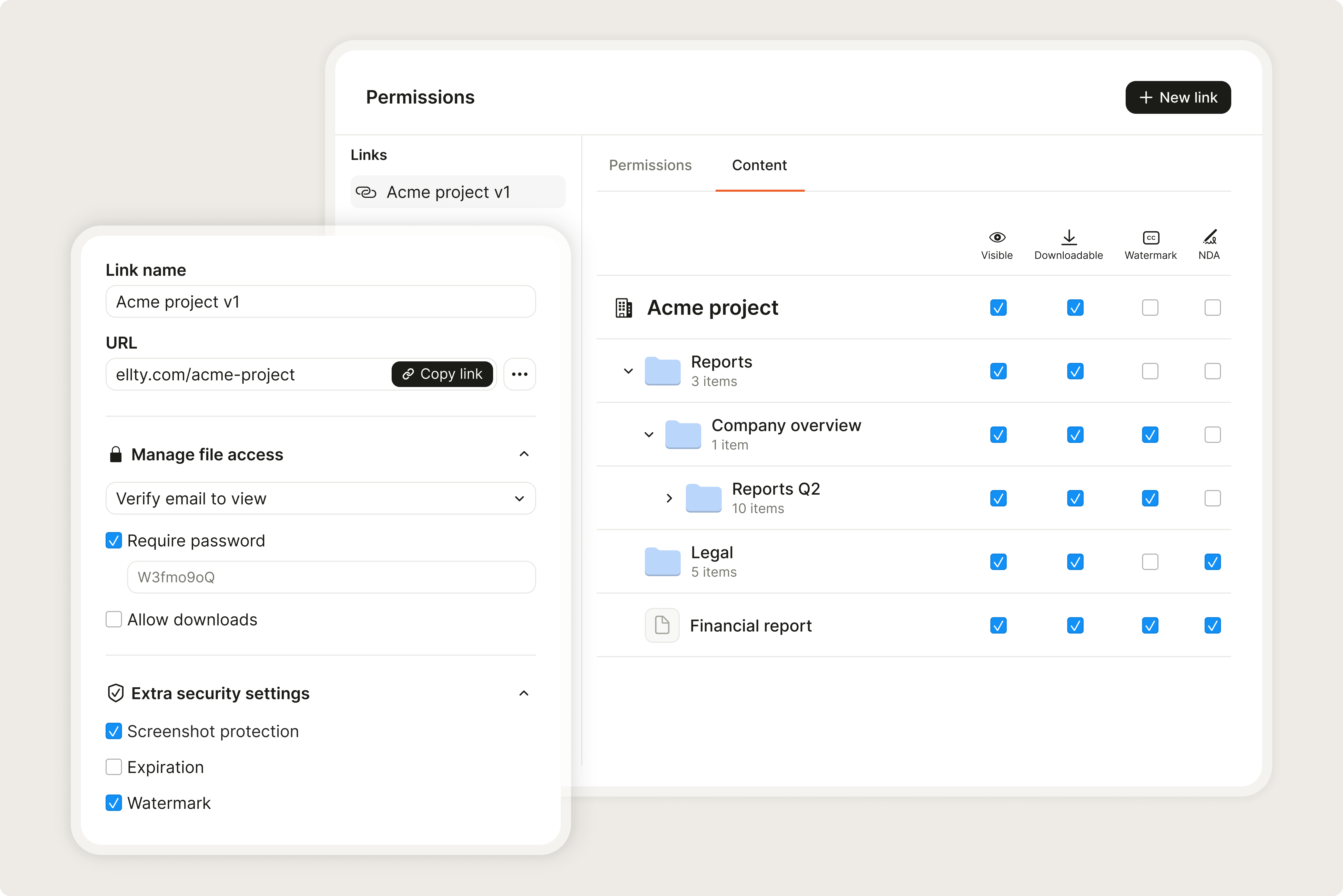
- 2.Set link permissions for each investorRequire email verification before any investor accesses your cap table or detailed financial projections. Use screenshot protection for proprietary unit economics or customer data.
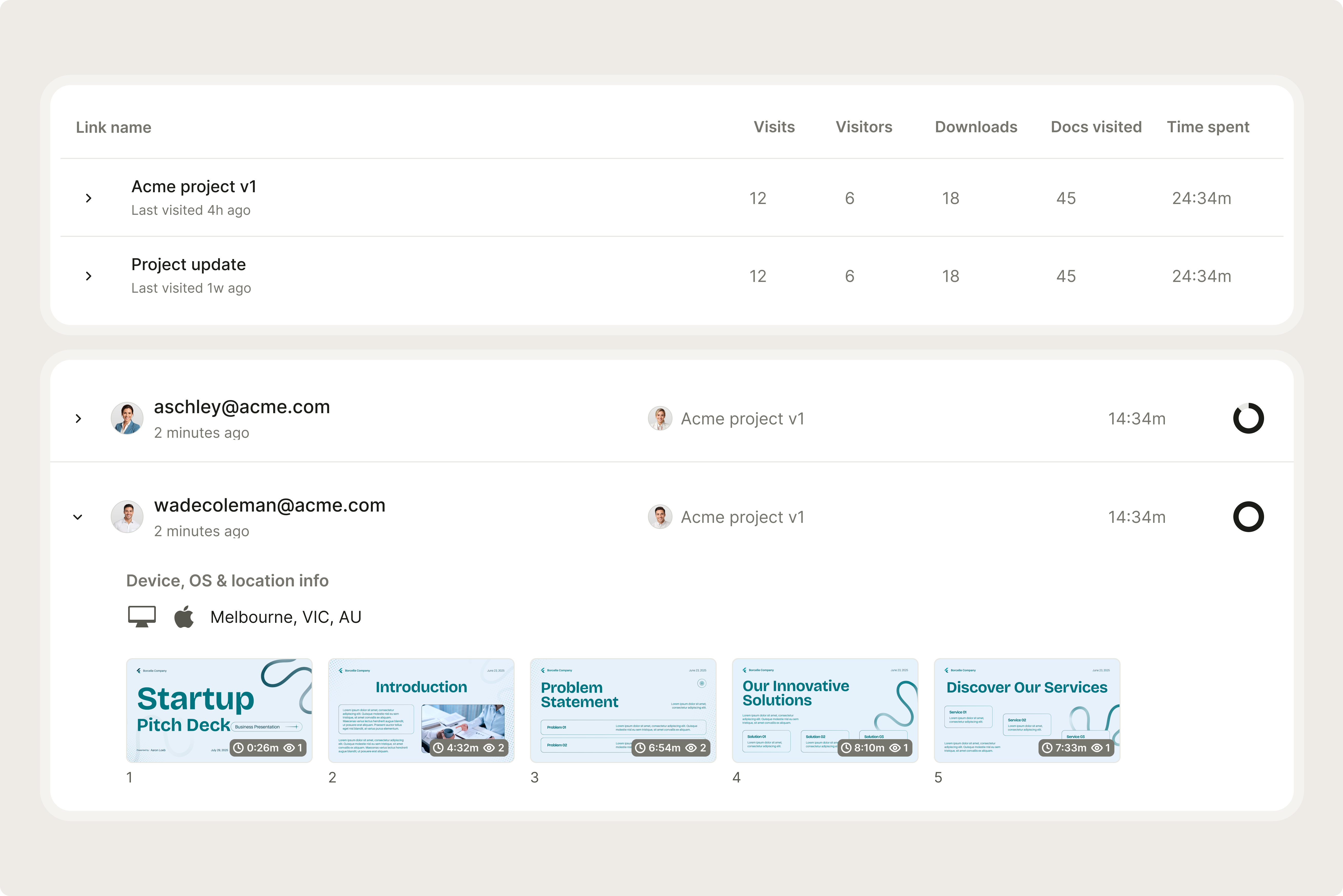
- 3.Get real-time alerts when investors open your deckKnow which investors open your data room and how long they spend on each slide. If a Rhino partner reads your NRR cohort section twice, follow up on those metrics the same day.
Common questions about Vancouver SaaS investors
- InBC and WUTIF require BC presence. GTMfund, Rhino, Pender, and Version One fund Canadian SaaS companies regardless of location. A Vancouver office helps with InBC and provincial tax credits.
- Most Vancouver SaaS Series A rounds close between $1M and $2M ARR, with 110%+ NRR. Below that, seed extensions from funds like GTMfund or Garage Capital are more realistic.
- Yes, and they ask about it directly. Investors want to know your AI moat - proprietary data, workflow integration, or switching costs. A GPT wrapper alone isn't a defensible answer in 2026.
- Usually 8-12 weeks from first meeting to wire, faster than biotech or cleantech. Having your NRR cohorts and financial model in an Ellty data room before intro speeds up diligence significantly.
- Before your first investor conversation. Upload your metrics and pitch to Ellty and send trackable links - you'll know which investors are genuinely engaged before spending time on follow-up calls.
- Horizontal SaaS needs to prove it can win against entrenched incumbents. Vertical SaaS just needs to own a specific buyer segment. Vancouver investors fund vertical plays much more readily right now.