Toronto has 118 active insurtech startups as of 2026. 46 are funded. The investors who close Canadian insurance tech deals are a distinct group - and pitching the wrong one wastes your best referral.
Canada's insurance market sits at over $200B in annual premiums. Toronto is where most of the underwriting infrastructure, brokerage networks, and carrier headquarters concentrate. That matters when you're raising for an insurtech company.
Toronto insurtech investors aren't generalists who occasionally look at insurance. Intact Ventures only does insurance-adjacent deals. Portage has a dedicated P&C claims thesis. Luge Capital led Foxquilt's Series A because they understand SMB coverage markets. Pitching the wrong fund is a waste of a referral you won't get twice.
The Canadian insurtech market is projected to grow at 32.87% CAGR through 2033, reaching $3.5B by then. Quandri raised $12M in July 2025. PolicyMe closed $30M CAD across three tranches since 2023. Deals are happening and the timing is real, not manufactured.
This list covers 14 investors who closed insurtech deals or actively deploy in insurance tech as of 2026. Read how to send your pitch deck to investors before you start reaching out.
| Stage | Check size | Sector focus | Contact | |
|---|---|---|---|---|
| Intact Ventures | Seed - Series B | $1M-$10M | Insurtech, fintech, mobility | intactventures.com |
| Portage Ventures | Seed - Series C | $1M-$15M | Insurtech, wealthtech, fintech | portageinvest.com |
| Luge Capital | Seed, Series A | $500K-$5M | Insurtech, AI in finance | luge.vc |
| Framework Venture Partners | Series A, Series B | $3M-$15M | Insurtech AI, fintech | framework.vc |
| MaRS IAF | Seed | Up to $500K | Fintech, health, insurtech | marsiaf.com |
| BDC Capital | Pre-seed - Growth | $500K-$20M | Cross-sector, fintech | bdc.ca |
| Golden Ventures | Pre-seed, Seed | $250K-$2M | AI, fintech, insurtech adjacent | golden.ventures |
| Diagram Ventures | Pre-seed, Seed | $500K-$5M | Insurtech, fintech | diagram.vc |
| Panache Ventures | Pre-seed, Seed | $250K-$1.5M | B2B SaaS, insurtech | panache.vc |
| OMERS Ventures | Series A, Series B | $5M-$25M | Fintech, insurtech | omersventures.com |
| Georgian | Growth, Series B+ | $10M-$50M | AI SaaS, insurtech infra | georgian.io |
| Inovia Capital | Seed - Growth | $1M-$30M+ | Fintech, SaaS, AI | inovia.vc |
| Information Venture Partners | Series A | $2M-$10M | B2B insurtech, enterprise SaaS | informationvp.com |
| American Family Ventures | Seed - Series B | $500K-$10M | Insurtech, data analytics | amfamventures.com |
Track which investors open your deck
Upload your insurtech pitch to Ellty and see exactly who opens what - and which slides they spend time on.
Start free 14-day trialWhat is a Toronto insurtech investor?
Toronto insurtech investors differ from generalist VCs because they have direct relationships with Canada's Big Six banks and major P&C carriers. Intact Ventures can fast-track a pilot with one of the largest P&C insurers in North America. Portage can get you in front of Manulife or Sun Life without a cold intro.
Most write initial checks between $1M and $10M at seed and Series A. Growth rounds start at $10M+ and typically involve OMERS or Georgian, who expect at least $2-3M ARR. Pure B2C insurance plays are harder to raise in Toronto than B2B or B2B2C models.
What they want back is access to distribution. If you're building underwriting automation, they want to know which carriers you can sell to. If you're building embedded insurance, they want to understand your enterprise channel.
For context, explore how active fintech investors in Toronto overlap with insurtech - several funds deploy across both verticals.
The investment appetite for Canadian fintechs will continue to grow in 2026, as investors prioritize quality, scale and strategic fit, signalling a market that is maturing and aligning more closely with long-term value creation.
14 top Toronto insurtech investors in 2026
1. Intact Ventures
The venture arm of Intact Financial - Canada's largest P&C insurer. Their check comes with direct access to one of the largest insurance distribution networks in North America, and that's the real value beyond the capital.
- Recent deals: Rosella (Insurance Brokers, April 2026), Shepherd $42M Series B participation (March 2026), Quandri $12M Series A co-investment (July 2025). 42 portfolio companies, 9 exits.
- LinkedIn: Intact Ventures
- Sector focus: Insurtech, fintech, mobility, data and AI for insurance
- Stage focus: Seed, Series A, Series B
- Location: Toronto, ON
- Website: intactventures.com
2. Portage Ventures
Canada's largest fintech and insurtech VC with $6.3B AUM across venture and growth strategies. Their dedicated P&C claims tech thesis is one of the most specific in the Canadian market - Elysian's $6M seed in September 2025 shows they still write early cheques.
- Recent deals: Elysian $6M seed (September 2025), ZILO $26.9M Series A co-led with State Street (2025), $280M Point72 continuation fund (January 2026)
- LinkedIn: Portage Ventures
- Sector focus: Insurtech, wealthtech, payments, fintech infrastructure
- Stage focus: Seed, Series A, Series B, Series C
- Location: Toronto, ON
- Website: portageinvest.com
3. Luge Capital
Montreal-based but heavily active in Toronto deal flow. They led Foxquilt's $8M Series A and have backed Finaeo, ProNavigator, and Westhill. Their knowledge of SMB and broker distribution channels is more specific than most Canadian funds.
- Recent deals: Cybrid $10M Series A (October 2025), Velix $1.47M pre-seed (February 2026), 45 total investments with 4 exits
- LinkedIn: Luge Capital
- Sector focus: Insurtech, fintech, AI in financial services
- Stage focus: Seed, Series A
- Location: Montreal, QC (active Toronto deal flow)
- Website: luge.vc
4. Framework Venture Partners
Toronto's dedicated Series A fund for fintech and AI companies applying ML to proprietary financial datasets. They led Quandri's $12M round - the biggest Canadian insurtech deal of 2025. BDC and Deloitte Ventures are LPs.
- Recent deals: Quandri $12M Series A lead (July 2025), DealMaker investment (2025), 50 portfolio companies with 5 new investments in the last 12 months
- LinkedIn: Framework Venture Partners
- Sector focus: Fintech, integrated AI, insurtech with proprietary datasets
- Stage focus: Series A, Series B
- Location: Toronto, ON
- Website: framework.vc
5. MaRS Investment Accelerator Fund (IAF)
Canada's most active early-stage VC by deal count. Ontario-focused mandate means they won't fund you if you're not building here. They co-invest consistently with BDC across health, fintech, and insurance-adjacent tech.
- Recent deals: Brickeye seed (construction and insurance risk platform, 2025), Moselle $1.54M seed (2025), 210 companies backed since 2008 with 2 new investments in the last 12 months
- LinkedIn: MaRS IAF
- Sector focus: Fintech, digital health, B2B SaaS, insurtech adjacent
- Stage focus: Seed
- Location: Toronto, ON
- Website: marsiaf.com
6. BDC Capital
The federal government's venture arm with no geography restriction. They write cheques at every stage from pre-seed to growth and co-invest with almost every Canadian VC. Their April 2026 $150M life sciences fund shows continuous deployment appetite.
- Recent deals: Enurgen $4.1M seed co-investment (October 2025), $150M life sciences fund launch (April 2026), continuous deployment across Canadian tech
- LinkedIn: BDC Capital
- Sector focus: Cross-sector, fintech, B2B SaaS, insurtech
- Stage focus: Pre-seed through growth
- Location: Toronto, ON (national mandate)
- Website: bdc.ca
Share your insurtech deck with trackable links
Know which Toronto VCs opened your materials and which slides they spent the most time on.
Start free 14-day trial7. Golden Ventures
Toronto's most consistent seed fund - sector-agnostic and founder-led. Their intros to Portage, Framework, and OMERS are the real asset beyond the cheque itself. They backed Pillar Security's $9M seed in April 2025.
- Recent deals: Pillar Security $9M seed (April 2025), swXtch.io (April 2026), Cybrid Series A co-investment (2025), 145 companies backed with 10 new investments in the last 12 months
- LinkedIn: Golden Ventures
- Sector focus: AI, fintech, B2B SaaS, insurtech adjacent
- Stage focus: Pre-seed, Seed
- Location: Toronto, ON
- Website: golden.ventures
8. Diagram Ventures
Montreal-based with active Toronto coverage. They build companies through a company-creation model but also write seed cheques into external founders. Their fintech and insurance interest includes the broker and MGA distribution layer.
- Recent deals: Active pre-seed and seed deployment across fintech and insurtech (2025-2026), portfolio focused on financial infrastructure
- LinkedIn: Diagram Ventures
- Sector focus: Fintech, web3, insurtech, climate tech
- Stage focus: Pre-seed, Seed
- Location: Montreal, QC (active Toronto coverage)
- Website: diagram.vc
9. Panache Ventures
Canada's most active pre-seed fund by volume - they write 20-30 cheques per year. For insurtech founders, Panache is the fastest path to a first institutional cheque and warm intros to every major Canadian Series A fund.
- Recent deals: Dominion Dynamics $4M pre-seed (January 2026), Cybrid Series A co-investment (2025), 130+ companies backed with $3.3B+ raised collectively
- LinkedIn: Panache Ventures
- Sector focus: B2B SaaS, fintech, insurtech, AI
- Stage focus: Pre-seed, Seed
- Location: Toronto, ON (national coverage)
- Website: panache.vc
10. OMERS Ventures
The venture arm of OMERS pension fund. They bring patient capital and write $5-25M cheques at Series A and B. For insurtech founders with $2M+ ARR, OMERS is the right Toronto conversation. They don't do seed.
- Recent deals: Active Series A and B deployment across Canadian fintech and enterprise tech (2025-2026), portfolio includes Wealthsimple and Hootsuite
- LinkedIn: OMERS Ventures
- Sector focus: Fintech, enterprise software, insurtech infrastructure, AI
- Stage focus: Series A, Series B
- Location: Toronto, ON
- Website: omersventures.com
11. Georgian
Toronto's growth equity specialist writing $10-50M cheques for AI SaaS companies. Their applied AI focus makes them relevant for insurtech companies building underwriting, claims, or fraud detection platforms. They don't do early stage.
- Recent deals: Active growth equity deployment across AI SaaS companies (2025-2026), strong enterprise software focus with Toronto HQ
- LinkedIn: Georgian
- Sector focus: AI SaaS, fintech infrastructure, insurtech at growth stage
- Stage focus: Growth, Series B+
- Location: Toronto, ON
- Website: georgian.io
12. Inovia Capital
Pan-Canadian multi-stage fund with $2.5B AUM. For insurtech founders planning US expansion, Inovia's Boston and SF relationships are useful beyond the cheque. Their Discovery Fund writes seed and pre-seed first checks.
- Recent deals: Bench IQ $5.3M (August 2025), Venture Scientist Fund with Mila (January 2026), Ranger (May 2026), 10 unicorns in portfolio
- LinkedIn: Inovia Capital
- Sector focus: Fintech, SaaS, AI, insurtech
- Stage focus: Seed through growth
- Location: Toronto, ON / Montreal, QC / Calgary, AB
- Website: inovia.vc
13. Information Venture Partners (IVP)
Founded by former RBC executives. They only back B2B financial services SaaS. Their LP introductions to financial services buyers actually close pilots - portfolio founders confirm this, not marketing copy.
- Recent deals: DealMaker investment (2025), Arteria AI $30M Series B participation (GGV-led), 34 portfolio companies in financial services SaaS
- LinkedIn: Information Venture Partners
- Sector focus: B2B fintech, insurtech SaaS, enterprise financial services software
- Stage focus: Series A
- Location: Toronto, ON
- Website: informationvp.com
14. American Family Ventures
The corporate venture arm of American Family Insurance. US-based but actively invests in Canadian insurtechs with US market potential. They backed Foxquilt's Series A alongside Luge Capital and participated in Elysian's 2025 seed round.
- Recent deals: Elysian $6M seed participation (September 2025), Foxquilt Series A participation, active across global insurtech seed and Series A
- LinkedIn: American Family Ventures
- Sector focus: Insurtech, data analytics, risk platforms
- Stage focus: Seed, Series A, Series B
- Location: Madison, WI (active Toronto deal flow)
- Website: amfamventures.com
How to verify a Toronto fund is still deploying
Dead funds look active. Partners list their firm on LinkedIn for years after the fund stops writing cheques. Check Crunchbase for investments in the last 12 months before spending a referral on a meeting.
Look at fund vintage. A 2019 fund is on its last deals or already past deployment. Ask directly: "Are you actively deploying from your current fund?" If they hedge the answer, that's your answer.
Upload your deck to Ellty and send trackable links to each investor. You'll see in real-time if they actually open your deck or archive it. Read about best pitch deck sharing tools to understand your options before you start sending.
Where to find Toronto insurtech investors in 2026
BetaKit and the CVCA member list are your two best research tools. BetaKit covers every Canadian funding round - search your target fund's name there to confirm active deployment.
The Canada FinTech Symposium and Canadian Finance Summit (both May 2026 in Toronto) are where deals start. These aren't networking events - they're where GPs evaluate founders in person before deciding on meetings. InnSure's Creative Destruction Lab program at Rotman School of Management is where insurance-specific seed deals originate.
Set up trackable links with Ellty before any conference. Toronto insurtech investors review materials faster than you'd expect once they're interested - often within 48 hours. Check data room trends in 2026 to understand what Toronto VCs expect during diligence.
What Toronto insurtech VCs expect at each stage
Pre-seed investors like MaRS IAF and Panache want domain expertise and a specific distribution thesis. "We'll sell to brokers" isn't specific enough - name the brokers and explain the channel before you walk into the meeting.
Seed investors - Intact Ventures, Luge, Golden Ventures - want early evidence that the insurance buyer trusts your team. A named pilot with a carrier or brokerage is the minimum entry point. Toronto seed funds are conservative on burn - they've watched US-style growth-before-profit plays fail at Canadian market size.
Set up an Ellty data room with your cap table, financial projections, carrier agreements, and pilot data before any partner meeting. Having everything organized in a virtual data room for your seed round speeds up the process by weeks. Toronto VCs will request materials within 48 hours of a strong first conversation.
How to pitch a Toronto insurtech investor
Five steps for founders raising from insurance tech investors in Toronto in 2026.
- 1.Research the fund's insurance thesis before reaching outCheck their last 5 deals on Crunchbase before any outreach. Pitching Intact Ventures with a pure B2C consumer insurance play won't get a callback - they only do insurance-adjacent and B2B.
- 2.Lead with a specific Canadian carrier or broker relationshipName the company, not just 'established insurance relationships.' Investors need a concrete pilot partner to evaluate your distribution thesis before anything else.
- 3.Prepare your data room before the first meetingUpload cap table, financials, pilot agreements, and product deck to Ellty. Toronto VCs request materials within 48 hours of any promising first conversation - be ready.
- 4.Show your path to the US market clearlyMost Toronto funds need a 10x opportunity beyond Canada's market size. Explain which US states you enter first and why your Canadian regulatory experience gives you an edge there.
- 5.Send trackable links from the start of your raiseSend each investor a unique Ellty link so you see who actually engages with your deck. If they spend time on your underwriting data slides, that's your follow-up angle.
How Ellty helps you land a Toronto insurtech investor
You've found the right 14 investors. Now send your materials the right way - with full visibility into who reads what and when. Upload your insurtech documents to Ellty and share a trackable link with each investor you contact.
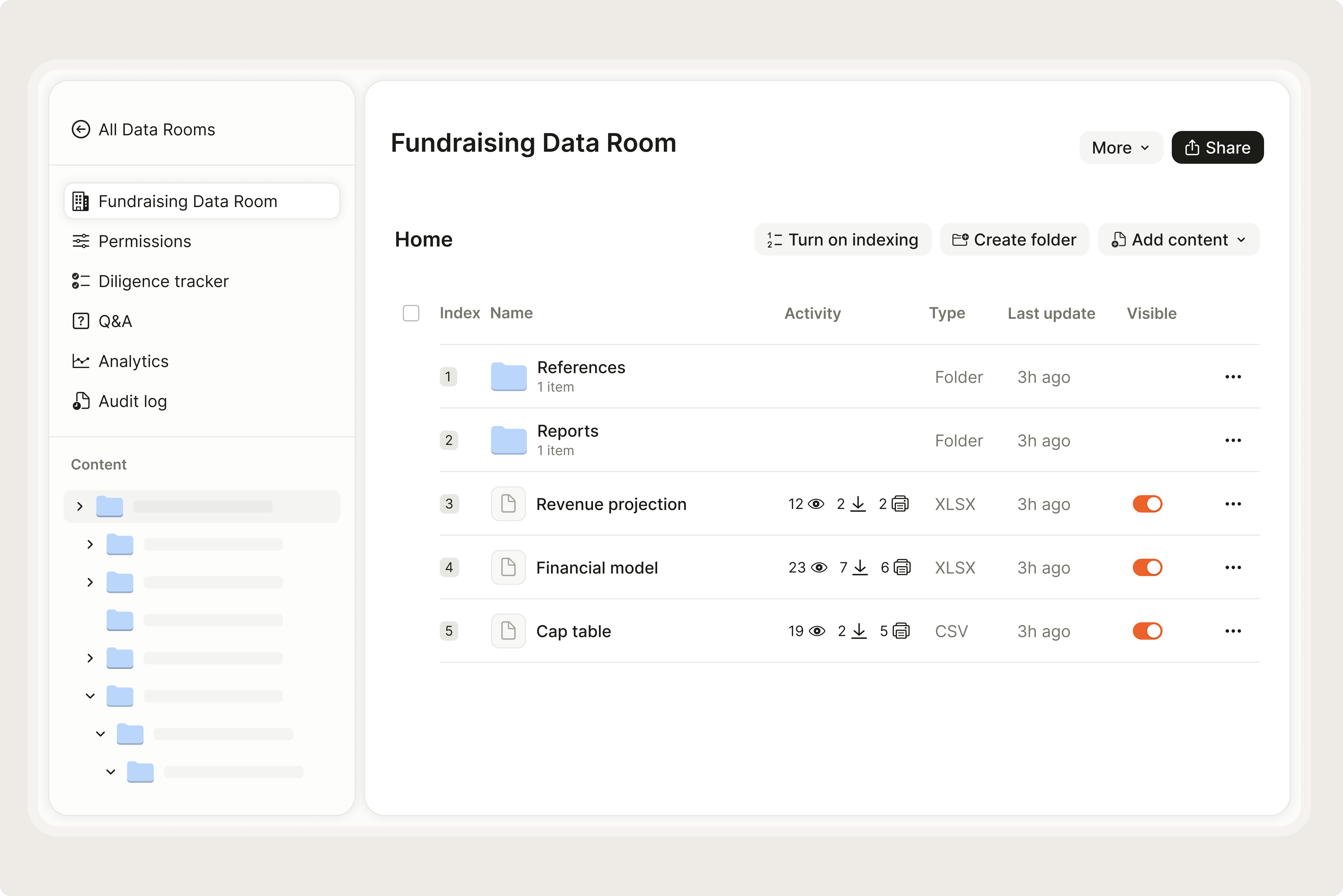
- 1.Build your insurtech data room and upload all documentsUpload your pitch deck, cap table, pilot agreements, and financial model to Ellty. Organize by folder so investors find each document without asking twice - it signals execution speed from day one.
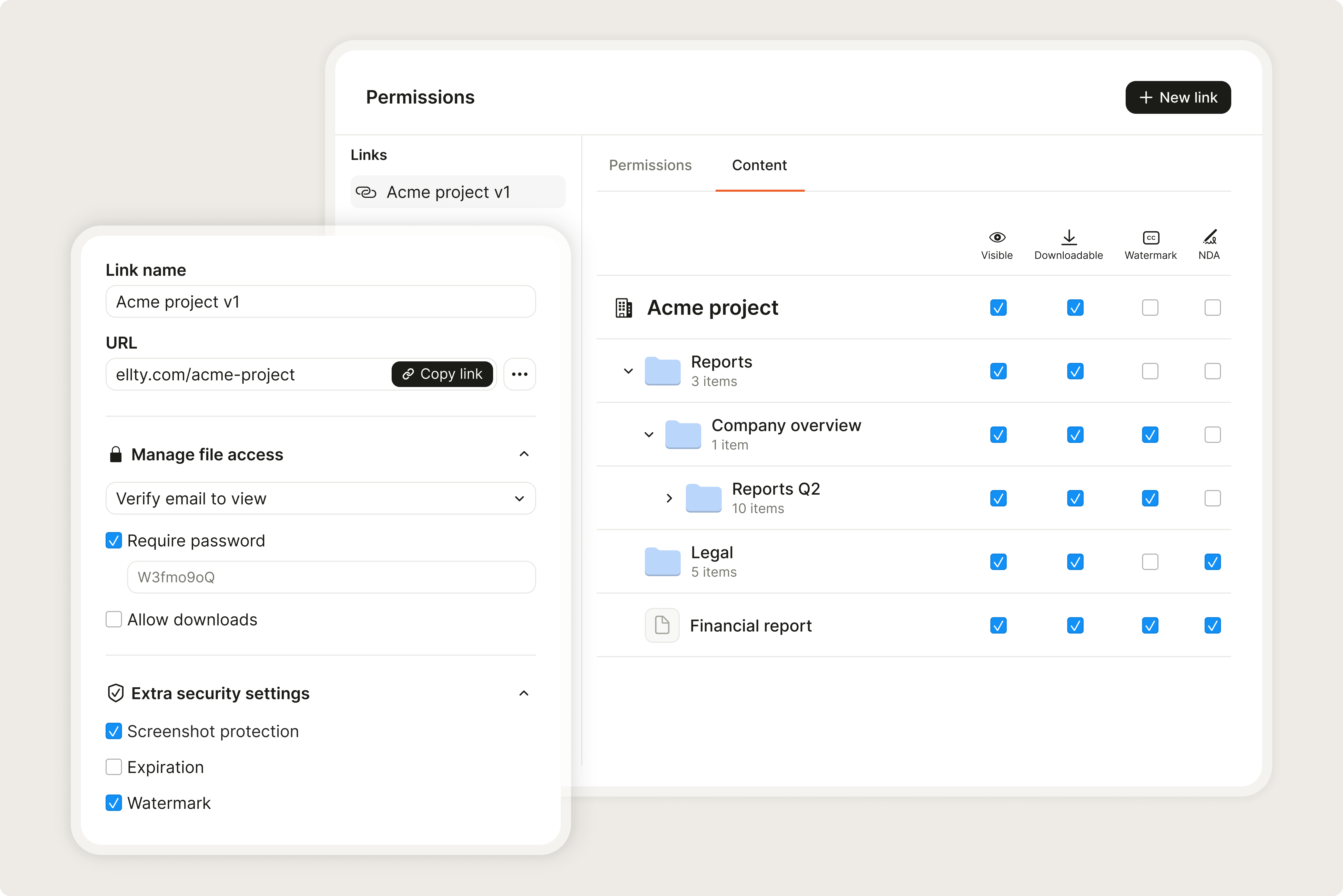
- 2.Configure separate link permissions for each investorSet email verification and screenshot protection before sharing your cap table and financial model. Control who can download your underwriting data versus who gets view-only access.
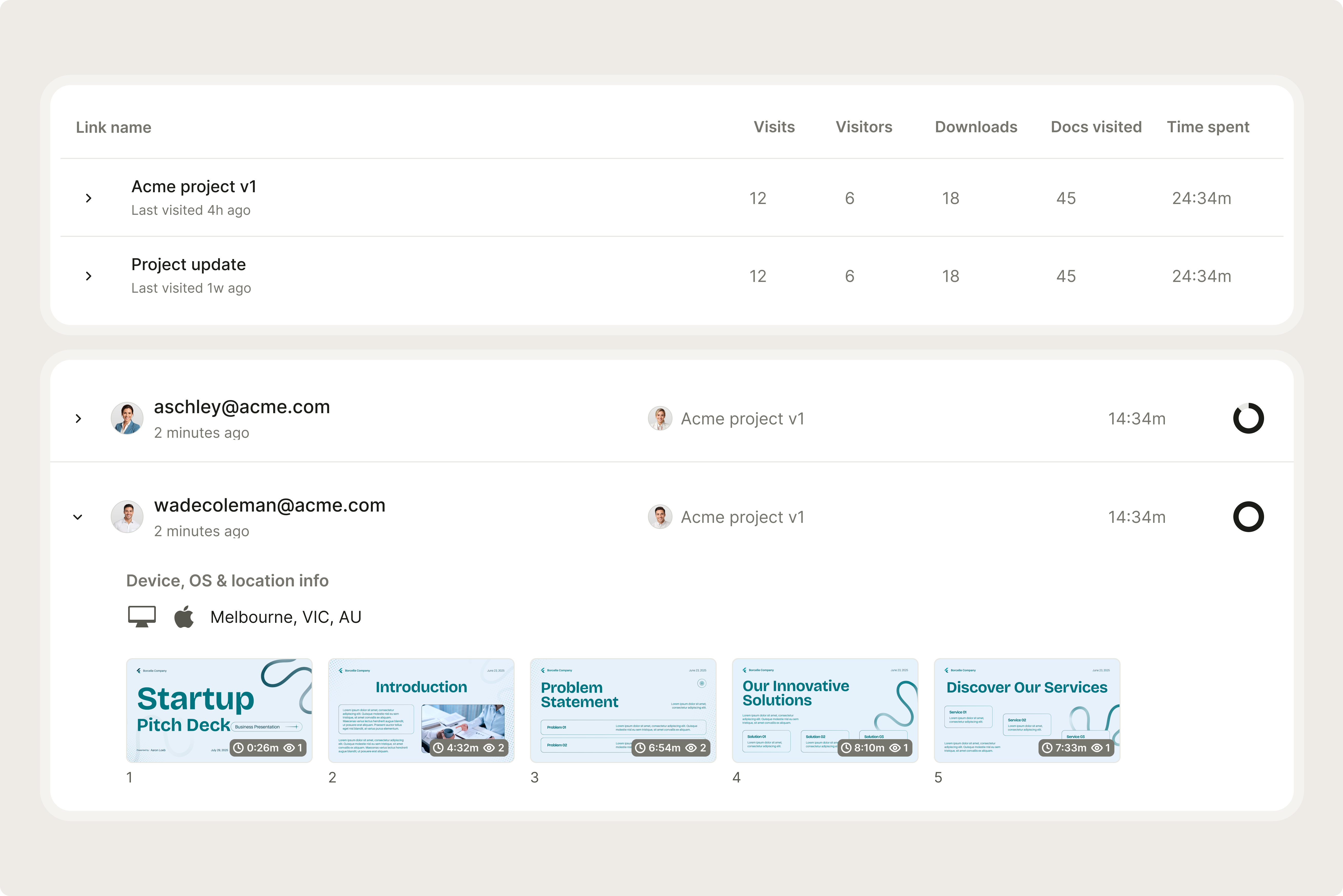
- 3.Get instant alerts and read engagement signalsSee which investors open your deck and how long they spend on each slide. If an Intact Ventures partner reads your broker GTM section twice, follow up on that the same day.
Common questions about Toronto insurtech investors
- Not always, but it helps significantly at seed stage. Intact Ventures and MaRS IAF strongly prefer Ontario-based founders. Framework and Luge will fund remotely if traction is clear enough.
- Typically 8-12 weeks from first meeting to wire. That's slower than San Francisco but faster than most European markets. Have your Ellty data room ready from week one to avoid delays.
- Start with independent funds like Luge or Panache, then use their term sheet to accelerate conversations with Intact. Corporate VCs move slower but add more strategic distribution value.
- Pitching a generic insurance automation story without a named distribution partner. Toronto investors have heard it before - they need specifics on which carriers or brokers you're selling to.
- Preferred but not required. You need at least one advisor or early hire with deep broker or carrier relationships. Pure tech teams without any insurance domain expertise rarely close seed rounds here.
- Before your first investor meeting. Upload your materials to Ellty and send a trackable link. You'll know which investors are actually engaged before spending time on follow-up calls.