Digital health startups raised $4B globally in Q1 2026 - the strongest quarter since the pandemic peak. These 13 Montreal healthtech investors are actively writing checks into Quebec health companies right now.
Montreal's healthtech ecosystem is anchored by proof points. Dialogue raised $60M before being acquired by Sun Life for $365M. BrainBox AI scaled HVAC optimization AI to real enterprise customers. The McGill Health system and CHUM create a clinical trial and pilot infrastructure most cities can't match.
What investors in 2026 want from healthtech is different from 2021. They're not funding virtual care apps. They want health AI companies with real clinical validation, B2B enterprise sales, and a clear regulatory pathway. You still need payer integration clarity before a Series A in most cases.
Montreal has an advantage in clinical evidence. Academic medical centers - CHUM, MUHC, CHU Sainte-Justine - will partner on studies. That academic-clinical channel is real and investors know it. If your company has a clinical partnership with a Montreal hospital, mention it early.
Before you pitch any of these 13 healthtech investors, build an Ellty data room with your clinical evidence, regulatory strategy, and financial model. Send a unique trackable link per fund. Health investors review clinical data and compliance documentation before product decks.
| Stage | Check size | Sector focus | Contact | |
|---|---|---|---|---|
| Amplitude Ventures | Seed, Series A | $2M-$15M | Precision medicine, AI-health | amplitudevc.com |
| Inovia Capital | Seed to late stage | $1M-$10M | Digital health, health AI, SaaS | inovia.vc |
| Panache Ventures | Pre-seed, Seed | Up to $1.5M | Healthtech, AI-health, digital health | panache.vc |
| Real Ventures | Pre-seed, Seed | $250K-$2M | Digital health, health SaaS | realventures.com |
| BDC Life Sciences Fund | Seed, Series A | $500K-$5M | Canadian healthtech, medtech | bdc.ca |
| Investissement Québec | Seed to growth | $1M-$25M+ | Quebec healthtech, all sectors | investquebec.com |
| Fonds de solidarité FTQ | Seed to growth | $500K-$5M | Quebec healthtech, all sectors | fondsftq.com |
| White Star Capital | Seed, Series A, B | $500K-$5M | Digital health, consumer health | whitestarcapital.com |
| Lumira Ventures | Seed to late stage | $3M-$20M | Medtech, digital health, devices | lumiraventures.com |
| Desjardins Capital | Seed to growth | $500K-$5M | Quebec healthtech, all industries | desjardins.com |
| Kli Capital | Pre-seed, Seed | Up to $1.5M | Healthtech, SaaS, consumer | klicapital.vc |
| Anges Québec | Pre-seed, Seed | $50K-$500K | Quebec healthtech, all sectors | angesquebec.com |
| CDPQ | Growth, late stage | $10M+ | Healthtech scale-ups, medtech | cdpq.com |
Track who opens your healthtech pitch
Send trackable links to health investors and see who reviews your data room.
Start free 14-day trialWhat is a Montreal healthtech investor?
A Montreal healthtech investor backs digital health, telehealth, health AI, medical software, and health infrastructure companies. Unlike biotech investors, they evaluate SaaS metrics - ARR, churn, customer acquisition cost - not clinical trial timelines.
The key distinction in 2026 is between health AI and traditional digital health. Health AI companies with real clinical validation data get more meetings than EMR workflow tools. Investors want to see that your AI actually changes clinical outcomes, not just automates forms.
Montreal's clinical infrastructure is a real advantage. A pilot at CHUM or MUHC carries weight with health investors that a generic "hospital pilot" doesn't. Portage backed Dialogue because it had real enterprise customers - not just a strong product. That's the template for Montreal healthtech raises in 2026.
For broader context on Quebec investing, see Quebec investors. Read what investors look for in a data room before any healthtech investor meeting.
Health AI companies that can show real clinical outcomes data get meetings. The ones that just demo the interface don't.
13 Montreal healthtech investors
1. Amplitude Ventures
Montreal's precision medicine and AI-health fund. Amplitude backs health AI companies with computational biology and clinical AI theses - not digital health SaaS without scientific validation. They backed companies at the intersection of AI, genomics, and drug discovery. For Montreal health AI founders with clinical validation data and a clear precision medicine thesis, Amplitude is your most relevant first call.
- Recent Deals: RIME Therapeutics founding round lead (April 2026); Congruence Therapeutics $39.5M co-investor (2025); 3 investments in 2025; active Montreal health AI deal flow; CA$200M+ raised
- LinkedIn: Amplitude Ventures LinkedIn
- Sector Focus: Precision medicine, health AI, computational biology, oncology AI
- Stage Focus: Seed, Series A
- Location: Montreal, QC
- Website: amplitudevc.com
2. Inovia Capital
Montreal's leading full-stack VC backed Dialogue - Montreal's biggest healthtech exit - from early stage. Inovia writes $1M to $10M checks in digital health and health AI companies. They evaluate health companies on SaaS metrics, not clinical timelines. For Montreal healthtech founders at $300K+ ARR with a B2B enterprise model serving payers, employers, or health systems, Inovia is worth approaching.
- Recent Deals: Toyo (2026); Flare follow-on (2026); Dialogue (acquired by Sun Life $365M); 15 investments in 2025; US$2.2B+ AUM; active digital health portfolio
- LinkedIn: Inovia Capital LinkedIn
- Sector Focus: Digital health, health AI, SaaS, fintech, consumer
- Stage Focus: Seed to late stage
- Location: Montreal, QC (global offices)
- Website: inovia.vc
3. Panache Ventures
Canada's most active pre-seed fund backs healthtech and health AI founders at pre-revenue stage. Panache has a Montreal partner and writes checks up to $1.5M. For Montreal healthtech founders with strong clinical domain expertise and a clear B2B distribution model, Panache is worth approaching before any institutional VC.
- Recent Deals: Nord Quantique (Q1 2026); Soma Energy (April 2026); 5 investments in 2026; active Montreal healthtech deal flow; 40+ Fund II companies
- LinkedIn: Panache Ventures LinkedIn
- Sector Focus: Healthtech, health AI, digital health, enterprise SaaS, AI
- Stage Focus: Pre-seed, Seed
- Location: Montreal, QC (offices in 4 cities)
- Website: panache.vc
4. Real Ventures
Montreal's foundational VC backed digital health companies through FounderFuel and direct investment. Real backs technical founders in health with platform and software theses. For healthtech software founders coming out of Montreal's university system with early traction, Real is worth approaching via FounderFuel.
- Recent Deals: Active FounderFuel cohorts 2025-2026; 100+ portfolio companies; $600M+ raised since inception; active Montreal digital health deal flow
- LinkedIn: Real Ventures LinkedIn
- Sector Focus: Digital health, health SaaS, enterprise, AI
- Stage Focus: Pre-seed, Seed
- Location: Montreal, QC
- Website: realventures.com
5. BDC Life Sciences Venture Fund
BDC launched a dedicated $150M Life Sciences Venture Fund in April 2026 covering both healthtech and biotech. This is fresh capital with a specific life sciences mandate. For Montreal healthtech founders at seed and Series A, this fund is actively deploying in 2026.
- Recent Deals: $150M Life Sciences Venture Fund launched April 2026; actively deploying into Canadian healthtech and life sciences; specific mandate for next generation health companies
- LinkedIn: BDC Capital LinkedIn
- Sector Focus: Canadian healthtech, medtech, digital health, life sciences
- Stage Focus: Seed, Series A
- Location: Montreal, QC (national mandate)
- Website: bdc.ca
Share your healthtech deck with trackable links
Set up an Ellty data room with your clinical evidence and financial model before any investor call.
Start free 14-day trial6. Investissement Québec
Quebec's provincial investment arm co-invests in healthtech companies with Quebec operations. IQ has specific life sciences and digital health mandates and co-invests after a private VC leads. For Montreal healthtech founders at Series A+ with Quebec incorporation, IQ reliably fills round gaps once terms are set.
- Recent Deals: Active Quebec life sciences and digital health equity programs 2025-2026; Quebec Life Sciences Strategy 2025-2028 investments; active co-investment mandate
- LinkedIn: Investissement Québec LinkedIn
- Sector Focus: Quebec healthtech, life sciences, all sectors
- Stage Focus: Seed to growth
- Location: Montreal, QC
- Website: investquebec.com
7. Fonds de solidarité FTQ
Quebec's $23B+ labor-sponsored fund co-invests in healthtech companies alongside private VCs. Fonds FTQ deployed $241M in 172 Quebec businesses in 2025-2026. For healthtech founders with Quebec operations, add Fonds FTQ to your co-investor pipeline once your private lead is confirmed.
- Recent Deals: $241M deployed in 172 Quebec businesses (2025-2026); $23B+ net assets (November 2025); active Quebec healthtech co-investment
- LinkedIn: Fonds de solidarité FTQ LinkedIn
- Sector Focus: Quebec healthtech, all sectors
- Stage Focus: Seed to growth
- Location: Montreal, QC
- Website: fondsftq.com
8. White Star Capital
Montreal-headquartered global VC with consumer health and digital health in its portfolio. White Star backed Dialogue early alongside Inovia. Their North American Seed Fund ($25M first close, September 2025) covers digital health. For Montreal healthtech founders with a B2B or consumer health platform at $300K+ ARR, White Star is worth approaching.
- Recent Deals: Trayd (2026); Kulipa follow-on (2026); Dialogue early investor; North American Seed Fund $25M first close (September 2025); 15 investments in 2025
- LinkedIn: White Star Capital LinkedIn
- Sector Focus: Digital health, consumer health, fintech, marketplace, enterprise
- Stage Focus: Seed, Series A, B
- Location: Montreal, QC (global offices)
- Website: whitestarcapital.com
9. Lumira Ventures
Canada's largest life sciences VC with strong digital health and medtech coverage. Lumira invests from early stage through revenue-generating companies. Their Fund V ($200M USD target) and new Cancer Breakthrough Fund are actively raising. For Montreal medtech or digital health founders with clinical evidence and enterprise customers, Lumira's depth of experience spans the full healthtech spectrum.
- Recent Deals: Fund V raising $200M USD + $30M CAD Cancer Breakthrough Fund; Congruence Therapeutics co-investor (2025); 100+ portfolio companies; active Montreal health deal flow
- LinkedIn: Lumira Ventures LinkedIn
- Sector Focus: Medtech, digital health, diagnostics, biotherapeutics
- Stage Focus: Seed to late stage
- Location: Montreal, QC (Toronto and San Francisco offices)
- Website: lumiraventures.com
10. Desjardins Capital
Quebec's cooperative financial institution co-invests in Quebec healthtech companies. Desjardins has specific interest in occupational health and employee wellness companies - sectors that align with its cooperative membership base. For Montreal healthtech founders building for employers or cooperative institutions, Desjardins adds strategic distribution value alongside capital.
- Recent Deals: Vention $150M CAD co-investor (2025); new investment model January 2026; CRCD $116.5M net earnings FY2025; active Quebec healthtech network
- LinkedIn: Desjardins Capital LinkedIn
- Sector Focus: Quebec healthtech, employee wellness, all industries
- Stage Focus: Seed to growth
- Location: Montreal, QC
- Website: desjardins.com
11. Kli Capital
Montreal-New York VC with healthtech in its $50M Fund III mandate. Kli writes checks up to $1.5M and leads at pre-seed and seed. Latest investments included Result Flow AI (February 2026). For Montreal healthtech SaaS founders with early traction, Kli moves faster than most funds.
- Recent Deals: Result Flow AI (seed, February 2026); Brickroad (seed, February 2026); 52+ total investments; $50M Fund III active; healthtech and SaaS focus
- LinkedIn: Kli Capital LinkedIn
- Sector Focus: Healthtech, SaaS, AI, consumer, fintech
- Stage Focus: Pre-seed, Seed
- Location: Montreal, QC / New York, NY
- Website: klicapital.vc
12. Anges Québec
Canada's largest angel network with 230+ members includes physicians, healthcare executives, and medical device operators. For Quebec healthtech founders raising $100K-$500K before approaching institutional VCs, Anges Québec's medical network and structured pitch process is worth the time.
- Recent Deals: EmergConnect $1.75M seed (2025); 3 investments in 2025; 230+ members; active Quebec healthtech deal flow
- LinkedIn: Anges Québec LinkedIn
- Sector Focus: Quebec healthtech, life sciences, tech
- Stage Focus: Pre-seed, Seed
- Location: Montreal, QC
- Website: angesquebec.com
13. CDPQ
Quebec's $400B+ pension fund backs late-stage healthtech and medtech scale-ups. CDPQ backed Dialogue's later rounds before the Sun Life acquisition. They write $10M+ checks and don't do seed. For Montreal healthtech founders at Series B+ with $5M+ ARR and a clear path to health system scale, CDPQ is worth approaching through a warm intro from an existing investor.
- Recent Deals: Dialogue late-stage investor (pre-Sun Life acquisition); active Quebec healthtech growth investments 2025-2026; $400B+ AUM; strategic Quebec technology mandate
- LinkedIn: CDPQ LinkedIn
- Sector Focus: Healthtech scale-ups, medtech, Quebec technology, growth stage
- Stage Focus: Growth, late stage
- Location: Montreal, QC
- Website: cdpq.com
What healthtech investors check before writing checks
Healthtech investors in 2026 want payer integration clarity first. How does your product get paid for? Who pays - the employer, the insurer, or the patient? If you're building for healthcare systems, what's the procurement cycle and who signs the contract?
Clinical evidence is the second filter. A pilot at CHUM or MUHC with 50 patients and measurable outcome improvement is worth more than 500 enterprise "pilots" without outcome data. Some don't fund until you have peer-reviewed evidence, or at minimum, IRB-approved validation data.
Build your Ellty data room with your payer strategy, clinical evidence summary, and customer evidence before any meeting. Read how to build a data room for VC fundraising before approaching any Montreal healthtech investor.
How to use Montreal's clinical infrastructure as a fundraising asset
Most Montreal healthtech founders underuse CHUM, MUHC, and Sainte-Justine. These academic medical centers will partner on clinical validation studies - especially if your technology has a clear patient benefit and doesn't disrupt existing workflows heavily.
A signed pilot agreement with one of these centers is a fundable milestone for most investors on this list. Inovia backed Dialogue partly because it had enterprise customer traction. AmorChem backs companies with McGill and UdeM research relationships. The academic-clinical channel consistently unlocks funding conversations in Montreal.
Set up your Ellty data room with your clinical partnership agreements, IRB approvals, and outcome data before any investor meeting. Upload everything and send trackable links. You'll see which investors open your clinical evidence section - those are your most serious prospects. Read what investors look for in a data room before any health investor conversation.
Health AI vs. digital health: what gets funded in 2026
The distinction matters for your pitch. Health AI companies - where AI generates clinical insights, identifies risk, or makes diagnostic suggestions - are getting more attention in 2026. Traditional digital health SaaS - appointment booking, patient engagement, care coordination - is harder to fund without significant ARR and proven payer integration.
If you're building health AI, lead with your model's clinical evidence. What does your AI catch that doctors miss? What's the false positive rate? How does it integrate with existing workflows? If you're building digital health SaaS, lead with ARR, net revenue retention, and payer contract structure.
Before any pitch, set up your Ellty data room with separate sections for your clinical evidence and your SaaS metrics. Send trackable links so you know which section each investor reviews first. That tells you whether they're evaluating you as a health AI company or a SaaS business. Read due diligence for investors to understand what health investors check during diligence.
How to pitch a Montreal healthtech investor
Five steps for Quebec healthtech founders raising capital in 2026.
- 1.Lead with your payer integration modelInvestors want to know who pays and how contracts are structured. Answer this before showing product demos.
- 2.Show clinical evidence from Montreal hospital pilotsA CHUM or MUHC pilot with outcome data is more fundable than 10 generic enterprise pilots without metrics.
- 3.Build a data room with clinical evidence and payer docsUpload your clinical data, payer strategy, and financial model to Ellty before any first investor call.
- 4.Know whether you're health AI or digital health SaaSThese are different pitches to different investors. Lead with AI clinical evidence or SaaS ARR metrics accordingly.
- 5.Get a private lead before approaching Quebec public fundsSecure Inovia or Panache first. Then approach IQ, Fonds FTQ, and BDC as co-investors on similar terms.
How Ellty helps you land a Montreal healthtech investor
You know the 13 investors. Here's how to share your clinical data and compliance docs without losing control of sensitive materials.
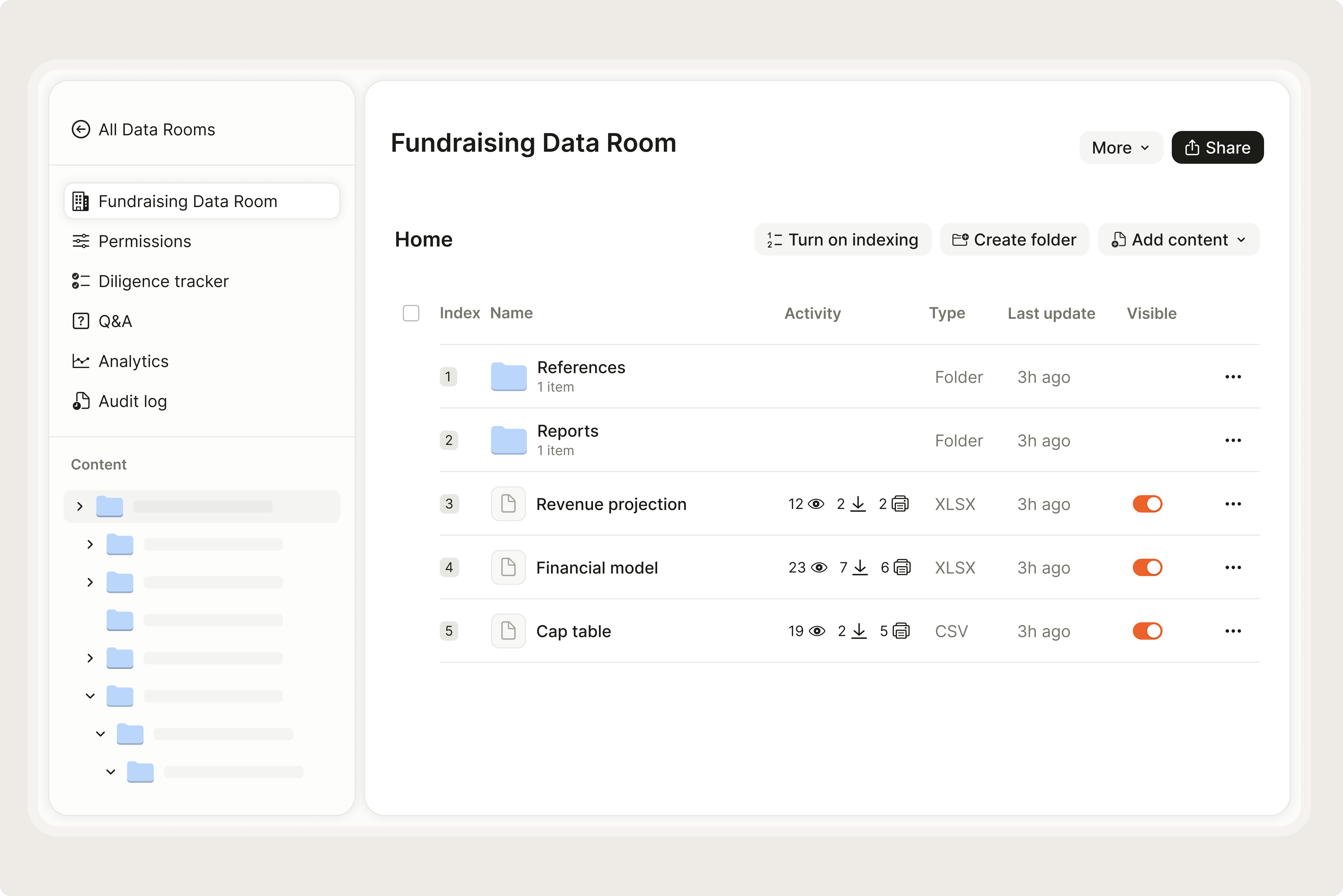
- 1.Create a data room and upload filesCreate an Ellty data room and upload your pitch, clinical validation data, and financial model. Health investors ask for clinical evidence within 24 hours of any promising first call.
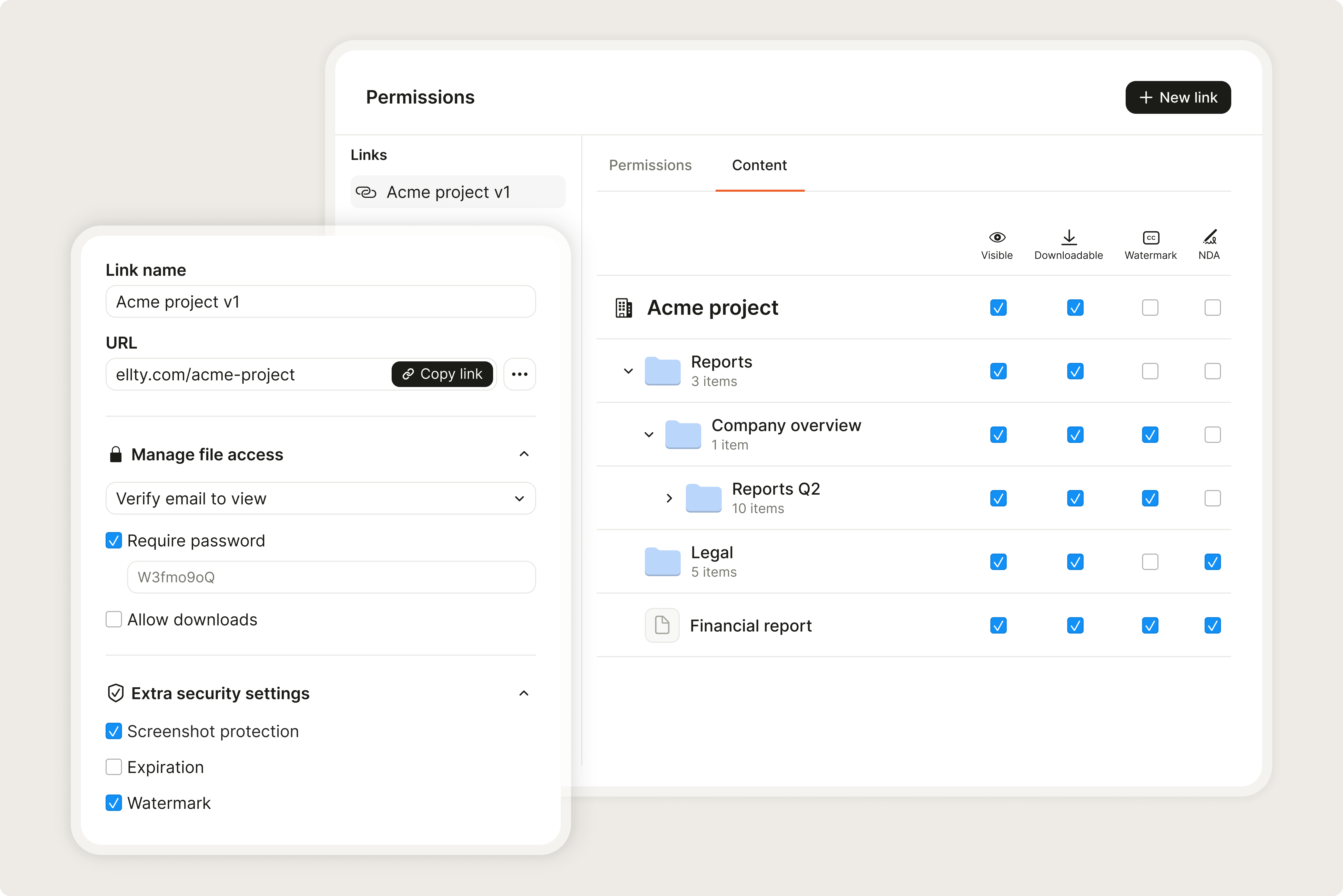
- 2.Create and configure a link ...Require email verification before any investor accesses your clinical evidence. Screenshot protection keeps sensitive health data confidential during due diligence.
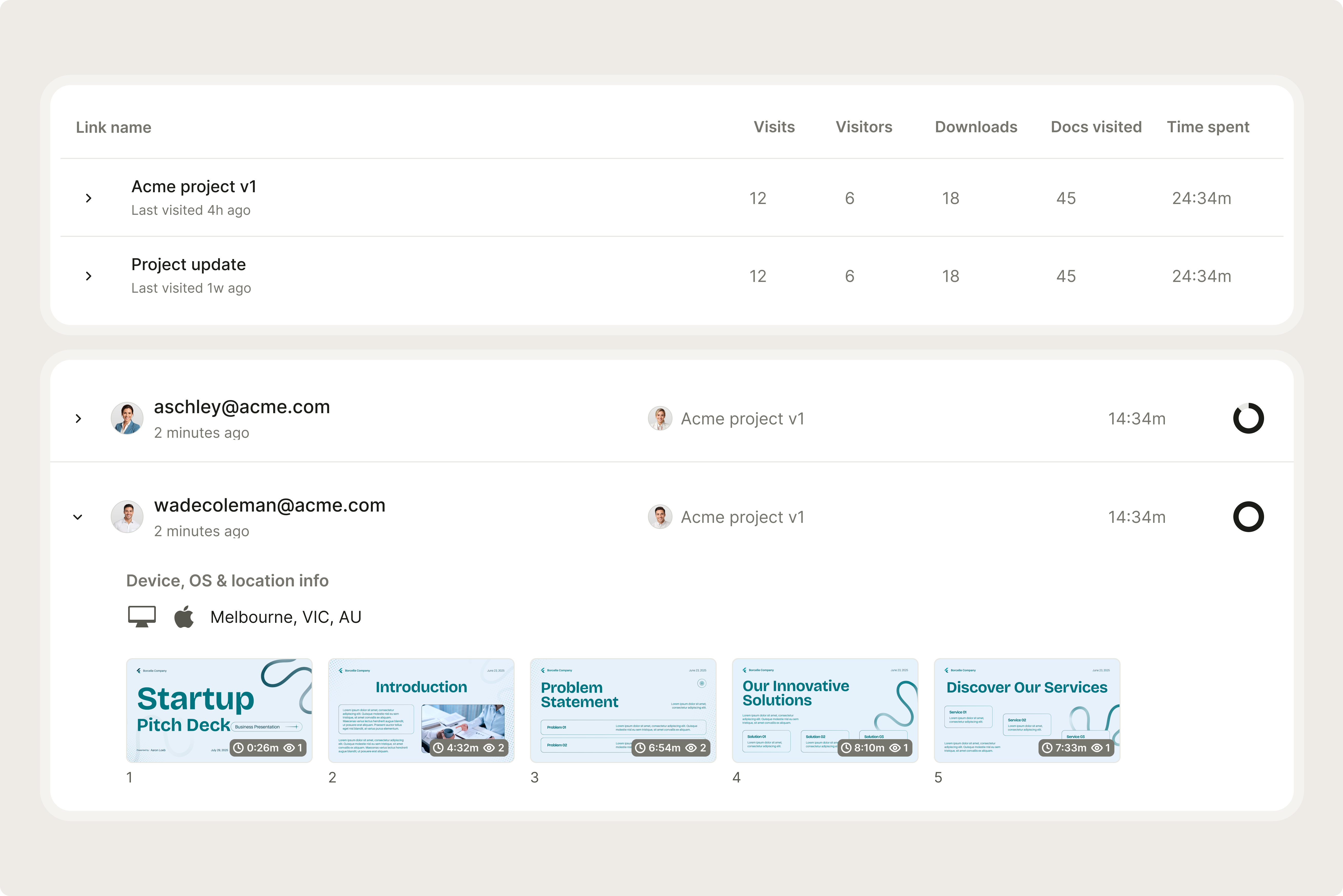
- 3.Get instant notifications ...Know which healthtech VCs open your data room and how long they spend on clinical evidence. If Amplitude reads your outcome data three times, follow up on that data specifically.
Questions healthtech founders ask before raising
- Biotech investors evaluate clinical trial timelines and scientific data. Healthtech investors evaluate SaaS metrics - ARR, churn, LTV:CAC - and payer integration clarity. Amplitude invests in both. Inovia and Panache focus on healthtech SaaS and health AI.
- Inovia, Panache, and Real Ventures don't require Quebec incorporation. Investissement Québec, Fonds FTQ, and Desjardins specifically require Quebec operations and will ask for local jobs and R&D activity data.
- Very. A signed pilot with CHUM, MUHC, or Sainte-Justine with measurable outcomes is a standard milestone most Montreal healthtech investors look for before Series A. Anges Québec and FounderFuel will support you before you get there.
- Before you send your first pitch email. Upload your clinical evidence, payer strategy, and financial model to Ellty. Investors who open your clinical data section multiple times before a call are genuinely interested.
- Clinical evidence that your AI changes outcomes - not just automates workflows. At minimum, IRB-approved validation data and a clear integration pathway with clinical systems. Generic demos without outcome data won't get you past a first meeting.
- Start with 6-8 investors. Use Ellty to send separate trackable links and monitor who opens your clinical evidence vs. your financials. Prioritize investors who review both - that's where real interest sits.