Montreal has 87 funded food and beverage startups as of 2026 - from OatBox and Mid-Day Squares to Dispatch Coffee. These 13 investors are actively writing checks into Quebec food, CPG, and restaurant tech companies right now.
Food and beverage investing in Montreal has two distinct tracks. The first is consumer CPG - brands like Mid-Day Squares and OatBox that need patient capital and distribution partnerships. The second is foodtech - software and infrastructure that serves restaurants, food manufacturers, and supply chains.
Investors on both tracks want different things. CPG investors want gross margin above 35%, retail velocity data, and a clear path to a major grocery chain. Foodtech investors want ARR growth rate, customer retention, and a B2B revenue model that scales without proportional headcount.
Quebec's food and beverage sector has real advantages for investors. The province has deep food manufacturing heritage - from dairy cooperatives to specialty food producers - and Investissement Québec actively co-invests in food companies with Quebec operations.
Before you pitch any of these 13 food investors, build an Ellty data room with your deck, retail velocity reports, and financial model. Send a unique trackable link per fund. You'll see which investors actually review your distribution data before any follow-up call.
| Stage | Check size | Sector focus | Contact | |
|---|---|---|---|---|
| Investissement Québec | Seed to growth | $1M-$25M+ | Quebec food, all sectors | investquebec.com |
| Fonds de solidarité FTQ | Seed to growth | $500K-$5M | Quebec food, manufacturing, all sectors | fondsftq.com |
| Anges Québec | Pre-seed, Seed | $50K-$500K | Quebec food brands, tech | angesquebec.com |
| BDC Capital | Seed, Series A | $500K-$5M | Canadian food, CPG, tech | bdc.ca |
| District Ventures Capital | Seed, Series A | $250K-$3M | CPG, food, consumer brands | districtventures.ca |
| Panache Ventures | Pre-seed, Seed | Up to $1.5M | Foodtech, agtech, consumer SaaS | panache.vc |
| Real Ventures | Pre-seed, Seed | $250K-$2M | Tech-enabled food, consumer | realventures.com |
| White Star Capital | Seed, Series A, B | $500K-$5M | Consumer, marketplace, food delivery | whitestarcapital.com |
| Inovia Capital | Seed to late stage | $1M-$10M | Foodtech, restaurant SaaS, consumer | inovia.vc |
| Cycle Capital | Seed, Series A | $1M-$5M | Sustainable food, agtech, cleantech | cyclecapital.com |
| Desjardins Capital | Seed to growth | $500K-$5M | Quebec food co-ops, agriculture | desjardins.com |
| Kli Capital | Pre-seed, Seed | Up to $1.5M | Food e-commerce, consumer tech | klicapital.vc |
| Brightspark Ventures | Seed, Series A | $500K-$3M | Canadian consumer, food delivery tech | brightspark.com |
Know who reviews your F&B pitch
Upload your deck to Ellty and track exactly which investors open your materials and spend time on your retail velocity data.
Start free 14-day trialWhat is a Montreal food investor?
A Montreal food and beverage investor backs CPG brands, foodtech software, and restaurant infrastructure companies operating in or from Quebec. There's no dedicated food VC in Montreal - you're pitching generalist funds that evaluate food deals on consumer brand metrics or SaaS metrics depending on your model.
CPG investors want retail velocity, gross margin above 35%, and a clear path to national distribution. Foodtech investors want ARR, net revenue retention, and a B2B model that serves food manufacturers, restaurant chains, or grocery retailers at scale.
Quebec has structural advantages in food investing. The province has strong food manufacturing infrastructure, Desjardins Capital has deep roots in agricultural co-operatives, and Investissement Québec specifically supports Quebec food companies that maintain local production and jobs.
For broader context on Quebec investing, see Quebec investors. Read what investors look for in a data room before any food investor meeting.
Quebec food founders with real retail velocity and a path to 40% gross margin get meetings. Founders selling the category opportunity without unit economics don't.
13 Montreal food and beverage investors
1. Investissement Québec
Quebec's provincial investment arm is the most structurally important food investor in the province. IQ provides equity checks from $1M to $25M+ and frequently co-invests with Fonds FTQ and private VCs in Quebec food and beverage companies. For Montreal food founders with Quebec manufacturing or production operations, IQ is the first institutional call - they specifically support companies that create Quebec jobs and maintain local production.
- Recent Deals: Active equity and loan programs for Quebec food and consumer businesses; Vention $150M CAD Series D lead (2025); "I Adopt Quebec's Tech" initiative co-founder
- LinkedIn: Investissement Québec LinkedIn
- Sector Focus: Quebec food, manufacturing, consumer, all sectors
- Stage Focus: Seed to growth
- Location: Montreal, QC
- Website: investquebec.com
2. Fonds de solidarité FTQ
Quebec's labor-sponsored fund with $23B+ net assets backs food and agricultural businesses as part of its mandate to support Quebec's economy. The Fonds regionaux deployed $241M in 172 Quebec businesses in 2025-2026 and frequently co-invests in food manufacturing, food distribution, and CPG companies. For Quebec food founders with operations in the province, Fonds FTQ is a reliable co-investor after a private fund commits.
- Recent Deals: $241M in 172 Quebec businesses (2025-2026); $23B+ net assets (November 2025); Jolt Capital strategic partnership; active food and agricultural co-investment mandate
- LinkedIn: Fonds de solidarité FTQ LinkedIn
- Sector Focus: Quebec businesses, food, manufacturing, agriculture, all sectors
- Stage Focus: Seed to growth
- Location: Montreal, QC
- Website: fondsftq.com
3. Anges Québec
Canada's largest angel network with 230+ members has backed early Quebec food companies alongside institutional VCs. Anges Québec members include former food industry operators and CPG executives from Quebec's food manufacturing sector. For Quebec food founders at pre-seed - before you have $300K ARR and can approach institutional VCs - Anges Québec is the most structured source of first food capital in Montreal.
- Recent Deals: EmergConnect $1.75M seed (2025); Frank & Oak early co-investor; 230+ member network; active consumer brand and food deal flow
- LinkedIn: Anges Québec LinkedIn
- Sector Focus: Quebec tech, food, consumer brands, all sectors
- Stage Focus: Pre-seed, Seed
- Location: Montreal, QC
- Website: angesquebec.com
4. BDC Capital
Canada's national co-investor backs food and beverage companies at every stage from seed through expansion. BDC has 5 investments in the past 12 months and is one of the most active co-investors in Canadian CPG and food technology. They don't lead rounds - they co-invest after a private VC sets terms and move in 2-4 weeks once a lead is confirmed. Every Montreal food founder should have BDC in their co-investor pipeline once a private lead commits.
- Recent Deals: 5 investments in past 12 months; $150M Life Sciences fund launch (April 2026); 384+ total investments; active Canadian food and CPG co-investment mandate
- LinkedIn: BDC Capital LinkedIn
- Sector Focus: Canadian food, CPG, tech, all sectors
- Stage Focus: Seed, Series A
- Location: Montreal, QC (national mandate)
- Website: bdc.ca
5. District Ventures Capital
Calgary-based consumer and CPG fund that actively reviews Canadian food and beverage deals. District Ventures has made 2 investments in the past 12 months and focuses on consumer brands with strong unit economics and retail distribution. For Montreal food founders who've cleared $300K+ ARR and have real grocery retail traction, District Ventures is the most dedicated CPG-focused fund available to Canadian food companies.
- Recent Deals: 2 investments in past 12 months; active Canadian CPG and food brand deployment 2025-2026; consumer brand and food mandate
- LinkedIn: District Ventures Capital LinkedIn
- Sector Focus: CPG, food, consumer brands, retail
- Stage Focus: Seed, Series A
- Location: Calgary, AB (national mandate)
- Website: districtventures.ca
Share your F&B deck with trackable links
Set up an Ellty data room with your retail velocity and margin data before any investor meeting.
Start free 14-day trial6. Panache Ventures
Canada's most active pre-seed fund backs foodtech and agtech companies with a clear software or platform thesis. Panache writes checks up to $1.5M and leads at pre-revenue stage for technical founders. If you're building restaurant management software, food supply chain tools, or precision fermentation infrastructure - not a CPG brand - Panache is worth approaching at idea stage in Montreal.
- Recent Deals: Nord Quantique (Q1 2026); Soma Energy (April 2026); 5 investments in 2026; active agtech and foodtech deal flow from Montreal partner
- LinkedIn: Panache Ventures LinkedIn
- Sector Focus: Foodtech, agtech, consumer SaaS, AI, fintech
- Stage Focus: Pre-seed, Seed
- Location: Montreal, QC (offices in 4 cities)
- Website: panache.vc
7. Real Ventures
Montreal's foundational early-stage fund backs tech-enabled food companies with a platform or infrastructure thesis. Real won't back a food brand without a clear tech differentiation angle, but they've backed consumer companies from their Montreal base for over a decade. For foodtech software founders - restaurant SaaS, food delivery infrastructure, or food supply chain tools - Real is worth approaching at FounderFuel or directly through a warm intro.
- Recent Deals: Active FounderFuel cohorts 2025-2026; 100+ portfolio companies; consumer and tech-enabled food deals in Montreal; $600M+ raised since inception
- LinkedIn: Real Ventures LinkedIn
- Sector Focus: Tech, tech-enabled food, consumer, enterprise
- Stage Focus: Pre-seed, Seed
- Location: Montreal, QC
- Website: realventures.com
8. White Star Capital
Montreal-headquartered global VC with a consumer and marketplace thesis. White Star's portfolio includes consumer and e-commerce companies and their new North American Seed Fund ($25M first close, September 2025) covers consumer and food delivery platforms. For Montreal food delivery, restaurant tech, or CPG e-commerce founders with $300K+ ARR, White Star is worth approaching given their local presence and global co-investor network.
- Recent Deals: Trayd (2026); Kulipa follow-on (2026); North American Seed Fund first close $25M (September 2025); 15 investments in 2025; consumer and marketplace portfolio
- LinkedIn: White Star Capital LinkedIn
- Sector Focus: Consumer, marketplace, food delivery, e-commerce, fintech
- Stage Focus: Seed, Series A, B
- Location: Montreal, QC (global offices)
- Website: whitestarcapital.com
9. Inovia Capital
Montreal's leading full-stack VC backs foodtech and restaurant SaaS companies with strong recurring revenue. Inovia led Sonder's growth and has backed consumer platforms at multiple stages. For foodtech founders at $300K+ ARR with a clear B2B model serving restaurants, grocers, or food manufacturers, Inovia is worth approaching. They won't back a CPG brand without a tech platform thesis attached.
- Recent Deals: Toyo (2026); Flare follow-on (2026); Sonder (portfolio); Vessel $10.3M (2025); 15 investments in 2025; US$2.2B+ AUM
- LinkedIn: Inovia Capital LinkedIn
- Sector Focus: Foodtech, restaurant SaaS, consumer tech, e-commerce, AI
- Stage Focus: Seed to late stage
- Location: Montreal, QC (global offices)
- Website: inovia.vc
10. Cycle Capital
Montreal's dedicated cleantech and sustainability fund backs sustainable food, alternative proteins, and agricultural technology companies. Cycle Capital invests in companies where environmental impact and food system transformation intersect - precision fermentation, sustainable packaging, waste reduction technology, and regenerative agriculture. For Montreal food founders building in sustainable food infrastructure, Cycle Capital is the most relevant specialist fund in Quebec.
- Recent Deals: Active sustainable food and agtech deployment 2025-2026; Montreal-based cleantech and sustainability mandate; alternative protein and precision fermentation deal flow
- LinkedIn: Cycle Capital LinkedIn
- Sector Focus: Sustainable food, alternative proteins, agtech, cleantech, circular economy
- Stage Focus: Seed, Series A
- Location: Montreal, QC
- Website: cyclecapital.com
11. Desjardins Capital
Quebec's cooperative financial institution has deep roots in Quebec's agricultural and food cooperative sectors. Desjardins co-invested in Vention's $150M CAD round and is an active LP in Quebec-focused funds. For Montreal food founders building companies that serve Quebec's agricultural cooperative sector - dairy, grain, or specialty food co-operatives - Desjardins has the deepest industry network of any investor on this list.
- Recent Deals: Vention $150M CAD co-investor (2025); new investment model launched January 2026; CRCD $116.5M net earnings FY2025; Quebec agricultural and food sector network
- LinkedIn: Desjardins Capital LinkedIn
- Sector Focus: Quebec food co-ops, agriculture, all industries
- Stage Focus: Seed to growth
- Location: Montreal, QC
- Website: desjardins.com
12. Kli Capital
Montreal-New York VC that covers food e-commerce and consumer tech in its $50M Fund III. Kli writes checks up to $1.5M and leads or co-leads pre-seed and seed rounds. Latest investment was Brickroad (February 2026). For Montreal food e-commerce founders with early traction and a clear unit economics story, Kli moves faster than most institutional funds and is worth approaching at pre-seed stage.
- Recent Deals: Brickroad (seed, February 2026); Result Flow AI (February 2026); Pattern exit (May 2025); 52+ total investments; $50M Fund III active
- LinkedIn: Kli Capital LinkedIn
- Sector Focus: E-commerce, consumer, food tech, fintech, healthtech
- Stage Focus: Pre-seed, Seed
- Location: Montreal, QC / New York, NY
- Website: klicapital.vc
13. Brightspark Ventures
Montreal-based VC with $250M+ deployed across Canadian software and consumer tech. Brightspark backed Hopper - which started as a travel consumer app - and has appetite for consumer platforms with strong tech differentiation. For Montreal foodtech founders building software that serves restaurants, food delivery, or grocery retailers, Brightspark is worth approaching once you have $300K+ ARR and a clear SaaS model.
- Recent Deals: DeepSky (active portfolio); Vetster growth stage; Hopper (portfolio); $250M+ total deployed; active Canadian consumer tech deployment 2025-2026
- LinkedIn: Brightspark Ventures LinkedIn
- Sector Focus: Canadian software, consumer tech, food delivery tech, SaaS
- Stage Focus: Seed, Series A
- Location: Montreal, QC
- Website: brightspark.com
What food investors evaluate before writing checks
Food investors look at different metrics depending on whether you're a CPG brand or a foodtech platform. CPG investors want retail velocity (units per store per week), gross margin above 35%, and proof of repeat purchase. Most won't lead without a signed purchase order from a major grocery chain.
Foodtech investors evaluate ARR, net revenue retention, and gross margin above 60%. They want to see a B2B sales motion - restaurants, grocers, or food manufacturers paying monthly for your software or infrastructure. Some don't care about Quebec economic benefit at all - they're looking at unit economics first and geography second.
Before any investor meeting, build an Ellty data room with your financial model, retail velocity reports, and customer references. Use Ellty to send separate trackable links to CPG investors vs. foodtech investors. You'll see which section each investor spends time on. Read how to organize your data room before approaching any of these 13 investors.
How to approach Quebec food co-investors
Quebec's public food investment infrastructure is unusually strong. Investissement Québec, Fonds FTQ, and Desjardins Capital all have explicit mandates to support Quebec food companies. They co-invest with private VCs on similar terms and typically add $1M to $5M to a round after a private lead is confirmed.
The sequencing matters. A private VC - Panache, Real, or District Ventures - should lead and set terms first. Then you approach IQ, Fonds FTQ, and BDC simultaneously. Each runs their own diligence, but they're familiar with each other's processes and often communicate. Build 4-6 extra weeks into your timeline for the public co-investment layer.
Set up your Ellty data room with Quebec economic impact projections - jobs created, Quebec-based production volume, and R&D spend - before you approach any Quebec public co-investor. Investissement Québec specifically asks for these metrics in their investment assessment. Read what investors look for in a data room before any IQ or Fonds FTQ meeting.
How to find active food investors in Quebec
Not every fund listed publicly is actively deploying into food. Some Montreal funds that raised in 2021-2022 are in harvest mode by 2026. A fund with no new food investments announced in 12+ months is likely not a priority sector for them right now.
Check three things before investing time in a pitch. Has the fund announced any consumer or food investment in the last 6 months? Do they list a current fund size and vintage? Are their partners reachable on LinkedIn with recent activity in the food sector?
Upload your pitch to Ellty and send trackable links to your target investor list. If a Cycle Capital partner opens your sustainable packaging data three times in a week, they're interested - follow up on that data specifically. If a Panache partner never opens your link, your foodtech thesis likely doesn't fit their current portfolio. Read due diligence for investors to understand what food VCs review before writing checks.
How to pitch a Montreal food investor
Five steps for Quebec food and beverage founders raising capital in 2026.
- 1.Know which track you're on: CPG or foodtechCPG investors want retail velocity and gross margin. Foodtech investors want ARR and net revenue retention. Pitch the right metrics to the right investor from the start.
- 2.Show 35% gross margin or a clear path to itMost Montreal food investors won't lead a round below 35% gross margin. Show your margin at current scale and your path to 40%+ within 18 months.
- 3.Build a data room before any first emailUpload your retail velocity reports, financial model, and Quebec economic impact data to Ellty. Send trackable links so you see which investors review your data.
- 4.Secure a private lead before approaching Quebec public fundsApproach Investissement Quebec and Fonds FTQ after a private VC commits. They follow private leads and add 4-6 weeks to your close timeline.
- 5.Prepare Quebec economic impact data earlyIQ and Fonds FTQ ask for job creation projections and Quebec production volume. Have these numbers ready before your first public fund meeting.
How Ellty helps you land a Montreal food investor
You know the 13 investors. Here is how to get your retail data and financial model in front of them before the process drags.
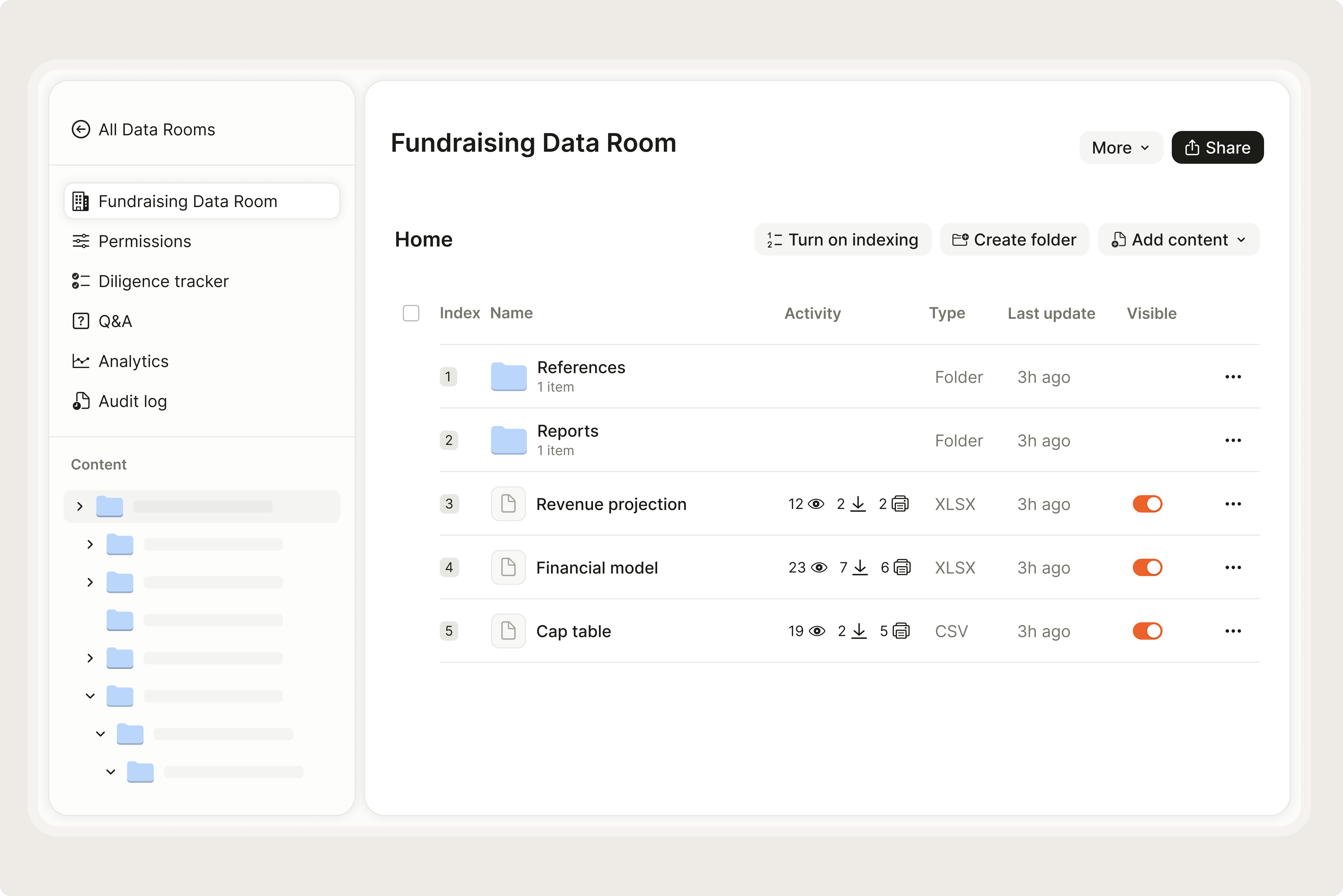
- 1.Build your food data room with retail velocity dataCreate an Ellty data room and upload your pitch, retail velocity reports, and financial model. Food investors ask for this data within 48 hours of any promising first call.
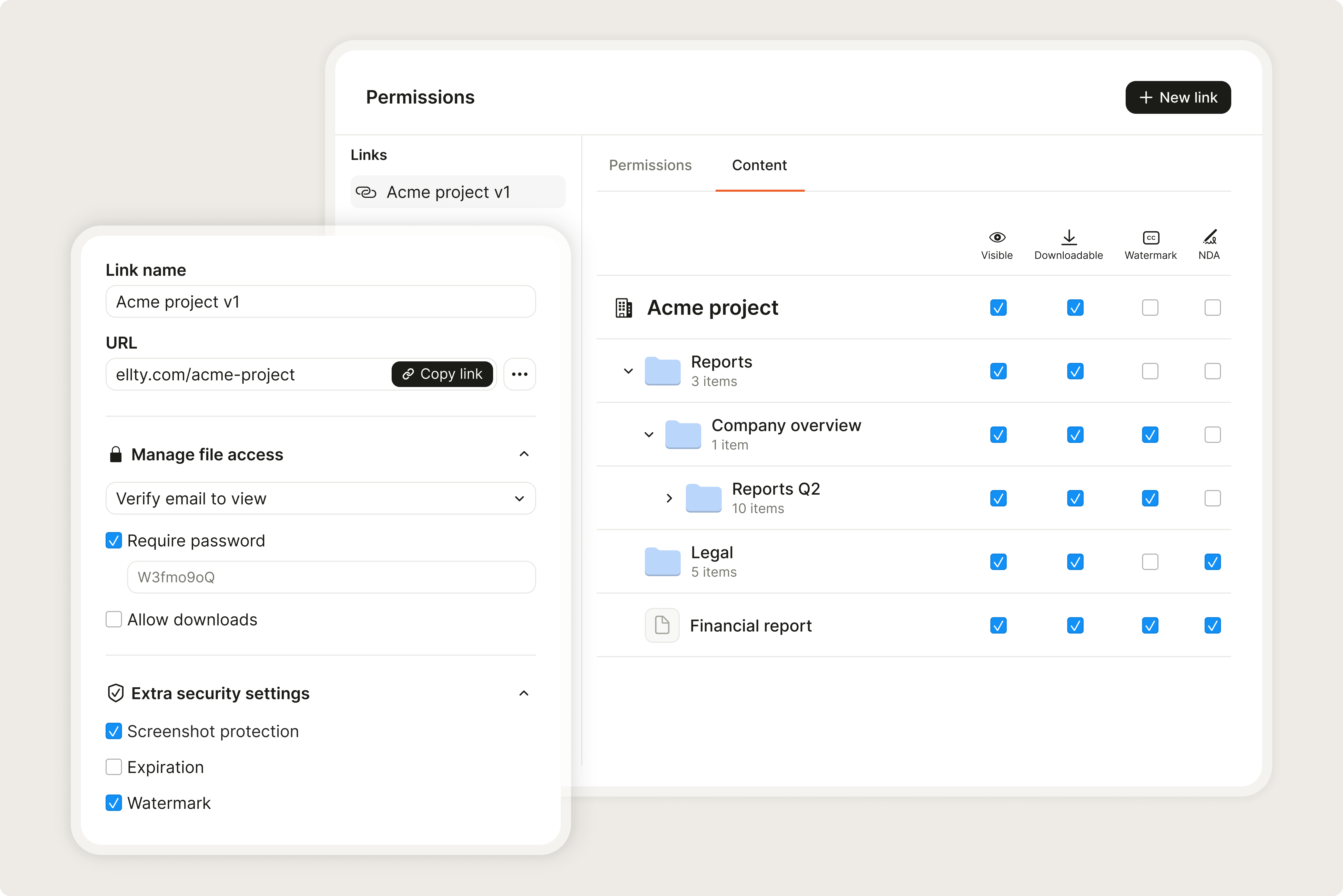
- 2.Set permissions before sharing margin and supply dataRequire email verification before any investor accesses your margin breakdown or supplier agreements. Screenshot protection keeps your cost structure confidential.
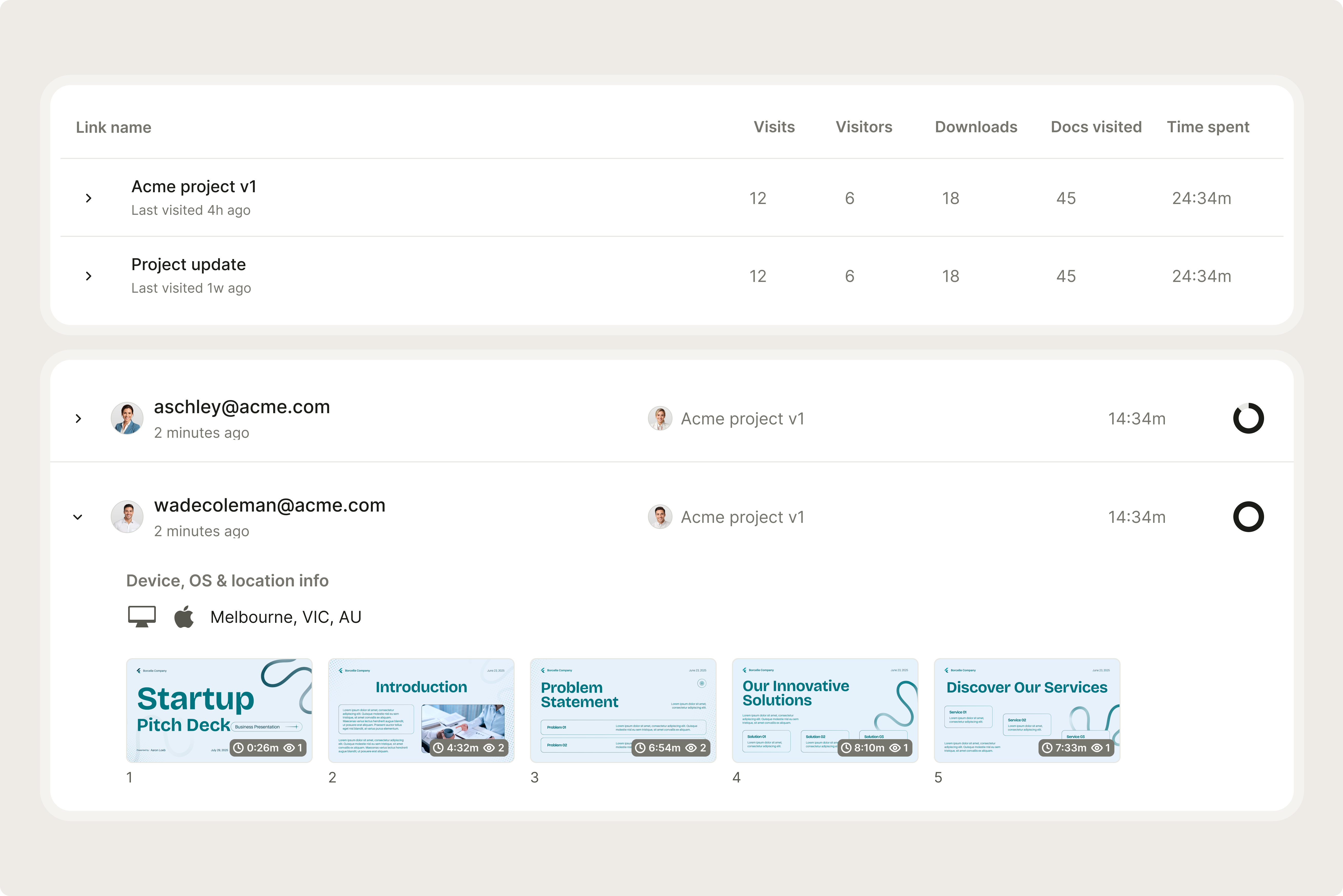
- 3.See which investors review your retail velocity dataKnow which food VCs open your data room and how long they spend on each section. If a District Ventures partner reads your retail velocity data twice, follow up on that metric immediately.
Questions food founders ask before raising
- Both, but with different criteria. CPG investors want 35%+ gross margin and retail traction. Foodtech investors want ARR and a B2B SaaS model serving restaurants or grocers.
- 35%+ gross margin for CPG brands, 60%+ for foodtech SaaS. Below those thresholds, investors will want a very clear path to those margins within 18 months.
- IQ looks for Quebec incorporation, local jobs created, and Quebec production or R&D activity. They co-invest alongside private VCs and write $1M-$25M+ equity checks.
- Yes, if you're Quebec-incorporated with real Quebec operations. Approach them after a private VC commits - they co-invest on similar terms and add 4-6 weeks to close.
- District Ventures backs CPG consumer brands with retail traction. Cycle Capital backs sustainable food tech, alternative proteins, and agtech with an environmental thesis.
- Before you send your first pitch email. Upload your retail velocity reports and financial model to Ellty. Investors who open your financials multiple times before a call are genuinely interested.