Montreal has a real ecommerce track record - Hopper, SSENSE, Frank & Oak, OatBox, Mia & Milo. These 11 investors are writing checks into Quebec ecommerce and commerce infrastructure companies right now.
Montreal's ecommerce ecosystem is more mature than most people outside Quebec realize. Hopper scaled to $5B+ and pioneered predictive travel commerce. SSENSE became a global luxury marketplace before its August 2025 restructuring. Mid-Day Squares built a CPG brand with real national retail distribution. That track record creates a reference point for investors evaluating new ecommerce deals.
The investor reality in 2026 is that pure DTC brands without strong unit economics rarely raise institutional VC. What gets funded is ecommerce infrastructure - tools, platforms, and SaaS that help brands acquire customers, manage logistics, or increase retention. Commerce platforms that can generate recurring revenue get better valuations than one-time-purchase brands.
For DTC brands that do raise, the bar is 50%+ gross margins, CAC payback under 6 months, and day-30 repeat purchase rate above 40%. These are non-negotiable for a Montreal seed raise in ecommerce in 2026. If you're building ecommerce tech rather than a brand, you're pitching SaaS metrics.
Before you pitch any of these 11 ecommerce investors, set up an Ellty data room with your pitch, unit economics dashboard, and financial model. Send a unique trackable link per fund. Ecommerce investors check gross margin, CAC, and LTV before any brand narrative.
| Stage | Check size | Sector focus | Contact | |
|---|---|---|---|---|
| Inovia Capital | Seed to late stage | $1M-$10M | Commerce platforms, AI retail | inovia.vc |
| White Star Capital | Seed, Series A, B | $500K-$5M | Consumer, marketplace, ecommerce | whitestarcapital.com |
| Panache Ventures | Pre-seed, Seed | Up to $1.5M | Commerce tech, consumer SaaS | panache.vc |
| Kli Capital | Pre-seed, Seed | Up to $1.5M | Ecommerce, consumer, SaaS | klicapital.vc |
| District Ventures Capital | Seed, Series A | $250K-$3M | CPG brands, consumer ecommerce | districtventures.ca |
| BDC Capital | Seed, Series A | $500K-$5M | Canadian ecommerce, tech | bdc.ca |
| Investissement Québec | Seed to growth | $1M-$25M+ | Quebec ecommerce, consumer, tech | investquebec.com |
| Fonds de solidarité FTQ | Seed to growth | $500K-$5M | Quebec consumer, ecommerce | fondsftq.com |
| Real Ventures | Pre-seed, Seed | $250K-$2M | Commerce tech, consumer platforms | realventures.com |
| Brightspark Ventures | Seed, Series A | $500K-$3M | Consumer tech, ecommerce platforms | brightspark.com |
| Anges Québec | Pre-seed, Seed | $50K-$500K | Quebec consumer brands, ecommerce | angesquebec.com |
Track who opens your ecommerce pitch
Send trackable links to ecommerce investors and see who reviews your deck.
Start free 14-day trialWhat is a Montreal ecommerce investor?
A Montreal ecommerce investor backs DTC consumer brands, commerce infrastructure, marketplace platforms, and commerce SaaS companies. They're not dedicated ecommerce specialists - like most sectors in Montreal, you're pitching generalist VCs who evaluate ecommerce deals on consumer brand metrics or SaaS metrics depending on your model.
The SSENSE bankruptcy restructuring in August 2025 made Montreal investors more cautious about capital-intensive luxury and fashion ecommerce. Frank & Oak's IP sale in April 2025 reinforced that DTC brands without genuine unit economics don't get institutional support, no matter how strong the brand.
What gets funded in 2026 is commerce technology - tools that help brands grow, retain customers, and manage supply chains at scale. If you're building the infrastructure layer that makes ecommerce more efficient, you'll get more meetings than a brand without exceptional traction.
For broader context on Quebec investing, see Quebec investors. Read what investors look for in a data room before any ecommerce investor meeting.
The ecommerce founders who raise in Montreal have one thing in common: they can show a business that works at current scale. No more growth-at-all-costs stories.
11 Montreal ecommerce investors
1. Inovia Capital
Montreal's leading VC backed Hopper from early stage through $5B+ valuation. Inovia evaluates ecommerce companies on platform metrics - recurring revenue, cohort retention, and clear network effects. They won't back a single-category DTC brand without exceptional traction, but they'll back commerce platforms that create scalable recurring revenue. For Montreal ecommerce tech founders at $300K+ ARR, Inovia is your highest-value first call.
- Recent Deals: Hopper (portfolio, $5B+ valuation); Toyo (2026); Flare follow-on (2026); 15 investments in 2025; US$2.2B+ AUM; active consumer and commerce portfolio
- LinkedIn: Inovia Capital LinkedIn
- Sector Focus: Commerce platforms, travel commerce, consumer AI, fintech, SaaS
- Stage Focus: Seed to late stage
- Location: Montreal, QC (global offices)
- Website: inovia.vc
2. White Star Capital
Montreal-headquartered global VC with a consumer and marketplace thesis. White Star has backed ecommerce and marketplace companies across Canada, Europe, and Asia. Their North American Seed Fund ($25M first close, September 2025) covers ecommerce and consumer tech. Latest investments: Trayd (2026) and Kulipa follow-on (2026). For Montreal ecommerce founders at $300K+ ARR with global ambitions, White Star's local presence and international co-investor network is genuinely useful.
- Recent Deals: Trayd (2026); Kulipa follow-on (2026); North American Seed Fund $25M first close (September 2025); 15 investments in 2025; consumer and marketplace portfolio
- LinkedIn: White Star Capital LinkedIn
- Sector Focus: Consumer, ecommerce, marketplace, fintech, enterprise
- Stage Focus: Seed, Series A, B
- Location: Montreal, QC (global offices)
- Website: whitestarcapital.com
3. Panache Ventures
Canada's most active pre-seed fund backs commerce tech founders with B2B distribution or platform theses. Panache won't back a DTC brand without exceptional early traction, but will back ecommerce infrastructure - tools for brands to grow, manage supply chains, or increase customer LTV. For commerce tech founders at pre-revenue with strong domain expertise, Panache leads checks up to $1.5M.
- Recent Deals: Nord Quantique (Q1 2026); Soma Energy (April 2026); 5 investments in 2026; active Montreal consumer tech deal flow; 40+ Fund II companies
- LinkedIn: Panache Ventures LinkedIn
- Sector Focus: Commerce tech, consumer SaaS, AI, enterprise, fintech
- Stage Focus: Pre-seed, Seed
- Location: Montreal, QC (offices in 4 cities)
- Website: panache.vc
4. Kli Capital
Montreal-New York VC with ecommerce in its $50M Fund III mandate. Kli writes checks up to $1.5M and leads at pre-seed and seed. Latest investments were Brickroad and Result Flow AI (both February 2026). For Montreal ecommerce founders with early traction - $50K-$200K ARR or early retail velocity data - Kli moves faster than most institutional funds.
- Recent Deals: Brickroad (seed, February 2026); Result Flow AI (seed, February 2026); Pattern exit (May 2025); 52+ total investments; $50M Fund III active
- LinkedIn: Kli Capital LinkedIn
- Sector Focus: Ecommerce, consumer, SaaS, fintech, healthtech
- Stage Focus: Pre-seed, Seed
- Location: Montreal, QC / New York, NY
- Website: klicapital.vc
5. District Ventures Capital
Calgary-based consumer and CPG fund that actively reviews Canadian DTC and ecommerce brands. District Ventures focuses on consumer brands with strong unit economics and real retail distribution. For Montreal DTC founders with 50%+ gross margins, retail velocity data, and a path to national distribution, District Ventures is the most dedicated CPG-ecommerce fund available to Quebec founders.
- Recent Deals: 2 investments in past 12 months; active Canadian consumer brand and DTC deployment 2025-2026; ecommerce and CPG mandate; national deal flow including Quebec
- LinkedIn: District Ventures Capital LinkedIn
- Sector Focus: CPG brands, consumer ecommerce, retail, lifestyle brands
- Stage Focus: Seed, Series A
- Location: Calgary, AB (national mandate)
- Website: districtventures.ca
Share your ecommerce deck with trackable links
Set up an Ellty data room with your unit economics and financial model before any investor call.
Start free 14-day trial6. BDC Capital
Canada's national co-investor backs ecommerce and consumer brands across every stage. BDC has backed Canadian ecommerce companies including DTC brands with real retail traction. They don't lead rounds, but they co-invest after a private VC sets terms. Use Ellty to send BDC a data room link alongside your private lead outreach.
- Recent Deals: 384+ total investments; active Canadian consumer and ecommerce co-investment mandate; 5 investments in past 12 months; $150M Life Sciences fund launch (April 2026)
- LinkedIn: BDC Capital LinkedIn
- Sector Focus: Canadian ecommerce, consumer tech, all sectors
- Stage Focus: Seed, Series A
- Location: Montreal, QC (national mandate)
- Website: bdc.ca
7. Investissement Québec
Quebec's provincial investment arm has backed Quebec consumer brands and ecommerce companies. IQ writes $1M to $25M+ checks and is the most reliable public co-investor for Quebec ecommerce founders after a private VC leads. For ecommerce founders at Series A+ with Quebec operations and local jobs, IQ fills round gaps efficiently.
- Recent Deals: Vention $150M CAD Series D lead (2025); active Quebec consumer and ecommerce equity programs; "I Adopt Quebec's Tech" initiative
- LinkedIn: Investissement Québec LinkedIn
- Sector Focus: Quebec ecommerce, consumer, all sectors
- Stage Focus: Seed to growth
- Location: Montreal, QC
- Website: investquebec.com
8. Fonds de solidarité FTQ
Quebec's $23B+ labor-sponsored fund co-invests in consumer and ecommerce companies alongside private VCs. Fonds FTQ deployed $241M in 172 Quebec businesses in 2025-2026. Add Fonds FTQ to your co-investor list once a private VC commits.
- Recent Deals: $241M deployed in 172 Quebec businesses (2025-2026); $23B+ net assets; active Quebec consumer and ecommerce co-investment
- LinkedIn: Fonds de solidarité FTQ LinkedIn
- Sector Focus: Quebec consumer, ecommerce, all sectors
- Stage Focus: Seed to growth
- Location: Montreal, QC
- Website: fondsftq.com
9. Real Ventures
Montreal's foundational VC backed Hopper in its early days. Real won't back a traditional DTC brand, but they will back commerce platforms and ecommerce infrastructure with a clear tech differentiation thesis. For commerce tech founders, Real is worth approaching via FounderFuel, which connects you directly to Inovia and Panache as follow-on investors.
- Recent Deals: Hopper early investor ($5B+ valuation); active FounderFuel cohorts 2025-2026; 100+ portfolio companies; $600M+ raised since inception
- LinkedIn: Real Ventures LinkedIn
- Sector Focus: Commerce tech, consumer platforms, enterprise, SaaS
- Stage Focus: Pre-seed, Seed
- Location: Montreal, QC
- Website: realventures.com
10. Brightspark Ventures
Montreal-based VC with $250M+ deployed in Canadian tech including consumer platforms. Brightspark backed Hopper and has appetite for consumer tech with platform-level scale potential. For ecommerce tech founders with a marketplace or platform thesis at seed or Series A, Brightspark is worth approaching if you have $300K+ ARR.
- Recent Deals: DeepSky (active portfolio); Vetster growth stage; Hopper (portfolio); $250M+ total deployed; active Canadian consumer tech 2025-2026
- LinkedIn: Brightspark Ventures LinkedIn
- Sector Focus: Consumer tech, ecommerce platforms, Canadian SaaS, enterprise
- Stage Focus: Seed, Series A
- Location: Montreal, QC
- Website: brightspark.com
11. Anges Québec
Canada's largest angel network includes former CPG executives, retail operators, and ecommerce founders among its 230+ members. For Quebec DTC or ecommerce founders raising $100K-$400K before institutional VCs, Anges Québec's consumer brand network is worth the structured pitch process.
- Recent Deals: Frank & Oak early co-investor; EmergConnect $1.75M seed (2025); 3 investments in 2025; 230+ members; active Quebec consumer and ecommerce deal flow
- LinkedIn: Anges Québec LinkedIn
- Sector Focus: Quebec consumer brands, ecommerce, CPG, all sectors
- Stage Focus: Pre-seed, Seed
- Location: Montreal, QC
- Website: angesquebec.com
Unit economics Montreal ecommerce investors check first
CAC payback under 6 months is the first filter. If it takes more than 8 months to recover your customer acquisition cost, most Montreal investors won't lead a round. This is different from 2021 - growth-at-all-costs DTC is effectively dead for institutional raises.
Day-30 repeat purchase rate above 40% is the second filter. For any subscription or consumable product, investors want to see cohort retention before they engage. A single cohort with 50% Day-30 retention is worth more than 5,000 first-time customers with no repeat data.
Set up your Ellty data room with a cohort analysis, CAC payback calculation, and gross margin breakdown. These are the first three documents an ecommerce investor will request. Send trackable links so you see which investors review your unit economics vs. your brand story. Read what investors look for in a data room before any ecommerce investor meeting.
DTC brand vs. ecommerce infrastructure: two different pitches
DTC brand founders and ecommerce infrastructure founders are pitching different things to different investors. If you're a DTC brand, you need 50%+ gross margins, real retail traction, and repeat purchase data. If you're building ecommerce infrastructure - tools for brands to grow, retain, or optimize - you're pitching SaaS metrics.
The mistake Montreal ecommerce founders often make is pitching the brand story to infrastructure investors, or pitching SaaS metrics to consumer brand investors. District Ventures backs CPG brands. Inovia backs platforms. Kli backs both, but with different criteria for each.
Before any pitch, upload separate sections to your Ellty data room for your brand metrics and your technology layer. Send trackable links to different investor types. If a District Ventures partner opens your retail velocity data three times, they're interested in the brand. If a Panache partner opens your API documentation, they're interested in the infrastructure. Read how to organize your data room before any ecommerce investor conversation.
How to find ecommerce investors in Montreal who are still active
The Hopper and SSENSE outcomes are 5+ years apart in funding vintage. Some funds that backed early Montreal ecommerce deals have already moved on. Check for portfolio company activity before spending time on outreach.
A fund whose Montreal ecommerce portfolio companies went quiet in 2022-2023 likely shifted appetite. Look for funds that have made at least one ecommerce or consumer investment in the last 12 months. Kli Capital, White Star, and District Ventures all made consumer investments in 2026.
Set up your Ellty data room before you start outreach. Send trackable links and monitor who opens your unit economics data. An investor who opens your CAC payback calculation twice in a week is actively evaluating you. One who never opens the link has moved on. Read due diligence for investors to understand what ecommerce VCs check before writing checks.
How to pitch a Montreal ecommerce investor
Five steps for Quebec ecommerce founders raising capital in 2026.
- 1.Lead with CAC payback and Day-30 retention - not brand storyMontreal ecommerce investors check unit economics first. Put CAC payback under 6 months and Day-30 retention before any brand narrative.
- 2.Know whether you're pitching a brand or ecommerce infrastructureDistrict Ventures backs CPG brands. Inovia backs platforms. Don't pitch brand metrics to infrastructure investors.
- 3.Build a data room with cohort analysis and unit economicsUpload your cohort data, CAC payback calculation, and gross margin breakdown to Ellty before any first investor call.
- 4.Get a private lead before approaching Quebec public fundsSecure White Star, Panache, or District Ventures first. Then approach IQ and Fonds FTQ as co-investors.
- 5.Have retail velocity data if you're a CPG brandFor Quebec consumer brands, Investissement Québec specifically asks for retail distribution data and Quebec production volume.
How Ellty helps you land a Montreal ecommerce investor
You know the 11 investors. Here's how to share your unit economics and brand data without giving away your customer acquisition strategy.
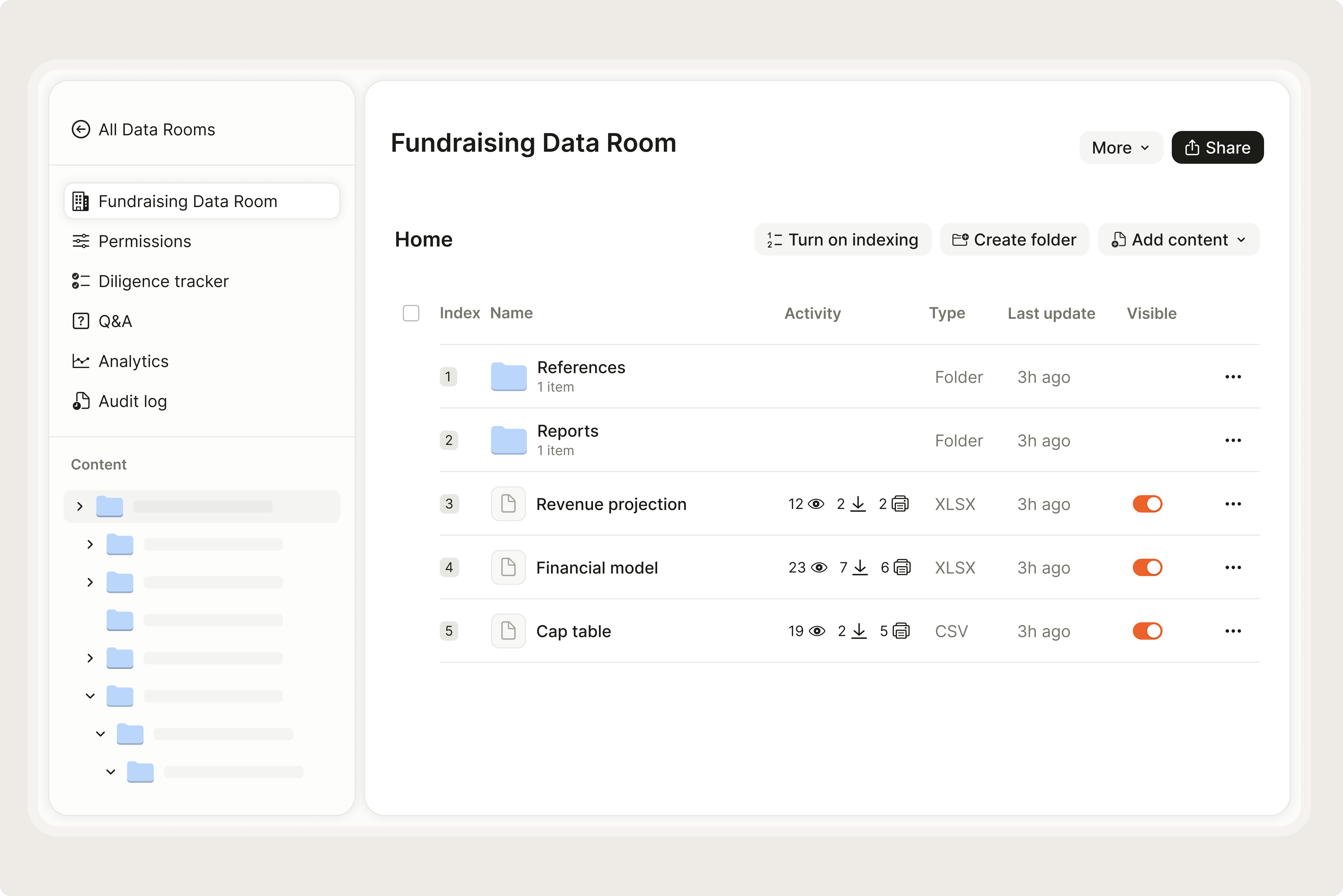
- 1.Create a data room and upload filesCreate an Ellty data room and upload your pitch, cohort analysis, and financial model. Ecommerce investors request unit economics within 48 hours of any promising first conversation.
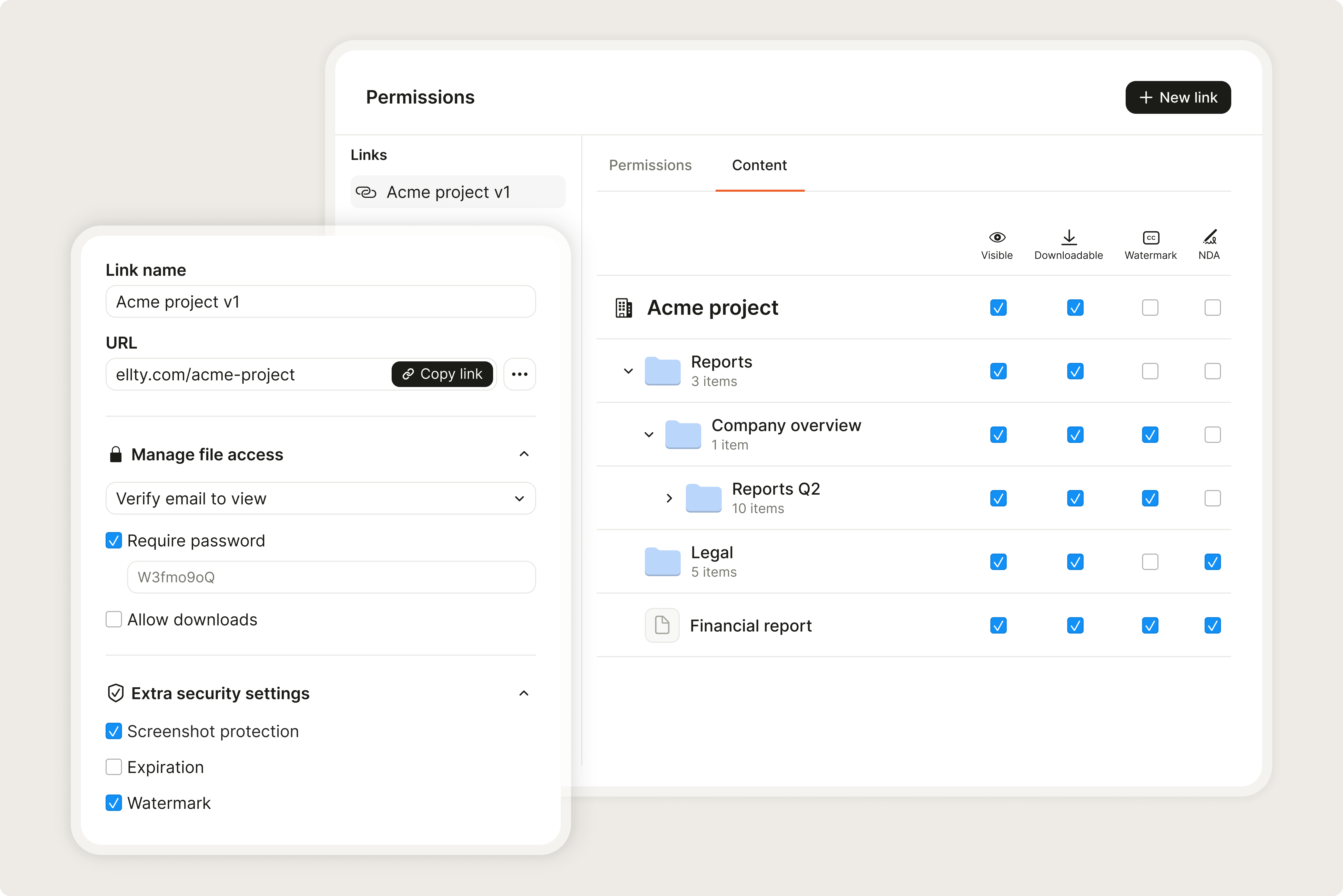
- 2.Create and configure a link ...Require email verification before investors access your CAC breakdown and supplier agreements. Screenshot protection keeps your acquisition strategy confidential.
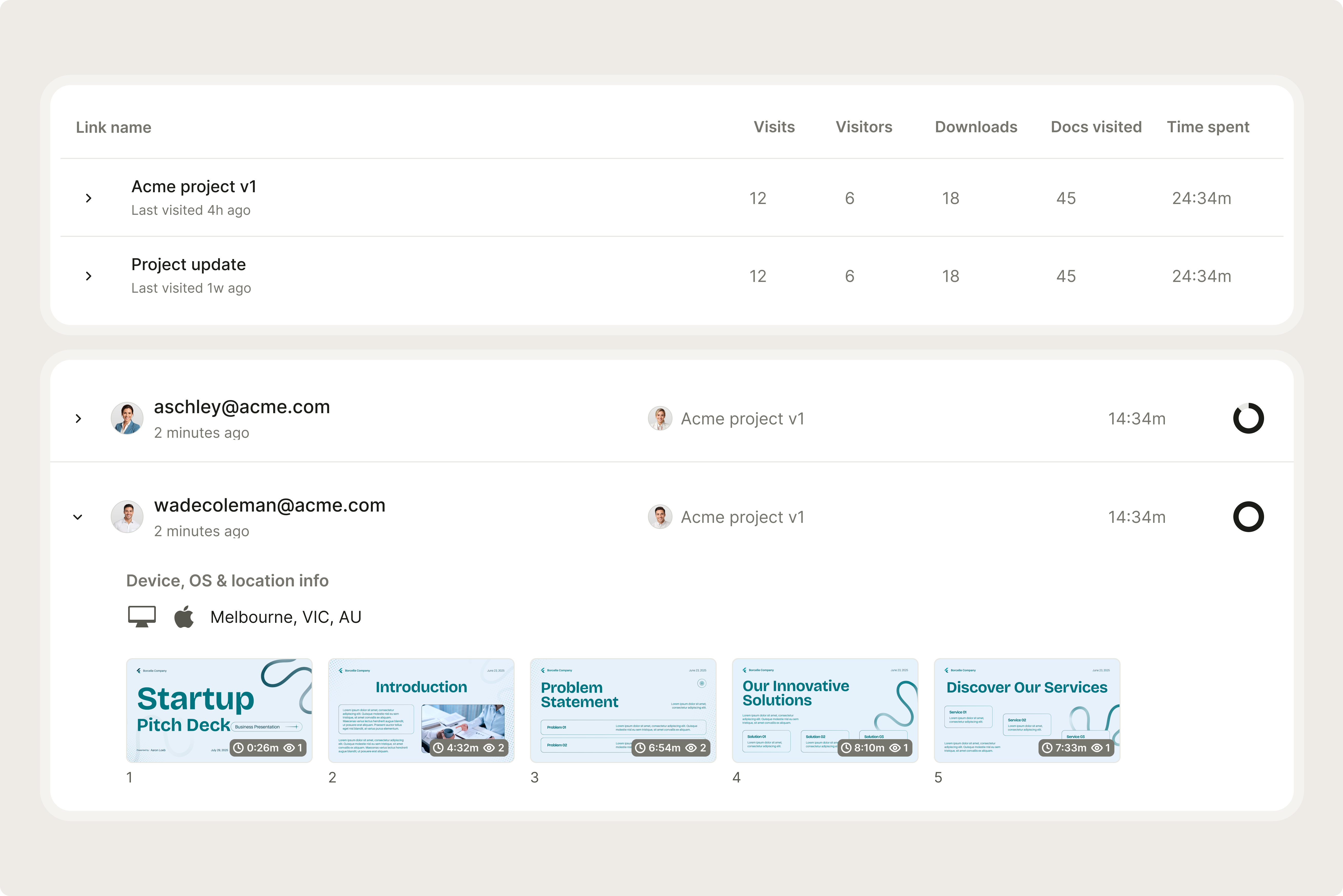
- 3.Get instant notifications ...Know which ecommerce VCs open your data room and how long they spend on cohort analysis. If a District Ventures partner reads your retail velocity data twice, follow up on that specifically.
Questions ecommerce founders ask before raising
- Yes, but the bar is high. 50%+ gross margins, Day-30 retention above 40%, and CAC payback under 6 months are now expected before Montreal VCs lead a DTC brand seed round.
- It made investors more conservative about capital-intensive ecommerce brands without proven unit economics. Investors now ask harder questions about gross margins and repeat purchase data before any consumer brand commitment.
- Inovia, White Star, Panache, and Kli don't require Quebec incorporation. Investissement Québec, Fonds FTQ, and Desjardins require Quebec operations and will ask for local jobs and retail distribution data.
- District Ventures backs consumer CPG brands with retail traction and 50%+ gross margins. Inovia backs commerce platforms and ecommerce tech with recurring revenue models. These are different pitches with different metrics.
- Before your first pitch email. Upload your cohort analysis, CAC payback, and financial model to Ellty. Investors who open your unit economics data multiple times before a call are genuinely evaluating you.
- Yes, as a platform example. Hopper raised from Real Ventures and Inovia by building predictive commerce technology, not just a booking interface. That platform thesis is what Montreal investors want to hear, not just a cleaner DTC interface.