Wisconsin commercial property has two checks that are easy to miss: shoreland zoning, which applies to all commercial development within 1,000 feet of a navigable lake or 300 feet of a navigable river statewide, and the Tyco International PFAS contamination in Marinette County - one of the most significant non-military PFAS manufacturing contamination sites in the Midwest.
Wisconsin's shoreland zoning program is administered by Wisconsin DNR (through Wis. Admin. Code NR 115 for unincorporated areas) and applies to commercial development near Wisconsin's more than 15,000 named lakes and extensive river systems. Shoreland zoning sets minimum setbacks from ordinary high water marks, impervious surface limits, and vegetation buffer requirements for commercial development within the shoreland zone. Commercial property within the shoreland zone that was developed before current shoreland zoning standards may be non-conforming; expansions or changes of use can trigger compliance reviews.
PFAS in Marinette County: Tyco International (and related companies) manufactured AFFF (aqueous film-forming foam) containing PFAS compounds at a facility in Marinette, Wisconsin; PFAS contamination from manufacturing and testing affected groundwater and drinking water in the Marinette and Peshtigo areas of Marinette County. This is one of the most significant non-military PFAS manufacturing contamination sites in the Midwest and has been the subject of major litigation.
Wisconsin's Real Estate Transfer Fee is $3 per $1,000 of consideration (0.3%), paid by the seller. Title companies (without attorney supervision) can close Wisconsin commercial real estate transactions; attorney involvement is not legally required but is common for complex commercial deals. Wisconsin property records are maintained at the county register of deeds.
Set up an Ellty due diligence data room before diligence opens. Load ALTA title, Wisconsin DNR records, Phase I ESA, shoreland zoning documents, and lease files before advisors arrive.
Where Wisconsin property deals go wrong
Not every check carries the same weight. The table below sorts risks by deal impact - dealbreakers first, then what moves the price, then basic hygiene - so your Wisconsin attorney and environmental consultant know what to clear first.
| Area | Documents to pull | WI red flag | Matters most for | Tier | |
|---|---|---|---|---|---|
| Title - register of deeds | Title - register of deeds | ALTA owner's title commitment, county register of deeds title search, ALTA/NSPS survey, UCC fixture search | Wisconsin property records are at the county register of deeds; title companies (without attorney supervision) can close commercial transactions; confirm clear title against all mortgages and liens; Wisconsin has both warranty deeds and quitclaim deeds - confirm warranty deed chain for commercial acquisitions | All buyers | Dealbreaker |
| Shoreland zoning - lake and river setbacks | Shoreland zoning - lake and river setbacks | Wisconsin DNR shoreland zoning records, county shoreland/floodplain zoning ordinance, ordinary high water mark (OHWM) determination, non-conforming use status | Wis. Admin. Code NR 115 shoreland zoning applies to commercial development within 1,000 feet of navigable lakes or 300 feet of navigable rivers (in unincorporated areas); requires minimum setbacks from ordinary high water mark, limits impervious surface, and mandates vegetation buffer; non-conforming shoreland structures have limited expansion rights | Lakefront, riverfront, and water-adjacent commercial | Dealbreaker |
| PFAS - Tyco Marinette and DNR database | PFAS - Tyco Marinette and DNR database | Wisconsin DNR PFAS database, EPA PFAS site locator, Phase I ESA PFAS addendum, well water PFAS testing | Tyco International manufactured AFFF (PFAS-containing firefighting foam) in Marinette, WI; contamination of groundwater and drinking water sources in Marinette County has affected commercial and residential properties in the Marinette/Peshtigo area; Wisconsin DNR maps PFAS contamination statewide | Marinette County commercial, well-water sites statewide | Dealbreaker |
| Environmental - Milwaukee and industrial legacy | Environmental - Milwaukee and industrial legacy | Phase I ESA (ASTM E1527-21), Wisconsin DNR Environmental Remediation database, Bureau of Remediation and Redevelopment (RR) search, PECFA (petroleum cleanup fund) records | Milwaukee has significant industrial contamination legacy from tanneries, foundries, machine shops, and brewing operations; the Milwaukee River corridor and Harbor area have documented contamination; Wisconsin DNR's Environmental Remediation database (Wis. Stats. NR 700 series) covers regulated contaminated sites; PECFA covers petroleum UST cleanup | Milwaukee metro industrial, former industrial brownfield | Price-adjuster |
| Military PFAS - Wisconsin bases | Military PFAS - Wisconsin bases | Wisconsin DNR PFAS database, EPA PFAS locator, Phase I PFAS addendum, well testing | Truax Field ANG Base (Madison), Volk Field ANG Base (Camp Douglas, Juneau County), and Fort McCoy (Monroe County) have documented PFAS contamination from AFFF; commercial properties near these installations require PFAS screening | Properties near military installations; well-water sites | Price-adjuster |
| Flood risk - Wisconsin rivers and FEMA | Flood risk - Wisconsin rivers and FEMA | FEMA FIRM, Wisconsin DNR floodplain zoning, county floodplain map, river stage history | Wisconsin commercial properties along the Wisconsin, Fox, Black, Chippewa, Rock, and Milwaukee River systems have flood risk; Wisconsin counties administer FEMA floodplain maps through county floodplain zoning ordinances; confirm both FEMA flood zone and county floodplain zoning designation | River corridor commercial | Price-adjuster |
| Zoning and county comprehensive plan | Zoning and county comprehensive plan | Municipal or county zoning certificate, Wisconsin comprehensive planning law compliance check, conditional use permit review | Wisconsin municipalities (cities, villages) and counties have separate zoning authority; Wisconsin's Smart Growth comprehensive planning law (Wis. Stats. 66.1001) requires all municipalities to adopt comprehensive plans; zoning must be consistent with the adopted comprehensive plan; confirm the commercial use is consistent with the plan and base zoning | All commercial | Price-adjuster |
| Transfer fee and closing costs | Transfer fee and closing costs | Wisconsin Real Estate Transfer Return (RETR) calculation, county register of deeds recording, ALTA title insurance premium | Wisconsin Real Estate Transfer Fee: $3 per $1,000 of consideration (0.3%), paid by seller; Wisconsin RETR (form used to report the transfer) must be filed at the county register of deeds; no additional buyer's transfer tax; total WI closing costs are low by Midwest standards | All buyers | Standard check |
| Insurance and valuation | Insurance and valuation | MAI appraisal, commercial property insurance, pollution legal liability for brownfield, loss run (10 years) | Wisconsin commercial properties don't have elevated wind or flood insurance costs except for river corridor and shoreland assets; brownfield commercial acquisitions may require pollution legal liability (PLL) insurance as a lender condition; Milwaukee commercial market has thin institutional comp data for some secondary submarkets | Brownfield, Milwaukee, river corridor | Standard check |
| Leases - Wisconsin commercial terms | Leases - Wisconsin commercial terms | All lease contracts, rent roll, operating expense reconciliations, shoreland use permit provisions (if applicable) | Wisconsin commercial leases are freely negotiable; for waterfront resort or lake commercial with DNR permits: review lease provisions tied to DNR permit compliance, seasonal operations, and permitted use scope; DNR permits for commercial use on navigable waters may have use restrictions that affect tenant operations | All income-producing commercial | Standard check |
| Seller KYC and AML | Seller KYC and AML | Wisconsin DFI entity filing, UBO identification, FinCEN compliance, OFAC screen | Wisconsin commercial markets attract regional and national institutional capital; FinCEN beneficial ownership rules apply; run OFAC and sanctions checks on all principals; for large all-cash commercial purchases near major Wisconsin cities: confirm FinCEN GTO applicability | All deals | Standard check |
Due diligence on a Wisconsin property?
Set up your Ellty data room before diligence starts.
Start free 14-day trialWisconsin CRE checklist
The table ranked risks by severity. This is the full list to work through, grouped by area.
Title - county register of deeds
- Order the ALTA owner's title commitment from a Wisconsin-licensed title insurer on day one
- Wisconsin property records are maintained at the county register of deeds; title searches run against the county grantor-grantee index; most Wisconsin county register of deeds offices have online deed search access
- Wisconsin title companies can close commercial real estate transactions without attorney supervision; however, for complex commercial deals, engaging Wisconsin real estate counsel is standard practice
- Confirm the deed in the chain of title is a warranty deed (not quitclaim); warranty deed chains are standard for arm's length commercial transactions in Wisconsin
- UCC fixture filings: search Wisconsin DPFI (Department of Financial Institutions) UCC database for any fixture filings against the commercial parcel
- ALTA/NSPS survey: confirm commercial boundaries, easements, and any encroachments
Shoreland zoning - lakes and rivers
- Confirm whether the commercial property is within the Wisconsin shoreland zone (within 1,000 feet of the ordinary high water mark of a navigable lake or 300 feet of a navigable river or stream) in an unincorporated area
- Wis. Admin. Code NR 115: Wisconsin DNR administers minimum shoreland zoning standards for all Wisconsin counties; counties administer their own shoreland zoning ordinances which must meet or exceed NR 115 minimums
- NR 115 minimum standards for commercial development: 75-foot setback from ordinary high water mark (OHWM); maximum 15-30% impervious surface depending on lot size; 35-foot vegetative buffer zone adjacent to the water
- Non-conforming shoreland structures: commercial structures that predate current shoreland zoning standards may have non-conforming status with limited expansion rights; under NR 115 revisions, non-conforming commercial structures can be repaired but major expansion that increases non-conformity may be restricted
- For incorporated municipalities (cities and villages) in shoreland areas: municipalities administer their own shoreland zoning, which may differ from NR 115 county standards; confirm the relevant ordinance
- Ordinary high water mark (OHWM) determination: if the OHWM is unclear for a water-adjacent commercial property, Wisconsin DNR can determine the OHWM; inaccurate OHWM assumptions can invalidate setback calculations
Set up each advisor's access in Ellty. Wisconsin attorney or title company sees title chain. Environmental consultant sees Wisconsin DNR records and Phase I. Shoreland zoning consultant sees OHWM determination and county ordinance. Lender sees valuation and rent roll.
PFAS - Tyco Marinette and Wisconsin statewide
- Search Wisconsin DNR's PFAS database and EPA's PFAS contamination site locator for the property location and surrounding area
- Tyco International Marinette contamination: Tyco International and related companies (including what became the Fire Protection segment) manufactured AFFF at a Marinette, Wisconsin facility; PFAS from manufacturing and testing contaminated groundwater in the Marinette and Peshtigo areas of Marinette County; affected public and private water supplies in the area
- Marinette County commercial diligence: for any commercial property in Marinette or Peshtigo with private well water: commission PFAS well testing; confirm Wisconsin DNR monitoring well results and any remediation active at or near the site
- Wisconsin DNR PFAS response: Wisconsin DNR has been actively monitoring PFAS statewide and has established PFAS standards for groundwater and drinking water in Wisconsin Administrative Code NR 140
- For any Wisconsin commercial property with private well water: commission PFAS well testing alongside Phase I ESA (lab results take 3-5 weeks)
Environmental - Milwaukee and industrial legacy
- Commission Phase I ESA meeting ASTM E1527-21 from a Wisconsin DNR-familiar environmental professional
- Wisconsin DNR Environmental Remediation database: publicly searchable database of Wisconsin contaminated sites managed under the Wis. Stats. NR 700 series; search by property address or latitude/longitude
- Milwaukee industrial corridor: Milwaukee County has documented contamination from the city's industrial past (tanneries, foundries, machine shops, electroplating, and brewing); the Milwaukee River and Harbor areas, and the Menomonee River Valley (a major Milwaukee industrial redevelopment area), have legacy contamination
- Menomonee River Valley: a significant Milwaukee brownfield redevelopment zone with ongoing site remediation; many parcels have active or completed Wisconsin DNR environmental remediation cases; confirm case status before bidding
- PECFA (Petroleum Environmental Cleanup Fund Award): Wisconsin's state petroleum cleanup fund for UST releases; search DNR PECFA database for any UST releases affecting the commercial parcel; PECFA can pay eligible cleanup costs for qualifying petroleum releases
Track document access in Ellty. If the environmental consultant accesses the DNR Environmental Remediation database and the PECFA records repeatedly, they're building the Phase II scope. Know before the formal report.
Military PFAS - Wisconsin bases
- Search Wisconsin DNR's PFAS database for military installations near the property
- Truax Field Air National Guard Base (Madison, Dane County): documented PFAS contamination from AFFF use; commercial properties in Madison near Truax Field with private well water require PFAS screening
- Volk Field Air National Guard Base (Camp Douglas, Juneau County): confirmed PFAS contamination from AFFF; commercial development near Volk Field should include PFAS assessment
- Fort McCoy (Monroe County, Sparta area): documented PFAS contamination from AFFF; commercial properties near Fort McCoy in Monroe County require PFAS screening
Flood risk - Wisconsin river systems
- Pull FEMA FIRMs for the property's flood zone designation; Wisconsin commercial river corridor properties may be in SFHAs
- Wisconsin counties administer county floodplain zoning ordinances that must be consistent with FEMA maps; confirm both FEMA flood zone and county floodplain zoning designation
- Wisconsin rivers with commercial flood exposure: Wisconsin River (Stevens Point, Wisconsin Rapids, Wausau corridor), Fox River (Green Bay, Appleton, Oshkosh), Black River (La Crosse area), Chippewa River (Chippewa Falls, Eau Claire), Milwaukee River and Menomonee River (Milwaukee metro), and Rock River (Janesville, Beloit)
- For commercial properties along these river systems in FEMA SFHAs: NFIP coverage is required for federally-backed mortgages
Zoning and comprehensive planning
- Confirm the zoning designation from the applicable city, village, or county zoning department
- Wisconsin Smart Growth (Wis. Stats. 66.1001): Wisconsin requires all municipalities and counties to adopt comprehensive plans; all land use decisions, including zoning and conditional use permits, must be consistent with the adopted comprehensive plan
- For proposed commercial development or rezoning: confirm consistency with the adopted comprehensive plan before assuming zoning can be obtained; a comprehensive plan amendment may be required and is a public process
- Wisconsin agricultural zoning: in some Wisconsin counties (particularly rural western and central WI), agricultural preservation zoning restricts commercial development of agricultural land; confirm the parcel isn't subject to farmland preservation restrictions before planning commercial development
Compare Michigan's commercial property diligence process when running Great Lakes or Midwest portfolio acquisitions. Michigan and Wisconsin share Great Lakes shoreland concerns, automotive and industrial legacy contamination, and PFAS exposure from both military and manufacturing sources. Key Wisconsin differences: Wisconsin's shoreland zoning program (NR 115) applies more broadly and with different setback standards than Michigan's shoreland regulation; Wisconsin's PECFA petroleum cleanup fund has no direct Michigan equivalent; Wisconsin's PFAS manufacturing contamination from Tyco Marinette is geographically distinct from Michigan's Wolverine World Wide contamination.
Transfer fee and closing costs
- Wisconsin Real Estate Transfer Fee: $3 per $1,000 of consideration (0.3%); paid by seller; filed via the Wisconsin Real Estate Transfer Return (RETR form) at the county register of deeds
- No additional buyer's transfer tax in Wisconsin
- No Wisconsin mortgage recording tax
- Wisconsin closing costs for buyers: ALTA title insurance + environmental fees + legal/advisory; total buyer acquisition cost runs approximately 0.5-1% of purchase price (excluding environmental), making Wisconsin one of the lower-cost commercial real estate acquisition environments in the Midwest
Insurance and valuation
- Commission an MAI appraisal from a Wisconsin-licensed appraiser; Milwaukee and Madison markets have institutional comp data; Green Bay, Appleton, Racine/Kenosha, and Waukesha markets have reasonable data sets
- Pollution legal liability (PLL) insurance: for Milwaukee or Menomonee Valley brownfield acquisitions, lenders typically require PLL coverage; commission PLL quotes alongside the Phase I ESA
- Standard commercial property insurance in Wisconsin is generally available at reasonable rates; waterfront commercial may face higher wind and ice insurance costs
Leases - Wisconsin commercial terms
- Abstract every commercial lease for rent, operating expense structure, renewal options, and termination rights
- For Milwaukee mixed-use or brewery-conversion commercial (former Pabst and Schlitz brewery sites): review tenant lease provisions around building systems, historic preservation compliance, and specialized HVAC requirements common in historic conversion commercial
- For Madison commercial with biotech or university-affiliated tenants: review lease provisions around research equipment installations, specialized utility requirements, and permitted use clauses
Load all lease abstracts, Wisconsin DNR records, Phase I, and shoreland zoning documents into Ellty. Title company or Wisconsin attorney sees closing documents. Environmental consultant sees DNR and Phase I records. Lender sees valuation and lease abstracts. Track who reviews what and when.
How due diligence works in Wisconsin
Step 1 - Title and shoreland zoning
Day one: order ALTA title commitment and simultaneously confirm whether the commercial property is within the Wisconsin shoreland zone. The shoreland zone check is fast: confirm the nearest navigable waterbody and measure the setback from the OHWM against the 1,000-foot (lake) or 300-foot (river) threshold.
If the property is in the shoreland zone: pull the county shoreland zoning ordinance and confirm compliance for existing structures. Engage a Wisconsin DNR-familiar zoning consultant if OHWM determination is uncertain.
Step 2 - PFAS and environmental
Commission Phase I ESA with Wisconsin DNR database search (Environmental Remediation database, PECFA database) alongside standard federal databases. For Marinette County or any Wisconsin commercial property with private well water: commission PFAS well testing alongside the Phase I.
For Milwaukee metro industrial areas: Phase II is commonly expected by Wisconsin commercial lenders; commission Phase I and Phase II together if industrial history is documented.
Step 3 - Flood zone and zoning
Pull FEMA FIRMs and county floodplain zoning. For Wisconsin river corridor commercial: confirm both FEMA designation and county floodplain zoning ordinance classification.
Confirm zoning from the city, village, or county planning department. Confirm consistency with the adopted Wisconsin comprehensive plan if any rezoning or conditional use permit is needed.
Load all Phase I, DNR records, PFAS data, shoreland zoning, and FEMA maps into Ellty. Advisors get scoped access; track who reviews what before formal reports are delivered.
Step 4 - Leases and closing prep
Abstract all leases. Model Wisconsin transfer fee (seller pays 0.3%) and buyer acquisition costs. Wisconsin commercial closings are handled by title companies or attorneys; no attorney requirement.
Budget 30-60 days for standard Wisconsin commercial diligence; shoreland compliance review and PFAS testing add time if triggered.
How to set up your Wisconsin data room in Ellty.
Wisconsin commercial deals involve ALTA title, Wisconsin DNR environmental records, shoreland zoning compliance, PFAS screening, FEMA flood maps, and lease abstraction. Load everything into Ellty before advisors arrive.
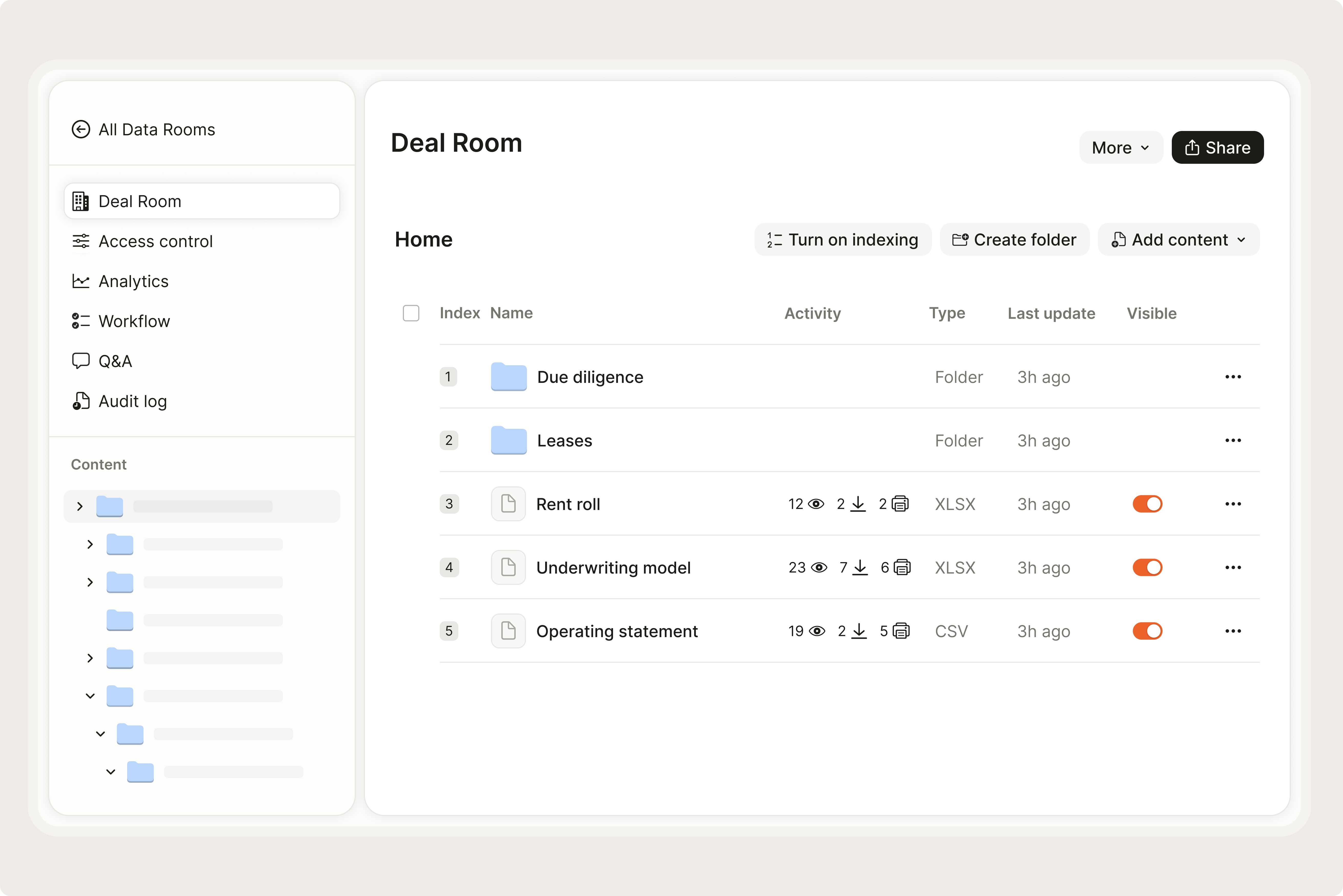
- 1.Upload Wisconsin property files to a secure roomDrop ALTA title commitment, Wisconsin DNR environmental database records, Phase I ESA, shoreland zoning documents, PFAS data, FEMA flood maps, and lease pack into Ellty.
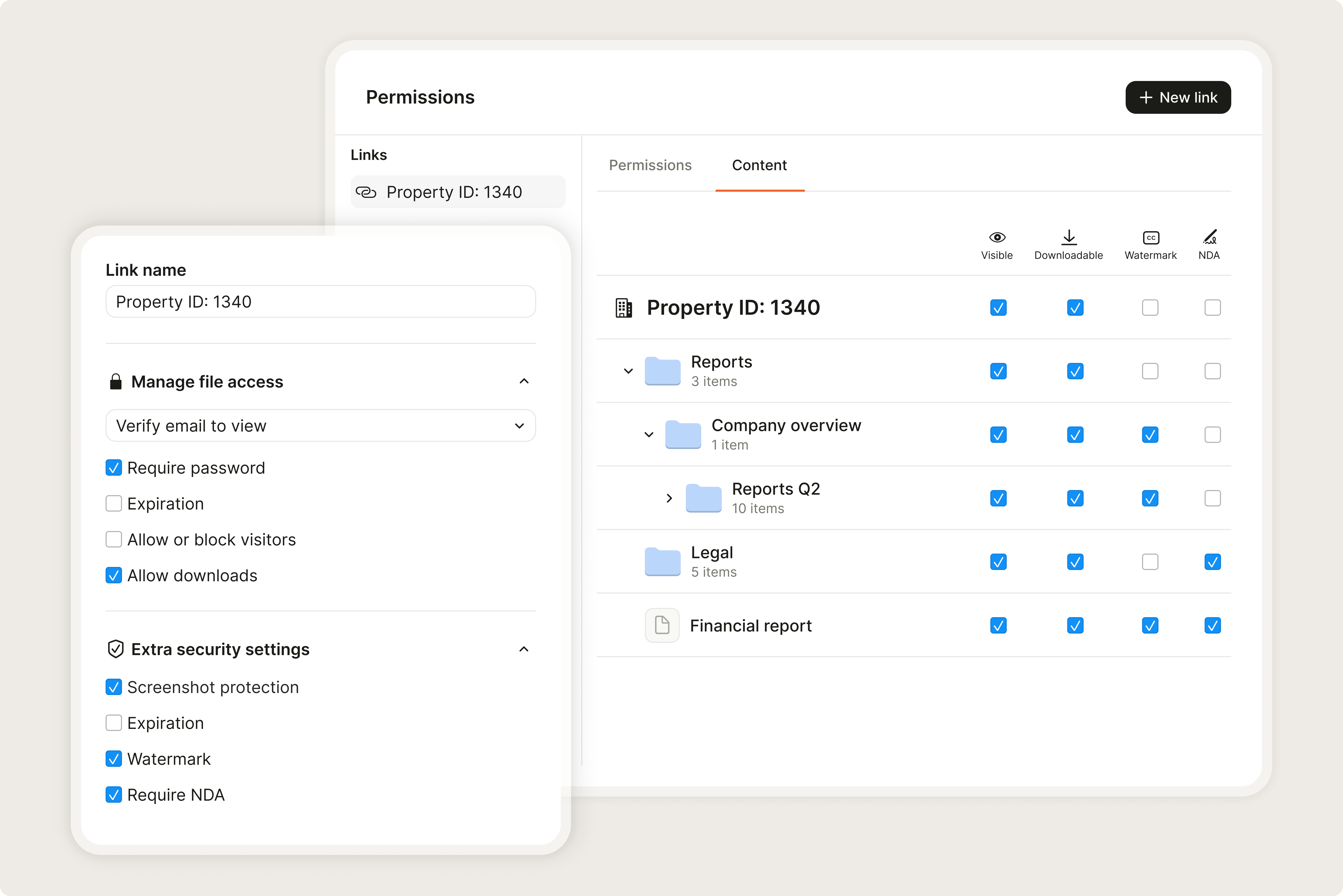
- 2.Give each advisor a scoped, tracked linkWisconsin attorney or title company sees title chain. Environmental consultant sees DNR records and Phase I. Shoreland zoning specialist sees county ordinance and OHWM records. Lender sees valuation and lease abstracts.
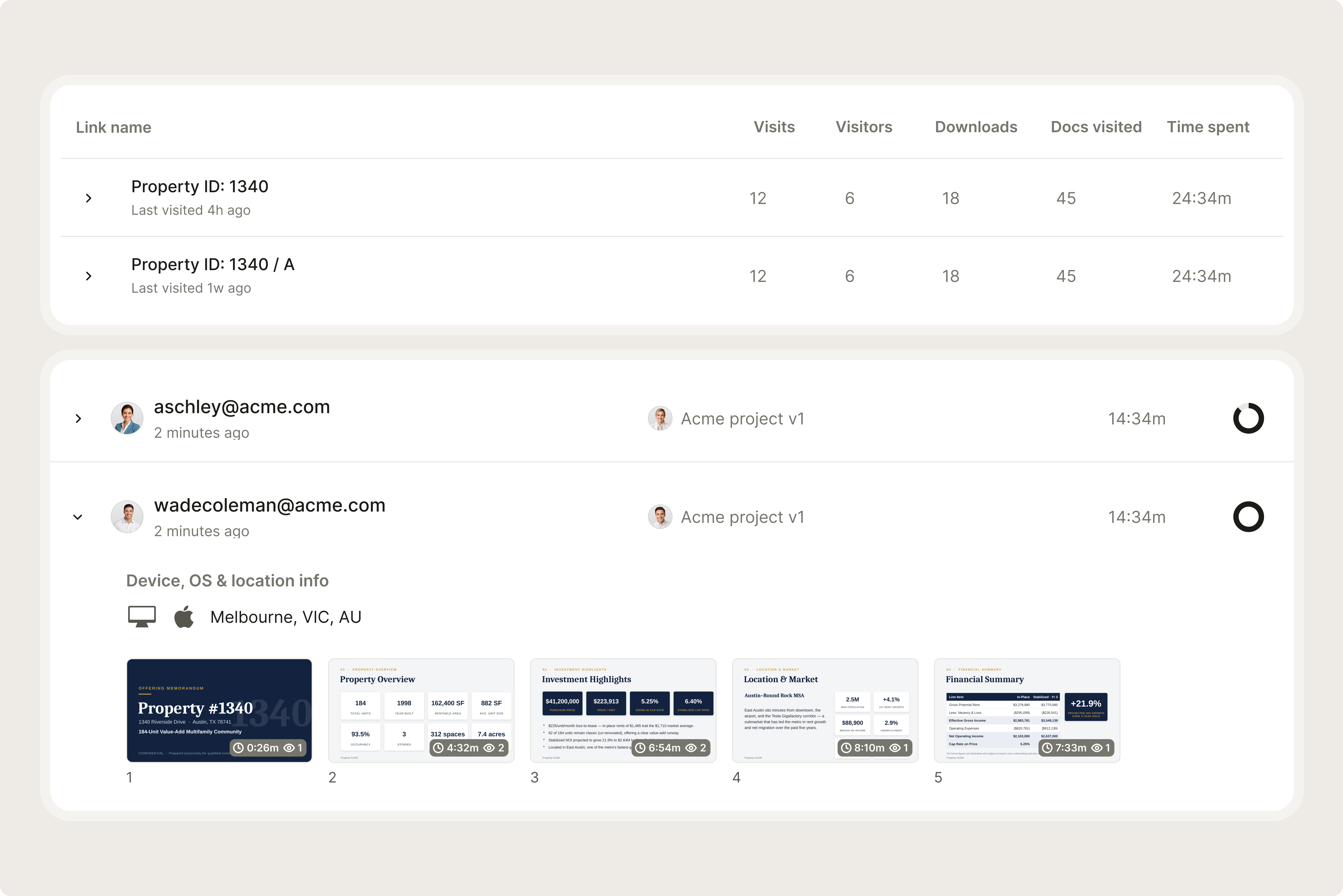
- 3.Monitor who reviews which documentsSee exactly which files each advisor opened and when. Catch shoreland compliance gaps or PFAS scope expansion before the formal reports arrive.
What makes Wisconsin different
Wisconsin's shoreland zoning program is the due diligence item that out-of-state buyers most consistently underestimate. Wisconsin has over 15,000 named lakes and a network of navigable rivers; the shoreland zone (1,000 feet from navigable lakes, 300 feet from navigable rivers) covers an enormous proportion of the commercial real estate in northern Wisconsin resort communities, lakefront commercial in Madison and Milwaukee suburbs, and river-corridor commercial across the state. The setback requirements, impervious surface limits, and vegetative buffer requirements can significantly constrain what's buildable or expandable on a Wisconsin waterfront commercial parcel. Confirm shoreland zoning status before pricing any Wisconsin commercial property with water adjacency.
Tyco Marinette's PFAS contamination is Wisconsin's most geographically concentrated commercial real estate PFAS risk. Unlike military base PFAS plumes that are relatively bounded, Tyco's manufacturing and testing activities created PFAS contamination that entered municipal and private water supplies in the Marinette and Peshtigo area. Wisconsin DNR has been active in monitoring and response; any commercial property in Marinette County with private water supply requires PFAS well testing before closing.
Milwaukee's brownfield opportunity is real and actively being redeveloped. The Menomonee River Valley, the former Pabst and Schlitz brewery sites, the Harbor District, and the 30th Street Industrial Corridor are all active Milwaukee brownfield redevelopment zones. Wisconsin's combination of DNR-administered environmental remediation, PECFA petroleum cleanup fund reimbursements, and local Tax Increment Financing (TIF) has made Milwaukee brownfield deals financially viable. The key is engaging Wisconsin environmental and brownfield finance consultants who know the specific programs and TIF history for each parcel.
Wisconsin's transfer fee at 0.3% of consideration (seller-paid) is among the lowest in the Great Lakes region. Michigan's transfer tax runs 0.86%; Illinois real estate transfer taxes run higher; Ohio's conveyance fee is comparable. Wisconsin buyers face very low transfer tax burden, making Wisconsin commercial acquisitions less expensive at the transaction level than most surrounding states.
Wisconsin's Shoreland Zoning Program (Wis. Admin. Code NR 115) establishes minimum standards for county shoreland zoning ordinances applicable to all unincorporated areas within 1,000 feet of the ordinary high water mark (OHWM) of navigable lakes, ponds, or flowages, and within 300 feet of navigable rivers and streams. Under NR 115, minimum setback requirements, impervious surface limits, and vegetative buffer requirements apply to all commercial development within the shoreland zone. County shoreland zoning ordinances must meet or exceed NR 115 minimum standards; counties may adopt more restrictive standards. For incorporated municipalities (cities and villages), shoreland zoning is administered by the municipality, which may have its own shoreland provisions. Non-conforming shoreland structures and uses have limited expansion rights under NR 115 and applicable county ordinances.
Timeline and cost in Wisconsin
Weeks 1-2 cover kickoff: ALTA title commitment order, shoreland zone confirmation and county shoreland zoning ordinance review, Wisconsin DNR Environmental Remediation database search, PECFA database search, Phase I ESA commission, PFAS screening assessment, FEMA flood zone check, zoning confirmation, and lease abstraction initiation. Legal and advisory fees in this phase run USD 4,000-12,000.
Load all files into Ellty before advisors engage. Wisconsin commercial deals can move on 30-60 day timelines for standard assets; shoreland zoning review or PFAS testing add 2-5 weeks.
Weeks 2-4 cover deep review: Phase I ESA delivery, shoreland compliance analysis, PFAS well results (if commissioned), Wisconsin DNR brownfield case status, county floodplain zoning, lease abstraction, and insurance quotes. Costs in this phase: USD 8,000-25,000.
Weeks 4-8 handle resolution: Phase II ESA (if triggered), OHWM determination (if needed for shoreland), PLL insurance binding (if required), Wisconsin DNR case closure confirmation, title exception clearance, and closing.
Wisconsin total acquisition costs for buyers: ALTA title insurance + legal/advisory fees + environmental. Seller pays the 0.3% transfer fee. Buyer total acquisition cost typically runs 0.5-1.5% of purchase price, one of the lowest in the Great Lakes region.
Running a Wisconsin property deal from one room
Hold ALTA title, Wisconsin DNR records, shoreland zoning compliance, and lease files in one secure, tracked Ellty data room.
Start free 14-day trialCommon questions about due diligence on Wisconsin commercial property
- Wisconsin commercial deals for standard assets typically take 30-60 days. Shoreland zoning review adds 1-2 weeks if OHWM determination is needed. PFAS well testing (if required) takes 3-5 weeks for lab results. For Milwaukee brownfield commercial requiring Phase II ESA and Wisconsin DNR case review: allow 60-90 days. Wisconsin DNR environmental remediation case closure can take months depending on contamination scope.
- Wisconsin shoreland zoning (Wis. Admin. Code NR 115) applies to commercial development in unincorporated areas within 1,000 feet of navigable lakes or 300 feet of navigable rivers. It requires minimum setbacks from the ordinary high water mark (OHWM), limits impervious surface, and mandates vegetative buffers. Existing commercial structures that don't meet current standards may have non-conforming status with limited expansion rights. For any Wisconsin commercial property near a navigable waterbody: confirm shoreland zone status, OHWM determination, and compliance for existing structures before bidding.
- Tyco International and related companies manufactured AFFF (aqueous film-forming foam) containing PFAS compounds at a facility in Marinette, Wisconsin. PFAS from manufacturing operations and testing contaminated groundwater in the Marinette and Peshtigo areas of Marinette County, affecting both public and private water supplies. Wisconsin DNR has been actively monitoring and responding to the contamination. Commercial properties in Marinette County with private well water require PFAS testing before closing. Wisconsin has adopted PFAS standards for groundwater under Wis. Admin. Code NR 140.
- Wisconsin's Real Estate Transfer Fee is $3 per $1,000 of consideration (0.3% of purchase price), paid by the seller. The fee is reported via the Wisconsin Real Estate Transfer Return (RETR form) filed at the county register of deeds at recording. There is no additional buyer's transfer tax and no Wisconsin mortgage recording tax. On a $5M Wisconsin commercial deal, the seller pays $15,000 in transfer fees. Wisconsin's transfer fee is among the lowest in the Great Lakes region.
- No. Wisconsin does not legally require an attorney to supervise commercial real estate closings. Wisconsin title companies can and do close commercial transactions without attorney oversight. However, Wisconsin real estate attorneys are commonly involved in complex commercial deals for contract review, title examination, and closing supervision. Engaging Wisconsin real estate counsel is advisable for commercial transactions involving environmental issues, shoreland zoning, or complex title questions.
- Milwaukee has significant industrial contamination legacy from tanneries, foundries, machine shops, and brewing operations. Active brownfield redevelopment zones include the Menomonee River Valley, Harbor District, and 30th Street Industrial Corridor. Wisconsin DNR administers brownfield remediation under the NR 700 series; PECFA covers petroleum UST cleanup reimbursements; local TIF programs fund brownfield redevelopment costs. For Milwaukee brownfield commercial acquisitions: check Wisconsin DNR Environmental Remediation database and PECFA records; commission Phase II ESA; engage a Wisconsin brownfield finance consultant to assess TIF and PECFA cost recovery.