Virginia commercial property due diligence has two structural issues that trip up buyers from other states: the Chesapeake Bay Preservation Act (CBPA) creates waterfront development restrictions in 16 Tidewater localities, and Virginia is a strict Dillon's Rule state - meaning localities can only do what the General Assembly expressly authorizes, which makes zoning and special exception analysis harder to shortcut.
Virginia's transfer taxes are among the lowest in the US for commercial buyers: the state recordation tax runs 0.25% of purchase price (paid by buyer) and the grantor's tax runs 0.10% (paid by seller). Most localities add a local recordation tax of roughly one-third of the state rate. Total buyer acquisition transfer costs typically land below 0.40% - a material difference from states like New York, Pennsylvania, or Maryland.
Northern Virginia (NoVA) is defined by federal government and defense contracting; Loudoun County's Ashburn corridor is the world's largest data center market by concentration. Hampton Roads is the largest defense military complex in the world and a major logistics hub. Both markets operate with specialized demand drivers that affect commercial zoning, use permissions, and operating cost structures that out-of-state buyers regularly underestimate.
Virginia uses deeds of trust (not mortgages) for financing; title examination runs through the circuit court land records in the county or independent city where the property is located. Virginia has 38 independent cities - treated as separate jurisdictions from the surrounding counties - which affects which circuit court and local tax authority governs the property.
Set up a Virginia due diligence data room before advisors are engaged. Load ALTA title commitment, VDEQ VRP records, CBPA documentation, Phase I ESA, VDOT access records, and lease files before the buyer's request list lands.
Where Virginia property deals go wrong
Not every check carries the same weight. The table below sorts risks by deal impact - dealbreakers first, then what moves the price, then basic hygiene - so your Virginia attorney and environmental consultant know what to clear first.
| Area | Documents to pull | VA red flag | Matters most for | Tier | |
|---|---|---|---|---|---|
| Title - circuit court land records | Title - circuit court land records | ALTA owner's title commitment, circuit court deed book search, ALTA/NSPS survey, UCC fixture search at VA SCC | VA property records are kept at the circuit court of the city or county where the property is located; Virginia has 38 independent cities treated as separate jurisdictions from surrounding counties - Fairfax City is separate from Fairfax County; confirm you're searching the correct jurisdiction before ordering title | All buyers | Dealbreaker |
| Zoning - Dillon's Rule localities | Zoning - Dillon's Rule localities | Local zoning ordinance, special use permit or special exception approval, site plan, proffer agreement, BZA decisions | Virginia is a strict Dillon's Rule state: local governments have only powers expressly granted by the General Assembly; zoning authority is constrained and localities cannot adopt zoning conditions beyond those permitted by the VA Code; proffers (conditions offered by applicants) and special use permits are common in NoVA commercial deals; confirm proffered conditions recorded in the zoning approval travel with the land | NoVA commercial, mixed-use development | Dealbreaker |
| Chesapeake Bay Preservation Act - Tidewater VA | Chesapeake Bay Preservation Act - Tidewater VA | CBPA designation maps, RPA/RMA delineation, local CBPA ordinance, variance records, DEQ CBPA review | The Chesapeake Bay Preservation Act (Va. Code § 62.1-44.15:67 et seq.) applies to 16 Tidewater Virginia localities including Virginia Beach, Norfolk, Chesapeake, Hampton, Newport News, Portsmouth, and Poquoson; CBPA designates Resource Protection Areas (RPAs) - 100-foot vegetated buffers from tidal wetlands and streams where nearly all development is prohibited - and Resource Management Areas (RMAs); commercial development near any waterway in Tidewater VA requires CBPA analysis | Hampton Roads commercial, Tidewater VA waterfront | Dealbreaker |
| Environmental - VDEQ VRP and brownfields | Environmental - VDEQ VRP and brownfields | Phase I ESA (ASTM E1527-21), VDEQ VRP database, VDEQ Underground Storage Tank database, Superfund NPL, RCRA database | Virginia's Voluntary Remediation Program (VRP) through VDEQ provides a Certificate of Completion with prospective purchaser protection for brownfield buyers who complete cleanup; search VDEQ's online databases (RAPIDS) before bidding on any VA industrial or former petroleum site; NoVA has significant petroleum and dry-cleaning contamination from commercial strip development | Former industrial, NoVA retail/strip commercial | Dealbreaker |
| VDOT access and right-of-way | VDOT access and right-of-way | VDOT access permit records, secondary road maintenance agreements, VDOT land use permit, site distance study | VDOT (Virginia Department of Transportation) maintains and controls secondary roads in most VA localities - unlike most states where local governments control local roads; access to commercial property from VDOT-maintained roads requires VDOT access permits; changes to commercial access, additional curb cuts, or driveway modifications during redevelopment all need VDOT approval; confirm current access permits are valid for intended use | All commercial, industrial, retail | Price-adjuster |
| Hampton Roads flooding and sea level rise | Hampton Roads flooding and sea level rise | FEMA FIRM, NOAA sea level rise projections, Army Corps Hampton Roads study, post-event flood records, tidal gauge data | Hampton Roads is one of the fastest sea level rise zones in the US due to a combination of ocean rise and land subsidence (groundwater extraction legacy); Norfolk, Virginia Beach, and Portsmouth commercial areas experience chronic tidal flooding (nuisance flooding) as well as major storm surge events; commercial buyers in Hampton Roads should pull NOAA tidal gauge data and Army Corps flood risk studies, not just FEMA FIRMs | Hampton Roads, Norfolk, Virginia Beach commercial | Price-adjuster |
| Leases and tenancies | Leases and tenancies | All commercial leases, rent roll, tenant estoppel certificates, SNDA agreements, lease assignment consents | NoVA government/federal tenants (GSA-leased space) have specific assignment and subletting restrictions; defense contractor tenants in Arlington, Fairfax, and Loudoun counties may have SCIF build-out (classified facility) that affects alterations and releases; confirm lease assignment consent requirements for any existing government or cleared-contractor tenants | NoVA office, government-leased space | Price-adjuster |
| Transfer taxes and recordation | Transfer taxes and recordation | State recordation tax calculation, local recordation tax (1/3 of state), grantor tax, deed of trust tax | VA state recordation tax: $0.25 per $100 (0.25%) paid by buyer; VA grantor's tax: $0.50 per $500 of consideration (0.10%) paid by seller; most VA localities add a local recordation tax of approximately one-third of the state rate (~0.083%); deed of trust recording tax also applies to the loan amount; total commercial buyer cost typically runs 0.33-0.40% - one of the lowest in the mid-Atlantic | All buyers | Standard check |
| Military overlay zones - NoVA and Hampton Roads | Military overlay zones - NoVA and Hampton Roads | AICUZ (Air Installation Compatible Use Zone) maps, JLUS (Joint Land Use Study) records, BRAC adjustment records, noise contour maps | Virginia has one of the largest military footprints in the US; commercial properties near Quantico, Fort Belvoir, Pentagon/DCA, Naval Station Norfolk, Naval Air Station Oceana, Langley AFB, and Fort Gregg-Adams may fall in AICUZ noise contour zones or accident potential zones that restrict commercial density or use; NAS Oceana has specifically shaped Virginia Beach commercial development through AICUZ restrictions | NoVA, Hampton Roads commercial near installations | Standard check |
| Insurance and building condition | Insurance and building condition | Property condition assessment (ASTM E2018), roof/HVAC/MEP reports, flood insurance (NFIP or private), wind/named storm coverage | Hampton Roads commercial properties face both hurricane wind risk and tidal flooding risk; confirm flood insurance (NFIP or private) is available and at what premium for Hampton Roads coastal commercial; NoVA commercial should confirm HVAC capacity if data center or high-density office conversion is planned (Loudoun County power infrastructure is deep but specific campuses vary) | Hampton Roads coastal, NoVA data center conversion | Standard check |
| Seller KYC and AML | Seller KYC and AML | VA SCC entity records, UBO identification, FinCEN GTO compliance, OFAC screen | NoVA commercial (especially Tysons, Reston, and Arlington submarkets) attracts significant institutional and international capital; FinCEN GTOs apply to all-cash purchases above threshold in DC metro; run OFAC and sanctions screens on all principals | All deals | Standard check |
Due diligence on a Virginia property?
Set up your Ellty data room before diligence starts.
Start free 14-day trialVirginia commercial property due diligence checklist
The table ranked risks by severity. This is the full list to work through, grouped by area.
Title - circuit court land records
- Order the ALTA owner's title commitment on day one from a VA-licensed title insurer
- Virginia's 38 independent cities: VA has 38 independent cities (Arlington, Alexandria, Fairfax City, Norfolk, Virginia Beach, Chesapeake, Richmond, etc.) that are entirely separate political and judicial jurisdictions from surrounding counties; the circuit court, tax authority, and recording office for a Fairfax City property is entirely separate from Fairfax County; confirm the correct jurisdiction before ordering title or sending any document requests
- Title search: VA title examination runs through the circuit court deed books (deeds, deeds of trust, lis pendens, mechanics' liens); VA title companies and attorneys examine chains of title at the circuit court
- Deeds of trust: Virginia uses deeds of trust (not mortgages) for all financing; existing deeds of trust must be released at or before closing; confirm payoff and release obligations with the title insurer
- Virginia curative statutes: VA has curative statutes that extinguish certain types of old claims after statutory periods; your title attorney should confirm any boundary, easement, or old deed of trust issues against the curative statutes before marking them as exceptions
- UCC fixtures: search VA State Corporation Commission (SCC) UCC database for fixture filings against the commercial parcel; in NoVA data center deals, equipment fixture filings can be complex
- Commission ALTA/NSPS survey for all significant VA commercial acquisitions
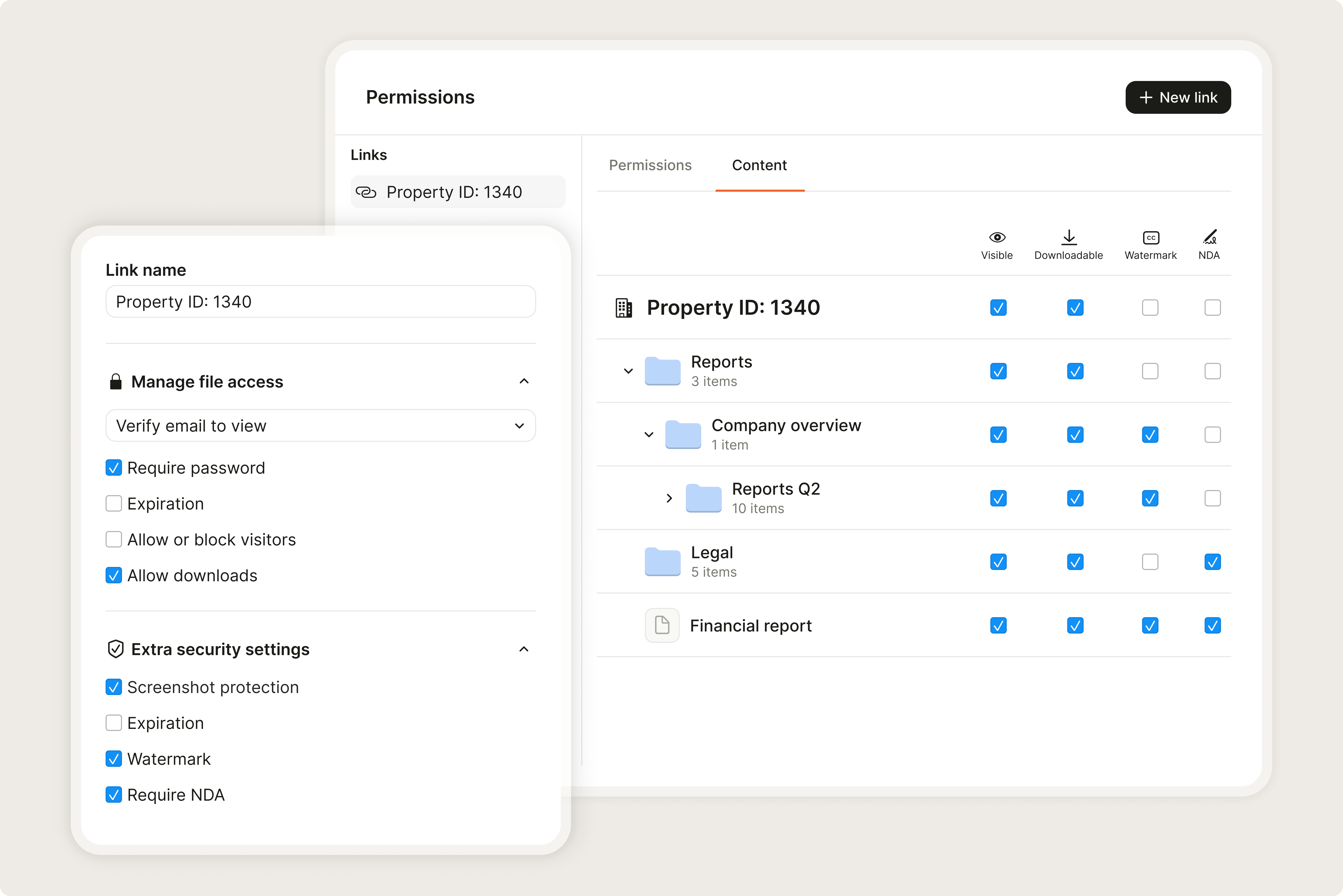
Give each advisor a scoped link in Ellty. VA attorney sees title chain and circuit court records. Environmental consultant sees VDEQ records and Phase I/II. CBPA specialist sees waterfront delineation and compliance records. Lender sees clean title and valuation.
Zoning - Dillon's Rule and proffers
- Confirm the zoning classification from the applicable city or county planning department; in Virginia each independent city and county has its own zoning ordinance
- Dillon's Rule jurisdiction: Virginia localities derive zoning authority strictly from the General Assembly; this limits creative local conditions and means some zoning interpretations require checking state enabling statutes, not just local ordinances
- Proffers: in NoVA and many urban Virginia localities, zoning approvals for commercial development come with proffers - conditions offered by the applicant and accepted by the governing body that become binding conditions on the land; proffers run with the land and bind successors; review all proffers carefully for cash contribution requirements, use restrictions, and development timing obligations
- Special use permits (SUPs): many Northern Virginia commercial uses (data centers, auto dealers, car washes, drive-throughs) require SUPs; confirm any existing SUP is current, transferable, and covers the intended use
- By-right vs. SUP: confirm whether the intended commercial use is by-right under current zoning or requires a new SUP; SUP approval in Fairfax County, for example, typically requires a 6-12 month public hearing process
Chesapeake Bay Preservation Act - Tidewater localities
- Determine whether the property is in a CBPA-subject locality (16 Tidewater Virginia jurisdictions); if yes, commission a CBPA buffer delineation as part of the Phase I scope or separately before contract
- Resource Protection Areas (RPAs): under CBPA, a minimum 100-foot vegetated buffer is required from tidal wetlands, tidal shores, and perennial streams in Tidewater VA; nearly all development, land disturbance, or impervious surface within the RPA is prohibited except for water-dependent uses; an RPA that bisects your development footprint is a dealbreaker or requires costly variance
- Resource Management Areas (RMAs): commercial development in RMAs is permitted but subject to stormwater and best management practice (BMP) requirements beyond standard state requirements
- CBPA compliance records: obtain any existing CBPA buffer delineation reports, variance approvals, and prior stormwater plan approvals from the local planning department
- Non-Tidewater CBPA counties: some inland Virginia localities near the Chesapeake Bay watershed have voluntarily adopted CBPA-like buffer requirements; confirm whether any basin-level buffer ordinance applies even if the locality is not a formal CBPA jurisdiction
Track which advisor is reviewing CBPA and environmental records in Ellty. If the CBPA specialist is revisiting the RPA delineation maps multiple times, they're building a variance or setback argument - know before the formal report lands.
Environmental - VDEQ VRP and brownfields
- Commission Phase I ESA meeting ASTM E1527-21; use a VA DEQ-familiar environmental professional for any Hampton Roads or Northern Virginia industrial or former-petroleum site
- VDEQ Voluntary Remediation Program (VRP): Virginia's VRP (Va. Code § 10.1-1232) is the brownfield liability protection mechanism; a buyer who completes cleanup under VRP and receives a VDEQ Certificate of Completion gets prospective purchaser protection from VDEQ for the remediated contamination; search VDEQ's RAPIDS online database for any VRP or prior cleanup records at the property address
- VDEQ RAPIDS database: publicly searchable for UST records, VRP sites, aboveground storage tanks, and other VDEQ regulatory programs; run it for every VA commercial property before bidding
- Northern Virginia petroleum contamination: the NoVA commercial strip from the 1960s-1990s left significant underground storage tank (UST) contamination at former gas stations, dry cleaners, and industrial uses; NoVA Phase II ESA is a routine lender requirement for any property with industrial or former-petroleum use history
- Hampton Roads industrial: Norfolk, Portsmouth, and Newport News have significant heavy industrial and shipbuilding contamination legacy; the Norfolk Naval Shipyard and surrounding private shipbuilding facilities have documented soil and groundwater contamination from petroleum, solvents, and metal finishing operations
VDOT access and secondary road issues
- Confirm all existing commercial access points are covered by current, valid VDOT access permits if the property fronts a VDOT-maintained road; secondary roads (Route numbers) in Virginia are generally VDOT-maintained, unlike most states where local governments maintain local roads
- VDOT land use permit: any new access point, curb cut, or driveway modification on a VDOT road requires a land use permit; permits can be denied or conditioned; confirm access permit validity for the intended commercial use
- Sight distance: VDOT requires commercial access to meet minimum sight distance requirements for the road speed limit; existing low-speed commercial access may not meet sight distance for higher-intensity redevelopment; commission a sight distance study for any significant commercial redevelopment
- Secondary road maintenance: in some rural Virginia localities, subdivision streets and commercial access roads may not have been formally accepted into the VDOT secondary road system; unaccepted private roads create ongoing maintenance obligations and potential access easement issues
Hampton Roads flooding and sea level rise
- Pull FEMA FIRMs for all Hampton Roads commercial properties; confirm flood zone, BFE, and LOMA or LOMR history
- Sea level rise and subsidence: Hampton Roads is experiencing sea level rise at approximately 4-5mm per year - approximately twice the global average - due to a combination of ocean rise and ongoing land subsidence from groundwater extraction; this compounds flood risk for commercial properties well beyond what FEMA FIRMs currently capture
- Nuisance flooding: Norfolk and Virginia Beach commercial areas in low-lying areas now experience routine tidal flooding (sunny day flooding) several times per year even without storm events; confirm the frequency and depth of nuisance flooding for any Hampton Roads commercial near tidal waterways
- Army Corps study: the Army Corps Norfolk Coastal Storm Risk Management Study is ongoing; confirm current status and any planned flood risk infrastructure that may affect property access or development constraints
- Commercial flood insurance: NFIP commercial flood insurance premiums in Hampton Roads have increased significantly under FEMA's Risk Rating 2.0; confirm flood insurance availability and current premium for any Hampton Roads coastal commercial before finalizing deal economics
Load all Hampton Roads flood documentation, CBPA records, VDEQ environmental files, and VDOT access permits into Ellty. Environmental, legal, and flood engineering advisors each get a scoped, tracked link. Monitor what gets reviewed most closely - repeated access to CBPA RPA maps or flood elevation certificates signals where the price adjustment will come.
Military overlay zones
- Identify whether the property is within an Air Installation Compatible Use Zone (AICUZ) for any Virginia military installation; AICUZ maps are published by the installation and are publicly available
- NAS Oceana Virginia Beach: NAS Oceana (Virginia Beach) has one of the most actively enforced AICUZ programs in the US; the City of Virginia Beach has adopted AICUZ-compatible zoning to protect flight operations; commercial development in Oceana's accident potential zones or high noise contour zones is restricted; confirm AICUZ compliance before any Virginia Beach commercial development near the flight patterns
- NoVA installations: Pentagon, Fort Belvoir, Quantico, and Davison Army Airfield each have AICUZ or compatible use zones; Northern Virginia commercial development near these installations should check Joint Land Use Study (JLUS) recommendations
- BRAC history: Virginia has several former BRAC-affected installations; confirm property is not on or near former BRAC property with environmental deed restrictions or federal reversionary interests
Transfer tax - state recordation, grantor tax, and deed of trust
- VA State Recordation Tax: $0.25 per $100 of purchase price (0.25%), paid by buyer, collected at circuit court clerk recording
- VA Grantor's Tax: $0.50 per $500 of consideration (0.10%), paid by seller; some localities assess an additional local grantor's tax
- Local Recordation Tax: most VA localities add approximately one-third of the state recordation rate (~$0.0833 per $100); confirm the specific local rate for the city or county
- Deed of Trust Tax: VA charges $0.10 per $100 on the face amount of any deed of trust (loan amount); this is separate from the purchase price recordation tax and is paid by the borrower; for significant commercial loans, the deed of trust tax is a material closing cost
- Total buyer commercial cost: state + local recordation + deed of trust tax typically runs 0.33-0.40% of purchase price for cash deals; with financing, add the deed of trust tax on the loan amount
- No exemption for related-party transfers: confirm VA recordation tax exemptions available for corporate reorganizations and related-entity transfers with VA tax counsel before assuming an exemption applies
Compare North Carolina's commercial property due diligence process when running mid-Atlantic coastal portfolio acquisitions. VA and NC share military installation AICUZ concerns and coastal flooding risk, but differ significantly on brownfield programs (VA VRP vs. NC Brownfields), transfer taxes (VA's 0.25% recordation vs. NC's tiered excise tax on deed value), and coastal buffer regulations (VA CBPA in Tidewater vs. NC CAMA coastal area management).
How due diligence works in Virginia
Step 1 - Title, jurisdiction, and zoning
Day one: identify whether the property is in an independent city or a county - this determines the circuit court for title, the tax authority, and the planning department for zoning. Order the ALTA title commitment immediately.
Simultaneously: confirm zoning classification and pull any proffered conditions or SUPs attached to the property. In NoVA, proffer review is often as important as the title chain for understanding development constraints.
Step 2 - Environmental, CBPA, and VDOT
For Tidewater VA: commission CBPA buffer delineation immediately - RPA determination is a go/no-go decision for development feasibility.
Search VDEQ RAPIDS for environmental records. Commission Phase I ESA with VA-specific databases. For Hampton Roads or NoVA former industrial: Phase II ESA is the commercial lender baseline.
Confirm VDOT access permit validity for current and intended use. For any commercial redevelopment: commission sight distance study before assuming existing access is adequate.
Step 3 - Flood risk, military overlay, and leases
Pull FEMA FIRMs. For Hampton Roads: add NOAA tidal gauge data and Army Corps study review - FEMA maps alone understate Hampton Roads flood risk given ongoing subsidence.
Check AICUZ maps for proximity to Virginia military installations. Abstract all leases; for NoVA government-tenant space, review assignment and subletting restrictions carefully.
Load all documents into Ellty. Each advisor gets a scoped, tracked link. The environmental consultant gets VDEQ records and Phase I. The CBPA specialist gets RPA delineation maps. The flood engineer gets FEMA FIRMs and NOAA data. Monitor who reviews what.
Step 4 - Transfer taxes and closing
Calculate recordation tax, grantor tax, local recordation, and deed of trust tax (if financing). VA commercial closings are handled by title companies or attorneys; no statutory attorney requirement.
Standard VA commercial diligence runs 45-60 days. Hampton Roads coastal with CBPA, flood engineering, and AICUZ review adds 2-4 weeks. NoVA SUP or proffer analysis adds time if rezoning is needed.
How to set up your Virginia data room in Ellty.
VA commercial deals involve ALTA title, VDEQ VRP records, CBPA documentation, VDOT access permits, Hampton Roads flood engineering, military AICUZ review, and lease abstraction. Load everything into Ellty before advisors engage.
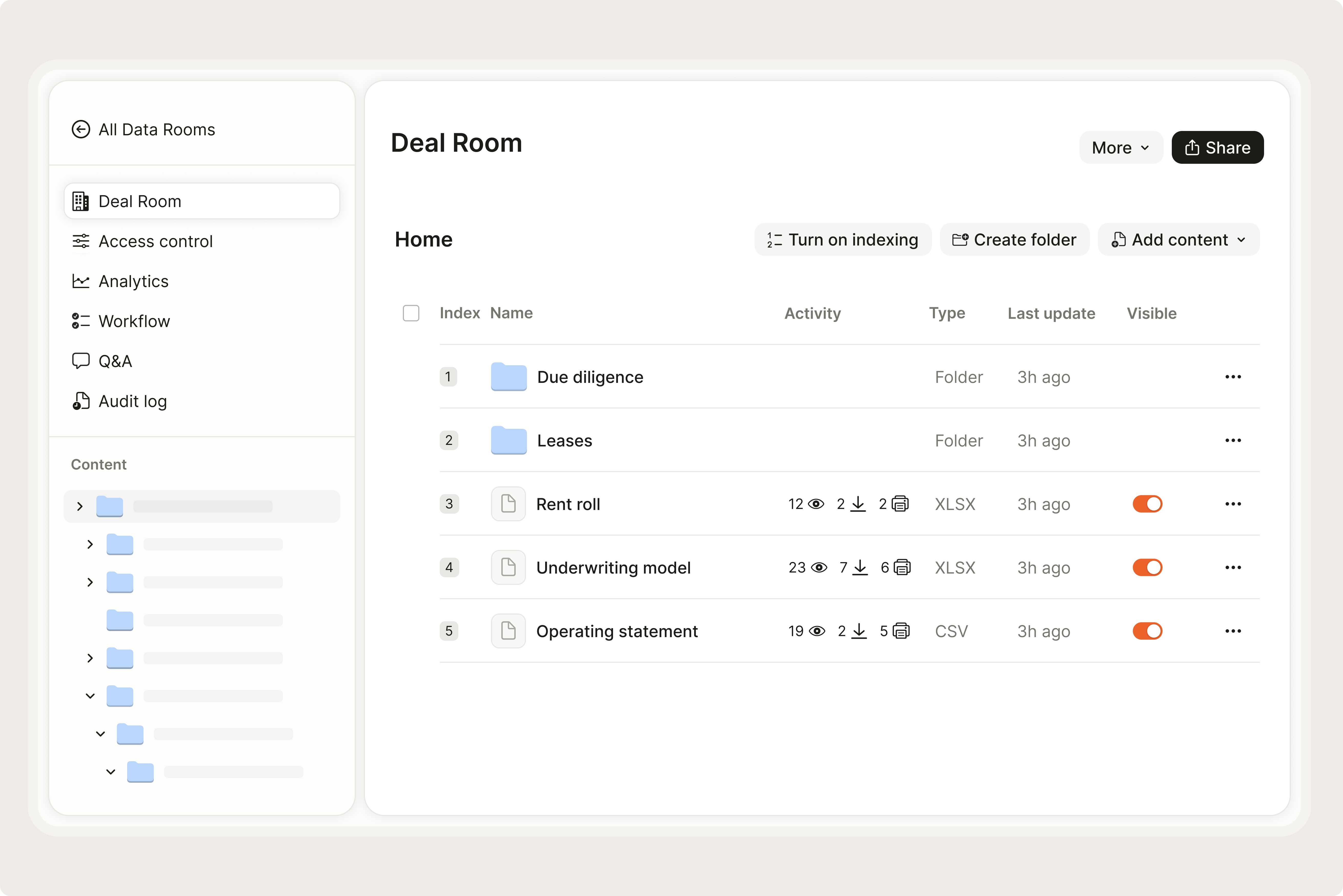
- 1.Upload Virginia property files to a secure roomDrop ALTA title commitment, VDEQ RAPIDS records, Phase I ESA, CBPA buffer delineation, VDOT access permits, FEMA FIRMs, AICUZ maps, and lease pack into Ellty.
- 2.Give each advisor a scoped, tracked linkVA attorney sees title chain and circuit court records. Environmental consultant sees VDEQ records and Phase I/II. CBPA specialist sees waterfront delineation. Flood engineer sees FEMA and NOAA data. Lender sees VRP certificate and valuation.
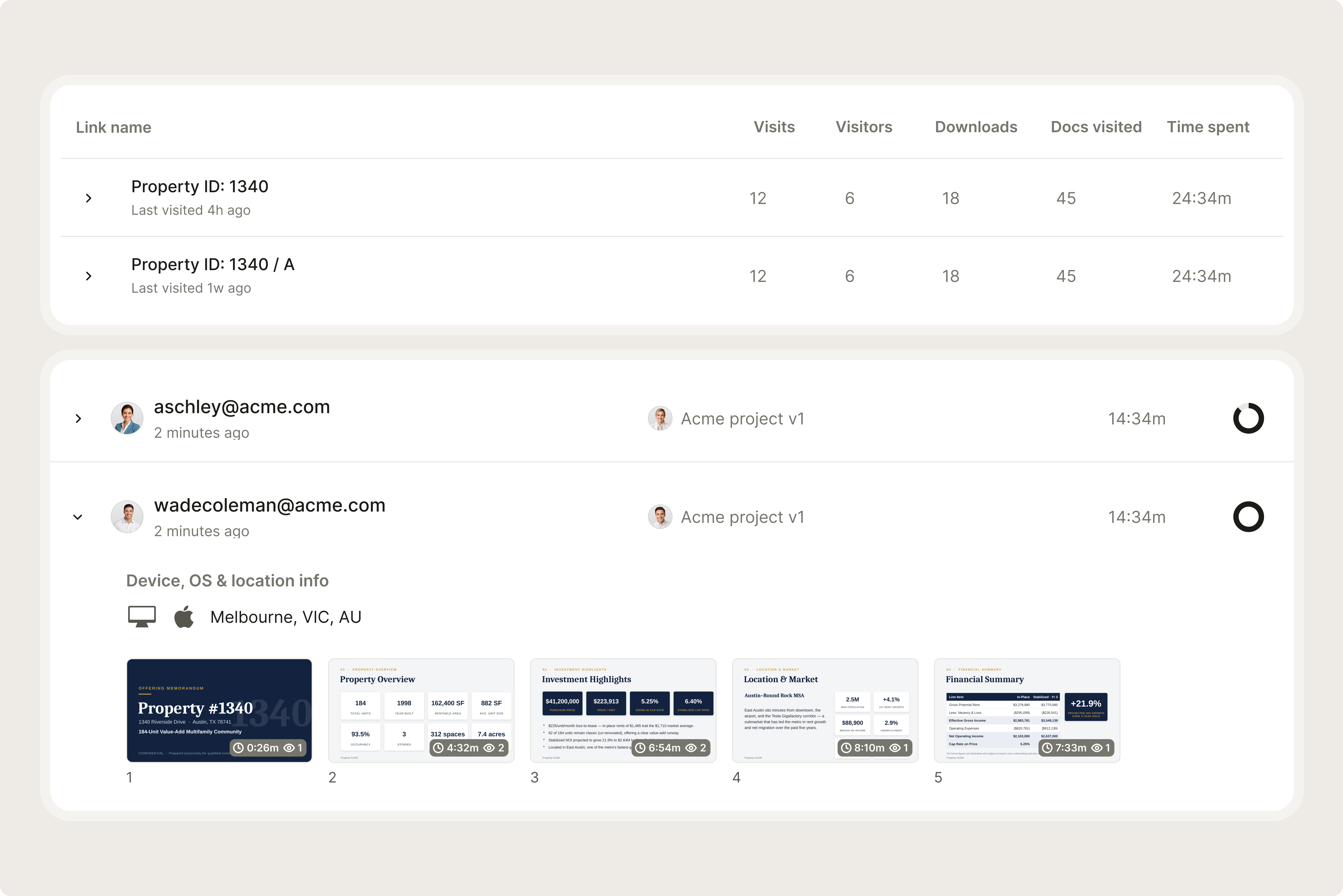
- 3.Monitor who reviews which documentsSee exactly which files each advisor opened and when. Catch CBPA RPA conflicts or VDOT access issues before they derail closing.
What makes Virginia different
Dillon's Rule is not abstract constitutional theory for Virginia commercial buyers - it shapes every zoning and special use permit analysis. Because Virginia localities can only exercise powers expressly granted by the General Assembly, you can't assume that a county can grant a use variance, waive a setback, or negotiate a creative condition the way localities in home-rule states can. Proffer agreements (conditions offered by the applicant and accepted by the governing body) have become the NoVA mechanism for negotiating development flexibility, and proffers run with the land - binding every successor owner. Before buying any NoVA commercial asset with a rezoning or SUP history: pull all proffered conditions from the zoning approval record and confirm none restrict the intended use, impose cash contribution obligations, or require development timing that conflicts with your hold period.
The Chesapeake Bay Preservation Act's Resource Protection Area (RPA) rule is one of the most restrictive development buffers in the mid-Atlantic: a minimum 100-foot no-disturbance buffer from tidal wetlands, tidal shores, and perennial streams, applicable in all 16 Tidewater Virginia localities. There is no as-of-right development in the RPA except for water-dependent uses; variances are difficult and fact-specific. An RPA that cuts across the development envelope of a Tidewater commercial parcel can eliminate the project's feasibility without any environmental liability - it's a straight zoning and land use constraint. Commission the CBPA buffer delineation before spending money on Phase I or engineering; if the RPA location kills the development program, nothing else matters.
Hampton Roads sea level rise is not a future risk - it's a current operating condition for commercial property. Norfolk, Virginia Beach, and Portsmouth commercial areas in low-lying locations flood routinely during high tides and moderate rain events, not just major hurricanes. FEMA FIRMs, while useful, are not calibrated to the subsidence-accelerated rise rate Hampton Roads is experiencing; a property that shows minimal FEMA flood risk may still flood regularly under current conditions. The Army Corps Norfolk study and NOAA tidal gauge data provide a more accurate current risk picture. Hampton Roads commercial buyers should model flood insurance premium trajectory (FEMA Risk Rating 2.0 has significantly increased Hampton Roads premiums) and physical adaptation costs alongside cap rate and NOI analysis.
The Chesapeake Bay Preservation Act (Va. Code § 62.1-44.15:67 et seq.) requires all localities in Tidewater Virginia to adopt local ordinances establishing Resource Protection Areas (RPAs) and Resource Management Areas (RMAs). RPAs are the most restrictive designation: a minimum 100-foot vegetated buffer is required from tidal wetlands, tidal shores, and perennial streams, within which land disturbance, impervious surface, and most structures are prohibited. Commercial development within or encroaching on an RPA requires a variance from the local board of zoning appeals, which must find that no reasonable use of the property exists outside the RPA and that the development will not cause net increase in nonpoint source pollution. VDEQ provides technical guidance to localities on CBPA implementation and reviews local programs periodically. The CBPA applies in 16 Tidewater localities including all Hampton Roads cities and several Northern Neck and Eastern Shore counties.
Timeline and cost in Virginia
Weeks 1-2 cover kickoff: ALTA title commitment order, independent city/county jurisdiction confirmation, VDEQ RAPIDS search, CBPA buffer delineation commission (Tidewater VA), Phase I ESA commission, VDOT access permit review, FEMA flood zone check, AICUZ military overlay review, zoning confirmation and proffer review, and lease abstraction initiation. Legal fees in this phase: USD 5,000-15,000.
Load all files into Ellty before advisors engage. Standard VA commercial: 45-60 days. Hampton Roads coastal with CBPA, flood engineering, and AICUZ: 60-90 days.
Weeks 2-5 cover deep review: Phase I ESA delivery, VDEQ VRP status confirmation, CBPA RPA delineation delivery, VDOT access permit validity confirmation, sight distance study (if redevelopment), flood risk analysis, proffer and SUP review, AICUZ compliance confirmation, lease abstraction, and insurance quotes. Costs in this phase: USD 10,000-30,000.
Weeks 5-10 handle resolution: Phase II ESA (if triggered), VRP enrollment and remediation planning (if brownfield acquisition), CBPA variance (if RPA encroachment), VDOT access permit modification (if needed), title exception clearance, and closing preparation.
Virginia total buyer acquisition costs: state recordation tax (0.25%) + local recordation (~0.083%) + deed of trust tax (0.10% of loan amount) + ALTA title insurance + legal/advisory + environmental. Total buyer transfer cost runs 0.33-0.40% for cash deals in most VA localities - one of the lowest commercial transfer tax burdens in the mid-Atlantic.
Running a Virginia property deal from one room
Hold ALTA title, VDEQ records, CBPA docs, VDOT access permits, and lease files in one secure, tracked Ellty data room.
Start free 14-day trialCommon questions about due diligence on Virginia commercial property
- Standard Virginia commercial deals take 45-60 days. Hampton Roads coastal commercial requiring CBPA buffer delineation, flood engineering review, and AICUZ military overlay analysis typically runs 60-90 days. Northern Virginia deals with proffer review, SUP confirmation, and VDOT access analysis add 2-4 weeks if rezoning history is complex. NoVA brownfield deals requiring VDEQ VRP enrollment and cleanup: add 12-24 months for VRP certificate.
- Virginia is a strict Dillon's Rule state: local governments have only the powers expressly granted to them by the General Assembly. This means VA localities cannot impose zoning conditions beyond what state law permits. In practice, this makes NoVA commercial zoning analysis more complex - proffers (conditions offered by applicants) have become the primary mechanism for negotiating development flexibility, and all proffer conditions run with the land and bind successors. Review all proffered conditions from zoning approvals before buying any Virginia commercial asset with a rezoning or SUP history.
- The CBPA (Va. Code § 62.1-44.15:67 et seq.) applies to 16 Tidewater Virginia localities including Virginia Beach, Norfolk, Chesapeake, Hampton, Newport News, Portsmouth, Poquoson, and several counties. It requires localities to designate Resource Protection Areas (RPAs) - minimum 100-foot no-disturbance buffers from tidal wetlands and perennial streams - where nearly all development is prohibited. Commercial development in or encroaching on an RPA requires a variance. Commission a CBPA buffer delineation before bidding on any Tidewater VA commercial property with waterfront proximity.
- Hampton Roads is experiencing sea level rise at approximately 4-5mm per year - roughly twice the global average - due to a combination of ocean rise and ongoing land subsidence from historical groundwater extraction. Commercial properties in Norfolk, Virginia Beach, and Portsmouth now experience routine nuisance flooding (tidal flooding without storm events) several times per year. FEMA FIRMs understate the current risk because they're not calibrated to Hampton Roads' subsidence rate. NOAA tidal gauge data and the Army Corps Norfolk study provide a more accurate current flood risk picture for commercial buyers.
- Virginia state recordation tax: $0.25 per $100 of purchase price (0.25%), paid by buyer. Virginia grantor's tax: $0.50 per $500 of consideration (0.10%), paid by seller. Most localities add approximately one-third of the state recordation rate (~0.083%). Deed of trust (mortgage equivalent) recording tax: $0.10 per $100 of loan amount, paid by borrower. Total buyer transfer cost for commercial cash deals runs approximately 0.33-0.40% - significantly lower than neighboring Maryland, DC, or New York.
- No. Virginia does not legally require an attorney to supervise commercial real estate closings. Licensed title companies can handle VA commercial transactions without mandatory attorney involvement. However, for complex commercial deals involving Dillon's Rule zoning analysis, CBPA compliance, VDEQ VRP brownfield clearance, proffer review, or significant government-tenant leases in NoVA, engaging a Virginia real estate attorney is advisable and effectively standard practice for institutional transactions.