North Carolina commercial property has three checks that rarely appear together in a single state: CAMA (Coastal Area Management Act) permits for the 20-county coastal zone, GenX PFAS contamination in the Cape Fear River basin from Chemours Fayetteville Works, and the 2024 Hurricane Helene flood damage zone in western NC that has permanently changed flood risk underwriting for Asheville and Buncombe County commercial real estate.
North Carolina requires an attorney for all real estate closings - it's one of the stricter attorney-state requirements in the Southeast. Your NC real estate attorney handles the closing and title opinion; a title insurer issues ALTA coverage based on the attorney's title examination. The attorney requirement applies to commercial as well as residential transactions.
NC's excise tax on conveyances (deed stamps) is $2 per $500 of consideration (0.4% of purchase price), paid by the seller. Buyers pay the deed of trust stamp tax on the loan at $0.35 per $100 of principal (0.35%). Total transfer tax exposure on a financed NC commercial deal runs approximately 0.75% split between buyer and seller, with seller paying the larger share.
North Carolina's commercial real estate markets in 2026 span two distinct profiles. The Charlotte-Raleigh-Durham corridor (Bank of America and Truist Financial HQs in Charlotte; Research Triangle Park with IBM, Lenovo, Cisco, Biogen) runs hot with limited industrial and office vacancy. Asheville and western NC remain in 2024 Hurricane Helene recovery; commercial market activity in Buncombe County is significantly affected by flood damage assessment and reconstruction timelines.
Set up an Ellty data room before diligence opens. Load ALTA title commitment, NC DEQ environmental records, CAMA permits, Phase I ESA, and lease files before advisors arrive.
Where NC property deals go wrong
Not every check carries the same weight. The table below sorts risks by deal impact - dealbreakers first, then what moves the price, then basic hygiene - so your NC attorney and technical advisor know what to clear first.
| Area | Documents to pull | NC red flag | Matters most for | Tier | |
|---|---|---|---|---|---|
| Title - register of deeds and attorney exam | Title - register of deeds and attorney exam | ALTA owner's title commitment, attorney title examination, NC county register of deeds search, ALTA/NSPS survey | NC property records are at the county register of deeds; NC requires a licensed attorney to examine title and issue a title opinion before ALTA title insurance is issued; deed of trust (not mortgage) is the standard NC lien instrument; confirm no deed of trust discharge gaps | All buyers | Dealbreaker |
| CAMA coastal permits - 20-county zone | CAMA coastal permits - 20-county zone | NC Division of Coastal Management (NC DCM) CAMA major and minor permit history, AEC mapping, CAMA setback confirmation | NC CAMA applies to 20 coastal counties; any commercial development in an Area of Environmental Concern (AEC) requires a CAMA major permit; unpermitted development, expired CAMA permits, or CAMA setback violations create title and lending problems that block commercial transactions | Coastal commercial, beach commercial, marina, coastal industrial | Dealbreaker |
| Hurricane Helene flood - western NC | Hurricane Helene flood - western NC | Post-Helene FEMA individual assistance records, Buncombe County flood damage assessment, updated FEMA FIRM, Phase I ESA for debris-contaminated sites | Hurricane Helene (September 2024) caused catastrophic flooding in Buncombe County (Asheville), Yancey, Mitchell, McDowell, Rutherford, and Haywood counties; commercial properties in affected areas may have flood damage, altered flood maps, contamination from debris, or substantially changed insurance terms | Western NC commercial, Asheville metro | Dealbreaker |
| PFAS - Chemours GenX and Cape Fear basin | PFAS - Chemours GenX and Cape Fear basin | EPA PFAS site locator, NC DEQ PFAS database, Chemours Fayetteville Works contamination plume records, well water PFAS testing | Chemours Fayetteville Works (Bladen County) released GenX PFAS compounds into the Cape Fear River; the plume affects drinking water supplies in the Cape Fear basin including portions of Bladen, Cumberland, Pender, New Hanover, and Brunswick counties; any commercial property with private well water in the Cape Fear basin requires PFAS testing | Cape Fear basin commercial, Wilmington area, well-water sites | Dealbreaker |
| Coal ash - Duke Energy sites | Coal ash - Duke Energy sites | NC DEQ coal ash database, EPA coal combustion residuals site records, Phase I ESA for utility-adjacent commercial | Duke Energy operates or has closed multiple coal ash impoundments in NC (Belews Creek, Roxboro, Asheville, Marshall, Mayo, Sutton plants); the 2014 Dan River coal ash spill (Eden, NC) demonstrated the contamination risk; commercial properties adjacent to former or active utility plants require Phase I and often Phase II ESA | Former utility site adjacent commercial | Dealbreaker |
| Environmental - textile and CAFO legacy | Environmental - textile and CAFO legacy | Phase I ESA (ASTM E1527-21), NC DEQ Brownfields database, Superfund NPL search, eastern NC CAFO records | NC Piedmont region (Greensboro, Burlington, Burlington, Alamance County area) has textile mill contamination legacy; eastern NC has concentrated hog and poultry CAFO operations with documented groundwater impacts; any commercial property adjacent to CAFOs or former textile sites requires Phase I with NC-specific database searches | Piedmont industrial, eastern NC rural commercial | Price-adjuster |
| Coastal flood risk - eastern NC | Coastal flood risk - eastern NC | FEMA FIRM, NC flood maps, hurricane history records, storm surge modeling for coastal commercial | NC's Outer Banks, Wilmington, and eastern coastal counties face storm surge and flood risk from Atlantic hurricanes; Hurricane Florence (2018) caused catastrophic inland flooding in New Hanover, Pender, and Onslow counties; commercial properties in FEMA SFHAs face mandatory flood insurance for federally backed mortgages | Coastal and eastern NC commercial | Price-adjuster |
| Zoning and deed restrictions | Zoning and deed restrictions | Municipal or county zoning certificate, conditional use permit review, deed restrictions in title chain | NC municipalities and counties each maintain separate zoning codes; NC unincorporated county areas may have zoning or may not (some rural NC counties have limited zoning); deed restrictions from historic subdivisions are common in the Charlotte and Raleigh areas and bind commercial use | All commercial | Price-adjuster |
| Transfer taxes - excise and deed of trust | Transfer taxes - excise and deed of trust | NC excise tax calculation, deed of trust stamp calculation, attorney closing fee, ALTA title insurance premium | NC excise tax is $2 per $500 of consideration (0.4%), paid by seller; deed of trust stamp tax is $0.35 per $100 of principal (0.35%), paid by buyer; both are filed and paid at the county register of deeds at closing; attorney fees for commercial NC closings run $1,500-5,000+ | All buyers | Standard check |
| Insurance - wind and flood | Insurance - wind and flood | NC wind and hail insurance quotes, NFIP flood insurance for SFHA properties, loss run (10 years) | NC coastal commercial properties face wind and hail insurance in the NC Beach Plan (involuntary market) if private carriers decline; western NC commercial properties in Helene-affected counties face changed flood and specialty insurance availability post-2024; model current premium levels before bidding | Coastal and western NC commercial | Standard check |
| Seller KYC and AML | Seller KYC and AML | NC SOS entity filing, UBO identification, FinCEN compliance, OFAC screen | Charlotte's financial sector and Research Triangle's tech concentration attract significant institutional and international capital; FinCEN beneficial ownership rules apply to all-cash commercial purchases above the GTO threshold; run OFAC and sanctions screens on all principals | All deals | Standard check |
Due diligence on a North Carolina property?
Set up your Ellty data room before diligence starts.
Start free 14-day trialNorth Carolina CRE checklist
The table ranked risks by severity. This is the full list to work through, grouped by area.
Title - register of deeds and attorney examination
- Order the ALTA owner's title commitment and engage an NC-licensed real estate attorney for the title examination on day one
- NC property records are maintained at the county register of deeds; title searches run against the county grantor-grantee index; most NC county register of deeds offices have online deed book access, but a local attorney's search is still required for title insurance
- NC uses a deed of trust (not a mortgage) as the standard real property security instrument; confirm all prior deeds of trust have been properly satisfied and released at the register of deeds
- UCC fixture filings: search the NC Secretary of State UCC database for any fixture filings against the property
- ALTA/NSPS survey: required for all significant commercial NC transactions; confirms boundaries, easements, and encroachments
CAMA coastal permits - NC coastal area management act
- For any commercial property in the 20-county CAMA zone (the 20 coastal counties defined by NC CAMA statute): search NC Division of Coastal Management (NC DCM) records for all CAMA major and minor permits issued for the property
- NC CAMA Areas of Environmental Concern (AECs) include: estuarine shorelines, public trust areas, coastal wetlands, ocean hazard areas, and inlet hazard areas; development in any AEC requires a CAMA permit
- Confirm all existing structures have current CAMA permits; unpermitted development in AECs is a violation that must be remediated; confirm no CAMA setback violations exist for any building relative to the mean high water line or vegetation line
- For proposed commercial development in the CAMA zone: engage an NC DCM CAMA consultant early in diligence to assess whether the proposed use requires a CAMA major permit and what the timeline is (CAMA major permits require 75-day public notice periods)
- CAMA permits do not automatically transfer to new owners; confirm the status and transferability of any CAMA permits with NC DCM before closing
Set up each advisor's access in Ellty. NC attorney sees title chain and deed of trust records. Environmental consultant sees NC DEQ and CAMA records. CAMA consultant sees coastal permit history. Lender sees valuation and lease abstracts.
Hurricane Helene flood damage - western NC
- For any commercial property in Buncombe, Yancey, Mitchell, McDowell, Rutherford, Haywood, Madison, or Avery counties: commission a current physical inspection that specifically addresses 2024 Hurricane Helene flood damage
- Hurricane Helene (September 26-27, 2024) caused record-breaking flooding in western NC; the French Broad River in Asheville crested at levels far exceeding FEMA 500-year flood levels in some locations; entire commercial districts in Asheville, Marshall, and other Buncombe/Madison County communities were flooded
- For commercial properties in Helene-affected areas: request building damage assessment records (from NC Emergency Management or FEMA individual assistance records); confirm whether any demolition orders, condemnation notices, or building condemnation tags were issued
- Phase I ESA for Helene-affected properties: flood events can mobilize buried contamination; a post-Helene Phase I should address any debris field contamination, mobilized underground storage tanks, and agricultural or industrial contamination that may have been displaced by the flood
- Confirm flood insurance availability, premium, and any FEMA map revisions post-Helene for the specific parcel; FEMA has been revising flood maps in western NC following Helene
PFAS - Chemours Fayetteville Works and Cape Fear basin
- Search NC DEQ's PFAS database and EPA's PFAS contamination site locator for the property location
- Chemours Fayetteville Works (Fayetteville, NC, Bladen County): Chemours (formerly DuPont) operated a chemical manufacturing plant that discharged GenX PFAS compounds into the Cape Fear River for decades; the contamination affects Cape Fear River-basin drinking water supplies
- Cape Fear basin PFAS geographic scope: public water systems drawing from the Cape Fear River in Bladen, Robeson, Cumberland, Sampson, Harnett, Lee, Chatham, Moore, Hoke, Scotland, Richmond, Anson, Union, and Montgomery counties have been affected
- For any commercial property with private well water in the Cape Fear basin: commission PFAS well water testing before contract; North Carolina has adopted PFAS maximum contaminant levels (MCLs) for drinking water that apply to private wells under some NC DEQ programs
- For commercial properties adjacent to or downstream of Chemours Fayetteville Works in Bladen County: Phase II soil and groundwater investigation for PFAS is warranted
Coal ash - Duke Energy utility sites
- Search NC DEQ's coal combustion residuals database and EPA's coal ash site records for any coal ash impoundments on or adjacent to the commercial property
- Duke Energy has operated coal-fired power plants with coal ash storage at multiple NC locations: Belews Creek (Forsyth County), Roxboro (Person County), Asheville (Buncombe County), Marshall (Catawba County), Mayo (Person County), and Sutton (New Hanover County near Wilmington), among others
- The 2014 Dan River coal ash spill (Eden, NC) released 39,000 tons of coal ash into the Dan River; it is the benchmark event for NC coal ash liability and contamination potential
- For any commercial property within a half-mile of a former or active Duke Energy coal-fired plant: Phase I ESA with coal ash contamination focus, groundwater direction analysis, and review of NC DEQ enforcement records is standard practice
Environmental - textile and CAFO legacy
- Commission Phase I ESA meeting ASTM E1527-21 from an NC DEQ-familiar environmental professional
- NC Piedmont textile legacy: Burlington, Alamance County, and the surrounding Piedmont counties have textile mill contamination from decades of textile manufacturing (solvents, dyes, metals); commercial property in former mill buildings or adjacent to mill sites in Burlington, Graham, Mebane, and similar Piedmont communities requires Phase I and possibly Phase II ESA
- Eastern NC concentrated animal feeding operations (CAFOs): eastern NC has the highest concentration of hog and poultry CAFOs in the US; documented groundwater contamination from lagoon overflows and land application affects rural commercial properties in Duplin, Sampson, Bladen, Wayne, and Onslow counties
- Search NC DEQ Brownfields Program records for any Brownfields Agreement covering the property; NC's Brownfields program provides prospective purchaser protections (liability relief) for eligible properties
Track all document access in Ellty. If the environmental consultant accesses the NC DEQ PFAS records and the Chemours plume maps repeatedly, the Phase II scope is broadening before the formal report.
Coastal flood risk - eastern NC
- Pull FEMA FIRMs for the property's flood zone; NC coastal and eastern counties have extensive SFHA (Special Flood Hazard Area) designations
- Hurricane Florence (2018): caused catastrophic flooding in New Hanover, Pender, Onslow, Duplin, Lenoir, Greene, Jones, and Craven counties; FEMA maps have been updated in some areas but not all post-Florence; review both current FEMA maps and post-Florence flood event records
- For commercial properties on barrier islands (Outer Banks communities, Oak Island, Bald Head Island, Atlantic Beach): confirm CAMA permit status, FEMA V-Zone (velocity wave action zone) designation, and wind and flood insurance availability; V-Zone commercial properties face dramatically higher insurance costs
- NC Beach Plan: the NC Beach Plan (FAIR Plan equivalent for coastal insurance) provides wind and hail coverage of last resort for coastal properties where private carriers decline; confirm whether the target property is currently insured through the Beach Plan and at what premium
Zoning and deed restrictions
- Confirm the zoning designation from the city, town, or county planning department
- For Charlotte metro area commercial: Mecklenburg County and Charlotte maintain separate zoning codes; confirm which jurisdiction applies; Charlotte's zoning is administered through the Charlotte-Mecklenburg Planning Department
- For Research Triangle area commercial: Wake County, Durham County, and the cities of Raleigh, Durham, Chapel Hill maintain separate zoning codes; Triangle commercial zoning is complex with significant mixed-use overlay zones
- Deed restrictions: older Charlotte and Raleigh subdivisions recorded private deed restrictions that run with the land and can restrict commercial use; the attorney's title examination should flag any deed restrictions that limit commercial use
Compare South Carolina's commercial property diligence process when running Southeast corridor acquisitions. NC and SC share attorney state closings, Southeast hurricane flood risk, and similar transfer tax structures (SC's deed recording fee is $3.70 per $500 = 0.74% vs. NC's seller-paid $2 per $500 = 0.4%). Key NC differences: CAMA coastal permits have no equivalent in SC's coastal regulatory framework; NC's GenX PFAS contamination in the Cape Fear basin is geographically and legally distinct from any SC environmental issue; Hurricane Helene 2024 western NC damage has no SC equivalent.
Transfer taxes - excise and deed of trust stamp
- Calculate NC excise tax at $2 per $500 of consideration (0.4%); paid by seller; recorded on the deed at the register of deeds
- Calculate deed of trust stamp tax at $0.35 per $100 of the principal amount of each deed of trust (0.35%); paid by buyer at closing
- Attorney fees for NC commercial closings: typically $1,500-5,000+ for mid-market commercial transactions; confirm attorney fee estimate early
- No additional county transfer tax in most NC counties; confirm with local register of deeds
Insurance - wind, flood, and post-Helene
- Wind and hail insurance for coastal NC commercial: confirm whether private carrier coverage is available; if not, NC Beach Plan (NCIUA) provides last-resort coverage at higher premiums; Beach Plan coverage availability and premium should be confirmed before bidding on coastal commercial properties
- Flood insurance: for eastern NC commercial in FEMA SFHAs: NFIP coverage is available; private flood insurance is increasingly available for commercial properties; model both NFIP and private flood premiums
- Western NC (post-Helene): for commercial properties in Helene-affected counties: obtain flood and property insurance quotes before bidding; post-Helene insurance availability and premiums in western NC have changed materially from pre-2024 levels
Leases - NC commercial terms
- Abstract every commercial lease for base rent, operating expense structure, renewal options, and termination rights
- For Charlotte financial district commercial: review anchor tenant credit quality; financial sector tenant concentration (bank and insurance company tenants) creates credit risk correlated with sector performance
- For Research Triangle Park or RTP-adjacent commercial: review biotech and pharma tenant lease terms; RTP commercial leases often include specialized lab and R&D facility provisions including hazardous materials handling, special ventilation, and utility supply provisions that affect buildout and operating costs
Load all lease files into Ellty. Lender sees rent roll and lease abstracts. Environmental consultant sees Phase I and NC DEQ records. NC attorney sees title chain and CAMA documents. Track exactly who reviews what and when.
How due diligence works in North Carolina
Step 1 - Title and CAMA
Day one: engage NC real estate attorney for title examination and order ALTA title commitment. For coastal county properties simultaneously: pull NC DCM CAMA permit history. Both the attorney's title exam and the CAMA permit review run on a similar 2-3 week timeline.
For non-coastal NC commercial: CAMA is not applicable. The attorney title examination, ALTA title commitment, and UCC search cover the title workstream.
Step 2 - Environmental: Helene, PFAS, and coal ash
For western NC commercial: commission post-Helene physical inspection and damage assessment before Phase I ESA. The Phase I for Helene-affected properties needs to specifically address flood-mobilized contamination risk.
For Cape Fear basin commercial with private wells: commission PFAS water testing alongside Phase I ESA. PFAS well testing takes 3-5 weeks for lab results.
For utility-adjacent commercial near former Duke Energy coal plant sites: Phase I with coal ash focus. NC DEQ coal ash database search is publicly available.
Step 3 - Coastal and flood risk
Pull FEMA FIRMs. For coastal counties: also confirm CAMA AEC mapping and CAMA setback compliance for existing structures. For western NC: obtain post-Helene flood event records from NC Emergency Management alongside FEMA maps.
Load all Phase I, NC DEQ records, CAMA permits, FEMA maps, and Helene damage assessment files into Ellty. Environmental consultant, CAMA specialist, and lender each get a separate scoped link. Track who reviews what before the formal reports arrive.
Step 4 - Zoning, leases, and insurance
Confirm zoning from the relevant city or county planning department. For Charlotte-Mecklenburg: use Charlotte-Mecklenburg Planning Department. For the Triangle: separate searches for Wake, Durham, and Orange counties and the relevant municipalities.
Abstract all leases. For coastal commercial: obtain wind and hail insurance quotes alongside the lease review. Know the insurance cost structure before committing.
Step 5 - Closing with attorney
NC attorney handles closing, prepares closing documents, and ensures all instruments are recorded at the county register of deeds. NC excise tax (seller) and deed of trust stamp tax (buyer) are calculated and paid at closing. NC commercial closings typically run 45-60 days for straightforward assets.
How to set up your North Carolina data room in Ellty.
NC commercial deals involve ALTA title, CAMA permits, NC DEQ environmental records, GenX PFAS screening, post-Helene flood assessment, and lease abstraction. Load everything into Ellty before advisors arrive.
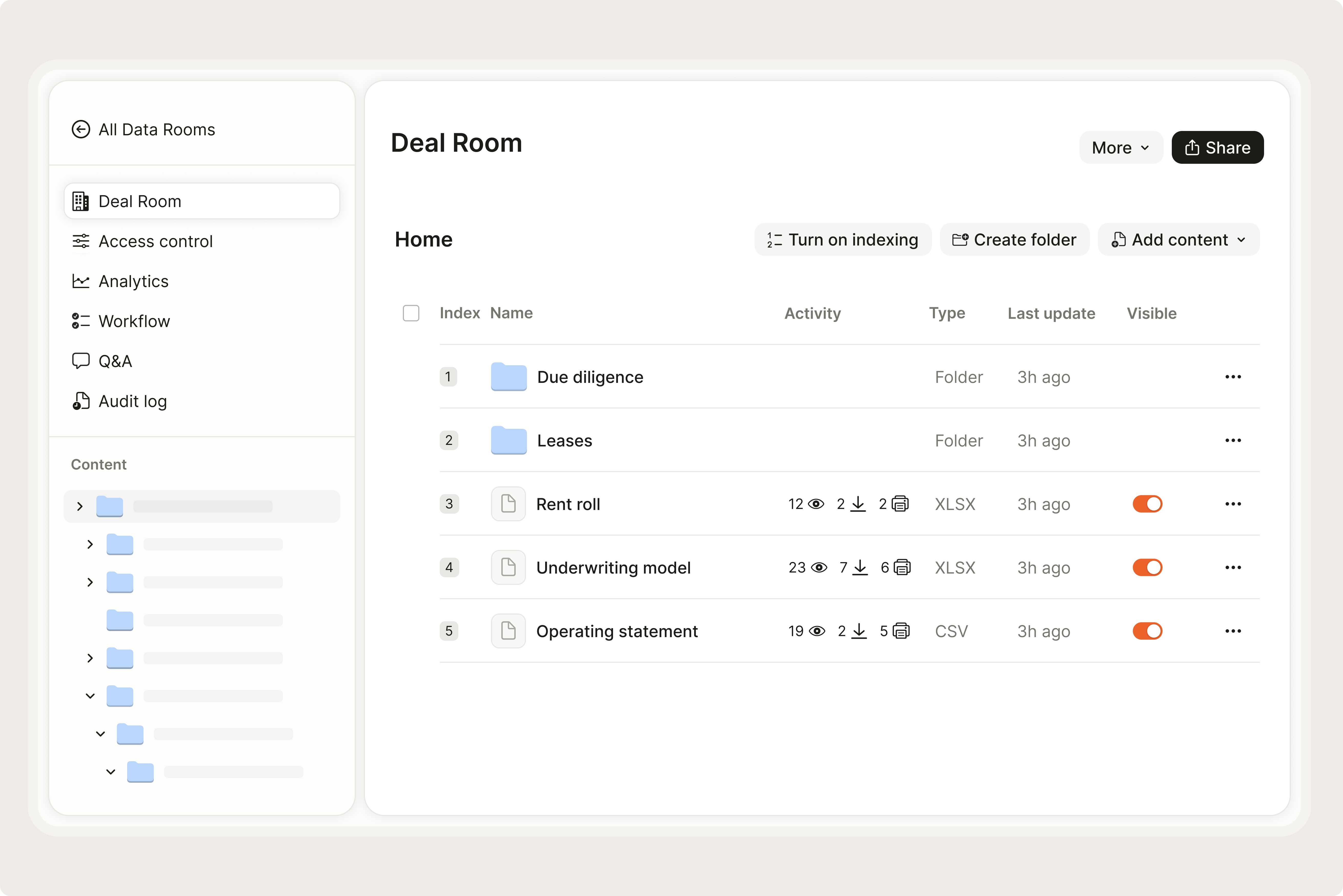
- 1.Upload NC property files to a secure roomDrop ALTA title commitment, CAMA permit history, NC DEQ records, Phase I ESA, FEMA flood maps, post-Helene damage assessment, and lease pack into Ellty.
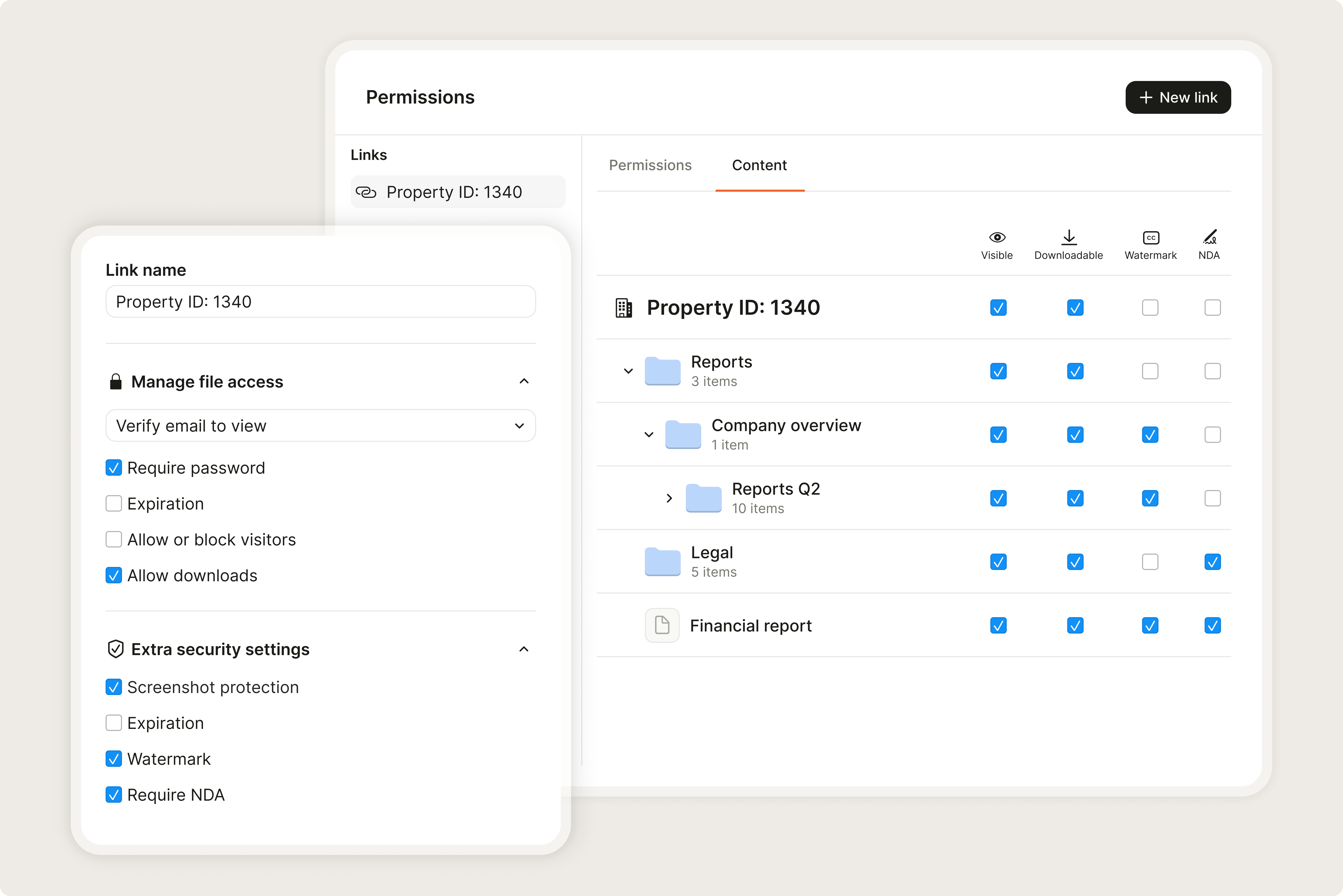
- 2.Give each advisor a scoped, tracked linkNC attorney sees title chain and deed records. Environmental consultant sees NC DEQ, Phase I, and PFAS records. CAMA specialist sees coastal permit history. Lender sees valuation and rent roll.
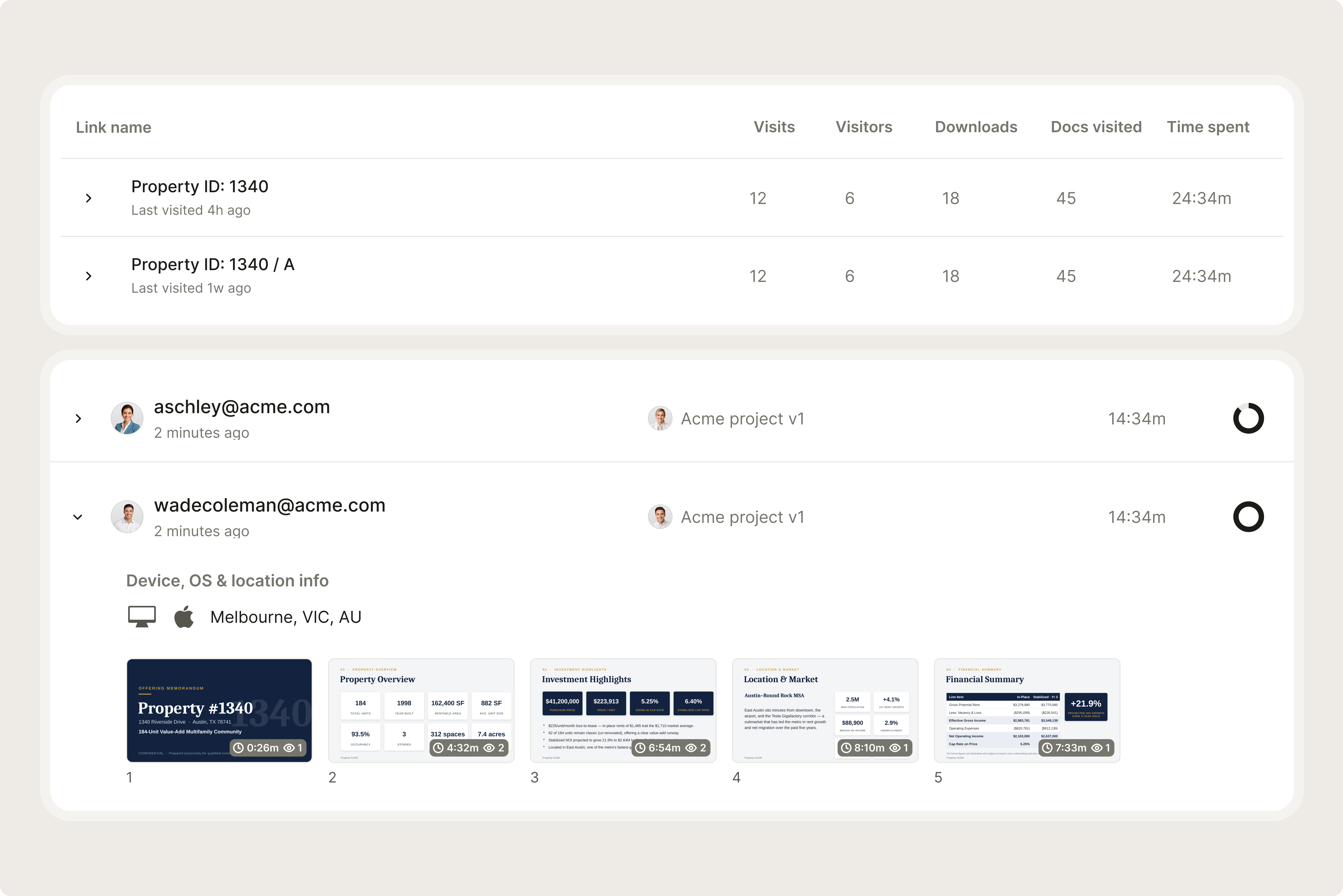
- 3.Monitor who reviews which documentsSee exactly which files each advisor opened and when. Catch CAMA violations or post-Helene damage concerns before they stall the lender's underwriting review.
What makes North Carolina different
CAMA is the regulatory check that makes NC coastal commercial diligence distinct from every other Southeast state. The NC Coastal Area Management Act applies to 20 coastal counties and gives NC's Division of Coastal Management authority to require permits for any development in Areas of Environmental Concern. Unpermitted structures in CAMA AECs are a violation that must be corrected, and CAMA setback violations can require removal of structures that encroach the setback. For coastal NC commercial buyers: the CAMA permit history is not optional diligence, it's the check that determines whether the property can be financed and insured.
Hurricane Helene's 2024 damage to western NC has permanently changed how commercial real estate diligence is conducted in Buncombe and surrounding counties. Before Helene, Asheville commercial real estate was a strong and growing market. After Helene, buyers need to assess not just whether a specific building was damaged, but whether the surrounding commercial infrastructure - roads, utilities, neighboring commercial tenants - has been restored. Post-Helene Asheville commercial deals require a level of physical site investigation and insurance market assessment that simply didn't exist before September 2024.
GenX PFAS from Chemours Fayetteville Works is one of the most geographically specific contamination issues in the US commercial real estate market. Unlike military base PFAS plumes that are relatively localized, the Cape Fear River basin contamination from Chemours affects drinking water over a large geographic area in southeastern NC. For any commercial property in the Cape Fear basin that draws water from a private well: commission PFAS testing before contract. NC has adopted PFAS MCLs that create regulatory obligations; a property with a contaminated well is a material finding.
North Carolina's attorney-state requirement is strictly enforced and cannot be worked around. Unlike states where title companies run commercial closings, NC requires a licensed NC real estate attorney to examine title, issue a title opinion, and handle the closing. This adds a step and a fee that doesn't exist in non-attorney states, but it also means you have an attorney's professional opinion backing the title examination - which is meaningful for complex commercial title with prior easements, deed restrictions, or multiple prior lenders.
The Coastal Area Management Act (CAMA) of 1974 (NC G.S. Chapter 113A) established a system for managing development in North Carolina's 20 coastal counties. Under CAMA, the North Carolina Division of Coastal Management (NC DCM) designates Areas of Environmental Concern (AECs), which include ocean hazard areas, estuarine systems, public trust areas, and inlet hazard areas. Development within AECs requires CAMA major or minor permits, depending on project scope. CAMA major permits require a 75-day public notice period before issuance. CAMA setback requirements establish minimum distances between structures and the first line of stable natural vegetation or mean high water line. Structures that violate CAMA setbacks are subject to enforcement action including removal orders.
Timeline and cost in North Carolina
Weeks 1-2 cover kickoff: NC attorney engagement and ALTA title commitment order, NC DCM CAMA permit history search (coastal), post-Helene physical inspection (western NC), NC DEQ database search, Phase I ESA commission, PFAS screening assessment (Cape Fear basin), FEMA flood zone check, zoning confirmation, and lease abstraction initiation. Legal fees in this phase run USD 5,000-15,000.
Load all files into Ellty before advisors engage. NC commercial deals run 45-60 days for standard assets; post-Helene western NC deals or CAMA-intensive coastal deals may run longer.
Weeks 2-5 cover deep review: Phase I ESA delivery, CAMA permit compliance review, post-Helene damage assessment delivery, PFAS well test results (if commissioned), NC DEQ brownfields check, zoning compliance, lease abstraction, and wind/flood insurance quotes. Costs in this phase: USD 10,000-30,000.
Weeks 5-8 handle resolution: Phase II ESA (if triggered), CAMA violation remediation (if found), Helene damage repair assessment, title exception clearance, and closing preparation.
North Carolina total acquisition costs: NC excise tax (0.4%, seller pays) + deed of trust stamp tax (0.35%, buyer pays) + ALTA title insurance + attorney fee + environmental. Buyer's total acquisition cost runs approximately 1.5-2.5% of purchase price. North Carolina's combined transfer tax burden is moderate by national standards, split between buyer and seller.
Running a North Carolina property deal from one room
Hold ALTA title, CAMA permits, NC DEQ records, and lease files in one secure, tracked Ellty data room.
Start free 14-day trialCommon questions about due diligence on North Carolina commercial property
- NC commercial deals typically take 45-60 days. For coastal commercial properties requiring CAMA permit review: add 2-3 weeks for NC DCM coordination. For post-Hurricane Helene western NC commercial: add time for damage assessment, post-event Phase I ESA, and insurance market assessment. PFAS well testing (if required in Cape Fear basin) takes 3-5 weeks for lab results.
- CAMA (NC Coastal Area Management Act) is a NC statute that gives the NC Division of Coastal Management authority to regulate development in 20 coastal counties. Development within CAMA's designated Areas of Environmental Concern (estuarine shorelines, ocean hazard areas, public trust areas, coastal wetlands) requires CAMA major or minor permits. Structures built without required CAMA permits are violations subject to enforcement orders including removal. For coastal NC commercial buyers: confirming CAMA permit history and setback compliance is non-negotiable diligence before closing.
- Hurricane Helene (September 2024) caused catastrophic flooding in western NC, including Asheville and Buncombe County. Commercial properties in affected areas may have sustained flood damage, face altered FEMA flood maps, have contamination from flood-mobilized debris, or face changed insurance availability. For any commercial acquisition in Buncombe, Yancey, Mitchell, McDowell, Rutherford, Haywood, or Madison counties: commission a post-Helene physical inspection and damage assessment before committing, and confirm current flood and property insurance availability before bidding.
- Chemours Fayetteville Works (Bladen County, NC) discharged GenX PFAS compounds into the Cape Fear River for decades. The contamination has affected drinking water supplies in communities drawing from the Cape Fear River basin, spanning portions of Bladen, Cumberland, Pender, New Hanover, Brunswick, and other southeastern NC counties. For commercial properties with private well water sources in the Cape Fear basin: commission PFAS well water testing before contract. NC has adopted PFAS maximum contaminant levels (MCLs) for drinking water that create regulatory obligations.
- NC imposes two transfer-related taxes: (1) NC excise tax on conveyances: $2 per $500 of consideration (0.4%), paid by the seller and recorded on the deed; (2) NC deed of trust stamp tax: $0.35 per $100 of the principal amount of each deed of trust (0.35%), paid by the buyer at closing. On a $5M commercial deal with a $3.5M loan, seller pays $20,000 in excise tax and buyer pays $12,250 in deed of trust stamp tax. Total NC closing costs for buyers run approximately 1.5-2.5% of purchase price including attorney fees and title insurance.
- Yes. North Carolina is an attorney state: a licensed NC real estate attorney must examine title, issue a title opinion, and handle the closing for all real estate transactions, including commercial. Title companies cannot close NC real estate transactions without attorney involvement. NC real estate attorney fees for commercial closings typically run $1,500-5,000+ depending on transaction complexity. The attorney's title examination is the basis for ALTA title insurance issuance in NC.