Vermont commercial property has one check that exists nowhere else in the US at this scale: Act 250, Vermont's state land use permit law that covers most commercial development above 1 acre and runs with the land in perpetuity. Any existing Act 250 permit, its conditions, and its compliance history must be reviewed before any Vermont commercial acquisition.
Vermont Act 250 (10 V.S.A. Chapter 151) was enacted in 1970 and requires a state-level land use permit for most commercial and industrial development above threshold sizes. The permit is reviewed by a District Environmental Commission against 10 criteria covering traffic, water supply, wastewater, utilities, scenic beauty, historic sites, and conformance with the municipality's plan. Act 250 permits run with the land; the buyer inherits the permit and all its conditions.
PFAS contamination is Vermont's highest-profile environmental issue in 2026. The Bennington and North Bennington area has documented PFAS groundwater contamination from the former ChemFab/Saint-Gobain facility, affecting drinking water wells across a wide area. Vermont has some of the most stringent PFAS drinking water standards in the US. For any commercial property with water well dependency in Bennington County, PFAS testing is required.
Vermont's flood risk was demonstrated catastrophically by Hurricane Irene in 2011, which caused devastating flooding across Washington, Orange, Windsor, Windham, and Addison counties. Vermont's river corridors and floodplains are more flood-prone than FEMA maps alone suggest; Vermont ANR's River Corridor maps provide additional flood risk data beyond FEMA.
Set up an Ellty data room before diligence opens. Load Act 250 permit documents, ANR contaminated site records, FEMA flood maps, and lease files before advisors arrive.
Where Vermont property deals go wrong
Not every check carries the same weight. The table below sorts risks by deal impact - dealbreakers first, then what moves the price, then basic hygiene - so your Vermont attorney and technical advisor know what to clear first.
| Area | Documents to pull | VT red flag | Matters most for | Tier | |
|---|---|---|---|---|---|
| Act 250 permit review | Act 250 permit review | Act 250 permit (all conditions and amendments), NRB permit tracking, Act 250 compliance history | Most Vermont commercial developments above threshold sizes require an Act 250 permit; the permit runs with the land and all conditions bind the buyer; permit violations create enforcement exposure that transfers on closing | All buyers of commercial assets with development permits | Dealbreaker |
| Title - attorney title opinion | Title - attorney title opinion | Vermont attorney title opinion, town land records search, ALTA title commitment, warranty deed chain | Vermont uses town-level land records, not a central state registry; title search is conducted at the town clerk's office; a Vermont licensed attorney must certify title; title insurance is available but not always required for smaller commercial deals | All buyers | Dealbreaker |
| PFAS contamination | PFAS contamination | ANR PFAS site database, well water testing for PFAS compounds, Phase I ESA PFAS addendum | Bennington and North Bennington (Saint-Gobain/ChemFab plume) have documented PFAS groundwater contamination; Vermont has stringent PFAS standards at 20 ppt; any commercial property using well water in Bennington County requires PFAS testing | Bennington County, well-water dependent sites | Dealbreaker |
| Flood risk - Irene corridors | Flood risk - Irene corridors | FEMA Flood Insurance Rate Map, VT ANR River Corridor map, hurricane Irene inundation records | Hurricane Irene (2011) caused catastrophic Vermont river flooding beyond FEMA 100-year floodplain boundaries; VT ANR River Corridor maps show actual flood risk better than FEMA maps for many Vermont river valleys | All river valley commercial assets | Dealbreaker |
| Environmental - ANR VSDB sites | Environmental - ANR VSDB sites | Phase I ESA (ASTM E1527-21), VT ANR Sites Data Base (VSDB), dry cleaning solvent sites, LUST sites | VT ANR's VSDB tracks all known contaminated and potentially contaminated sites; former industrial sites in Barre, Rutland, Burlington, Springfield, and Brattleboro carry significant contamination history | Industrial, brownfield | Price-adjuster |
| Vermont wetlands | Vermont wetlands | Wetland delineation, VT Significant Wetlands Inventory (SWVI), ANR Wetlands Program permit history | Vermont Class I wetlands have 100-foot buffers; Class II wetlands have 50-foot buffers; rural commercial sites commonly have wetlands that reduce developable area significantly | Development or redevelopment plans | Price-adjuster |
| Ski resort and seasonal dependency | Ski resort and seasonal dependency | Lease terms and rental seasons, ski mountain operational agreements, seasonal revenue data (3 years) | Vermont ski resort commercial assets (Stowe, Killington, Sugarbush, Stratton) generate 60-80% of revenue in the winter season; climate risk from reduced snowfall affects ski season length and resort commercial revenue | Resort commercial assets | Price-adjuster |
| Property Transfer Tax and transfer | Property Transfer Tax and transfer | Vermont PTT return (Form PTT-172), attorney closing statement, warranty deed preparation | Vermont charges 1.25% PTT on commercial property purchase price; the PTT return must be filed with VT DFR at closing; Vermont closings are typically attorney-handled rather than escrow-agent driven | All buyers | Standard check |
| Insurance and valuation | Insurance and valuation | MAI appraisal, flood insurance availability check, commercial property insurance, loss run | Flood insurance availability is a significant issue for Vermont river valley commercial assets; NFIP coverage caps at $500,000 for commercial buildings and $500,000 for contents; private flood insurance may be needed for larger commercial properties | River valley commercial assets | Standard check |
| Utilities and septic | Utilities and septic | Well water test results, septic permit and design, VT ANR wastewater permit, utility connections | Many Vermont commercial properties rely on on-site wells and septic systems rather than municipal water and sewer; confirm VT ANR wastewater system permit is current and capacity matches the building use | Rural commercial assets | Standard check |
| Seller KYC and AML | Seller KYC and AML | Vermont SOS entity filing, UBO identification, FinCEN compliance, OFAC screen | Vermont is a border state with Canada; confirm UBO for any entity with Canadian or offshore connections; FinCEN beneficial ownership rules apply to Vermont commercial property deals | All deals | Standard check |
Due diligence on a Vermont property?
Set up your Ellty data room before diligence starts.
Start free 14-day trialVermont CRE checklist
The table ranked risks by severity. This is the full list to work through, grouped by area.
Act 250 permit review
- Search the Vermont Natural Resources Board (NRB) Act 250 permit database by address or municipality to confirm whether an Act 250 permit exists for the property
- Act 250 permits are public documents; obtain the full permit including all conditions, amendments, and any enforcement actions
- Act 250 thresholds: commercial development on 1+ acres in municipalities without zoning and subdivision ordinances; 10+ acres everywhere else; any state-regulated project regardless of size
- Permit conditions can restrict hours of operation, truck traffic, lighting, signage, drainage, and dozens of other operational parameters; confirm that current operations comply with all conditions
- Permit amendments: any modification to the permitted use or development requires a permit amendment from the District Environmental Commission; unauthorized modifications are violations
- Permit compliance history: check for any Act 250 enforcement proceedings against the permit; open enforcement actions transfer to the buyer and must be resolved
Title - attorney title opinion
- Vermont property records are maintained at the town level; the title search is conducted at the town clerk's land records office for the town where the property is located
- Engage a Vermont licensed attorney to conduct the title search and render a title opinion; title insurance is available and advisable for all commercial transactions
- The title opinion must trace the chain of title from the current owner back through all prior owners and confirm clear, marketable title
- Vermont deeds are recorded at the town clerk; mechanic's liens under Vermont law can be filed within 180 days of the last work performed (longer than most states)
- For properties in multiple Vermont towns: conduct separate title searches in each town's land records office
PFAS contamination
- Search the VT ANR PFAS contamination database and confirm whether the property is near a known PFAS source
- Bennington and North Bennington PFAS plume: caused by the former ChemFab/Saint-Gobain fluoropolymer plant; documented groundwater contamination in the Walloomsac River watershed; municipal water connections have been extended to affected residents and some businesses, but the plume remains active
- For any Bennington County commercial property using a private well: PFAS water testing is required; Vermont's Maximum Contaminant Level (MCL) for PFOA plus PFOS is 20 parts per trillion (ppt) combined - among the strictest in the US
- St. Albans area: former manufacturing and dairy industry contamination; check ANR VSDB for PFAS-related records
- Phase I ESA must include a PFAS-specific historical records search addendum for all Vermont commercial properties in areas with known industrial PFAS use
Flood risk - Irene corridors and river corridors
- Check FEMA Flood Insurance Rate Maps (FIRMs) for the property's flood zone designation
- Also check VT ANR's River Corridor maps (available via the VT online mapping system); river corridors extend beyond FEMA floodplains and reflect actual Vermont river meander and flood risk more accurately
- Hurricane Irene (2011) flooded commercial properties that were outside the FEMA 100-year floodplain; properties along the White River, Winooski River, Black River, and West River were severely affected
- Vermont has also experienced significant flooding in 2023 (July 2023 flooding in Burlington and central Vermont); assess whether the property sustained Irene or 2023 flood damage
- FEMA SFHA (Zone A or AE) designation: flood insurance is required for federally-backed mortgages; NFIP commercial coverage caps at $500,000 for buildings; private flood insurance is needed for larger commercial buildings
Set up a scoped link for each advisor in Ellty. Vermont attorney sees title search records and Act 250 permit documents. Environmental consultant sees ANR VSDB, Phase I ESA, and PFAS records. Building inspector sees permit history and septic design. No one sees what they don't need.
Environmental - ANR VSDB sites
- Search VT ANR's Sites Data Base (VSDB) online by address or parcel to identify any known or suspected contamination
- Key Vermont industrial contamination areas: Barre/Montpelier (granite quarrying, Rock of Ages quarry dust, metalworking); Rutland (former railroad shops, oil distribution, marble quarrying); Burlington (waterfront industrial uses, Winooski corridor); Springfield (machine tool manufacturing, the "Precision Valley"); Brattleboro (former manufacturing)
- Dry cleaning solvent contamination (PCE/TCE): widespread in Vermont town centers; former dry cleaning sites are common VSDB entries
- For any Phase I findings with RECs: proceed to Phase II before any binding commitment; VT ANR Solid Waste program can provide additional records on specific sites
Vermont wetlands
- Commission a wetland delineation from a VT ANR-certified wetland scientist for any site with potential wetland presence
- Vermont Significant Wetlands Inventory (SWVI): publicly available mapping of Class I and Class II wetlands; search by address before ordering the delineation
- Class I wetlands (highest protection): 100-foot buffer that cannot be developed; Class II wetlands: 50-foot buffer
- Vermont Act 250 also covers wetland impacts in permit conditions; confirm whether the existing Act 250 permit addresses any wetland on the property
- Army Corps of Engineers Section 404 jurisdiction: federal wetland permits required for commercial development affecting wetlands above de minimis thresholds; confirm whether any prior 404 permits were obtained
Ski resort and seasonal dependency
- For any Vermont commercial asset in a ski resort town (Stowe, Killington, Sugarbush, Stratton, Mad River Glen, Burke Mountain): review 3 years of actual revenue seasonality data
- Vermont ski resort commercial revenue is 60-80% winter-season dependent; climate risk from shorter snow seasons is a real underwriting variable
- Ski resort operating agreements: confirm whether the commercial property has any operational ties or agreements with the adjacent ski resort; these can create both revenue and dependency risk
- Killington, Stratton, and Stowe have significant summer and fall activity (mountain biking, hiking); assess year-round revenue potential before assuming a pure ski-season model
Compare Canada's commercial property diligence process when running Northeast cross-border portfolios. Vermont borders Quebec and has significant Canadian investor activity in its commercial market, particularly in ski resort towns. Canadian commercial property uses a provincial land registry system (rather than town-level records), has its own PFAS and wetlands regulatory structure, and uses different transfer tax mechanisms; but the cold-climate building condition issues (freeze-thaw damage, HVAC loads, snow load structural requirements) are directly comparable.
Property Transfer Tax and closing
- Vermont Property Transfer Tax (PTT): 1.25% of the purchase price for commercial property
- The PTT return (Form PTT-172) must be filed with the Vermont Department of Financial Regulation at closing
- Vermont closings are typically conducted by Vermont licensed attorneys; both the buyer's and seller's attorneys are involved in closing; verify they are licensed in Vermont
- The warranty deed must be executed and recorded in the town land records office; recording is required to complete the transfer against third parties
Building permits and utilities
- Pull the building permit history from the local town or city building department
- Vermont towns vary significantly in their permitting sophistication; some towns have online records; others require in-person visits to the town office
- Confirm the Certificate of Occupancy or completion of final inspections for all permitted structures
- For properties with on-site wells: commission a water test covering bacteria (coliform), nitrates, arsenic, and PFAS; Vermont recommends and often requires water testing at commercial property transfers
- For properties with on-site septic systems: confirm the VT ANR wastewater system permit (Act 250 often includes wastewater conditions) covers the current building use and population load; changes in building use may trigger permit amendment requirements
Track all advisor document reviews in Ellty. If the environmental consultant is accessing the PFAS records and the ANR VSDB repeatedly, Phase II may be coming. Track it before the formal report.
Insurance and valuation
- Commission an MAI appraisal from a Vermont-familiar appraiser using current Vermont commercial comparable sales; the Vermont commercial market is thin in most submarkets outside Burlington
- Flood insurance: for SFHA commercial properties, confirm NFIP coverage availability and the coverage cap; consider private flood insurance riders for buildings above the NFIP commercial cap
- Vermont commercial building insurance: confirm the policy includes roof snow load coverage; Vermont commercial roofs can carry 40+ lbs/sq ft of snow in heavy winters; roof collapse from snow load is a documented risk
Seller KYC and AML
- Pull the Vermont Secretary of State entity filing for any Vermont entity seller
- Vermont borders Canada; for any entity with Quebec, Ontario, or offshore affiliations, perform enhanced UBO analysis
- Run OFAC, UN, and EU sanctions checks on all principals before funds transfer
How due diligence works in Vermont
Step 1 - Act 250 and title
Day one: search the NRB Act 250 permit database and engage a Vermont attorney for the town land records title search. Both take 2-3 weeks.
The Act 250 permit review determines whether the current operations comply with all permit conditions. Any non-compliance must be resolved before closing or escrowed with a realistic remediation plan. New owners inherit enforcement exposure immediately on closing.
Step 2 - Flood and environmental
Check FEMA FIRMs and VT ANR River Corridor maps simultaneously. Commission Phase I ESA from an environmental consultant familiar with Vermont ANR databases; generic national ESA providers sometimes miss Vermont-specific database sources.
For Bennington County properties: PFAS testing is non-negotiable. The Saint-Gobain plume has been extensively documented but continues to evolve; check current VT DEC PFAS site status data before relying on older Phase I assessments.
Step 3 - Wetlands and permits
Commission wetland delineation if the SWVI mapping shows potential Class I or II wetlands near the site. Run the building permit history through the town building department.
For ski resort commercial assets: review 3 years of revenue data and confirm the actual winter vs. year-round revenue split before setting underwriting assumptions.
Load all documents into Ellty. Vermont attorney sees title opinion and Act 250 permit. Environmental consultant sees Phase I and ANR records. Lender sees valuation and rent roll. Separate scoped access, tracked in real time.
Step 4 - Utilities and closing
For rural commercial assets: confirm the water test results and septic permit capacity before closing. For mountain or isolated sites: confirm road access is legally deeded and adequate for the intended commercial use; some Vermont properties rely on shared or seasonal access easements.
Vermont closings are handled by attorneys for both parties. The PTT return is filed at closing; confirm both attorneys have coordinated the PTT calculation and return preparation.
How to set up your Vermont data room in Ellty.
Vermont commercial deals involve Act 250 permits, town land records title search, ANR VSDB and PFAS records, River Corridor flood maps, wetland delineation, and septic permits. Load everything into Ellty before advisors arrive.
- 1.Upload Vermont property files to a secure roomDrop Act 250 permit, title opinion, ANR VSDB records, Phase I ESA, PFAS data, FEMA maps, wetland delineation, and building permits into Ellty.
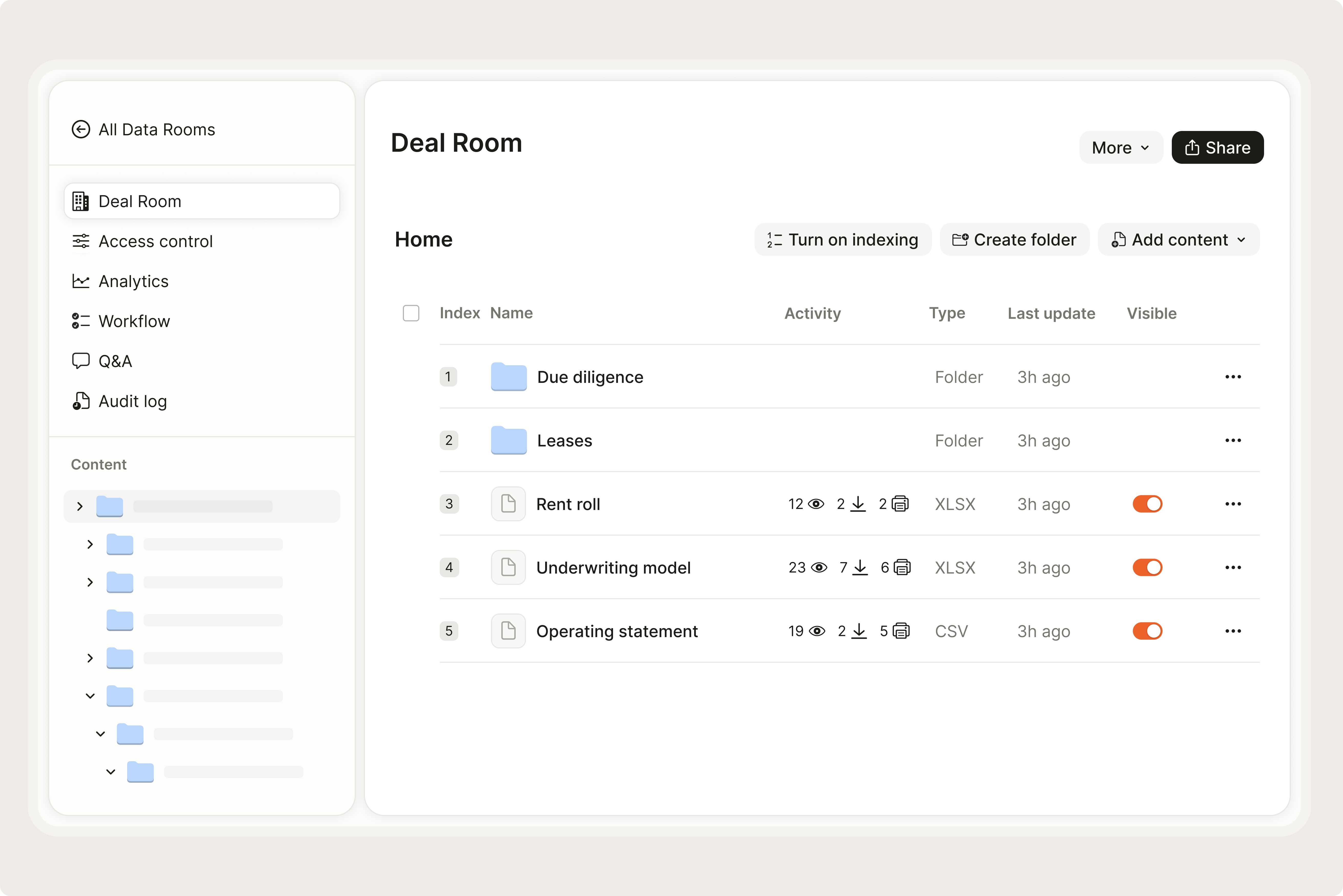
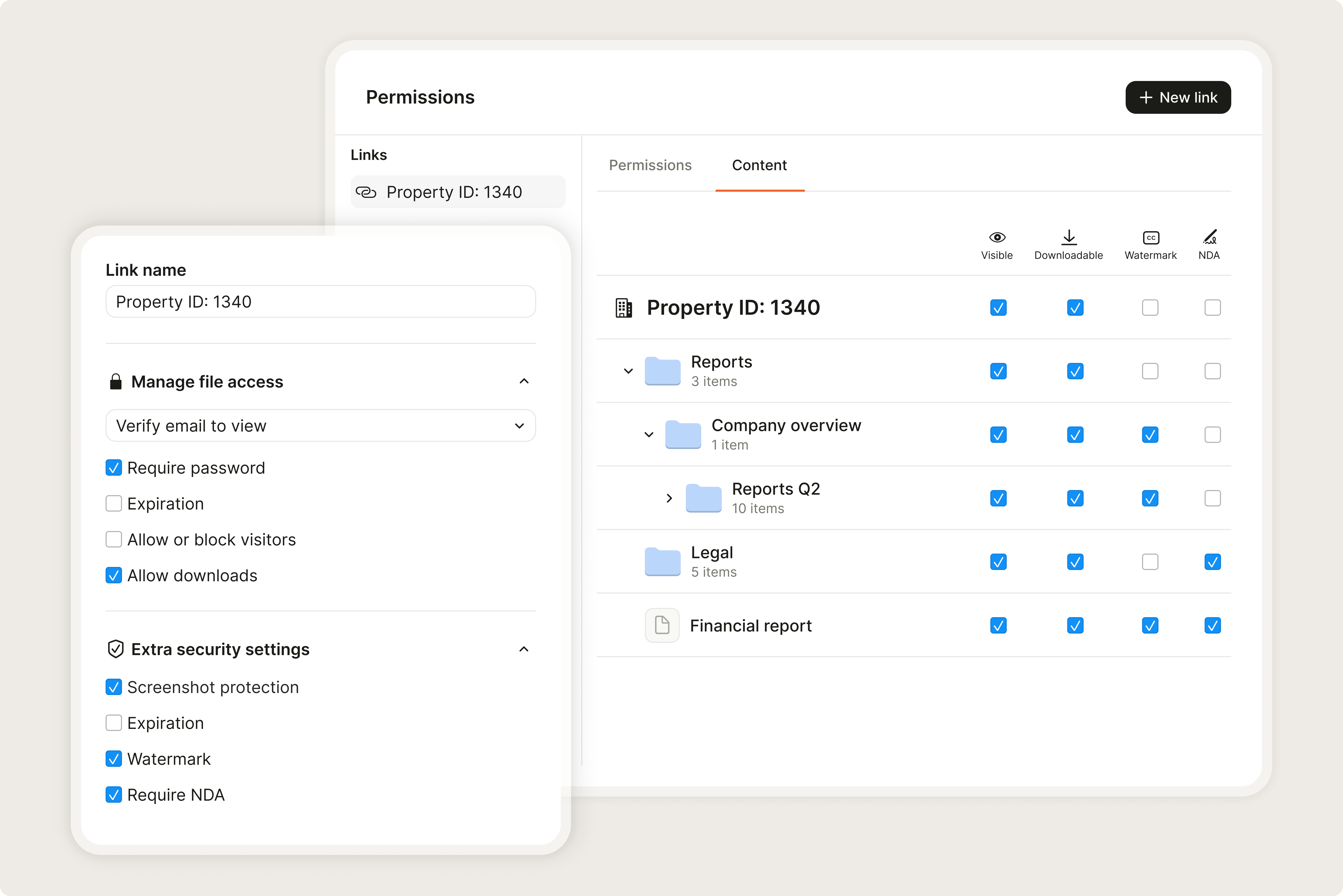
- 2.Give each advisor a scoped, tracked linkVermont attorney sees title records and Act 250 documents. Environmental consultant sees ANR records and Phase I. Lender sees valuation and rent roll. Ellty enforces the scope.
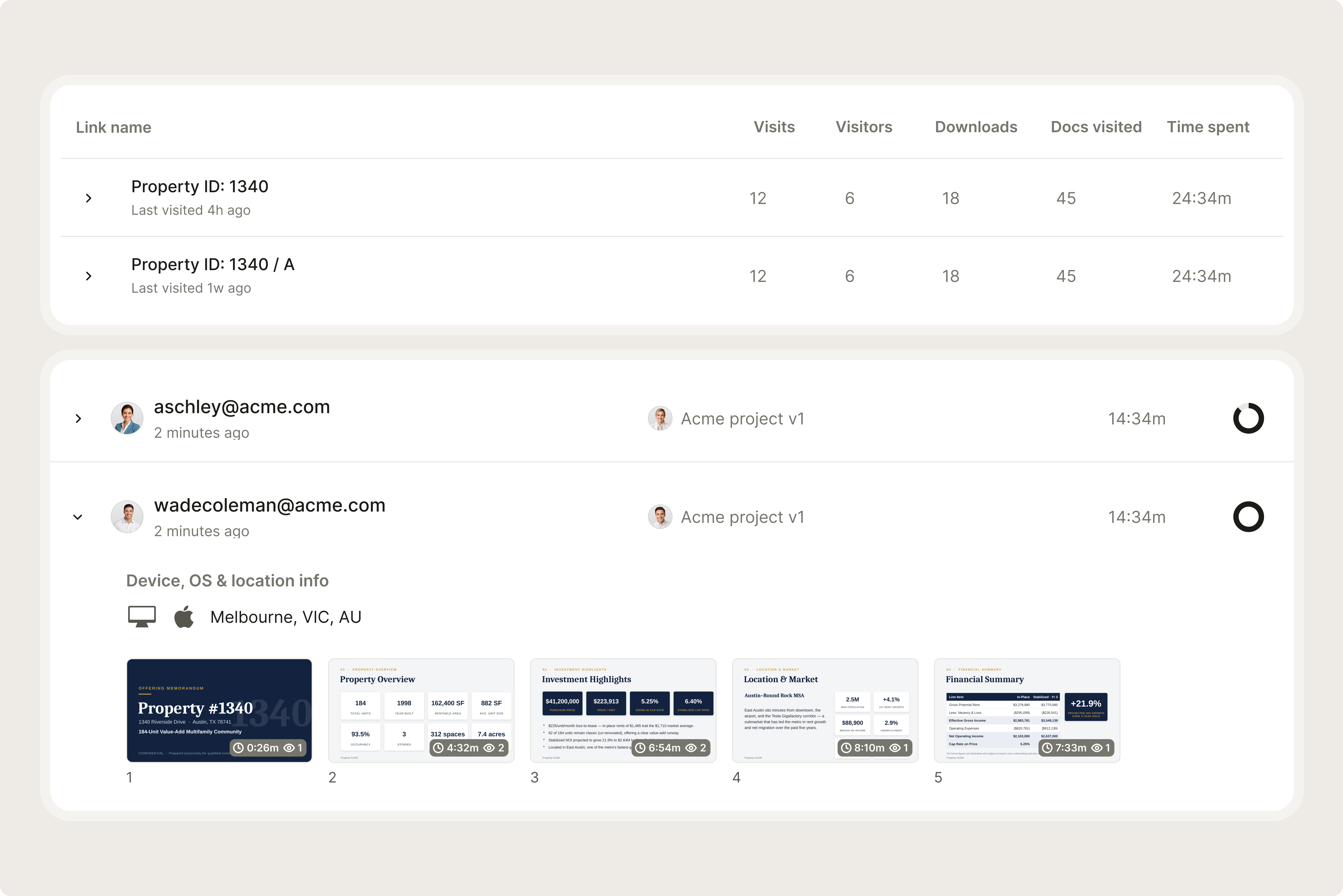
- 3.Monitor who reviews which documentsSee exactly which files each advisor opened and when. Catch Act 250 compliance questions before they affect the closing date.
What makes Vermont different
Act 250 is Vermont's defining commercial real estate regulatory feature. No other US state has a comparable statewide land use permit system that covers the range and scale of development that Vermont's Act 250 does. The permit's conditions are substantive and operational - not just about what was built, but about how it can be used, what traffic it can generate, and what environmental impacts are allowed. For any Vermont commercial buyer: understanding the Act 250 permit conditions governing the asset is as important as understanding the lease terms.
Vermont's town-level title system is a real structural difference from most other states. Vermont doesn't have a central state property registry. Title is tracked at the town clerk's office for the town where the land is located. Vermont attorneys conduct manual searches of town land records books; records in smaller towns are sometimes handwritten or on microfilm going back decades. Allow additional time for title searches in towns where records are not yet digitized.
Irene and 2023 flooding redefined Vermont's flood risk. FEMA maps underestimated the flood risk in Vermont river valleys before 2011; Hurricane Irene proved it. VT ANR's River Corridor maps, which reflect actual Vermont river dynamics and historical flood evidence, show significantly larger areas of flood risk than FEMA maps in many Vermont valleys. For any commercial property within a mile of a Vermont river, check both FEMA and ANR river corridor maps.
PFAS contamination in Vermont is more regulated than almost anywhere else in the US. Vermont's PFAS MCL of 20 ppt (combined PFOA and PFOS) is among the most stringent state standards. The Bennington plume from Saint-Gobain's former ChemFab facility is documented, but other potential PFAS sources (airport firefighting foam, industrial sites) require review across the state. Any Vermont commercial property with water well dependency needs PFAS testing before closing.
Vermont Act 250 (10 V.S.A. Chapter 151) requires a land use permit for commercial and industrial development above applicable thresholds in Vermont. The permit is reviewed by a District Environmental Commission against ten statutory criteria, including impacts on water and air quality, traffic, utilities, scenic beauty, historic sites, and conformance with local and regional plans. Act 250 permits are appurtenant to the land; they run with the property and bind successor owners. All permit conditions, amendments, and compliance records are public documents maintained by the Vermont Natural Resources Board.
Timeline and cost in Vermont
Weeks 1-3 cover kickoff: Act 250 permit database search, Vermont attorney engagement for town land records title search, Phase I ESA commission (with PFAS addendum), FEMA and ANR River Corridor flood map review, VT SWVI wetland check, and building permit history request. Legal and advisory fees in this phase run USD 8,000-20,000.
Load all documents into Ellty before advisors engage. Vermont commercial diligence often involves pulling records from multiple state agencies (ANR, NRB, VT DEC, VT DFR) and local town offices; centralized document management is essential.
Weeks 3-7 cover deep review: Phase I ESA delivery, Act 250 permit conditions compliance review, title opinion delivery, PFAS testing results (for Bennington County or well-water dependent sites), wetland delineation, building permit and septic permit review, and ski resort revenue analysis if applicable. Costs in this phase: USD 15,000-40,000.
Weeks 7-12 handle resolution: any Act 250 compliance issues addressed, Phase II ESA (if triggered), title exception clearance, flood insurance procurement, Vermont attorney closing preparation, PTT return preparation, and warranty deed execution.
Vermont total acquisition costs: 1.25% PTT + ALTA title insurance + attorney fees (typically both parties use attorneys; combined USD 5,000-15,000) + environmental + Phase II if triggered. Total acquisition cost runs approximately 2-3% of purchase price on Vermont commercial deals; meaningfully lower than major metro markets. Vermont has no local transfer tax.
Running a Vermont property deal from one room
Hold Act 250 permits, ANR records, town title records, and lease files in one secure, tracked Ellty data room.
Start free 14-day trialCommon questions about due diligence on Vermont commercial property
- Vermont commercial property deals typically take 45-90 days. Town land records title search, Act 250 permit review, Phase I ESA, and wetland delineation are the main lead-time items. For PFAS testing in Bennington County, add 2-4 weeks. For ski resort seasonal revenue analysis, allow additional time to collect 3-year historical revenue data from the seller.
- Vermont Act 250 (10 V.S.A. Chapter 151) is Vermont's statewide land use permit law requiring permits for commercial and industrial development above threshold sizes. Permits are reviewed against 10 statutory criteria by District Environmental Commissions. Act 250 permits run with the land; a buyer inherits the permit and all its conditions. Violations of Act 250 permit conditions create enforcement exposure that transfers to the new owner at closing. Always obtain and review the full Act 250 permit and compliance history before any commercial commitment.
- Vermont does not have a central state property registry. Property records are maintained at the town clerk's office for each Vermont town. Title searches are conducted manually at the town clerk's office against town land records books. A Vermont licensed attorney must conduct the search and certify title. Title insurance is available from major underwriters but is not legally required; it is strongly advisable for commercial transactions. Allow extra time for title searches in towns where land records are not yet fully digitized.
- Vermont has significant PFAS groundwater contamination, most notably the Bennington and North Bennington PFAS plume from the former ChemFab/Saint-Gobain fluoropolymer manufacturing plant. Vermont's PFAS Maximum Contaminant Level (MCL) of 20 parts per trillion (combined PFOA and PFOS) is among the strictest state standards in the US. For any commercial property in Bennington County that relies on a private well, PFAS water testing is required before closing.
- Vermont charges a Property Transfer Tax (PTT) of 1.25% of the purchase price on commercial property. There is no local Vermont transfer tax. The PTT return (Form PTT-172) must be filed with the Vermont Department of Financial Regulation at closing. Vermont closings are typically conducted by licensed Vermont attorneys rather than escrow agents.
- Check both FEMA Flood Insurance Rate Maps and Vermont ANR River Corridor maps. FEMA maps underestimated Vermont river flood risk; Hurricane Irene (2011) and significant 2023 flooding proved that FEMA 100-year floodplains in Vermont are often narrower than actual flood risk. ANR River Corridor maps show a wider area of flood risk based on actual Vermont river dynamics and historical flood evidence. For any commercial asset within a mile of a Vermont river, both map sources should be reviewed and a flood risk assessment completed.