Canada CRE deals have two costs non-Canadian buyers consistently underestimate: provincial land transfer tax that doubles in Toronto (provincial plus municipal), and a 25% withholding obligation when the seller is a non-resident without a Section 116 clearance. This checklist covers every check before you close in 2026.
Canada's commercial markets split across Toronto, Vancouver, Montreal, Calgary, Ottawa, and Edmonton. Each province has its own land transfer tax, title system, and environmental register.
HST/GST applies to many commercial property sales. It must be structured correctly before contract - going concern exemptions and HST self-assessment rules can save or cost 13% of the deal price.
Non-resident sellers must obtain a Section 116 clearance certificate from the CRA before closing. Without it, the buyer is legally required to withhold 25% of the purchase price and remit it to the CRA.
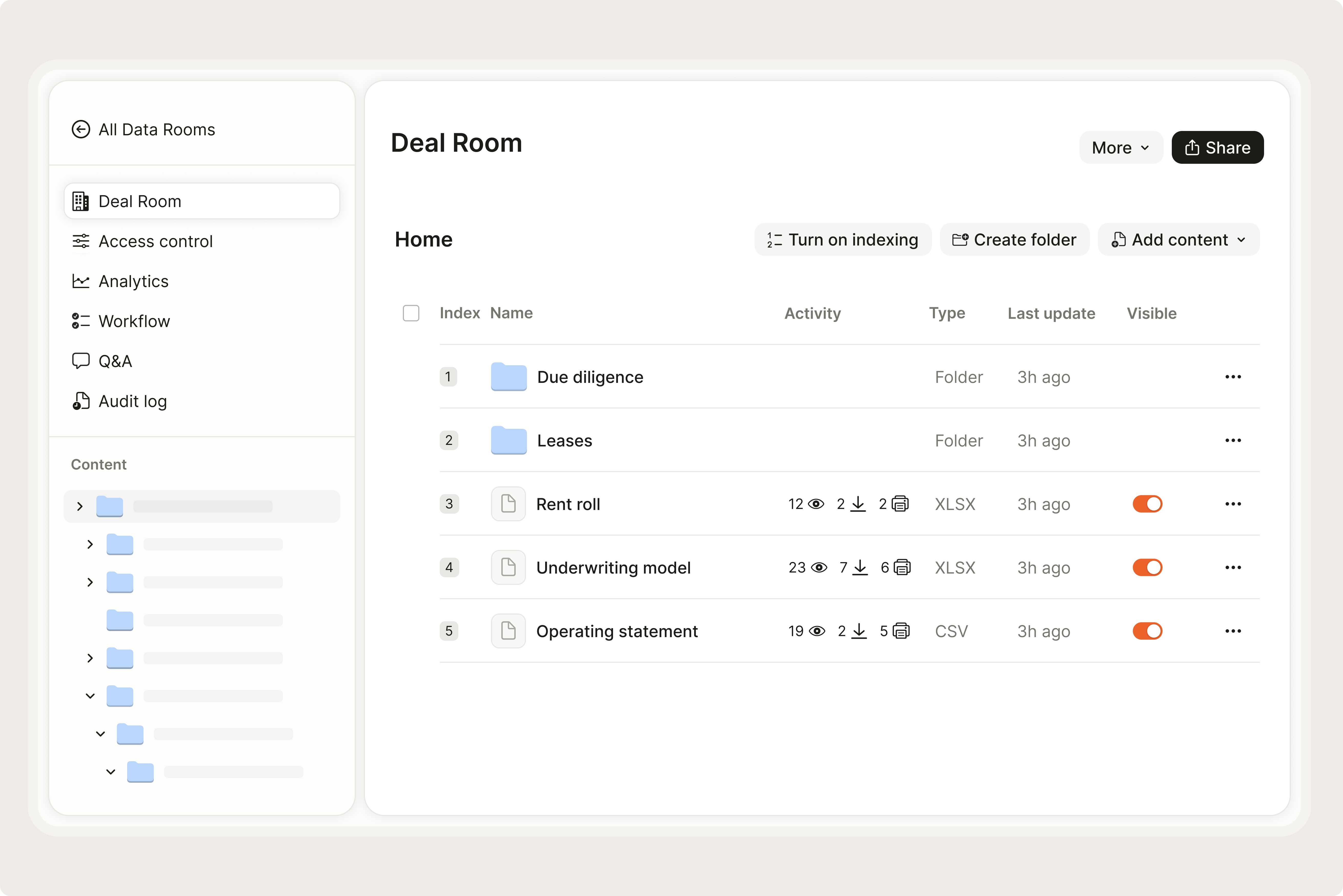
Set up an Ellty data room before diligence opens. Load all title searches, zoning documents, and lease files so each advisor gets a scoped link from day one.
Where Canadian deals actually go wrong
Not every check carries the same weight. The table below sorts risks by deal impact - dealbreakers first, then what moves the price, then basic hygiene - so your lawyer and valuer know what to clear first.
| Area | Documents to pull | Canada red flag | Matters most for | Tier | |
|---|---|---|---|---|---|
| Title and ownership | Title and ownership | Provincial title search, executions search, PIN/PID confirmation, survey | Canada uses provincial land titles systems; title searches must be run in the specific province where the property sits | All buyers | Dealbreaker |
| Section 116 - non-resident seller | Section 116 - non-resident seller | Seller residency confirmation, Section 116 clearance certificate, CRA withholding analysis | If the seller is a non-resident and no clearance certificate is issued, buyer must withhold 25% of purchase price | Any deal with non-Canadian seller | Dealbreaker |
| Zoning and official plan | Zoning and official plan | Zoning By-law certificate, Official Plan designation, minor variance history, site plan agreement | Canadian municipalities actively update Official Plans and Zoning By-laws; check for pending revisions | Development, office, retail | Dealbreaker |
| Environmental - Phase I ESA | Environmental - Phase I ESA | Phase I ESA (CSA Z768), provincial environmental register search, UST records | Former industrial sites in Toronto's west end, Vancouver's industrial East Side, and Montreal harbour carry contamination | Industrial, legacy commercial | Dealbreaker |
| Leases and tenancies | Leases and tenancies | All leases, estoppel certificates, rent roll, HST/GST status of tenants, sublease consents | Canadian commercial leases must confirm HST/GST registrant status for each tenant; affects income tax model | Income-producing assets | Price-adjuster |
| Building and condition | Building and condition | PCA, building permit history, occupancy permit, ASHRAE energy audit, asbestos and mould survey | Canadian buildings face harsh climate loads; roof, mechanical systems, and parking structure deterioration are common | All asset types | Price-adjuster |
| Property tax and operating costs | Property tax and operating costs | 3y operating statements, municipal property tax assessment, MPAC or equivalent, CAM reconciliations | Canada's property tax reassessment cycles vary by province; confirm current assessed value and any pending appeal | Income-producing assets | Price-adjuster |
| Land transfer tax and HST | Land transfer tax and HST | Provincial LTT calculation, municipal LTT (Toronto), HST going concern analysis, closing statement | Toronto adds a second LTT on top of Ontario's; combined rate reaches ~4% on commercial values above $2M | All deals | Price-adjuster |
| Insurance and valuation | Insurance and valuation | Current policies, loss run, flood zone check, title insurance binder, AACI appraisal | Calgary flood zones, BC wildfire risk, and Ontario sinkhole areas carry insurance exclusions buyers miss | All | Standard check |
| Utilities and access | Utilities and access | Utility connection records, hydro letter, municipal water connection, easement search on title | Canadian utility easements are registered on provincial title; confirm they don't restrict development rights | All | Standard check |
| Seller KYC and AML | Seller KYC and AML | Entity docs, CBCA/provincial registry extract, UBO identification, FINTRAC compliance | FINTRAC (Canada's AML regulator) requires real estate lawyers to report suspicious transactions and verify client ID | All deals | Standard check |
Due diligence on a Canadian property?
Set up your Ellty data room before diligence starts.
Start free 14-day trialCanada CRE checklist
The table ranked risks by severity. This is the full list to work through, grouped by area.
Title and ownership
- Run the provincial title search in the specific province where the property is located
- For Ontario: search via Teranet / POLARIS; for BC use BC Land Title Office; for Alberta use Alberta Land Titles
- Pull executions and writs of seizure search against the seller in the relevant provincial system
- Confirm the PIN (Ontario) or PID (BC) matches all sale, lease, and planning documents exactly
- Check for easements, rights-of-way, and restrictive covenants registered on title
- Run a title insurance binder from a Canadian title insurer; lenders require it and it covers some searches
Section 116 - non-resident seller
- Confirm seller residency status for tax purposes before contract is signed
- If seller is a non-resident: require the Section 116 clearance certificate from the CRA before closing
- Section 116 application takes 4-8 weeks at the CRA; don't set a closing date before it's in process
- Without a clearance certificate: buyer must withhold 25% of the gross purchase price at closing
- Withheld amounts must be remitted to the CRA within 30 days; failure creates personal liability for the buyer
- For corporate sellers: confirm if any shareholders are non-resident; trust structures can trigger the same rules
Zoning and official plan
- Pull the Zoning By-law compliance certificate from the local municipality
- Confirm the Official Plan designation for the parcel and the current permitted uses
- For Toronto: check both the City-Wide Zoning By-law and any site-specific exceptions
- Check for pending Official Plan amendments or Zoning By-law updates that could affect the property
- Pull the site plan agreement if one exists; these run with the land and impose ongoing obligations
- Confirm no minor variance or Committee of Adjustment conditions attach to the current use
Environmental - Phase I ESA
- Commission a Phase I ESA per CSA Z768 standard; lenders require it for all commercial deals
- For Ontario: search the Environmental Site Registry and Brownfields Registry
- For BC: search the Contaminated Sites Registry (CSRS) for the property and surrounding area
- For Alberta: search the Environmental Site Registry maintained by AENV
- Former industrial sites in Toronto's west end, Vancouver's East Side, and Montreal's harbour carry high contamination risk
- Budget Phase II ESA (CAD 15,000-50,000) if Phase I identifies areas of potential environmental concern (APECs)
Leases and tenancies
- Collect all commercial leases and confirm estoppel certificates are obtainable before closing
- Check the HST/GST registrant status of each tenant; non-registrant tenants can't self-assess HST
- Review rent escalation clauses; Canadian commercial leases use CPI, fixed-step, and market review mechanisms
- Confirm make-good obligations; Canadian institutional leases often include detailed reinstatement provisions
- Cross-reference the rent roll against 12 months of actual receipts before relying on income projections
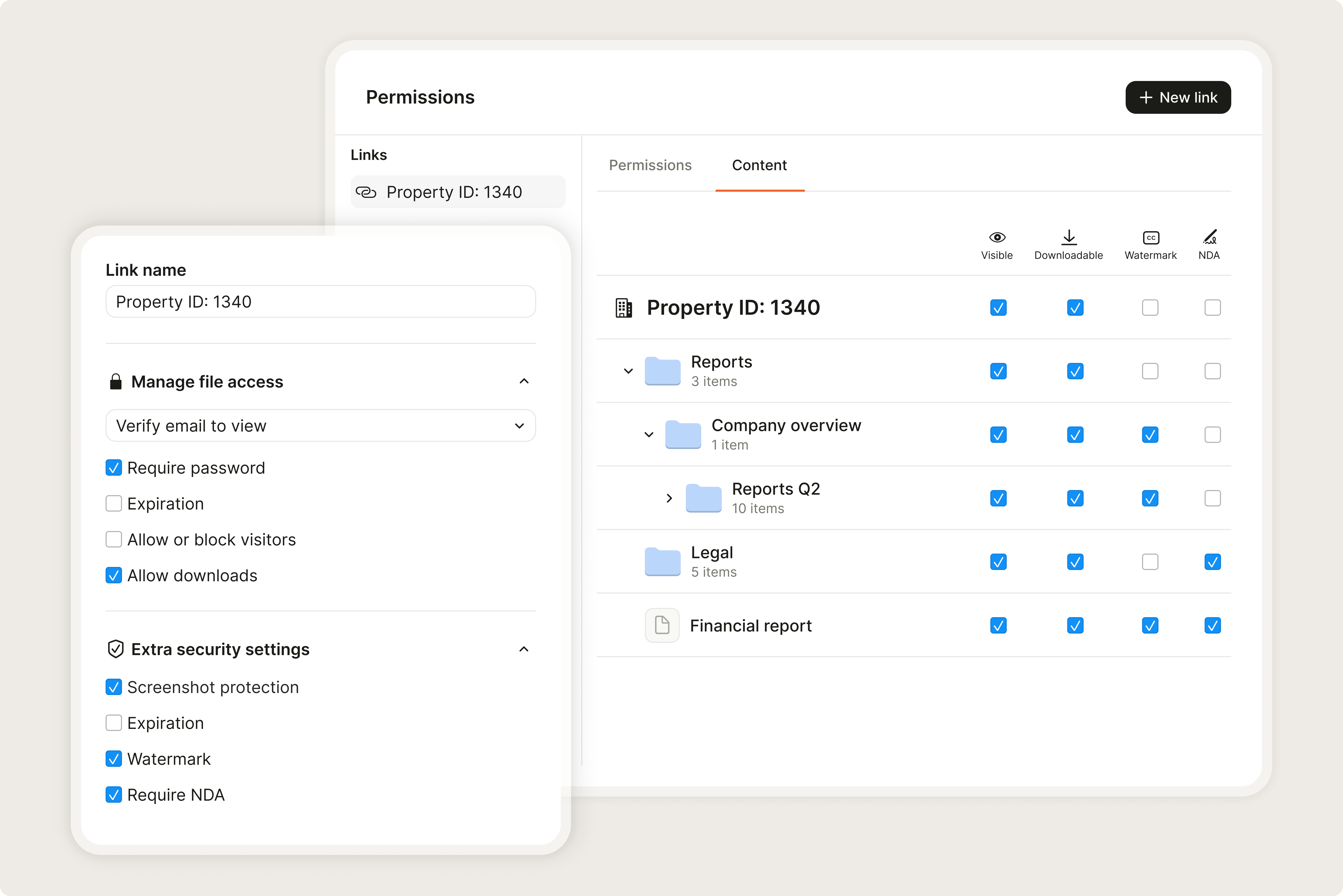
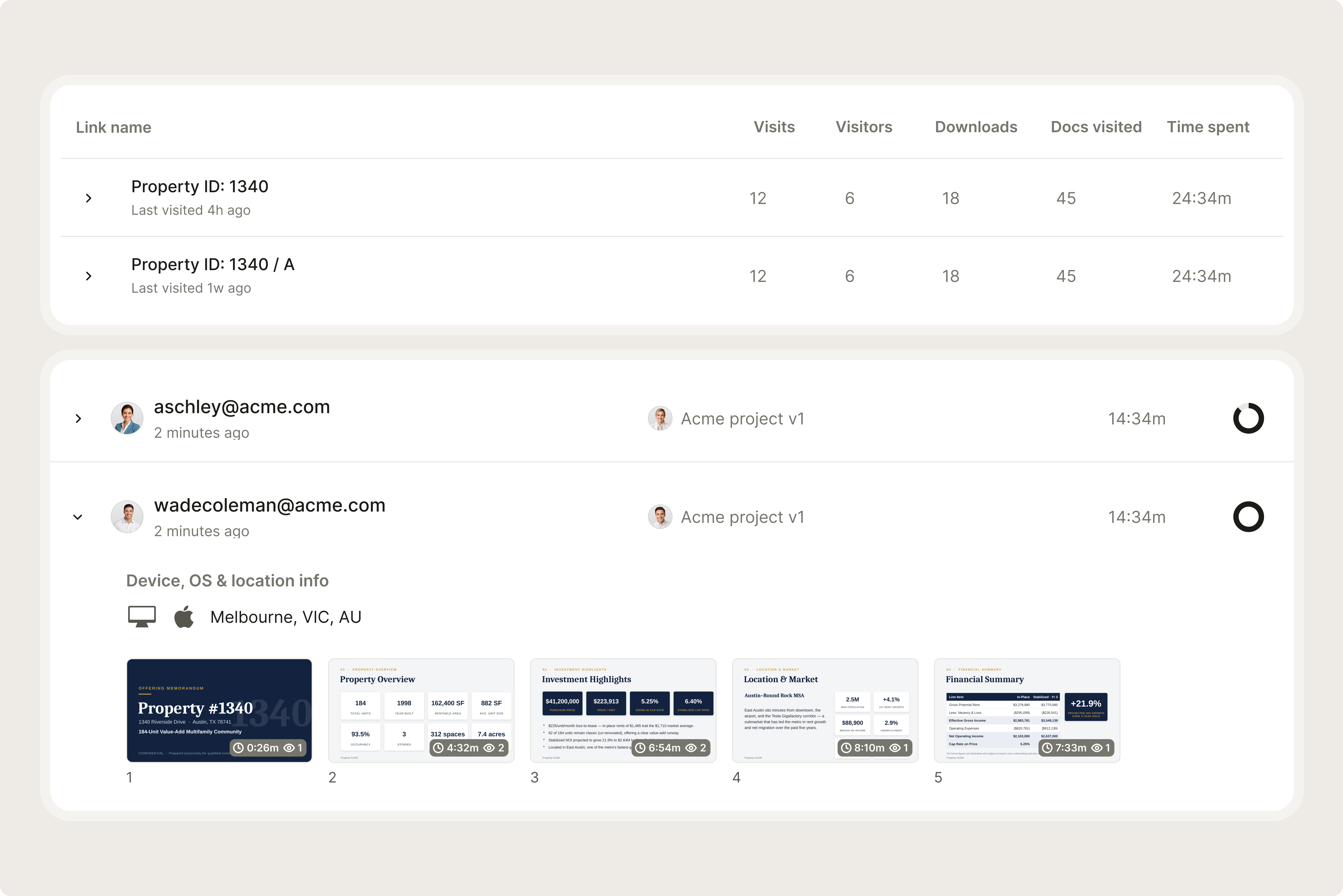
Give each advisor a scoped link in Ellty. Lease lawyers see lease files; environmental consultants see Phase I reports; lenders see the financial package. Track who opened what, in real time.
Building and physical condition
- Commission a Property Condition Assessment to ASTM E2018 or equivalent Canadian standard
- Priority checks: roof, mechanical systems, parking structure, and electrical for climate-related wear
- Pull the full building permit history from the local municipality
- Confirm the occupancy permit covers all current commercial uses in the building
- For pre-1990 buildings: confirm asbestos and mould surveys are current; both must be disclosed in Ontario and BC
- For office towers: commission an ASHRAE Level II energy audit if the building is being repositioned
Property tax and operating costs
- Pull 3 years of operating statements and reconcile against municipal property tax assessment notices
- For Ontario: confirm the MPAC current value assessment and any pending appeal by the seller or tenants
- For BC: confirm the BC Assessment value and any appeal proceedings affecting assessed value
- Audit CAM reconciliations against lease terms for all multi-tenant assets
- Check for outstanding municipal local improvement charges (LICs) that survive closing
Land transfer tax and HST
- Confirm the provincial LTT rate for the province where the property is located
- For Toronto: add the Municipal LTT on top of Ontario's provincial rate; combined rate reaches ~4% above $2M
- Confirm whether HST (Ontario 13%, BC 5% GST, Quebec 14.975%) applies to the sale
- For going concern sales: both parties must be GST/HST registrants and file the election jointly before closing
- For new commercial construction: confirm HST applies in full; no going concern exemption
- Model Section 116 withholding if the seller is non-resident; it's calculated on the gross purchase price
Insurance and valuation
- Pull current insurance policies and a 3-year loss run history from the seller
- Check flood zone designation from local conservation authority or municipality
- For BC: check wildfire risk designation; BC Wildfire Service maintains risk maps
- For Calgary: confirm flood zone and sewer backup risk from the 2013 flood history in the area
- Order an AACI (Accredited Appraiser Canadian Institute) appraisal for lender requirements
Utilities and access
- Verify all utility connections are active and include valid supply contracts
- Confirm local hydro utility service; name varies by province (Hydro One, BC Hydro, ATCO, etc.)
- Check for utility easements on title; confirm they don't restrict development or expansion
- Confirm legal road access via public road or a registered right-of-way easement on title
Seller KYC and AML
- Pull a corporate profile from the relevant provincial or federal registry (CBCA, OBCA, BCBCA, etc.)
- Confirm all beneficial owners; FINTRAC requires real estate lawyers to verify client identity for all CRE deals
- Run a bankruptcy and insolvency search through the OSB (Office of the Superintendent of Bankruptcy)
- Confirm the seller's authority to sell is supported by a current board resolution or authorized officer certificate
How due diligence in Canada works
Step 1 - Title search and Section 116 analysis
Pull the provincial title search and run the seller residency analysis on the same day. Section 116 clearance takes 4-8 weeks at the CRA and sets the floor for your closing date when the seller is a non-resident.
For multi-provincial buyers: confirm which provincial title system applies. Each province has its own search portal and fee schedule - Ontario, BC, and Alberta are electronic and fast; other provinces vary.
Step 2 - Zoning and planning confirmation
Pull the Official Plan and Zoning By-law compliance certificate from the local municipality immediately after contract. Canadian municipalities are actively updating Official Plans under provincial housing and commercial intensification policies.
For Toronto and Vancouver: check for pending by-law amendments. Both cities have active development planning reviews that can affect permitted density and use for commercial parcels already under contract.
Step 3 - Leases and HST structure
Confirm the HST going concern election eligibility in the first week. Both parties must be HST registrants, the property must be a going concern, and the election must be filed before closing. Getting any of these wrong means 13% HST on the full Ontario purchase price.
Compare Norway's diligence process if you run international portfolio acquisitions. Both countries have optional VAT regimes on commercial leases where opt-in status directly affects buyer tax recovery - confirming that status early is critical in both markets.
Step 4 - Environmental review
Commission the Phase I ESA per CSA Z768 and run the provincial environmental register search in parallel. Former auto parts, foundry, and dry-cleaning sites in Toronto, Montreal, and Vancouver carry Phase I flags that convert to Phase II costs of CAD 15,000-50,000.
Load all Phase I ESA findings, environmental register searches, and APEC findings into Ellty. Lenders and environmental consultants get watermarked, tracked access - every document open is logged.
Step 5 - Closing via real estate lawyer
Canadian commercial closings are handled by provincial real estate lawyers. Electronic registration (OREA/Teranet in Ontario; myLTSA in BC) means same-day title registration on closing.
Title insurance binders are obtained pre-closing from a Canadian title insurer. The policy insures against unknown title defects and covers many search risks that would otherwise require additional due diligence.
How to set up your Canada data room in Ellty.
Canadian CRE deals require tight document control across provinces. Load files into Ellty before advisors arrive. Each party gets a scoped, tracked link from day one.
- 1.Upload Canadian property files to a secure roomDrop title searches, zoning docs, Phase I ESA, leases, HST election docs, and Section 116 certificate into Ellty.
- 2.Give each advisor a scoped, tracked linkYour lawyer sees title docs. Your environmental consultant sees Phase I reports. Your lender sees the financial package. Ellty enforces the scope.
- 3.Monitor who reviews which documentsSee exactly which files each advisor opened and when. Catch delays before they affect the Section 116 or closing timeline.
What makes Canada different
Section 116 is the most expensive surprise in Canadian CRE for international buyers acting as buyers. If the seller is a non-resident and doesn't produce a clearance certificate, the buyer must withhold 25% of the gross purchase price and remit it to the CRA. The buyer gets no receipt until months later. Budget accordingly.
The HST going concern election is binary. Both parties must be registrants, the election must be filed on the correct form before closing, and the property must genuinely be a going concern. Miss any of these three and 13% HST applies to the full purchase price in Ontario.
Toronto's double land transfer tax is not a typo. The City of Toronto levies its own municipal LTT in addition to Ontario's provincial LTT. Combined, they reach approximately 4% on commercial values above CAD 2M - higher than many buyers expect when coming from Alberta, where there is no provincial LTT at all.
Canada's Phase I ESA standard (CSA Z768) differs from the US ASTM standard. Environmental consultants from the US don't automatically transfer their reports without Canadian standard compliance.
Under subsection 116(5) of the Income Tax Act, where a non-resident person disposes of taxable Canadian property and a Section 116 certificate has not been issued by the CRA, the purchaser is jointly and severally liable to pay 25% of the purchase price to the Receiver General. The purchaser's liability exists regardless of whether the purchaser was aware of the vendor's non-resident status.
Timeline and cost in Canada
Weeks 1-2 cover kickoff: provincial title search, executions search, zoning compliance certificate, Phase I ESA engagement, Section 116 residency confirmation, and HST analysis. Budget CAD 5,000-15,000 for this phase.
Load all files into Ellty before advisors arrive. Give each party a scoped, tracked link - that removes at least one week of email document exchange from a standard Canadian diligence process.
Weeks 2-4 cover deep review: Phase I ESA delivery, PCA, lease abstraction, HST going concern election preparation, MPAC assessment review, and operating cost audit. Cost runs CAD 8,000-25,000 depending on asset complexity.
Section 116 CRA clearance runs 4-8 weeks from application. Don't set a closing date until the CRA has confirmed the application is in process or the seller has confirmed Canadian residency.
Weeks 4-6 handle resolution: Phase II if needed, title exceptions, zoning confirmation, title insurance binder, and electronic registration via provincial land titles portal.
Canada's total acquisition cost runs 3-8% of purchase price depending on province. Toronto has the highest LTT stack; Alberta has the lowest. HST exposure can add 13% if the going concern election fails - that's the number that matters most.
Running a Canadian property deal from one room
Hold title searches, zoning docs, and lease files in one secure, tracked Ellty data room.
Start free 14-day trialCommon questions about due diligence on Canadian property
- Most Canada CRE deals complete in 4-8 weeks. Section 116 CRA clearance for non-resident sellers is the critical path item and typically takes 4-8 weeks from application.
- Section 116 of the Income Tax Act requires buyers to withhold 25% of the purchase price when the seller is a non-resident of Canada unless the CRA issues a clearance certificate. The buyer is personally liable for the withheld amount.
- Provincial land transfer tax varies: Ontario ~0.5-2%, BC (PTT) 1-5%, Quebec ~1-3%, Alberta has no provincial LTT. Toronto adds a municipal LTT on top of Ontario's, reaching ~4% combined on higher commercial values.
- HST applies to commercial property sales unless the going concern exemption applies. Both parties must be HST registrants and file the joint election before closing. Failure means 13% HST (Ontario) on the full purchase price.
- Canadian Phase I ESAs are conducted per CSA Z768 (Phase I ESA) standard. US ASTM standard reports don't automatically satisfy Canadian lender and environmental requirements; confirm compliance with Canadian standard before relying on existing reports.
- Yes. The Prohibition on the Purchase of Residential Property by Non-Canadians Act applies only to residential property. Commercial property has no foreign ownership restrictions, but non-resident sellers trigger Section 116 withholding requirements at closing.