Norway CRE deals have two traps non-Nordic buyers consistently miss: tomtefeste leasehold that doesn't transfer with the title deed, and a 2.5% document duty that restructures most deals above NOK 50M into share purchases. This checklist covers every check before you close in 2026.
Norway's commercial market centers on Oslo, Bergen, Stavanger, and Trondheim. Each city follows different municipal planning rules and property tax rates.
Most Norwegian CRE above NOK 50M closes as a share deal, not an asset deal. That avoids the 2.5% document duty but expands diligence scope to the full selling entity.
Tomtefeste (ground lease) is common across Norway. Properties held on tomtefeste don't transfer land ownership; annual rent reviews and redemption restrictions run with the property for decades.
Set up an Ellty data room before diligence opens and load all title, lease, and environmental files. Each advisor gets a scoped link from day one.
Where Norway deals actually go wrong
Not every check carries the same weight. The table below sorts risks by deal impact - dealbreakers first, then what moves the price, then basic hygiene - so your lawyer and valuer know what to clear first.
| Area | Documents to pull | Norway red flag | Matters most for | Tier | |
|---|---|---|---|---|---|
| Title and ownership | Title and ownership | Kartverket title search, deed extract, encumbrance register, cadastral map | Kartverket is Norway's single property registry; older unregistered rights can still encumber title | All buyers | Dealbreaker |
| Tomtefeste - ground lease | Tomtefeste - ground lease | Tomtefeste agreement, annual rent terms, review clauses, redemption right documentation | Tomtefeste properties don't include land ownership; rent reviews and redemption restrictions run for decades | All buyers, especially non-Nordic | Dealbreaker |
| Share deal structure | Share deal structure | Share purchase agreement, seller entity docs, cap table, debt schedule, tax history | Most Norway CRE uses share deals to avoid 2.5% document duty; expands DD scope to the full entity | All deals above NOK 50M | Dealbreaker |
| Environmental - contaminated land | Environmental - contaminated land | Phase I ESA, Grunnforurensning database, Miljødirektoratet search, UST records | Norway's Grunnforurensning database must be searched; oil sector contamination is common near Stavanger | Industrial, port-adjacent, legacy commercial | Dealbreaker |
| Leases and tenancies | Leases and tenancies | All leases, Norwegian Tenancy Act compliance check, VAT registration, rent roll | Norwegian commercial leases can opt into 25% VAT; the opt-in status affects buyer's VAT recovery position | Income-producing assets | Price-adjuster |
| Building and energy certificate | Building and energy certificate | PCA, energiattest (energy performance certificate), building permit history | Energiattest is legally required for every commercial sale or lease in Norway; missing one blocks closing | All asset types | Price-adjuster |
| Service charge and municipal tax | Service charge and municipal tax | 3y operating statements, eiendomsskatt bills, CAM reconciliations, VAT recovery summary | Norwegian municipalities levy eiendomsskatt (property tax) up to 0.7% of assessed value - varies by city | Income-producing assets | Price-adjuster |
| Document duty / deal structure | Document duty / deal structure | Document duty calculation, share vs. asset deal tax model, closing statement | 2.5% document duty on asset deals is the single largest closing cost; share deal avoids it entirely | All deals | Price-adjuster |
| Insurance and valuation | Insurance and valuation | Current policies, loss run, flood zone check, Norway Finance appraisal report | Norway has active flood risk in river valleys and coastal zones; standard policies exclude some areas | All | Standard check |
| Utilities and access | Utilities and access | Utility connection records, grid connection letter, road access easement survey | Norwegian utility connections vary by municipality; confirm active supply contract and grid connection | All | Standard check |
| Seller KYC and AML | Seller KYC and AML | Entity docs, Brønnøysund Register extract, UBO register check, bankruptcy search | Norway's UBO register (Foretaksregisteret) is mandatory since 2021; all beneficial owners must be verified | All deals | Standard check |
Due diligence on a Norway property?
Set up your Ellty data room before diligence starts.
Start free 14-day trialNorway CRE checklist
The table ranked risks by severity. This is the full list to work through, grouped by area.
Title and ownership
- Pull the Kartverket title extract and confirm the registered owner matches the seller exactly
- Search the encumbrance register (grunnbok) for mortgages, easements, and servitudes
- Confirm whether the land is freehold or tomtefeste before committing to the deal
- Check for unregistered easements or access rights from neighboring parcels
- Confirm the cadastral number matches all sale documents, leases, and planning approvals
- Run a judgment lien search through Brønnøysund against the registered property owner
Tomtefeste - ground lease
- Confirm whether the property is held on tomtefeste or freehold title
- Pull the full tomtefeste agreement and note annual ground rent and review dates
- Check the Tomtefesteloven (Ground Lease Act) redemption right status for the property
- Confirm whether the tomtefeste is registered at Kartverket and with whom it runs
- Flag any annual rent review clauses; reviews can trigger significant rent increases at intervals
- Note the remaining lease term; tomtefeste with under 20 years remaining affects financing
Share deal structure (if applicable)
- Confirm the deal structure early: share deal avoids 2.5% document duty, asset deal does not
- Pull the full corporate documents for the property-owning entity from Brønnøysund
- Review the entity's full tax history, VAT registration, and any open tax disputes
- Confirm the cap table and confirm no hidden shareholders or nominee arrangements
- Check for any legacy liabilities in the entity (debt, environmental, pending litigation)
- Confirm the entity has no historic document duty or asset transfer obligations that survive
Environmental - contaminated land
- Search the Grunnforurensning (contaminated ground) database for the parcel and surrounding area
- Commission a Phase I ESA per standard Norwegian Environmental Agency protocols
- For Stavanger and Bergen parcels: search for oil sector contamination and legacy industrial use
- Check for underground storage tanks (USTs); petroleum releases are common near older industrial sites
- Run an Miljødirektoratet (Environment Agency) search for any open cleanup orders near the site
- Budget Phase II soil sampling (NOK 100,000-400,000) if Phase I identifies recognized conditions
Leases and tenancies
- Collect all leases and confirm compliance with the Norwegian Tenancy Act (Husleieloven)
- Confirm the lease's VAT opt-in status; VAT-registered commercial leases affect buyer recovery
- Check rent indexation clauses; most Norwegian leases index to the Norwegian Consumer Price Index
- Cross-reference the rent roll against 12 months of actual receipts from the seller
Give each advisor a scoped link in Ellty. Lawyers see lease files; valuers see building reports; lenders see financials. No one gets access they don't need, and you track every open.
Building and physical condition
- Confirm the energiattest (energy performance certificate) is current and valid for the property
- Commission a Property Condition Assessment; prioritize roofing and insulation for Norwegian climate loads
- Pull the full building permit history from the local municipality
- Verify the use permit (brukstillatelse) covers all commercial uses in the building
- Check for asbestos; Norwegian buildings constructed before 1985 require an asbestos inventory
Service charge and municipal tax
- Pull 3 years of operating statements and reconcile against eiendomsskatt (property tax) bills
- Confirm the municipality and the applicable eiendomsskatt rate; it varies from 0 to 0.7% of assessed value
- Audit CAM reconciliations against lease terms for all multi-tenant assets
- Check for outstanding municipal improvement charges or utility infrastructure levies
Document duty and deal structure
- Confirm document duty: 2.5% of purchase price applies on all registered deed transfers
- Model the share deal vs. asset deal scenarios before heads of terms are signed
- For share deals: confirm no tax indemnity triggers from prior restructurings inside the entity
- Confirm the Kartverket filing timeline and who bears document duty if deal structure changes
Insurance and valuation
- Pull current insurance policies and 3-year loss run history from the seller
- Check flood zone status near rivers and coastal areas; Norway has active flood risk in many zones
- Order an independent appraisal by a Norwegian-registered valuer for lender requirements
- Confirm wildfire and landslide coverage; Norwegian mountain-adjacent parcels carry both risks
Utilities and access
- Verify all utility connections are active and include active supply contracts with the provider
- Confirm grid connection letter from the local grid operator for electricity supply
- Check for any shared utility easements that restrict development rights on the parcel
- Confirm legal road access via a public road or a registered private road easement
Seller KYC and AML
- Pull a full Brønnøysund Register extract (Foretaksregisteret) on the selling entity
- Check the UBO register for all beneficial owners; mandatory since 2021 for Norwegian entities
- Run a bankruptcy search and judgment lien search on the selling entity before committing
- For non-EEA sellers: confirm Norwegian tax authority pre-clearance requirements apply
How due diligence in Norway works
Step 1 - Title search and deal structure
Pull the Kartverket title extract and confirm tomtefeste status on day one. The share vs. asset deal decision must be made before heads of terms - document duty exposure depends on it.
For share deals, the diligence scope expands to the full entity. Engage a Norwegian tax adviser before the deal structure locks.
Step 2 - Survey and inspection
Order the Property Condition Assessment and energiattest review immediately. The energiattest is legally required for closing in Norway - a missing certificate delays the deal.
Norwegian climate loads put harder stress on roofing, insulation, and drainage systems than buyers from warmer markets expect. Budget for higher PCA scope on older buildings.
Step 3 - Leases and income review
Pull all leases and confirm the VAT opt-in status first. A commercial lease without VAT registration means the buyer can't recover input VAT on property costs - that affects the yield model immediately.
Compare Luxembourg's process if you run European multi-market acquisitions. Both countries require specific deal structuring analysis early - Luxembourg for the VAT vs. registration duty decision, Norway for the share vs. asset deal.
Step 4 - Environmental review
Run the Grunnforurensning database search and Phase I ESA in parallel. Former oil sector and industrial sites near Stavanger, Drammen, and Bergen carry the highest contamination risk.
Load all Phase I findings, environmental search results, and soil reports into Ellty. Every file is watermarked with the recipient's identity - lenders and advisors access docs with full tracking enabled.
Step 5 - Closing and Kartverket registration
Norwegian property transfers don't require a notary. A lawyer or conveyancer handles the deed and filing with Kartverket. Kartverket online registration takes 3-5 business days after filing.
For share deals, closing follows standard Norwegian corporate law. The share register update is not a Kartverket filing - it's handled at the Brønnøysund Register and is separate from any property deed.
How to set up your Norway data room in Ellty.
Norwegian deals move quickly to deed stage. Load files into Ellty before advisors arrive. Each party gets a scoped, tracked link from day one.
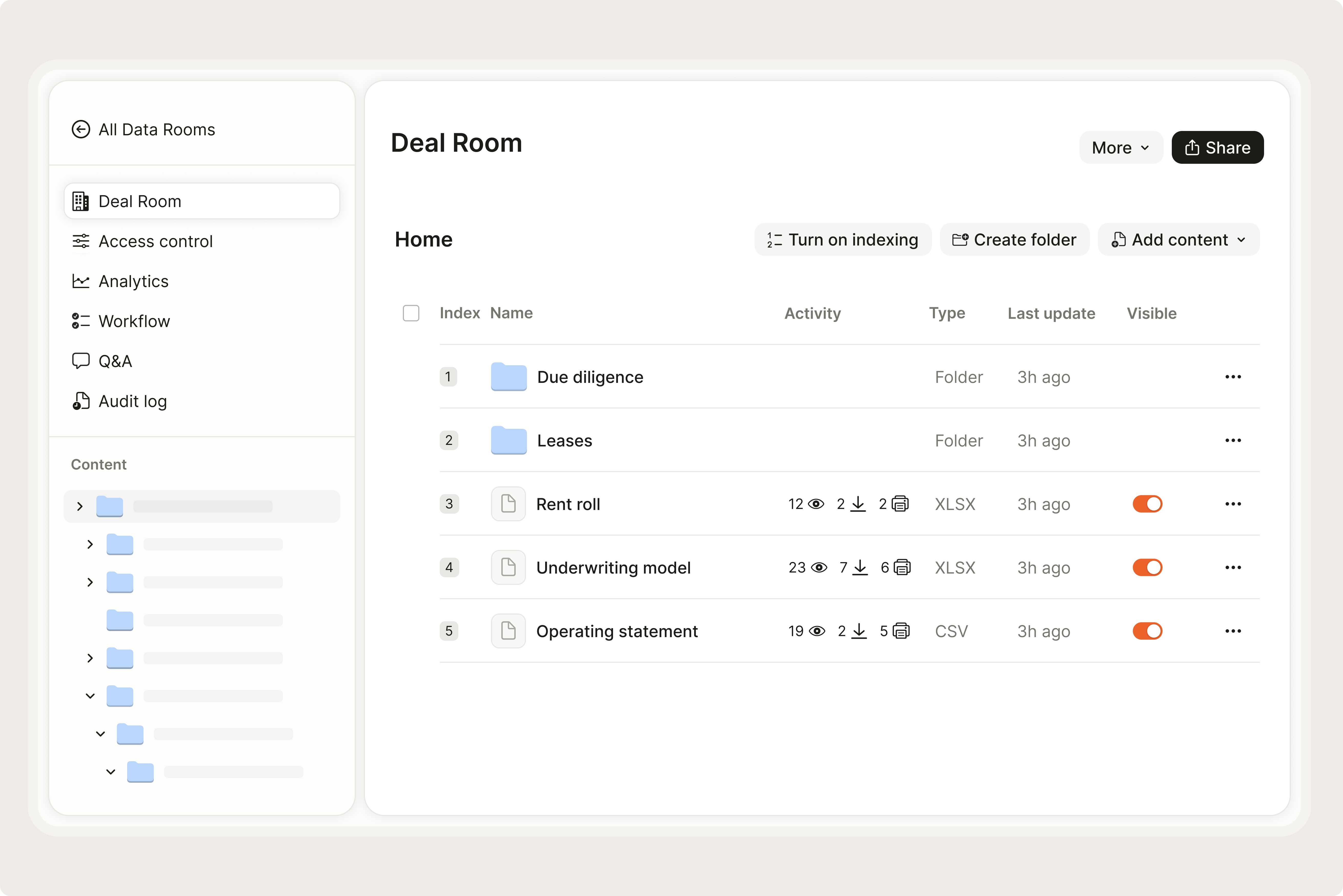
- 1.Upload Norway property files to a secure roomDrop Kartverket title extracts, leases, energiattest, Grunnforurensning records, and tomtefeste docs into Ellty.
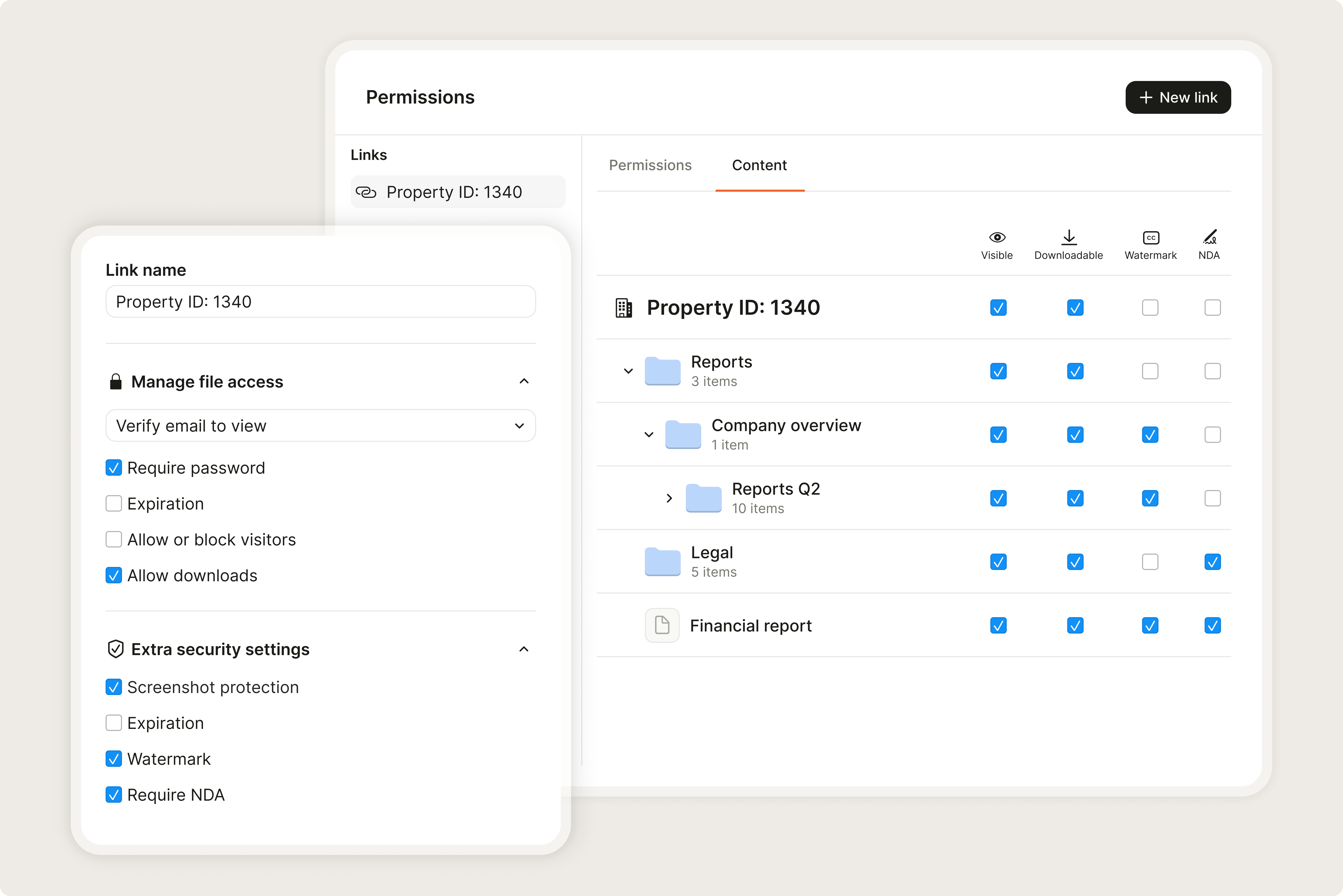
- 2.Give each advisor a scoped, tracked linkYour lawyer sees title files. Your tax adviser sees the deal structure model. Ellty enforces the scope.
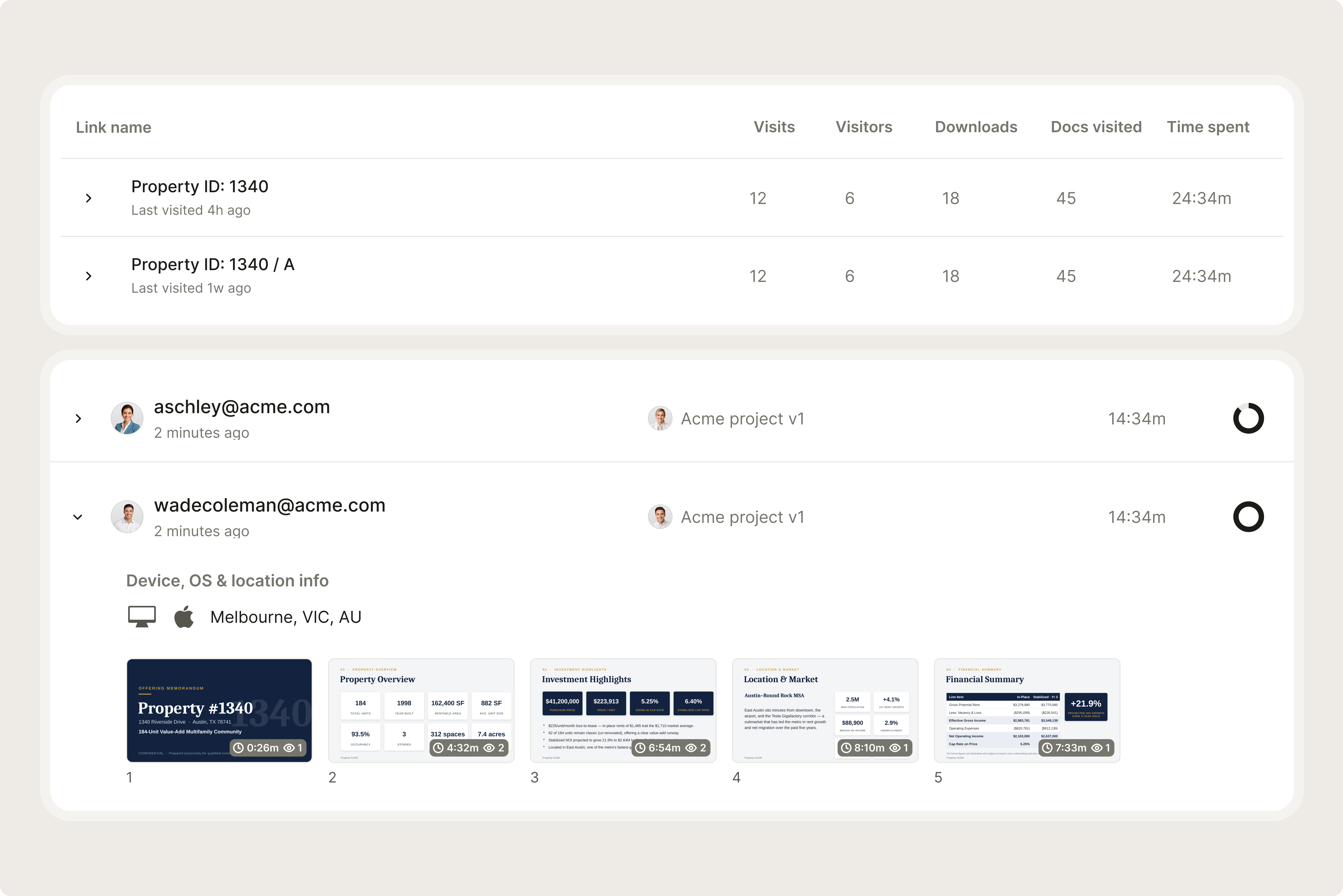
- 3.Monitor who reviews which documentsSee exactly which files each advisor opened and when. Catch delays before they push the Kartverket filing.
What makes Norway different
Tomtefeste is the most common trap for non-Nordic buyers. When a Norwegian property sits on a ground lease, you're buying the building - not the land. Annual rent reviews and long-remaining lease terms affect valuation and financing.
Document duty at 2.5% is the single largest closing cost on asset deals. Most Norwegian CRE above NOK 50M closes as a share deal specifically to avoid it. The share deal adds entity-level diligence that buyers don't always budget for.
The energiattest is a legal requirement, not a formality. A missing or expired energy performance certificate blocks closing in Norway. Order it early - it can take 2-3 weeks to produce on older commercial buildings.
Norwegian VAT on commercial leases is optional but critical. Landlords must opt in; if they haven't, the buyer can't recover input VAT on the building's operating costs. Check the VAT registration status in the first week of diligence.
A ground lease (tomtefeste) means the leaseholder owns the building on the land, but not the land itself. The terms of the tomtefeste agreement - including rent, review clauses, and redemption rights - bind subsequent buyers. These terms are registered in the Norwegian Land Registry (Kartverket) and transfer with the building on any sale.
Timeline and cost in Norway
Weeks 1-2 cover kickoff: Kartverket title search, tomtefeste status check, Grunnforurensning database search, energiattest review, Phase I ESA engagement, and deal structure decision. Budget NOK 80,000-200,000 for this phase.
Load all files into Ellty before advisors arrive. Give each party a tracked, scoped link from day one - that removes one full week of email document exchange from a standard Norwegian deal.
Weeks 2-4 cover deep review: Phase I ESA delivery, PCA, lease abstraction, VAT recovery analysis, CPI indexation review, and entity-level diligence for share deals. Cost runs NOK 150,000-450,000 depending on deal structure and asset complexity.
Phase II soil sampling adds NOK 100,000-400,000 if Phase I flags recognized environmental conditions. Budget early for Stavanger and Bergen industrial-adjacent parcels.
Weeks 4-6 handle resolution: Phase II if needed, title exceptions, eiendomsskatt confirmation, and final deed or share transfer. Kartverket online registration completes in 3-5 days after filing.
Document duty at 2.5% is avoided on most large deals via share structure. Buy-side legal fees run NOK 150,000-500,000 for a standard Norwegian CRE transaction. VAT adviser fees add NOK 50,000-150,000 for deals with complex VAT recovery structures.
Running a Norway property deal from one room
Hold Kartverket title docs, leases, and environmental records in one secure, tracked data room.
Start free 14-day trialCommon questions about due diligence on Norway property
- Most Norway CRE deals complete diligence in 4-8 weeks. Share deal entity reviews and Kartverket registration add time on complex deals.
- Norway's document duty is 2.5% of the property value, payable when a deed is registered at Kartverket. Most CRE deals above NOK 50M use share deal structure to avoid it.
- Tomtefeste is a ground lease structure where the buyer owns the building but not the land. Rent review clauses and redemption restrictions transfer with the property and bind subsequent buyers.
- No. Unlike most of continental Europe, Norway does not require a notary for property transactions. A lawyer or conveyancer handles the deed and Kartverket registration.
- Grunnforurensning is Norway's national contaminated land register, managed by the Norwegian Environment Agency (Miljødirektoratet). It must be searched in due diligence before any commercial property acquisition.
- VAT on Norwegian commercial leases is optional. Landlords must opt in; if they haven't, the buyer cannot recover input VAT on property costs. Check VAT registration status in the first week of diligence.