Texas commercial property has three checks that surprise buyers from other states: the mineral rights split (surface rights and mineral rights are separate estates in Texas and the mineral estate is dominant), Houston's catastrophic flood history beyond FEMA maps, and annual property taxes that regularly run 2-3% of assessed value with no state income tax offsetting the burden.
Texas has no state transfer tax on commercial real estate - one of the very few US states at commercial scale with no transfer tax. Recording fees run less than $100 for most transactions. That's the good news. The counterweight is Texas's high annual property tax burden, levied by county appraisal districts (CADs) at assessed market value; commercial property tax rates in the major Texas metros often run 2-2.5% of assessed value annually, with some suburban MUD (Municipal Utility District) overlays pushing total rates above 3%.
Mineral rights in Texas can be severed from the surface estate and sold or leased separately. When mineral rights have been severed from the property being purchased, the buyer receives only the surface estate. The mineral estate is dominant in Texas: mineral rights holders have the right to access the surface for exploration and production, including drilling and pipeline easements. For any commercial property in a Texas oil-producing area, confirm the mineral rights status before bidding.
Houston is the flood risk case study for the US commercial real estate market. Hurricane Harvey (2017) inundated approximately 130,000 structures in Harris County - including thousands of commercial properties that were outside the FEMA 100-year floodplain. Prior major flood events (Memorial Day 2015, Tax Day 2016, Tropical Storm Imelda 2019) reinforce that Houston's flood risk is systematic and recurring, not exceptional.
Set up an Ellty data room before diligence opens. Load ALTA title, mineral rights documentation, TCEQ environmental records, and lease files before advisors arrive.
Where Texas property deals go wrong
Not every check carries the same weight. The table below sorts risks by deal impact - dealbreakers first, then what moves the price, then basic hygiene - so your Texas attorney and technical advisor know what to clear first.
| Area | Documents to pull | TX red flag | Matters most for | Tier | |
|---|---|---|---|---|---|
| Title - ALTA and mineral rights | Title - ALTA and mineral rights | ALTA owner's title commitment, full title search, ALTA/NSPS survey, mineral rights conveyance history | Texas mineral rights are separately conveyable from surface rights; the mineral estate is dominant; if mineral rights have been severed, the buyer receives only the surface estate; confirm the mineral chain of title separately from the surface chain | All buyers; critical in oil-producing areas | Dealbreaker |
| Houston flood risk - Harvey corridors | Houston flood risk - Harvey corridors | FEMA FIRM, Harvey inundation mapping, Harris County Flood Control District records, MUD drainage capacity | Hurricane Harvey (2017) inundated approximately 130,000 structures in Harris County including commercial buildings outside the FEMA 100-year floodplain; check Harvey actual inundation maps alongside FEMA maps for any Houston commercial asset | Houston, Harris County, Galveston County | Dealbreaker |
| Houston deed restrictions - no zoning | Houston deed restrictions - no zoning | Deed restriction research from county records, subdivision plats, HOA documents, deed restriction enforcement history | Houston has no traditional zoning; permitted use is governed by private deed restrictions recorded in the county; deed restrictions in older Houston subdivisions may restrict commercial uses, hours, or specific business types | Houston commercial assets | Dealbreaker |
| Environmental - TCEQ and petrochemical | Environmental - TCEQ and petrochemical | Phase I ESA (ASTM E1527-21), TCEQ databases, EDR Radius Map, Harris County HGAC records | Texas's petrochemical corridor (Houston Ship Channel, Texas City, La Marque, Deer Park, Pasadena) has significant legacy contamination; TCEQ LUST database, Spills & Remediation database, and Superfund (CERCLIS) must all be searched | Industrial, petrochemical corridor, brownfield | Dealbreaker |
| Property tax - CAD assessment and MUDs | Property tax - CAD assessment and MUDs | County appraisal district (CAD) certified appraised value, current tax bills, MUD tax rate disclosure, pending tax protests | Texas commercial property tax is based on appraised market value with no homestead cap; CAD assessments can increase dramatically after a sale at a higher price; MUD taxes in suburban Houston can add 0.5-1% to the total rate | All buyers | Price-adjuster |
| Oil and gas lease surface use | Oil and gas lease surface use | Oil and gas lease abstracts, surface use agreements, pipeline easements, Railroad Commission records | Even where mineral rights are severed, existing oil and gas leases may grant surface use rights to drillers; pipeline easements from recorded oil and gas activity run with the land and can affect commercial site plans | Oil-producing areas; Permian, Eagle Ford, Barnett Shale areas | Price-adjuster |
| Winter Storm Uri building resilience | Winter Storm Uri building resilience | Building mechanical inspection, HVAC system freeze protection, pipe insulation, insurance loss run | Winter Storm Uri (February 2021) caused widespread commercial property damage from frozen pipes and burst water systems in Texas; buildings that were damaged and repaired may have residual system vulnerabilities | All commercial buildings | Price-adjuster |
| Leases - Texas commercial terms | Leases - Texas commercial terms | All lease contracts, rent roll, NNN expense reconciliations, property tax pass-through provisions | Texas commercial leases are typically NNN (Triple Net); the high Texas property tax is usually passed through to tenants; confirm the property tax pass-through caps and base year in each lease; post-sale assessment increases affect the NOI | All income-producing assets | Price-adjuster |
| Insurance and valuation | Insurance and valuation | MAI appraisal, flood insurance coverage confirmation, windstorm insurance (coastal), loss run | Texas Gulf Coast commercial properties require separate windstorm insurance from the Texas Windstorm Insurance Association (TWIA) for hurricane coverage; standard commercial policies exclude windstorm in the TWIA eligibility area (14 coastal counties) | Gulf Coast commercial assets | Standard check |
| Texas permits and zoning | Texas permits and zoning | City building permit history, Certificate of Occupancy, zoning certificate (Austin/Dallas/SA/Fort Worth) | Austin, Dallas, Fort Worth, and San Antonio use traditional zoning; Houston uses deed restrictions; in all Texas cities, confirm the building permit, C of O, and current use compliance before closing | All commercial buildings | Standard check |
| Seller KYC and AML | Seller KYC and AML | Texas SOS entity filing, UBO identification, FinCEN compliance, OFAC screen | Texas is a major market for foreign real estate investment; FinCEN beneficial ownership rules apply to all-cash commercial purchases; CFIUS national security reviews apply to agricultural and sensitive site acquisitions | All deals | Standard check |
Due diligence on a Texas property?
Set up your Ellty data room before diligence starts.
Start free 14-day trialTexas CRE checklist
The table ranked risks by severity. This is the full list to work through, grouped by area.
Title - ALTA and mineral rights
- Order the ALTA owner's title commitment from a Texas-licensed title company on day one
- Texas title insurance rates are set by the Texas Department of Insurance (TDI); all insurers charge the same rate schedule; the difference is service quality, not price
- The title search must cover both the surface estate and the mineral estate chains; in Texas, these can have completely separate conveyance histories
- Pull all deeds in the chain of title and identify any mineral reservations or conveyances; a seller who "reserved" the minerals in a prior deed does not convey them unless expressly included
- Order a separate mineral abstract from a Texas landman if there is any oil and gas history in the county; mineral rights research requires a specialist
- Texas Railroad Commission (RRC): search the RRC database for any active oil and gas permits, wells, or pipeline easements on or near the property
- Order an ALTA/NSPS Land Title Survey; confirm the survey includes any pipeline easements or well pad locations
Houston flood risk - Harvey corridors
- For any Harris County, Fort Bend County, Brazoria County, or Galveston County commercial property: pull both the current FEMA FIRM and the Hurricane Harvey actual inundation mapping
- Harvey inundation mapping is available from Harris County Flood Control District (HCFCD); it shows actual flooding extent from Harvey rather than modeled FEMA flood zones
- Properties inside Harvey's inundation area but outside FEMA Special Flood Hazard Areas: were flooded despite having no mandatory flood insurance; do not rely on FEMA maps alone
- MUD (Municipal Utility District) and LID (Local Improvement District) drainage systems: confirm the MUD's detention pond capacity and its maintenance status; underfunded MUD drainage is a recurring Houston commercial property issue
- Confirm whether any flood damage occurred during Harvey, Memorial Day 2015, Tax Day 2016, or Imelda 2019; obtain the insurance loss run and any flood damage remediation documentation
Houston deed restrictions - no zoning
- Houston is the only major US city without a traditional zoning ordinance; permitted commercial use is governed by private deed restrictions (covenants running with the land) recorded in the county deed records
- Pull all deed restrictions and subdivision plats from the Harris County Appraisal District and Harris County Clerk's deed records
- Deed restriction terms: identify any use restrictions (residential-only, commercial type restrictions, operating hour restrictions, signage limits) that could affect the intended commercial use
- Deed restriction enforcement: private deed restrictions in Houston are enforced by neighboring property owners or civic club associations; confirm whether there is an active civic club or property owners' association and whether the current use is compliant
- Areas outside Houston with traditional zoning (Austin, Dallas, Fort Worth, San Antonio): pull the zoning certificate from the city and confirm the current use and intended use are permitted in the zoning district
Environmental - TCEQ and petrochemical
- Search TCEQ databases: LUST (Leaking Underground Storage Tank) database, Spills and Remediation database, State Superfund registry, and Virtual File Cabinet for records on the specific address
- Commission Phase I ESA meeting ASTM E1527-21 from an environmental professional with Texas TCEQ database access
- Houston Ship Channel and Texas City petrochemical corridor: Deer Park, Pasadena, La Marque, Texas City, and Galveston Bay area have significant petrochemical industry legacy contamination; Phase I ESA and likely Phase II intrusive investigation are required for any industrial or former industrial site in this corridor
- Texas Voluntary Cleanup Program (VCP): TCEQ's program provides liability determination for contaminated site remediation; for brownfield acquisitions assess VCP eligibility; VCP is widely used in Texas commercial redevelopment
- Leaking USTs: Texas has a significant UST legacy from gas stations, fleet facilities, and oil-related operations; search TCEQ's petroleum storage tank database for any UST registrations at the property
Give each advisor a scoped link in Ellty. Your Texas attorney and landman see the title and mineral rights documents. Environmental consultants see TCEQ records and Phase I ESA. Flood risk engineers see Harvey inundation data and HCFCD records. No overlap.
Property tax - CAD assessment and MUDs
- Pull the current county appraisal district (CAD) record for the property; confirm the current assessed value and the current tax rate
- Texas permits do not cap commercial property tax increases; after a sale at a higher price, the CAD typically increases the assessed value to the sale price at the next annual reassessment; model the post-closing property tax at the acquisition price
- Municipal Utility Districts (MUDs): suburban Houston commercial properties often lie within MUD jurisdictions that levy additional property taxes for water, sewer, and drainage infrastructure; total MUD plus city/county rates can exceed 3% annually
- Tax Increment Reinvestment Zones (TIRZs): confirm whether the property is in a TIRZ; TIRZs capture incremental property tax to fund infrastructure but do not typically exempt the base tax burden
- Confirm whether any pending property tax protest (Appraisal Review Board or district court appeal) is outstanding against the seller; pending protests must be assigned to the buyer or resolved before closing
Oil and gas lease surface use
- If mineral rights have been severed from the surface: confirm whether any active oil and gas lease is in effect
- An active oil and gas lease gives the lessee the right to access the surface for exploration and production, including surface use, roads, pipelines, and well pads; these rights are superior to the surface owner's rights in Texas
- Search Texas Railroad Commission records for any active wells or pipeline permits on or near the property
- For properties in the Permian Basin, Eagle Ford Shale (South Texas), Barnett Shale (North Texas/DFW area), or Haynesville Shale (East Texas): mineral rights and surface use review is a first-day diligence item, not a secondary check
Winter Storm Uri building resilience
- For any Texas commercial building constructed before 2022: review the building mechanical inspection for freeze protection
- Uri (February 2021) caused an estimated USD 195 billion in Texas property damage; burst pipes, frozen HVAC systems, and failed building envelope insulation were the primary commercial damage types
- Buildings in West Texas (Lubbock, Midland, Amarillo, El Paso) are at higher cold weather risk than coastal markets; but Uri proved even Houston commercial properties are vulnerable to sustained below-freezing temperatures
- Confirm: pipe insulation upgraded in exterior walls, hose bibs protected, sprinkler systems winterized, HVAC heat tape on exterior lines; request the post-Uri repair and upgrade records
Leases - Texas commercial terms
- Texas commercial leases are typically Triple Net (NNN); tenants pay base rent plus all operating expenses, property taxes, and insurance
- Property tax pass-through: confirm the base year, rate stop, and any property tax increase caps in each NNN lease; post-sale CAD reassessment to the acquisition price can significantly increase the property tax burden passed through to tenants
- Confirm no tenant lease has a co-tenancy clause (common in retail) that allows rent reduction or termination if an anchor tenant leaves; Texas retail centers often include anchor co-tenancy provisions
Compare Oklahoma's commercial property diligence process when running Southern Plains portfolio acquisitions. Oklahoma and Texas share oil and gas mineral rights complexity (both have dominant mineral estate doctrines), but Oklahoma has a state transfer tax (1.5% of face value for deeds) while Texas has none. Oklahoma's seismicity from wastewater injection wells is a structural risk that Texas markets don't carry at the same scale, though Texas also has injection well activity near the Permian Basin.
Insurance and valuation
- Commission an MAI appraisal using current Texas market data; major Texas commercial markets (DFW, Austin, Houston, San Antonio) have sufficient comparable data; smaller markets have thin comp sets
- Gulf Coast commercial properties (Corpus Christi, Galveston, Beaumont, Port Arthur, Brownsville): confirm TWIA (Texas Windstorm Insurance Association) windstorm insurance eligibility and coverage; TWIA is the insurer of last resort for the 14 Texas coastal counties
- Flood insurance: for Houston commercial assets in or near FEMA SFHAs, confirm NFIP coverage; the NFIP commercial building cap of $500,000 means private excess flood insurance is needed for larger commercial buildings
- Loss run: for any Houston commercial property: request 10-year loss run to capture Harvey (2017), Imelda (2019), and any other major flood events
Track all document reviews in Ellty. If the environmental consultant is repeatedly accessing the TCEQ Spills database and the HCFCD flood records, the environmental and flood risk questions are building simultaneously. Know before the formal reports land.
Texas permits and zoning
- For Houston: pull all deed restrictions from the county deed records; confirm no commercial use restrictions apply to the intended business
- For Austin, Dallas, Fort Worth, San Antonio: pull the zoning certificate from the city planning department; confirm the current use and the intended use are both permitted under the zoning classification
- Building permits: pull permit history from the city; Texas cities vary significantly in their online permit record availability
- Certificate of Occupancy: confirm the C of O reflects the current use; confirm all final inspections are complete
Seller KYC and AML
- Pull the Texas Secretary of State entity filing for the selling entity; confirm active status
- Texas is a major market for foreign investment (particularly from Latin American and Gulf investors); perform enhanced UBO analysis for any entity with offshore or foreign affiliations
- CFIUS review: foreign acquisitions of agricultural land in Texas, or commercial assets near military bases (Ft. Hood, Ft. Bliss, Dyess, Lackland, etc.) may trigger CFIUS national security review under FIRRMA; assess before closing
- Run OFAC, UN, and EU sanctions checks on all principals
How due diligence works in a Texas commercial deal
Step 1 - Title and mineral rights
Day one: order the ALTA title commitment and, for any property in an oil and gas producing area, engage a Texas landman for a mineral abstract. Both are parallel workstreams that must close before any binding commitment.
For the mineral abstract: trace the mineral conveyance history from the current surface deed backward through all prior owners. A common Texas pattern: an original owner sells the surface but "reserves unto grantor and grantor's heirs" the mineral rights. Those minerals don't come with the surface sale unless expressly conveyed. A landman who specializes in county deed records is the right resource; general real estate attorneys often lack the specialized mineral title skills needed.
Step 2 - Flood and environmental
For Houston area commercial assets: Harvey inundation mapping from HCFCD is the first environmental check - even before Phase I ESA. If the building was flooded in Harvey, the Phase I and building condition inspection need to specifically address flood damage remediation and mold risk.
For any petrochemical corridor asset: commission Phase I ESA from a TCEQ-experienced environmental firm on day one. The Ship Channel and Texas City area require Phase II intrusive investigation for most industrial or former industrial sites.
Step 3 - Deed restrictions (Houston) or zoning
For Houston: pull all deed restrictions before investing time in lease review. A deed restriction that prohibits the intended commercial use is a dealbreaker; finding it after lease analysis wastes weeks.
For other Texas cities: confirm the zoning certificate covers the current and intended use. Austin's commercial zoning has become increasingly complex with its Land Development Code revisions since 2023; engage a local Austin land use attorney for any Austin commercial acquisition with development or redevelopment plans.
Load all documents into Ellty. Your landman sees the mineral chain documents. Environmental consultant sees TCEQ and Phase I records. Flood risk engineer sees HCFCD and Harvey mapping. Each advisor works from a separate scoped link.
Step 4 - Property tax modeling
Request 3 years of CAD assessed values and tax bills. Model the property tax at the acquisition price (assume the CAD reassesses to the sale price). For suburban Houston properties in MUDs: confirm the total rate (CAD + MUD) and the MUD's financial health and infrastructure status.
For any commercial deal in a tax increment reinvestment zone (TIRZ): confirm whether the TIRZ captures incremental taxes that would otherwise fund the CAD rate; TIRZ participation is usually neutral for buyers but should be confirmed.
Step 5 - Closing
Texas commercial closings are typically title company-driven with escrow. Attorneys for buyer and seller review documents but the title company handles the closing mechanics. There is no state transfer tax to calculate; the only fees are nominal county recording fees (typically under $100).
How to set up your Texas data room in Ellty.
Texas commercial deals involve ALTA title, mineral rights chain, TCEQ environmental records, Harvey flood mapping, Houston deed restrictions, and property tax analysis. Load everything into Ellty before advisors arrive.
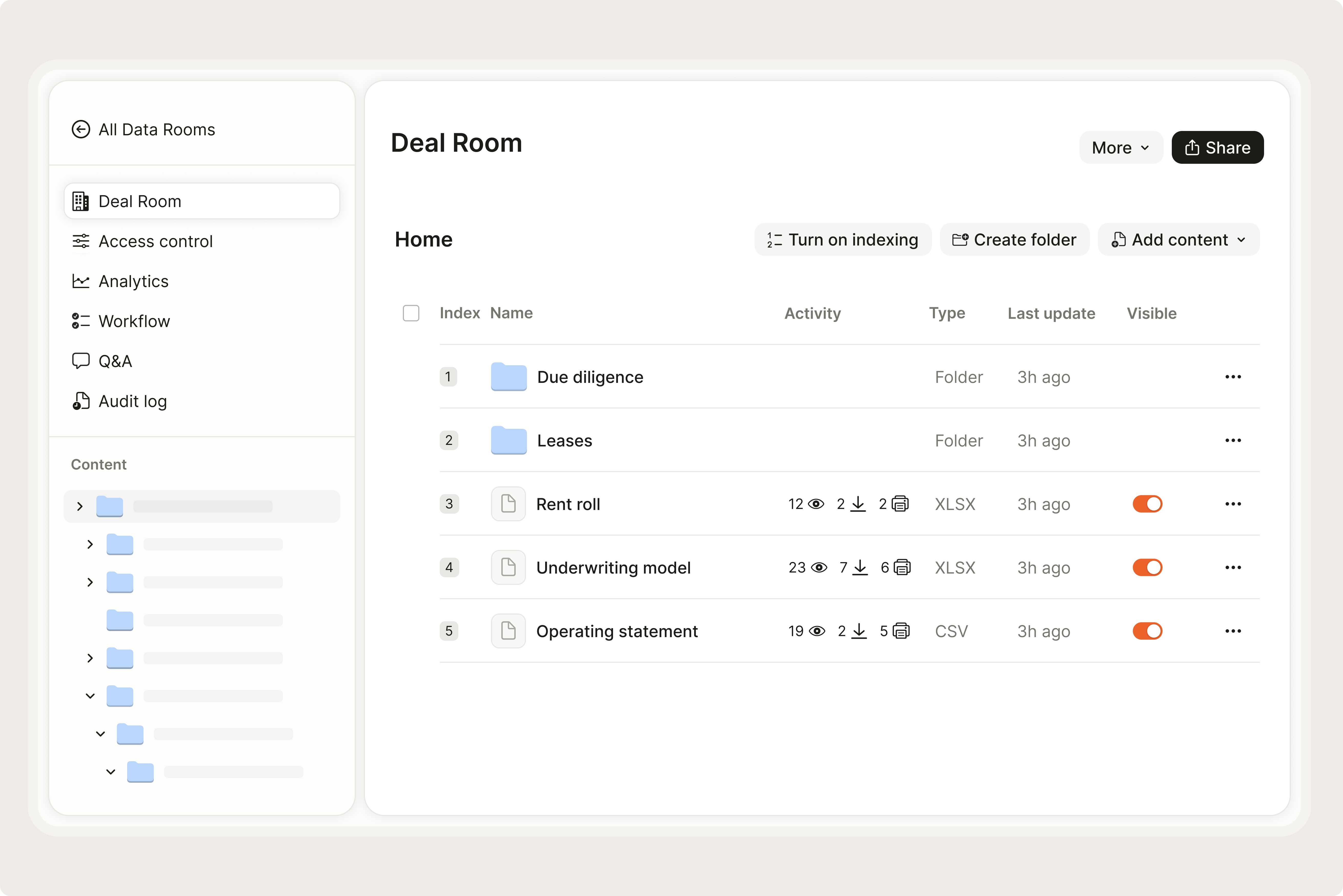
- 1.Upload Texas property files to a secure roomDrop ALTA title commitment, mineral abstract, TCEQ records, Phase I ESA, Harvey flood mapping, deed restrictions, and lease pack into Ellty.
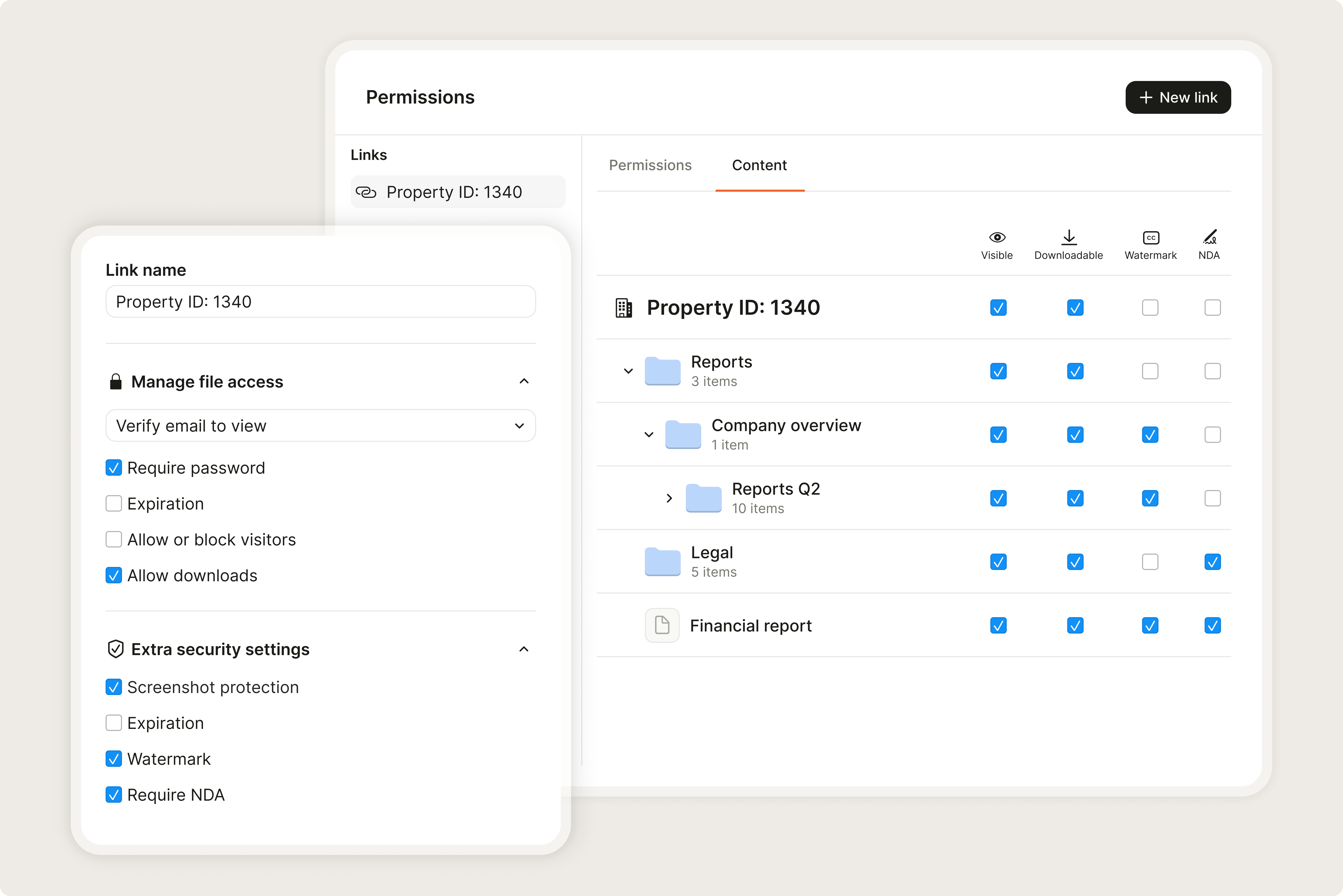
- 2.Give each advisor a scoped, tracked linkTexas attorney and landman see title and mineral docs. Environmental consultant sees TCEQ and Phase I records. Flood risk engineer sees HCFCD records. Ellty enforces the scope.
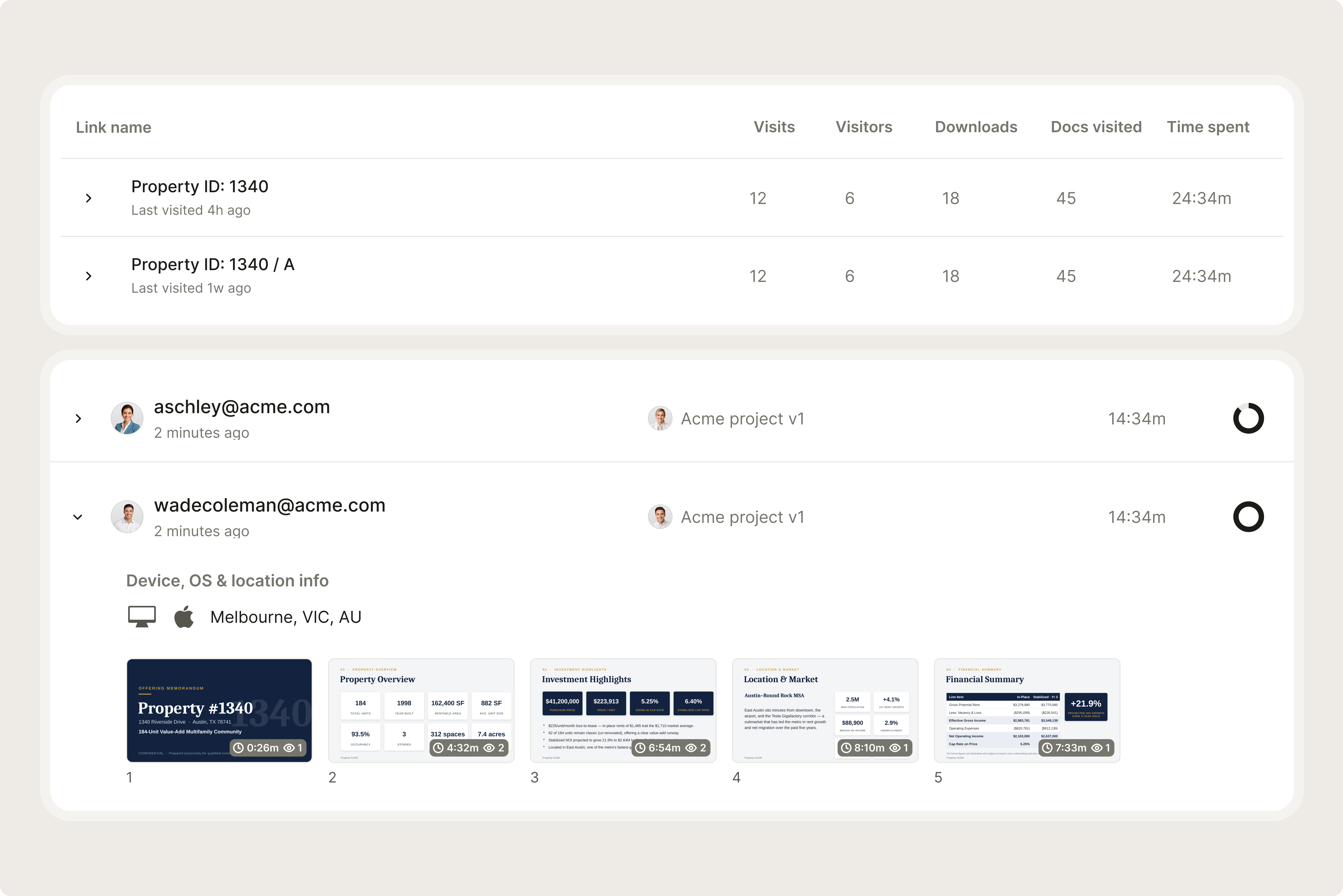
- 3.Monitor who reviews which documentsSee exactly which files each advisor opened and when. Catch mineral rights questions or environmental flags before the formal reports are issued.
What makes Texas different
The mineral rights split is Texas's most distinctive commercial real estate diligence feature. In most US states, when you buy land, you buy everything: surface, subsurface, and mineral rights. In Texas, the mineral estate can be and frequently has been severed from the surface estate; millions of Texas land parcels have separate surface and mineral ownership chains. When you buy a commercial property in Texas without mineral rights, the mineral rights owner has a dominant right of surface access. This is standard in Texas but genuinely surprising to buyers from most other states.
Houston's flood risk is not fully captured by FEMA maps. This is documented, not theoretical. Harvey flooded tens of thousands of Houston commercial properties that were outside the FEMA 100-year floodplain. FEMA maps in Harris County have been updated post-Harvey but still don't fully reflect actual risk in some subwatersheds. The only reliable flood risk assessment for Houston commercial property uses Harvey actual inundation mapping from HCFCD alongside FEMA FIRMs. Both maps together, not one alone.
Texas property taxes are the ongoing operating cost that resets the cap rate math. With no state income tax, Texas relies heavily on property taxes levied by county appraisal districts. Commercial property in the major Texas metros (DFW, Austin, Houston) is regularly assessed at or near market value, and the rates applied to that assessed value run 2-2.5% annually. On a $10M commercial asset, that's $200,000-$250,000 in annual property taxes. For NNN-leased assets, the tenants pay it; for gross-lease or mixed assets, the landlord absorbs it. Model it explicitly.
No state transfer tax in Texas is a genuine cost advantage. On a $50M commercial acquisition, avoiding a 1-2% transfer tax saves $500,000-$1,000,000 compared to California, New York, or most European markets. That cost advantage is real and it's part of why Texas commercial real estate has attracted significant domestic and international institutional capital.
Under Texas law, the mineral estate is a dominant estate. The owner of the mineral estate has the right to use as much of the surface of the land as is reasonably necessary for the exploration, development, and production of minerals, without the consent of the surface owner and without compensation for that surface use, subject to the accommodation doctrine (which requires the mineral lessee to use reasonable care not to unnecessarily damage the surface). When mineral rights have been severed from the surface estate, the buyer of the surface estate receives no rights to oil, gas, or other minerals unless they are expressly included in the conveyance instrument.
Timeline and cost in Texas
Weeks 1-2 cover kickoff: ALTA title commitment order, mineral abstract engagement (for oil-producing areas), TCEQ database search, Phase I ESA commission, Harvey inundation mapping pull (for Houston), deed restriction research (for Houston), CAD property tax record review, and lease abstraction initiation. Legal and landman fees in this phase run USD 5,000-20,000.
Load all files into Ellty before advisors engage. Texas commercial deals move fast; institutional buyers expect 30-45 day close timelines in competitive markets. Centralized document management from day one keeps pace with deal velocity.
Weeks 2-5 cover deep review: Phase I ESA delivery, mineral abstract completion and title opinion, Harvey flood risk analysis, deed restriction compliance confirmation, property tax modeling at acquisition price, lease abstraction, NNN expense reconciliation review, and building condition inspection (including Uri freeze protection review). Costs in this phase: USD 15,000-50,000.
Weeks 5-8 handle resolution: Phase II ESA (if triggered), mineral rights negotiation (if severed minerals create surface use exposure), deed restriction compliance plan, and title exception clearance.
Texas total acquisition costs: no state RETT + ALTA title insurance + recording fees (under $100) + legal fees + landman (mineral abstract). Total acquisition cost runs approximately 1-2% of purchase price - significantly lower than most US states with transfer taxes. The high annual property tax (2-3% of assessed value) is the ongoing NOI cost that must be modeled throughout the hold period.
Running a Texas property deal from one room
Hold ALTA title, mineral documents, TCEQ records, and lease files in one secure, tracked Ellty data room.
Start free 14-day trialCommon questions about due diligence on Texas commercial property
- Texas commercial deals typically close in 30-60 days. ALTA title with mineral abstract, Phase I ESA, deed restriction research (for Houston), and property tax modeling are the main items. Houston flood risk analysis using Harvey inundation mapping adds 1-2 weeks. Deals in competitive Texas markets often target 30-45 day closings; have advisors engaged and parallel-running from day one.
- No. Texas has no state real estate transfer tax on commercial property. Only nominal county recording fees (typically under $100) apply at closing. This is a significant cost advantage over states like New York (RPTT + NYS transfer tax ~2-3%), California (documentary transfer tax), and most European markets. The counterweight is Texas's high annual property tax burden of 2-3% of assessed value.
- Mineral rights are ownership rights to oil, gas, and other subsurface minerals. In Texas, mineral rights can be and frequently have been severed from the surface estate and sold or leased separately. The mineral estate is dominant over the surface estate in Texas, meaning mineral rights holders have the right to access the surface for exploration and production. If a commercial property's mineral rights have been severed, the buyer receives only the surface estate and must accept the mineral rights owner's right to access the surface. Always confirm the mineral rights status before bidding on Texas commercial property.
- Hurricane Harvey (2017) inundated approximately 130,000 structures in Harris County, including many commercial buildings outside the FEMA 100-year Special Flood Hazard Area. Multiple prior Houston flood events (Memorial Day 2015, Tax Day 2016, Tropical Storm Imelda 2019) also exceeded FEMA floodplain boundaries. Harris County Flood Control District (HCFCD) maintains Harvey actual inundation mapping that shows real flooding extent. For any Houston commercial asset, both FEMA maps and HCFCD Harvey inundation maps should be reviewed; FEMA alone is insufficient.
- Houston has no traditional Euclidean zoning ordinance. Permitted commercial use is governed by private deed restrictions (covenants) recorded in county deed records and enforced by neighboring property owners or civic club associations. Before any Houston commercial acquisition, all applicable deed restrictions must be researched and confirmed. Restrictions can prohibit specific business types, hours of operation, signage, or any commercial use. Finding a deed restriction violation after closing can trigger neighbor enforcement actions that force a change of use.
- Texas commercial property taxes are levied annually by county appraisal districts (CADs) at the assessed market value of the property. Texas has no state income tax, so local government revenue is heavily property-tax dependent. Commercial property tax rates in major Texas metros (Houston, Dallas, Austin, San Antonio) typically run 2-2.5% of assessed value annually. Municipal Utility Districts (MUDs) in suburban Houston can push total rates above 3%. After a commercial property sale, the CAD typically reassesses the property to the sale price; model property taxes at the acquisition price throughout the hold period.