Oklahoma commercial property has three checks that exist nowhere else in the same combination: mineral rights that are frequently severed from the surface (Oklahoma Corporation Commission regulates oil and gas rather than Texas's Railroad Commission), induced seismicity from wastewater injection wells that has made Oklahoma one of the most seismically active states in the continental US, and McGirt v. Oklahoma jurisdictional implications in eastern Oklahoma commercial markets including Tulsa.
Oklahoma's mineral estate doctrine mirrors Texas: mineral rights can be and frequently have been severed from surface rights; the mineral estate is dominant. For any Oklahoma commercial property in an oil-producing area, confirm the mineral rights chain of title separately from the surface chain. Oklahoma Corporation Commission (OCC) well and pipeline records must be searched at the county level.
Induced seismicity is Oklahoma's most distinctive commercial real estate physical risk. The dramatic increase in Oklahoma earthquake frequency from 2011 to 2016 - largely attributed to wastewater disposal wells from oil and gas production - made Oklahoma one of the most seismically active states in the country during that period. Peak seismicity years saw multiple M4+ and M5+ events. Activity has declined since 2017 as injection volumes decreased, but Oklahoma's seismic background remains elevated vs. pre-2010 levels. For commercial buildings in high-seismicity counties (Pawnee, Logan, Lincoln, Payne, Garfield): structural seismic assessment for older buildings is a real diligence item.
The McGirt v. Oklahoma Supreme Court decision (2020) and subsequent Oklahoma Supreme Court decisions have confirmed that significant portions of eastern Oklahoma - including the Tulsa metro area - fall within the boundaries of Indian reservations that were never formally disestablished. McGirt doesn't change fee title to property but affects jurisdictional questions for commercial operations in eastern Oklahoma. For commercial real estate in the Tulsa metro and eastern Oklahoma: address McGirt in the legal due diligence.
Set up an Ellty data room before diligence opens. Load ALTA title, mineral abstract, OCC records, ODEQ environmental data, and lease files before advisors arrive.
Where Oklahoma property deals go wrong
Not every check carries the same weight. The table below sorts risks by deal impact - dealbreakers first, then what moves the price, then basic hygiene - so your Oklahoma attorney and technical advisor know what to clear first.
| Area | Documents to pull | OK red flag | Matters most for | Tier | |
|---|---|---|---|---|---|
| Title - ALTA and mineral rights | Title - ALTA and mineral rights | ALTA owner's title commitment, mineral abstract from Oklahoma landman, OCC well and pipeline records, county deed records | Oklahoma mineral rights are separately conveyable; the mineral estate is dominant; OCC regulates oil and gas and maintains well/pipeline records by section-township-range; engage a landman alongside the title attorney for any oil-producing area | All buyers; critical in oil areas | Dealbreaker |
| McGirt tribal jurisdiction - eastern OK | McGirt tribal jurisdiction - eastern OK | Indian country mapping, tribal enrollment records, OTC jurisdiction confirmation, McGirt legal opinion | McGirt v. Oklahoma (2020) and subsequent cases confirmed that Tulsa metro and much of eastern Oklahoma falls within Indian reservation boundaries; fee title is unchanged but tribal jurisdiction affects law enforcement, regulatory oversight, and some tax matters for commercial operations | Tulsa metro, Creek, Cherokee, Chickasaw, Choctaw, Seminole Nation areas | Dealbreaker |
| Induced seismicity risk | Induced seismicity risk | OGS seismicity database, USGS induced seismicity map, structural engineering assessment for pre-1990 buildings | Oklahoma had multiple M4-5+ induced seismic events 2011-2016; elevated seismicity persists in central Oklahoma; for any pre-1990 commercial building in high-seismicity counties, structural seismic assessment is standard practice | Pre-1990 buildings, Pawnee/Logan/Lincoln/Garfield counties | Dealbreaker |
| Environmental - Tar Creek Superfund | Environmental - Tar Creek Superfund | Phase I ESA, ODEQ contaminated sites database, EPA CERCLIS Superfund search, OCC spills database | Tar Creek Superfund site (Ottawa County, Miami/Pitcher area) is one of the most contaminated sites in the US; lead and zinc mining waste (chat piles) created massive heavy metal contamination; commercial development in Ottawa County requires Phase I and likely Phase II ESA | Ottawa County, former mining areas | Dealbreaker |
| PFAS - Tinker AFB and military | PFAS - Tinker AFB and military | EPA PFAS site locator, ODEQ PFAS records, Phase I ESA PFAS addendum, well water testing | Tinker Air Force Base (Oklahoma City metro, Midwest City) has documented PFAS groundwater contamination from AFFF; Altus AFB (western Oklahoma) also has PFAS contamination; commercial properties near these bases require PFAS screening | Properties near military bases; well-water sites | Price-adjuster |
| Oil and gas contamination | Oil and gas contamination | OCC well records, ODEQ petroleum storage tank database, produced water spill records, pipeline ROW records | Oklahoma's extensive oil and gas history (producing since 1897) has left produced water spills, abandoned wells, and pipeline releases across much of the state; any commercial property in an oil-producing county requires OCC records review as part of Phase I ESA | Rural, industrial, oil-producing counties | Price-adjuster |
| Tornado risk - building resilience | Tornado risk - building resilience | Structural engineering report for older buildings, wind-load design review, loss run (10 years), wind-resistant construction confirmation | Oklahoma is in the core of Tornado Alley; Moore (F5 in 1999 and 2013), Tulsa, and OKC metro areas have experienced multiple catastrophic tornadoes; confirm any older commercial building meets current wind-load standards or has been retrofitted | All pre-2000 commercial buildings | Price-adjuster |
| Documentary stamp tax and transfer | Documentary stamp tax and transfer | Oklahoma documentary stamp tax calculation, county clerk recording, ALTA title insurance premium | Oklahoma documentary stamp tax is $1.50 per $500 of consideration (0.3%); no separate mortgage recording tax; closing in Oklahoma is handled by title companies or attorneys; no attorney-only requirement | All buyers | Standard check |
| Insurance and valuation | Insurance and valuation | MAI appraisal, windstorm and hail insurance confirmation, earthquake insurance for seismicity-zone buildings, loss run | Oklahoma commercial wind and hail insurance premiums are elevated due to tornado exposure; earthquake insurance is increasingly required by lenders for commercial assets in high-seismicity counties; confirm coverage before bidding | All | Standard check |
| Leases - energy sector commercial | Leases - energy sector commercial | All lease contracts, energy company tenant credit review, surface use agreement review for any O&G lease on commercial land | Oklahoma City and Tulsa commercial markets have significant energy sector tenant concentration; oil and gas company lease credit has been volatile; review tenant credit quality, lease terms, and sublease rights for energy company tenants | OKC and Tulsa commercial office | Standard check |
| Seller KYC and AML | Seller KYC and AML | Oklahoma SOS entity filing, UBO identification, FinCEN compliance, OFAC screen | Oklahoma energy sector commercial real estate attracts oil and gas industry investment including international capital; run OFAC and sanctions checks on all principals; FinCEN beneficial ownership rules apply to all-cash commercial purchases | All deals | Standard check |
Due diligence on an Oklahoma property?
Set up your Ellty data room before diligence starts.
Start free 14-day trialOklahoma CRE checklist
The table ranked risks by severity. This is the full list to work through, grouped by area.
Title - ALTA and mineral rights
- Order the ALTA owner's title commitment from an Oklahoma-licensed title insurer on day one
- Oklahoma property records are maintained at the county clerk's office; title searches run against the county grantor-grantee index
- For any property in an oil-producing Oklahoma county: engage an Oklahoma landman for a mineral abstract simultaneously with the ALTA title search; the mineral chain of title is a separate research exercise from the surface chain
- OCC (Oklahoma Corporation Commission) oil and gas division maintains well records by legal description (section-township-range); search OCC records for any wells on or near the commercial parcel
- Pipeline rights-of-way recorded with the OCC or county clerk can significantly affect commercial site plans; confirm no pipeline ROW crosses the intended development footprint
- Oklahoma's split estate: even where the commercial property was sold as a single parcel, the mineral rights may have been severed generations ago; a landman who searches the full title chain for mineral conveyances is the right resource
McGirt tribal jurisdiction - eastern Oklahoma
- For any commercial property in the Tulsa metro area or the historic territories of the Five Civilized Tribes (Muscogee Creek Nation, Cherokee Nation, Chickasaw Nation, Choctaw Nation, Seminole Nation): obtain a legal opinion addressing McGirt v. Oklahoma jurisdictional implications
- McGirt v. Oklahoma (2020): US Supreme Court held that the Muscogee (Creek) Nation's historical reservation was never disestablished; subsequent Oklahoma Supreme Court decisions extended this reasoning to the Cherokee, Chickasaw, Choctaw, and Seminole Nations
- McGirt's geographic scope: approximately 43% of Oklahoma's land area may fall within Indian reservation boundaries per the McGirt and subsequent decisions; this includes most of the Tulsa metro area
- What McGirt means for commercial real estate: fee title to non-Indian-owned property is NOT changed; commercial property ownership and transfer are governed by state law. What changes: criminal jurisdiction, some regulatory jurisdiction, and complex questions about taxation and regulatory oversight of commercial activities
- Get an updated legal opinion from an Oklahoma attorney specializing in Indian law before any Tulsa metro or eastern Oklahoma commercial acquisition of material size
Induced seismicity risk
- Search the Oklahoma Geological Survey (OGS) earthquake catalog and the USGS induced seismicity mapping for the property location and county
- Peak Oklahoma induced seismicity: 2015-2016 saw over 900 M2.5+ earthquakes per year; multiple M4+ and M5+ events occurred in Pawnee, Cushing, Fairview, and other areas
- OCC Induced Seismicity Protocol: OCC monitors injection well activity and issues directives to reduce injection volumes when seismic activity increases; confirm whether any OCC seismicity directives are currently in effect in the relevant county
- For any pre-1990 commercial building in Pawnee, Logan, Lincoln, Garfield, Payne, or Kingfisher counties: commission a structural engineering seismic assessment; these buildings predate any seismic design consideration in Oklahoma
- Earthquake insurance: Oklahoma lenders are increasingly requiring earthquake insurance coverage for commercial properties in high-seismicity counties; confirm coverage availability and premium before bidding
Environmental - Tar Creek and oil contamination
- Search ODEQ's contaminated sites database (Brownfields, LUST, and hazardous waste databases) by property address
- Tar Creek Superfund site (Ottawa County): the former Tri-State Lead and Zinc Mining District in the Miami/Pitcher, Oklahoma area is one of the most contaminated US Superfund sites; chat piles (mining waste) with extreme lead and zinc concentrations cover the area; no commercial development in Ottawa County should proceed without Phase I and Phase II ESA
- Oil and gas spills: search OCC's Oil Field Pollution database for any produced water spills or hydrocarbon releases on or adjacent to the commercial parcel; Oklahoma has had thousands of produced water releases that have affected commercial and agricultural land
- Commission Phase I ESA meeting ASTM E1527-21 from an Oklahoma environmental professional with ODEQ and OCC database access
Set up each advisor's access in Ellty. Oklahoma attorney sees title and county clerk records. Landman sees mineral abstract. Environmental consultant sees ODEQ and OCC records. McGirt legal specialist sees jurisdictional analysis. No cross-contamination.
PFAS - Tinker AFB and military bases
- Search EPA PFAS contamination site locator and ODEQ PFAS records for any PFAS sources near the property
- Tinker AFB (Midwest City, Oklahoma County): large military logistics and maintenance base; documented PFAS groundwater contamination from AFFF firefighting foam; the Tinker plume is one of the larger military PFAS plumes in the US; commercial properties in the Midwest City area on private well water require PFAS testing
- Altus AFB (Jackson County, western Oklahoma): confirmed PFAS contamination; relevant for commercial development in the Altus area
- For any commercial property within 3-5 miles of a military installation with documented AFFF use: Phase I ESA with PFAS addendum is required; commission well water testing for private-well dependent sites
Oil and gas contamination
- For any commercial property in Pottawatomie, Pontotoc, Creek, Okmulgee, Seminole, Muskogee, Rogers, or Osage counties: oil and gas production has been ongoing for over a century; produced water spills, abandoned wells, and pipeline releases are documented and common
- Search OCC records for any abandoned oil and gas wells on or near the commercial parcel; Oklahoma has tens of thousands of orphan wells (abandoned wells with no responsible operator) across the state
- Abandoned wells on commercial property are not just environmental risks; they can create liability for the surface owner and must be properly plugged before any development
- OCC Pollution Control Abatement Program: maintains records of oil field pollution complaints and cleanup actions; search by location before bidding
Tornado risk - building resilience
- Oklahoma is in Tornado Alley; the OKC and Tulsa metro areas have experienced multiple significant tornadoes in the past 25 years (1999 Moore F5, 2003 OKC-area tornado outbreak, 2013 Moore EF5)
- For any pre-2000 commercial building: commission a structural engineering inspection and review the wind-load design specifications
- Oklahoma commercial buildings post-2000 are generally built to higher wind-load standards; pre-1980 commercial buildings may have minimal wind resistance design
- Request 10-year loss run to identify any tornado or wind/hail damage claims; frequency of claims is informative for insurance underwriting
Compare Texas's commercial property diligence process when running Southern Plains portfolio acquisitions. Texas and Oklahoma share oil and gas mineral rights complexity, dominant mineral estate doctrines, OCC/RRC oil and gas regulation, and no state income tax structures. Key Oklahoma differences: induced seismicity risk doesn't exist at Oklahoma's scale in Texas; Oklahoma's Tar Creek contamination has no Texas equivalent; Oklahoma's McGirt jurisdictional question affects a significant portion of the state's most important commercial metro (Tulsa) in a way that has no Texas parallel.
Documentary stamp tax and closing
- Oklahoma documentary stamp tax: $1.50 per $500 of consideration (0.3%); filed and paid at the county clerk's office at recording
- No separate mortgage recording tax in Oklahoma; nominal recording fees for deed and mortgage instruments
- Oklahoma commercial closings are handled by title companies or real estate attorneys; no attorney-only requirement
- For complex commercial deals: engage an Oklahoma real estate attorney for contract review and closing supervision; Oklahoma attorneys are commonly involved in commercial transactions
Insurance and valuation
- Commission an MAI appraisal using current OKC or Tulsa commercial market data; Oklahoma commercial market data is available but thinner in secondary markets (Enid, Lawton, Shawnee)
- Wind and hail insurance: Oklahoma commercial wind and hail premiums are elevated compared to non-Tornado Alley states; confirm current premium levels before modeling operating expenses
- Earthquake insurance: for commercial properties in central Oklahoma seismicity counties, earthquake insurance is increasingly required by institutional lenders; confirm availability and premium; some Oklahoma insurers have tightened earthquake underwriting after the 2011-2016 seismicity period
Leases - Oklahoma commercial terms
- Abstract every commercial lease; review energy company tenant credit quality specifically
- OKC and Tulsa commercial office markets have significant energy sector tenant concentration (Devon Energy, Expand Energy [formerly Chesapeake], Williams Companies, ONEOK, ConocoPhillips operations); energy company credit has been volatile with commodity cycles
- For any lease with an energy company tenant: review the lease for industry-standard oil price cycle provisions (expansion/contraction rights, early termination linked to business restructuring)
- Confirm no existing oil and gas surface use agreements on the commercial land that could affect tenant operations or parking
Track all advisor document access in Ellty. If the environmental consultant repeatedly accesses the OCC oil field pollution records alongside the ODEQ database, Phase II scope is likely broadening. Know before the report.
How due diligence works in Oklahoma
Step 1 - Title, mineral abstract, and McGirt
Day one: order ALTA title commitment, engage an Oklahoma landman for the mineral abstract (if oil-producing county), and for eastern Oklahoma/Tulsa assets get a McGirt legal opinion underway. All three are parallel tracks.
The McGirt opinion is not optional for material commercial investments in Tulsa or eastern Oklahoma. The question isn't whether fee title is affected (it isn't) - it's how McGirt affects the regulatory, taxation, and operational environment for the specific commercial use. A specialist opinion from an Oklahoma Indian law attorney takes 2-3 weeks.
Step 2 - Seismicity and environmental
Search OGS earthquake catalog for the property county. For high-seismicity counties or pre-1990 buildings: commission structural seismic assessment in the first two weeks. Commission Phase I ESA simultaneously; Oklahoma-specific databases (OCC, ODEQ) must be covered by the Phase I environmental professional.
For PFAS screening near Tinker or Altus: commission the PFAS addendum to the Phase I at the same time. PFAS testing for private-well dependent sites takes 2-4 weeks for lab results.
Step 3 - Oil and gas contamination and zoning
Search OCC Oil Field Pollution database and abandoned well records for the commercial parcel. For any rural or transitional commercial site: abandoned well plugging status must be confirmed; unplugged orphan wells create environmental liability and development restrictions.
Confirm zoning from the city or county. Oklahoma cities have standard commercial zoning codes; rural county zoning is less consistent.
Load all documents into Ellty. Oklahoma attorney sees title and county clerk records. Landman sees mineral abstract. Environmental consultant sees ODEQ, OCC, and Phase I records. Each advisor tracks their scope.
Step 4 - Tornado and wind insurance
Request 10-year loss run. For any pre-2000 commercial building in OKC or Tulsa metro: commission structural engineering inspection for wind-load review.
Model wind and hail insurance premiums from current market quotes into the operating expense underwriting. Oklahoma commercial wind premiums have increased over the past decade.
Step 5 - Closing
Oklahoma commercial closings are handled by title companies or attorneys. Documentary stamp tax is calculated, filed, and paid at the county clerk's office. The deed is recorded after stamp tax payment.
Oklahoma conveyance fees are among the lowest in the US. Total acquisition costs on an Oklahoma commercial deal run approximately 1-2% of purchase price, excluding environmental remediation.
How to set up your Oklahoma data room in Ellty.
Oklahoma commercial deals involve ALTA title, mineral abstract, OCC records, McGirt legal opinion, ODEQ environmental, seismicity data, and tornado insurance review. Load everything into Ellty before advisors arrive.
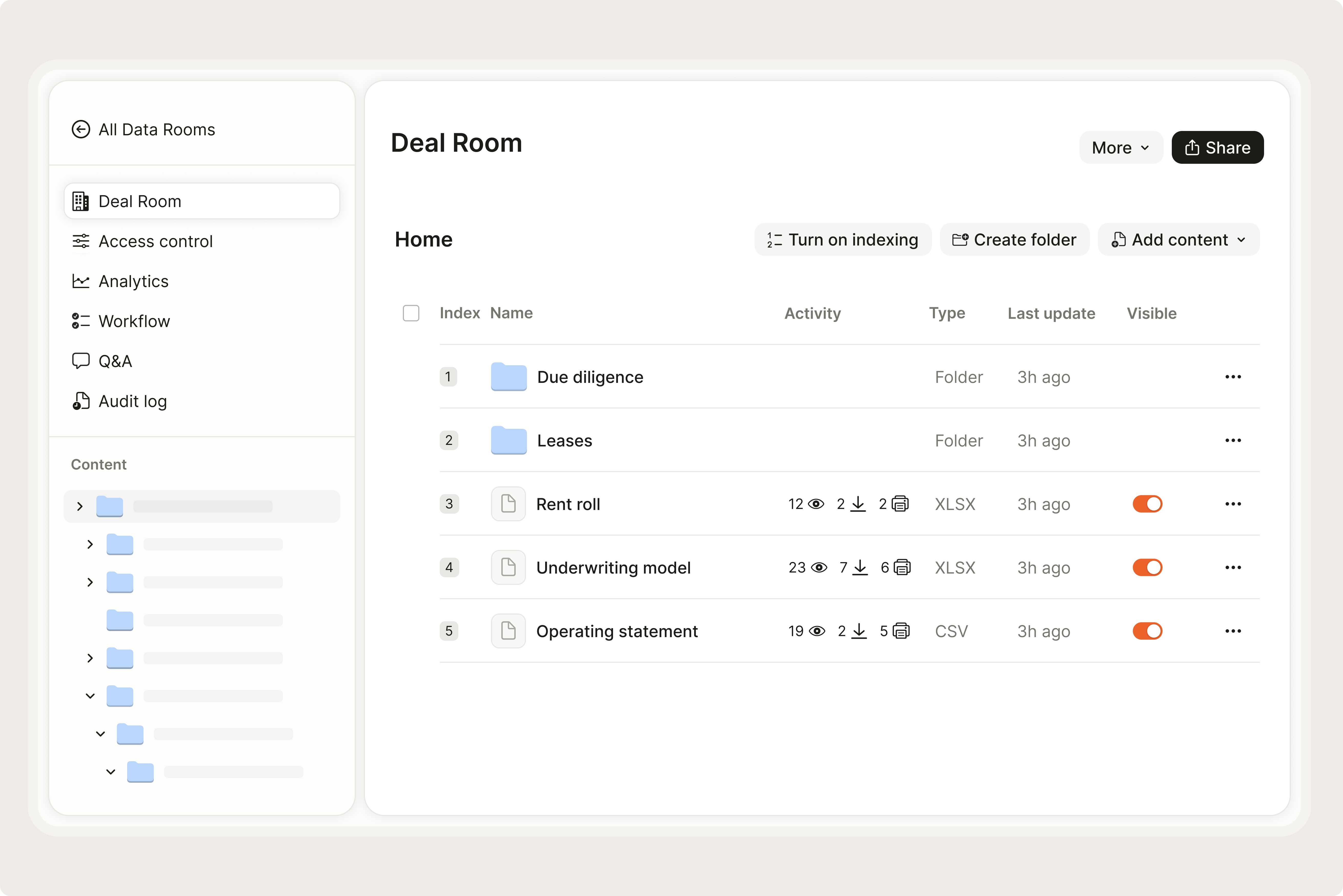
- 1.Upload Oklahoma property files to a secure roomDrop ALTA title commitment, mineral abstract, OCC well/pipeline records, McGirt opinion, Phase I ESA, seismicity data, and lease pack into Ellty.
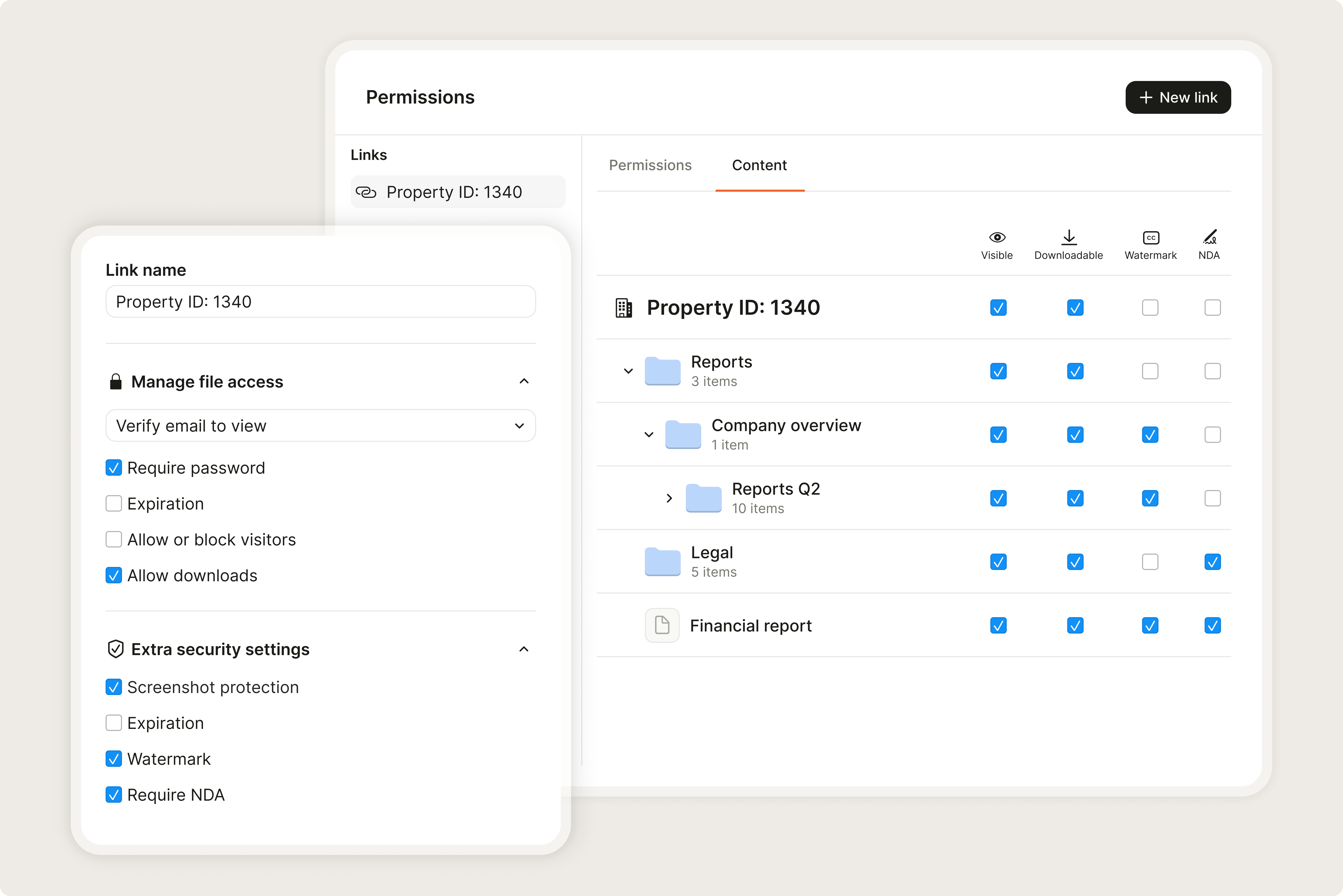
- 2.Give each advisor a scoped, tracked linkOklahoma attorney sees title and county clerk records. Landman sees mineral abstract. Environmental consultant sees ODEQ and OCC records. McGirt specialist sees jurisdictional analysis.
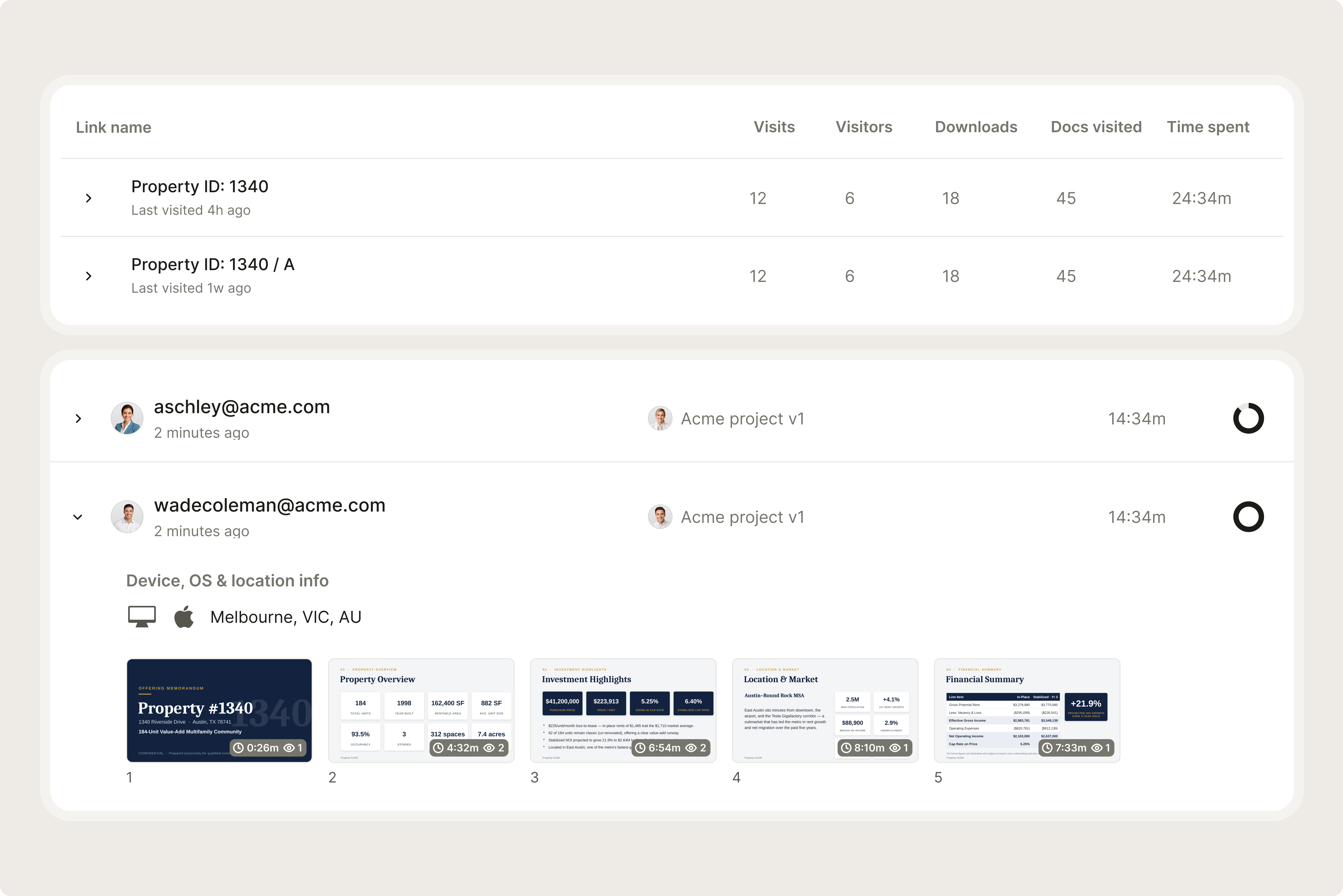
- 3.Monitor who reviews which documentsSee exactly which files each advisor opened and when. Catch mineral rights questions or seismicity concerns before the formal reports are delivered.
What makes Oklahoma different
Induced seismicity is the physical risk that makes Oklahoma commercially distinct from every other major US real estate market except parts of California. Oklahoma went from having near-zero seismic activity to being the most seismically active state in the continental US in 2015, and then partially back down again as injection volumes were reduced. The seismicity hasn't disappeared - it's at an elevated background level that's higher than pre-2010. For buyers of older commercial buildings in central Oklahoma counties with documented seismic history: structural seismic assessment is not optional, and earthquake insurance is increasingly a lender requirement.
McGirt is the jurisdictional question that the commercial real estate market is still working through in 2026. The Supreme Court confirmed in McGirt that Congress never formally disestablished the historical Indian reservations in eastern Oklahoma. The practical implications for commercial real estate are being defined by ongoing litigation and legislative responses. What's clear: fee title to property owned by non-Indians is not affected. What's complex: overlapping regulatory jurisdiction between state, tribal, and federal authority in some commercial activity areas. For any significant commercial investment in Tulsa or eastern Oklahoma, a McGirt-specific legal opinion from an Oklahoma Indian law specialist is worth the cost.
Oklahoma mineral rights require a landman, not just a real estate attorney. Oklahoma's oil production history goes back to 1897; the Osage Nation oil fields, the Seminole oil fields, the Red Fork discovery near Tulsa - a century of oil and gas production means a century of mineral right transfers, oil and gas lease assignments, and pipeline easements recorded in county deed records. Standard real estate title abstractors don't always trace mineral chains with the same rigor they trace surface chains. Engage a specialist landman for any Oklahoma commercial property in an oil-producing county.
Tar Creek is the most contaminated site in Oklahoma's commercial real estate context. The former Tri-State Lead and Zinc Mining District in Ottawa County left chat pile contamination (lead and zinc mine tailings) at concentrations that exceed EPA standards by orders of magnitude. Pitcher, Oklahoma was essentially an abandoned ghost town by 2009, with the federal government buying out remaining residents. Ottawa County commercial development near the former mining district requires Phase I and very likely Phase II ESA; the contamination plume and chat pile locations are well documented.
In McGirt v. Oklahoma (2020), the United States Supreme Court held that the Muscogee (Creek) Nation's reservation, as established by treaty in the 1830s, was never explicitly disestablished by Congress and therefore remains an Indian reservation for purposes of the Major Crimes Act. Subsequent Oklahoma Supreme Court decisions extended the McGirt reasoning to the Cherokee, Chickasaw, Choctaw, and Seminole Nations. These decisions do not affect the fee simple title of non-Indian property owners within the reservation boundaries. They do create concurrent or exclusive tribal jurisdiction over certain matters, including criminal jurisdiction over enrolled tribal members and complex questions about regulatory jurisdiction over commercial activities conducted within reservation boundaries.
Timeline and cost in Oklahoma
Weeks 1-2 cover kickoff: ALTA title commitment order, mineral abstract engagement (for oil-producing counties), OCC well and pipeline record search, McGirt legal opinion engagement (for eastern Oklahoma/Tulsa), ODEQ database search, Phase I ESA commission, OGS seismicity check, and PFAS screening assessment for Tinker/Altus area properties. Legal and landman fees in this phase run USD 5,000-18,000.
Load all files into Ellty before advisors engage. Oklahoma commercial deals can move on 45-60 day timelines; centralized document management from day one keeps pace.
Weeks 2-5 cover deep review: Phase I ESA delivery, mineral abstract and landman opinion, McGirt legal opinion delivery, structural seismic assessment (if triggered), PFAS results (if triggered), OCC oil field pollution review, lease abstraction, wind and hail insurance quotes. Costs in this phase: USD 15,000-45,000.
Weeks 5-8 handle resolution: Phase II ESA (if triggered), abandoned well plugging assessment, seismic retrofit cost modeling (if needed), title exception clearance, and closing preparation.
Oklahoma total acquisition costs: documentary stamp tax (0.3%) + ALTA title insurance + legal fees + landman + environmental. Total acquisition cost runs approximately 1.5-2.5% of purchase price. Oklahoma has no mortgage recording tax and no state income tax, making it one of the lower-cost commercial real estate acquisition environments in the US.
Running an Oklahoma property deal from one room
Hold ALTA title, mineral abstract, OCC records, and lease files in one secure, tracked Ellty data room.
Start free 14-day trialCommon questions about due diligence on Oklahoma commercial property
- Oklahoma commercial deals typically take 30-60 days for non-brownfield assets. Mineral abstract, Phase I ESA, OCC records review, and McGirt legal opinion (for eastern Oklahoma) are the main lead-time items. For Tar Creek area (Ottawa County) assets requiring Phase II ESA, add 4-8 weeks. Structural seismic assessment for pre-1990 buildings in high-seismicity counties adds 2-3 weeks.
- Induced seismicity refers to earthquakes caused by human activity - in Oklahoma's case, primarily wastewater disposal from oil and gas production injected into deep disposal wells. Oklahoma experienced a dramatic increase in seismic activity from 2011 to 2016, reaching multiple M4+ and M5+ events per year and making Oklahoma the most seismically active state in the continental US during those years. Activity has declined since 2017 but remains elevated. For commercial buildings in central Oklahoma counties with documented seismicity history, structural seismic assessment and earthquake insurance are prudent diligence items.
- McGirt v. Oklahoma (2020) is a US Supreme Court decision holding that the Muscogee (Creek) Nation's reservation in eastern Oklahoma was never formally disestablished by Congress. Subsequent Oklahoma court decisions extended the ruling to the Cherokee, Chickasaw, Choctaw, and Seminole Nations, covering approximately 43% of Oklahoma including most of the Tulsa metro area. McGirt does NOT change fee title to commercial property owned by non-Indians. It does create jurisdictional complexity around regulatory oversight, criminal jurisdiction, and some taxation matters for commercial operations in reservation areas. Obtain an Oklahoma Indian law specialist opinion before any material commercial acquisition in Tulsa or eastern Oklahoma.
- Tar Creek is one of the most contaminated Superfund sites in the United States, located in Ottawa County in northeastern Oklahoma. The former Tri-State Lead and Zinc Mining District left massive chat pile (mine tailings) contamination with extremely high lead and zinc concentrations across the Miami and Pitcher, Oklahoma area. Commercial development in Ottawa County near the former mining district requires Phase I and typically Phase II ESA. Pitcher, Oklahoma was essentially abandoned due to contamination. Any commercial property near the Tar Creek Superfund area requires thorough environmental investigation before acquisition.
- Like Texas, Oklahoma allows mineral rights to be severed from surface rights and conveyed separately. The mineral estate is dominant in Oklahoma: mineral rights holders have the right to access the surface for oil and gas exploration and production, including drilling, pipeline, and surface use rights, without the surface owner's consent. For any Oklahoma commercial property in an oil-producing county, engage an Oklahoma landman to trace the mineral chain of title separately from the surface chain, and search OCC records for any active wells, pipeline ROWs, or surface use agreements affecting the commercial parcel.
- Oklahoma documentary stamp tax is $1.50 per $500 of consideration, or 0.3% of the purchase price. On a $5M commercial deal, the documentary stamp tax is $15,000. There is no separate Oklahoma mortgage recording tax. Total Oklahoma commercial acquisition costs run approximately 1.5-2.5% of purchase price, among the lowest in major US commercial real estate markets.