Tennessee commercial property due diligence has two localized hazards that Phase I ESAs regularly miss: karst limestone geology across the Nashville Basin and East Tennessee (sinkholes and subsurface voids require geotechnical investigation before construction, not just after Phase I), and the 2010 Nashville Flood - a documented 1,000-year flood event on the Cumberland River that flooded major commercial areas and permanently changed how lenders model Nashville flood risk.
Tennessee's deed recording tax runs $0.37 per $100 of consideration (0.37%) on commercial property transfers - paid to the register of deeds at recording. Tennessee also charges a mortgage recording tax of $0.115 per $100 of principal debt for any deed of trust recorded at closing. These are real costs that move deal math; the mortgage recording tax on a $10M commercial loan runs $11,500 at closing.
Tennessee's commercial CRE markets divide cleanly: Nashville (Davidson County and surrounding Middle Tennessee) is one of the fastest-growing commercial markets in the southeast with significant office, multifamily, and logistics activity. Memphis (Shelby County) is a major logistics and industrial market anchored by FedEx and port-on-river access. East Tennessee (Knoxville, Chattanooga) has mixed industrial and retail commercial markets.
Tennessee Valley Authority (TVA) is the federal power utility for most of Tennessee and parts of surrounding states. TVA easements and rights-of-way for transmission lines are common on Tennessee commercial parcels; lakefront commercial near TVA reservoirs (Watts Bar, Chickamauga, Fort Loudon, Douglas, Percy Priest) requires TVA shoreline management permits.
Set up a Tennessee real estate data room before advisors engage. Load ALTA title, TDEC VOAP records, karst geotechnical screening, TVA easement records, flood documentation, and lease files before diligence opens.
Where Tennessee property deals go wrong
Not every check carries the same weight. The table below sorts risks by deal impact - dealbreakers first, then what moves the price, then basic hygiene - so your Tennessee attorney and environmental consultant know what to clear first.
| Area | Documents to pull | TN red flag | Matters most for | Tier | |
|---|---|---|---|---|---|
| Title - register of deeds | Title - register of deeds | ALTA owner's title commitment, county register of deeds search, ALTA/NSPS survey, UCC fixture search at TN Secretary of State | Tennessee property records are at the county register of deeds; confirm clear chain of title against all deeds of trust, mechanic's liens, and tax liens; Tennessee is generally treated as an attorney state where real estate attorneys conduct closings; title companies also operate in TN commercial; confirm current practice for the county and transaction size | All buyers | Dealbreaker |
| Karst geology - sinkholes and voids | Karst geology - sinkholes and voids | Geotechnical investigation (borings + ground-penetrating radar for karst), sinkhole screening, TN Geological Survey karst maps | The Nashville Basin (Davidson, Williamson, Wilson, Rutherford, and surrounding Middle TN counties) and East Tennessee (Knox, Blount, Anderson counties near Knoxville) overlie carbonate limestone that produces karst sinkholes and subsurface voids; commercial construction on karst without proper geotechnical investigation has resulted in significant structural failures; standard Phase I ESAs do not evaluate karst risk; commission karst screening for any Middle or East TN commercial construction or redevelopment project | Nashville Basin commercial, East TN commercial | Dealbreaker |
| Environmental - TDEC VOAP brownfields | Environmental - TDEC VOAP brownfields | Phase I ESA (ASTM E1527-21), TDEC VOAP database, TDEC UST database, TDEC Leaking UST (LUST) list, EPA Superfund NPL, RCRA database | Tennessee DEQ (TDEC) operates the Voluntary Cleanup Oversight and Assistance Program (VOAP) for brownfield commercial sites; a VOAP Certificate of Completion provides liability protection for buyers completing cleanup; search TDEC's online database (OneStop) for any VOAP, LUST, or cleanup records before bidding on any TN industrial or former-petroleum commercial site; Memphis industrial corridor and Nashville's Dickerson Pike area have documented contamination | Former industrial, Memphis industrial, Nashville Eastside | Dealbreaker |
| Flood risk - 2010 Nashville flood and Cumberland River | Flood risk - 2010 Nashville flood and Cumberland River | FEMA FIRM, Army Corps Cumberland River study, post-2010 flood records, Tennessee Emergency Management Agency records | May 2010 Nashville Flood: the Cumberland River crested at 51.86 feet (flood stage 40 feet) in a documented 1,000-year flood event; downtown Nashville, the Opryland Hotel and Convention Center, and significant commercial areas in Davidson, Cheatham, and other counties flooded catastrophically; updated FEMA FIRMs post-2010 revised flood zones; commercial lenders in Nashville now routinely require post-2010 flood risk analysis beyond standard FEMA zone confirmation | Nashville metro commercial, Cumberland River corridor | Dealbreaker |
| TVA easements and reservoir shorelines | TVA easements and reservoir shorelines | TVA easement and ROW records, TVA Shoreline Management Initiative records, TVA Section 26a permit history, county register of deeds TVA easements | TVA holds easements and rights-of-way across much of Tennessee for transmission lines, flood control, and reservoir operations; TVA easements are recorded at the county register of deeds and must be identified in the ALTA title search; commercial development on TVA reservoir shorelines (Watts Bar, Chickamauga, Fort Loudoun, Douglas, Percy Priest, Norris) requires TVA Section 26a permits and compliance with TVA's Shoreline Management Initiative, which restricts commercial structures within TVA's flowage easement area | East TN lakefront commercial, TVA transmission corridor | Price-adjuster |
| Zoning - county and municipal | Zoning - county and municipal | Local zoning certificate, Nashville Metro Planning zoning records, conditional use permit, sign ordinance compliance, deed restrictions | Nashville has a consolidated metro government (Nashville-Davidson County Metro); Nashville Metro Planning Commission administers zoning; Brentwood (Williamson County) and Franklin have their own zoning separate from Nashville Metro; confirm whether the property is in Nashville Metro jurisdiction or a separate municipality; Williamson County commercial (Brentwood, Franklin) has separate planning and zoning with different commercial intensity standards | Nashville metro, Williamson County commercial | Price-adjuster |
| Leases and tenancies | Leases and tenancies | All commercial leases, rent roll, estoppel certificates, SNDA agreements, tenant TI allowance records | Nashville office has experienced significant post-COVID lease-up dynamics; confirm current occupancy and lease terms for any Nashville office or mixed-use commercial; Memphis retail and industrial has strong long-term logistics tenant demand but retail tenant quality varies; check co-tenancy clauses in any Tennessee retail lease - anchor vacancies can trigger co-tenancy rent reduction rights | Nashville office, Memphis retail, TN shopping centers | Price-adjuster |
| Deed recording tax and mortgage tax | Deed recording tax and mortgage tax | TN deed recording tax calculation, county register recording fee, TN mortgage recording tax calculation | Tennessee deed recording tax: $0.37 per $100 of consideration (0.37%) paid to the county register of deeds; Tennessee mortgage recording tax: $0.115 per $100 of principal debt on any deed of trust recorded; on a $20M commercial purchase with $15M in financing, total TN recording taxes run approximately $74,000 (deed) + $17,250 (mortgage) = $91,250; model both taxes explicitly in deal economics | All buyers | Standard check |
| Insurance and building condition | Insurance and building condition | Property condition assessment (ASTM E2018), roof and HVAC reports, flood insurance (NFIP or private), tornado/wind coverage confirmation | Tennessee sits in a significant tornado corridor; Tornado Alley extends into middle Tennessee and West Tennessee; confirm wind/tornado coverage on TN commercial; Nashville flood insurance premiums have increased post-Risk Rating 2.0 for properties in revised flood zones post-2010; karst subsidence risk may not be covered by standard commercial property insurance | All TN commercial | Standard check |
| Memphis Mississippi River and MLGW utilities | Memphis Mississippi River and MLGW utilities | Mississippi River flood stage records, Army Corps Memphis District records, MLGW utility capacity records, Memphis Light Gas and Water documentation | Memphis commercial along the Mississippi River faces Mississippi River flood risk; Army Corps Memphis District actively manages river levels; Memphis Light Gas and Water (MLGW) is the unique combined utility serving Memphis commercial (electric, gas, and water from one utility); confirm MLGW utility capacity for any Memphis commercial industrial or data center development | Memphis industrial, Mississippi River corridor | Standard check |
| Seller KYC and AML | Seller KYC and AML | TN SOS entity records, UBO identification, FinCEN GTO compliance, OFAC screen | Nashville has attracted significant domestic and international institutional investment; FinCEN GTOs apply to all-cash purchases in Nashville MSA above threshold; run OFAC and sanctions screens on all principals; confirm TN Secretary of State entity records for all selling entities | All deals | Standard check |
Due diligence on a Tennessee property?
Set up your Ellty data room before diligence starts.
Start free 14-day trialTennessee commercial property due diligence checklist
The table ranked risks by severity. This is the full checklist to work through, grouped by area.
Title - county register of deeds
- Order the ALTA owner's title commitment on day one from a Tennessee-licensed title insurer
- Tennessee property records: maintained at the county register of deeds office; Tennessee has 95 counties each with a separate register of deeds; confirm the correct county before ordering title
- Tennessee uses trust deeds (deeds of trust) rather than mortgages for commercial financing; existing trust deeds must be released before or at closing by a full release/satisfaction deed
- Mechanic's liens: Tennessee has a 90-day mechanic's lien filing period for commercial work; for any recently improved commercial property, confirm no mechanic's liens are pending and obtain lien waivers from all contractors
- Tax liens and sale: Tennessee county trustee offices collect property taxes; unpaid property taxes become a priority lien; confirm no delinquent property tax, special assessment, or utility lien against the property
- UCC fixture filings: search Tennessee Secretary of State UCC database for fixture filings against the commercial parcel
- Commission ALTA/NSPS survey for all significant Tennessee commercial acquisitions
Give each advisor a scoped link in Ellty. TN attorney sees title chain and register of deeds records. Environmental consultant sees TDEC OneStop and Phase I/II. Geotechnical engineer sees karst screening results. Lender sees TDEC VOAP clearance and valuation.
Karst geology - Nashville Basin and East Tennessee
- Determine whether the property is in a karst-prone area using Tennessee Geological Survey maps before proceeding with development planning; the Nashville Basin (Davidson, Williamson, Wilson, Rutherford, Robertson, and surrounding Middle TN counties) and East Tennessee (Knox, Blount, Sevier, Anderson, Roane counties) overlie carbonate limestone that produces karst sinkholes and subsurface solution voids
- Karst risk for commercial development: sinkholes and subsurface voids can open beneath commercial building foundations, pavement, and utility infrastructure with little warning; standard Phase I ESAs (ASTM E1527-21) do not evaluate karst risk; a Phase I that concludes "no recognized environmental conditions" on a Nashville Basin commercial site tells you nothing about karst
- Karst geotechnical investigation: commission a geotechnical investigation specifically addressing karst for any Middle or East Tennessee commercial construction or major redevelopment; karst geotechnical scope typically includes soil borings, rock coring, ground-penetrating radar (GPR) scanning, and potentially electrical resistivity tomography (ERT) to identify subsurface voids before construction
- Foundation design: for commercial construction in karst areas, foundation engineers must design for karst conditions (typically deeper foundations, grouting of identified voids, or structural grade beams to span potential future sinkhole openings); confirm that existing commercial buildings in karst areas have foundations designed for karst conditions
- Tennessee Geological Survey: TDEC's Tennessee Geological Survey maintains publicly available karst geologic maps; check these before commissioning scope
Load all karst geotechnical reports, TDEC environmental records, TVA easement documents, and flood records into Ellty. Environmental consultant and geotechnical engineer each see their relevant files without accessing the other's sensitive data.
Environmental - TDEC VOAP and brownfields
- Commission Phase I ESA meeting ASTM E1527-21 from a TDEC-familiar environmental professional
- TDEC OneStop database: Tennessee DEQ maintains OneStop, a publicly searchable environmental database for VOAP sites, LUST sites, USTs, hazardous waste generators, and other TDEC regulatory programs; search OneStop by address before bidding on any TN commercial property with industrial history
- Tennessee Voluntary Cleanup Oversight and Assistance Program (VOAP): TDEC's brownfield liability protection mechanism; a buyer who completes cleanup under VOAP and receives a Certificate of Completion gets regulatory closure from TDEC for the remediated contamination; the Certificate of Completion is the standard TN brownfield lender clearance document
- Memphis industrial contamination: the Memphis industrial corridor along the Mississippi River and the Shelby County industrial areas have significant contamination legacy from petroleum, chemical, and manufacturing operations; Memphis Phase II ESA is the commercial lender baseline for any former industrial or petroleum-adjacent site
- Nashville's Dickerson Pike and East Nashville: former industrial and auto-related commercial uses in North Nashville and East Nashville corridors have documented petroleum and LUST contamination; routine Phase II ESA for any redevelopment along these corridors
- Leaking USTs: Tennessee has thousands of open LUST cases; search TDEC LUST database for any LUST site on or adjacent to the property before finalizing diligence scope
2010 Nashville flood and Cumberland River risk
- Pull FEMA FIRMs for any Nashville-area commercial property; confirm whether the property is in a revised flood zone based on post-2010 FEMA map updates
- May 2010 Nashville Flood: the Cumberland River crested at 51.86 feet on May 3, 2010 - more than 11 feet above flood stage of 40 feet; the event was classified as a 1,000-year flood; it caused $2 billion+ in property damage in Davidson County alone; Opryland Hotel (1,000+ rooms), downtown Nashville commercial, Bellevue and other suburban commercial areas flooded
- Post-2010 flood zone revision: FEMA updated Nashville-area FIRMs following the 2010 event; confirm which FIRM panel and effective date applies to the property; pre-2010 FIRMs significantly understated flood risk for many Nashville commercial areas
- Commercial lender flood underwriting: Nashville commercial lenders now routinely require elevation certificates and post-2010 flood history review for any Cumberland River tributary commercial, not just properties in designated FEMA special flood hazard areas
- Nashville Riverwalk and East Bank development: Nashville's East Bank redevelopment (including planned Major League Soccer stadium) has significant Cumberland River proximity; confirm flood zone and elevation certificate for any East Bank commercial
TVA easements and reservoir shoreline commercial
- Search the county register of deeds for any TVA easements, rights-of-way, or flowage easement deeds recorded against the property; TVA easements are recorded documents and should appear in the ALTA title search
- TVA easements: TVA holds easements across significant portions of Tennessee for high-voltage transmission lines, flood control, and reservoir operations; transmission line easements typically prohibit construction of permanent structures within the easement corridor and restrict grading, landscaping, and vegetation; these easements are material constraints on commercial development
- TVA reservoir shoreline permits: commercial development within TVA's flowage easement area or on TVA reservoir shorelines (Watts Bar, Chickamauga, Fort Loudoun, Douglas, Percy Priest, Norris, Cherokee, Boone, Watauga, and others) requires TVA Section 26a permits under the Tennessee Valley Authority Act; the permit process adds 3-6 months to commercial development timelines
- TVA Shoreline Management Initiative (SMI): TVA's SMI classifies all TVA reservoir shoreline into management zones from natural resource protection to developed recreation; confirm the SMI zone for any lakefront commercial and what structures and uses are permitted under that zone designation
- East Tennessee lakefront commercial: significant commercial hospitality and marina development exists near TVA reservoirs in East Tennessee; all require TVA Section 26a permits and SMI zone compliance
Track advisor document access in Ellty. If the TVA easement specialist is reviewing the easement language and flowage maps repeatedly, they're building the development constraint analysis. Know before the formal legal opinion comes back.
Zoning - Nashville Metro and county jurisdictions
- Confirm the applicable zoning jurisdiction; in Middle Tennessee, several separate municipalities have separate zoning codes even within the broader metro area
- Nashville-Davidson County: Nashville has a consolidated city-county Metro government; Nashville Metro Planning Commission administers zoning; use Metro Planning's online portal to confirm zoning classification, any overlay districts (Envision Nashville form-based code areas, transit overlay zones), and pending rezoning applications
- Williamson County municipalities: Brentwood, Franklin, Spring Hill, and Nolensville each have their own planning commissions and zoning codes separate from Nashville Metro; Franklin's downtown commercial overlay and Brentwood's commercial zoning are distinct from Nashville's code
- Memphis-Shelby County: Memphis and Shelby County have a unified planning commission; Memphis Code section governs city commercial; unincorporated Shelby County has separate standards
- Tennessee has no statewide land use planning framework like Oregon's DLCD; local zoning varies significantly between Tennessee's major markets
Deed recording tax and mortgage recording tax
- Calculate Tennessee deed recording tax: $0.37 per $100 of consideration (0.37%), paid to the county register of deeds at deed recording; on a $15M purchase, deed recording tax = $55,500
- Tennessee mortgage recording tax: $0.115 per $100 of principal debt on the deed of trust recorded at closing; on a $10M commercial loan, mortgage recording tax = $11,500
- Both taxes are paid at recording and are the responsibility of the buyer in TN commercial custom (though negotiable)
- Tennessee county-specific variations: some Tennessee counties may have minor additional recording fee variations; confirm with the county register of deeds office for the applicable county before finalizing closing cost estimates
- No separate grantor's tax: Tennessee does not have a separate grantor's excise tax on transfers; the deed recording tax at 0.37% is the primary transfer-related cost
Compare Georgia's commercial property due diligence process when running southeastern portfolio acquisitions. Tennessee and Georgia share a southeast US commercial growth profile, but differ significantly on transfer taxes (TN deed recording tax 0.37% vs. GA transfer tax also $1 per $1,000 = 0.10%), environmental brownfield mechanisms (TN VOAP vs. GA Voluntary Remediation Program), and unique localized hazards (TN karst geology and TVA easements have no Georgia equivalent; GA has Atlanta-specific stormwater and tree ordinance issues).
How due diligence works in Tennessee
Step 1 - Title, karst screening, and flood zone
Day one: order ALTA title commitment and simultaneously search TDEC OneStop for any VOAP, LUST, or environmental records. Identify karst zone from Tennessee Geological Survey maps before commissioning Phase I scope.
For Nashville-area commercial: confirm FEMA FIRM and post-2010 flood zone status immediately. For East Tennessee or TVA reservoir-adjacent: search county register of deeds for TVA easements as part of title.
Step 2 - Karst geotechnical and environmental
For Nashville Basin or East Tennessee commercial construction or redevelopment: commission karst geotechnical investigation in parallel with Phase I ESA - don't wait for Phase I to complete before starting karst scope; they run independently.
Commission Phase I ESA with TDEC OneStop, LUST, and UST database review. For Memphis industrial or Nashville Eastside redevelopment: Phase II ESA is standard lender expectation.
Step 3 - TVA, flood, zoning, and leases
For TVA reservoir or transmission-adjacent commercial: pull TVA easement records from county register of deeds; identify TVA SMI zone for lakefront commercial; budget 3-6 months for TVA Section 26a permit if required.
Confirm Nashville Metro or applicable county zoning. Abstract all leases, including co-tenancy clause review for TN retail. Model deed recording tax and mortgage recording tax in closing cost estimates.
Step 4 - Closing and transfer taxes
Calculate deed recording tax (0.37% of purchase price) and mortgage recording tax (0.115% of loan amount). Tennessee commercial closings are handled by attorneys or title companies; confirm closing arrangement and attorney involvement based on lender requirements.
Standard Tennessee commercial diligence: 45-60 days. Nashville karst geotechnical investigation adds 3-5 weeks. TDEC VOAP brownfield clearance: 12-24 months for Certificate of Completion. TVA Section 26a permit: 3-6 months.
Load all files into Ellty before advisors engage. Geotechnical engineer gets karst reports. Environmental consultant gets TDEC OneStop and Phase I/II. TN attorney gets title chain and TVA easements. Flood engineer gets FEMA FIRMs and post-2010 records. Lender gets VOAP certificate and valuation.
How to set up your Tennessee data room in Ellty.
TN commercial deals involve ALTA title, TDEC VOAP records, karst geotechnical reports, TVA easements, 2010 Nashville flood records, zoning docs, and lease files. Load everything into Ellty before advisors engage.
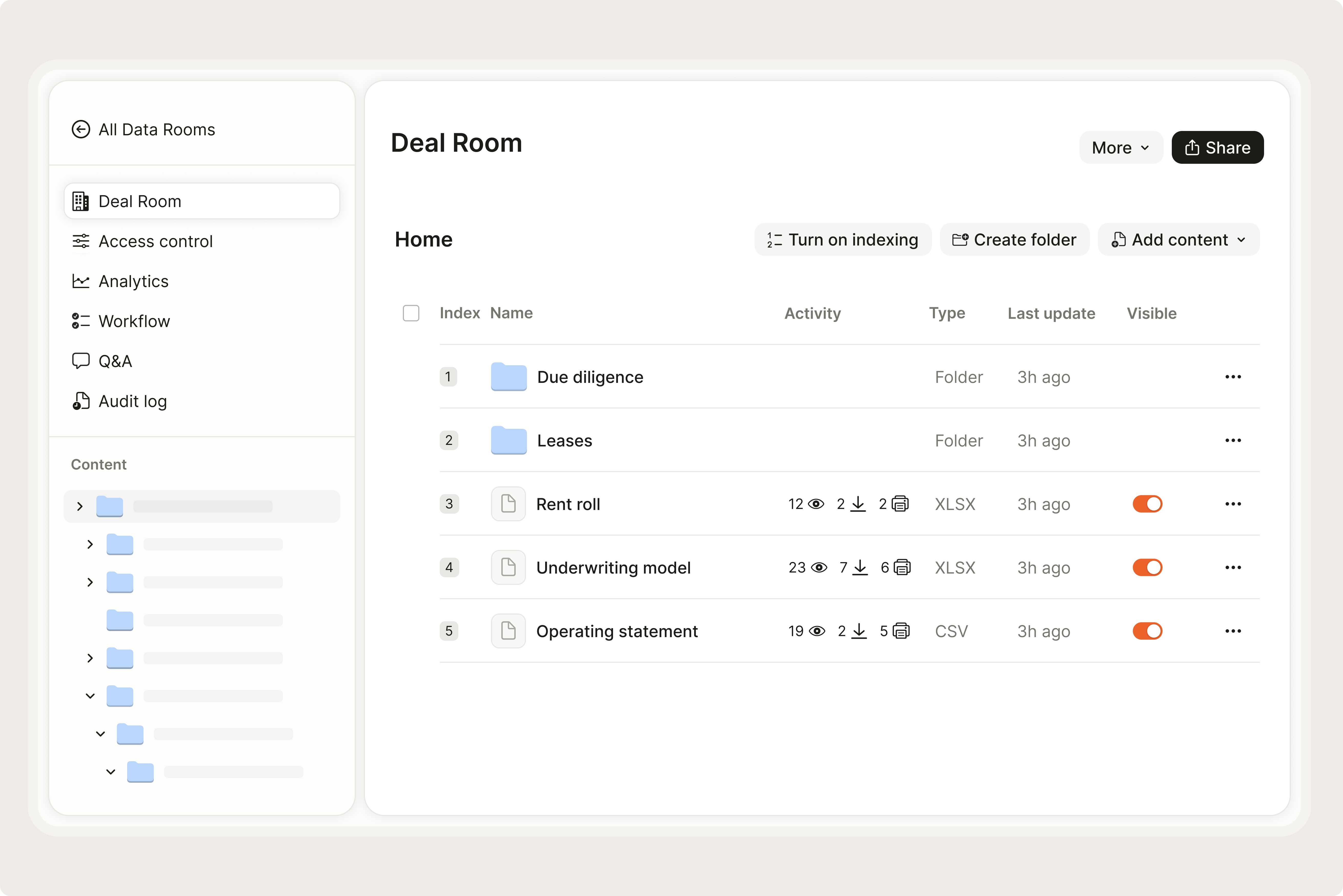
- 1.Upload Tennessee property files to a secure roomDrop ALTA title, TDEC OneStop records, Phase I ESA, karst geotechnical report, TVA easement docs, FEMA FIRMs, post-2010 flood records, and lease pack into Ellty.
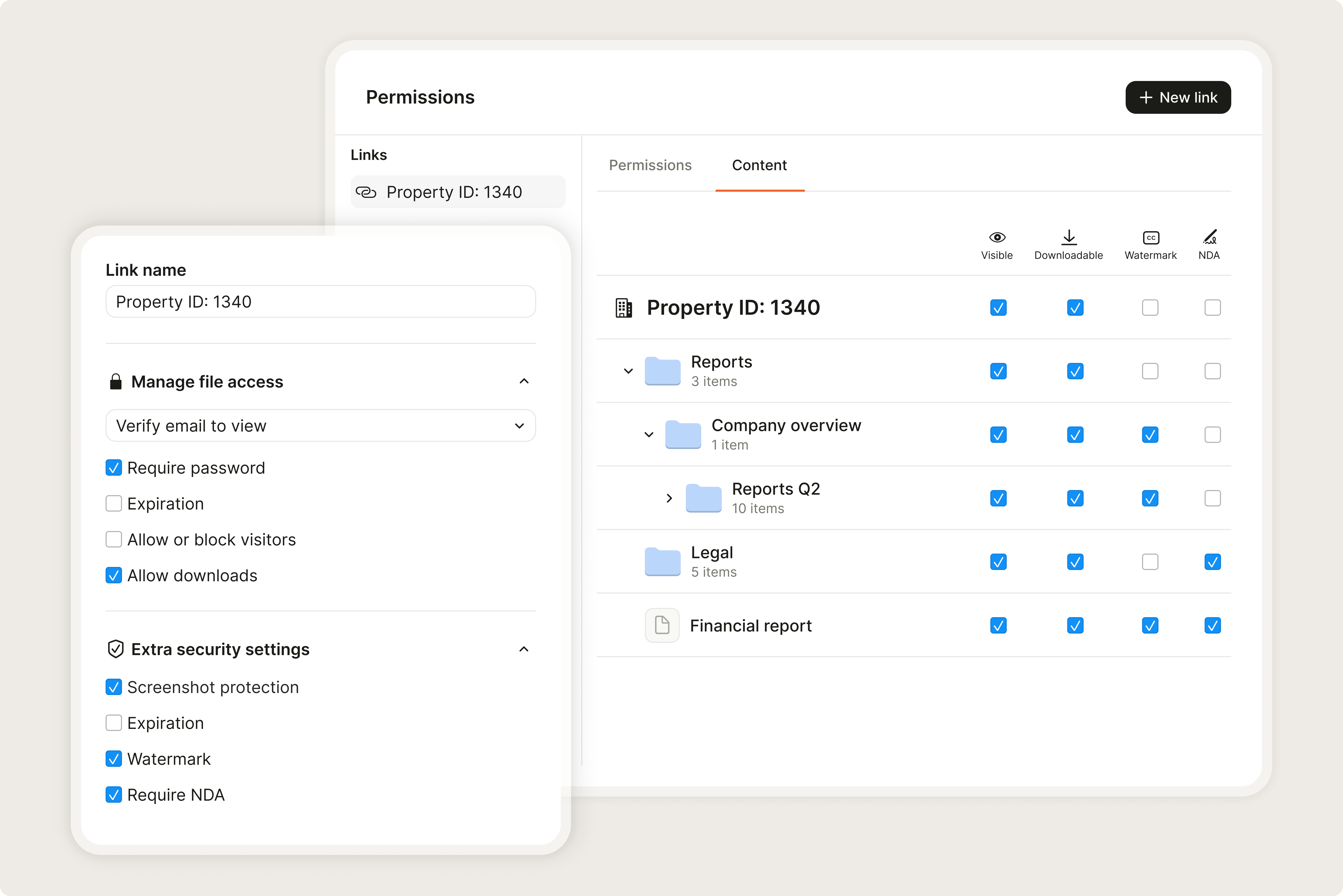
- 2.Give each advisor a scoped, tracked linkTN attorney sees title chain and TVA easements. Environmental consultant sees TDEC records, Phase I/II, and VOAP. Geotechnical engineer sees karst screening and borings. Flood engineer sees FEMA data. Lender sees VOAP certificate and valuation.
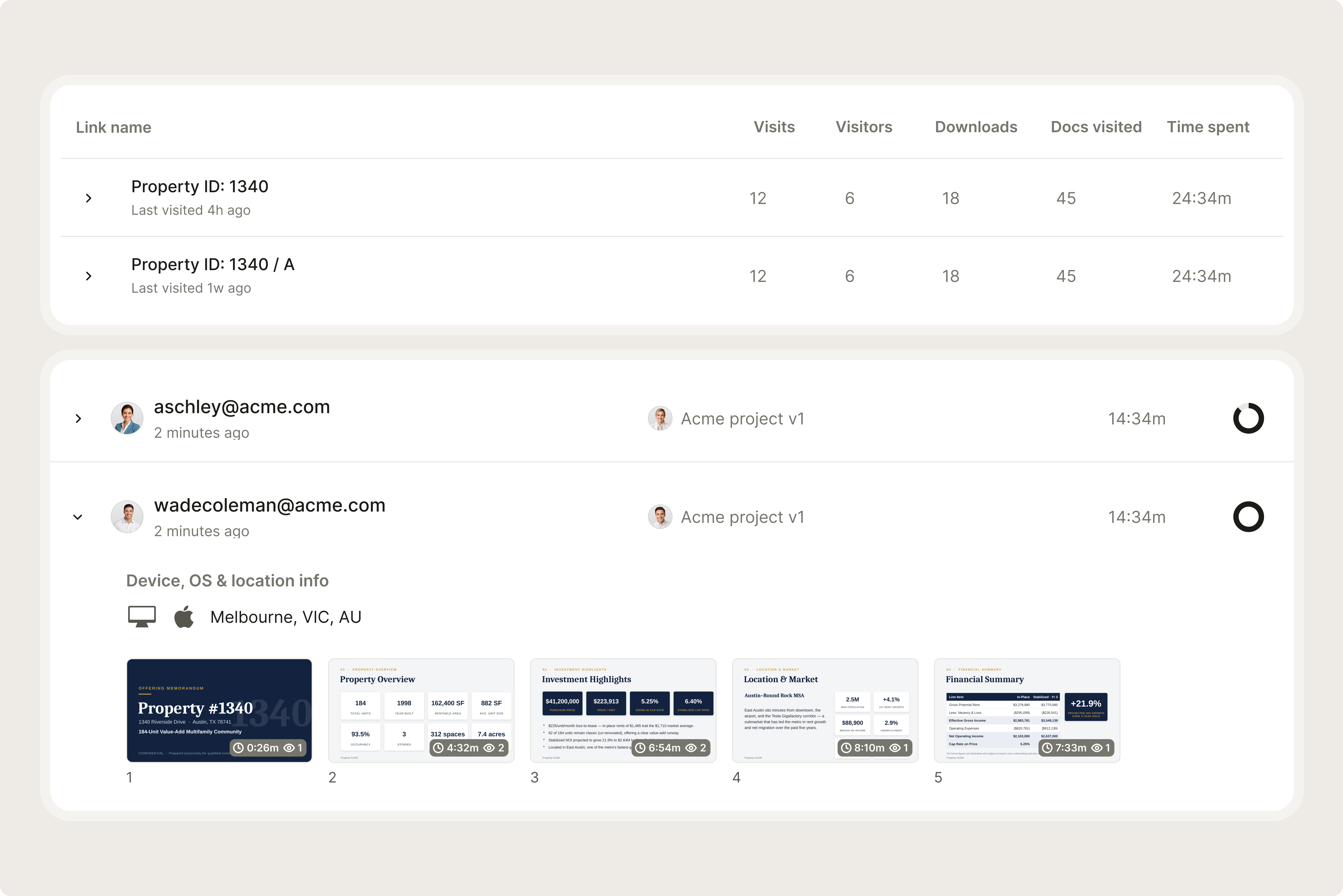
- 3.Monitor who reviews which documentsSee exactly which files each advisor opened and when. Catch karst foundation concerns or TVA easement conflicts before they affect deal pricing or closing.
What makes Tennessee different
Karst limestone geology is the Tennessee commercial hazard that standard Phase I ESAs are not designed to find - and that's the problem. A Phase I ESA (ASTM E1527-21) reviews regulatory databases, interviews, historical records, and site reconnaissance to identify recognized environmental conditions (contamination from petroleum, chemicals, waste). It does not evaluate subsurface geologic hazards. In Tennessee's Nashville Basin and East Tennessee, the limestone bedrock produces sinkholes and subsurface solution voids that can open beneath commercial foundations with little warning. Commercial buildings in the Nashville area have experienced sinkhole events during and after construction. The fix is straightforward: commission a karst geotechnical investigation - borings, rock coring, and GPR scanning - for any Nashville Basin or East Tennessee commercial construction or redevelopment. But the timing matters: start the karst scope as soon as you're under contract, not after Phase I delivers. Karst investigation takes 4-6 weeks and is not on the critical path only if you start it early.
The 2010 Nashville Flood permanently changed how institutional lenders underwrite Nashville commercial flood risk. Before May 2010, many Nashville commercial areas were mapped outside special flood hazard areas on FEMA FIRMs, had no flood insurance requirements, and weren't modeled for significant flood exposure. The Cumberland River's 1,000-year flood event in May 2010 proved those maps were wrong. FEMA updated Nashville-area FIRMs afterward, and commercial lenders now require post-2010 flood zone confirmation and elevation certificates for any Cumberland River tributary commercial - not just properties in revised Special Flood Hazard Areas. For Nashville commercial in areas that flooded in 2010, check whether the property is on the TEMA (Tennessee Emergency Management Agency) post-disaster damage records and whether flood mitigation improvements were made.
TVA's easements are pervasive across Tennessee in a way that surprises buyers from most other states. TVA operates the largest public power system in the US and built dozens of dams across Tennessee's river systems; the transmission infrastructure to distribute that power crosses essentially every Tennessee county. TVA transmission line easements typically run 200-300 feet wide and prohibit permanent structures, significant grading, or tree growth within the easement corridor. For commercial development sites, a TVA transmission easement can eliminate a significant portion of developable area. These easements show up in the title search if you're searching the right county register records - but buyers need to map them against the development footprint before pricing is finalized.
The Nashville Basin of Middle Tennessee is underlain by Ordovician limestone of the Lebanon, Carters, Catheys, and related formations, which are highly susceptible to dissolution by groundwater and formation of karst features including sinkholes, sinking streams, caves, and subsurface solution voids. Development in karst terrain requires careful geotechnical investigation including soil borings, rock coring to characterize void and soil conditions, and often geophysical methods such as ground-penetrating radar (GPR) or seismic refraction to identify subsurface anomalies prior to foundation design. Tennessee Geological Survey mapping shows karst-prone geology across Davidson, Williamson, Wilson, Rutherford, Robertson, and Maury counties in Middle Tennessee, and across Knox, Blount, Anderson, Roane, and Sevier counties in East Tennessee. Foundation failures related to karst subsidence are documented in the peer-reviewed geotechnical literature and in Tennessee engineering records.
Timeline and cost in Tennessee
Weeks 1-2 cover kickoff: ALTA title commitment order, TDEC OneStop search, karst zone screening (Tennessee Geological Survey maps), FEMA FIRM flood zone confirmation (post-2010), TVA easement search from county register of deeds, karst geotechnical investigation commission (Nashville Basin and East TN commercial), Phase I ESA commission (TDEC OneStop databases), zoning confirmation (Nashville Metro or applicable municipality), and lease abstraction initiation. Legal fees in this phase: USD 5,000-15,000.
Load all files into Ellty before advisors engage. Standard Tennessee commercial: 45-60 days. TDEC VOAP brownfield: 12-24 months for Certificate of Completion. TVA Section 26a permit: 3-6 months.
Weeks 2-6 cover deep review: Phase I ESA delivery, TDEC VOAP status confirmation, karst geotechnical investigation delivery (borings, GPR, foundation recommendation), TVA easement mapping and development constraint analysis, Nashville post-2010 flood history review and elevation certificate, Metro/county zoning compliance confirmation, lease abstraction, and insurance/flood insurance quotes. Costs in this phase: USD 10,000-35,000.
Weeks 6-12 handle resolution: Phase II ESA (if triggered), TDEC VOAP enrollment (brownfield), TVA Section 26a permit application (lakefront), karst foundation design (if voids identified), title exception clearance, and closing preparation.
Tennessee total buyer acquisition costs for commercial: deed recording tax (0.37% of purchase price) + mortgage recording tax (0.115% of loan amount) + ALTA title insurance + legal/advisory + environmental (Phase I/II + VOAP) + karst geotechnical. Total buyer transfer-related cost runs approximately 0.40-0.50% of purchase price - moderate for a southeast commercial market.
Running a Tennessee property deal from one room
Hold ALTA title, TDEC VOAP records, karst geotech reports, TVA easements, and lease files in one secure, tracked Ellty data room.
Start free 14-day trialCommon questions about due diligence on Tennessee commercial property
- Standard Tennessee commercial deals take 45-60 days. Nashville Basin or East Tennessee commercial requiring karst geotechnical investigation: add 4-6 weeks. TDEC Voluntary Cleanup Oversight and Assistance Program (VOAP) brownfield clearance: 12-24 months for Certificate of Completion from TDEC. TVA Section 26a permit for reservoir shoreline commercial: 3-6 months. Post-2010 Nashville flood risk analysis and elevation certificate: add 2-3 weeks for Cumberland River corridor commercial.
- Karst geology refers to limestone terrain that is prone to dissolution by groundwater, creating sinkholes, subsurface voids, and caves. The Nashville Basin (Davidson, Williamson, Wilson, Rutherford, and surrounding Middle TN counties) and East Tennessee (Knox, Blount, Sevier, Anderson counties) overlie carbonate limestone susceptible to karst. Commercial construction on karst without proper geotechnical investigation risks foundation failure if sinkholes or voids open beneath the structure. Standard Phase I ESAs don't evaluate karst risk. Commission a separate karst geotechnical investigation - soil borings, rock coring, and GPR - for any Nashville Basin or East TN commercial construction or redevelopment project.
- The May 2010 Nashville Flood occurred when the Cumberland River crested at 51.86 feet - over 11 feet above flood stage - in a documented 1,000-year flood event. Downtown Nashville, the Opryland Hotel and Convention Center, and significant commercial areas across Davidson and surrounding counties flooded catastrophically. FEMA updated Nashville-area FIRMs after the event. Commercial lenders now routinely require post-2010 flood zone confirmation and elevation certificates for any Nashville Cumberland River tributary commercial. The 2010 event reshaped flood risk underwriting for Nashville commercial property.
- TVA (Tennessee Valley Authority) holds recorded easements and rights-of-way for electrical transmission lines, flood control infrastructure, and reservoir operations across much of Tennessee. TVA transmission line easements (typically 200-300 feet wide) prohibit permanent structures, significant grading, and tree growth within the easement corridor. Commercial development on TVA reservoir shorelines requires TVA Section 26a permits under the TVA Act and compliance with TVA's Shoreline Management Initiative (SMI) zone classification. TVA easements appear in county register of deeds records and must be identified in the ALTA title search.
- Tennessee deed recording tax: $0.37 per $100 of consideration (0.37%), paid to the county register of deeds at recording. Tennessee mortgage recording tax: $0.115 per $100 of principal debt on the deed of trust, paid at recording. On a $20M commercial purchase with $15M financing: deed recording tax = $74,000 + mortgage recording tax = $17,250 = $91,250 total recording taxes. There is no separate Tennessee grantor excise tax on commercial transfers.
- TDEC's VOAP is Tennessee's brownfield liability protection mechanism for contaminated commercial site buyers. A buyer who completes cleanup under VOAP to TDEC-approved standards receives a Certificate of Completion that provides regulatory closure from TDEC for the remediated contamination. The Certificate of Completion is the standard Tennessee brownfield lender clearance document required before institutional lenders will fund brownfield commercial acquisitions. Search TDEC's OneStop database for any VOAP or cleanup records before bidding on any Tennessee industrial or former-petroleum commercial site.