Taiwan commercial property due diligence has three localized issues that most foreign buyers underestimate: the Land Value Increment Tax (LVIT) is paid by the seller but directly affects negotiated pricing and deal economics; foreign buyers (including companies with foreign shareholders) require Investment Commission or other government approval for certain commercial acquisitions; and Taiwan is in a high seismic zone requiring structural assessment for pre-1999 buildings.
Taiwan's transfer-related taxes for the seller: Land Value Increment Tax (LVIT, 土地增值稅) charged on the assessed increase in land value since the last transfer at progressive rates of 20-40% of the assessed increment; sellers typically bear this cost but it affects net proceeds and negotiated price. For the buyer: Deed Tax (契稅) at 6% of the assessed building value (not the total transaction price); applies to buildings only; land is not subject to deed tax. Combined with LVIT, total transaction tax burden in Taiwan is significant by Asia-Pacific standards.
Taiwan's land and building registration system is maintained by the Land Administration Bureau (地政事務所, Dìzhèng shìwùsuǒ) of each district; registration uses a cadastral identifier system with lot numbers (地號) for land and building numbers (建號) for buildings; land and building ownership are registered separately and must be checked separately. Taiwan completed a major land registry reform integrating cadastral and ownership records.
Foreign companies and individuals purchasing commercial property in Taiwan must comply with the Land Act (土地法) provisions on foreign land rights; most foreigners (from countries with reciprocal agreements with Taiwan) can purchase commercial property; however, in some land categories (agricultural land, land in restricted areas) foreign purchase is prohibited or requires approval from the Investment Commission (投資審議委員會) under the Ministry of Economic Affairs.
Set up an Ellty data room before diligence opens. Load land registry records, building ownership certificates, LVIT calculation documentation, building permits, seismic assessment records, and lease files before advisors engage.
Where Taiwan property deals go wrong
Not every check carries the same weight. The table below sorts risks by deal impact - dealbreakers first, then what moves the price, then basic hygiene - so your Taiwan attorney and advisor know what to clear first.
| Area | Documents to pull | Taiwan red flag | Matters most for | Tier | |
|---|---|---|---|---|---|
| Land and building registration | Land and building registration | Land ownership certificate (土地登記謄本, Tǔdì dēngjì téngběn), Building ownership certificate (建物登記謄本, Jiànwù dēngjì téngběn), cadastral map (地籍圖, Dìjí tú), land use zoning certificate | Taiwan registers land and buildings separately; both must be checked independently; the land ownership certificate shows land lot (地號), registered owner, area, land use classification, and all encumbrances (mortgages/hypothecs (抵押權), easements (地役權), superficies rights (地上權)); the building ownership certificate shows building number (建號), registered owner, floor plan (建築面積), and encumbrances; confirm ownership of both land and building and that both are in the name of the selling party with no encumbrances that must be cleared at closing | All buyers | Dealbreaker |
| Foreign buyer approval and land categories | Foreign buyer approval and land categories | Land Act (土地法) land category classification, Investment Commission (投資審議委員會) approval status, Ministry of Interior approval (for certain land types), reciprocity agreement confirmation | Taiwan's Land Act restricts foreign purchase of certain land categories: agricultural land, forested land, and land in protected areas (military exclusion zones, water source protection areas, national parks, natural scenic areas) are either prohibited or require government approval; commercial land (建) in urban areas is generally open to foreign purchase from countries with reciprocal agreements; foreign-invested companies (FIEs) with foreign shareholding must confirm their land purchase rights under Investment Commission regulations; confirm the specific land use classification on the land registry certificate before any commercial bid | Foreign buyers, FIEs with foreign shareholders | Dealbreaker |
| Land Value Increment Tax (LVIT) and deal economics | Land Value Increment Tax (LVIT) and deal economics | LVIT calculation from Land Administration Bureau (current assessed land value minus last transfer assessed land value), seller LVIT burden analysis, tax authority (National Taxation Bureau) assessment confirmation | Taiwan's Land Value Increment Tax (LVIT, 土地增值稅) is imposed on the seller on the assessed increase in officially declared land value from the last registered transfer; progressive rates: 20% for increments up to a threshold, 30% for larger increments, 40% for very large increments; LVIT is not a capital gains tax in the Western sense - it is applied to the officially assessed value increment (公告土地現值 minus previous 公告土地現值), not to actual market price appreciation; for land that has been held for many years without transfer, LVIT can be substantial and significantly affects seller net proceeds; buyers should model LVIT as part of negotiated deal economics because it reduces what sellers are effectively willing to accept | All buyers - affects negotiated price | Dealbreaker |
| Building structure - seismic risk | Building structure - seismic risk | Building structural assessment, pre-1999 building seismic compliance review, Construction and Planning Agency (營建署) earthquake safety records, building permit and structural drawings from original construction | Taiwan experienced the devastating 921 Chi-Chi earthquake (September 21, 1999, Mw 7.6) which killed over 2,400 people and collapsed thousands of buildings; the earthquake exposed critical deficiencies in pre-1999 Taiwan construction: soft-story failures (商業建築 where ground floor commercial use with fewer walls created weak floors), inadequate rebar, substandard concrete quality; Taiwan revised building codes after 921 with much stricter seismic requirements; any commercial building built before 1999 requires a seismic structural assessment as standard diligence; lenders financing pre-1999 Taiwan commercial regularly require structural certification | All pre-1999 Taiwan commercial buildings | Dealbreaker |
| Building permit and usage approval | Building permit and usage approval | Building permit (建造執照), building completion certificate (使用執照 - usage permit), building inspection records, Construction and Planning Agency records | Taiwan commercial buildings require a building permit (建造執照) and a final usage permit (使用執照) from the competent municipal building authority (建管機關) before the building can legally be used; the usage permit also specifies the approved use category; any commercial use that differs from the approved usage permit category requires a change-of-use permit; unpermitted changes of use (e.g. residential converted to commercial without permit) create enforcement risk; confirm from the land administration bureau that both building permit and usage permit are in order and that the registered use matches the intended commercial use | All Taiwan commercial | Price-adjuster |
| Encumbrances - mortgages and hypothecs | Encumbrances - mortgages and hypothecs | Land registry encumbrance section (抵押權, 地役權, 地上權 sections of the ownership certificate), mortgage holder release confirmation | Taiwan land and building mortgages (抵押權) are registered in the land registry encumbrance section; maximum mortgage (最高限額抵押) is a common structure in Taiwan where the mortgage covers a maximum amount rather than a specific loan; confirm all registered mortgages and encumbrances; superficies rights (地上權) giving a third party the right to use the land for a defined period can affect commercial development; easements (地役權) for utilities or access may restrict commercial use; obtain releases from all mortgage holders before closing | All buyers | Price-adjuster |
| Deed Tax and transaction costs | Deed Tax and transaction costs | Deed Tax (契稅) calculation based on assessed building value (公告建築物現值), land registry agent fee, land value increment tax assessment from Land Administration Bureau | Taiwan Deed Tax (契稅): 6% of the officially assessed building value (公告建築物現值), which is typically lower than the market building value; applies to the building only (land ownership transfers are not subject to deed tax); paid by the buyer within 30 days of the transfer agreement; separately, the seller pays LVIT on the land; land registration fee of 0.1% of the assessed land and building value is also payable; total buyer acquisition overhead from taxes is typically 1-3% of total commercial deal value (deed tax on assessed building value + registration fees) | All buyers | Standard check |
| Leases and tenancies | Leases and tenancies | All commercial leases, rent roll, lease registration confirmation (for leases over 1 year), tenant occupancy confirmation | Taiwan commercial leases for over 1 year should ideally be registered in the land registry to be fully binding on subsequent owners; unregistered commercial leases may still be protected under Taiwan Civil Code tenant protection provisions but registration is recommended; confirm all commercial leases are registered if over 1 year; confirm tenant identity and rent payment history; for commercial with retail tenants: confirm whether any tenant has a registered operating business license at the address under a different commercial category than approved by the building usage permit | Tenanted Taiwan commercial | Standard check |
| Zoning and urban planning | Zoning and urban planning | City/county urban planning map (都市計畫圖), land use zoning certificate (土地使用分區證明), building setback and FAR requirements, construction easements | Taiwan urban planning designates each parcel into land use zones (商業區 commercial zone, 住宅區 residential zone, 工業區 industrial zone, etc.); a commercial building in a residential zone is not permitted; land in non-urban planning areas (非都市土地) has separate land use category regulations; obtain a land use zoning certificate from the competent city/county government confirming commercial zone designation; for any redevelopment or renovation: confirm floor area ratio (FAR, 容積率) and building coverage ratio (BCR, 建蔽率) compliance | All commercial, especially redevelopment | Standard check |
| Environmental - industrial zones and contamination | Environmental - industrial zones and contamination | Phase I ESA, EPA Taiwan (環境部, Environmental Ministry) contaminated sites database, soil and groundwater contamination list searches | Taiwan's Environmental Ministry maintains a publicly searchable Soil and Groundwater Pollution Control Act (土壤及地下水污染整治法) contaminated sites database; Taiwan has significant industrial contamination legacy from electronics, semiconductor, petrochemical, and heavy industrial operations; Taiwan's major semiconductor and electronics manufacturing areas (Hsinchu Science Park surroundings, Taichung industrial zone, Kaohsiung petrochemical zone) have documented soil and groundwater contamination; search the EPA Taiwan contaminated sites database before bidding on any former-industrial Taiwan commercial | Former industrial commercial, semiconductor zone adjacent | Standard check |
| Seller KYC and AML | Seller KYC and AML | Taiwan Company Registry (公司登記) entity confirmation, UBO identification, OFAC screen, ROC government sanctions check | Confirm seller entity at Taiwan Company Registry (MOEA Bureau of Commerce); for real estate transactions above certain thresholds, lawyers are AML-regulated subject persons in Taiwan; run OFAC screens and confirm no exposure to entities designated under US, EU, or ROC sanction programs; for cross-border transactions, confirm that fund repatriation to the seller is not subject to Taiwan Central Bank foreign exchange controls | All deals, especially cross-border | Standard check |
Due diligence on a Taiwan property?
Set up your Ellty data room before diligence starts.
Start free 14-day trialTaiwan commercial property due diligence checklist
The table ranked risks by severity. This is the full checklist to work through, grouped by area.
Land and building registry search
- Pull land ownership certificate (土地登記謄本) and building ownership certificate (建物登記謄本) from the competent Land Administration Bureau on day one; in Taiwan these are distinct documents for the land lot and the building structure respectively
- Land ownership certificate review: confirms land lot number (地號), registered owner, land area, land use category (地目 or urban planning zone), and all registered encumbrances including mortgages (抵押權), easements (地役權), superficies rights (地上權), and any annotations (注意事項)
- Building ownership certificate review: confirms building number (建號), registered owner, total floor area, completion year, and registered encumbrances; compare the registered floor plan against the physical building to identify unauthorized floor additions or structural changes
- Cadastral map (地籍圖): confirm parcel boundaries, parcel shape, and relationship to neighboring parcels; confirm access road status
- Land use category: confirm from the land ownership certificate that the land is in a commercial zone (商業區) or other zone permitting the intended commercial use; for non-urban land (非都市土地): confirm the land use class designation
Give each advisor a scoped link in Ellty. Taiwan real estate attorney sees land and building registry records. Construction engineer sees building permit and usage permit. Structural engineer sees building drawings and seismic assessment. Environmental consultant sees EPA Taiwan contaminated sites data. Lender sees LVIT documentation and valuation.
Land Value Increment Tax - modeling the deal
- Obtain the LVIT calculation from the competent Land Administration Bureau before finalizing the bid; the Bureau can provide the current officially assessed land value (公告土地現值) and confirm the last registered transfer assessed value
- LVIT rate structure: the assessed increment (difference between current and last-transfer official land values) is taxed at 20% for increments up to 100% of the original value, 30% for increments of 100-200%, and 40% for increments over 200%; for land that has been held for many years in a high-appreciation market (Taipei commercial especially), LVIT can equal 30-40% of the assessed land value increment
- Seller net proceeds modeling: model the seller's net proceeds after LVIT as part of the price negotiation; if the seller's LVIT burden is large, they may accept a lower nominal price that still leaves them with a higher net-of-LVIT amount; or they may be motivated to sell before a reassessment date
- LVIT preferential rate: Taiwan allows a one-time reduced LVIT rate for owner-occupiers selling their primary residence (applies to residential; not to commercial); confirm with Taiwan tax counsel whether any reduced rate or exemption applies
Seismic structural assessment for pre-1999 buildings
- For any Taiwan commercial building with a construction completion date before September 21, 1999 (Chi-Chi earthquake date): commission a structural assessment from a licensed Taiwan structural engineer as standard diligence; this is not optional for institutional buyers
- Pre-1999 building vulnerabilities: soft-story failure (where ground-floor commercial space with few walls creates a structurally weak floor compared to upper floors), inadequate rebar percentage, substandard concrete compressive strength (particularly from 1970s-1980s construction); buildings with these deficiencies may require costly structural retrofitting before being financeable by Taiwan lenders
- Post-1999 Taiwan building codes: the 921 earthquake led to revised Taiwan Building Code (建築技術規則) seismic provisions; post-2000 construction should comply with updated seismic standards; confirm construction completion date from the building ownership certificate
- Insurance: Taiwan commercial property insurance premiums vary significantly with seismic assessment results; inadequate seismic performance can result in higher insurance premiums or reduced insurance availability from Taiwan insurers; model insurance cost before finalizing bid
Load land and building registry records, LVIT documentation, building permits, seismic assessment report, EPA Taiwan contaminated sites records, and lease files into Ellty. Each advisor sees their scoped file set. Track who reviews the structural assessment most closely.
Building permit and usage approval
- Confirm building permit (建造執照) and final usage permit (使用執照) from seller; both should be available from the city or county construction management office (建管機關)
- Usage permit category: the usage permit specifies the approved use category (e.g. B class commercial, D class educational, F class medical); confirm the approved category matches the intended commercial use; any different use requires a change-of-use permit application
- Unauthorized additions: many Taiwan commercial buildings have added floors, extended structures, or internal modifications without building permit amendment; compare the building ownership certificate registered floor area against the physical building; unauthorized additions create enforcement risk from the city building management office
- Illegal partitioning: commercial buildings in Taiwan, particularly older office buildings, are sometimes subdivided into smaller units without building permit amendment; confirm the registered unit configuration against the physical layout
LVIT, deed tax, and registration costs
- Calculate deed tax at 6% of the officially assessed building value (公告建築物現值) from the competent county/city tax authority; this is typically much lower than the market building value and often represents 10-30% of total deal value
- Land registration fee: 0.1% of the combined assessed land and building value; paid to the Land Administration Bureau at registration
- Land registry agent fee: a licensed land registrar (地政士, dikuai shi or land agent) typically handles Taiwan property registration; fee is negotiable but typically 0.1-0.3% of transaction value for commercial
- Seller's LVIT payment: confirm the seller will pay LVIT in full before or at closing; LVIT must be paid before the transfer registration can be completed at the Land Administration Bureau
Compare Singapore's commercial property due diligence process for Asia-Pacific portfolio acquisitions. Taiwan and Singapore are both major Asia-Pacific commercial markets with sophisticated legal frameworks, but differ significantly on foreign buyer restrictions (Singapore ABSD foreign buyer surcharge vs. Taiwan Land Act category restrictions), seismic risk (Singapore minimal vs. Taiwan very high), and transfer taxes (Singapore ABSD up to 60% for foreigners vs. Taiwan 6% deed tax plus LVIT).
How due diligence works in Taiwan
Step 1 - Registry search and LVIT calculation
Day one: pull land ownership certificate and building ownership certificate from Land Administration Bureau, simultaneously request LVIT calculation from the Bureau. Confirm land use zone from city/county urban planning department.
LVIT calculation is the most important economic diligence step - it must be modeled before the bid is finalized, not after.
Step 2 - Building permits, seismic, and foreign buyer status
Request building permit and usage permit from seller. For pre-1999 buildings: commission structural seismic assessment from licensed Taiwan structural engineer.
Confirm buyer's status under Taiwan Land Act for the specific land category. For foreign-invested companies: confirm Investment Commission clearance is not required.
Step 3 - Environmental, leases, and AML
Commission Phase I ESA with EPA Taiwan contaminated sites database review for former-industrial or industrial-zone-adjacent commercial.
Abstract all commercial leases. Confirm lease registration for any lease over 1 year. Run AML/KYC and OFAC screens on all principals.
Step 4 - Deed tax, registration, and closing
Calculate deed tax at 6% of assessed building value. Pay deed tax to competent tax authority. Engage licensed land registrar (地政士) to handle Land Administration Bureau registration.
Load all files into Ellty before closing. Taiwan real estate attorney sees full title chain. Lender sees structural assessment, LVIT documentation, and valuation. Each party sees only their scoped files.
How to set up your Taiwan data room in Ellty.
Taiwan commercial deals involve land and building ownership certificates, LVIT documentation, building permits, usage permits, seismic structural assessments, EPA contaminated sites records, and lease files.
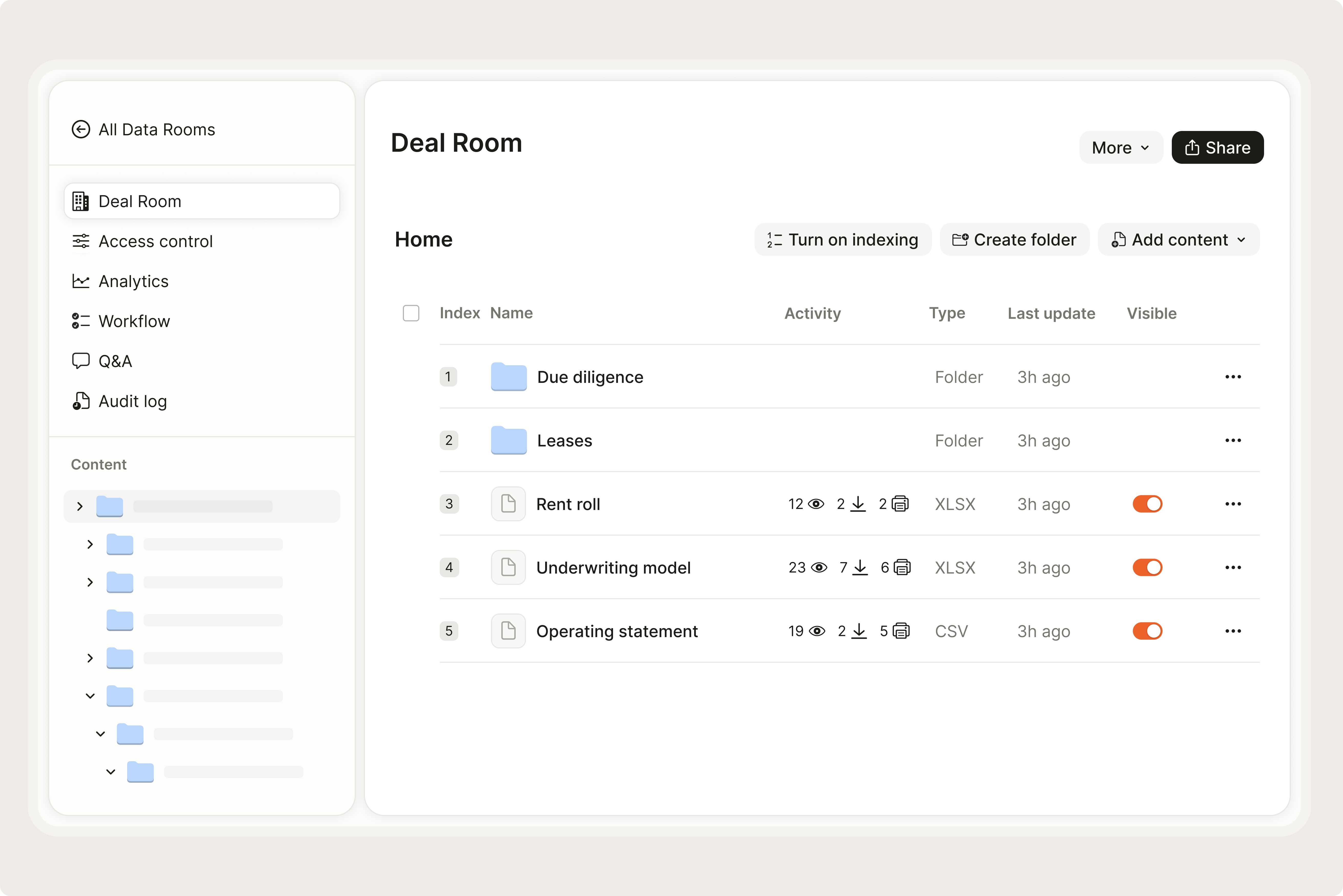
- 1.Upload Taiwan property files to a secure roomDrop land ownership certificate, building ownership certificate, LVIT documentation, building permit, usage permit, seismic structural assessment, EPA Taiwan contaminated sites records, Phase I ESA, and lease pack into Ellty.
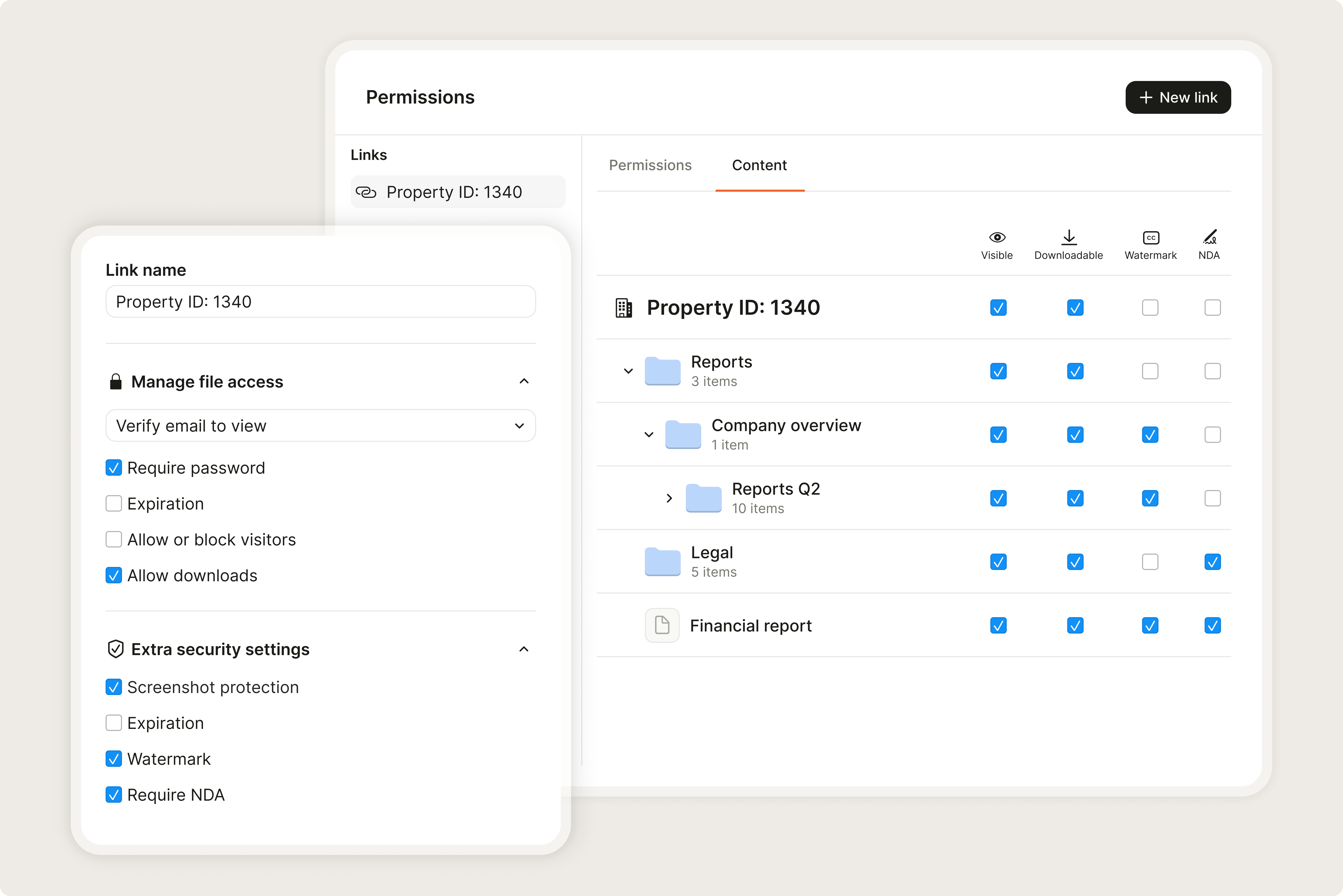
- 2.Give each advisor a scoped, tracked linkTaiwan real estate attorney sees land and building registry. Construction engineer sees building permits and usage permits. Structural engineer sees building drawings and seismic assessment. Environmental consultant sees EPA records. Lender sees LVIT documentation and valuation.
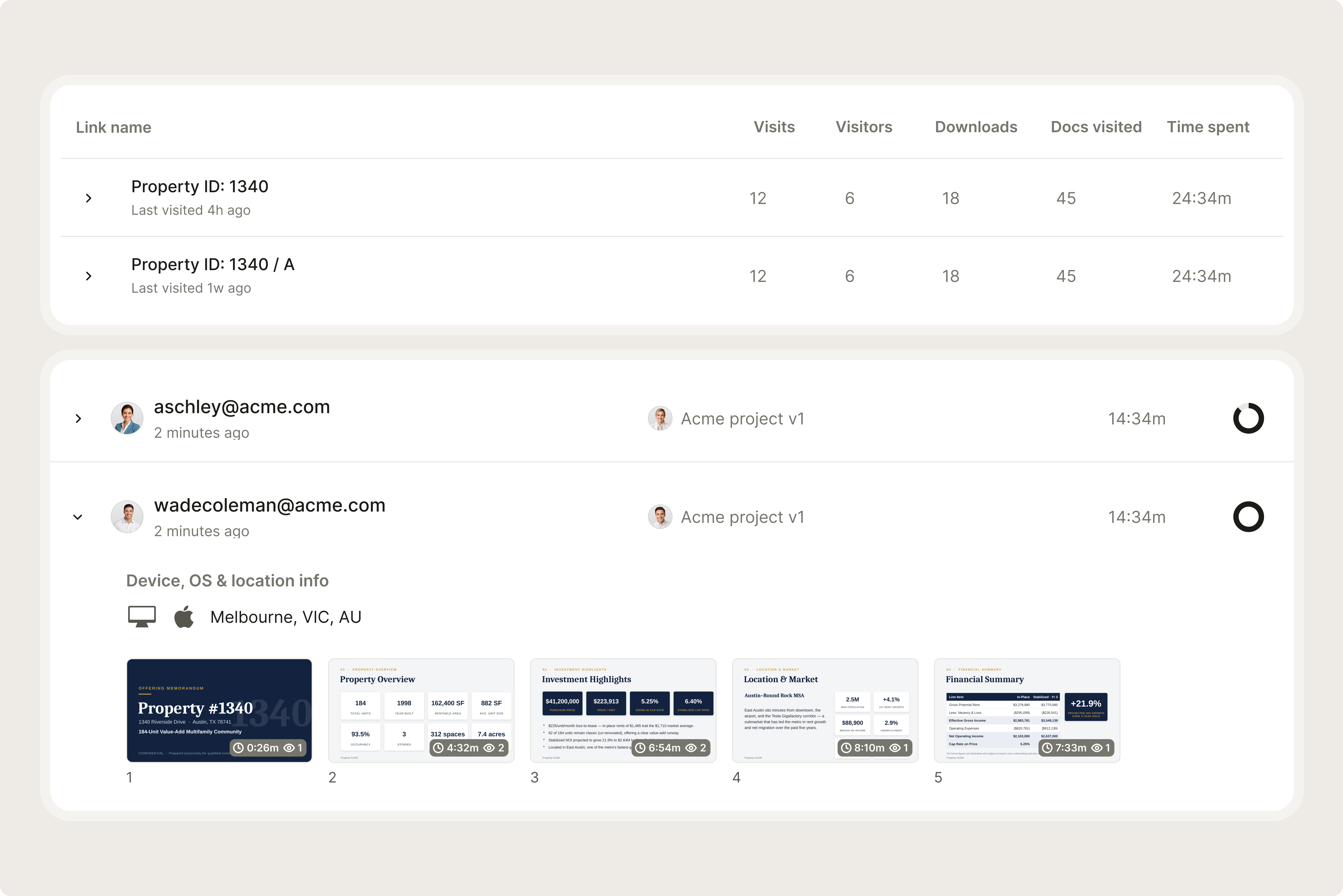
- 3.Monitor who reviews which documentsSee exactly which files each advisor opened and when. Catch seismic vulnerabilities or LVIT calculation surprises before they affect deal pricing.
What makes Taiwan different
Taiwan's Land Value Increment Tax (LVIT) is one of the few major commercial real estate transfer taxes in the world applied to an officially assessed value increment rather than an actual sale price gain. The tax base is the difference between the current official land price (公告土地現值, announced annually by local governments) and the official land price at the time of the last registered transfer, not the difference between the actual purchase price and actual sale price. This creates a situation where the LVIT amount can bear little relation to the actual economic gain on a given sale. In a market like Taipei, where official land values have been periodically revised upward over decades, a seller who bought at market price in 1985 and sells at market price in 2026 may face an LVIT calculated on a large officially-assessed increment that doesn't reflect what they actually netted after inflation. The result is that LVIT is a substantial transaction friction that directly influences deal economics, seller motivation, and timing of property sales in Taiwan. Buyers who don't model LVIT from the outset of the negotiation are likely to misread seller pricing logic.
The 921 Chi-Chi earthquake of September 21, 1999 is the defining structural event in Taiwan commercial real estate risk. The Mw 7.6 earthquake caused 2,416 deaths, injured over 11,000, and destroyed approximately 51,000 buildings. The earthquake exposed specific construction failures that were endemic to Taiwan commercial building practice: soft-story collapses in buildings where the ground floor commercial space had minimal walls and inadequate shear resistance relative to the upper residential or office floors; inadequate rebar ratios (some investigations found rebar with bamboo substitutions in certain buildings); substandard concrete quality; and inadequate connections between structural members. Taiwan revised its Building Code seismic provisions after 921 with substantially higher seismic design requirements. The practical implication for commercial due diligence is straightforward: any building with a construction completion date before September 21, 1999 has an unknown seismic performance profile under current standards unless a structural assessment has been conducted. European and US institutional lenders who have become active in Taiwan commercial lending after 2010 now routinely require seismic structural certification for pre-1999 buildings as a standard underwriting condition.
Taiwan's electronics and semiconductor manufacturing legacy creates localized environmental risk that many foreign buyers of Taiwan commercial underestimate. The Hsinchu Science Park (新竹科學工業園區) and its surrounding municipalities, Taichung industrial zones, and Kaohsiung's petrochemical and shipbuilding corridors have documented soil and groundwater contamination from decades of industrial operations. Taiwan's Soil and Groundwater Pollution Control Act (SGPCA) maintains a publicly searchable contaminated sites database (土壤及地下水污染整治網); the database lists both confirmed contaminated sites (污染控制場址) and remediation sites (污染整治場址). A buyer of any Taiwan commercial property in or near an industrial zone should search this database before commissioning a Phase I ESA to ensure the consultant reviews the Taiwan-specific databases as part of the Phase I scope.
Land Value Increment Tax (LVIT, 土地增值稅) is imposed under the Land Tax Act (土地稅法) on the increase in publicly announced land value (公告土地現值) between successive transfers of land ownership. The tax base is the difference between the current publicly announced land value and the announced land value at the time of the previous registered transfer, multiplied by the land area. Progressive rates apply: 20% for an increment up to 100% of the original value (the announced land value at previous transfer); 30% for increments between 100-200%; 40% for increments exceeding 200%. LVIT is an obligation of the transferring party (seller) and must be paid to the competent tax authority before the Land Administration Bureau will complete the transfer registration. The effective LVIT burden varies significantly depending on how long the land has been held and whether publicly announced land values have increased since the last transfer.
Timeline and cost in Taiwan
Weeks 1-2 cover kickoff: land and building ownership certificate pull from Land Administration Bureau, LVIT calculation request, land use zone certificate from city/county, foreign buyer status confirmation (if non-ROC buyer), building permit and usage permit request from seller, seismic assessment commission (pre-1999 building), EPA Taiwan contaminated sites database search, land registry encumbrance review, lease abstraction, and AML/KYC. Legal fees in this phase: USD 3,000-10,000.
Load all files into Ellty before advisors engage. Standard Taiwan commercial: 30-60 days. Pre-1999 building seismic assessment: 2-4 weeks additional.
Weeks 2-4 cover deep review: land and building certificate analysis, encumbrance clearance plan, seismic structural assessment delivery, LVIT economics modeling, building permit vs. physical building comparison, usage permit category confirmation, Phase I ESA delivery, EPA Taiwan database review, lease registration confirmation, urban planning zone confirmation, and deed tax calculation. Costs in this phase: USD 5,000-20,000.
Weeks 4-8 handle resolution: mortgage releases, usage permit amendment (if needed), land registrar engagement for registration process, deed tax payment, seller LVIT confirmation, and closing registration at Land Administration Bureau.
Taiwan total buyer acquisition costs: deed tax (6% of officially assessed building value, typically 1-3% of total deal value) + land registration fee (0.1% of assessed value) + land registrar fee + legal and advisory fees. Seller pays LVIT (potentially 20-40% of assessed land value increment); seller's LVIT affects negotiated price. Total buyer closing cost is low by Asia-Pacific standards; the major transfer cost sits with the seller.
Running a Taiwan property deal from one room
Hold land registry records, LVIT documentation, seismic assessment, and lease files in one secure, tracked Ellty data room.
Start free 14-day trialCommon questions about due diligence on Taiwan commercial property
- Standard Taiwan commercial property deals take 30-60 days. Seismic structural assessment for pre-1999 buildings adds 2-4 weeks. Land Administration Bureau LVIT calculation: 1-2 weeks. Foreign buyer Investment Commission clearance (if required): 2-8 weeks. Usage permit change-of-use permit: 2-6 months depending on municipality and proposed use. Land registration at closing: 2-4 weeks from deed submission.
- Taiwan's LVIT (土地增值稅) is a seller's tax on the officially assessed increase in land value between successive transfers. Progressive rates: 20% for increments up to 100% of the original assessed value; 30% for 100-200% increments; 40% for increments over 200%. It is applied to official announced land values (公告土地現值), not actual sale prices. For long-held commercial land in Taipei, LVIT can equal 30-40% of the officially assessed land value increment. Buyers must model LVIT as part of deal economics because it significantly affects seller net proceeds and negotiated pricing logic. Obtain the LVIT calculation from the Land Administration Bureau before finalizing the bid.
- Taiwan is in one of the world's highest seismic activity zones. The September 21, 1999 Chi-Chi earthquake (Mw 7.6) caused 2,416 deaths and revealed endemic construction failures in pre-1999 Taiwan buildings including soft-story collapses, inadequate rebar ratios, and substandard concrete quality. Taiwan revised its Building Code seismic standards after 921. Any commercial building completed before September 21, 1999 has unknown seismic performance under current standards without a structural assessment. European and US institutional lenders now routinely require seismic structural certification for pre-1999 Taiwan commercial as a standard underwriting condition.
- Deed Tax (契稅): 6% of the officially assessed building value (公告建築物現值), which is typically much lower than market value; applies to the building only (land does not attract deed tax); paid by the buyer within 30 days of the transfer deed. Land registration fee: 0.1% of the combined officially assessed land and building value; paid to the Land Administration Bureau at registration. Land registrar (地政士) fee: typically 0.1-0.3% of transaction value. Total buyer tax burden is typically 1-3% of total commercial deal value. The seller pays Land Value Increment Tax (LVIT) on the land separately.
- Companies incorporated in Taiwan (including foreign-invested companies with foreign shareholders) can generally purchase commercial land (商業區) in Taiwan without additional approval for most commercial zones. Companies from jurisdictions with reciprocal agreements with Taiwan can purchase commercial property; Taiwan has reciprocal agreements with most major commercial real estate investing countries. Certain land categories (agricultural land, land in military exclusion zones, national parks, water source protection areas) are restricted or prohibited for foreign purchase regardless of reciprocity. Confirm the specific land use category from the land ownership certificate and the applicable rules with Taiwan real estate counsel before any bid.
- Taiwan's main environmental risks in commercial real estate come from its semiconductor, electronics, and petrochemical industrial legacy. Key high-risk areas: Hsinchu Science Park surroundings (semiconductor manufacturing solvent and chemical contamination), Taichung industrial zones, Kaohsiung petrochemical and shipbuilding corridor. Taiwan's Environmental Ministry maintains a public Soil and Groundwater Pollution Control Act database searchable by address. Commission Phase I ESA with specific review of this database for any Taiwan commercial in or near industrial zones. Taiwan's contamination disclosure requirements are less comprehensive than US CERCLA, so Phase I scope must include Taiwan-specific database searches.