South Korea commercial property due diligence is anchored by the real estate register (부동산 등기부, Budongsan Deunggibu), a public online system covering ownership, mortgages, and all encumbrances. Foreign investors need to navigate: acquisition tax at approximately 4.6-5% of declared value, foreign exchange transaction reporting requirements, and urban zoning classifications that govern permitted commercial use.
South Korea acquisition tax (취득세, chwideukse) is the main transfer tax: 4% of the declared acquisition value for commercial property, plus supplemental taxes (농어촌특별세 at 0.2% and 지방교육세 at 0.4%) for a combined effective rate of approximately 4.6% for commercial property acquisitions by corporate buyers; higher combined rates apply for certain luxury or non-residential acquisitions; the acquisition tax is assessed by the local government (시/군/구) based on the transaction amount or standard price, whichever is higher; filed and paid within 60 days of acquisition.
South Korea's real estate register (부동산 등기부, Budongsan Deunggibu) is maintained by district courts and searchable online at the Supreme Court's Internet Register Office (인터넷 등기소, iros.go.kr); the register has three sections: 표제부 (Title Section, piaje-bu: property description including lot number, area, building details), 갑구 (Section A, gap-gu: ownership history and ownership-related claims including provisional attachments/가압류), and 을구 (Section B, eul-gu: mortgages/근저당권 and other encumbrances); title to South Korean real property passes on registration, not on signing the contract; all transfers must be registered to be effective against third parties.
Set up a due diligence data room before advisors engage. Load register extracts, cadastral map, building permit, occupancy certificate, urban planning certificate, foreign investment report documentation, and lease files.
Where South Korea property deals go wrong
Not every check carries the same weight. The table below sorts them by deal impact - dealbreakers first, then what moves the price, then basic hygiene - so your Korean attorney and advisor know what to clear first.
| Area | Documents to pull | South Korea red flag | Matters most for | Tier | |
|---|---|---|---|---|---|
| Real estate register (등기부등본) search | Real estate register (등기부등본) search | Certified register extract (등기부등본, deunggibu deungbon) from iros.go.kr for land and building registers, cadastral map (지적도, jidokdo) and building register (건축물대장, geonchungmul daejang) | Pull the certified register extract (등기부등본) from iros.go.kr - both the land register (토지 등기부) and building register (건물 등기부) for the specific parcel identified by lot number (지번) and road name address (도로명주소); Section 갑구 (gap-gu) shows: current registered owner, prior ownership history, any provisional attachment (가압류, ga-amnyu), provisional disposition (가처분, gacheobun), or ownership-related injunctions; these are critical - a 가압류 or 가처분 in 갑구 can prevent or challenge a valid transfer; Section 을구 (eul-gu) shows: all mortgages (근저당권, geunjeo-dangkwon), leasehold rights registered for deposit protection (전세권, jeonse-gwon), and other encumbrances; confirm ownership in 갑구 matches seller exactly; review all 을구 encumbrances; also pull the Building Register (건축물대장) from the Ministry of Land, Infrastructure and Transport system (세움터, seumteo.go.kr) which shows official building information, approved use, and floor area that may differ from the real estate register | All buyers - foundational check | Dealbreaker |
| Provisional attachment (가압류) and injunctions | Provisional attachment (가압류) and injunctions | Gap-gu (갑구) section of register extract, Korean court records for seller entity (대법원 나의사건 search), seller financial position confirmation | A provisional attachment (가압류, ga-amnyu) registered in 갑구 is a court-ordered freeze on the property at the request of a creditor pending resolution of a debt claim; a provisional disposition (가처분, gacheobun) is a court order preserving the status quo pending litigation; either annotation in 갑구 effectively blocks a clean transfer to a buyer; the seller cannot grant clear title while a 가압류 or 가처분 is in force; these can be registered by courts at the request of creditors or litigants on short notice and can appear on the register between the initial search and the closing; for South Korean commercial: monitor the register until the moment of transfer completion; in practice: pull a fresh register extract on the day of closing before submitting the transfer registration; also confirm the seller entity has no pending insolvency (회생절차) at the Korean courts | All buyers; especially for corporate seller deals | Dealbreaker |
| Foreign exchange reporting and foreign investment | Foreign exchange reporting and foreign investment | Foreign Exchange Transactions Act (외국환거래법, FETA) compliance documentation, Bank of Korea or authorized bank foreign exchange transaction report, foreign real estate acquisition report (해외부동산취득신고) if applicable | Foreign individuals and companies acquiring South Korean real estate must comply with Korea's Foreign Exchange Transactions Act (FETA) and Real Estate Acquisition Act; for foreign buyers: the acquisition fund transfer must comply with FETA reporting requirements; specifically: foreign-sourced funds transferred into Korea for real estate purchase must be reported to an authorized foreign exchange bank; the real estate acquisition must be reported to the Ministry of Land, Infrastructure and Transport (국토교통부) within 60 days of acquisition; failure to comply with reporting requirements creates compliance risk and potential fines; for foreign institutional investors (foreign funds, REITs investing in Korean commercial): Foreign Direct Investment (FDI) registration may be required under the Foreign Investment Promotion Act; confirm FETA compliance approach with Korean legal counsel and the authorized bank before funds are transferred | All non-Korean buyers; foreign institutional investors in Korean commercial | Dealbreaker |
| Urban planning zone and permitted use | Urban planning zone and permitted use | Urban planning certificate (토지이용계획확인원, toji iyong gyehoek hwagin-won) from the relevant local government, National Land Planning and Utilization Act zone classification | South Korean land is classified under the National Land Planning and Utilization Act (국토의 계획 및 이용에 관한 법률) into zones that govern permitted use, FAR, building coverage ratio (BCR), and height limits; key commercial zones: Central Commercial Zone (중심상업지역, FAR up to 1,500%), General Commercial Zone (일반상업지역, FAR up to 1,300%), Neighborhood Commercial Zone (근린상업지역, FAR up to 900%), Entertainment Commercial Zone (유통상업지역, FAR up to 1,100%); the urban planning certificate (토지이용계획확인원) is the official document showing the zone classification, any urban planning facilities designation, and any other restrictions on land use; obtain from the local government or online at LURIS (luris.molit.go.kr); confirm the zone permits the intended commercial use and planned FAR; green belt (개발제한구역, greenbelt zone) designation is a dealbreaker for most commercial development | All Korea commercial; development sites | Price-adjuster |
| Building permit and occupancy certificate | Building permit and occupancy certificate | Building permit (건축허가, geonchuk heoga), occupancy permit (사용승인, sayong seungyin) or pre-use inspection certificate, Building Register (건축물대장) from seumteo.go.kr | South Korean building permits are issued by the local government (시/군/구 level for most commercial; metropolitan city government for larger developments); after construction, the building undergoes a completion inspection (준공검사, jun-gong geomsa) and an occupancy permit (사용승인, sayong seungyin) is issued confirming the building is fit for use; the Building Register (건축물대장) at seumteo.go.kr shows the official building data including: lot number, floor areas, approved use, owner, and inspection history; compare the Building Register building area and use with the Real Estate Register and the physical condition; discrepancies between Building Register approved use and actual current use are common in older Korean commercial buildings and create compliance risk; unlicensed additions (불법 건축물, bulbeop geonchugmul) are flagged in the Building Register and require resolution | All South Korea commercial buildings | Price-adjuster |
| Mortgages and 을구 encumbrances | Mortgages and 을구 encumbrances | Eul-gu (을구) section of register extract, mortgage holder (근저당권자) discharge confirmation, registered lease deposits (전세권, jeonse-gwon) confirmation | All mortgages registered in 을구 (eul-gu) of the Real Estate Register; Korean mortgages are typically registered as maximum mortgage (근저당권, geunjeo-dangkwon) - the registered maximum amount (채권최고액) is typically 120-130% of the actual loan amount; confirm actual outstanding debt versus the registered maximum; obtain discharge (말소) commitment from the mortgage holder confirming release at or before transfer; also check 을구 for registered leasehold rights (전세권, jeonse-gwon): this is a Korean institution where a tenant deposits a large lump sum (전세금) with the landlord in lieu of monthly rent and has a registered right in 을구; registered 전세권 holders have priority over unsecured creditors and must be accommodated at transfer; for commercial leases in Korea: chonsei (전세) structures are less common in prime commercial than in residential, but confirm whether any registered 전세권 exist in 을구 | All buyers | Price-adjuster |
| Commercial leases | Commercial leases | All commercial leases, rent roll, Commercial Lease Protection Act (상가건물 임대차보호법) tenant renewal right status, registered 전세권 or lease deposit protection confirmations | South Korea's Commercial Lease Protection Act (상가건물 임대차보호법, Sang-ga Geonmul Imdaecha Boho-beop): tenants who have occupied commercial premises and received a business registration (사업자등록) for the premises are protected against eviction; qualifying tenants have a right to request lease renewal (계약갱신청구권) which the landlord can only refuse on specific grounds; the renewal period under the Act is up to 10 years total (including the original lease term); this significantly limits a commercial landlord's ability to terminate leases for renovation or redevelopment within the 10-year protection window; review all commercial leases for: tenant's length of occupancy, whether the tenant has business registration at the premises (which triggers Act protection), applicable rent increase cap (the Act caps rent increases at 5% per year), and any court proceedings relating to lease disputes; for prime institutional Seoul commercial leases: these are typically negotiated directly at institutional terms and may have contractually agreed-upon protections above the statutory floor | Tenanted Korea commercial; retail; mixed-use | Price-adjuster |
| Acquisition tax calculation and filing | Acquisition tax calculation and filing | Korean tax counsel acquisition tax calculation, local government standard prices (기준시가) for the property, acquisition tax filing confirmation within 60 days | South Korean acquisition tax (취득세) for commercial property: 4% of the acquisition price plus supplemental taxes (농어촌특별세 0.2% + 지방교육세 0.4%), bringing the effective combined rate to approximately 4.6%; the acquisition tax base is the higher of the reported transaction price and the local government's standard price (기준시가); acquisition tax must be filed and paid within 60 days of the acquisition date; registration of the title transfer requires proof of acquisition tax payment; also confirm if the property acquisition triggers comprehensive real estate tax (종합부동산세, CREIT) obligations for corporate holders; for foreign corporate buyers: confirm CIT implications of holding and eventual disposal of Korean commercial property through the relevant tax treaty (Korea has tax treaties with most major investor countries) with Korean tax counsel | All buyers; especially foreign corporate buyers | Price-adjuster |
| Environmental - industrial and petrochemical zones | Environmental - industrial and petrochemical zones | Ministry of Environment contaminated sites register (토양오염 공개 정보), Soil Environment Conservation Act contamination investigation records for the property, Phase I ESA from Korean environmental consultant | South Korea's major industrial and petrochemical zones - Ulsan (Korea's largest petrochemical complex, also major automotive), Pohang and Gwangyang (steel), Yeosu (petrochemical), Geoje (shipbuilding), and Incheon port industrial zones - have significant environmental contamination legacy from decades of heavy industrial use; South Korea's Soil Environment Conservation Act (토양환경보전법) governs contaminated site investigation and remediation; the Ministry of Environment maintains a database of contaminated sites and remediation orders; for commercial on or adjacent to former industrial land in these zones: Phase I ESA and review of Ministry of Environment contamination records is standard; also check for any soil contamination investigation orders (토양오염 정밀조사 명령) registered against the property which can be found through the local government or Ministry of Environment records | Ulsan, Pohang, Yeosu, Geoje, Incheon port commercial and industrial | Standard check |
| Seller KYC and AML | Seller KYC and AML | Korean Business Register (사업자등록증, saeopja deungnokjeung) or Corporate Register (법인등기부등본, beobin deunggibu deungbon) for seller, UBO confirmation, OFAC/UN sanctions screens | Korea's AML law (특정 금융거래정보의 보고 및 이용 등에 관한 법률) requires real estate transaction reporting by certain parties; Korean attorneys and real estate brokers involved in real estate transactions are subject to AML reporting obligations; confirm seller entity using the Corporate Register (법인등기부등본, beobin deunggibu deungbon) from iros.go.kr; identify UBOs; run OFAC, UN, and EU sanctions screens on all principals; for Korean sellers: check the Korean National Tax Service (국세청, NTS) for any tax lien information; Korean tax authorities can register liens on real property for tax debt which may not appear immediately in the real estate register | All deals; corporate sellers | Standard check |
Due diligence on a South Korea property?
Set up your Ellty data room before diligence starts.
Start free 14-day trialSouth Korea commercial property due diligence checklist
The table ranked risks by severity. This is the full checklist to work through, grouped by area.
Real estate register search and title
- Day one: search iros.go.kr for the property's Real Estate Register (부동산 등기부); identify the property by both lot number address (지번 주소) and road name address (도로명주소); pull both the land register (토지 등기부) and building register (건물 등기부) certified extracts (등기부등본)
- Gap-gu (갑구) review: confirm current registered owner matches the seller; review the entire ownership history in 갑구; identify any provisional attachment (가압류), provisional disposition (가처분), or ownership injunction; any such annotation in 갑구 must be cleared before transfer is possible
- Eul-gu (을구) review: list all mortgages (근저당권) with registered maximum amounts and mortgage holders; identify any registered 전세권 (leasehold deposit rights); confirm discharge plan for all 을구 encumbrances before closing
- Cross-check with Building Register (건축물대장) at seumteo.go.kr: confirm building area, approved use, number of floors; flag any unlicensed additions (불법 건축물) noted in the Building Register
Give each advisor a scoped link in Ellty. Korean attorney sees register extracts and Building Register. Building inspector sees building permit and occupancy certificate. Environmental consultant sees Ministry of Environment records and Phase I ESA. Lender sees register extract, tax payment confirmation, and lease pack. Each party sees only their files.
Foreign exchange and FETA compliance
- Confirm buyer entity type and nationality: Korean commercial real estate can be acquired by foreign individuals and companies subject to reporting requirements; confirm with Korean legal counsel whether the specific buyer type requires Foreign Direct Investment registration under the Foreign Investment Promotion Act
- For fund transfers into Korea to fund the acquisition: the transfer must be reported to an authorized foreign exchange bank in Korea under FETA; the fund transfer path (routing through Korean bank account, use of authorized channel) must be structured with the authorized bank before transfer
- Within 60 days of closing: file the real estate acquisition report (외국인 부동산취득 신고) with the Ministry of Land, Infrastructure and Transport (국토교통부) through the Real Estate Transaction Management System (RTMS, 부동산거래관리시스템); the required information includes buyer details, seller details, property details, transaction amount, and financing information; penalties apply for non-filing or late filing
- Confirm the applicable Korean tax treaty for the buyer's home country; Korea has comprehensive tax treaties with most OECD countries affecting withholding tax on rental income and capital gains on disposition; structure the holding vehicle with Korean tax counsel to optimize treaty benefits
Load all files into Ellty before advisors engage. Korean attorney sees FETA compliance documentation. Tax counsel sees treaty analysis and acquisition tax calculation. Lender sees all register extracts. Foreign exchange bank sees funds transfer documentation.
Building compliance and use confirmation
- Request building permit (건축허가) from seller; verify with local government building authority (건축과, geonchuk-gwa) at the si/gun/gu level; the permit will show the approved use, FAR, BCR, and building scope
- Request occupancy permit (사용승인) from seller; verify with local government; the occupancy permit is the final official confirmation that the building was completed in compliance with the permit and is fit for its designated use
- Check the Building Register (건축물대장) on seumteo.go.kr for any flagged violations (위반건축물); any violation flag means unauthorized construction, additions, or use change has been detected; the owner must remedy violations to clear the flag; violations can prevent sale or financing
- For any building modification or addition after original construction: confirm separate building permits were obtained; unauthorized additions to commercial buildings in South Korea are a common finding in older stock
Compare Japan's commercial property due diligence process for Northeast Asian portfolio strategy. South Korea and Japan are neighboring developed Asian markets with deep institutional commercial sectors; key differences: South Korea (KRW currency, real estate register through courts at iros.go.kr, acquisition tax 4.6-5%, Commercial Lease Protection Act tenant rights) vs. Japan (JPY, Legal Affairs Bureau registry at touki.moj.go.jp, no acquisition transfer tax but 2% registration tax, FEFTA foreign investment screening for certain asset types); Seoul's prime office cap rates and Tokyo's prime office cap rates have historically tracked different pricing levels reflecting different risk and liquidity profiles.
How due diligence works in South Korea
Step 1 - Register search and title
Day one: pull certified extracts from iros.go.kr for both land and building registers. Check 갑구 for provisional attachments and ownership injunctions. Check 을구 for all mortgages and 전세권. Cross-reference with Building Register at seumteo.go.kr.
For any 가압류 or 가처분 in 갑구: full stop - confirm clearance timeline with Korean counsel before proceeding.
Step 2 - FETA compliance and urban planning
Structure FETA compliance approach with authorized Korean bank and Korean legal counsel before funds are transferred. Obtain urban planning certificate (토지이용계획확인원) from local government or LURIS system. Confirm zone classification and FAR for the property.
Request building permit and occupancy certificate. Check Building Register for any violation flags.
Step 3 - Leases, acquisition tax, and AML
Abstract all commercial leases. Check each tenant for Commercial Lease Protection Act coverage (business registration at the premises and total occupancy period). Confirm 전세권 registered leasehold deposits in 을구. Calculate acquisition tax with Korean tax counsel. Confirm seller corporate register and UBO. Run OFAC and sanctions screens.
Step 4 - Transfer and registration
Korean commercial property transfer: the purchase contract (매매계약서) is signed, then the transfer registration is submitted to the district court KW section by a licensed 법무사 (judicial scrivener) within the required timeline; the transfer registration requires proof of acquisition tax payment; upon registration in 갑구, the buyer becomes the registered owner effective against third parties; pull a fresh register extract on the day of registration submission to confirm no new attachments or injunctions were registered between diligence and closing.
Load closing files into Ellty before the transfer registration date. Korean 법무사 sees all required transfer documents. Tax counsel confirms acquisition tax payment receipt. Lender sees post-closing register extract with buyer registered in 갑구.
How to set up your South Korea data room in Ellty.
South Korea commercial deals involve certified real estate register extracts (land and building), Building Register (건축물대장), urban planning certificate, building permit, occupancy permit, FETA compliance documentation, environmental records, and all commercial leases.
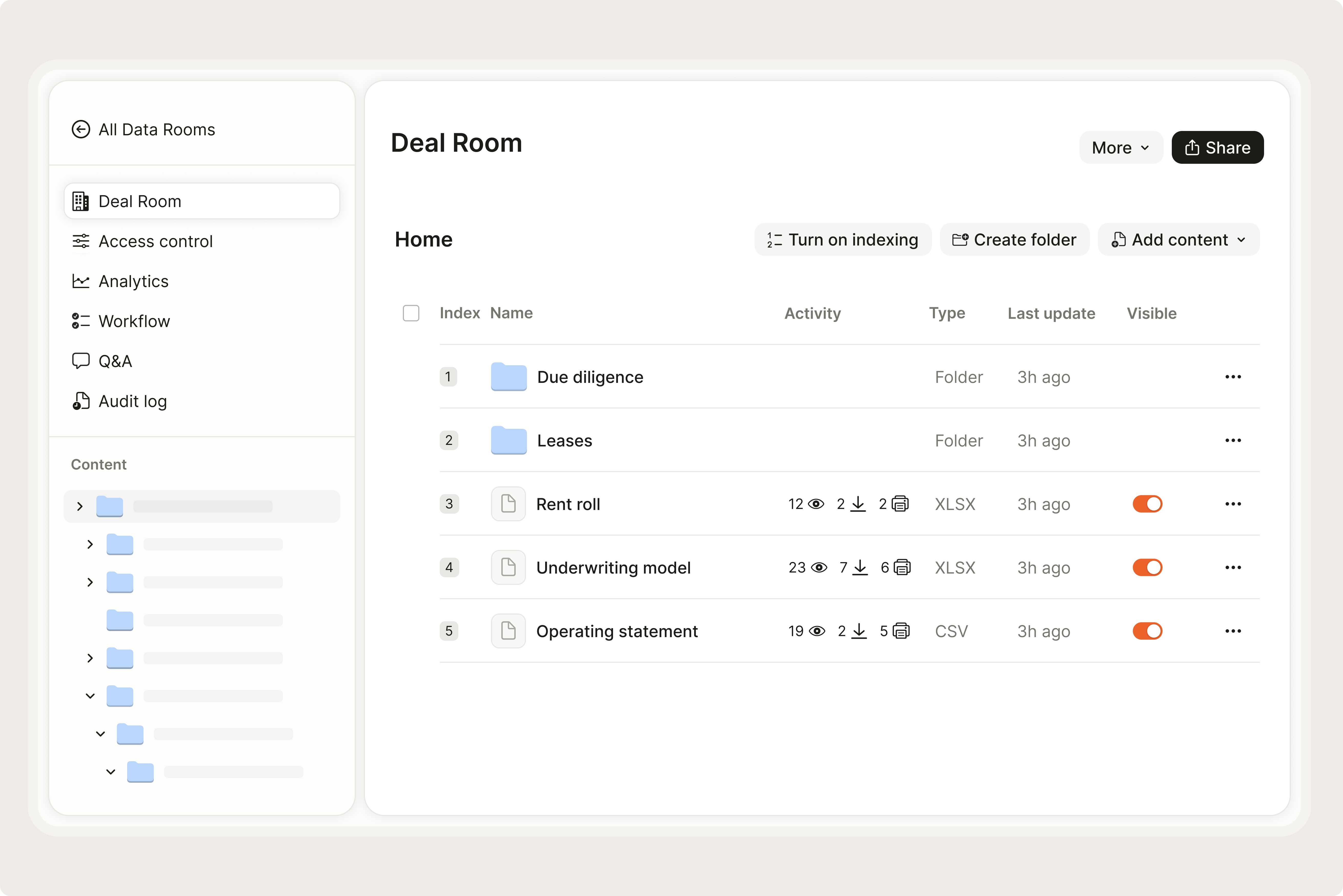
- 1.Upload South Korea property files to a secure roomDrop certified 등기부등본 (land and building register extracts), Building Register (건축물대장), urban planning certificate (토지이용계획확인원), building permit, occupancy permit (사용승인), Ministry of Environment contamination records, FETA compliance documents, acquisition tax calculation, and commercial lease pack into Ellty.
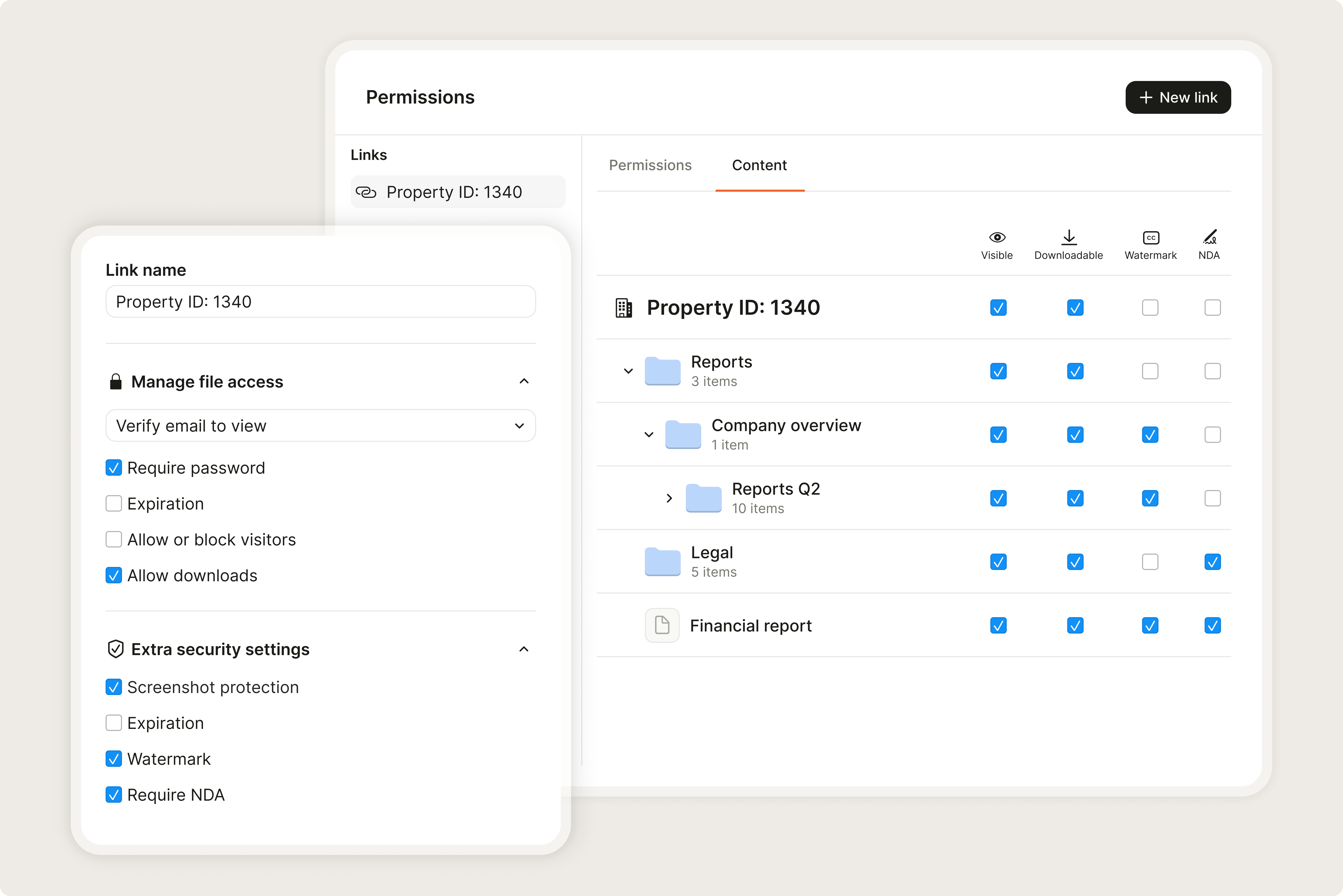
- 2.Give each advisor a scoped, tracked linkKorean attorney sees register extracts and FETA compliance docs. Building inspector sees building permit and occupancy permit. Environmental consultant sees contamination records. Tax counsel sees acquisition tax calculation and treaty analysis. Each party sees only their files.
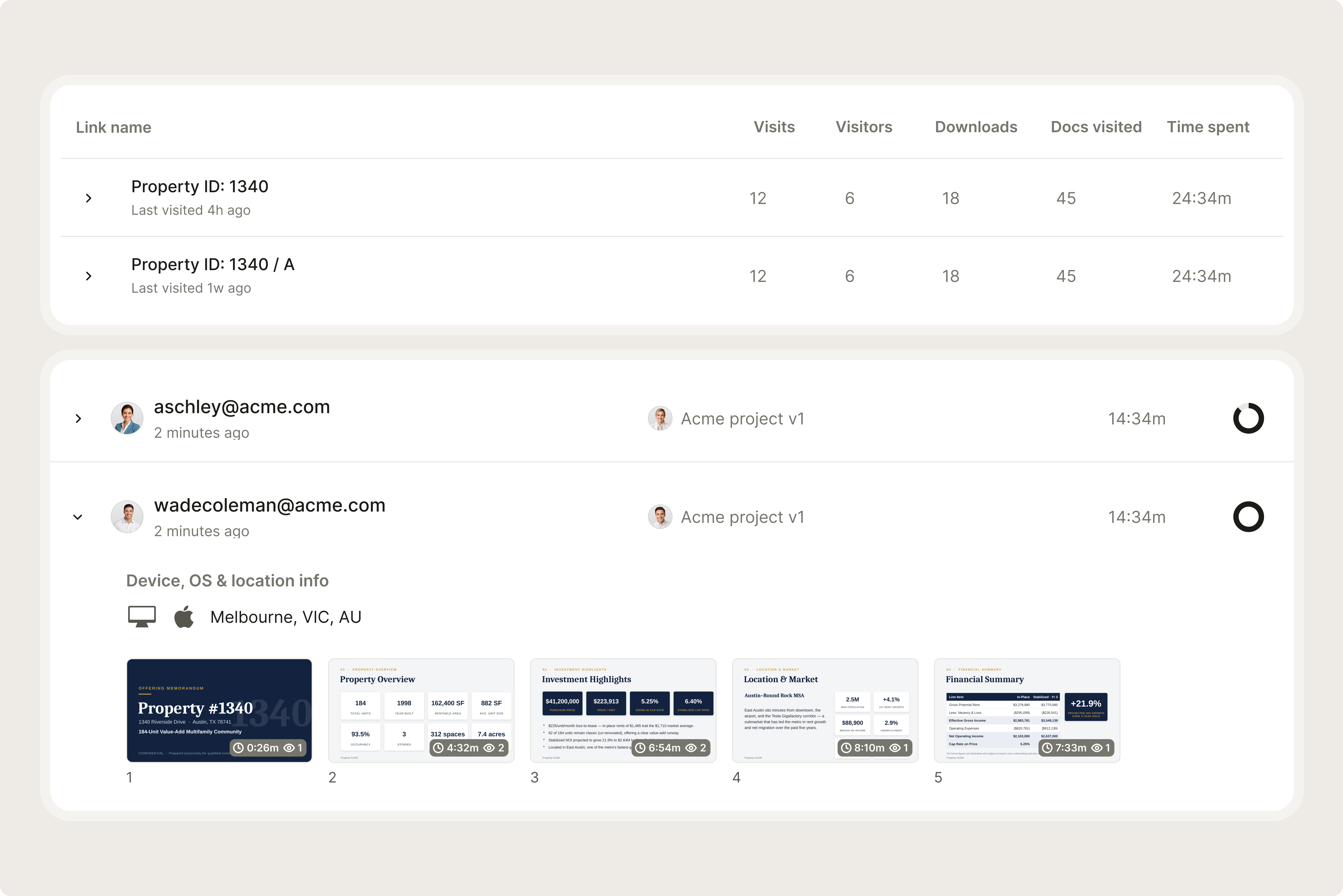
- 3.Monitor who reviews which documentsSee exactly which files each advisor opened and when. Catch provisional attachment issues in 갑구 or FETA compliance gaps before they stall deal closing.
What makes South Korea different
The provisional attachment (가압류, ga-amnyu) system in Korean real property law creates a timing risk that has no exact parallel in most Western European or Anglophone commercial markets. A creditor of the property owner can apply to a Korean court for a provisional attachment order, which the court can grant ex parte (without notice to the property owner) if the creditor demonstrates a prima facie claim. The provisional attachment is then registered in 갑구 of the Real Estate Register, where it immediately blocks any clean transfer to a buyer because a buyer cannot receive title free of the attachment. The problem for commercial transactions is the timing: a 가압류 can be registered between the date of the initial register search and the date of the transfer registration, particularly in situations where the seller has financial difficulties that were not apparent at deal entry. Standard Korean commercial practice addresses this with two measures: first, a provision in the purchase contract requiring the seller to indemnify against any attachment registered after signing; second, a fresh register extract on the day of closing (or even the day of registration submission) to confirm no new attachments have appeared between final sign-off and registration. For leveraged acquisitions with a gap between signing and closing: the lender's Korean counsel typically monitors the register during the closing gap period. This vigilance is not paranoia - in Korean commercial deals involving sellers with complex capital structures or financial stress, the 가압류 risk is real and the fresh-extract-at-closing practice exists precisely because it has mattered in actual transactions.
South Korea's Commercial Lease Protection Act (상가건물 임대차보호법) creates tenant rights that materially affect commercial real estate underwriting when tenants qualify for its protections. The Act gives qualifying commercial tenants (those with business registration at the premises, a deposit below a specified threshold, and lease duration within the protection period) the right to request lease renewal for up to 10 years total from the commencement of tenancy; the landlord can only refuse renewal on specific enumerated grounds including the landlord's own use of the premises for business. The 5% annual rent increase cap under the Act applies to qualifying tenants. For prime institutional Seoul commercial (large floor plate office, Grade A retail) the typical tenants have deposits above the Act's threshold and leases are negotiated on institutional terms, so the Act's practical impact is limited. But for mid-market commercial, multi-tenant buildings, and any commercial with small business tenants who have long occupancy histories: the Act's protections are live and affect: the ability to terminate tenancies for refurbishment, the maximum rent increase achievable at renewal, and the realistic timeline for full vacancy possession if redevelopment is planned. For any acquisition where the investment thesis requires near-term tenant turnover or redevelopment: confirm every tenant's occupancy period, business registration status at the premises, and Act eligibility before pricing the deal.
Seoul's commercial real estate market is split between three main submarkets that trade at different pricing and liquidity levels, and foreign investors should be clear on submarket fundamentals before underwriting. The CBD (중구/종로구, Central Seoul and Gwanghwamun) is the traditional financial and government zone with legacy stock (many older buildings) and is headquarters for Korean financial institutions and law firms; rents have been growing as prime CBD supply has been limited. Yeouido (영등포구) is the financial and broadcasting district, home to the Korean Stock Exchange (KRX) and major securities houses; a mix of 1980s-2000s institutional office stock. Gangnam (강남구, particularly Teheran-ro and its environs) is the new business district, favored by IT and tech firms, with newer and higher-specification office stock; demand from Korean tech, e-commerce, and startup ecosystem firms has supported strong Gangnam fundamentals. Each submarket has its own pricing, tenant profile, and liquidity characteristics; institutional buyers (foreign funds, Korean REITs/CR-REITs, insurance companies) are active across all three but Gangnam commands premium pricing and lowest vacancy relative to other submarkets in recent years.
The Commercial Building Lease Protection Act (상가건물 임대차보호법, Act No. 6542 as amended) provides that a commercial tenant who has been delivered the building and has completed business registration (사업자등록) for the premises has the right to request renewal of the lease for a further term upon expiry of the lease period. The landlord may refuse a renewal request only on the specific grounds listed in Article 10(1), including the landlord's own intended business use of the premises. The total period of lease protection (including the original lease period and any renewal periods) is 10 years from the first commencement date of the tenancy. The annual rent increase during the protected period is capped at 5% of the existing rent or deposit.
Timeline and cost in South Korea
Weeks 1-2 cover kickoff: certified Real Estate Register extracts from iros.go.kr (land and building), Building Register from seumteo.go.kr, 가압류/가처분 check in 갑구, urban planning certificate (LURIS), building permit and occupancy certificate request from seller and local authority, Ministry of Environment contaminated sites check, Phase I ESA commission for industrial zone commercial, lease abstraction and Commercial Lease Protection Act eligibility review for each tenant, FETA compliance structure planning with Korean bank, acquisition tax calculation with Korean tax counsel, seller corporate register check and UBO identification, OFAC and sanctions screens. Korean attorney fees: KRW 10M-50M (approx. USD 7,500-38,000) for this phase.
Load all files into Ellty before advisors engage. Standard South Korea commercial: 45-90 days. FETA compliance filing (post-closing): within 60 days. Building Register violation remediation: 1-6 months if required.
Weeks 2-6 cover deep review: register analysis, 을구 encumbrance clearance plan, Building Register vs. occupancy permit vs. as-built comparison, urban planning zone vs. intended use confirmation, Phase I ESA delivery, Commercial Lease Protection Act rights analysis per tenant, acquisition tax calculation and treaty analysis, FETA structure finalization. Costs: KRW 20M-100M (approx. USD 15,000-75,000).
Weeks 6-12 handle resolution: mortgage discharge, Building Register violation clearance, FETA authorization and bank channel setup, acquisition tax payment (before or concurrent with registration), 법무사 transfer registration submission to district court, fresh register extract on day of registration, post-closing FETA and MLITT filing within 60 days.
South Korea total buyer-side transaction costs: acquisition tax approximately 4.6% of transaction value; 법무사 (judicial scrivener) fees for registration; Korean attorney fees (0.3-1% of transaction value); Korean tax counsel fees; FETA compliance administrative costs; real estate broker fee (typically 0.5-0.9% of transaction value for commercial, negotiable). Total effective buyer cost: approximately 5-7% of transaction value.
Running a South Korea property deal from one room
Hold register extracts, building permits, FETA compliance docs, and lease files in one secure, tracked Ellty data room.
Start free 14-day trialCommon questions about due diligence on South Korea commercial property
- The Real Estate Register (부동산 등기부, Budongsan Deunggibu) is maintained by district courts and publicly searchable at iros.go.kr. It has three sections: 표제부 (property description), 갑구 (ownership and ownership-related claims), and 을구 (mortgages and encumbrances). Title passes on registration, not on signing the contract. Pull both the land register (토지 등기부) and building register (건물 등기부) for any commercial property. Also pull the Building Register (건축물대장) from seumteo.go.kr which shows official building use and any violations.
- A provisional attachment (가압류, ga-amnyu) is a court-ordered freeze on the property registered in 갑구 at the request of a creditor pending resolution of a debt claim. Once registered, it blocks a clean transfer to a buyer. A new 가압류 can be registered between the initial register search and the closing. Standard practice: pull a fresh register extract on the day of closing (day of registration submission) to confirm no new 가압류 appeared. For sellers with financial difficulties: monitor the register actively during the closing gap.
- South Korea's acquisition tax (취득세) is 4% of the declared acquisition value for commercial property. Additional supplemental taxes (농어촌특별세 0.2% + 지방교육세 0.4%) bring the effective combined rate to approximately 4.6% for commercial acquisitions. The tax base is the higher of the reported transaction price and the local government's standard price (기준시가). Acquisition tax must be filed and paid within 60 days of acquisition, and proof of payment is required before transfer registration at the district court.
- Foreign buyers must comply with Korea's Foreign Exchange Transactions Act (FETA): the acquisition funds transferred into Korea must be routed through an authorized foreign exchange bank and the transfer reported under FETA. After closing, the buyer must file a real estate acquisition report (외국인 부동산취득 신고) with the Ministry of Land, Infrastructure and Transport within 60 days. For foreign institutional investors: Foreign Direct Investment registration under the Foreign Investment Promotion Act may also be required. Structure FETA compliance with Korean legal counsel and the authorized bank before funds are transferred.
- Korea's Commercial Lease Protection Act (상가건물 임대차보호법) gives qualifying tenants with business registration at the premises a right to request lease renewal for up to 10 years total tenancy; landlords can only refuse on specific grounds. Annual rent increases are capped at 5%. For acquisitions where the thesis requires near-term tenant turnover or redevelopment: check every tenant's occupancy period, business registration status at the premises, and total occupancy to date against the 10-year protection window. Prime institutional office tenants typically negotiate outside the Act's threshold, but small business tenants in multi-tenant commercial often qualify.
- Seoul's main commercial submarkets: CBD (중구/종로구, Gwanghwamun area - traditional financial and government zone, older stock, headquarters of major banks and law firms), Yeouido (영등포구 - financial and broadcasting district, KRX, securities firms), and Gangnam (강남구, Teheran-ro corridor - new business district, IT/tech/e-commerce tenants, newer and higher-specification stock). Secondary markets: Bundang/Pangyo (tech corridor, niche institutional interest), Busan (regional market), Incheon (logistics around airport). Gangnam trades at premium pricing; CBD has the most historical ownership history; Yeouido is mid-tier on metrics.