Romania commercial property due diligence has three historically specific risks that persist in 2026: restitution claims from communist-era nationalizations (particularly in Bucharest city center), seismic vulnerability in pre-1977 buildings (Bucharest is in one of Europe's highest seismic risk zones), and overlapping cadastral registration gaps in some older properties. VAT at 19% on new commercial and notarial transfer are the standard transaction mechanics.
Romania transfer costs for commercial property: income tax on the transfer (impozit pe venitul din transferul proprietăților imobiliare) for individuals: 3% of the transfer value for properties held under 3 years; 1% for properties held over 3 years; withheld and paid by the notary; for corporate sellers: 16% CIT on net gains (or microenterprise tax rates); no separate RETT equivalent to Germany's tax. VAT at 19% applies to sales of new commercial buildings by VAT-registered sellers. Notary fees and ANCPI registration fees are also payable at closing.
Romania's Land Book (Cartea Funciară, CF) is maintained by the National Agency for Cadastre and Real Estate Publicity (Agenția Națională de Cadastru și Publicitate Imobiliară, ANCPI); each property has a cadastral number (număr cadastral) and a land book number; the land book is organized into three parts: Part A (property description - area, location, building details), Part B (ownership - registered owner and basis of acquisition), Part C (encumbrances - mortgages/ipoteci, easements/servituți, charges/sarcini, pending litigation/litigii); a land book extract (extras de carte funciară) from ANCPI shows the current status of all three parts; the extract is the primary title search tool in Romania.
All property transfers in Romania must be authenticated by a Romanian public notary (notar public); the notary calculates and withholds the income tax, registers the deed in the ANCPI e-Terra system, and the title transfer takes effect upon land book registration. Without notarial deed and registration, no valid transfer of ownership occurs.
Set up a due diligence data room before advisors engage. Load land book extracts, Urban Certificate, building permit, reception certificate, energy performance certificate, restitution history documentation, seismic risk classification, and lease files.
Where Romania property deals go wrong
Not every check carries the same weight. The table below sorts risks by deal impact - dealbreakers first, then what moves the price, then basic hygiene - so your Romanian attorney and advisor know what to clear first.
| Area | Documents to pull | Romania red flag | Matters most for | Tier | |
|---|---|---|---|---|---|
| Land Book (Cartea Funciară) search | Land Book (Cartea Funciară) search | Land book extract (extras de carte funciară) from ANCPI, cadastral documentation (documentație cadastrală), seller's title deed (act de proprietate) | The Cartea Funciară (CF) is Romania's land book registry; ANCPI maintains a national database searchable by cadastral number; obtain an 'extras de carte funciară pentru informare' for general due diligence and an 'extras de carte funciară pentru autentificare' (the notarial-grade extract) just before closing; Part A shows the property description (area, address, building details); Part B shows the registered owner and title chain; Part C shows all encumbrances (ipoteci/mortgages, sarcini/charges, servituți/easements, litigii/pending court cases, somaţii/notices of enforcement); any notation in Part C requires investigation; confirm the seller's name in Part B matches the contract counterparty; for company sellers: confirm the legal entity matches exactly | All buyers - foundational check | Dealbreaker |
| Restitution and communist-era nationalization claims | Restitution and communist-era nationalization claims | Romanian court records search (ECRIS - Portalul Instanțelor de Judecată) for pending restitution cases on the property, Law 10/2001 notification history, National Authority for Property Restitution (Autoritatea Națională pentru Restituirea Proprietăților, ANRP) records, historical title before 1945 | Romania's Law 10/2001 and subsequent laws created a framework for former owners to claim restitution of property abusively taken between 1945 and 1989; restitution claims have been filed on numerous Bucharest commercial properties, particularly in the historic center (Centrul Vechi), Calea Victoriei, and other pre-communist commercial zones; these claims can appear as court annotations (litigii) in Part C of the land book or may be pending in Romanian courts without having reached registration; a clean land book does not definitively exclude pending restitution litigation; search Romanian court portal (Portalul Instanțelor de Judecată) for cases involving the seller or the property address; engage Romanian real estate attorney to investigate ownership chain back to 1945 for central Bucharest and historic urban commercial; restitution claims can result in eviction of the current owner or payment of compensation | Central Bucharest, historic urban commercial, pre-communist commercial buildings | Dealbreaker |
| Seismic risk - pre-1977 buildings | Seismic risk - pre-1977 buildings | National Emergency Management Department (IGSU) seismic risk classification list (Risc Seismic I-IV), structural technical assessment from licensed Romanian structural engineer, building construction year from Land Book or building permit | Romania is in one of Europe's highest seismic risk zones; the March 4, 1977 Vrancea earthquake (M7.2) killed 1,578 people in Bucharest and damaged or destroyed hundreds of buildings; the Vrancea seismic zone in eastern Romania produces intermediate-depth (60-170km) earthquakes that have wide-area impact on Bucharest; Romanian government classifies buildings by seismic vulnerability on 4 tiers: Risc Seismic I (highest risk - consolidation required immediately), RS II, RS III, RS IV (lowest); many pre-1977 Bucharest commercial buildings (particularly older reinforced concrete structures and older masonry) are classified RS I or RS II; the government publishes a list of RS I buildings which includes many historic Bucharest commercial buildings; acquiring an RS I or RS II building creates significant consolidation cost obligations and may affect insurance and financing availability; confirm the building's seismic risk classification before any offer on Bucharest commercial built before 1977 | All Bucharest commercial, especially pre-1977 historic buildings | Dealbreaker |
| Mortgages and encumbrances (Part C) | Mortgages and encumbrances (Part C) | Land book extract (Part C), mortgage holder (creditor ipotecar) release confirmation, enforcement actions from the ANAF (National Agency for Fiscal Administration) or courts | All mortgages (ipoteci), legal mortgages (ipoteci legale), charges (sarcini), enforcement actions (somații), injunctions (sechestre), and pending court cases (litigii) are registered in Part C of the Cartea Funciară; review all Part C notations carefully; confirm all mortgages will be discharged before or at closing (the notary in Romania handles escrow-style arrangements to ensure concurrent mortgage discharge and transfer); any court seizure order (sechestru asigurator) or enforcement annotation in Part C prohibits transfer; also search ANAF for any fiscal claims against the seller entity which could result in fiscal mortgage registrations; tax debts in Romania can create legal mortgages (ipoteci legale) that ANAF registers against the property of a debtor company | All buyers | Dealbreaker |
| Building permit and reception certificate | Building permit and reception certificate | Building permit (Autorizație de Construire, AC), reception certificate (Procesul Verbal de Receptie la Terminarea Lucrărilor, PVRTL), Urban Certificate (Certificat de Urbanism, CU), energy performance certificate (Certificat de Performanță Energetică) | Romanian construction law (Law 50/1991 as amended) requires a building permit (Autorizație de Construire) for all commercial construction; after completion, a reception commission (comisie de recepție) performs an inspection and signs a Reception Certificate (Procesul Verbal de Recepție la Terminarea Lucrărilor, PVRTL); the PVRTL confirms the building was completed in compliance with the building permit; buildings without a PVRTL are in irregular legal status; the PVRTL is required to be submitted to ANCPI for cadastral registration of the building; for commercial buildings with multiple construction phases or additions: confirm each phase has its own permit and PVRTL; the energy performance certificate (Certificat de Performanță Energetică) is required for all property transactions and leasing | All Romania commercial buildings | Price-adjuster |
| VAT treatment on commercial transaction | VAT treatment on commercial transaction | Seller's VAT registration status, property first occupation date or substantial renovation date (for new vs. old classification), Romanian tax counsel VAT opinion on the specific transaction | Romanian VAT law (Law 227/2015, Fiscal Code): commercial property transactions are subject to VAT at 19% if: (1) the property is a 'new' building - first sold before or within 2 years after first occupation, or a substantially renovated building sold within 2 years of renovation completion; (2) the seller is a registered VAT payer; for 'old' commercial buildings (sold more than 2 years after first occupation): the default position is VAT exemption, but the seller can opt to apply VAT; for deals where the seller opts for VAT on an old building: the buyer must be a VAT payer or bear the irrecoverable VAT cost; many Romanian commercial real estate transactions by institutional sellers (investment funds, developers) involve VAT structuring to ensure efficient treatment; confirm VAT position with Romanian tax counsel before signing | All buyers - especially non-VAT registered buyers or VAT-exempt businesses | Price-adjuster |
| Leases and tenancies | Leases and tenancies | All commercial leases, rent roll, ANCPI registration of long-term leases (over 3 years), Civil Code tenant provisions | Romanian Civil Code (Law 287/2009): commercial leases over 3 years should be registered in the Land Book (Cartea Funciară) to be enforceable against a buyer; unregistered long-term leases may still create obligations depending on the buyer's knowledge; confirm which leases over 3 years are registered in Part C of the Land Book; review all leases for: term and break rights (denunțare unilaterală), rent indexation clauses (RON or EUR, CPI-linked, EUR-linked), renewal options, and any tenant rights of first refusal (drept de preempțiune); Romanian commercial leases are often EUR-denominated even though Romania is not in the Eurozone; note that since Romania uses RON, EUR-denominated leases create currency risk for Romanian borrowers | Tenanted Romania commercial | Price-adjuster |
| Urban planning and zoning (PUG/PUZ) | Urban planning and zoning (PUG/PUZ) | Urban Certificate (Certificat de Urbanism, CU), General Urban Plan (Plan Urbanistic General, PUG), Zonal Urban Plan (Plan Urbanistic Zonal, PUZ) for the area, permitted use confirmation from municipal urban planning department | Romania's planning system: General Urban Plans (PUG) set the framework zoning for a municipality; Zonal Urban Plans (PUZ) are more detailed plans for specific zones; the Urban Certificate (Certificat de Urbanism, CU) specifies the urban planning requirements applicable to a given parcel and is required before any building permit; the CU confirms: zoning category (funcțiuni, e.g., mixed, commercial, residential), FAR (POT - Procentul de Ocupare a Terenului), CUT (Coeficientul de Utilizare a Terenului), building height limits, and any special restrictions; for any commercial redevelopment or construction: confirm the applicable PUG/PUZ and that the planned use complies; Bucharest's urban planning situation is complex - multiple PUZ amendments and pending PUG updates create uncertainty for development commercial | All Romania commercial, especially development sites and Bucharest | Standard check |
| Environmental - communist-era contamination | Environmental - communist-era contamination | National Environmental Protection Agency (ANPM) contaminated sites list (Registrul Național al Siturilor Contaminate), Phase I ESA from licensed environmental consultant, environmental permit (Autorizație de Mediu) for regulated activities | Romania's communist-era industrial legacy (heavy industry, chemical plants, refineries, mining operations) created widespread soil and groundwater contamination particularly in: Ploiești and Prahova Valley (petrochemicals), Hunedoara and Galați (steel), Baia Mare and Copșa Mică (non-ferrous metals), and Bucharest industrial zones (Colentina, Militari, Titan); the National Environmental Protection Agency (ANPM) maintains the National Registry of Contaminated Sites; any former industrial or industrial-adjacent commercial should be reviewed against this registry and Phase I ESA commissioned; environmental permits (Autorizație de Mediu) are required for activities involving regulated pollutants; confirm environmental permit status for tenants in regulated industries | Former industrial commercial, Ploiești/Hunedoara/Copșa Mică adjacent | Standard check |
| Seller KYC, ANAF fiscal status, and AML | Seller KYC, ANAF fiscal status, and AML | Romanian Trade Register (ONRC) entity confirmation, ANAF fiscal certificate (certificat fiscal) confirming no tax debts, Real Beneficiary Register (Registrul Beneficiarilor Reali) UBO confirmation, OFAC/EU sanctions screens | Romania implements EU AML directives; notaries conducting property transactions are regulated persons under Romanian AML law; confirm seller entity at ONRC (Oficiul Național al Registrului Comerțului, Romanian Trade Register); request ANAF fiscal certificate (certificat fiscal) from the seller confirming no outstanding tax debts; ANAF can and does register fiscal mortgages (ipoteci legale fiscale) over the property of companies with tax debts; these appear in Part C of the Land Book but can also be registered between the land book search and the closing if a new tax assessment is made against the seller; confirm the seller's UBO at the Beneficial Owner Register (RBR); run OFAC and EU sanctions screens | All deals; corporate sellers | Standard check |
Due diligence on a Romania property?
Set up your Ellty data room before diligence starts.
Start free 14-day trialRomania commercial property due diligence checklist
The table ranked risks by severity. This is the full checklist to work through, grouped by area.
Land Book (Cartea Funciară) search and title chain
- Day one: obtain an extras de carte funciară pentru informare from ANCPI (online at e-terra.ro or in person at the local cadastre office) for the property's cadastral number; this is available to any person and shows the current Part A, B, and C status of the land book
- Part A review: confirm property description (address, area of land and building, building details) matches the property being sold; confirm the cadastral number matches the seller's title documentation
- Part B review: confirm the registered owner matches the seller; review the title chain (how the current owner acquired the property - purchase, inheritance, privatization, etc.); title acquired through privatization from the state (privatizare) in the 1990s-2000s may carry restitution risk if the state acquired the property through communist-era nationalization
- Part C review: systematically review every notation for mortgages, charges, easements, court annotations (litigii), enforcement notices (somații); any Part C notation requires specific investigation; a clean Part C is necessary but not sufficient (restitution claims may be in court but not yet annotated)
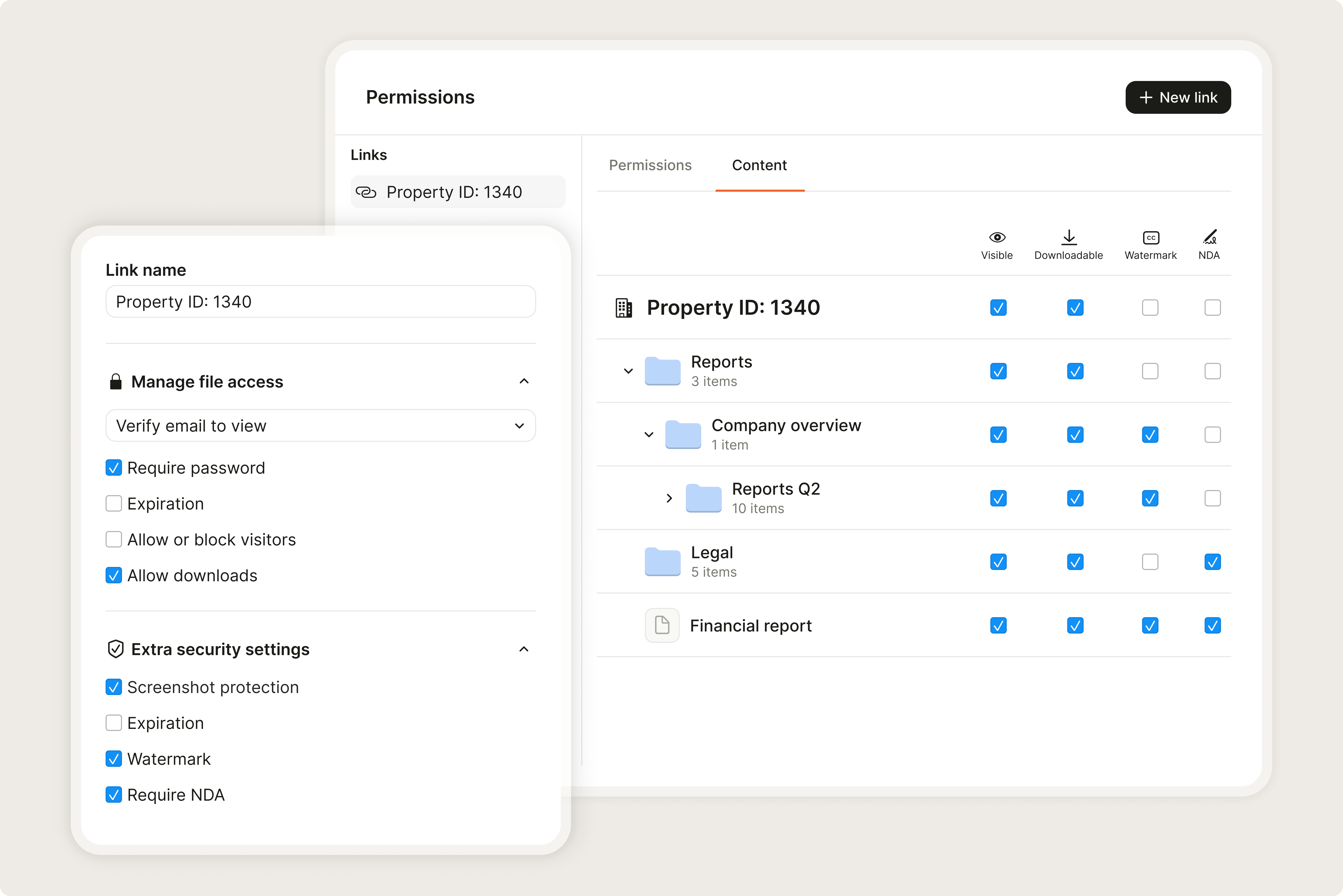
Give each advisor a scoped link in Ellty. Romanian attorney sees land book extract, title chain documentation, restitution history review, and court search results. Building inspector sees building permit, PVRTL, and Urban Certificate. Seismic structural engineer sees building construction year and risk classification. Environmental consultant sees ANPM contaminated site records and Phase I ESA. Lender sees land book extract, ANAF fiscal certificate, and valuation.
Restitution risk - communist-era property investigation
- For commercial properties in: Bucharest Centrul Vechi and central zones, Calea Victoriei corridor, historic commercial buildings in Brașov, Cluj-Napoca historic center, Timișoara, and other pre-communist urban commercial areas: request ownership history from ANCPI going back to 1945; investigate whether the property was nationalized under communist decrees (Decree 92/1950 nationalized residential buildings with commercial premises; various agricultural and industrial nationalization decrees)
- Search Romanian court portal (Portalul Instanțelor de Judecată, portal.just.ro) by property address, cadastral number, and seller name for any pending litigation involving restitution claims; search both the local court and Bucharest Court of Appeal (for higher court proceedings)
- Law 10/2001 framework: former owners had a specific deadline to file restitution claims under Law 10/2001; most claim filing periods are now expired; however, court litigation arising from earlier claims can continue for years and some cases are pending in Romanian courts or the European Court of Human Rights; confirm with Romanian counsel whether the specific property has any known or likely exposure
- For properties acquired from the state in the 1990s privatization wave: request the privatization documentation (contract de vânzare-cumpărare with the state) and confirm the property's state ownership was legitimate and not itself acquired by the state through an abusive act that could generate restitution rights
Seismic risk in Bucharest
- For any Bucharest commercial building: confirm the construction year from the land book or building permit; buildings completed before March 4, 1977 (date of the Vrancea earthquake) are pre-1977 and at higher seismic risk
- Check the national list of buildings with seismic risk (lista imobilelor cu risc seismic) published by IGSU and available on the Ministry of Development website; buildings classified RS I (the highest risk category) in Bucharest are listed by address; a Risc Seismic I classification creates an obligation for the building owner to proceed with seismic consolidation; RS I buildings may have court orders requiring consolidation
- For pre-1977 buildings not on the RS I list: commission a structural technical assessment (expertiză tehnică structurală) from a licensed Romanian structural engineer (expert tehnic atestat) to assess seismic performance; this is now standard practice for any institutional investment in Bucharest pre-1977 commercial
- Seismic consolidation cost: RS I buildings in Bucharest may require significant structural retrofitting (consolidare seismică); costs range from EUR 100-500+ per sqm depending on the structural intervention needed; this cost must be modeled into any pre-1977 Bucharest commercial acquisition
Load all files into Ellty before advisors engage. Romanian attorney sees land book extract and restitution history. Structural engineer sees building year and seismic classification. Environmental consultant sees ANPM records and Phase I ESA. Track seismic risk documents - they often drive the price adjustment conversation.
Building permit, PVRTL, and construction compliance
- Request building permit (Autorizație de Construire) from seller; verify with the municipal building authority that the permit was legally issued and covered the construction scope; for Bucharest: local sectors (Sectorul 1 through 6) each have their own Urban Planning Directorate (Direcția de Urbanism)
- Request Reception Certificate (PVRTL) from seller; confirm the reception commission was properly constituted and signed; the PVRTL must have been notified to ANCPI for the building to be properly registered in the cadastre
- For buildings constructed in multiple phases (common in post-2000 Romanian commercial): confirm each phase has its own permit and PVRTL; unfinished phases without PVRTL affect the registered building area
- Energy performance certificate (Certificat de Performanță Energetică): mandatory for all property sales and leases in Romania; the certificate must be issued by a licensed energy auditor; the energy class (A+ to G) is increasingly relevant for institutional ESG criteria; older Bucharest commercial with communist-era construction typically has poor energy class (E, F, G)
Compare Bulgaria's commercial property due diligence process for Balkan portfolio strategy. Romania and Bulgaria are neighboring EU member states with similar post-communist real estate histories - both went through privatization waves, land book reforms, and communist-era contamination legacy - but differ on market depth (Romania: larger institutional market concentrated in Bucharest vs. Bulgaria: Sofia-dominated smaller market), seismic risk (Romania: very high especially Bucharest vs. Bulgaria: moderate), and currency (Romania: RON not yet in Eurozone vs. Bulgaria: BGN pegged to Euro, applying to join Eurozone).
How due diligence works in Romania
Step 1 - Land book search and restitution check
Day one: pull extras de carte funciară from ANCPI. Confirm Part B owner and Part C encumbrances. For central Bucharest or historic urban commercial: commission ownership history to 1945 and court portal search for restitution litigation.
For Bucharest pre-1977 buildings: check RS seismic risk classification immediately - this gates the whole investment thesis.
Step 2 - Building permits, seismic, and environmental
Request building permit and PVRTL from seller. Commission structural assessment for pre-1977 Bucharest commercial. For former industrial zones: commission Phase I ESA with ANPM contaminated site search.
Request Urban Certificate to confirm current zoning and development rights.
Step 3 - VAT, leases, and AML
Confirm VAT treatment with Romanian tax counsel (new vs. old commercial; seller opt-in). Abstract all commercial leases. Confirm EUR vs. RON denomination and indexation terms. Check which leases over 3 years are registered in the Land Book. Request ANAF fiscal certificate from seller. Confirm seller at ONRC and UBO register. Run OFAC and EU sanctions screens.
Step 4 - Notarial deed and ANCPI registration
The Romanian notary coordinates the closing: prepares the deed, calculates and withholds the income tax, coordinates the simultaneous mortgage discharge and title transfer, and submits the authenticated deed to ANCPI for land book registration; the ANCPI registers the title transfer and the buyer's name appears in Part B; the full process from notarial signing to registered title typically takes 3-10 business days.
Load all closing documents into Ellty before the notarial appointment. Romanian attorney sees complete land book and restitution files. Lender sees clean post-closing land book extract with buyer registered in Part B.
How to set up your Romania data room in Ellty.
Romania commercial deals involve land book extracts, cadastral documentation, Urban Certificate, building permit, PVRTL, seismic risk classification, energy performance certificate, ANPM environmental records, ANAF fiscal certificate, and commercial lease files.
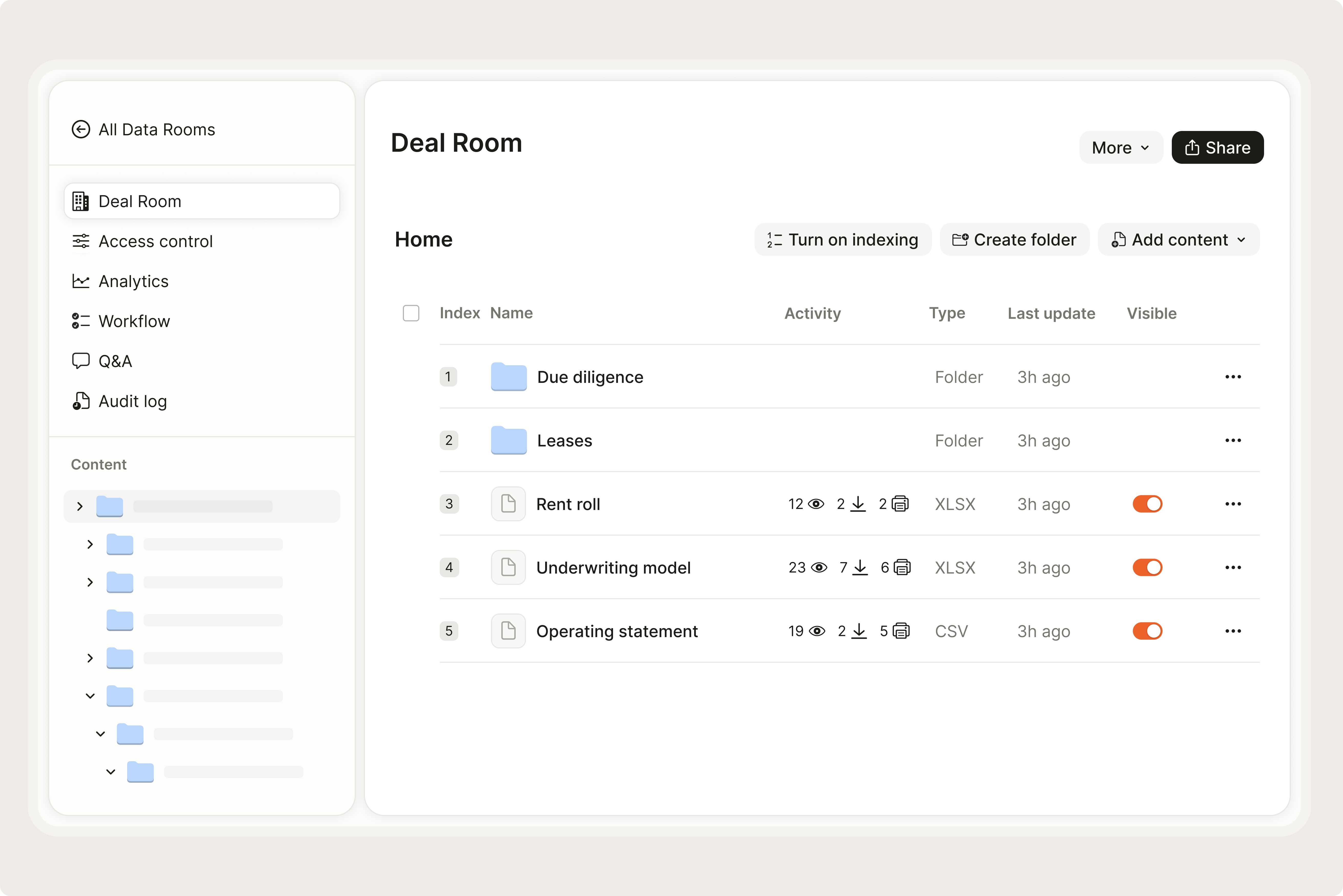
- 1.Upload Romania property files to a secure roomDrop extras de carte funciară (all three parts), cadastral documentation, Urban Certificate, building permit, Reception Certificate (PVRTL), seismic risk classification, energy performance certificate, ANPM contaminated site records, Phase I ESA if applicable, ANAF fiscal certificate, and commercial lease pack into Ellty.
- 2.Give each advisor a scoped, tracked linkRomanian attorney sees land book extract, title chain, and restitution history. Structural engineer sees building year and seismic classification. Environmental consultant sees ANPM records and ESA. Lender sees land book, ANAF certificate, and valuation. Each party sees only their files.
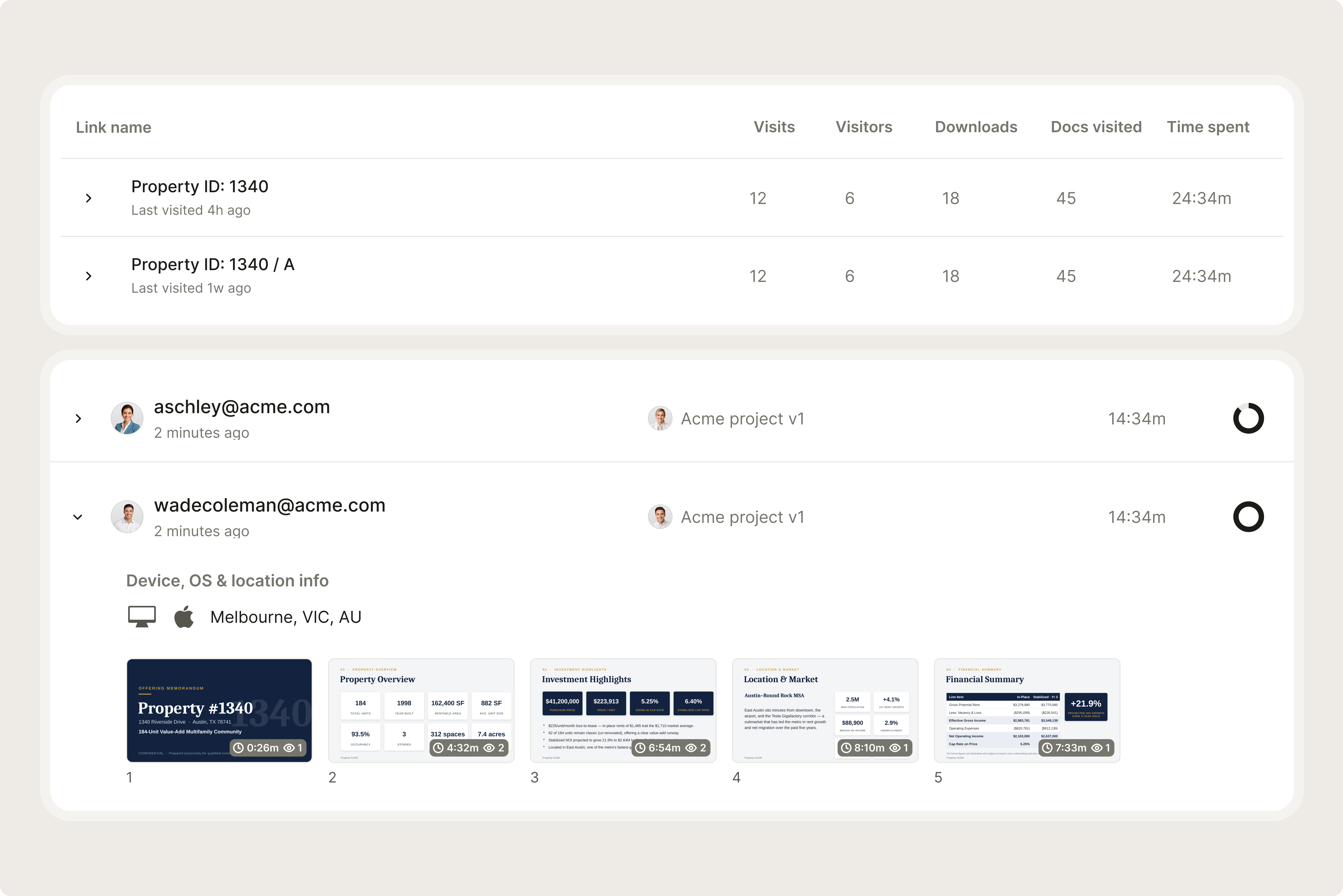
- 3.Monitor who reviews which documentsSee exactly which files each advisor opened and when. Catch seismic risk issues or Part C encumbrances before they stall deal pricing or closing.
What makes Romania different
Bucharest sits in one of Europe's highest seismic risk zones and the 1977 Vrancea earthquake left a specific commercial real estate risk legacy that remains highly relevant in 2026. The March 4, 1977 earthquake (M7.2) killed 1,578 people in Bucharest, collapsed 32 buildings, and seriously damaged hundreds more. The damage was concentrated in older reinforced concrete frame buildings and older masonry structures in the city's commercial center - precisely the building types that house a significant portion of Bucharest's historic commercial stock. Romania classifies its existing building inventory by seismic vulnerability into four tiers (Risc Seismic I through IV); Risc Seismic I buildings require urgent consolidation and the government publishes and regularly updates the RS I list for Bucharest. As of 2025, the Bucharest RS I list includes dozens of commercial buildings in the historic center, along Calea Victoriei, and in other central commercial zones. Acquiring an RS I building is not necessarily a deal-stopper - the market knows these buildings exist and prices them accordingly - but the consolidation cost (typically EUR 100-500+ per sqm of GBA depending on structural intervention) must be modeled into the acquisition price and the development plan. Lenders have become increasingly stringent about RS I buildings: some Romanian banks will not lend against RS I collateral, and international lenders routinely require structural assessment reports before committing. For any Bucharest commercial acquisition, check the current RS seismic list before any offer, and commission a structural technical assessment (expertiză tehnică structurală) for any pre-1977 building regardless of whether it appears on the public RS I list.
Romania's communist-era nationalization and subsequent restitution process created a specific title risk that has been slowly resolving over 35 years of litigation and administrative processes - but has not been fully eliminated for all properties. The Romanian state nationalized private urban property (primarily residential buildings, but also commercial buildings and mixed-use properties with commercial ground floors) through Decree 92/1950 and other legislative instruments. Law 10/2001 gave former owners and heirs the right to claim restitution of these properties; the process involved administrative claims and court litigation, with cases frequently appealed through multiple levels of Romanian courts and to the European Court of Human Rights. The practical risk today is not that entirely new claims can be filed (the main filing windows have closed) but that existing claims that were filed in the 1990s-2000s are still working through the court system, or that claims were filed but not yet annotated in the land book at the time of a title search. The Romanian court portal (portal.just.ro) allows property address searches that can surface litigation involving the property even before it's annotated in the CF. For any Bucharest commercial in a historically private residential or commercial building: an ownership history search to 1945 combined with a Romanian court portal search is the minimum restitution diligence step, and it should be done before any deposit is paid.
Romania's commercial lease market has a structural characteristic that creates currency risk for both tenants and lenders: EUR-denominated leases are standard in Bucharest Grade A and B office and retail commercial, even though Romania uses RON and is not in the Eurozone. This convention dates from the early 2000s when EUR was a more stable store of value during Romania's high-inflation period, and it has persisted even as Romania's macroeconomic stability improved. The result is that Romanian commercial tenants (who earn revenues in RON) pay rent in EUR, creating a currency mismatch that can stress tenants when RON depreciates against EUR. Romanian banks lending against EUR-denominated commercial lease income require borrowers to manage EUR-RON exchange rate risk through EUR-denominated loans (which creates exposure for the bank's own RON-funded portfolio) or RON hedging arrangements. For investors underwriting Romanian commercial: model the EUR-RON exchange rate risk in tenant stress scenarios, particularly for large-ticket leases with tenants whose core business is in the Romanian domestic market.
Law No. 10/2001 on the Legal Regime of Real Property Abusively Taken Over Between March 6, 1945 and December 22, 1989, as amended, provides that persons from whom real property was abusively taken through confiscation, forced sale, or other administrative measures during the communist period are entitled to restitution of their properties in kind (where possible) or to equivalent compensation where restitution in kind is no longer possible. The administrative procedure for filing restitution claims was subject to deadlines established by successive amendments; the National Authority for Property Restitution (ANRP) processes validated claims. The right to restitution under Law 10/2001 may be extinguished or transformed into a right to compensation where the property was transferred to a bona fide third party purchaser in good faith and for fair value after the entry into force of the law, subject to the conditions specified in Articles 18-20.
Timeline and cost in Romania
Weeks 1-2 cover kickoff: extras de carte funciară from ANCPI (Parts A, B, C), court portal search for pending restitution litigation, seismic risk classification check (IGSU RS list for Bucharest), Urban Certificate from municipal planning authority, building permit and PVRTL request from seller, energy performance certificate request, ANPM contaminated site register search, ANAF fiscal certificate request from seller, ONRC entity confirmation, Beneficial Owner Register UBO check, OFAC and EU sanctions screens, lease abstraction, and VAT position analysis. Romanian counsel fees in this phase: EUR 5,000-20,000.
Load all files into Ellty before advisors engage. Standard Romania commercial: 45-90 days. Restitution history investigation for complex Bucharest titles: 2-4 weeks additional. Structural seismic assessment: 3-6 weeks. Phase I ESA: 3-5 weeks.
Weeks 2-6 cover deep review: land book analysis, Part C encumbrance clearance plan, restitution history conclusion, structural seismic assessment delivery, building permit vs. PVRTL vs. cadastral area comparison, energy class review and renovation cost estimate, Phase I ESA delivery, lease currency and indexation analysis, VAT treatment confirmation, ANAF fiscal clearance, and lender pre-approval. Costs in this phase: EUR 10,000-40,000.
Weeks 6-12 handle resolution: mortgage discharge, court seizure clearance, seismic risk mitigation plan (if RS I or II), seller ANAF fiscal certificate update (at closing), notarial deed preparation, income tax calculation and withholding confirmation, notarial closing, ANCPI land book registration.
Romania total buyer-side transaction costs: no RETT; income tax withheld at source (1-3% of transfer price, technically seller's tax but borne at notary); VAT 19% if applicable on new commercial (buyer recovers as input VAT if a VAT payer); notary fees (negotiated, typically 0.2-0.5% of transaction value for commercial); ANCPI registration fee (small, typically under EUR 500); legal and advisory fees (1-2% of transaction value). Total effective buyer cost excluding VAT: 2-4% of transaction value.
Running a Romania property deal from one room
Hold land book extracts, seismic risk docs, building permits, and lease files in one secure, tracked Ellty data room.
Start free 14-day trialCommon questions about due diligence on Romania commercial property
- Standard Romania commercial deals take 45-90 days. ANCPI land book search: 1-2 days online. Court portal restitution litigation search: 1-2 weeks. Structural seismic assessment for pre-1977 Bucharest commercial: 3-6 weeks. Phase I ESA: 3-5 weeks. ANAF fiscal certificate from seller: 1-2 weeks. Notarial deed preparation: 1-2 weeks. ANCPI land book registration after notarial closing: 3-10 business days.
- Romania's Law 10/2001 gave former owners and heirs rights to claim restitution of property nationalized by the communist regime between 1945 and 1989. Most filing windows have closed, but existing claims are still in litigation at Romanian courts and the European Court of Human Rights. For central Bucharest and historic urban commercial in former private buildings: check the court portal (portal.just.ro) by address for pending restitution cases; search ownership history to 1945; investigate whether the property was nationalized under communist decrees. A clean land book does not exclude pending court restitution cases that haven't yet been annotated.
- Very serious for pre-1977 buildings. The 1977 Vrancea earthquake (M7.2) killed 1,578 people and destroyed or damaged hundreds of Bucharest commercial buildings. Romania classifies existing buildings by seismic vulnerability (Risc Seismic I-IV); RS I buildings require urgent consolidation and are listed publicly. Many historic Bucharest commercial buildings along Calea Victoriei, in Centrul Vechi, and other central areas are classified RS I or RS II. Romanian banks often refuse to lend against RS I collateral. Commission a structural technical assessment (expertiză tehnică structurală) for any pre-1977 Bucharest commercial, regardless of whether it's on the public RS I list.
- Romania has no separate real estate transfer tax equivalent to Germany's RETT or UK's SDLT. The main transfer cost is income tax on the transaction: for individuals, 1% of transfer value if held over 3 years; 3% if held under 3 years; withheld by the notary at closing. For companies: 16% CIT on net gains from the sale. VAT at 19% applies to sales of new commercial buildings by VAT-registered sellers. Notary fees are typically 0.2-0.5% of transaction value for commercial. Total buyer-side costs excluding VAT: 2-4% of transaction value.
- Romanian VAT at 19% applies to commercial property transactions when: (1) the building is 'new' - sold before or within 2 years of first occupation, or substantially renovated and sold within 2 years of renovation completion; and (2) the seller is VAT-registered. For 'old' commercial (sold more than 2 years after first occupation): default is VAT exemption, but seller can elect to apply VAT. VAT-registered buyers using the property for taxable business can recover VAT as input VAT. Non-VAT-registered buyers or buyers using for VAT-exempt activities bear irrecoverable VAT. Confirm VAT treatment with Romanian tax counsel before signing.
- Romania's communist-era heavy industrial legacy created significant soil and groundwater contamination in specific industrial zones: Ploiești/Prahova Valley (petrochemicals), Hunedoara and Galați (steel), Baia Mare and Copșa Mică (non-ferrous metals, among Europe's most contaminated areas historically), and Bucharest's industrial zones (Militari, Colentina, Titan). ANPM maintains the National Registry of Contaminated Sites. Phase I ESA with ANPM register search is recommended for any former industrial or industrial-adjacent commercial. Copșa Mică historically had some of the worst heavy metal contamination in Europe from the Sometra and Carbon Black facilities.