Portugal commercial property has two costs non-Portuguese buyers rarely model correctly upfront: IMT at 6.5% on commercial property (calculated on the higher of transaction value or VPT - the fiscal reference value) plus 0.8% Imposto de Selo on top. Both are due at the notary on closing day.
Portugal uses a civil law system; all property transfers require a notary (Notário). The notary drafts the escritura (deed of sale) and the property is then registered in the Conservatória do Registo Predial (land registry). These are two separate steps after signing.
There are two separate registries for Portuguese property: the Conservatória do Registo Predial (land registry) and the Caderneta Predial (fiscal registration at the tax authority, AT). Both must be consistent and current before any transaction.
The licença de utilização (use license from the Câmara Municipal) is mandatory for all commercial buildings. Without it, the building has no legal authority to operate commercially. Missing use licenses are common in Portugal, especially in older or renovated buildings.
Set up an Ellty data room before diligence opens. Load land registry extracts, caderneta, building permits, use licenses, and lease files before advisors arrive. Each advisor gets a scoped link from day one.
Where Portugal property deals go wrong
Not every check carries the same weight. The table below sorts risks by deal impact - dealbreakers first, then what moves the price, then basic hygiene - so your Portuguese advogado and technical advisor know what to clear first.
| Area | Documents to pull | Portugal red flag | Matters most for | Tier | |
|---|---|---|---|---|---|
| Land registry and title | Land registry and title | Certidão de teor (Conservatória do Registo Predial), caderneta predial (AT), CPCV if in place | Portuguese land registry (Conservatória) and fiscal caderneta are separate systems; both must be checked and consistent; discrepancies indicate unregistered works or fiscal non-compliance | All buyers | Dealbreaker |
| Licença de utilização | Licença de utilização | Licença de utilização from Câmara Municipal, building use history, any alvará de licença | Portugal's use license (licença de utilização) is mandatory for all commercial buildings; missing it means the building cannot legally be used commercially | All commercial buildings | Dealbreaker |
| Encumbrances and ónus | Encumbrances and ónus | Certidão de teor (full land registry extract), mortgage discharge certificates, lien search | Portuguese property encumbrances (ónus) are registered in the Conservatória; they must be discharged before the notary will proceed with the escritura | All buyers | Dealbreaker |
| Planning violations - desconformidades | Planning violations - desconformidades | Licença de construção, PDM zoning, Câmara Municipal inspection record, photos of as-built vs licensed | Unauthorized extensions and change of use without license (desconformidades) are common in Portuguese commercial buildings; buyers inherit municipal enforcement risk | Older buildings, renovated assets | Dealbreaker |
| IMT, IS, and VPT gap | IMT, IS, and VPT gap | Caderneta predial (VPT), IMT calculation at higher of VPT or price, IS calculation | IMT is calculated on the higher of the transaction price or the VPT (fiscal reference value); a high VPT relative to price forces a higher IMT bill than expected | All deals | Price-adjuster |
| IMI arrears | IMI arrears | AT property tax certificate, IMI payment history, outstanding debts certificate from AT | IMI (annual property tax) arrears create a charge on the Portuguese property; the notary requires an AT clearance certificate confirming no outstanding IMI before proceeding | All commercial property | Price-adjuster |
| Leases and tenant rights | Leases and tenant rights | All lease contracts (arrendamentos), NRAU compliance, rent roll, stamp duty receipts on leases | Portuguese commercial leases under the NRAU regime have specific rules on renewal, termination notice, and rent updates; older leases may have indefinite protection | Income-producing assets | Price-adjuster |
| Energy certificate - CDE | Energy certificate - CDE | CDE (Certificado de Desempenho Energético), SCE register confirmation, energy class | Portugal's CDE energy certificate is mandatory for all commercial property transactions; missing CDE blocks the notary and is a frequent bottleneck in closings | All buildings | Price-adjuster |
| Environmental - mines and industrial | Environmental - mines and industrial | APA SIRER contaminated sites register, Phase I ESA, historical maps | Abandoned mines (Panasqueira, São Domingos, Aljustrel) and industrial zones around Setúbal and Sines carry significant soil and groundwater contamination | Industrial, brownfield | Price-adjuster |
| Insurance and valuation | Insurance and valuation | Current policies, loss run, CMVM-licensed appraisal, flood risk check (SNIRH) | Portuguese flood risk maps (SNIRH) show significant flood risk in Tagus and Douro floodplains; confirm insurance availability and coverage cost for Lisbon riverside and Porto | All | Standard check |
| Seller KYC and AML | Seller KYC and AML | RCBE (UBO registry) extract, RNPC company extract, AT compliance, sanctions screen | Portuguese notaries and lawyers are required to perform AML checks and RCBE (UBO registry) verification on all property transactions | All deals | Standard check |
Due diligence on a Portugal property?
Set up your Ellty data room before diligence starts.
Start free 14-day trialPortugal CRE checklist
The table ranked risks by severity. This is the full list to work through, grouped by area.
Land registry and title
- Pull the certidão de teor from the Conservatória do Registo Predial on day one; this is the definitive land registry extract
- Pull the caderneta predial from AT (tax authority) simultaneously; confirm both documents describe the same property and the same owner
- Any discrepancy between the Conservatória and the AT caderneta signals unregistered works, fiscal irregularity, or title issues
- Check the article number (artigo matricial) in the caderneta against the description (descrição) in the land registry; they should correspond
- For rural properties or older industrial sites: confirm whether there are multiple parcels and that all parcels are correctly registered
- Confirm the NIPC (tax identification number) of the selling entity matches on all documents
Licença de utilização
- Request the licença de utilização for the building from the Câmara Municipal (local council)
- Confirm the authorized use on the license matches the current commercial use of the property
- For buildings constructed before 1951 in Lisbon and 1944 in Porto: some older buildings are exempt from the requirement under legacy provisions, but confirm the exemption with the local council
- For buildings that have been renovated: confirm a new or updated licença de utilização was issued post-renovation
- Missing use license: budget 3-6 months for regularization via the local Câmara; it requires as-built drawings, technical reports, and council inspection
Encumbrances and ónus
- Confirm from the certidão de teor that all encumbrances (ónus) are listed: mortgages (hipotecas), liens, rights of use, and easements
- Confirm any existing mortgage has a bank commitment to discharge on closing; the notary will require this
- For properties with multiple encumbrances: your advogado should prepare a discharge sequence plan as part of the CPCV negotiation
- Check for any pending court proceedings (penhoras - judicial attachments) registered on the land title
Planning violations - desconformidades
- Compare the licença de construção and as-built plans against the current physical state of the building
- For any additional floor, mezzanine, extension, or change from the licensed use: confirm whether municipal licensing was obtained
- Unauthorized works (obras sem licença) are common in Portuguese commercial buildings and create enforcement risk for the new owner
- The Câmara Municipal can require demolition or regularization of unauthorized structures
- Regularization (licenciamento extraordinário) is possible in some cases but is time-consuming and not guaranteed
IMT, IS, and VPT gap
- Confirm the VPT (Valor Patrimonial Tributável) from the caderneta predial; this is the AT's fiscal reference value
- Calculate IMT on the higher of the transaction price or the VPT: for commercial (prédios urbanos não habitacionais), the IMT rate is 6.5%
- Calculate IS (Imposto de Selo) at 0.8% on the same base; it's payable in addition to IMT
- For transactions where IVA (VAT) at 23% applies (new commercial buildings or opted transactions): confirm whether IMT is waived; IS still applies
- Request IMT guia (payment slip) from AT through your advogado; it must be paid before the notary appointment
IMI arrears
- Confirm the AT has no outstanding IMI (annual property tax) balance against the property via an AT debt certificate
- The notary requires confirmation of no outstanding IMI before completing the escritura
- Outstanding IMI arrears are charged against the property itself; they transfer to the buyer if not cleared
- Confirm the VPT on the caderneta is reasonable relative to market value; significantly undervalued VPT may attract AT challenge
Give each advisor a scoped link in Ellty. Your advogado sees the Conservatória and caderneta. Technical consultants see building plans and licença. Environmental advisors see Phase I reports. No overlap.
Leases and tenant rights
- Collect all lease contracts (contratos de arrendamento) and confirm compliance with the NRAU (New Urban Leasing Regime)
- Check for older pre-NRAU leases: commercial leases signed before the NRAU reforms (2012-2019) may have indefinite renewal rights or protected status
- Confirm Imposto de Selo was correctly paid on each lease at signing; unpaid IS creates AT liability
- Cross-reference the rent roll against 12 months of actual receipts; confirm any outstanding rent arrears
- For vacant commercial properties: confirm the licença de utilização covers the authorized use class and that no enforcement proceedings are active
Energy certificate - CDE
- Confirm the CDE (Certificado de Desempenho Energético) is registered in the SCE (Sistema de Certificação Energética) database
- The CDE is mandatory for any commercial property transaction or new tenancy agreement; missing CDE blocks the notary
- Check the energy class (A to G); Portuguese commercial buildings commonly rate C to F
- For older buildings with poor energy ratings: model the energy upgrade investment required to comply with upcoming EU minimum energy performance standards
Environmental - mines and industrial
- Commission Phase I ESA for any site near former mining areas: Panasqueira (tungsten), São Domingos (copper), Aljustrel (pyrite), and Rio Tinto watershed
- For Setúbal Industrial Zone (Baía do Tejo) and Sines petrochemical complex: contamination risk is significant; Phase I is mandatory and Phase II likely
- Search the APA SIRER (contaminated sites register) for the property address and surrounding area
- For logistics and industrial assets in the Lisbon Logistics Corridor (Azambuja, Santarém): background contamination check is standard
Load all Phase I ESA, APA search results, and building certifications into Ellty. Environmental advisors, lenders, and technical consultants each get tracked, watermarked access from one secure link.
Insurance and valuation
- Confirm current insurance covers the current commercial use; confirm transferability at closing
- Check SNIRH (Portuguese water resources information) flood risk maps for properties near the Tagus (Lisboa), Douro (Porto), or other major rivers
- Commission an independent valuation from a CMVM-certified appraiser; required for bank financing
- For coastal properties in Algarve or Setúbal: confirm cliff erosion and coastal flood risk from the Portuguese Environment Agency (APA) coastal risk maps
Seller KYC and AML
- Pull the RCBE (Registo Central do Beneficiário Efetivo) extract to confirm UBO disclosure for the selling entity
- Pull the RNPC commercial registration extract from IRN confirming the entity is in good standing
- Portuguese notaries and advogados are designated entities under AMLD5 and must perform KYC on all property transactions
- Confirm the selling entity has no outstanding AT tax debt or AT enforcement proceedings
How due diligence in Portugal works
Step 1 - Land registry and use license
Pull the certidão de teor and the caderneta predial simultaneously on day one. Cross-reference them. Portuguese registrations are managed by two separate systems and discrepancies are common, especially in older commercial buildings that have undergone informal works.
Request the licença de utilização from the Câmara Municipal at the same time. In Lisbon and Porto, response times vary from a few days to several weeks. If the license is missing, the timeline to regularize it must be built into the deal schedule.
Step 2 - IMT, IS, and VPT calculation
Calculate IMT on the higher of the transaction price or the VPT before making any offer. On a EUR 10M commercial asset, IMT at 6.5% is EUR 650,000, plus IS at 0.8% is an additional EUR 80,000. If the VPT is higher than the agreed price, the real IMT bill will exceed the estimate.
Confirm with your Portuguese tax advisor whether the transaction could qualify for IVA treatment (new building or opted transaction); this changes the IMT calculation. Your advogado handles the IMT guia and payment to AT.
Step 3 - Leases and NRAU compliance
Identify all existing tenants and their lease documentation. For any lease signed before the 2012 NRAU reform: check for indefinite protection or legacy renewal rights. These are relatively common in older Lisbon and Porto commercial buildings and directly affect the exit timeline.
Compare Spain's commercial lease framework if you run Iberian portfolio acquisitions. Both Spain and Portugal require notarized deeds, have separate land registry and fiscal registries, and have stamp duty equivalents (Spain's ITP or AJD vs. Portugal's IS). The key difference is Portugal's IMT at 6.5% vs. Spain's ITP at 6-11% (regional) for commercial.
Step 4 - Environmental review and building compliance
Commission Phase I ESA for any brownfield or former industrial site. Portugal's mining legacy is significant and not well-publicized; sites near the Iberian Pyrite Belt (Aljustrel, São Domingos) require specific assessment.
Confirm the CDE energy certificate is on file. Missing CDE delays closings; the notary appointment cannot proceed without it. Order it at the same time as the licença de utilização request.
Track all document requests and advisor reviews in real time via Ellty. You see which advisors are actively working on which files - and which ones have been reviewing the lease documentation repeatedly, signaling the issue before it surfaces in a due diligence report.
Step 5 - CPCV, notary, and escritura
Portuguese deals commonly use a Contrato Promessa Compra Venda (CPCV) - a binding promissory sales contract with a deposit of 10-20% - before the final escritura. If the seller defaults after the CPCV, the buyer receives double the deposit (sinal em dobro). If the buyer defaults, the deposit is forfeited.
The escritura is executed at the notary. The buyer pays IMT and IS to AT before the appointment. Title transfers to the buyer at the escritura. The advogado then registers the transfer in the Conservatória, which typically takes 1-3 weeks.
How to set up your Portugal data room in Ellty.
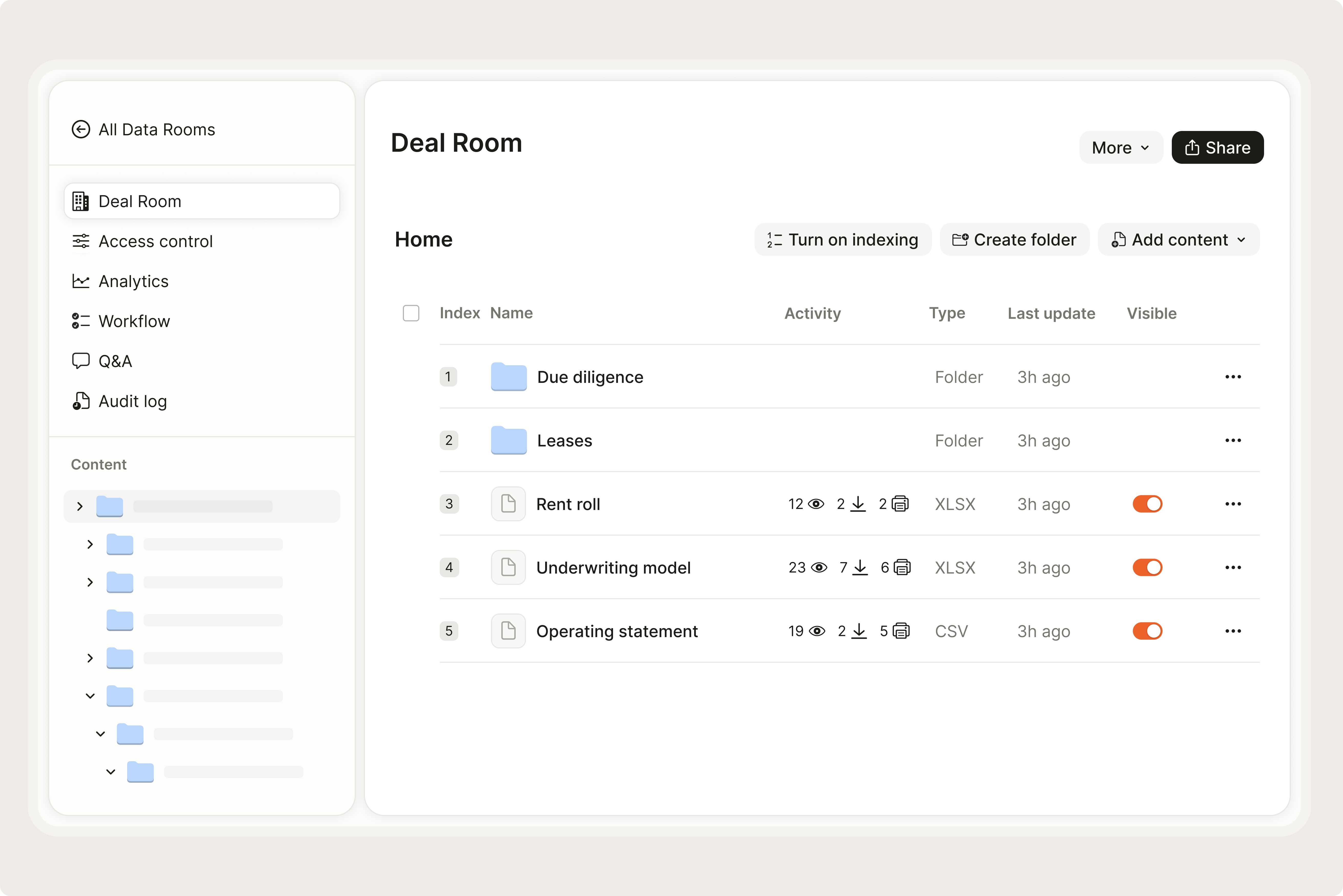
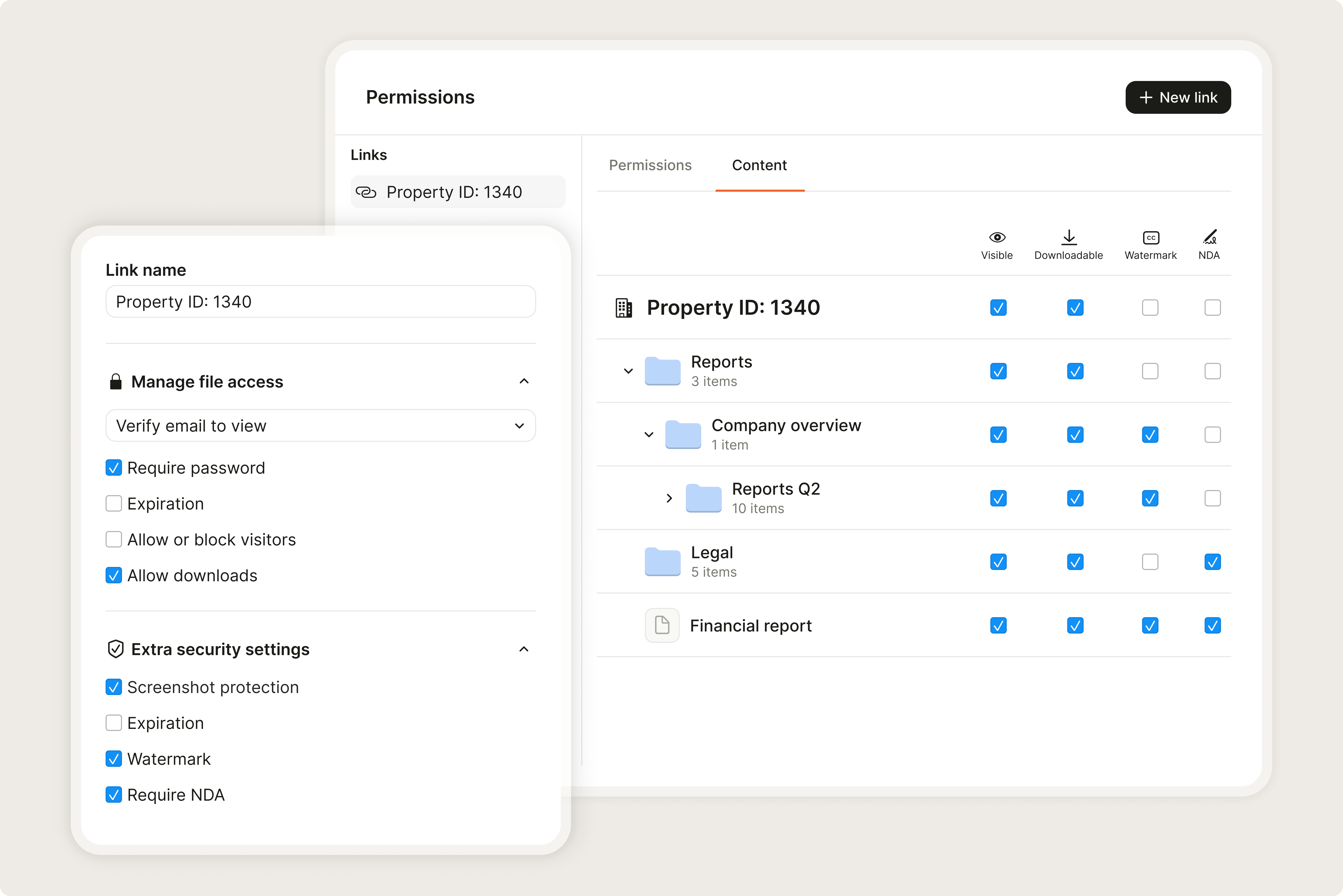
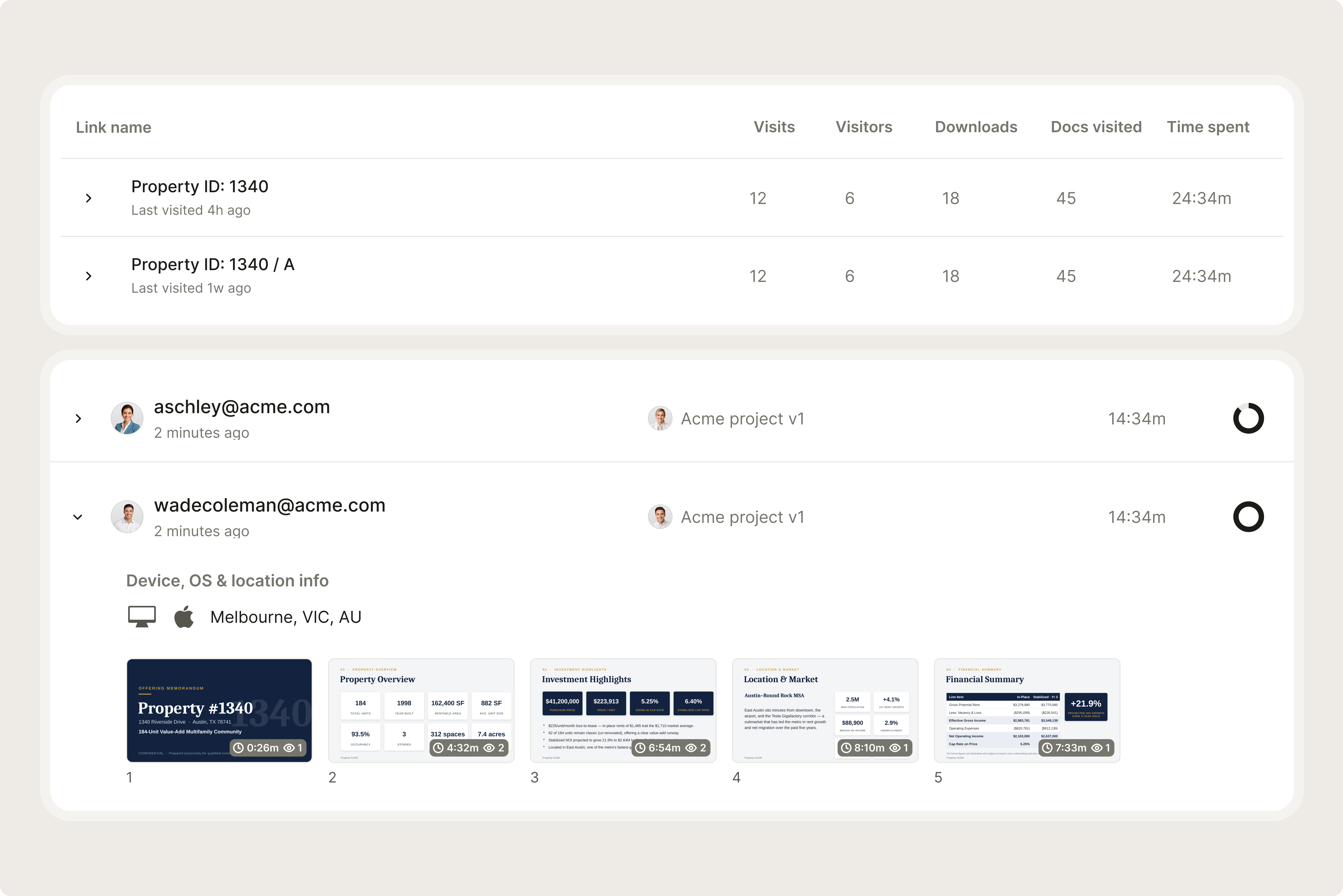
Portugal CRE deals involve the Conservatória, caderneta, Câmara Municipal, AT tax authority, APA environmental, and notary across multiple weeks. Load files into Ellty before advisors arrive. Each party gets a scoped, tracked link from day one.
- 1.Upload Portugal property files to a secure roomDrop certidão de teor, caderneta predial, licença de utilização, CDE, leases, and Phase I ESA into Ellty.
- 2.Give each advisor a scoped, tracked linkAdvogado sees land registry and caderneta. Tax advisors see IMT and VPT calculations. Technical consultants see building permits and CDE. Ellty enforces the scope.
- 3.Monitor who reviews which documentsSee exactly which files each advisor opened and when. Catch delays before they affect the CPCV deposit date or the notary appointment.
What makes Portugal different
Portugal has two separate property registries and both must agree. The Conservatória do Registo Predial is the legal land registry. The caderneta predial is the fiscal registry at the tax authority (AT). They're maintained independently. Any discrepancy - in the owner's name, the property description, or the area - signals an unregistered transaction or fiscal irregularity that must be resolved before the notary will proceed. This is the check that surprises most non-Portuguese buyers.
The VPT and IMT gap problem is endemic. IMT is calculated on the higher of the transaction price or the VPT. If the fiscal reference value (VPT) has not been updated in years, it may exceed the current market price. In that case, you pay IMT on a number higher than what you actually paid for the property. Always pull the caderneta and calculate the VPT gap before any commercial discussion.
The licença de utilização is not negotiable. No use license means no legal commercial occupation. In Portugal, the Câmara Municipal can enforce closure of unlicensed commercial premises. Missing use licenses in commercial buildings are common - particularly in renovated or converted properties in Lisbon and Porto historic centers - and regularization timelines are long and uncertain.
The CPCV structure creates a binary risk. Once you sign the promissory contract and pay the deposit, the buyer's downside is the deposit (typically 10-20% of the price) and the seller's downside is returning double the deposit. This creates strong mutual incentive to complete. But it also means all critical diligence must be done before the CPCV is signed - not between CPCV and escritura.
The Imposto Municipal sobre Transmissões Onerosas de Imóveis (IMT) is levied under the IMT Code (Decreto-Lei 287/2003) and is payable to the Autoridade Tributária e Aduaneira prior to the execution of the deed of transfer (escritura pública). For non-residential urban property (prédios urbanos não habitacionais), the applicable IMT rate is 6.5% applied to the taxable base, defined as the higher of the declared transaction value and the fiscal patrimonial value (Valor Patrimonial Tributável) registered in the caderneta predial. The Imposto de Selo of 0.8% is levied separately and concurrently.
Timeline and cost in Portugal
Weeks 1-3 cover kickoff: certidão de teor, caderneta predial, licença de utilização request, CDE energy certificate check, IMT and VPT calculation, AT IMI clearance, and Phase I ESA engagement. Budget EUR 5,000-15,000 for advisory fees in this phase.
Load all files into Ellty before advisors start. Scoped, tracked links for each advisor eliminate the email document chase that adds weeks to Portugal CRE diligence timelines.
Weeks 3-6 cover deep review: lease abstraction, NRAU compliance check, building compliance review, planning violation investigation, Phase I ESA delivery, and CPCV negotiation. Cost runs EUR 10,000-30,000 depending on complexity.
CPCV signing: this is the binding step. Sign only when title, use license, VPT, and major planning items are confirmed.
Weeks 6-10 handle resolution: outstanding compliance items (licença regularization if needed), CDE if missing, IMT payment to AT, notary appointment, and escritura execution. Conservatória registration follows within 1-3 weeks of the escritura.
Portugal total acquisition cost: 6.5% IMT + 0.8% IS + legal fees EUR 10,000-30,000 + valuation + Phase I ESA if brownfield. Total acquisition cost on a Portuguese commercial deal runs approximately 7.5-8.5% of purchase price. Annual IMI at 0.3-0.45% of VPT is the ongoing tax obligation.
Running a Portugal property deal from one room
Hold Conservatória docs, caderneta, and lease files in one secure, tracked Ellty data room.
Start free 14-day trialCommon questions about due diligence on Portugal property
- Most Portugal CRE deals complete in 6-10 weeks. Obtaining the licença de utilização from the Câmara Municipal, resolving any Conservatória and caderneta discrepancies, and scheduling the notary appointment are the typical lead-time items.
- IMT (Imposto Municipal sobre Transmissões Onerosas de Imóveis) is Portugal's municipal property transfer tax. For commercial property (prédios urbanos não habitacionais), the rate is 6.5%. It is calculated on the higher of the declared transaction price or the VPT (Valor Patrimonial Tributável) from the caderneta predial. IMT plus Imposto de Selo (0.8%) must be paid to AT before the notary will execute the escritura.
- The VPT (Valor Patrimonial Tributável) is the fiscal reference value for a Portuguese property, set by the tax authority (AT) and shown on the caderneta predial. IMT is calculated on the higher of the transaction price or the VPT. If the VPT exceeds the agreed purchase price, you pay IMT on the VPT, not the price. Always pull the caderneta and check the VPT before making an offer.
- The licença de utilização is the use license issued by the Câmara Municipal (local council) authorizing the commercial use of a building. It is mandatory for all commercial buildings in Portugal. Without a valid use license, the building has no legal authority to operate commercially, and the Câmara Municipal can enforce closure. Missing use licenses are common in renovated or converted commercial properties and must be regularized before the escritura.
- The CPCV (Contrato Promessa Compra Venda) is a binding promissory sales contract signed before the final deed (escritura). It typically involves a deposit of 10-20% of the purchase price. If the seller defaults, the buyer receives double the deposit. If the buyer defaults, the deposit is forfeited. Sign the CPCV only after confirming title, use license, VPT gap, and major planning items - not before.
- The CDE (Certificado de Desempenho Energético) is Portugal's mandatory building energy performance certificate, registered with the SCE (Sistema de Certificação Energética dos Edifícios). It is required for all commercial property transactions and new commercial tenancy agreements. A missing or expired CDE blocks the notary appointment. Order it early - alongside the licença de utilização - to avoid delays at closing.