Spain CRE deals have a tax structure most non-Spanish buyers get wrong the first time: transfer tax is either 6-10% ITP or 21% IVA depending on whether the seller is a developer and whether you waive the VAT exemption. Which one applies moves the deal math significantly since IVA is recoverable for VAT-registered buyers and ITP is not.
Spain's commercial property transfers require a notario público (public notary). Title only transfers on the date the escritura (notarial deed) is signed and the property is inscribed in the Registro de la Propiedad.
The nota simple is the basic land registry extract from the Registro de la Propiedad. It shows the owner, surface area, permitted use, mortgages, liens, and encumbrances. Pull it on day one.
Spain's 17 autonomous communities each have their own ITP rate and environmental regulations. A Madrid deal and a Barcelona deal have different tax costs, different planning authorities, and different environmental registries.
Set up an Ellty data room before diligence opens. Load all nota simple documents, planning certificates, Catastro extracts, and lease files so each advisor gets a scoped link from day one.
Where Spanish deals actually go wrong
Not every check carries the same weight. The table below sorts risks by deal impact - dealbreakers first, then what moves the price, then basic hygiene - so your abogado, notario, and technical advisor know what to clear first.
| Area | Documents to pull | Spain red flag | Matters most for | Tier | |
|---|---|---|---|---|---|
| Title and Registro de la Propiedad | Title and Registro de la Propiedad | Nota simple, certificación registral, chain of title deeds, Catastro extract, referencia catastral | Spain's Registro de la Propiedad is the authoritative title source; nota simple shows all hipotecas, embargos, and servidumbres | All buyers | Dealbreaker |
| Urban planning - urbanismo | Urban planning - urbanismo | Informe urbanístico, PGOU/PGOM extract, licencia de obras, licencia de actividad | Spain's urbanismo is managed at the municipal level; confirm permitted use in the Plan General and the licencia de actividad is current | All assets | Dealbreaker |
| First occupancy license | First occupancy license | Licencia de primera ocupación, certificado de fin de obra, licencia de actividad | Many Spanish commercial buildings lack a valid licencia de primera ocupación; without it, the building can't be legally occupied or connected to utilities | All commercial buildings | Dealbreaker |
| Environmental - suelo contaminado | Environmental - suelo contaminado | Phase I ESA, informe de situación del suelo from autonomous community, industrial activity register | Catalonia (COSI register), Basque Country, and Madrid industrial outskirts carry contamination from manufacturing and petrochemical history | Industrial, logistics, port | Dealbreaker |
| Leases and tenancies | Leases and tenancies | All leases, rent roll, LAU compliance, arras agreements, sublease consents | Spanish commercial leases under LAU give tenants limited protection but confirmed verbal occupancies in older buildings must be identified | Income-producing assets | Price-adjuster |
| IBI and local tax arrears | IBI and local tax arrears | IBI (property tax) receipts for last 4 years, plusvalía municipal status, local council certificate | IBI arrears and plusvalía municipal unpaid by the seller create a tax lien on the property that transfers to the buyer | All deals | Price-adjuster |
| ITP vs IVA structure | ITP vs IVA structure | Seller VAT status, ITP rate for the autonomous community, IVA waiver election, IAJD calculation | IVA (21% VAT recoverable) vs ITP (6-10% non-recoverable) depends on seller type and waiver; wrong structure costs millions | All commercial deals | Price-adjuster |
| Building and structural condition | Building and structural condition | PCA, ITE (Inspección Técnica de Edificios), building permit history, asbestos survey | ITE (Technical Building Inspection) is mandatory for buildings over 50 years old; confirm it's been done and passed | Older buildings, pre-1970 construction | Price-adjuster |
| Insurance and valuation | Insurance and valuation | Current policies, loss run, flood zone check (SNCZI), earthquake risk zone, independent tasación | Spain's SNCZI national flood mapping shows significant commercial flood risk in Valencia, Murcia, and Ebro valley areas | All | Standard check |
| Utilities and access | Utilities and access | Electricity supply agreement, water connection, access road confirmation, servitude of way | Spanish utility supply contracts are property-specific; confirm active connection and name transfer process before closing | All | Standard check |
| Seller KYC and AML | Seller KYC and AML | BORME (company registry extract), NIE/NIF confirmation, UBO identification, notario AML compliance | Spanish notarios are subject to AML law and perform independent KYC on both buyer and seller before deed signing | All deals | Standard check |
Due diligence on a Spain property?
Set up your Ellty data room before diligence starts.
Start free 14-day trialSpain CRE checklist
The table ranked risks by severity. This is the full list to work through, grouped by area.
Title and Registro de la Propiedad
- Pull the nota simple from the Registro de la Propiedad immediately on day one; it costs under EUR 10
- Pull the certificación registral (full certified extract) for a legally binding version of the property record
- Check the nota simple for: hipotecas (mortgages), embargos (court attachments), servidumbres (easements), derechos de adquisición (pre-emptive rights)
- Confirm the Catastro referencia catastral matches the Registro and reconcile any discrepancies between registral and cadastral surface areas
- Run the full chain of title through the escritura (notarial deed) history to identify any gaps or undisclosed encumbrances
- For strata/propiedad horizontal: pull the estatutos de la comunidad and last 3 years of community meeting minutes
Urban planning - urbanismo
- Pull the informe urbanístico from the local municipality (Ayuntamiento) immediately after contract
- Confirm the land classification: suelo urbano (developed), suelo urbanizable (developable), or suelo no urbanizable (rural; can't be developed)
- Check the Plan General de Ordenación Urbana (PGOU) or equivalent for the permitted commercial uses on the parcel
- Confirm all licencias de obras (building permits) and licencias de actividad (activity licenses) are current and on file
- For development sites: confirm the sistema de actuación (development mechanism) and any cuotas de urbanización (development charges) outstanding
First occupancy license
- Confirm the licencia de primera ocupación (first occupancy license) from the municipality is valid and on file
- Many Spanish commercial buildings lack this license; without it, the building cannot legally be occupied
- For licencias de actividad (activity/use licenses): confirm they cover all current commercial uses in the building
- Pull the certificado de fin de obra (construction completion certificate) from the architect and confirm it was filed
- For buildings with regularized works (obras sin licencia): confirm the prescription period has passed and municipal regularization is confirmed
Environmental - suelo contaminado
- Commission a Phase I ESA per Real Decreto 9/2005 standards
- Search the autonomous community's contaminated soil register; Catalonia has the COSI register, Basque Country has similar
- Pull the informe de situación del suelo from the regional environmental authority for the parcel
- For industrial, logistics, and port-adjacent sites in Catalonia, Basque Country, Madrid, and Valencia: order Phase II investigation immediately
- Budget Phase II soil investigation (EUR 10,000-40,000) if Phase I identifies hazardous activities under RD 9/2005 categories
Leases and tenancies
- Collect all arrendamientos (leases) and confirm they comply with LAU (Ley de Arrendamientos Urbanos) and specific commercial provisions
- Check for any verbal or informal occupancies, particularly in older commercial buildings in Madrid and Barcelona city centers
- Confirm rent review mechanism; Spanish commercial leases use IPC (CPI) escalation as the most common mechanism
- Cross-reference the rent roll against 12 months of actual receipts and any IVA invoicing records
- Confirm fianzas (security deposits) are current; commercial tenants in Spain typically provide 2 months deposit
Issue NDA-tracked links in Ellty when sharing lease files with multiple advisors. Each party gets a watermarked, scoped link; you see who opened what file and when.
IBI and local tax arrears
- Request IBI (Impuesto sobre Bienes Inmuebles) receipts for the last 4 years from the seller
- Confirm the local tax authority (Ayuntamiento or tax collection agency) has no outstanding IBI arrears
- Confirm the plusvalía municipal (Impuesto sobre el Incremento de Valor de los Terrenos) has been calculated and the seller is responsible for payment at closing
- Post-2021 Constitutional Court ruling: plusvalía only applies if there's a real increase in land value; seller must provide the calculation
- Check for any outstanding cuotas de urbanización (development charges) or contribuciones especiales (special levy contributions) against the parcel
ITP vs IVA structure
- Determine whether the sale is subject to IVA (21% VAT) or ITP (6-10% regional transfer tax)
- IVA applies when the seller is an empresario (business) selling as part of their business activity and the property is new or the seller waives the IVA exemption
- ITP applies when the seller is a private individual or when the IVA exemption is not waived
- For IVA-subject sales: confirm the buyer is also IVA registered; a registered buyer can deduct the input IVA and the economic cost is zero
- Add IAJD (stamp duty on the notarial deed) to the IVA cost: rates vary 0.5-1.5% by autonomous community
- For Catalonia: ITP rate is 10%; for Madrid: 6%; this difference alone is EUR 400,000 on a EUR 10M deal
Building and structural condition
- Commission a Property Condition Assessment; check structural condition, roof, mechanical systems
- For buildings older than 50 years: confirm the ITE (Inspección Técnica de Edificios) has been completed and passed
- Pull the full building permit history from the Ayuntamiento; confirm no obras sin licencia (unpermitted works) are outstanding
- For pre-1980 buildings: commission an asbestos survey; asbestos is prevalent in Spanish commercial construction of this era
- Confirm fire safety compliance certificate from the local bomberos (fire service) is current
Insurance and valuation
- Pull current insurance policies and 3-year loss run from the seller
- Check SNCZI (National Flood Mapping System) for the property; Valencia, Murcia, Almería, and Ebro valley areas carry significant commercial flood risk
- For Granada, Almería, and Murcia: check earthquake risk zone (Spain has seismic activity in the south); confirm earthquake coverage
- Order a tasación (independent appraisal) from a TINSA or other certified Spanish valuation firm for lender requirements
Seller KYC and AML
- Pull a BORME (Boletín Oficial del Registro Mercantil) extract confirming the selling entity is registered and in good standing
- Confirm all UBOs are identified; Spanish AML regulations require notarios and abogados to perform KYC
- Confirm the seller has a valid NIF (Spanish tax ID); foreign sellers need an NIE (foreign identification number)
- Spanish notarios independently perform AML client due diligence before the escritura is signed
How due diligence in Spain works
Step 1 - Nota simple and ITP/IVA analysis
Pull the nota simple from the Registro de la Propiedad and run the ITP vs IVA tax structure analysis in the first 48 hours. The tax structure determines whether the buyer pays 6-21% non-recoverable or 21% recoverable; getting it wrong is the most expensive mistake in Spanish CRE.
For non-Spanish buyers: confirm you have a Spanish NIF or NIE before trying to sign the escritura. No NIF/NIE means no closing.
Step 2 - Urbanismo and first occupancy license
Request the informe urbanístico from the Ayuntamiento and confirm the licencia de primera ocupación simultaneously. Both typically take 2-4 weeks to obtain from the municipality.
Check the PGOU land use classification carefully. Spanish suelo no urbanizable (non-developable rural land) cannot be converted to commercial use without a complex regional plan amendment - a common trap for buyers who discover the parcel can't be developed as planned.
Step 3 - IBI and encumbrances
Confirm IBI receipts are current before signing the contrato de arras (deposit agreement). IBI arrears create a tax lien that follows the property after transfer; they don't stay with the seller.
Pull the plusvalía municipal certificate from the Ayuntamiento. Post the 2021 Constitutional Court decision that struck down the automatic calculation method, sellers now calculate plusvalía only when the land value actually increased. Get this confirmed and documented before the escritura.
Step 4 - Environmental review
Commission the Phase I ESA per Real Decreto 9/2005 standards. For industrial sites in Catalonia (Tarragona petrochemical corridor, Badalona, Cornellà), Basque Country (Bilbao estuary), or Madrid outskirts (Vallecas, Alcobendas), order Phase II in parallel.
Compare Germany's environmental diligence process if you run EU portfolios. Both countries have significant industrial contamination in specific regions, but Germany uses a federal contaminated sites regime while Spain's enforcement is autonomous-community-level.
Step 5 - Escritura and Registro inscription
Spanish commercial closings close at the notario's office. Both buyer and seller must be present or send authorized representatives with notarized power of attorney. The notario verifies the nota simple on the closing date.
Transfer tax (ITP) or IAJD must be paid within 30 days of the escritura date; self-liquidation filing with the regional tax authority is required. Load all closing documents into Ellty. Confirm document receipt for each advisor in real time.
How to set up your Spain data room in Ellty.
Spanish CRE deals involve the Registro de la Propiedad, Catastro, notario, and municipal Ayuntamiento across multiple weeks. Load files into Ellty before diligence opens. Each advisor gets a scoped, tracked link from day one.
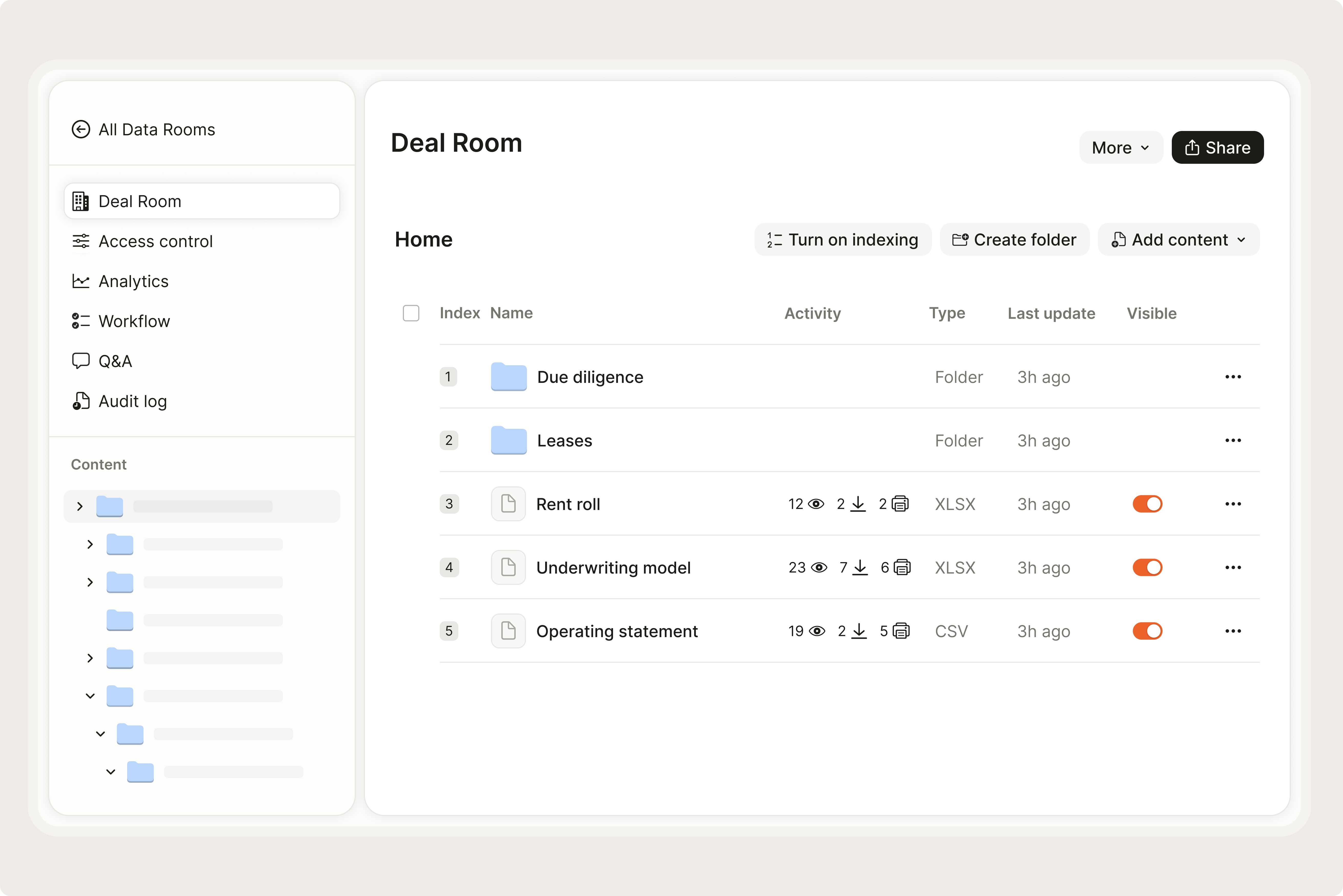
- 1.Upload Spanish property files to a secure roomDrop nota simple, Catastro extract, licencias, leases, IBI receipts, and Phase I ESA into Ellty. Each folder maps to a diligence area.
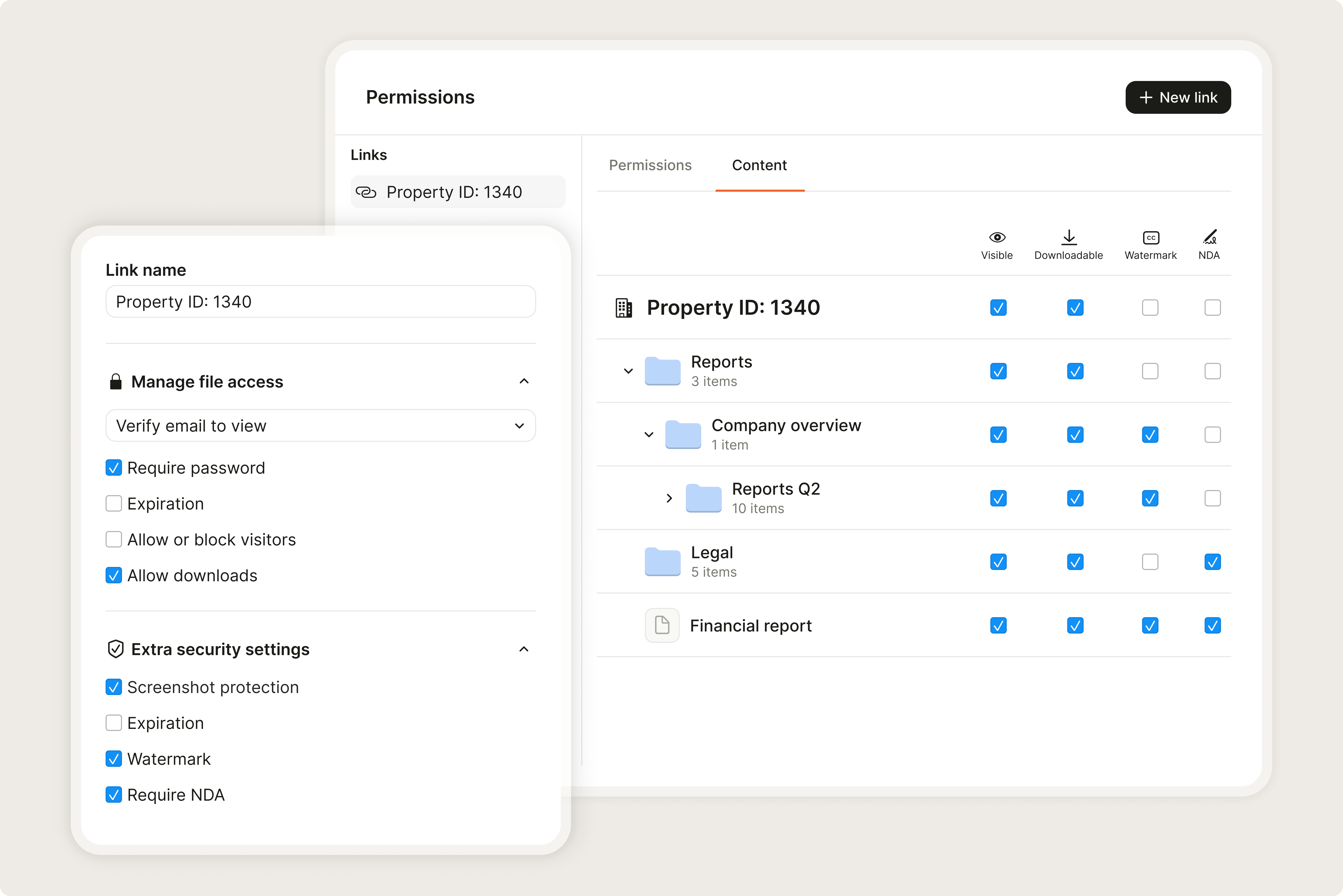
- 2.Give each advisor a scoped, tracked linkYour abogado sees title and encumbrance docs. Your tax advisor sees ITP/IVA analysis. Your environmental consultant sees Phase I reports. Ellty enforces the scope.
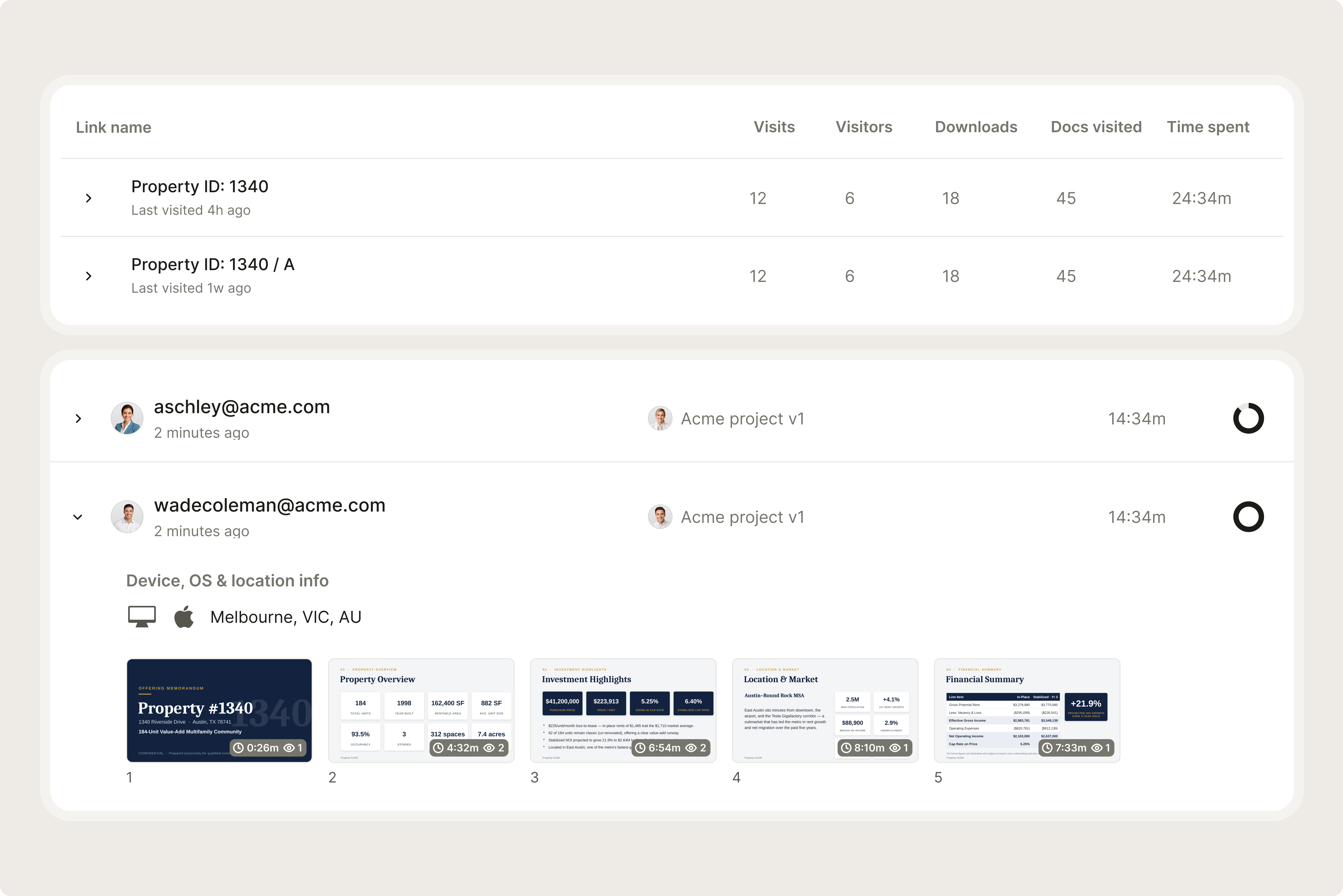
- 3.Monitor who reviews which documentsSee exactly which files each advisor opened and when. Catch delays before they affect the notario escritura date.
What makes Spain different
The ITP vs IVA choice is the most important pre-contract decision in Spanish CRE. On a EUR 20M transaction, ITP at 10% (Catalonia) is EUR 2M non-recoverable. IVA at 21% is EUR 4.2M in VAT, but a VAT-registered buyer recovers all of it as input tax. The economic cost difference is EUR 2M. Get the tax analysis before signing anything.
Urbanismo is decentralized. Each of Spain's 17 autonomous communities and 8,000+ municipalities has separate planning frameworks. A single building can be subject to national, regional, autonomous community, and local plans simultaneously. Confirm which plan controls the permitted use.
IBI arrears follow the property. If the seller has 4 years of unpaid IBI, that debt is a registered lien that transfers to the buyer at closing. The Ayuntamiento will not issue a tax clearance certificate until the IBI is paid - but they won't always alert you proactively. Request the 4-year IBI receipt history upfront.
Spain's licencia de primera ocupación gap is more common than buyers expect. Older commercial buildings in central Madrid, Barcelona, and coastal tourist areas were often built under permits that were never finalized with the first occupancy certificate. Regularization is possible in some cases but adds cost and time.
In Spain, the transfer of real property is completed through a two-step process: first, the signing of the escritura de compraventa (notarial deed of sale) before a notario público; and second, the inscription of that deed in the Registro de la Propiedad. The inscription of the deed creates the public record of ownership and protects the buyer against third-party claims under the principle of fe pública registral. A deed that is not inscribed does not confer full protection against competing interests.
Timeline and cost in Spain
Weeks 1-2 cover kickoff: nota simple from Registro de la Propiedad, Catastro extract, informe urbanístico from Ayuntamiento, ITP/IVA tax structure analysis, IBI receipt request, and Phase I ESA engagement. Budget EUR 4,000-12,000 for this phase.
Load all files into Ellty before advisors arrive. Scoped, tracked links for each party remove at least one week of document request emails from a standard Spanish CRE diligence process.
Weeks 2-4 cover deep review: licencia de primera ocupación confirmation, Phase I ESA delivery, lease abstraction, building permit history, ITE check for older buildings, plusvalía municipal calculation, and operating cost audit. Cost runs EUR 6,000-20,000 depending on asset complexity.
For Catalonia COSI register sites and Basque Country industrial heritage: Phase II ESA adds EUR 10,000-40,000. Don't skip this step for any former industrial parcel in these regions.
Weeks 4-6 handle resolution: Phase II if triggered, ITP/IVA election documentation, notario deed preparation, and Registro de la Propiedad inscription. Registry inscription typically completes within 15 working days of filing.
Spain total acquisition cost: 6-10% ITP (varies by autonomous community) or 21% IVA + 0.5-1.5% IAJD + notario fee (0.1-0.5%) + Registro inscription + legal fees EUR 15,000-40,000. For a Madrid commercial deal with ITP at 6%, total acquisition cost runs approximately 7-8% of purchase price.
Running a Spain property deal from one room
Hold nota simple docs, licencias, and lease files in one secure, tracked Ellty data room.
Start free 14-day trialCommon questions about due diligence on Spain property
- Most Spain CRE deals complete in 4-8 weeks. The informe urbanístico from the Ayuntamiento, licencia de primera ocupación confirmation, and Phase I ESA are the typical long lead-time items.
- The nota simple is a basic extract from Spain's Registro de la Propiedad showing the registered owner, surface area, permitted use, and all encumbrances (mortgages, liens, easements). It costs under EUR 10 online and should be pulled on day one of any Spanish property diligence.
- ITP (Property Transfer Tax) is 6-10% depending on the autonomous community and is non-recoverable by the buyer. IVA (21% VAT) applies when the seller is a business and the sale is of a new commercial property or the VAT exemption is waived. IVA is recoverable by VAT-registered buyers; ITP is not. Choosing the wrong structure can cost millions.
- The plusvalía municipal (IIVTNU) is a local tax on the increase in land value, payable by the seller. After the 2021 Constitutional Court ruling, it only applies if the land value actually increased. Sellers must calculate and pay it before or at closing; unpaid plusvalía creates a lien that can transfer to the buyer.
- The licencia de primera ocupación is a municipal certificate confirming a building has passed its final inspection and can legally be occupied. Many older Spanish commercial buildings lack it. Without it, the building cannot be legally used, utilities can be refused, and lenders may not finance the acquisition.
- Yes. There are no restrictions on foreign ownership of commercial property in Spain. Non-EU buyers must obtain a NIE (Número de Identificación de Extranjero) before signing any property documents. The notario will verify the NIE at the escritura signing.