Poland commercial property due diligence has two structural issues that are unlike any other EU market: perpetual usufruct (użytkowanie wieczyste) affects a significant portion of Warsaw and major-city commercial land plots, and the Warsaw Decree (Dekret Bieruta, 1945) creates residual title risk in the Polish capital. Get these two right first; the rest of the diligence is standard EU commercial process.
Poland transfer costs for commercial property: Property Transfer Tax (Podatek od czynności cywilnoprawnych, PCC) at 2% of the declared property value applies to VAT-exempt transactions; if the sale is subject to VAT at 23% (new commercial within 2 years of first occupation, or seller opts for VAT on older commercial with buyer agreement): PCC does not apply - this is a fundamental structuring choice in Polish CRE. VAT-registered buyers recover the 23% VAT as input; the PCC-vs-VAT decision is made before signing and affects the net acquisition cost by the full PCC amount for non-VAT-recoverable buyers.
Poland's Land and Mortgage Register (Księga wieczysta, KW): maintained by district courts (sądy rejonowe) across Poland; publicly searchable at ekw.ms.gov.pl since 2010; each property has a KW number; four sections: Section I (property description and associated rights), Section II (ownership - właściciel or użytkownik wieczysty/perpetual usufruct right holder), Section III (rights, claims and restrictions including easements), Section IV (mortgages - hipoteki). All property transfers in Poland must be executed as a notarial deed (akt notarialny) by a Polish notary (notariusz); the notary submits the deed electronically for KW registration; registration takes weeks to months depending on court district workload.
Set up a real-estate data room before advisors engage. Load KW extracts, perpetual usufruct agreement and conversion status, building permit, occupancy certificate, MPZP zoning extract, and lease files.
Where Poland property deals actually go wrong
Not every check carries the same weight. The table below sorts them by deal impact - dealbreakers first, then what moves the price, then basic hygiene - so your Polish attorney and advisor know what to clear first.
| Area | Documents to pull | Poland red flag | Matters most for | Tier | |
|---|---|---|---|---|---|
| KW Land Register search | KW Land Register search | Full KW extract (odpis z księgi wieczystej) from ekw.ms.gov.pl for all KW numbers comprising the property, title deed chain from seller | The Księga wieczysta is publicly searchable at ekw.ms.gov.pl; for diligence: obtain certified full extracts (pełny odpis KW) from the relevant district court, not just the online information extracts; confirm Section II owner/usufructuary matches the seller precisely; review Section III for all registered encumbrances (easements, claims, restrictions, injunctions, pre-emptive rights); review Section IV for all registered mortgages (hipoteki) - multiple mortgages can be registered in priority sequence; confirm any enforcement notice (wzmianka) in the KW which flags a pending registration or challenge and creates alert status; a KW wzmianka requires investigation before any deposit or binding offer | All buyers - foundational check | Dealbreaker |
| Perpetual usufruct (Użytkowanie wieczyste) | Perpetual usufruct (Użytkowanie wieczyste) | Perpetual usufruct agreement (umowa ustanowienia użytkowania wieczystego), current annual fee (opłata roczna) amount and payment history, conversion status documentation if applicable | Perpetual usufruct (użytkowanie wieczyste, UW) is a fundamentally different property right from full ownership; the land is owned by the state or local government and the right holder (użytkownik wieczysty) has the right to use it for a specified period (typically 99 years, renewable); an annual fee (opłata roczna) is paid to the land owner (state/municipality); the annual fee amount can be updated by the municipality - increases in opłata roczna for Warsaw commercial plots have been contentious and have led to significant disputes between property owners and the City of Warsaw; UW rights can be transferred (sold), mortgaged, and used commercially like ownership in practice, but have specific restrictions in the UW agreement regarding permitted use; failure to comply with permitted use conditions can result in termination of the UW right; confirm the permitted use in the UW agreement matches the current commercial use; confirm opłata roczna is current; check if the UW is nearing its expiry term and whether renewal has been agreed; for commercial plots: UW conversion to full ownership (uwłaszczenie) is available under Polish law but requires an application and fee; confirm conversion status | Warsaw commercial, major city center commercial; any commercial on state or municipal land | Dealbreaker |
| Warsaw Decree (Dekret Bieruta) risk | Warsaw Decree (Dekret Bieruta) risk | Warsaw administrative proceedings search (Biuro Administracji i Spraw Obywatelskich, BASiO) for pre-war ownership claims, Reprivatization Act (ustawa o szczególnych zasadach usuwania skutków prawnych decyzji reprywatyzacyjnych) proceedings history, KW Section III annotations for claims | The Decree of October 26, 1945 (Dekret Bieruta) nationalized all land within Warsaw's pre-war city boundaries to enable post-war reconstruction; former owners and their heirs retained the right to apply for perpetual usufruct of the land but this right was systematically denied during communist rule; since 1989, former owners and heirs have been seeking compensation or return of Warsaw land through administrative and court proceedings; the 2016 Reprivatization Act created a process to address fraudulent reprivatization decisions but Decree claims on legitimate grounds still exist; for Warsaw commercial on land that was privately owned before 1939: check whether any Decree-based claims have been filed through the Warsaw administrative process; BASiO (Biuro Administracji i Spraw Obywatelskich) Warsaw maintains a register of pending Decree cases; some Warsaw commercial properties have unresolved Decree-basis historical claims that could cloud title or require compensation payments | All Warsaw commercial on historically private land within pre-war city boundaries | Dealbreaker |
| Mortgages and Section IV | Mortgages and Section IV | Full KW extract Section IV, mortgage holder (wierzyciel hipoteczny) discharge confirmation, enforcement proceedings from National Enforcement Register (KRZ) | All mortgages (hipoteki) are registered in Section IV of the KW in priority order; review all registered mortgages and confirm they will be discharged at or before closing; in Poland: mortgage holders have a statutory right to satisfy their claims from the property sale proceeds in priority order; a buyer who takes title subject to a mortgage becomes personally obligated to satisfy it; also check the National Enforcement Register (Krajowy Rejestr Zadłużonych, KRZ at krz.ms.gov.pl) for enforcement proceedings against the seller entity; Polish property can be seized and sold in enforcement proceedings even after a sale is agreed if the seller has pending enforcement orders; a certified excerpt from the KRZ for the seller is standard pre-closing practice | All buyers | Dealbreaker |
| Spatial zoning plan (MPZP) | Spatial zoning plan (MPZP) | Local Spatial Development Plan (Miejscowy Plan Zagospodarowania Przestrzennego, MPZP) extract, or individual development conditions (Warunki zabudowy, WZ) if no MPZP exists, planning certificate (wypis z MPZP) from the municipality | Poland's spatial planning system: if a valid MPZP exists for the parcel, it governs all permitted uses, building heights, FAR, setbacks, and other development parameters; not all Polish parcels are covered by a valid MPZP - some areas (particularly outside major cities and in some suburban zones) have no MPZP in force; for parcels without a valid MPZP: individual development conditions (decyzja o warunkach zabudowy, WZ) must be obtained for any development or significant change of use; a WZ is site-specific and its issuance is not guaranteed; confirm whether the parcel is covered by a valid MPZP; obtain a planning certificate (wypis i wyrys z MPZP) from the municipality; confirm the current MPZP zoning designation (przeznaczenie) matches the intended commercial use; Poland's spatial planning reform (Ustawa o planowaniu i zagospodarowaniu przestrzennym, significant amendments 2023-2025) has been changing procedures; confirm current applicable law with Polish counsel | All Poland commercial; development sites; logistics | Price-adjuster |
| Building permit and occupancy certificate | Building permit and occupancy certificate | Building permit (pozwolenie na budowę), occupancy permit (pozwolenie na użytkowanie) or completion notification (zawiadomienie o zakończeniu budowy), building log (dziennik budowy) | Polish construction law (Prawo budowlane) requires a building permit (pozwolenie na budowę) from the Starosta or Prezydent Miasta for most commercial construction; after completion: either a formal occupancy permit (pozwolenie na użytkowanie) issued by the building control authority (PINB - Powiatowy Inspektor Nadzoru Budowlanego) or a completion notification with tacit approval (zawiadomienie o zakończeniu budowy); confirm the form of occupancy authorization for the specific building; for buildings completed without proper occupancy authorization: legalization (legalizacja) is required which can be costly and time-consuming; also confirm the as-built technical documentation (dokumentacja powykonawcza) is available; WINB (Wojewódzki Inspektor Nadzoru Budowlanego) maintains building control records | All Poland commercial buildings | Price-adjuster |
| Leases and tenancies | Leases and tenancies | All commercial leases, rent roll, registered lease annotations in KW Section III (for long-term leases over 10 years), tenant payment history | Polish commercial leases are governed by the Civil Code (Kodeks cywilny); for leases over 10 years: registration in KW Section III is required to be effective against a purchaser; unregistered leases over 10 years are effective inter partes but not binding on a buyer who takes without notice; review all commercial leases for: term and break options (wypowiedzenie), indexation (typically EUR and HICP-indexed for institutional Polish commercial), maintenance obligations, service charge structure, deposits and guarantees (kaucja, gwarancja bankowa), and tenant options; Poland's logistics and industrial sector leases often include tenant fit-out obligations and significant break payments; for retail commercial: review anchor tenant leases and cross-default provisions | Tenanted Poland commercial; logistics; retail | Price-adjuster |
| PCC vs. VAT structuring | PCC vs. VAT structuring | Seller's VAT registration status, first occupation date or substantial renovation date (for VAT new/old classification), Polish tax counsel VAT/PCC structuring opinion | Poland's PCC-VAT mutual exclusivity rule (Article 2(4) of the PCC Act): when a commercial property sale is subject to VAT (either mandatory or by option), PCC at 2% does not apply; conversely, a VAT-exempt sale attracts PCC at 2%; for most institutional commercial sales in Poland: if both parties are VAT payers, both parties can jointly elect to apply VAT on the sale of a building that would otherwise be VAT-exempt (the so-called 'VAT option' under Article 43(1)(10a) of the VAT Act); the VAT election must be made before signing the deed and notified to the tax authority; this VAT election avoids the 2% PCC and allows buyer VAT recovery if the buyer is a VAT payer using the property for VAT-taxable purposes; for non-VAT-recoverable buyers: bearing 23% VAT is worse than 2% PCC; Polish tax counsel confirmation of VAT/PCC treatment is essential before signing | All institutional commercial acquisitions; especially non-VAT-recoverable buyers | Price-adjuster |
| Environmental - former industrial and logistics zones | Environmental - former industrial and logistics zones | Regional Director for Environmental Protection (RDOŚ) environmental decisions for the property, GIOŚ (Chief Inspectorate of Environmental Protection) contaminated sites register search, Phase I ESA from licensed environmental consultant | Poland's communist-era industrial legacy created significant contamination particularly in: Upper Silesia (Katowice, Gliwice, Bytom, Zabrze - coal mining, steel, zinc smelting; Bytom in particular has subsidence risk from historical mining), Łódź (textile chemicals), Kraków-Nowa Huta (steel complex), and Gdańsk Shipyard area; Poland's logistics boom post-2015 has driven brownfield redevelopment in these areas; any logistics or industrial commercial in Upper Silesia or brownfield locations: Phase I ESA is standard; also check for ground subsidence risk in Bytom and other historical mining areas; Poland has a GIOŚ contaminated sites register (Rejestr historycznych zanieczyszczeń powierzchni ziemi); for logistics parks in greenfield locations near historic industrial: check site boundaries and prior land use carefully | Logistics, industrial in Upper Silesia, brownfield commercial; Łódź, Nowa Huta | Standard check |
| Seller KYC and AML | Seller KYC and AML | Polish National Court Register (KRS at ekrs.ms.gov.pl) entity confirmation, Polish Beneficial Owner Register (CRBR - Centralny Rejestr Beneficjentów Rzeczywistych) UBO confirmation, OFAC/EU sanctions screens | Poland implements EU AML directives; the Polish Beneficial Owner Register (CRBR) is publicly accessible at crbr.podatki.gov.pl; confirm seller entity at KRS (National Court Register); check CRBR for UBO disclosure; run OFAC and EU sanctions screens on all principals; the National Enforcement Register (KRZ) also shows insolvency proceedings against the seller entity - check before closing; Polish notaries are AML-regulated persons under Polish AML law (ustawa o przeciwdziałaniu praniu pieniędzy i finansowaniu terroryzmu) | All deals; corporate sellers | Standard check |
Due diligence on a Poland property?
Set up your Ellty data room before diligence starts.
Start free 14-day trialPoland commercial property due diligence checklist
The table ranked risks by severity. This is the full checklist to work through, grouped by area.
KW Land Register search and title chain
- Day one: search ekw.ms.gov.pl for all KW numbers associated with the property; identify all cadastral parcels and KW numbers; request certified full extracts (pełny odpis KW) from the relevant district court for each KW number - online searches give current status but certified court extracts are the diligence standard
- Section II review: confirm the registered owner (właściciel) or perpetual usufruct holder (użytkownik wieczysty) matches the seller; for company sellers: exact legal name and KRS number match; note the basis of acquisition (how the current owner acquired the property)
- Section III review: list all encumbrances (obciążenia) - easements (służebności), registered claims (roszczenia), pre-emptive rights (prawa pierwokupu), injunctions (zakazy); any enforcement injunction (zakaz zbywania) registered in Section III prohibits transfer; any KW wzmianka (pending registration flag) requires full investigation
- Section IV review: list all mortgages (hipoteki) by amount, creditor, and priority; confirm the plan for discharge at or before closing; check the National Enforcement Register (KRZ at krz.ms.gov.pl) for enforcement proceedings against the seller entity
Give each advisor a scoped link in Ellty. Polish attorney sees KW extracts and perpetual usufruct agreement. Building inspector sees building permit and occupancy certificate. Environmental consultant sees GIOŚ records and Phase I ESA. Lender sees KW extract, valuation, and lease pack. Each party sees only their files.
Perpetual usufruct analysis
- Identify from Section II of the KW whether the property is held as full ownership (własność) or perpetual usufruct (użytkowanie wieczyste, UW); if UW: request the full perpetual usufruct agreement (umowa ustanowienia użytkowania wieczystego) from the seller; this agreement specifies: the term (typically 99 years from the original grant date with renewal rights), the annual fee (opłata roczna, typically 0.3% or 1% or 3% of assessed land value depending on use category), and the permitted use conditions
- Confirm the UW permitted use matches the current commercial use; the city or state can terminate a UW right if the permitted use conditions are materially breached; Warsaw has been active in reviewing UW permitted use compliance for high-value city center plots
- Confirm the annual fee (opłata roczna) is current with no arrears; the land owner (city/state) can initiate UW termination proceedings for fee non-payment; also model future opłata roczna levels - Polish municipalities update assessed land values periodically and the opłata roczna increases proportionally; Warsaw's annual opłata roczna updates have been significant for commercial plots in the city center
- Assess UW conversion to full ownership: conversion is available for commercial UW under Polish law (Act on Converting Perpetual Usufruct of Developed Land to Ownership); a conversion fee is payable (typically 20x the current annual opłata roczna for commercial); for UW near expiry or with significant opłata roczna exposure: model the conversion cost and consider negotiating it into the deal price
Load all files into Ellty. Polish attorney sees perpetual usufruct agreement, annual fee payment history, and conversion analysis. Lender sees UW term remaining and annual fee level. Track document reviews - perpetual usufruct analysis is where Warsaw deal questions concentrate.
Warsaw Decree check
- For any commercial property in Warsaw: check whether the land was privately owned before the 1939 Warsaw boundary limits; the Bieruta Decree nationalized all Warsaw land in 1945; confirm from the KW and prior ownership history whether the land was covered by the Decree and whether the former owners received the UW right they were entitled to (or were improperly denied it)
- Search Warsaw's administrative system (Biuro Mienia Miasta, successor to BASiO) for pending Decree-basis administrative proceedings on the parcel; some Warsaw parcels have pending claims filed by heirs of pre-war owners that are in administrative review or court litigation; these do not always appear in the KW Section III until a court decision is made
- The 2016 Reprivatization Act (ustawa reprywatyzacyjna, officially: ustawa o szczególnych zasadach usuwania skutków prawnych decyzji reprywatyzacyjnych) created a process to invalidate fraudulent reprivatization decisions but the Warsaw Decree issue extends beyond fraudulent cases; legitimate historical claims can still exist for parcels where the pre-war owner or heirs were improperly denied their UW right and never received compensation
- Engage a Polish attorney experienced in Warsaw Decree risk for any Warsaw commercial acquisition on historically private land; title insurance specifically covering Warsaw Decree risk has become available from certain insurers as the market has matured
Compare Czech Republic's commercial property due diligence process for Central European portfolio strategy. Poland and Czech Republic are the two largest Central European commercial markets and both EU members; key differences: Poland (PLN, one of Europe's largest logistics markets, perpetual usufruct, Warsaw Decree risk, PCC/VAT structuring) vs. Czech Republic (CZK, Prague-dominated office and retail, no RETT since 2020, church restitution risk for some assets, generally cleaner title structure); annual investment volumes: Poland typically EUR 4-6 billion vs. Czech Republic EUR 1.5-2.5 billion.
How due diligence works in Poland
Step 1 - KW search and perpetual usufruct analysis
Day one: pull KW extracts for all KW numbers from ekw.ms.gov.pl and district court. Section II: confirm owner/UW holder. Section III: map all encumbrances. Section IV: list all mortgages. KRZ: check enforcement proceedings against seller.
For Warsaw commercial on historically private land: commission Warsaw Decree search with Polish counsel immediately.
Step 2 - Building permits, MPZP, and environmental
Request building permit and occupancy certificate from seller. Verify with PINB building authority. Obtain MPZP planning certificate from municipality. For Upper Silesia or brownfield logistics: commission Phase I ESA with GIOŚ contaminated sites search.
For perpetual usufruct: request full UW agreement and current opłata roczna confirmation.
Step 3 - VAT/PCC structuring, leases, and AML
Confirm VAT/PCC treatment with Polish tax counsel before drafting the purchase agreement (the VAT election must be in place before signing). Abstract all commercial leases. Check lease registration status in KW Section III for leases over 10 years. Confirm tenant deposit instruments. Check CRBR for UBO. Confirm seller at KRS. Run OFAC and EU sanctions screens.
Step 4 - Notarial deed and KW registration
All commercial property transfers require a notarial deed (akt notarialny) executed before a Polish notary; the notary collects PCC (if applicable) and submits the deed electronically to the relevant KW court for registration; title becomes fully effective against third parties on KW registration; registration timelines vary from a few weeks to several months depending on the court district; a booking (wniosek) entered at submission creates a pending entry that protects buyer position during the registration gap.
Load closing documents into Ellty before the notarial appointment. Polish attorney sees signed akt notarialny and KW registration submission confirmation. Lender sees post-closing KW extract with buyer registered in Section II.
How to set up your Poland data room in Ellty.
Poland commercial deals involve KW Land Register extracts for all KW numbers, perpetual usufruct agreement, building permit, occupancy certificate, MPZP planning certificate, GIOŚ environmental records, and all commercial leases.
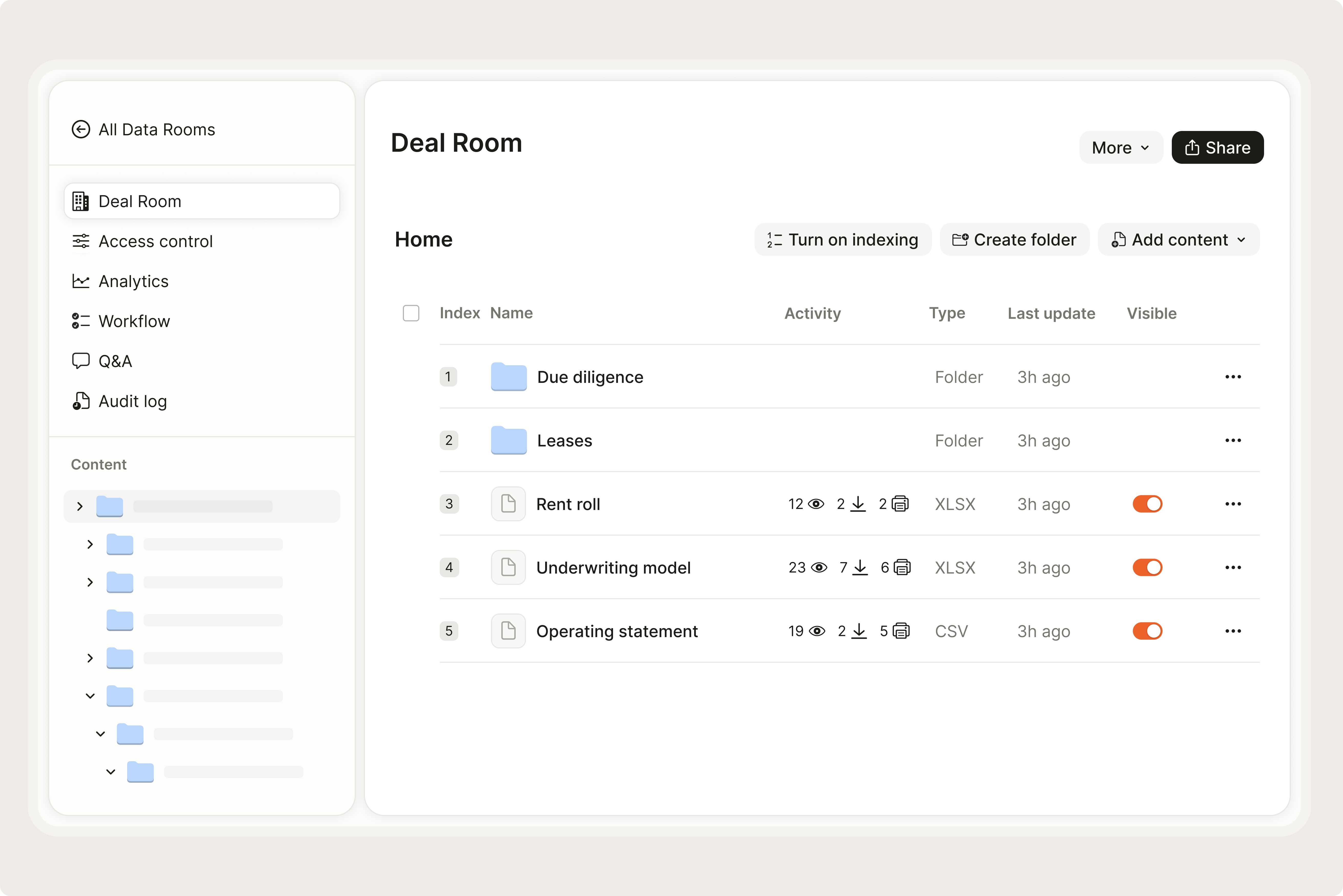
- 1.Upload Poland property files to a secure roomDrop KW Land Register extracts (Sections I-IV), perpetual usufruct agreement and annual fee payments, building permit, occupancy certificate (pozwolenie na użytkowanie), MPZP planning certificate, GIOŚ environmental records, Phase I ESA if applicable, KRZ enforcement check, and commercial lease pack into Ellty.
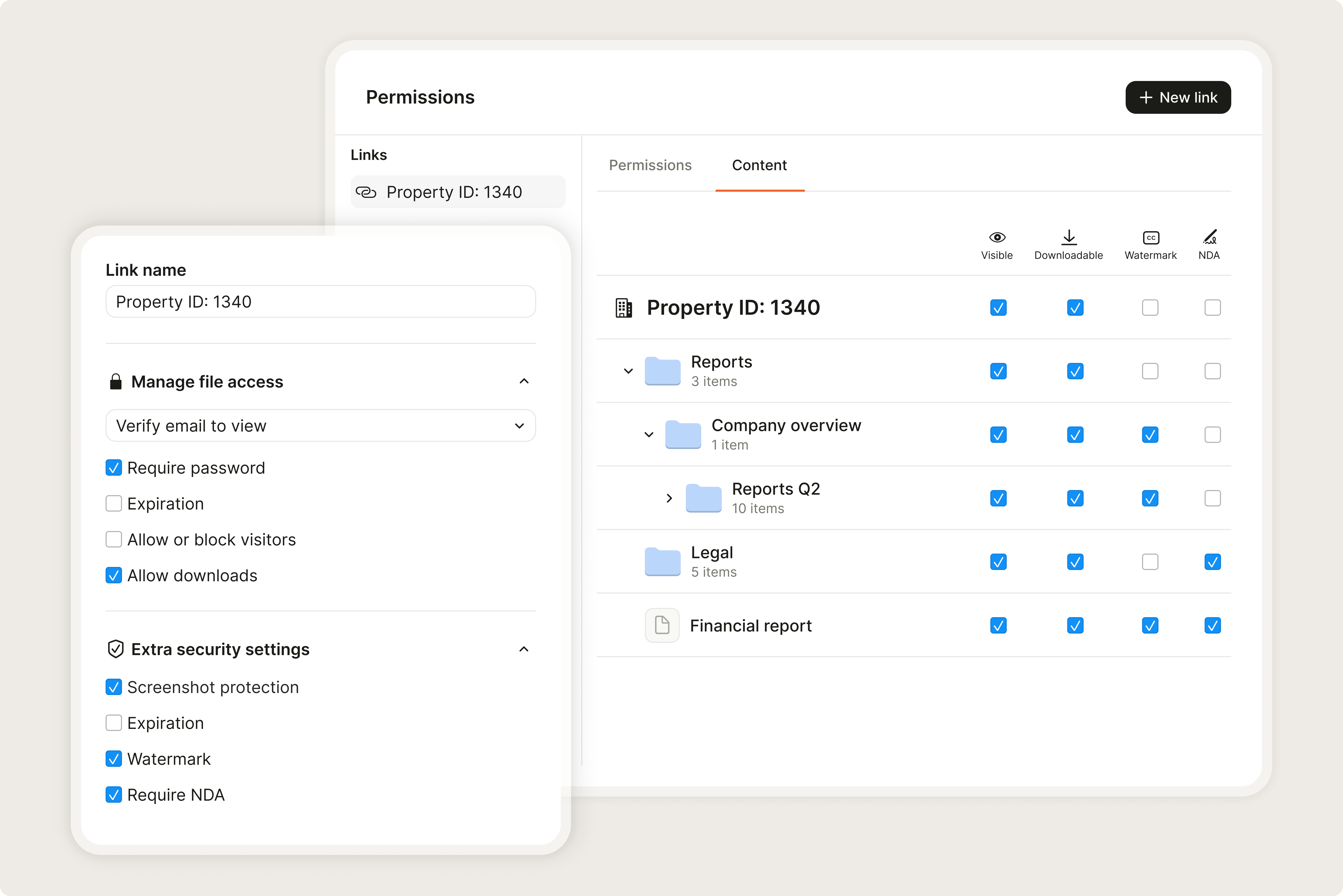
- 2.Give each advisor a scoped, tracked linkPolish attorney sees KW extracts, perpetual usufruct agreement, and Warsaw Decree check. Building inspector sees building permit and occupancy certificate. Environmental consultant sees GIOŚ records and Phase I ESA. Lender sees KW extract, valuation, and leases. Each party sees only their files.
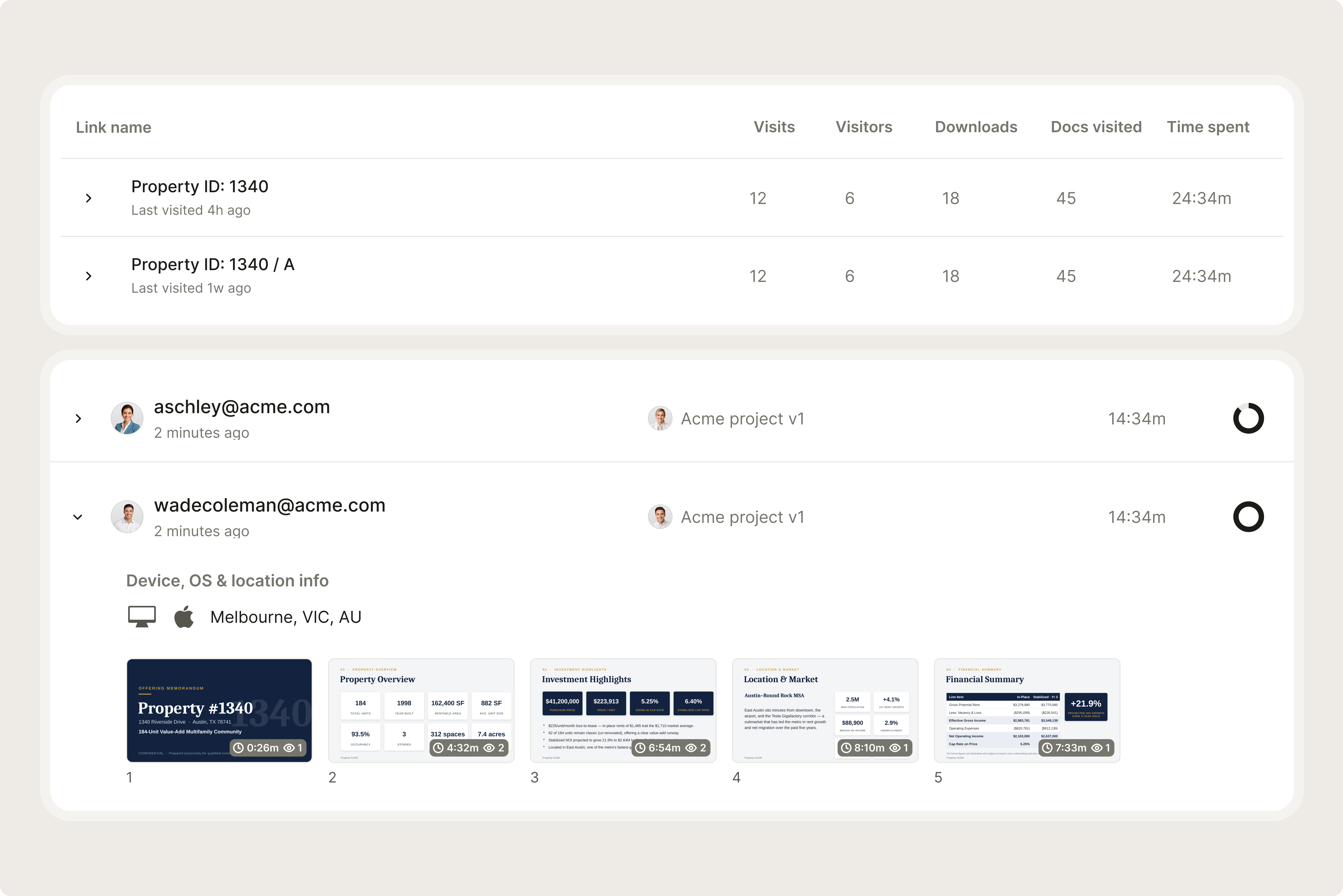
- 3.Monitor who reviews which documentsSee exactly which files each advisor opened and when. Catch perpetual usufruct issues or KW Section IV mortgage questions before they stall deal pricing or closing.
What makes Poland different
Perpetual usufruct (użytkowanie wieczyste) is the defining structural issue in Polish commercial real estate due diligence. It has no direct equivalent in most Western European legal systems and surprises buyers who haven't encountered it before. The concept originates from a solution to post-WWII urban reconstruction: rather than return land to private ownership immediately after nationalization, Polish law created a long-term right for private parties to use state or municipal land for 99-year terms (renewable) in exchange for an annual fee. For commercial property in Warsaw's central business district and other major Polish city centers where state or municipal land ownership is concentrated, the majority of commercial land plots are held under perpetual usufruct rather than full ownership. The practical consequences for due diligence are multiple: the permitted use condition in the UW agreement may differ from the actual current use and must be matched; the annual fee (opłata roczna) creates an ongoing cost obligation that should be checked for arrears and modeled for future increases (as municipalities update assessed land values and the fee scales accordingly); the UW right can in theory be terminated for breach of permitted use conditions, giving the land-owning municipality significant leverage; and the remaining UW term matters for leasehold financing since lenders require the UW term to substantially outlast the loan term and any primary lease term. The option to convert UW to full ownership (uwłaszczenie) has been available for residential since 2019 (automatic conversion at nominal cost) and for commercial by application with a conversion fee; the commercial conversion process is not automatic and requires negotiation with the relevant public entity. Institutional buyers have increasingly factored conversion into acquisition structures to eliminate UW uncertainty.
Poland's logistics and industrial commercial market has been one of Europe's most active since 2015, driven by e-commerce growth and nearshoring decisions by multinational manufacturers seeking supply chain proximity to European end-markets. Poland offers a combination of significantly lower labor costs than Western Europe, EU membership with integrated trade access, excellent highway infrastructure (motorway network largely completed in the 2010s), and large modern speculative logistics park development (with developers including Prologis, Panattoni, GLP, MLP, Hillwood operating in the market). The result for due diligence is that Poland's logistics CRE is relatively new stock (most modern warehouses built 2005-2024), with generally clean building permits and occupancy certificates, low environmental contamination risk for greenfield parks, and institutional-quality leases. However, brownfield logistics redevelopments in Upper Silesia and other former industrial zones introduce contamination risk, and the scale of speculative development has occasionally outpaced leasing demand in specific submarkets, creating tenant incentive structures (rent-free periods, fit-out contributions) that need to be carefully abstracted from lease agreements - headline rent and effective rent can differ significantly in post-2022 speculative logistics.
Warsaw's commercial property market is Central and Eastern Europe's largest and most actively institutionally traded market, but the combination of perpetual usufruct dominance in the center and Warsaw Decree title complexity creates a diligence burden that exceeds what a buyer of comparable assets in Prague, Vienna, or Berlin faces. The Warsaw Decree issue has been slowly resolving over 35 years of legal proceedings and administrative processes, but individual Warsaw commercial properties can still carry historical uncertainty about whether pre-war private owners' successors have fully waived or resolved their Decree-basis claims. Polish attorney firms with dedicated Warsaw Decree practice groups have developed specific methodologies for title searches that go beyond the KW extract to check Warsaw administrative records, court proceedings, and historical ownership documentation. For any Warsaw commercial in the central and inner city zones that were privately owned pre-1939: Warsaw Decree review by a specialized Polish attorney is not optional - it is a standard diligence step that should be commissioned before any deposit is paid.
The Decree of October 26, 1945 on the Ownership and Usage of Land in the Warsaw Area (Dekret z dnia 26 października 1945 r. o własności i użytkowaniu gruntów na obszarze m. st. Warszawy, commonly known as the Bierut Decree or Dekret Bieruta) transferred ownership of all land within the Warsaw city boundaries to the City of Warsaw Municipality. Former owners of such land were entitled to apply for perpetual usufruct (wieczysty najem) of the land on which they had buildings or economic facilities; former owners who were refused perpetual usufruct without proper legal basis, or who were denied the opportunity to apply, have been the subject of administrative and court proceedings seeking compensation or restitution since 1989. The 2016 Reprivatization Act established a procedure for reviewing and invalidating fraudulent administrative decisions relating to Warsaw Decree properties but did not extinguish all pre-existing substantive claims.
Timeline and cost in Poland
Weeks 1-2 cover kickoff: certified KW extracts for all KW numbers, KRZ enforcement register check against seller, KRS entity confirmation, CRBR UBO check, perpetual usufruct agreement request from seller (if UW), Warsaw Decree search commission for Warsaw commercial, MPZP planning certificate from municipality, building permit and occupancy certificate request from seller and PINB verification, GIOŚ contaminated sites search, Phase I ESA commission for brownfield or industrial, lease abstraction, VAT/PCC structuring analysis with Polish tax counsel, OFAC and EU sanctions screens. Polish attorney fees in this phase: PLN 50,000-200,000 (approx. EUR 12,000-47,000).
Load all files into Ellty before advisors engage. Standard Poland commercial: 45-90 days. Warsaw Decree review: 3-6 weeks. Phase I ESA: 4-6 weeks. MPZP planning confirmation (where amendment needed): 3-12 months.
Weeks 2-6 cover deep review: KW Section III encumbrance clearance plan, perpetual usufruct permitted use analysis, Warsaw Decree title opinion, building permit vs. occupancy certificate vs. as-built comparison, MPZP zoning vs. current use confirmation, Phase I ESA delivery, lease currency (PLN vs. EUR) and WAULT analysis, VAT/PCC treatment confirmation, opłata roczna payment history and projection. Costs: PLN 100,000-500,000 (approx. EUR 23,000-117,000).
Weeks 6-12 handle resolution: mortgage discharge, UW permitted use confirmation or amendment, Warsaw Decree risk opinion, occupancy certificate use-change if needed, VAT election registration with tax authority, akt notarialny preparation, signing, KW registration submission, and post-closing KW extract confirming buyer in Section II.
Poland total buyer-side transaction costs: PCC at 2% of declared property value (VAT-exempt transactions) or VAT at 23% (new or seller-elected, recoverable for VAT buyers); notary fees (regulated fee schedule, typically 0.5-1% of transaction value for commercial); KW registration court fee (relatively modest); Polish attorney fees (0.5-1.5% of transaction value). Total effective buyer cost: 2.5-5% of transaction value for VAT-exempt PCC deals; potentially lower net cost for VAT-elected transactions where buyer recovers VAT.
Running a Poland property deal from one room
Hold KW extracts, perpetual usufruct docs, building permits, and lease files in one secure, tracked Ellty data room.
Start free 14-day trialCommon questions about due diligence on Poland commercial property
- Perpetual usufruct (UW) is a long-term right (typically 99 years, renewable) to use state or municipal-owned land in exchange for an annual fee (opłata roczna). Many Warsaw and major-city commercial plots are held as UW rather than full ownership. The UW holder can build, occupy, lease, and mortgage the property like an owner - but the permitted use conditions in the UW agreement must be respected, the annual fee must be paid, and the land remains in public ownership. UW conversion to full ownership is available for commercial by application and fee payment (typically 20x the annual opłata roczna).
- The 1945 Bierut Decree nationalized all land within Warsaw's city limits for post-war reconstruction. Former owners and their heirs were entitled to apply for perpetual usufruct but were systematically denied this right during communist rule. Since 1989, heirs have sought compensation or property return through administrative and court proceedings. For any Warsaw commercial on land that was privately owned before 1939: a Warsaw Decree search through Warsaw administrative records and court proceedings is standard due diligence, beyond the standard KW Land Register search. A specialized Polish attorney should conduct this review.
- Poland's Property Transfer Tax (PCC) is 2% of the declared property value for VAT-exempt transactions. If the sale is subject to VAT at 23% (mandatory for new commercial within 2 years of first occupation, or by seller/buyer joint election for older commercial): PCC does not apply - VAT and PCC are mutually exclusive. VAT-registered buyers using the property for taxable business recover the 23% VAT as input tax. For most institutional commercial acquisitions in Poland: the VAT election is made to avoid PCC and allow buyer VAT recovery. Polish tax counsel confirmation before signing is essential.
- Standard Poland commercial: 45-90 days. KW Land Register certified extracts: 3-5 days from district court. Warsaw Decree search: 3-6 weeks for specialized review. Phase I ESA for brownfield or Upper Silesia industrial: 4-6 weeks. Building permit and occupancy certificate verification with PINB: 2-4 weeks. KW Land Register registration after notarial closing: weeks to months depending on court district. MPZP planning confirmation where plan amendment required: 3-12 months.
- EU/EEA nationals and EU/EEA-incorporated companies can own Polish commercial property freely. Non-EU/EEA nationals and companies generally need a permit from the Minister of Internal Affairs and Administration (MSWiA) to purchase Polish real estate. Exceptions apply for commercial non-agricultural property in most cases. In practice, most international institutional commercial acquisitions in Poland are structured through a Polish special purpose vehicle (SPV - typically a Polish sp. z o.o. or S.A.), which is a Polish legal entity and thus unrestricted in ownership rights.
- Communist-era industrial contamination is concentrated in: Upper Silesia (Katowice, Gliwice, Bytom - coal mining, steel, zinc smelting; Bytom has additional ground subsidence risk from historical mining), Łódź (textile and chemical industry legacy), Kraków-Nowa Huta (steel complex), and Gdańsk Shipyard area. Poland's GIOŚ (Chief Inspectorate of Environmental Protection) maintains the contaminated sites register. For logistics or industrial commercial in Upper Silesia or brownfield locations: Phase I ESA with GIOŚ register search is standard practice. Greenfield modern logistics parks built post-2000 generally have low environmental risk.