Pennsylvania commercial property has two environmental checks that define its brownfield and contaminated site market: Act 2 (Pennsylvania Land Recycling Program), which provides statutory liability relief for contaminated site buyers who complete cleanup to DEP-approved standards, and the Horsham/Willow Grove PFAS contamination plume in Montgomery County - one of the most significant military PFAS groundwater events in the Northeast, affecting municipal water supplies for over 25,000 residents.
Pennsylvania's Realty Transfer Tax runs 2% of purchase price on most commercial real estate transactions: 1% to the Commonwealth plus 1% to the local municipality. Philadelphia is the major exception: Philadelphia's local rate is 3.278% (city plus school district), making the total Philadelphia RTT 4.278%. The RTT is typically split between buyer and seller (each paying 1% in most PA locations; in Philadelphia, buyer conventionally pays 1% and seller pays 3.278%, though this is negotiable).
Pennsylvania Act 2 (Land Recycling and Environmental Remediation Standards Act, 35 P.S. § 6026.101 et seq.) is the brownfield liability protection mechanism every commercial buyer should understand before bidding on any PA industrial or contaminated site. Under Act 2, a buyer who completes cleanup to one of three standards (Background, Statewide Health, or Site-Specific) and receives PA DEP approval of a Final Report gets a release of liability from the Commonwealth for the remediated contamination. That release is the standard PA brownfield clearance document required by institutional lenders.
Marcellus Shale gas production covers a large swath of Pennsylvania; commercial properties in the Marcellus Shale footprint (SW and NE PA primarily) may have pipeline easements, well pad setbacks, and produced water concerns. Pennsylvania has no transfer tax exemption for Marcellus Shale-related conveyances.
Set up an Ellty real estate data room before diligence opens. Load ALTA title, PA DEP Act 2 records, Phase I ESA, PFAS screening, and lease files before advisors arrive.
Where Pennsylvania property deals go wrong
Not every check carries the same weight. The table below sorts risks by deal impact - dealbreakers first, then what moves the price, then basic hygiene - so your PA attorney and environmental consultant know what to clear first.
| Area | Documents to pull | PA red flag | Matters most for | Tier | |
|---|---|---|---|---|---|
| Title - recorder of deeds | Title - recorder of deeds | ALTA owner's title commitment, title search from county recorder of deeds, ALTA/NSPS survey, UCC fixture search | PA property records are at the county recorder of deeds; PA does not require an attorney for commercial closings (title companies can close); confirm clear title against all mortgages, municipal liens (PA municipalities have priority lien rights for unpaid water/sewer charges), and PA tax claims | All buyers | Dealbreaker |
| PA Act 2 and brownfield liability relief | PA DEP Act 2 Final Report, DEP acknowledgment letter, Covenant Not to Sue records, PA DEP eSite Tracker database | PA Act 2 and brownfield liability relief | Under PA Act 2, buyers of contaminated commercial property can obtain statutory liability relief by completing cleanup to Background, Statewide Health, or Site-Specific standards and receiving DEP approval of a Final Report; without Act 2 clearance, PA brownfield commercial sites are unlendable by most institutional lenders; confirm Act 2 status in PA DEP eSite Tracker before bidding | All PA brownfield, industrial, former manufacturing sites | Dealbreaker |
| PFAS - Horsham NAS and Montgomery County | PFAS - Horsham NAS and Montgomery County | PA DEP PFAS database, EPA PFAS site locator, Horsham Township PFAS plume maps, Phase I ESA PFAS addendum, well water testing | Former NAS Willow Grove (Horsham Township, Montgomery County) and adjacent Horsham Air Guard Station contaminated groundwater with AFFF PFAS; the Horsham plume affected municipal water supplies for over 25,000 residents in Horsham, Hatboro, and surrounding communities; commercial properties near the former base require PFAS investigation | Montgomery County commercial, Horsham/Hatboro area | Dealbreaker |
| Environmental - Pittsburgh steel and industrial | Environmental - Pittsburgh steel and industrial | Phase I ESA (ASTM E1527-21), PA DEP eSite Tracker, Brownfields database, CERCLIS Superfund NPL, PA DEP UST database | Allegheny County (Pittsburgh) and surrounding SW Pennsylvania have significant steel industry contamination legacy; former U.S. Steel, LTV Steel, and Bethlehem Steel sites (now brownfield redevelopment projects like Hazelwood Green) have documented soil and groundwater contamination; Pittsburgh brownfield Phase II is standard before lender commitment | Pittsburgh metro industrial, former mill sites | Dealbreaker |
| Marcellus Shale - pipeline and well setbacks | Marcellus Shale - pipeline and well setbacks | PA DEP oil and gas well records, PA PUC pipeline records, county recorder pipeline ROW deeds, methane migration screening | Marcellus Shale gas production affects SW and NE Pennsylvania; pipeline easements recorded at county recorder can significantly constrain commercial development; Act 13 setback requirements from gas wells affect development within 500 feet of certain commercial structures; methane migration from legacy wells is a concern in western PA coal and gas country | SW and NE PA commercial, greenfield development | Price-adjuster |
| Coal mine subsidence - central and western PA | Coal mine subsidence - central and western PA | PA DEP Bureau of Mining Programs mine map database, coal mine subsidence insurance records, structural engineering assessment for subsidence risk | Pennsylvania has more abandoned mine workings than any other state; mine subsidence (surface collapse over underground mines) is a documented hazard for commercial properties in Lackawanna, Luzerne, Schuylkill (anthracite) and Allegheny, Washington, Greene, Westmoreland (bituminous) counties; PA has mandatory mine subsidence insurance in affected areas | Central and western PA commercial in coal counties | Price-adjuster |
| Realty Transfer Tax - Philadelphia vs. rest of PA | Realty Transfer Tax - Philadelphia vs. rest of PA | PA RTT calculation, local RTT rate confirmation, RTT exemption review, Philadelphia Transfer Tax affidavit | PA RTT: 1% state + 1% local municipal (most PA) = 2% total, typically split 1% each; Philadelphia: 1% state + 3.278% city/school district = 4.278% total; buyer conventionally pays 1% and seller pays 3.278% in Philadelphia commercial; RTT exemptions include certain corporate restructuring and family transfers | All buyers | Standard check |
| Flood risk - Delaware and Schuylkill Rivers | Flood risk - Delaware and Schuylkill Rivers | FEMA FIRM, Army Corps Delaware River study, post-Ida flood damage records (2021), Schuylkill River flood history | Hurricane Ida (2021) caused catastrophic flooding in Philadelphia, Bucks County, and surrounding PA/NJ areas; Schuylkill River commercial in Philadelphia flooded; Delaware River commercial in Bucks County, Bristol, and Trenton-area NJ communities flooded; confirm current FEMA maps and post-Ida damage records for any river-adjacent PA commercial | Philadelphia, Bucks County, river corridor commercial | Price-adjuster |
| Zoning - PA municipalities | Zoning - PA municipalities | Municipal zoning certificate, PA Municipalities Planning Code (MPC) compliance, conditional use permit review, deed restrictions in title chain | PA municipalities each maintain zoning codes under the Municipalities Planning Code (53 P.S. § 10101 et seq.); PA second class townships and boroughs have separate zoning codes; Lehigh Valley commercial zoning (Allentown/Bethlehem) has been significantly revised to accommodate logistics growth; confirm current zoning and any pending MPC amendments | All commercial | Standard check |
| Insurance - mine subsidence and commercial | Insurance - mine subsidence and commercial | PA Mine Subsidence Insurance Fund (MSIF) records, commercial property insurance, pollution legal liability for Act 2 brownfield | PA mandates mine subsidence insurance for residential property in designated counties; commercial properties in mine subsidence areas should obtain PA MSIF coverage or commercial mine subsidence coverage; Pittsburgh brownfield lenders typically require pollution legal liability (PLL) insurance | Coal county commercial, Pittsburgh brownfield | Standard check |
| Seller KYC and AML | Seller KYC and AML | PA SOS entity filing, UBO identification, FinCEN compliance, OFAC screen | Philadelphia and Pittsburgh commercial markets attract significant institutional and some international capital; FinCEN beneficial ownership rules apply to all-cash purchases above the GTO threshold; run OFAC and sanctions screens on all principals | All deals | Standard check |
Due diligence on a Pennsylvania property?
Set up your Ellty data room before diligence starts.
Start free 14-day trialPennsylvania CRE checklist
The table ranked risks by severity. This is the full list to work through, grouped by area.
Title - county recorder of deeds
- Order the ALTA owner's title commitment from a PA-licensed title insurer on day one
- PA property records are maintained at the county recorder of deeds; title searches run against the county grantor-grantee index; PA county recorder offices have varying levels of online access
- PA does not legally require an attorney for commercial real estate closings; title companies can close PA commercial transactions; however, attorneys are commonly involved in significant PA commercial deals
- Pennsylvania municipal lien priority: PA municipalities have statutory priority lien rights for unpaid water, sewer, and certain municipal service charges; these municipal liens can take priority over first mortgages; the title search must specifically check for municipal claims
- PA tax claims: in PA, unpaid real property taxes can result in a tax claim filed at the county tax claim bureau; a tax claim that is not redeemed can result in judicial sale; confirm no outstanding PA tax claims against the property
- UCC fixture filings: search PA Department of State UCC database for fixture filings against the commercial parcel
- Commission ALTA/NSPS survey for all significant PA commercial acquisitions
PA Act 2 - Land Recycling Program brownfield clearance
- Search PA DEP's eSite Tracker database for any Act 2 or pre-Act 2 environmental remediation records for the property address
- Pennsylvania Act 2 (Land Recycling and Environmental Remediation Standards Act, 35 P.S. § 6026.101 et seq.): Act 2 provides a statutory liability relief mechanism for buyers of contaminated PA commercial property who complete cleanup to one of three standards:
1. Background Standard: cleanup to naturally occurring concentrations 2. Statewide Health Standard (SHS): cleanup to PA DEP statewide numeric cleanup standards for soil and groundwater 3. Site-Specific Standard (SSS): cleanup to site-specific risk-based standards developed by the buyer's licensed environmental professional - Act 2 clearance document: upon DEP approval of a Final Report (which documents cleanup completion), DEP issues an acknowledgment letter that includes a statutory release of liability from the Commonwealth for the remediated contamination; this is the standard PA brownfield clearance required by institutional lenders - For any PA commercial property with industrial history or documented contamination: check eSite Tracker; if no Act 2 case exists, the buyer starting the process from scratch must budget 6-24 months for Act 2 completion depending on contamination extent - Act 2 cleanup standards run with the land and impose ongoing land use restrictions (through Act 2 covenants recorded in the deed chain) if the cleanup was completed under the Statewide Health Standard with residual contamination
Set up each advisor's access in Ellty. PA attorney sees title chain and municipal lien records. Environmental consultant sees DEP eSite Tracker and Phase I/II. Act 2-specialized environmental professional sees Final Report and DEP acknowledgment. Lender sees Act 2 clearance and valuation.
PFAS - Horsham/Willow Grove NAS Montgomery County
- Search PA DEP's PFAS database and EPA's PFAS contamination site locator for the property location
- NAS Willow Grove/Horsham PFAS contamination: Naval Air Station Willow Grove (Horsham Township, Montgomery County) and the adjacent Horsham Air Guard Station were closed in 2011; prior to closure, AFFF containing PFAS compounds was used extensively at the flight line; PFAS contamination of groundwater and municipal water supply wells in Horsham, Hatboro, Warminster, and surrounding communities affected over 25,000 residents
- PA DEP PFAS response: PA DEP has been monitoring and responding to the Horsham PFAS plume; several municipal water authorities in Montgomery County installed treatment systems; some areas continue to have PFAS-affected groundwater
- For any commercial property in Horsham, Hatboro, Warminster, Horsham Township, or surrounding Montgomery County municipalities: commission Phase I ESA with PFAS addendum; for private-well dependent sites: commission PFAS well water testing
- Other PA PFAS sites: PA DEP maps PFAS contamination at multiple locations statewide beyond Horsham; search PA DEP's PFAS database for any PA property before finalizing the Phase I scope
Environmental - Pittsburgh, Philadelphia, and statewide
- Commission Phase I ESA meeting ASTM E1527-21 from a PA DEP-familiar environmental professional
- PA DEP eSite Tracker: publicly searchable database of PA contaminated sites under Act 2, HSCA, and pre-Act 2 remediation programs
- Pittsburgh brownfield: Allegheny County has significant steel industry contamination legacy; the Pittsburgh metro brownfield opportunity is substantial (Hazelwood Green on the former LTV Steel Hazelwood site is a 178-acre brownfield redevelopment), but brownfield Phase II is effectively the expected deliverable for PA institutional lenders before loan commitment on former mill sites
- Acid mine drainage (AMD): PA has more miles of AMD-impacted streams than any other state; central and western PA commercial properties near stream corridors affected by AMD should be assessed for stream water quality and any commercial water use impacts
- Philadelphia industrial corridor: Kensington, Port Richmond, South Philadelphia, and the Delaware River waterfront have documented industrial contamination from decades of manufacturing, tanning, and petroleum operations
Track advisor document access in Ellty. If the environmental consultant accesses the DEP eSite Tracker records and the Act 2 case files repeatedly, they're building the Phase II and Act 2 timeline picture. Know before the formal report.
Marcellus Shale - pipeline easements and well setbacks
- Search PA DEP oil and gas well records for any active or plugged Marcellus Shale wells on or near the commercial parcel; PA DEP maintains a publicly searchable well records database
- Pipeline easements: Marcellus Shale production requires extensive gathering pipeline infrastructure; pipeline easements recorded at the county recorder can significantly affect commercial development plans; search county recorder records for any recorded pipeline easements or ROW deeds
- PA Act 13 setbacks: Act 13 (58 Pa.C.S. Chapter 32) established minimum setbacks for oil and gas well operations from buildings and occupied structures; the setbacks may affect commercial development planning near active gas wells
- Legacy gas wells: western PA has thousands of legacy oil and gas wells from 19th and early 20th century production; many are unplugged or inadequately plugged; methane migration from legacy wells into commercial building foundations is a documented risk in western PA
- For any commercial property in Greene, Washington, Westmoreland, Fayette, Armstrong, Lawrence, or Butler counties (SW PA) or Bradford, Lycoming, Tioga, Sullivan, or Susquehanna counties (NE PA): check for active or abandoned oil and gas wells in the PA DEP database
Coal mine subsidence - central and western PA
- Check the PA DEP Bureau of Mining Programs mine map database for any underground mine workings beneath or near the commercial parcel; mine maps are publicly available through PA DEP
- Pennsylvania mine subsidence: PA has more surface land underlain by abandoned underground mines than any other state; commercial buildings constructed over shallow mine workings can experience subsidence (surface collapse or settlement) as mine pillars and roofs deteriorate over time
- Affected counties: Lackawanna and Luzerne counties (Scranton/Wilkes-Barre anthracite region); Schuylkill and Carbon counties (southern anthracite); Allegheny, Washington, Greene, Westmoreland, Fayette, Somerset, Cambria, and Clearfield counties (bituminous SW PA)
- PA Mine Subsidence Insurance Fund: PA maintains a state Mine Subsidence Insurance Fund (MSIF) for residential properties in designated mine subsidence areas; commercial properties in mine subsidence areas typically need to obtain commercial mine subsidence coverage (available through the MSIF for commercial properties meeting eligibility requirements or through specialty carriers)
- Structural assessment: for older commercial buildings in PA mine subsidence counties, commission a structural engineering assessment specifically addressing mine subsidence risk
Compare New Jersey's commercial property diligence process when running mid-Atlantic corridor acquisitions. PA and NJ are often in the same deal portfolio (I-95, I-78 logistics corridor). Key PA differences: PA Act 2 (brownfield liability relief) is conceptually similar to NJ's ISRA/LSRP mechanism but different in execution - Act 2 is opt-in and applies to any property, while ISRA is mandatory and triggered by industrial establishment transfer; PA has coal mine subsidence risk with no NJ equivalent; PA RTT at 2% (4.278% in Philadelphia) is comparable to NJ's combined RTF of ~2%.
Realty Transfer Tax - Philadelphia vs. rest of PA
- Calculate PA RTT at 1% (state) plus the applicable local municipal rate for the county and municipality where the property is located
- Most PA municipalities: 1% local (in addition to 1% state) = 2% total RTT; typically split 1% buyer and 1% seller
- Philadelphia: 3.278% local (city + school district) + 1% state = 4.278% total RTT; convention is buyer pays 1% state, seller pays 3.278% local, but this is negotiable in commercial transactions
- Pittsburgh (City of Pittsburgh): city transfer tax rate is higher than surrounding Allegheny County municipalities; confirm the specific Pittsburgh transfer tax rate at time of closing
- RTT is paid to the county recorder of deeds at recording; separate checks or wires to Commonwealth and local tax authorities
- Certain PA RTT exemptions exist for transfers between parent companies and wholly-owned subsidiaries, certain family transfers, and specific corporate reorganizations; confirm exemption eligibility with PA tax counsel before assuming a transfer is exempt
Flood risk - Delaware, Schuylkill, and Susquehanna Rivers
- Pull FEMA FIRMs for the property's flood zone; PA commercial properties along major river systems have documented flood risk
- Hurricane Ida (September 2021): remnants of Hurricane Ida caused catastrophic flash flooding and river flooding across SE Pennsylvania and NJ; Schuylkill River commercial in Manayunk (Philadelphia) and suburban Philadelphia flooded significantly; Delaware River commercial in Bucks County, Bristol, and downstream PA communities flooded; Ida updated the flood risk understanding for many SE PA commercial areas
- Delaware River: commercial properties in Bucks County, Lower Bucks, and Philadelphia's Delaware River waterfront area face Delaware River flood risk; the Delaware River Joint Toll Bridge Commission and Army Corps have ongoing flood risk studies
- Susquehanna River: Harrisburg and surrounding Dauphin County commercial have Susquehanna River flood risk; 2011 flood from Hurricane Lee inundated portions of Harrisburg's commercial district
- Monongahela and Allegheny Rivers (Pittsburgh): Pittsburgh commercial in the Strip District and along the Mon and Allegheny River corridors has documented flood risk; confirm FEMA zone and post-event flood records
Zoning - PA municipalities planning code
- Confirm the zoning designation from the applicable city, township, borough, or county planning department
- PA Municipalities Planning Code (MPC, 53 P.S. § 10101 et seq.): all PA municipalities administer local zoning under MPC authority; PA second class townships (most suburban PA) and boroughs have separate planning and zoning boards
- Lehigh Valley logistics zoning: the I-78/I-81 interchange area in Lehigh Valley (Northampton and Lehigh counties) has been significantly developed for logistics; confirm current commercial and industrial zoning in specific municipalities along the I-78 corridor before assuming zoning matches the Lehigh Valley logistics profile
- Philadelphia's zoning code: Philadelphia adopted a revised zoning code (2012, subsequently amended); Philadelphia's commercial zoning has multiple overlay districts and historic district designations that can constrain development
How due diligence works in Pennsylvania
Step 1 - Title and Act 2 status
Day one: order ALTA title commitment and simultaneously search PA DEP eSite Tracker for any Act 2 or remediation records at the property address. Both are fast checks; eSite Tracker is publicly available online.
If eSite Tracker shows an active or completed Act 2 case: obtain the Act 2 Final Report and DEP acknowledgment letter. If the case is completed with DEP approval, confirm the Act 2 clearance is current and any recorded Act 2 covenants (land use restrictions) are reviewed for commercial use impact.
If no Act 2 case exists but industrial history is evident from Phase I: the brownfield buyer starts from scratch under Act 2; timeline for Act 2 completion runs 6-24+ months depending on contamination extent.
Step 2 - PFAS, environmental, and mine subsidence
For Montgomery County commercial: commission PFAS addendum to Phase I and private well testing if applicable.
For Pittsburgh metro or SW/central PA: check PA DEP mine map database for underground mine workings. Commission Phase I ESA with PA-specific databases (eSite Tracker, PA DEP UST, AMD stream database). For Allegheny County industrial-legacy brownfield: Phase II is the expected commercial lender diligence baseline.
For Marcellus Shale counties: search PA DEP oil and gas well records and county recorder for pipeline easements as part of Phase I.
Step 3 - Flood, zoning, and Marcellus
Pull FEMA FIRMs and post-Ida (2021) flood records for SE PA commercial. Confirm zoning from the applicable municipality under MPC.
Load all Phase I, Act 2 records, DEP eSite Tracker records, PFAS data, mine map data, and flood maps into Ellty. Environmental consultant, Act 2 specialist, and PA attorney each get a scoped, tracked link. Monitor document access; if the Act 2 environmental professional accesses DEP eSite Tracker repeatedly alongside the Phase II reports, they're building the cleanup cost estimate.
Step 4 - Leases, RTT calculation, and closing
Abstract all leases. Calculate RTT for the specific municipality and model buyer vs. seller allocation. Philadelphia RTT of 4.278% is a material transaction cost; model it explicitly in deal economics.
PA commercial closings are handled by title companies or attorneys; no attorney requirement. Budget 45-60 days for standard PA commercial; Act 2 brownfield deals require significantly longer timelines.
How to set up your Pennsylvania data room in Ellty.
PA commercial deals involve ALTA title, Act 2 clearance docs, PA DEP eSite Tracker records, PFAS screening, mine subsidence data, flood maps, and lease abstraction. Load everything into Ellty before advisors arrive.
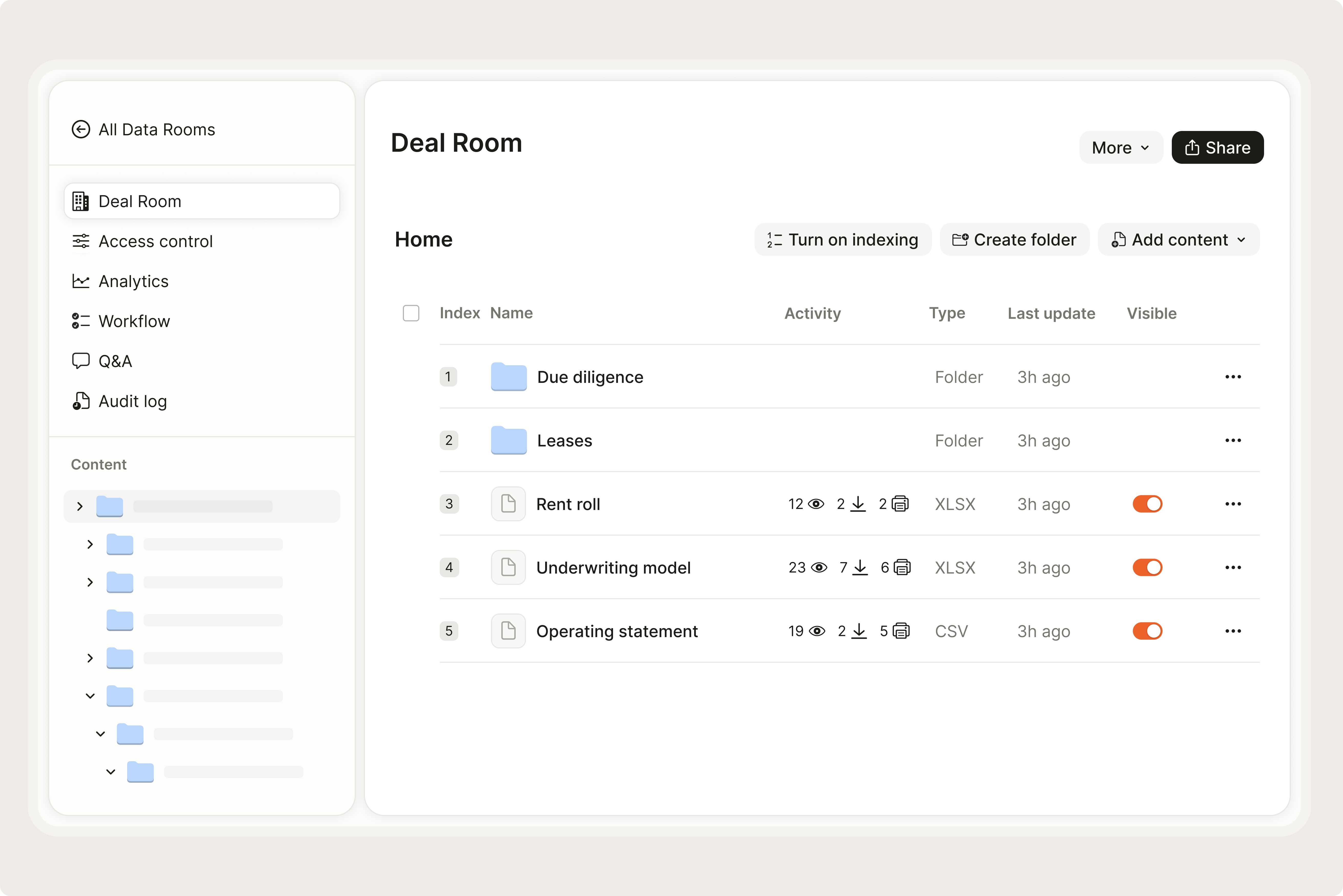
- 1.Upload Pennsylvania property files to a secure roomDrop ALTA title commitment, PA DEP eSite Tracker records, Act 2 Final Report, Phase I ESA, PFAS data, mine map records, FEMA flood maps, and lease pack into Ellty.
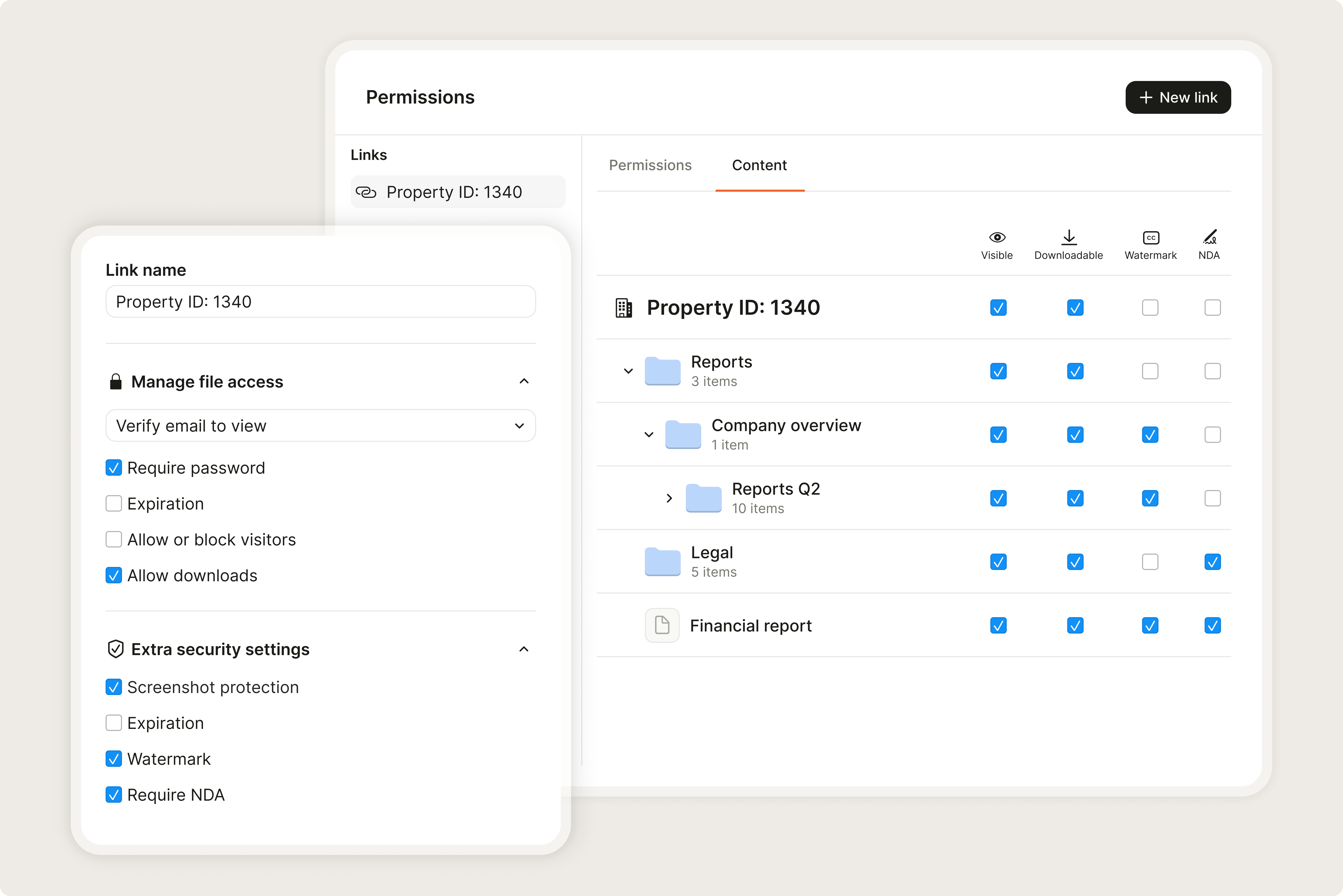
- 2.Give each advisor a scoped, tracked linkPA attorney sees title chain and municipal lien records. Environmental consultant sees DEP records, Phase I/II, and Act 2 case files. Mine subsidence engineer sees mine map and structural records. Lender sees Act 2 clearance and valuation.
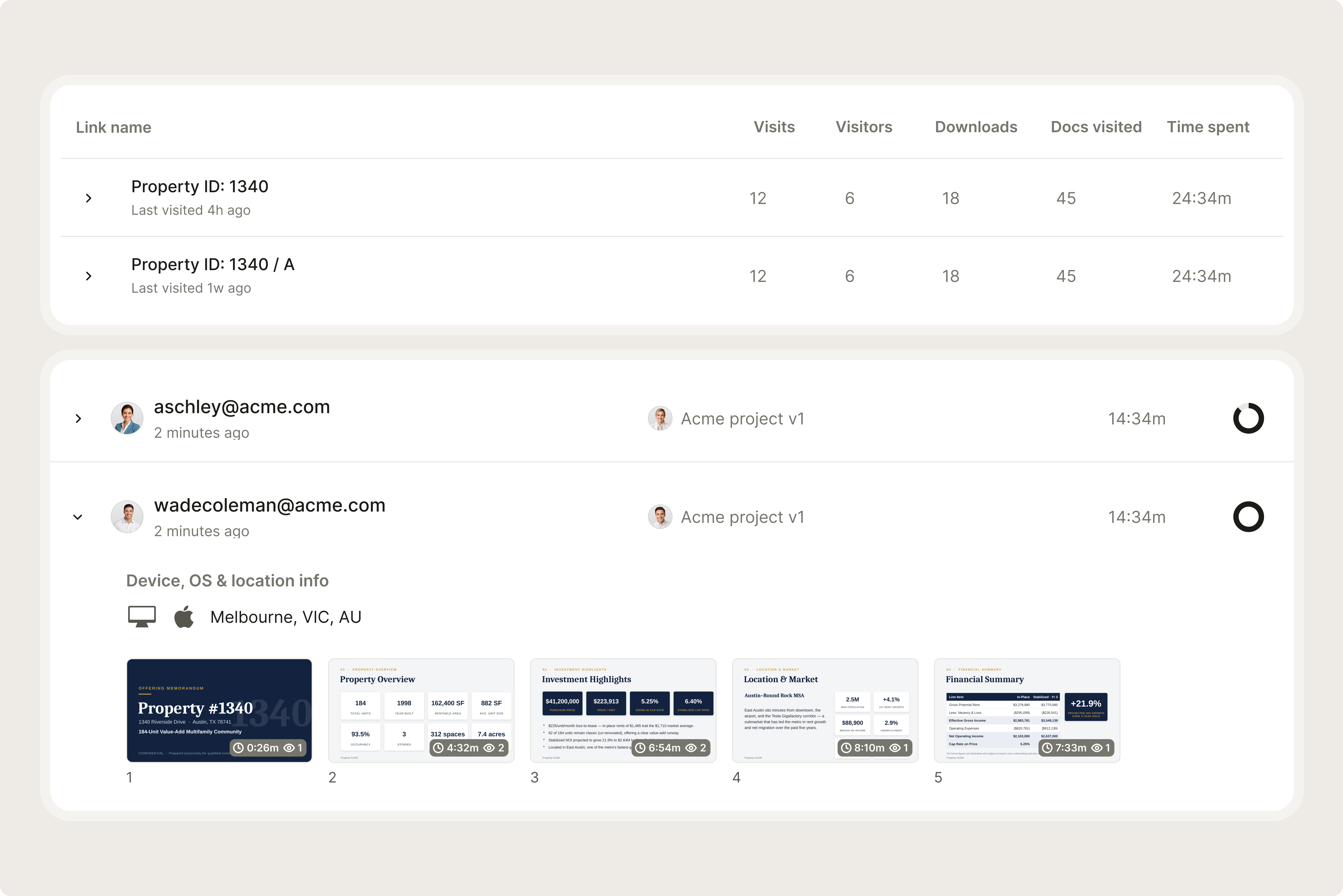
- 3.Monitor who reviews which documentsSee exactly which files each advisor opened and when. Catch Act 2 cleanup cost questions or mine subsidence findings before they stall lender approval.
What makes Pennsylvania different
Act 2 is the Pennsylvania brownfield mechanism that out-of-state buyers consistently underestimate in complexity and timeline. Unlike NJ's ISRA (which is mandatory for industrial establishment transfers), PA Act 2 is an opt-in program that any buyer can initiate. But to get the statutory liability relief - the DEP acknowledgment letter that institutional PA lenders require before funding brownfield acquisitions - the cleanup must be completed and DEP-approved. An Act 2 Final Report takes months to prepare, DEP review takes additional months, and if the cleanup requires active remediation, the timeline extends further. Confirm Act 2 status in eSite Tracker before bidding; a brownfield with no Act 2 case and significant contamination is a 12-24 month diligence project, not a 60-day transaction.
Horsham/Willow Grove PFAS is Philadelphia's most significant military environmental contamination event, and it's ongoing. Over 25,000 residents in Montgomery County had their municipal water supplies affected by PFAS from NAS Willow Grove and the adjacent Horsham Air Guard Station. Treatment systems have been installed at affected water systems, but the underlying groundwater plume remains. Commercial properties in Horsham, Hatboro, Warminster, and surrounding municipalities that rely on private wells or are near the groundwater plume require PFAS investigation as a standard part of diligence. PA DEP PFAS MCL standards are among the more stringent on the East Coast.
Pennsylvania mine subsidence is not a legacy concern - it's an active commercial real estate hazard. PA has more surface land over abandoned underground mines than any other state, concentrated in the anthracite coal counties (Lackawanna, Luzerne, Schuylkill, Carbon) and bituminous coal counties (Allegheny, Washington, Greene, Westmoreland). Mine voids collapse unpredictably as roof support pillars deteriorate; commercial building foundations can experience significant settlement. PA's Mine Subsidence Insurance Fund exists because the risk is real and insurable. For any commercial property in a PA mine subsidence county: PA DEP mine map database check is mandatory diligence, not optional.
Philadelphia's 4.278% total Realty Transfer Tax is one of the highest commercial transfer tax rates in the US. On a $20M Philadelphia commercial deal, the combined RTT runs approximately $855,600 - a material transaction cost. Philadelphia commercial buyers conventionally pay 1% (state) and sellers pay 3.278% (city/school district), but this is negotiable. Model the RTT explicitly in Philadelphia deal economics and confirm allocation in the purchase agreement.
Pennsylvania Act 2 (Land Recycling and Environmental Remediation Standards Act, 35 P.S. § 6026.101 et seq.) provides a mechanism for remediating contaminated properties to one of three cleanup standards: the Background Standard (cleanup to naturally occurring concentrations), the Statewide Health Standard (SHS, cleanup to PA DEP numeric values for soil and groundwater), or the Site-Specific Standard (SSS, cleanup to risk-based standards developed for the specific site). Upon completion of cleanup and approval of a Final Report by PA DEP, the owner receives an acknowledgment letter that includes a statutory release of liability from the Commonwealth for the contamination addressed in the Final Report. The Act 2 release runs with the land and protects successor owners who comply with any recorded Act 2 land use restrictions. PA DEP's eSite Tracker database maintains records of all Act 2 submissions and approvals and is publicly searchable by address.
Timeline and cost in Pennsylvania
Weeks 1-2 cover kickoff: ALTA title commitment order, PA DEP eSite Tracker Act 2 status search, PA DEP PFAS database search, Phase I ESA commission (with PA-specific databases), PA DEP mine map check (for coal counties), Marcellus Shale well and pipeline records search (for Marcellus counties), PFAS screening assessment (for Montgomery County), FEMA flood zone check, zoning confirmation, and lease abstraction initiation. Legal fees in this phase run USD 5,000-15,000.
Load all files into Ellty before advisors engage. Standard PA commercial deals run 45-60 days; Act 2 brownfield deals require 6-24+ months for full clearance.
Weeks 2-5 cover deep review: Phase I ESA delivery, Act 2 status confirmation and clearance strategy, mine subsidence engineering assessment (if in coal counties), PFAS results (if commissioned), Marcellus pipeline easement review, flood risk analysis, zoning compliance, lease abstraction, and PLL insurance quotes (for brownfield assets). Costs in this phase: USD 12,000-35,000.
Weeks 5-10+ handle resolution: Phase II ESA (if triggered), Act 2 Final Report preparation and DEP submission (for brownfield), mine subsidence insurance binding, RTT calculation and closing preparation, title exception clearance.
Pennsylvania total acquisition costs for buyers: RTT (1-4.278% split between buyer and seller depending on location) + ALTA title insurance + legal/advisory + environmental (Phase I/II + Act 2 specialist). Philadelphia buyers carry 1% of the 4.278% RTT; suburban PA buyers carry 1% of the 2% RTT. Total buyer acquisition cost runs approximately 1.5-2.5% in most PA markets and 1.5-3% in Philadelphia.
Running a Pennsylvania property deal from one room
Hold ALTA title, Act 2 clearance records, PA DEP environmental docs, and lease files in one secure, tracked Ellty data room.
Start free 14-day trialCommon questions about due diligence on Pennsylvania commercial property
- Standard PA commercial deals take 45-60 days. For brownfield commercial requiring PA Act 2 clearance where no existing Act 2 case is in place: add 6-24+ months depending on contamination extent and cleanup standard chosen. Mine subsidence engineering assessment adds 2-3 weeks for coal county commercial. PFAS well testing (if required in Montgomery County) adds 3-5 weeks. Marcellus Shale pipeline records research adds 1-2 weeks for affected counties.
- PA Act 2 (Land Recycling and Environmental Remediation Standards Act, 35 P.S. § 6026.101 et seq.) provides statutory liability relief for buyers of contaminated PA commercial property who complete cleanup to DEP-approved standards. Cleanup can be completed to Background, Statewide Health, or Site-Specific standards. Upon DEP approval of a Final Report, DEP issues an acknowledgment letter including a statutory release of liability for the remediated contamination. This Act 2 clearance document is required by most PA institutional lenders before funding brownfield commercial acquisitions. Search PA DEP eSite Tracker for Act 2 status before bidding on any PA commercial property with industrial history.
- Former NAS Willow Grove and the adjacent Horsham Air Guard Station (both in Horsham Township, Montgomery County) used AFFF containing PFAS for fire suppression, contaminating groundwater and municipal water supply wells serving over 25,000 residents in Horsham, Hatboro, Warminster, and surrounding communities. Water treatment systems have been installed at affected municipal water systems, but the underlying PFAS groundwater plume remains. Commercial properties in the affected area that rely on private wells require PFAS water testing. PA DEP maintains a PFAS database of contamination sites statewide.
- Mine subsidence is the collapse or settlement of surface land over abandoned underground mine workings as mine roof supports and pillars deteriorate. Pennsylvania has more surface land underlain by abandoned underground mines than any other state. Affected counties include Lackawanna, Luzerne, Schuylkill, and Carbon (anthracite region) and Allegheny, Washington, Greene, Westmoreland, and Fayette (bituminous SW PA). Commercial buildings over shallow mine workings face foundation damage risk. PA DEP maintains mine maps publicly accessible through the Bureau of Mining Programs. PA Mine Subsidence Insurance Fund (MSIF) provides coverage for eligible properties.
- PA Realty Transfer Tax (RTT) is 1% to the Commonwealth plus 1% to the local municipality for most PA locations, totaling 2%, typically split 1% each between buyer and seller. Philadelphia is the major exception: Philadelphia's local RTT rate is 3.278% (city plus school district), making the total Philadelphia RTT 4.278%. By commercial convention in Philadelphia, the buyer pays 1% (state) and the seller pays 3.278% (local), though this is negotiable. RTT is paid to the county recorder of deeds at recording.
- No. Pennsylvania does not legally require an attorney to supervise commercial real estate closings. PA title companies can and do close commercial transactions without mandatory attorney involvement. However, for complex commercial deals involving Act 2 brownfields, mine subsidence risk, Marcellus Shale pipeline easements, or significant environmental liability, engaging a PA real estate and environmental attorney is strongly advisable. PA real estate attorneys are commonly involved in significant commercial closings even without a legal requirement.