North Dakota commercial property due diligence has two defining features that most out-of-state buyers don't anticipate: mineral rights that are routinely severed from surface rights in western North Dakota's Bakken formation - where the mineral estate is dominant and oil company surface use rights can materially affect commercial development plans - and Red River flood risk in the Fargo-Grand Forks corridor that has produced catastrophic flooding events within the past 30 years.
North Dakota has no real estate transfer tax. This makes it one of a small number of US states with zero transfer tax on commercial real estate conveyances; total acquisition costs run accordingly low. The North Dakota Industrial Commission (NDIC) Oil and Gas Division is the state agency regulating oil and gas production, well permitting, and pipeline operations - the equivalent of Texas's Railroad Commission or Oklahoma's OCC.
Bakken mineral rights: the Williston Basin in western North Dakota (Williams, Mountrail, McKenzie, Dunn, Bottineau, Burke, and Divide counties) is one of the most productive tight-oil plays in the US. Mineral rights in this region have been actively bought, sold, and leased for decades; the mineral estate chain of title is often complex and frequently severed from the surface. For any commercial property in western ND oil country: engage a North Dakota landman for mineral abstract alongside the ALTA surface title search. Oil and gas surface use rights - the right to access the surface for drilling, pipeline installation, and production operations - can significantly affect commercial site planning.
Brine (produced water) spills are North Dakota's most distinctive commercial real estate environmental issue in oil country. Produced water from Bakken formation production is extremely saline and, when spilled, kills vegetation and can cause severe soil and groundwater contamination. ND DEQ (Department of Environmental Quality) maintains records of oil and brine spills. Commercial properties in western ND counties near active or former production areas should be checked against ND DEQ's spill database.
Set up an Ellty data room before diligence opens. Load ALTA title, mineral abstract, NDIC records, ND DEQ environmental data, and lease files before advisors arrive.
Where North Dakota property deals go wrong
Not every check carries the same weight. The table below sorts risks by deal impact - dealbreakers first, then what moves the price, then basic hygiene - so your North Dakota attorney and technical advisor know what to clear first.
| Area | Documents to pull | ND red flag | Matters most for | Tier | |
|---|---|---|---|---|---|
| Title - ALTA and mineral abstract | Title - ALTA and mineral abstract | ALTA owner's title commitment, full title search from county recorder, mineral abstract from ND landman, NDIC oil and gas well and pipeline records | ND mineral rights are separately conveyable; Williston Basin mineral estates have been actively traded for decades; the mineral estate is dominant over the surface; surface use rights granted to oil and gas operators can include drilling pad locations, road access, and pipeline corridors that affect commercial development; engage a landman for western ND oil country | All buyers; critical in Bakken counties | Dealbreaker |
| Red River flood risk - Fargo and Grand Forks | Red River flood risk - Fargo and Grand Forks | FEMA FIRM, Army Corps of Engineers flood study, Fargo-Moorhead Diversion project status, post-1997 and post-2009 flood damage records | The Red River of the North has flooded catastrophically in 1997 (52.97 ft in Grand Forks; $3.5B in damage) and 2009 (40.82 ft in Fargo); the Fargo-Moorhead Diversion project is under construction to provide long-term flood protection; commercial properties in Fargo and Grand Forks require careful FEMA map and diversion status review before bidding | Fargo metro, Grand Forks commercial | Dealbreaker |
| Brine and oil spills - western ND | Brine and oil spills - western ND | ND DEQ oil and brine spill database, NDIC oil field spill records, Phase I ESA with ND DEQ brine focus, soil and groundwater sampling | Bakken produced water (brine) has chloride concentrations of 200,000-300,000 mg/L - 10x saltier than seawater; brine spills kill vegetation and cause severe soil and groundwater salinization; ND DEQ spill database tracks reported spills; commercial properties near active or former production areas must be checked for brine contamination | Western ND commercial, oil country commercial | Dealbreaker |
| PFAS - Grand Forks AFB and Minot AFB | PFAS - Grand Forks AFB and Minot AFB | EPA PFAS site locator, ND DEQ PFAS records, Phase I ESA PFAS addendum, well water testing | Grand Forks Air Force Base (Grand Forks County) and Minot Air Force Base (Ward County) have documented PFAS groundwater contamination from AFFF firefighting foam; commercial properties near these bases require PFAS screening; private-well dependent commercial near the bases needs PFAS water testing | Properties near military bases; well-water sites | Price-adjuster |
| Surface use agreements - oil and gas | Surface use agreements - oil and gas | NDIC recorded surface use agreements, oil and gas lease records, pipeline right-of-way records from county recorder | North Dakota law requires oil and gas operators to enter surface use agreements with surface owners; these agreements specify drilling pad location, access road construction, surface disturbance compensation, and reclamation; existing surface use agreements run with the land and bind new surface owners; review all recorded surface use agreements before purchasing western ND commercial property | Western ND, Bakken county commercial | Price-adjuster |
| Agricultural lease obligations | Agricultural lease obligations | Agricultural lease contracts, ND Farm Service Agency CRP records, recorded agricultural lease review | ND commercial and industrial sites outside of Fargo, Bismarck, Grand Forks, and Minot are frequently on land that was or is leased for agricultural operations; confirm whether any agricultural lease is in place and the lease terms, including early termination rights; ND courts have held that some agricultural leases run with the land | Rural commercial, greenfield development | Price-adjuster |
| Zoning - ND municipalities and counties | Zoning - ND municipalities and counties | Municipal or county zoning certificate, conditional use permit review, ND flood hazard area designation | ND cities maintain their own zoning codes; many rural ND counties have limited or no county-wide commercial zoning; confirm the jurisdiction and applicable zoning code for the specific parcel; oil country commercial in western ND may be in a county with minimal zoning infrastructure | All commercial | Price-adjuster |
| No transfer tax - closing costs | No transfer tax - closing costs | County recorder recording fees, ALTA title insurance premium, closing agent fee | North Dakota has no real estate transfer tax; this is one of the lowest-cost states for commercial property acquisition from a transfer tax perspective; nominal county recorder fees are charged for deed and mortgage recording | All buyers | Standard check |
| Insurance and valuation | Insurance and valuation | MAI appraisal, commercial property insurance, flood insurance for Fargo/Grand Forks SFHA, loss run | ND commercial property insurance is generally available at standard rates except for Red River flood zone properties; Fargo and Grand Forks commercial in FEMA SFHAs require NFIP flood insurance for federally-backed mortgages; oil country commercial may require specialized insurance for proximity to production infrastructure | Fargo/Grand Forks flood zone, western ND oil country | Standard check |
| Leases - energy sector and agriculture | Leases - energy sector and agriculture | All lease contracts, energy company tenant credit review, agricultural sub-lease review if applicable | Western ND commercial markets are heavily energy-sector dependent (oil field services, equipment, workforce housing); energy sector tenant credit is cyclical with oil prices; Bakken boom-bust cycles (2012-2014 peak; 2015-2016 downturn; recovery since 2021) have significantly affected western ND commercial real estate occupancy | Western ND commercial, oil field services | Standard check |
| Seller KYC and AML | Seller KYC and AML | ND SOS entity filing, UBO identification, FinCEN compliance, OFAC screen | ND commercial oil country transactions attract energy sector capital including some international investment; FinCEN beneficial ownership rules apply to all-cash commercial purchases; run OFAC and sanctions screens on all principals | All deals | Standard check |
Due diligence on a North Dakota property?
Set up your Ellty data room before diligence starts.
Start free 14-day trialNorth Dakota CRE checklist
The table ranked risks by severity. This is the full list to work through, grouped by area.
Title - ALTA and mineral abstract
- Order the ALTA owner's title commitment from a North Dakota-licensed title insurer on day one
- ND property records are maintained at the county recorder's office; title searches run against the county grantor-grantee index
- For any commercial property in Williston Basin counties (Williams, Mountrail, McKenzie, Dunn, Bottineau, Burke, Divide, Renville, Ward): engage a North Dakota landman for mineral abstract simultaneously with the ALTA surface title search
- The mineral abstract traces the chain of title for mineral rights separately from the surface; in western ND oil country, the mineral and surface chains often diverge decades back and involve multiple severed mineral interests
- NDIC well records: the North Dakota Industrial Commission Oil and Gas Division maintains records of all oil and gas wells by legal description (section-township-range); search NDIC for any wells on or near the commercial parcel
- Pipeline rights-of-way recorded at the county recorder or with NDIC can affect commercial site development; confirm no pipeline ROW crosses the intended commercial footprint
- UCC fixture filings: search North Dakota Secretary of State UCC database for any fixture filings against the commercial parcel
Red River flood risk - Fargo and Grand Forks
- For any commercial property in the Fargo-Moorhead metro or Grand Forks metro: pull FEMA FIRMs and confirm current flood zone designation with post-2009 updated maps
- Red River of the North flood history: the Red River crested at 52.97 feet in Grand Forks (April 1997; downtown Grand Forks was flooded and burned in the aftermath); the Red River crested at 40.82 feet in Fargo (March 2009); both events caused hundreds of millions in commercial property damage
- Fargo-Moorhead Diversion: the Fargo-Moorhead Diversion project (a large flood diversion channel west of Fargo) has been under development and construction; confirm the current status of the diversion project and how it affects flood zone designations for specific commercial parcels in Fargo's southwest and north areas
- Grand Forks flood protection: Grand Forks constructed a ring levee system post-1997; confirm whether the specific commercial parcel is within the protected ring levee area or in an unprotected area
- NFIP flood insurance: for commercial properties in FEMA SFHAs in Fargo or Grand Forks: confirm NFIP flood insurance availability and premium before bidding; post-2009 flood insurance premiums in Fargo increased significantly
Set up each advisor's access in Ellty. ND attorney sees title and county recorder records. Landman sees mineral abstract and NDIC well records. Environmental consultant sees ND DEQ brine spill and PFAS records. Lender sees valuation and lease abstracts.
Brine and oil spills - western North Dakota
- Search ND DEQ's online spill database for any oil or brine spills on or adjacent to the commercial parcel; ND DEQ maintains a publicly searchable spill report database by location and county
- Bakken brine spill history: western North Dakota has experienced thousands of produced water spills since Bakken production accelerated post-2008; major spills have occurred in Williams, McKenzie, Mountrail, and Dunn counties; brine contamination is severe, killing vegetation and contaminating soil and groundwater
- Phase I ESA for western ND commercial: commission Phase I ESA from an environmental professional with ND DEQ database access; the Phase I must cover ND DEQ's brine and oil spill database, NDIC oil field spill records, and standard federal databases
- For any commercial site in western ND with documented or suspected brine contamination: soil salinity and chloride sampling as part of Phase II intrusive investigation confirms brine migration extent
- Brine remediation: brine-contaminated ND agricultural and commercial land can take years to remediate through freshwater flushing; significant brine contamination is a major deal-stopper for commercial development in affected areas
PFAS - Grand Forks AFB and Minot AFB
- Search EPA's PFAS contamination site locator and ND DEQ PFAS records for the property location and surrounding area
- Grand Forks Air Force Base (Grand Forks County, southeast of Grand Forks): documented PFAS groundwater contamination from AFFF use at the flight line; contamination plume has been confirmed and is under Air Force environmental response; commercial properties south and east of the base with private well water require PFAS testing
- Minot Air Force Base (Ward County, northeast of Minot): documented PFAS contamination from AFFF; commercial properties adjacent to the base or relying on private well water near the base require PFAS screening
- For commercial properties within 3 miles of either base: commission Phase I ESA with PFAS addendum; for private-well dependent sites near either base: commission PFAS well water testing (lab results take 3-5 weeks)
Surface use agreements - oil and gas operations
- Search NDIC records and county recorder records for any surface use agreements (SUAs) recorded against the commercial parcel
- North Dakota has a Surface Owner Protection Act (NDCC Chapter 38-11.1) that requires oil and gas operators to provide notice and enter into surface use agreements with surface owners before surface disturbance for oil and gas activities
- Existing surface use agreements: any SUA recorded against the property runs with the land and binds the new surface owner; review the SUA for: drilling pad location, access road specifications, pipeline corridor restrictions, surface disturbance compensation provisions, reclamation requirements
- For commercial development planning in western ND: confirm whether any NDIC-permitted well locations exist on or near the parcel that could trigger SUA-related surface disturbance in the future
- Confidential surface use agreement terms: while SUAs must be disclosed, not all terms are publicly recorded; request full SUA copies from the seller as part of diligence
Track advisor document access in Ellty. If the landman accesses the NDIC well records repeatedly alongside the mineral abstract, they're finding production history that affects surface use analysis. Know before the formal report.
Agricultural lease obligations
- Confirm whether any agricultural lease is in place on the commercial parcel; in rural ND, agricultural leases for row crops (corn, soybeans, wheat, sunflowers) are common on undeveloped or partially developed commercial land
- North Dakota agricultural lease law: ND Cash Rent Act (NDCC 47-16) governs agricultural cash rent leases; confirm the agricultural lease termination notice requirements and whether the tenant has given or can be given required notice before commercial development begins
- CRP (Conservation Reserve Program): check whether any portion of the commercial parcel is enrolled in USDA CRP; CRP enrollment restricts development during the contract period; early termination triggers significant financial penalties
- For commercial development on former agricultural land near Fargo, Bismarck, or Grand Forks: confirm agricultural lease status and CRP enrollment before setting a development timeline
Compare Oklahoma's commercial property diligence process when running mineral-rights-heavy Great Plains acquisitions. Oklahoma and North Dakota share dominant mineral estate doctrine, oil and gas surface use agreements, and OCC/NDIC oil and gas regulatory frameworks. Key ND differences: ND's Bakken brine spill issue (chloride contamination from produced water) has no Oklahoma equivalent at scale; ND's Red River flooding in Fargo and Grand Forks is a major commercial flood risk with no Oklahoma parallel; ND has no state real estate transfer tax while Oklahoma charges 0.3%.
Zoning and land use
- Confirm the zoning designation from the applicable city or county planning department
- North Dakota cities (Fargo, Bismarck, Grand Forks, Minot) maintain standard commercial zoning codes; rural ND counties often have limited or no county-wide commercial zoning
- For commercial development in western ND oil country (Williston, Watford City, Dickinson, Killdeer): these boom-town municipalities have expanded their commercial zoning infrastructure significantly since 2008; confirm current zoning and infrastructure service availability (water, sewer) for any commercial development in rapidly expanding western ND municipalities
Transfer tax and closing costs
- North Dakota has no real estate transfer tax; zero transfer tax is one of the lowest commercial acquisition cost environments in the country
- Nominal county recorder recording fees for deed and mortgage documents are charged; these run $100-500 for most commercial transactions
- ND commercial closings are handled by title companies or attorneys; no attorney-only requirement
- Total buyer acquisition cost in North Dakota: ALTA title insurance + environmental fees + landman fees (for mineral abstract) + legal/advisory; typically 0.5-1.5% of purchase price
Insurance and valuation
- Commission an MAI appraisal from a North Dakota-licensed appraiser; Fargo and Bismarck commercial markets have institutional comp data; western ND (Williston, Minot) markets are thinner on comparable sales and require market-specific appraisers with Bakken cycle experience
- Flood insurance: for Fargo and Grand Forks commercial in FEMA SFHAs: NFIP coverage is required for federally-backed mortgages; confirm post-diversion flood zone designation if the parcel is near the Fargo-Moorhead Diversion project impact area
- Oil country commercial insurance: specialty insurance coverage may be needed for commercial properties near active oil and gas production (produced water spill liability, contamination exposure)
Leases - energy sector cyclicality
- Abstract every commercial lease; focus on energy sector tenant credit quality for western ND commercial
- Bakken boom-bust cycle exposure: western ND commercial tenants (oil field service companies, equipment rental, workforce housing, retail serving oil workers) saw occupancy collapse during the 2015-2016 oil price crash; Williston, Watford City, and Dickinson commercial markets experienced significant vacancy; in 2026, western ND commercial occupancy has recovered with sustained higher oil prices, but the cyclical risk is inherent
- For workforce housing or multi-tenant commercial near Williston or Watford City: review lease terms, occupancy history through the 2015-2016 downturn, and current lease credit quality before committing
Load all lease abstracts, mineral abstract, NDIC records, ND DEQ brine spill data, PFAS records, and FEMA flood maps into Ellty. ND attorney sees title and county records. Landman sees mineral abstract and NDIC. Environmental consultant sees ND DEQ and Phase I records. Lender sees valuation and lease abstracts. Track every document access.
How due diligence works in North Dakota
Step 1 - Title and mineral abstract
Day one: order ALTA title commitment and - for western ND - engage a landman for the mineral abstract. Both are parallel tracks. The mineral abstract takes 2-4 weeks in western ND counties where extensive severed mineral interest chains require searching through decades of NDIC records.
For Fargo, Bismarck, or Grand Forks commercial with no oil production history: mineral abstract is much simpler; focus the NDIC check on pipeline ROW records rather than production wells.
Step 2 - Flood and brine
For Fargo or Grand Forks commercial: pull FEMA FIRMs and confirm flood zone status alongside diversion project construction progress. The Fargo-Moorhead Diversion is changing flood zone designations in parts of the metro; confirm the post-diversion zone for the specific parcel.
For western ND commercial: search ND DEQ brine and oil spill database. Commission Phase I ESA with ND DEQ-specific brine focus alongside standard Phase I. Brine spill history near the parcel is the key western ND environmental check.
Step 3 - PFAS and surface use agreements
For Grand Forks or Minot commercial near the AFBs: commission PFAS addendum and private well testing.
For western ND commercial: pull all surface use agreements recorded at the county recorder and NDIC records. Review SUA terms for any active drilling pad, access road, or pipeline ROW obligations that affect the commercial site plan.
Load all documents - mineral abstract, NDIC records, ND DEQ spill data, PFAS data, FEMA maps, SUAs - into Ellty. Each advisor gets a scoped link. Track who reviews what before the formal reports.
Step 4 - Zoning, agricultural leases, and closing
Confirm zoning. Check CRP enrollment and agricultural lease status for any greenfield commercial. North Dakota closings run 30-45 days for standard commercial; mineral abstract and NDIC research may add 2-3 weeks for complex western ND transactions.
No transfer tax; total acquisition costs are low. Budget for landman fees (mineral abstract), environmental (Phase I + brine sampling), and ALTA title insurance as the main line items.
How to set up your North Dakota data room in Ellty.
North Dakota commercial deals involve ALTA title, mineral abstract, NDIC oil and gas records, ND DEQ brine and spill data, PFAS screening, Red River flood maps, and lease abstraction. Load everything into Ellty before advisors arrive.
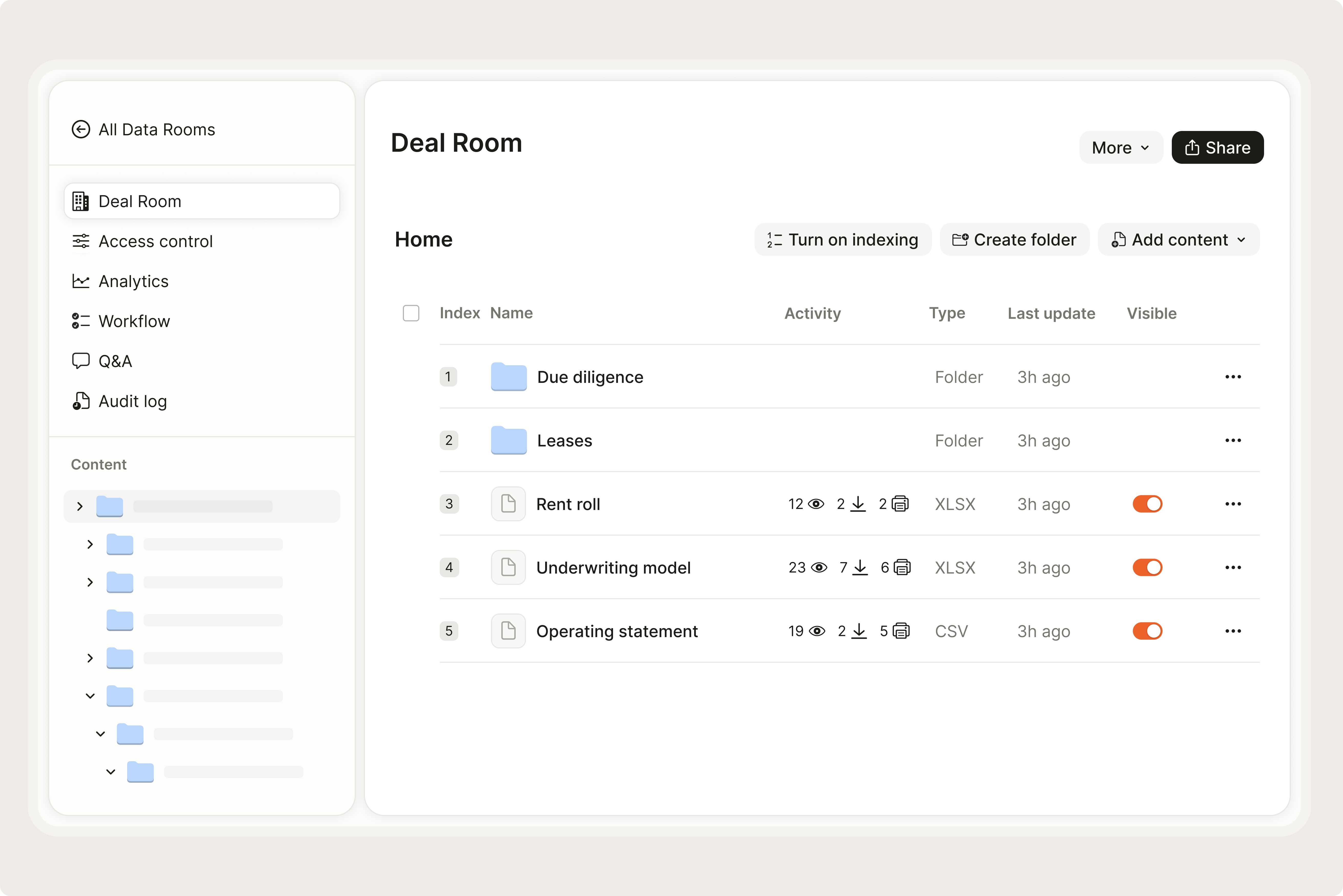
- 1.Upload North Dakota property files to a secure roomDrop ALTA title commitment, mineral abstract, NDIC well and pipeline records, ND DEQ brine spill database records, Phase I ESA, PFAS data, FEMA flood maps, surface use agreements, and lease pack into Ellty.
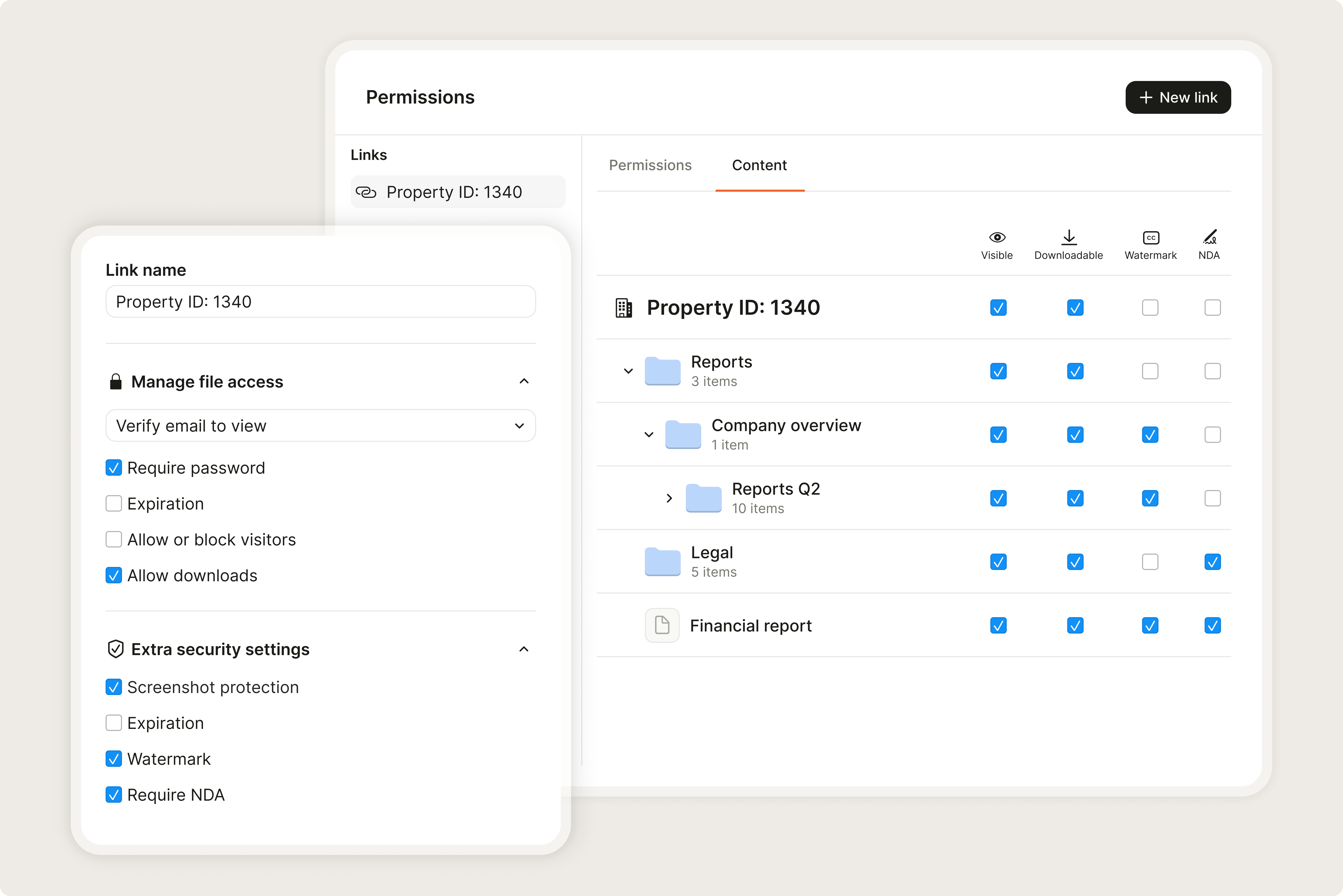
- 2.Give each advisor a scoped, tracked linkND attorney sees title and county recorder records. Landman sees mineral abstract and NDIC records. Environmental consultant sees ND DEQ, Phase I, and PFAS data. Lender sees valuation and lease abstracts.
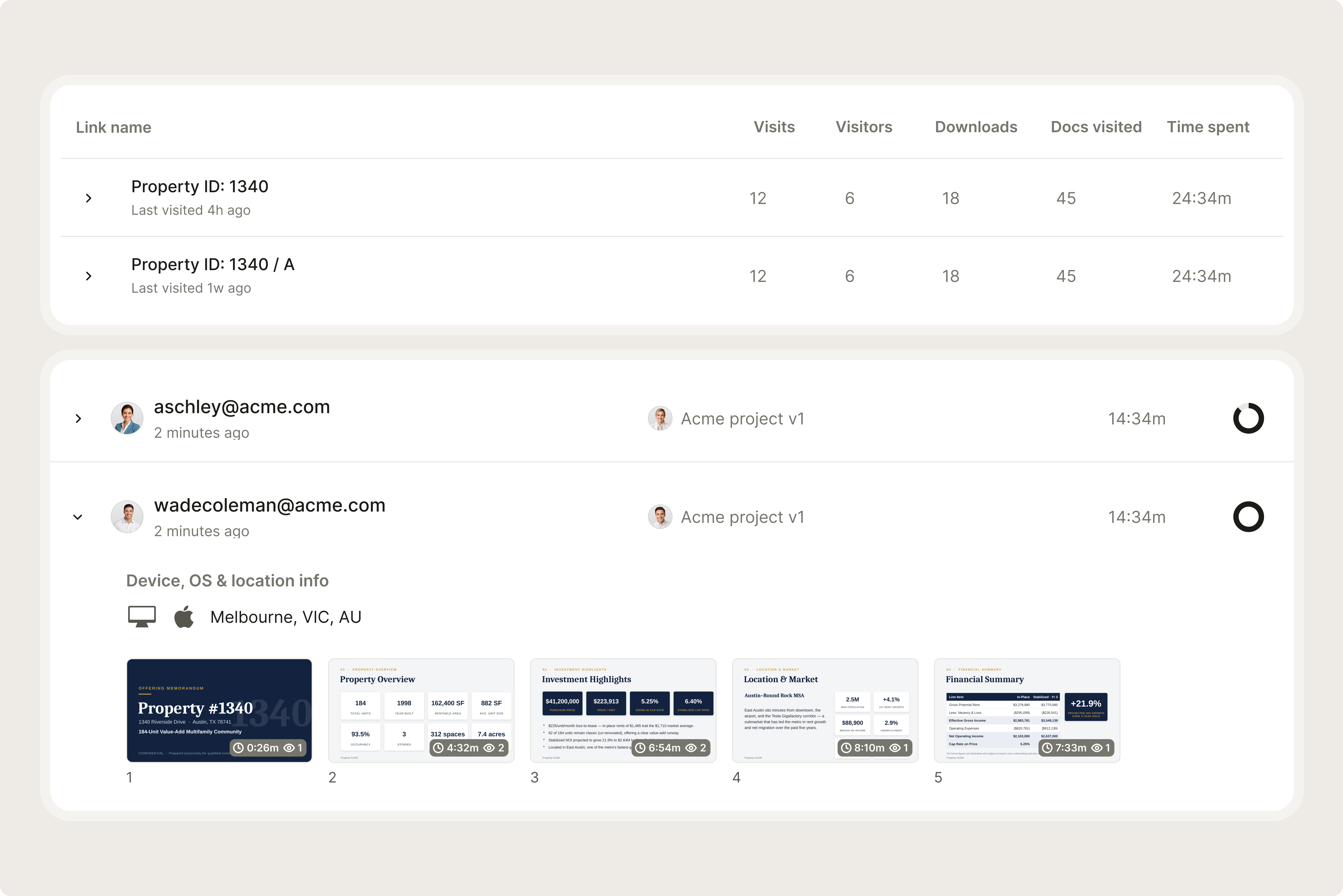
- 3.Monitor who reviews which documentsSee exactly which files each advisor opened and when. Catch mineral rights concerns or brine spill scope questions before they stall the deal.
What makes North Dakota different
Bakken brine contamination has no real equivalent in other US commercial real estate markets. Produced water from Bakken formation wells is enormously saline - chloride concentrations hundreds of times higher than drinking water standards. When brine spills, it kills everything growing on the affected soil and can contaminate groundwater for years. ND DEQ has documented thousands of brine spills since Bakken production accelerated. For any commercial property in western North Dakota within the oil production footprint: checking the ND DEQ spill database is the first environmental step, before Phase I ESA is even commissioned. A documented brine spill on or adjacent to the parcel with ongoing contamination is a deal-stopper or major price-adjuster depending on remediation status.
The Red River flooding in Fargo and Grand Forks is not historical trivia - it's commercial real estate due diligence. The 1997 Grand Forks flood forced evacuation of the city, destroyed hundreds of commercial properties, and caused over $3.5 billion in damage. The 2009 Fargo flood set records and mobilized thousands of volunteers sandbagging against a crest that tested the city's flood protection. Both events occurred within the past 30 years and within the existing commercial footprints of major North Dakota cities. FEMA maps have been updated, the Fargo-Moorhead Diversion is being built, and Grand Forks has ring levee protection - but flood risk in these markets requires current map review, not historical assumptions.
Surface use agreements in western ND are the property right most buyers miss. North Dakota's mineral estate dominance means that oil and gas operators with mineral leases have the legal right to access the surface for drilling, pipeline, and production operations. The Surface Owner Protection Act (NDCC 38-11.1) requires that operators enter SUAs with surface owners specifying how and where that access will occur. Existing SUAs run with the land; a commercial buyer inherits the SUA obligations. Drilling pad locations, access road rights, and pipeline corridors specified in existing SUAs can materially constrain commercial site development. Pull all NDIC and county recorder SUA records before bidding on any western ND commercial parcel.
North Dakota's zero transfer tax is a genuine acquisition cost advantage. Combined with no state income tax, ND is one of the lowest total acquisition cost commercial real estate environments in the US. The main buyer cost components are ALTA title insurance (typically 0.5-1% of purchase price), environmental (Phase I, landman, brine testing), and legal/advisory. Total buyer acquisition cost typically runs 0.5-1.5% of purchase price - lower than any other Midwest state and far below the 2%+ combined transfer taxes of New Jersey or New York.
The Surface Owner Protection Act (NDCC Chapter 38-11.1) provides that before an oil and gas operator commences surface disturbance activities for exploration or production operations, the operator must provide written notice to the surface owner and negotiate a Surface Use Agreement (SUA). The SUA must address: the location and dimensions of surface facilities; the construction and maintenance of access roads; compensation for surface damages; reclamation obligations; and insurance coverage. If the operator and surface owner cannot agree on SUA terms, either party may submit the matter to mediation under the North Dakota Dispute Resolution Commission. The SUA obligation applies to each new phase of surface disturbance and cannot be waived by the oil and gas lease. A Surface Use Agreement runs with the land and is binding on successor surface owners and mineral lessees.
Timeline and cost in North Dakota
Weeks 1-2 cover kickoff: ALTA title commitment order, mineral abstract engagement (for western ND), NDIC well and pipeline record search, ND DEQ brine and oil spill database search, Phase I ESA commission, PFAS screening assessment (near Grand Forks or Minot AFBs), FEMA flood zone check (Fargo/Grand Forks), zoning confirmation, agricultural lease and CRP check, and lease abstraction initiation. Legal and landman fees in this phase run USD 3,000-10,000.
Load all files into Ellty before advisors engage. North Dakota commercial deals can move on 30-45 day timelines for standard assets; mineral abstract research in western ND counties may add 2-3 weeks.
Weeks 2-4 cover deep review: Phase I ESA delivery, mineral abstract and landman opinion, surface use agreement review (western ND), PFAS results (if commissioned), flood zone confirmation, zoning compliance, lease abstraction, and insurance quotes. Costs in this phase: USD 5,000-15,000.
Weeks 4-6 handle resolution: brine spill Phase II sampling (if triggered), surface use agreement negotiation review, flood insurance binding (if needed), title exception clearance, and closing.
North Dakota total acquisition costs for buyers: zero transfer tax + ALTA title insurance + legal/advisory + landman + environmental. Total buyer acquisition cost runs approximately 0.5-1.5% of purchase price, among the lowest in the US for commercial real estate.
Running a North Dakota property deal from one room
Hold ALTA title, mineral abstract, NDIC records, ND DEQ brine data, and lease files in one secure, tracked Ellty data room.
Start free 14-day trialCommon questions about due diligence on North Dakota commercial property
- North Dakota commercial deals for standard assets typically take 30-45 days. Mineral abstract research in western ND oil counties (Williams, Mountrail, McKenzie, Dunn) adds 2-4 weeks depending on the complexity of the mineral chain. PFAS well testing (if required near Grand Forks or Minot AFBs) adds 3-5 weeks. Brine spill Phase II sampling (if triggered) adds 4-8 weeks. Red River flood zone review in Fargo or Grand Forks is typically completed within the standard timeline.
- Bakken brine (produced water from Bakken formation oil and gas wells) has chloride concentrations of 200,000-300,000 mg/L - far saltier than seawater. When produced water spills, it kills vegetation, causes severe soil salinization, and can contaminate groundwater. North Dakota DEQ has documented thousands of produced water spills in western ND. For any commercial property in Bakken-area counties (Williams, McKenzie, Mountrail, Dunn), check the ND DEQ spill database as the first environmental step; documented brine spills on or near the parcel with incomplete remediation are a dealbreaker or major price-adjuster.
- Under North Dakota's Surface Owner Protection Act (NDCC 38-11.1), oil and gas operators must enter into Surface Use Agreements (SUAs) with surface owners before commencing surface disturbance for oil and gas activities. SUAs specify the location and dimensions of drilling pads, access roads, pipeline corridors, compensation for surface damage, and reclamation obligations. Existing SUAs run with the land and bind successor surface owners. A buyer of western ND commercial property inherits the SUA obligations; drilling pad locations and access road rights specified in existing SUAs can materially constrain commercial development planning.
- North Dakota has no real estate transfer tax. This makes ND one of a small number of US states with zero transfer tax on commercial property conveyances. Nominal county recorder recording fees are charged for deed and mortgage document recording. Total buyer acquisition costs in North Dakota typically run 0.5-1.5% of purchase price (ALTA title insurance, legal/advisory, landman, environmental), among the lowest in the US for commercial real estate.
- The Red River of the North has produced catastrophic flooding in Fargo and Grand Forks in 1997 (Grand Forks crest 52.97 feet; city evacuated and partially destroyed) and 2009 (Fargo crest 40.82 feet; emergency flood fight). Both events caused major commercial property damage. Current flood protection includes ring levees in Grand Forks and the in-construction Fargo-Moorhead Diversion project. FEMA maps have been updated post-floods. For any Fargo or Grand Forks commercial property: pull current FEMA FIRMs, confirm whether the parcel is within the ring levee protection (Grand Forks) or the diversion project's protected area (Fargo), and confirm NFIP flood insurance availability.
- No. North Dakota does not require a licensed attorney to supervise commercial real estate closings. Title companies handle commercial closings in ND without mandatory attorney involvement. However, for complex commercial transactions involving mineral rights, surface use agreements, or significant environmental issues, engaging a North Dakota real estate attorney is strongly advisable. ND real estate attorneys routinely handle complex commercial and mineral rights title questions.