New York commercial property has three checks that consistently move the deal math: NYC transfer taxes (RPTT plus NYS transfer tax total approximately 2-3% of purchase price on commercial deals), Local Law 97 carbon emission compliance (six-figure annual penalties from 2024 for non-compliant buildings over 25,000 sq ft), and the NYC Zoning Resolution's FAR and use restrictions.
New York commercial real estate diligence runs across two distinct layers: state law (Real Property Law, SEQRA, DEC environmental) and New York City-specific requirements (DOB permits, zoning, Local Law 97, asbestos DEP licensing). For NYC commercial assets, both layers apply simultaneously and both require specialist advisors.
Title review in New York runs against an ALTA (American Land Title Association) owner's title commitment, updated after a full title search through the county recording system. New York uses a grantor-grantee index for older records, not a tract index; the title search covers all recorded instruments against the property and against prior owners in the chain of title.
NYC's Local Law 97 (the Climate Mobilization Act) is the most significant new financial risk for commercial building owners in 2026. Buildings over 25,000 sq ft that exceed carbon emission intensity limits set for their occupancy type face per-ton-of-CO2 fines from calendar year 2024. For a non-compliant office building, annual penalties can run into the hundreds of thousands of dollars. Confirm compliance and model any required capital improvements before bid.
Set up an Ellty data room before diligence opens. Load ALTA title commitment, DOB permits, Local Law 97 annual filings, lease abstracts, and Phase I ESA before advisors arrive. Each advisor gets a scoped link from day one.
Where New York property deals go wrong
Not every check carries the same weight. The table below sorts risks by deal impact - dealbreakers first, then what moves the price, then basic hygiene - so your New York attorney and technical advisor know what to clear first.
| Area | Documents to pull | NY red flag | Matters most for | Tier | |
|---|---|---|---|---|---|
| Title - ALTA and chain of title | Title - ALTA and chain of title | ALTA owner's title commitment, full title search, survey (ALTA/NSPS), UCC lien search | New York uses a grantor-grantee recording index; the title search must trace the chain from the current owner back through all predecessors; mechanic's liens, judgments, and open mortgages must be resolved at closing | All buyers | Dealbreaker |
| NYC zoning and FAR | NYC zoning and FAR | NYC Zoning Resolution map, Zoning lot merger review, FAR calculation, DOB zoning compliance audit | NYC Zoning Resolution is extremely complex; FAR and permitted use must be confirmed for the specific zoning district; Special Purpose Districts (Hudson Yards, Midtown, etc.) have additional overlays | All buyers; critical for redevelopment | Dealbreaker |
| DOB permits and certificate of occupancy | DOB permits and certificate of occupancy | NYC DOB BIS permit history, Certificate of Occupancy, ECB violations, DOB NOW records | The Certificate of Occupancy (C of O) must match the current use; DOB violations, open permits, and ECB (Environmental Control Board) violations must be identified and resolved or escrowed at closing | All buyers | Dealbreaker |
| Local Law 97 carbon compliance | Local Law 97 carbon compliance | LL97 annual report filings (via NYC DOB NOW), energy benchmarking (LL84 Benchmarking), carbon emission intensity calculation | NYC Local Law 97 requires commercial buildings over 25,000 sq ft to meet carbon intensity limits from 2024; non-compliant buildings face $268/ton-CO2 penalties annually; penalties can be six figures for large office buildings | All commercial buildings over 25,000 sq ft | Price-adjuster |
| Environmental - Phase I ESA and DEC | Environmental - Phase I ESA and DEC | Phase I ESA (ASTM E1527-21), NYSDEC Environmental Site Remediation database, EDR Radius Map | NYSDEC maintains the Environmental Site Remediation database (ERS); Superfund sites, BCP (Brownfield Cleanup Program) sites, and petroleum spill sites must be checked; NYC has significant brownfield from prior industrial use | Industrial, brownfield, waterfront | Price-adjuster |
| Transfer taxes - RPTT and NYS | Transfer taxes - RPTT and NYS | NYC RPTT calculation, NYS transfer tax, RPTT return TP-584 and NYC RPT, Mansion Tax for residential | NYC RPTT on commercial property runs 1.425-2.625% of consideration plus NYS transfer tax at 0.4%; on a $50M commercial deal the combined transfer tax is approximately $1.5M; confirm who bears the tax per the contract | All buyers | Price-adjuster |
| Leases - NYC commercial terms | Leases - NYC commercial terms | All lease contracts, rent roll, holdover tenant analysis, electricity pass-through, escalation provisions | NYC commercial leases often have complex rent escalation (fixed step-ups, CPI, operating expense pass-throughs); holdover tenants without statutory protection can be removed but the process takes 6-18 months in NYC Housing Court | All income-producing assets | Price-adjuster |
| NYC asbestos and hazmat | NYC asbestos and hazmat | NYC DEP asbestos investigation report (AIR), hazardous materials survey, Local Law 76 compliance | NYC Local Law 76 requires asbestos investigation before any demolition or renovation; DEP-licensed asbestos contractors must be used; ACM abatement in NYC is expensive and time-consuming | Pre-1980 commercial buildings | Price-adjuster |
| Insurance and valuation | Insurance and valuation | Property insurance, commercial general liability, loss run, MAI appraisal | NYC flood risk has increased post-Hurricane Ida (2021) and Sandy (2012); confirm flood zone FEMA designation and flood insurance availability for waterfront or below-grade commercial assets | All | Standard check |
| NYC property taxes and ICAP | NYC property taxes and ICAP | NYC DOF ACRIS property tax bills, ICAP/421-a/J-51 tax abatement schedules, tax certiorari proceedings | NYC commercial property taxes are high and escalate; confirm any active tax abatement (ICAP, ICIP) that will expire post-closing; tax certiorari proceedings pending against the property must be disclosed | All | Standard check |
| Seller KYC and AML | Seller KYC and AML | NY DOS entity filing, FinCEN GTO compliance, OFAC screen, beneficial owner disclosure | FinCEN Geographic Targeting Orders (GTOs) require title insurance companies to identify beneficial owners in all-cash commercial purchases above $300,000 in NYC; confirm compliance | All deals | Standard check |
Due diligence on a New York property?
Set up your Ellty data room before diligence starts.
Start free 14-day trialNew York CRE checklist
The table ranked risks by severity. This is the full list to work through, grouped by area.
Title - ALTA and chain of title
- Engage a New York real estate attorney to order an ALTA owner's title commitment from a title insurance underwriter (First American, Fidelity, Stewart, Chicago Title) on day one
- New York uses a grantor-grantee recording index in most counties; the title search must cover all recorded instruments against the current and prior owners through the chain of title
- Review Schedule B exceptions in the title commitment: identify all exceptions to coverage that require resolution before closing
- Order a UCC lien search against the current owner to identify any personal property security interests that attach to the real estate or fixtures
- For NYC assets: ACRIS (Automated City Register Information System) is the digital recording system for Manhattan, Bronx, Brooklyn, and Queens; use ACRIS to pull all recorded instruments against the property
- Order an ALTA/NSPS Land Title Survey for all commercial acquisitions; the survey identifies encroachments, easements, and boundary issues not visible in the title records
NYC zoning and FAR
- Confirm the zoning district on the NYC Zoning Resolution map; the ZoLa (Zoning and Land Use) tool provides the official district designation
- Calculate the permitted FAR for the specific zoning district; compare against the as-built square footage to identify unused development rights or violations
- For NYC: Special Purpose Districts (Hudson Yards Special District, Special Midtown District, Special Greenwich Street District, etc.) have additional zoning overlays that modify the base district rules; always check for SP district applicability
- For any development or conversion plan: confirm the target use is permitted in the zoning district; commercial-to-residential conversions in NYC require specific zoning authority under current rules
- NYC landmark designation: check with LPC (Landmarks Preservation Commission) whether the building is individually landmarked or in a historic district; any exterior alterations require LPC approval
DOB permits and certificate of occupancy
- Pull the full DOB BIS (Building Information System) permit history and ECB violation history on day one; both are publicly available via NYC DOB BIS and DOB NOW
- Confirm the Certificate of Occupancy (C of O) reflects the current building use; a C of O mismatch means the current use is not legally authorized
- Open DOB permits must be resolved before closing; open permits indicate unfinished work or unresolved inspections; they transfer to the buyer and can affect the ability to obtain new permits or financing
- ECB (Environmental Control Board) violations create liens against the property; all open ECB violations must be identified and either resolved or escrowed for resolution at closing
- NYC DOB has a backlog on permit processing and inspection scheduling; for any asset with open DOB items, allow 60-120 days for resolution
Local Law 97 carbon compliance
- Request the seller's LL97 annual report filing(s) submitted via NYC DOB NOW for calendar years 2024 and 2025
- LL84 Benchmarking data (submitted to NYC via ENERGY STAR Portfolio Manager) shows the building's historical energy use; pull the last 3 years of LL84 submissions
- Calculate the building's carbon emission intensity (tCO2e per sq ft) against the applicable LL97 limit for the building's occupancy type
- For non-compliant buildings: calculate the annual penalty ($268 per metric ton of CO2 excess above the limit); for large office buildings, this can run USD 200,000-1,000,000+ annually
- LL97 limits tighten in 2030 (a second compliance period with stricter limits); model both the 2024 penalty exposure and the 2030 capex requirement to reach the 2030 limit
- Available compliance pathways: energy efficiency upgrades (HVAC, insulation, lighting), electrification, renewable energy credits (RECs), and deductions for affordable housing; review with a LL97 compliance specialist
Give each advisor a scoped link in Ellty. Your New York attorney sees title commitment and DOB records. Environmental consultants see Phase I and DEC records. LL97 compliance specialist sees energy benchmarking data. No overlap.
Environmental - Phase I ESA and DEC
- Commission a Phase I ESA meeting ASTM E1527-21 standard from a qualified New York environmental professional on day one
- Check the NYSDEC Environmental Site Remediation database (ERS) using the property address; ERS identifies Superfund sites, BCP brownfield sites, petroleum spills, and remediated sites
- NYC has significant brownfield from prior industrial use, particularly: Greenpoint/Williamsburg (petroleum spills and industrial contamination), Long Island City (former manufacturing), Red Hook (waterfront industrial), South Bronx (industrial and waste processing)
- Petroleum Bulk Storage (PBS) registrations: check NYSDEC PBS database for any underground storage tanks (USTs) registered at or near the property
- For Phase I findings with Recognized Environmental Conditions (RECs): proceed to Phase II (subsurface investigation) before any binding commitment
- NYC Brownfield Cleanup Program (BCP) participation provides liability protection and potential tax credits for contaminated site remediation; for brownfield acquisitions, assess BCP eligibility
Transfer taxes - RPTT and NYS
- NYC RPTT on commercial property: 1.425% on consideration of $500,000 or more for commercial/non-residential property (standard rate); 2.625% is the combined rate including NYS transfer tax on larger commercial transactions
- NYS Real Property Transfer Tax: $4 per $1,000 of consideration (0.4% of purchase price) on all transfers; this is in addition to NYC RPTT
- NYC Mortgage Recording Tax: 2.05% to 2.175% of the mortgage amount for commercial mortgages; this is a significant additional cost if debt financing is used
- RPTT is typically split between buyer and seller per contract; confirm the allocation in the purchase and sale agreement
- For acquisitions structured as entity (LLC/LP/Corp) transfers where the entity holds the real estate: review whether the transaction triggers the NYC Real Property Transfer Tax or NYS transfer tax; entity sales can trigger transfer tax if they constitute a transfer of a controlling interest in an entity that owns NYC real estate
Leases - NYC commercial terms
- Abstract every lease: base rent, escalations (fixed step-ups, CPI, operating expense pass-throughs), electricity provisions, renewal options, and termination rights
- NYC commercial leases often include base year or expense stop provisions for operating expenses; review against actual operating expenses to assess exposure
- Confirm no tenants are in holdover beyond their lease term; NYC commercial holdover situations can take 6-18 months to resolve through litigation
- Check for any Yellowstone injunction proceedings: NYC commercial tenants can seek a Yellowstone injunction to enjoin lease termination while contesting a landlord's notice of default; pending Yellowstone proceedings must be disclosed
Compare New Jersey's commercial property diligence process if you're considering adjacent-market assets. NJ charges a Realty Transfer Fee (RTF) rather than NYC's RPTT; NJ has its own industrial site contamination issues (ISRA - Industrial Site Recovery Act) that create additional pre-closing steps for any site with industrial use history.
NYC asbestos and hazmat
- For any NYC commercial building constructed before 1987: engage a DEP-licensed asbestos inspector to perform an asbestos investigation
- NYC Local Law 76 requires an asbestos investigation before any demolition or renovation of a pre-1988 building; the investigation must be performed by a DEP-certified investigator
- Asbestos Abatement Report (AIR) must be filed with NYC DEP; DEP-licensed asbestos contractors must perform any abatement
- For buildings with confirmed ACMs: budget for DEP-licensed abatement; NYC asbestos abatement costs are among the highest in the country; licensed contractor capacity is constrained
- Other hazardous materials (PCBs in transformers, lead paint, fuel oil tanks): commission a comprehensive hazardous materials survey for pre-1980 commercial buildings
NYC property taxes and abatements
- Pull the current NYC DOF tax bill from ACRIS or the DOF online portal; confirm the assessed value and tax rate
- Identify any active property tax abatements or exemptions: ICAP (Industrial and Commercial Abatement Program), 421-a, J-51 (renovation abatement); confirm the abatement schedule and expiration date
- Active tax certiorari proceedings (tax assessment challenges) pending against the property must be disclosed; pending certiorari can result in a tax refund payable to the seller if resolved post-closing; negotiate the allocation in the contract
- NYC property taxes escalate significantly over time; model the pro-forma using the actual current assessment and a realistic escalation assumption
Track all document access in Ellty. If the environmental consultant is repeatedly reviewing the NYSDEC ERS search results and historical maps, Phase II is likely coming. Know before the formal report lands.
Insurance and valuation
- Commission an MAI (Member, Appraisal Institute) appraisal for all NYC commercial acquisitions; confirm the appraiser uses NYC-specific comparable sales and capitalization rates
- Confirm FEMA flood zone designation; NYC has flood zone mapping updates ongoing post-Sandy (2012) and Ida (2021); flood insurance is required for SFHA (Special Flood Hazard Area) properties with federally-backed mortgages
- For below-grade commercial space: confirm flood risk coverage is specifically included; basement and cellar flooding is endemic in NYC
Seller KYC and AML
- Pull the NY DOS (Department of State) entity filing for any seller entity; confirm active status and registered agent
- FinCEN GTOs: for all-cash commercial property purchases above $300,000 in NYC, FinCEN requires title insurance companies to collect and report beneficial ownership of purchasing entities; this is a federal AML requirement, not optional
- Run OFAC, UN, EU, and US sanctions checks on all principals before any funds transfer
How due diligence works in a New York commercial deal
Step 1 - ALTA title and DOB search
Day one: order the ALTA title commitment and commission the DOB BIS permit and ECB violation search simultaneously. Both are usually returned within 2-3 weeks.
The ALTA title commitment identifies all title exceptions that must be resolved before closing. The DOB review identifies open permits, ECB violations, and C of O mismatches. Both must be cleared before exchange.
Step 2 - LL97 compliance assessment
Within the first 2 weeks: request the seller's LL97 annual reports and LL84 benchmarking submissions. Have a LL97 compliance specialist review the energy performance data against the applicable 2024 and 2030 carbon intensity limits.
For any NYC office, retail, or hotel building above 25,000 sq ft: model the current annual penalty liability and the capital cost to achieve LL97 compliance by 2030. This number has moved commercial real estate valuations significantly in the New York market since 2024.
Step 3 - Phase I ESA and zoning
Commission Phase I ESA from an ASTM E1527-21 qualified environmental professional. Run the Phase I concurrently with the NYSDEC ERS search, petroleum bulk storage search, and CERCLIS federal Superfund database check.
Run the NYC zoning analysis in parallel. For complex assets: engage a NYC zoning attorney (not just a general real estate attorney) to confirm the FAR calculation, use compliance, and any Special Purpose District overlays.
Step 4 - Leases and operating expenses
Abstract every lease in the rent roll. NYC commercial leases can run 30-50 pages with complex escalation clauses, work letter provisions, and tenant improvement allowance obligations. Use a specialist lease abstraction team for multi-tenant buildings.
Confirm LL84 energy benchmarking data and LL97 reports. If the seller has not filed required Local Law compliance reports, the building is already in violation; confirm the status and any DOB penalties outstanding.
Load all lease abstracts, operating expense data, and LL97 reports into Ellty. Asset management, the acquisition team, and lenders each get their scoped access from one tracked link.
Step 5 - Closing and transfer taxes
New York commercial closings are table closings (buyer, seller, and their attorneys close simultaneously). Transfer taxes are paid at closing via NYC RPT and NYS TP-584 filing.
The NYC mortgage recording tax (2.05-2.175% of mortgage amount) is payable at the time of mortgage recording. For a $30M commercial mortgage, the recording tax runs approximately $615,000-$652,500. Confirm who bears this cost in the purchase agreement.
How to set up your New York data room in Ellty.
NYC commercial deals involve ALTA title, DOB permit history, Local Law 97 reports, LL84 benchmarking, Phase I ESA, zoning analysis, and complex lease abstracts across 60-90 days. Load files into Ellty before advisors arrive.
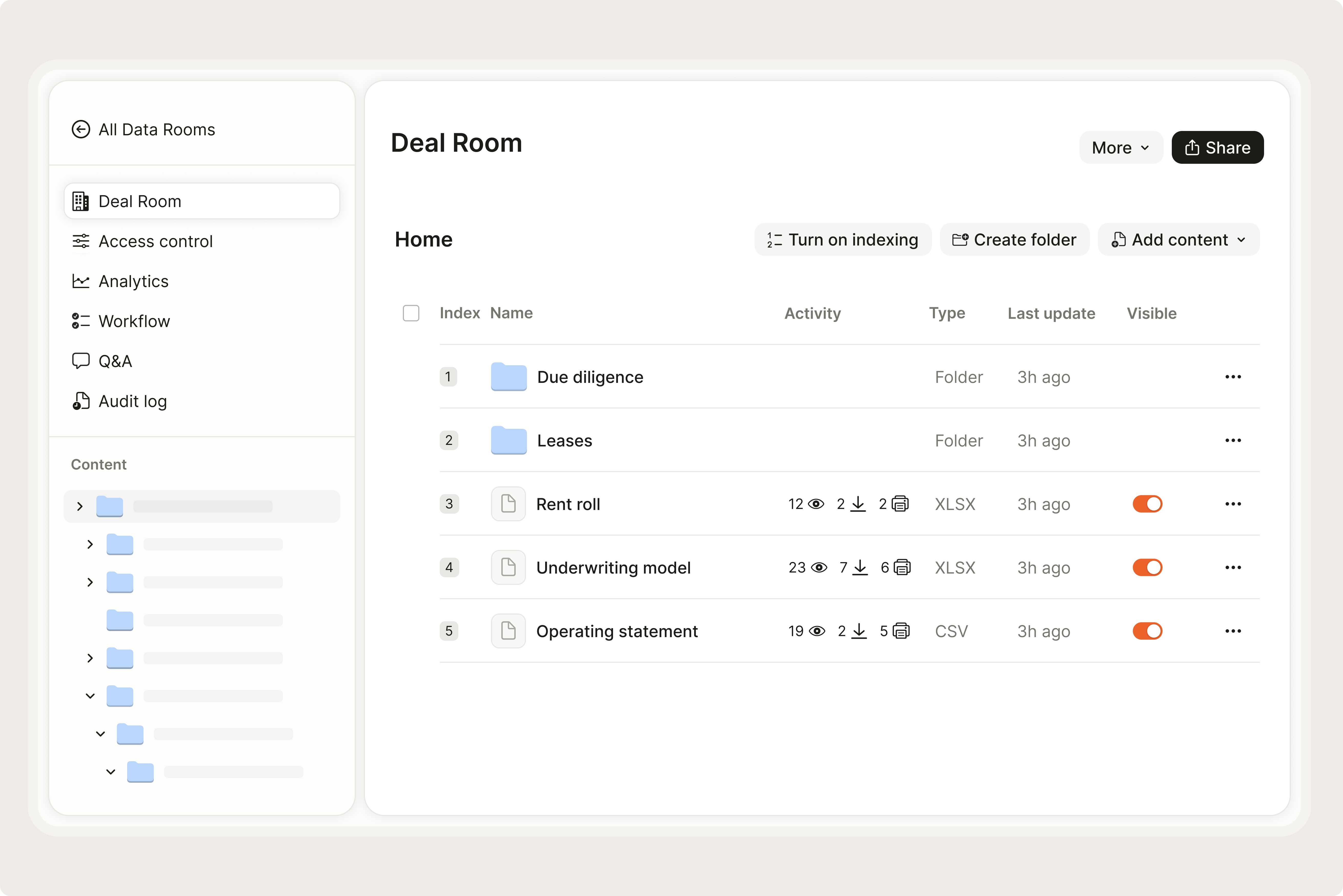
- 1.Upload New York property files to a secure roomDrop ALTA title commitment, DOB BIS records, LL97 reports, LL84 benchmarking, Phase I ESA, and lease pack into Ellty.
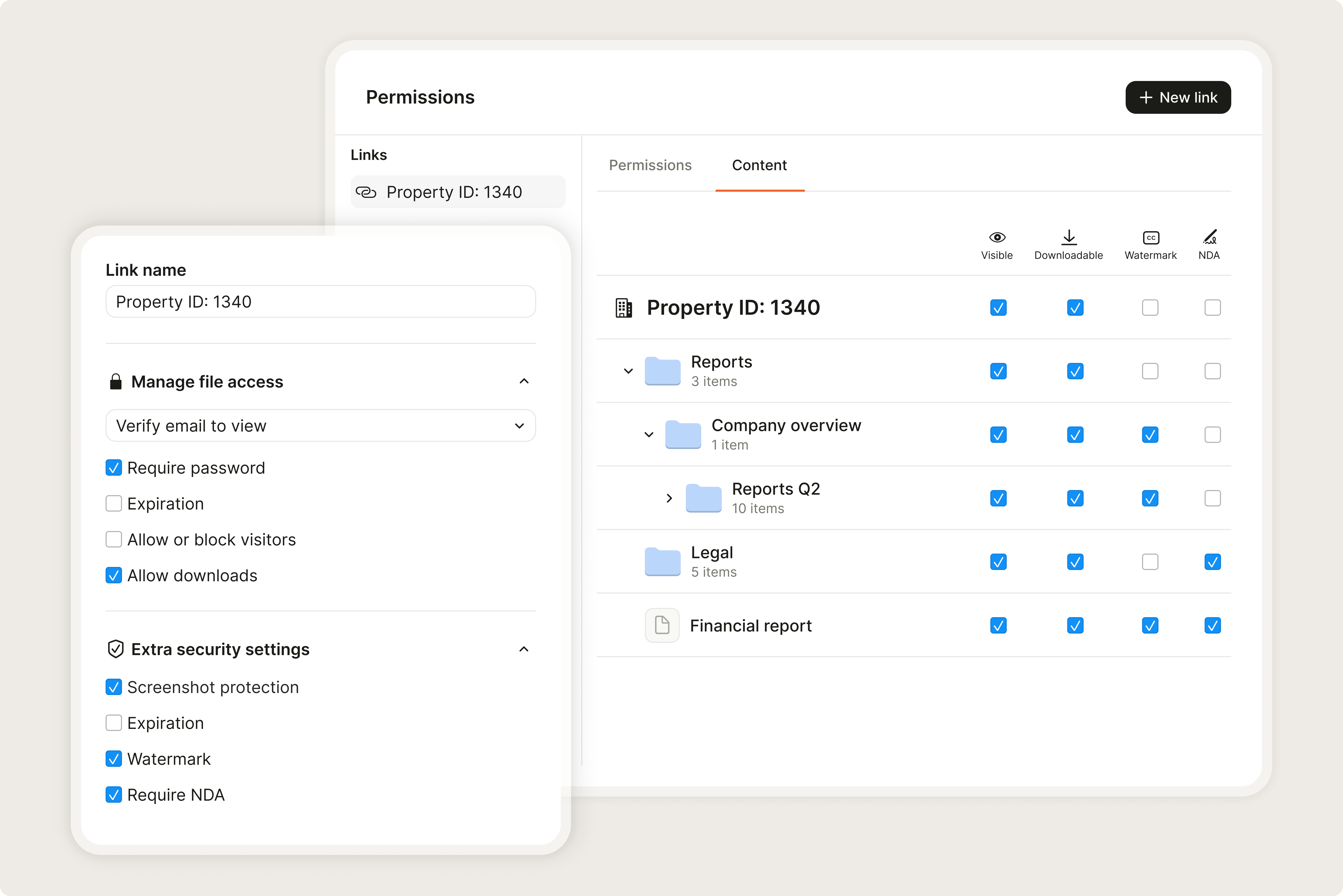
- 2.Give each advisor a scoped, tracked linkNY attorney sees title and DOB docs. Environmental consultant sees Phase I and DEC records. LL97 specialist sees energy data. Lender sees valuation and rent roll. Ellty enforces the scope.
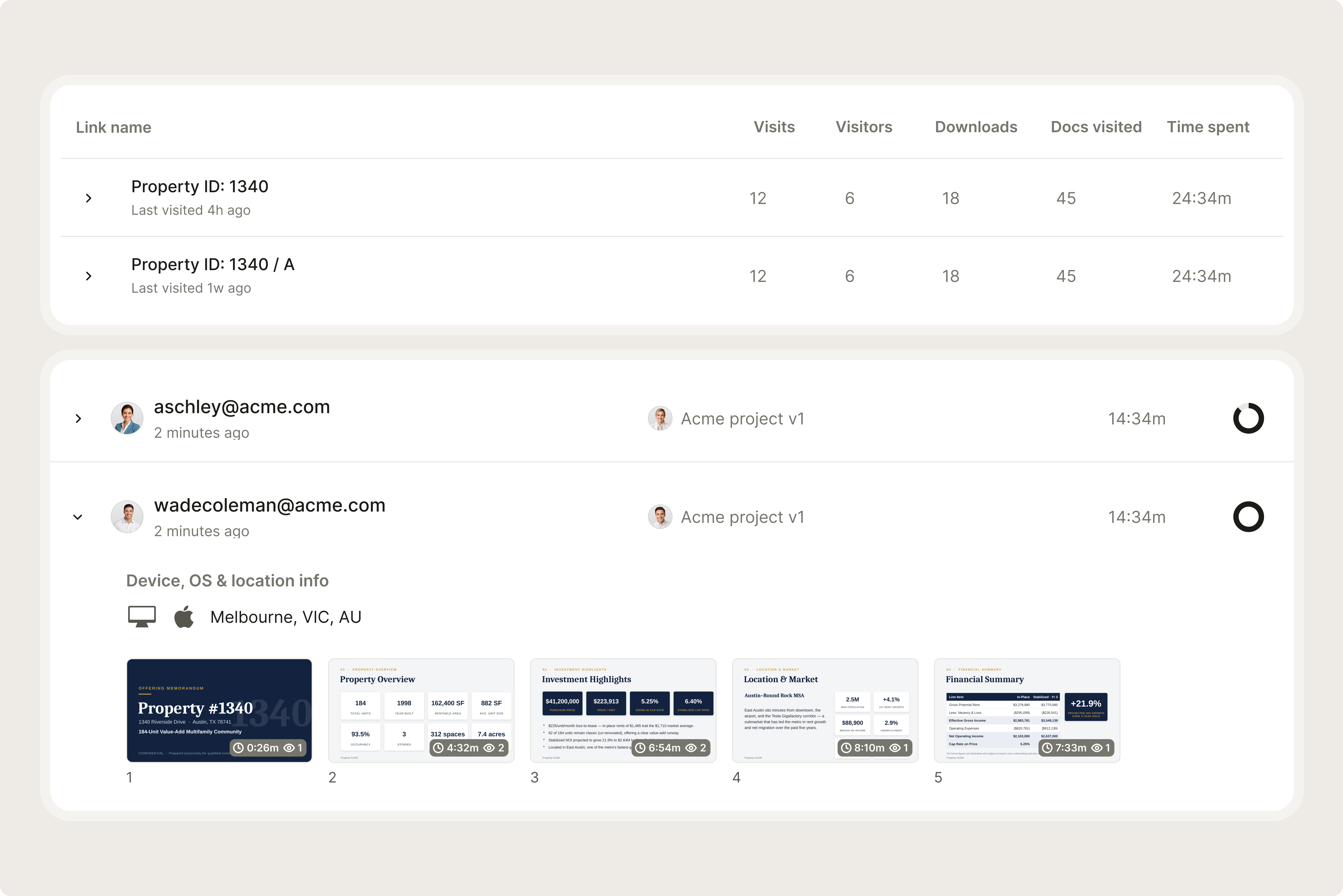
- 3.Monitor who reviews which documentsSee exactly which files each advisor opened and when. Catch LL97 compliance questions before they stall the lender's approval.
What makes New York different
Local Law 97 has materially repriced New York commercial real estate since 2024. The $268/ton-CO2 penalty for non-compliant buildings creates an ongoing P&L liability for any building over 25,000 sq ft that doesn't meet the carbon intensity limits. For a large Class B office building in Midtown that hasn't been mechanically upgraded, annual LL97 penalties can rival or exceed property management costs. The 2030 compliance period tightens the limits further. Any NYC commercial acquisition underwriting that doesn't include a LL97 compliance assessment is missing a material financial variable.
NYC's DOB violation and open permit problem is endemic to older commercial buildings. New York's stock of pre-1960 commercial buildings has decades of permit history; unauthorized alterations, open permits from prior renovations, and ECB violations are common. The DOB clearing process is slow and involves the NYC bureaucracy; budget time and legal fees for resolution, not just identification.
NYC transfer taxes stack in a way that surprises first-time New York commercial buyers. The NYC RPTT, NYS transfer tax, and NYC mortgage recording tax can combine for a total transfer cost of 4-5% of the purchase price on a leveraged commercial deal. This is before legal fees, title insurance, and environmental work. Model the total deal cost before finalizing the bid price.
The ALTA/NSPS survey is not optional in New York. NYC commercial properties have complex ownership situations: party walls, shared easements with adjacent buildings, vault rights under the sidewalk, and encroachments from neighboring structures are common in Manhattan. The survey identifies these issues before closing; finding them afterward creates disputes that can take years to resolve.
New York City Local Law 97 of 2019 (the Climate Mobilization Act) requires covered buildings over 25,000 gross square feet to meet carbon emission intensity limits beginning in calendar year 2024. Buildings that exceed their applicable limit are subject to a civil penalty of $268 per metric ton of CO2e above the limit per year. The limits tighten in the second compliance period beginning January 1, 2030. Property owners are required to file annual emissions reports with the NYC Department of Buildings via the DOB NOW portal by May 1 of the following year.
Timeline and cost in New York
Weeks 1-4 cover kickoff: ALTA title commitment order, DOB BIS and ECB violation search, LL97 annual report review, LL84 benchmarking data request, Phase I ESA commission, NYC zoning analysis, NYSDEC ERS and PBS database search, lease abstraction initiation. Legal and advisory fees in this phase run USD 25,000-75,000 for a mid-market NYC commercial deal.
Load all files into Ellty before advisors engage. Multiple workstreams (title, DOB, LL97, environmental, leases, zoning) run simultaneously; a central tracked data room is the difference between a 60-day close and a 90+ day close.
Weeks 4-8 cover deep review: title exception resolution, DOB violation and open permit clearance, LL97 penalty and capex modeling, Phase I delivery and Phase II decision, lease abstraction completion, NYC property tax certiorari review, RPTT and mortgage recording tax modeling. Costs in this phase: USD 50,000-150,000.
Weeks 8-12 handle resolution: title exceptions cleared, DOB items resolved or escrowed, LL97 compliance plan agreed and reflected in pricing, purchase and sale agreement negotiation and execution, lender due diligence, and closing.
New York total acquisition costs: NYC RPTT (commercial, 1.425-2.625%) + NYS transfer tax (0.4%) + NYC mortgage recording tax (2.05-2.175% of mortgage amount) + ALTA title insurance premium + legal fees. Total cost on a leveraged NYC commercial deal runs approximately 4-6% of purchase price. LL97 annual penalties are an ongoing operating cost that must be modeled in the NOI; they are not a one-time closing cost.
Running a New York property deal from one room
Hold ALTA title, DOB records, LL97 filings, and lease abstracts in one secure, tracked Ellty data room.
Start free 14-day trialCommon questions about due diligence on New York commercial property
- Most NYC commercial deals take 60-90 days from LOI to closing. ALTA title review, DOB violation clearance, Local Law 97 compliance assessment, Phase I ESA, and lease abstraction are the main lead-time items. DOB open permit resolution is the most unpredictable item; it can take 30-120 days depending on the specific DOB office and the complexity of the violation.
- NYC Local Law 97 (the Climate Mobilization Act) requires commercial buildings over 25,000 sq ft to meet carbon emission intensity limits beginning in calendar year 2024. Non-compliant buildings face a $268 per metric ton CO2e annual penalty. For a large Midtown office building, annual penalties can run USD 200,000-1,000,000+. The limits tighten further in 2030. Always request the seller's LL97 annual reports and model both the current and 2030 compliance cost before bidding.
- NYC commercial property transfers are subject to NYC Real Property Transfer Tax (RPTT) at 1.425% for commercial property consideration of $500,000 or more, plus New York State Real Property Transfer Tax at 0.4% of consideration. NYC mortgage recording tax of 2.05-2.175% of the mortgage amount applies to commercial mortgages. The combined transfer taxes on a leveraged NYC commercial deal can total 4-5% of purchase price. Confirm the contract allocation of transfer tax responsibilities.
- An ALTA/NSPS Land Title Survey is a comprehensive boundary and improvement survey meeting American Land Title Association standards. For NYC commercial property, the ALTA survey identifies encroachments, party wall agreements, vault rights, easements, and boundary issues not visible in the title records. NYC commercial buildings frequently have party wall arrangements and historic easement agreements with adjacent buildings; these must be surveyed and reviewed before closing.
- FinCEN Geographic Targeting Orders (GTOs) require title insurance companies to collect and report the beneficial owner information for legal entities making all-cash purchases of commercial and residential real estate in NYC above $300,000. This is a federal AML compliance requirement. The GTO applies to all-cash purchases by LLCs, partnerships, trusts, and corporations. Confirm the title agent's GTO compliance procedures before closing.
- Pull the full NYC DOB BIS permit history and ECB violation records on day one via the NYC DOB online portal. Key items to identify: open building permits (indicate unfinished or uninspected work), Certificate of Occupancy that doesn't match current use, active DOB stop-work orders, and outstanding ECB violations (which create liens). All open items must be resolved or escrowed before closing; they transfer to the buyer at completion.