New Mexico commercial property due diligence has three localized issues that routinely trip up buyers unfamiliar with the Southwest: water rights are separate from real property under prior appropriation and must be researched separately at the NM Office of the State Engineer; approximately 57% of New Mexico is federally owned land requiring BLM or agency access permits for commercial development in rural and suburban areas; and New Mexico's 19 federally recognized Pueblo tribes have jurisdictional and land ownership complexities that affect commercial properties adjacent to or within tribal land grant areas.
New Mexico has no state real estate transfer tax. County recording fees for commercial deeds are nominal - a few hundred dollars. This makes New Mexico one of the lowest acquisition cost states for commercial real estate transfer in the Southwest - comparable to Oregon, Utah, and Nevada.
New Mexico's commercial real estate divides into three distinct markets: Albuquerque (Bernalillo County and the central Rio Grande corridor), the Permian Basin (southeastern NM - Eddy and Lea Counties), and Santa Fe (Santa Fe County, with its significant historic preservation overlay). The Permian Basin is experiencing significant industrial and commercial growth driven by oil production; the Albuquerque market is the state's largest conventional commercial market; Santa Fe's historic district imposes architectural controls unlike any other NM jurisdiction.
The New Mexico Environment Department (NMED) administers the state's Voluntary Cleanup Program (VCP) for brownfield commercial sites. NM has significant petroleum contamination along the Route 66 (Central Avenue) commercial corridor in Albuquerque and in southeastern NM's oil production areas.
Set up a New Mexico real estate data room before diligence opens. Load ALTA title, NM OSE water rights records, NMED contamination records, BLM land status maps, oil and gas well records, and lease files before advisors engage.
Where New Mexico property deals go wrong
Not every check carries the same weight. The table below sorts risks by deal impact - dealbreakers first, then what moves the price, then basic hygiene - so your New Mexico attorney and environmental consultant know what to clear first.
| Area | Documents to pull | NM red flag | Matters most for | Tier | |
|---|---|---|---|---|---|
| Title - county clerk recording | Title - county clerk recording | ALTA owner's title commitment, county clerk deed records, ALTA/NSPS survey, UCC fixture search at NM Secretary of State | NM property records are at the county clerk's office; NM uses trust deeds (not mortgages) for commercial financing; standard ALTA title in NM should specifically address oil, gas, and mineral rights exceptions and whether they are severed (particularly in southeastern NM Permian Basin counties); confirm water rights are addressed in the title examination and purchase agreement | All buyers | Dealbreaker |
| Water rights - NM Office of State Engineer | Water rights - NM Office of State Engineer | NM OSE water rights database search (wrrs.ose.state.nm.us), water right permit or license, acequia association records, municipal water connection confirmation | New Mexico follows the prior appropriation doctrine; water rights are personal property separate from real property and do not automatically transfer with a land sale; research water rights at the NM Office of the State Engineer (OSE); NM acequia systems (traditional Spanish colonial irrigation ditch communities) create additional water rights and easement complexity for commercial properties in the Rio Grande valley and northern NM; confirm any water rights included in the transaction are valid, in beneficial use, and properly assigned | All non-municipal NM commercial; rural and agricultural | Dealbreaker |
| Pueblo land and tribal jurisdiction | Pueblo land and tribal jurisdiction | BLM land status maps (PLSSWeb), Pueblo tribal land boundary maps, NM Attorney General records, Indian Land Consolidation Act records, Bureau of Indian Affairs (BIA) title plant | New Mexico has 19 federally recognized Pueblo tribes with tribal lands; commercial properties adjacent to or within former Spanish land grant areas that overlap with Pueblo land grant boundaries have complex title and jurisdictional issues; the Pueblo Lands Act of 1924 and subsequent legislation adjudicated conflicting land claims; commercial development near Pueblo boundaries in Sandoval, Rio Arriba, Taos, Santa Fe, and Bernalillo counties requires careful title examination for any former Spanish land grant or Pueblo boundary proximity; some commercial properties are in checkerboard areas of tribal and non-tribal land | Northern NM commercial, Albuquerque metro area adjacent to Pueblo lands | Dealbreaker |
| Environmental - NMED VCP and petroleum | Environmental - NMED VCP and petroleum | Phase I ESA (ASTM E1527-21), NMED LEUST database, NMED contaminated sites database, EPA Superfund NPL, NMED VCP records | NMED operates a Voluntary Cleanup Program (VCP) for brownfield buyers; a VCP No Further Action (NFA) determination provides regulatory closure; NMED's LEUST (Leaking Underground Storage Tank) database has significant entries along Albuquerque's Central Avenue/Route 66 corridor; Permian Basin NM (Eddy, Lea counties) has significant petroleum contamination from oil exploration and production operations; search NMED contaminated sites database before bidding on any NM industrial or former-petroleum commercial site | Albuquerque Central Avenue commercial, Permian Basin | Dealbreaker |
| Oil and gas rights - Permian Basin and San Juan | Oil and gas rights - Permian Basin and San Juan | NM State Land Office oil and gas lease records, NM OCD (Oil Conservation Division) well records, BLM NM oil and gas permit records, mineral rights abstract for severed minerals | Southeastern NM (Eddy and Lea counties, Permian Basin) and northwestern NM (San Juan Basin, Farmington area) have active oil and gas production; commercial properties in these areas may have severed mineral estates with active oil or gas leases; NM Oil Conservation Division (OCD) regulates oil and gas well operations; confirm whether oil or gas rights are severed from the surface estate and whether any active leases or permitted wells exist on or near the commercial parcel | Permian Basin commercial, San Juan Basin commercial | Dealbreaker |
| Federal land adjacency and BLM access | Federal land adjacency and BLM access | BLM land status maps (BLM NM), Forest Service records, BLM right-of-way permit records, military land use maps (White Sands, Kirtland AFB, WIPP area) | ~57% of NM is federally owned; rural commercial properties frequently access through or abut BLM, Forest Service, or other federal land; commercial access across federal land requires BLM or Forest Service right-of-way permits; DoD military land (White Sands Missile Range, Kirtland Air Force Base) creates large no-development corridors; Waste Isolation Pilot Plant (WIPP) in Eddy County adds federal exclusion zone complexity in southeastern NM | Rural NM commercial, southeastern NM near WIPP | Price-adjuster |
| Santa Fe historic district controls | Santa Fe historic district controls | Santa Fe Historic Design Review records, Santa Fe Historic Preservation Division permits, Santa Fe Land Use Code, Certificate of Appropriateness history | Santa Fe's historic district (H Historic District) imposes significant architectural controls; commercial buildings in the historic district must comply with Pueblo Revival or Territorial style requirements for exteriors; all exterior modifications (signage, facade changes, additions) require a Certificate of Appropriateness from the Historic Preservation Division; commercial renovation in the Santa Fe historic district can be 2-3x more expensive than comparable non-historic commercial renovation due to material and design requirements | Santa Fe historic district commercial | Price-adjuster |
| Rio Grande flood risk - Albuquerque | Rio Grande flood risk - Albuquerque | FEMA FIRM, Army Corps Albuquerque District Rio Grande study, Rio Grande flood history records, Middle Rio Grande Conservancy District (MRGCD) maps | The Middle Rio Grande through Albuquerque is managed by the Army Corps and the Middle Rio Grande Conservancy District; MRGCD has an extensive levee and drain system; commercial properties in the bosque (Rio Grande floodplain) or near MRGCD drains may be subject to MRGCD easements and development restrictions; confirm FEMA flood zone and MRGCD easement status for any Albuquerque Rio Grande-adjacent commercial | Albuquerque Rio Grande-adjacent commercial | Price-adjuster |
| Zoning - NM municipalities | Zoning - NM municipalities | Municipal zoning ordinance, county planning records, conditional use permit, Albuquerque Integrated Development Ordinance (IDO), sector development plan | Albuquerque adopted the Integrated Development Ordinance (IDO) replacing its prior zoning code; the IDO is a form-based code with sector development plans for specific areas; confirm zoning under the IDO and whether any applicable sector development plan imposes additional requirements; Santa Fe has its own land use code separate from state law; unincorporated rural NM counties may have limited or no zoning | Albuquerque commercial, Santa Fe commercial | Standard check |
| No transfer tax - recording fees only | No transfer tax - recording fees only | County clerk recording fee confirmation | New Mexico has no state real estate transfer tax; county recording fees are nominal (based on page count, typically a few hundred dollars); NM trust deed recording fees are also nominal; total transfer-related closing cost from taxes is effectively zero - a significant advantage over neighboring Arizona (documentary tax $0.50 per $500 = 0.10%) or Colorado (very low documentary fee) | All buyers | Standard check |
| Seller KYC and AML | Seller KYC and AML | NM Secretary of State entity records, UBO identification, FinCEN GTO compliance, OFAC screen | Permian Basin NM commercial has attracted significant oil industry-backed capital; Albuquerque commercial attracts mixed domestic institutional investment; run OFAC and sanctions screens on all principals; confirm NM Secretary of State entity records for all selling entities; for Pueblo land-adjacent deals, confirm tribal entity standing if relevant | All deals | Standard check |
Due diligence on a New Mexico property?
Set up your Ellty data room before diligence starts.
Start free 14-day trialNew Mexico commercial property due diligence checklist
The table ranked risks by severity. This is the full checklist to work through, grouped by area.
Title - county clerk and mineral rights
- Order the ALTA owner's title commitment on day one from an NM-licensed title insurer; simultaneously initiate water rights research at NM OSE - these run in parallel
- NM uses trust deeds (deeds of trust) for commercial financing; existing trust deeds must be released at or before closing with a full reconveyance
- Mineral rights in Permian Basin NM (Eddy, Lea, Chaves counties): oil and gas rights are frequently severed from the surface estate in NM Permian Basin counties; commission a separate mineral rights abstract for any commercial property in southeastern NM where oil and gas rights may be severed; ALTA title typically excepts mineral rights unless specifically endorsed
- Spanish land grant title issues: some NM commercial properties are within the boundaries of historical Spanish land grants (mercedes) whose title history is complex; land grants whose boundaries were confirmed under the Surveyor General process or the Court of Private Land Claims (late 19th and early 20th century) have mostly been adjudicated, but title adjacent to confirmed grant boundaries can be complex; ensure your NM title attorney has Spanish land grant familiarity for central and northern NM commercial
- Acequia easements: traditional Spanish irrigation ditches (acequias) may cross NM commercial parcels; acequia easements may be prescriptive rather than recorded; confirm ALTA survey locates any existing acequia ditch and whether an acequia easement is recorded or prescriptive
- UCC fixture filings: search NM Secretary of State UCC database for fixture filings against the commercial parcel
Give each advisor a scoped link in Ellty. NM title attorney handles deed chain and Spanish land grant review. Water rights attorney handles OSE records and acequia analysis. Environmental consultant handles NMED contamination records and Phase I/II. Oil and gas attorney handles mineral abstract and OCD records (Permian Basin). Lender sees NMED VCP clearance and valuation.
Water rights - NM OSE prior appropriation
- Search the NM Office of the State Engineer (OSE) water rights database (wrrs.ose.state.nm.us) for any water rights associated with the property; this is a separate research track from ALTA title
- NM prior appropriation: New Mexico follows the prior appropriation doctrine; water rights are personal property separate from real property; they are based on priority date, source, type of use, volume, and point of diversion; they do not transfer with a land sale unless specifically included in the purchase agreement and separately assigned
- Assignment of water rights: any water right included in the NM commercial transaction must be conveyed by separate assignment; changes in point of diversion, place of use, or purpose of use require OSE approval (a formal change application); the OSE change process can take 6-36 months depending on objections
- Acequia water rights: acequias are traditional Spanish colonial irrigation ditch communities; acequia associations hold water rights in trust for their members (parciantes); commercial properties with historic agricultural irrigation from an acequia may have acequia membership and associated water rights; confirm whether any acequia membership or water rights are included in the transaction and whether the acequia association allows the intended commercial use
- Northern NM water adjudications: NM has ongoing stream adjudications in the Rio Grande and its tributaries; unconfirmed water rights in adjudication areas may have reduced certainty until the adjudication is complete; confirm OSE adjudication status for water rights in northern NM rivers
- Albuquerque municipal water: Albuquerque Water Authority (ABQ Water) provides municipal culinary water; commercial connection requires confirming available service capacity and water meter size adequacy for the intended commercial use
Load water rights certificates, OSE records, acequia agreements, NMED contamination records, oil and gas well records, and BLM access permits into Ellty. Each advisor sees their scoped files. Monitor who reviews the water rights records most closely.
Environmental - NMED VCP, petroleum, and Albuquerque
- Commission Phase I ESA meeting ASTM E1527-21 from an NMED-familiar environmental professional
- NMED LEUST database: search NMED's Leaking Underground Storage Tank database before bidding on any NM commercial property with petroleum history; the Albuquerque Central Avenue (Route 66) commercial corridor has significant LEUST entries from decades of gasoline stations and auto-related commercial
- NMED Voluntary Cleanup Program (VCP): NMED's brownfield liability protection mechanism; a buyer who completes cleanup under the VCP to NMED standards receives a No Further Action (NFA) determination providing regulatory closure; the NFA is the standard NM brownfield lender clearance
- NMED contaminated sites database: publicly searchable for RCRA, Superfund, and NMED cleanup sites; search before bidding on any NM industrial or former-petroleum commercial
- Permian Basin petroleum contamination: Eddy and Lea County commercial areas near oil production, pipeline corridors, and refinery-adjacent areas have significant petroleum contamination from over a century of Permian Basin production; Phase II ESA is standard lender expectation for former-industrial or petroleum-adjacent Permian Basin commercial
- Kirtland AFB PFAS: Kirtland Air Force Base in Albuquerque has documented AFFF PFAS groundwater contamination; the contamination plume has migrated beneath Albuquerque's southeast quadrant; commercial properties in southeast Albuquerque near Kirtland should be screened against PFAS plume maps before Phase I scope is finalized
Oil and gas - Permian Basin and San Juan Basin
- For any commercial property in Eddy, Lea, Chaves (Permian Basin) or San Juan, Rio Arriba (San Juan Basin) counties: check NM OCD well records for any active, abandoned, or permitted wells on or adjacent to the commercial parcel
- NM OCD well records: the NM Oil Conservation Division maintains publicly searchable records of all permitted oil and gas wells in NM; search by location before finalizing Phase I scope
- Severed mineral rights: in NM Permian Basin counties, oil and gas rights are frequently severed from the surface; confirm from the title examination or a separate mineral abstract whether oil and gas rights are included in the surface estate transaction
- NM State Land Office (SLO) leases: NM State Land Office holds oil and gas rights on state trust lands (granted to NM at statehood); commercial properties on or adjacent to State Land Office land may be subject to SLO oil and gas lease constraints; check NM SLO land status for any commercial property in southeastern NM
- Active production impacts: active oil production in Permian Basin NM creates significant traffic (heavy truck), air quality (flaring, VOC emissions), and nuisance issues for commercial development; model oil production activity levels and permit trends for any Permian Basin commercial before finalizing deal economics
Pueblo land and Spanish land grant title
- For any NM commercial property in Sandoval, Rio Arriba, Taos, Santa Fe, Bernalillo, Valencia, or Socorro County: confirm whether the property is within or adjacent to any Pueblo land grant boundary from BLM land status maps and BIA title records
- Pueblo land adjacency: commercial development adjacent to Pueblo land may involve Pueblo tribal jurisdiction for access easements, water rights, and environmental review; some commercial properties near Pueblos are in checkerboard areas of tribal trust and non-tribal land
- Spanish land grants: NM has hundreds of confirmed and unconfirmed Spanish and Mexican land grants; commercial properties within confirmed grant boundaries that were subsequently acquired by non-Hispanic owners have complex title histories going back to the 1800s; while most major NM Spanish land grant title issues were resolved through the Court of Private Land Claims (1891-1904), certain northern NM grant boundary areas still have title complexity
- Acequia easements on commercial parcels: acequia ditches crossing commercial parcels in the Rio Grande Valley may have prescriptive easements not recorded in the county clerk records; commission a Phase I survey with specific instructions to identify any existing ditch or acequia infrastructure
Santa Fe historic district and architectural controls
- Confirm whether the property is within Santa Fe's H Historic District (Historic District overlay) or any other Santa Fe historic or preservation overlay zone; the Santa Fe Historic Preservation Division maintains online GIS mapping of district boundaries
- Santa Fe architectural requirements: commercial buildings in the Santa Fe H Historic District must comply with either the Pueblo Revival style (adobe-look flat roofs, earth-tone stucco, portal design) or the Territorial style (brick coping, pitched or flat roof, Greek Revival details); all exterior modifications, additions, signage, and new construction require a Certificate of Appropriateness from the Historic Preservation Division
- Certificate of Appropriateness timeline: Santa Fe historic preservation review can add 2-6 months to commercial renovation projects; commission approval is not guaranteed for all proposed designs; build historic review timeline into any Santa Fe commercial renovation schedule
- Cost premium: Santa Fe historic district commercial renovation carries a significant cost premium over comparable non-historic renovation due to approved material requirements, skilled labor demands, and potential salvage requirements; commission a detailed cost estimate from a contractor experienced in Santa Fe historic commercial before modeling renovation cap rate
Compare Arizona's commercial property due diligence process when running Southwest portfolio acquisitions. NM and AZ share prior appropriation water rights systems and significant federal land adjacency, but differ on transfer taxes (NM: $0 vs. AZ: 0.10% documentary tax), Pueblo land complexity (NM's 19 Pueblos have a unique legal framework vs. AZ tribal lands), and Santa Fe's historic district (no Arizona commercial equivalent).
How due diligence works in New Mexico
Step 1 - Title, water rights, and environmental database
Day one: order ALTA title commitment, initiate NM OSE water rights research (parallel to title), search NMED LEUST and contaminated sites database, check NM OCD well records (Permian Basin), and pull BLM land status maps (rural commercial).
For Albuquerque southeast commercial: check Kirtland AFB PFAS plume maps. For Santa Fe commercial: confirm H Historic District status from Santa Fe Historic Preservation Division.
Step 2 - Environmental, mineral rights, and Pueblo adjacency
Commission Phase I ESA with NMED LEUST, contaminated sites, and OCD databases. For Permian Basin commercial: commission separate mineral abstract for oil and gas rights.
For northern NM (Sandoval, Rio Arriba, Taos, Santa Fe counties): review Pueblo land boundary maps and Spanish land grant history with NM title counsel.
Complete OSE water rights research: confirm priority, volume, type, and beneficial use status. Confirm acequia easements from survey.
Step 3 - Zoning, BLM access, and leases
Confirm zoning from applicable municipality (Albuquerque IDO, Santa Fe Land Use Code, or applicable county). Confirm BLM ROW permit for any rural access crossing federal land.
Abstract all commercial leases. For Santa Fe historic commercial: commission renovation cost estimate from a historic-experienced contractor. No transfer tax calculation needed.
Step 4 - Closing costs and timeline
NM has no state real estate transfer tax; calculate only nominal county recording fees. Standard NM commercial diligence: 45-60 days. NMED VCP brownfield: 12-24 months for NFA. OSE water right change application: 6-36 months.
Load all files into Ellty before advisors engage. Title attorney sees deed chain and Spanish land grant records. Water rights attorney sees OSE certificates. Environmental consultant sees NMED LEUST and Phase I/II. Mineral attorney sees OCD records and mineral abstract. Lender sees NMED VCP NFA and valuation.
How to set up your New Mexico data room in Ellty.
NM commercial deals involve ALTA title, NM OSE water rights, acequia records, NMED contamination docs, OCD oil and gas records, BLM access permits, Santa Fe historic records, and lease files.
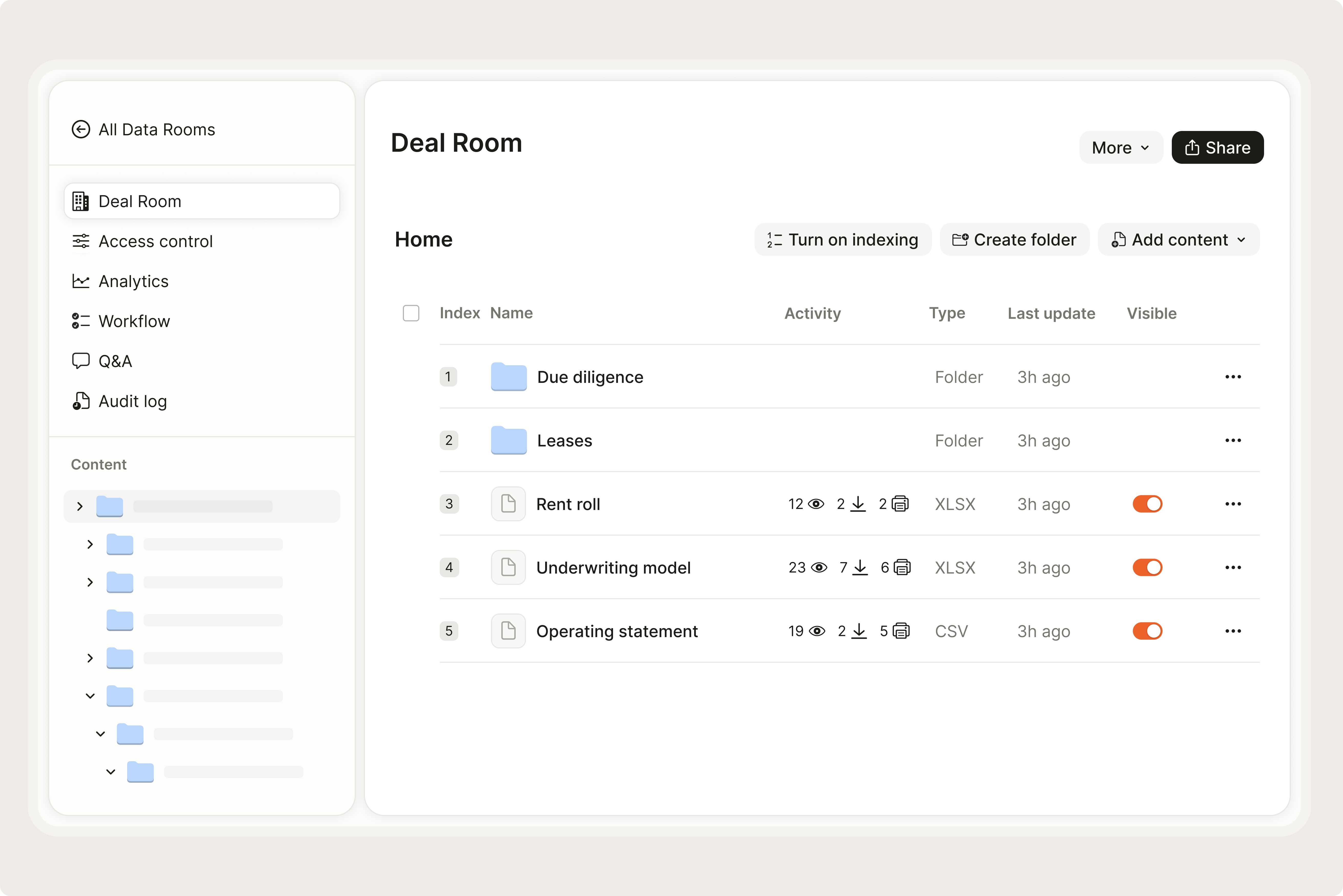
- 1.Upload New Mexico property files to a secure roomDrop ALTA title, OSE water rights certificates, NMED LEUST records, Phase I ESA, OCD well records, mineral abstract, BLM access permits, Santa Fe historic designation records, and lease pack into Ellty.
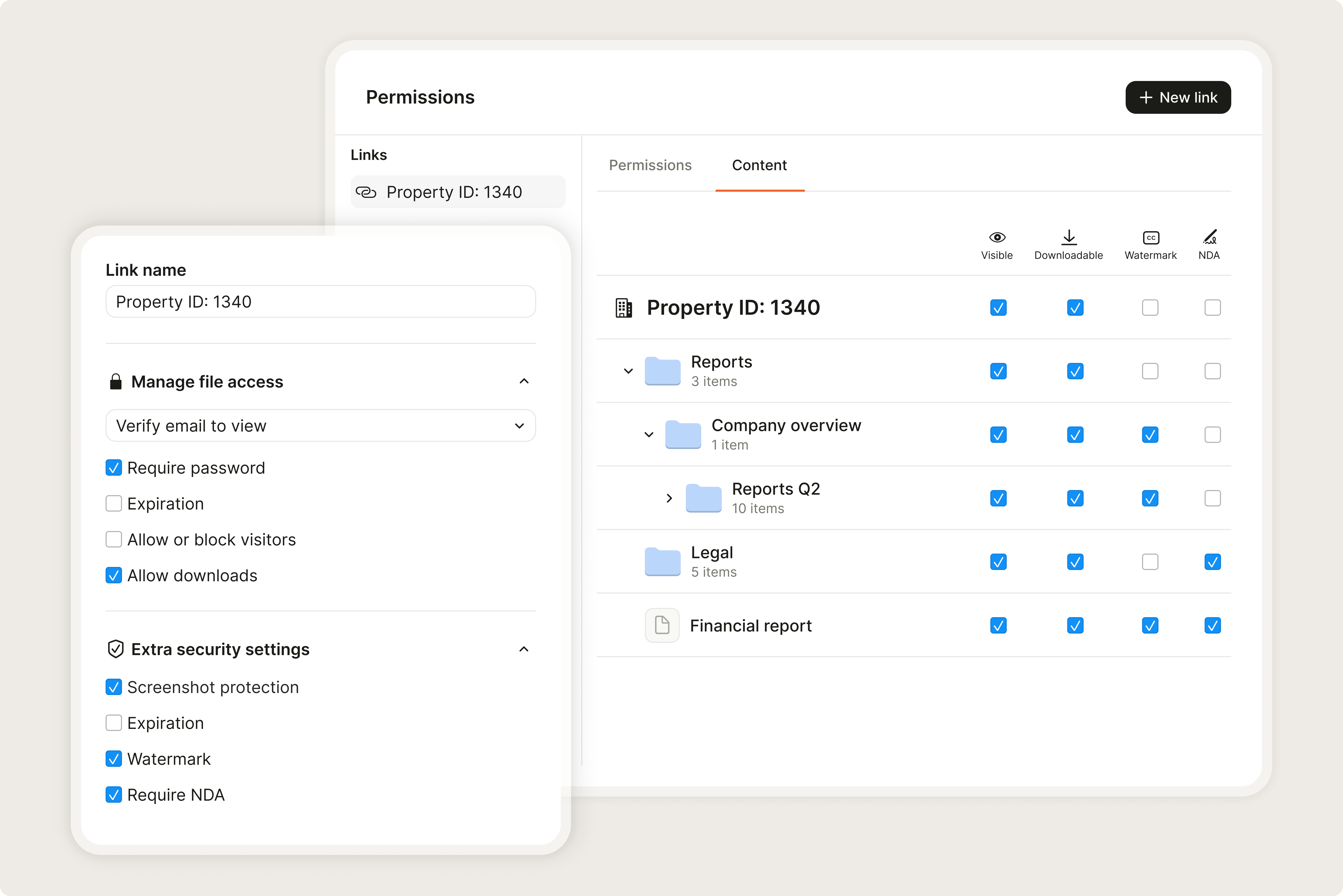
- 2.Give each advisor a scoped, tracked linkNM title attorney sees deed chain and Spanish land grant records. Water rights attorney sees OSE certificates. Environmental consultant sees NMED records and Phase I/II. Oil and gas attorney sees OCD records and mineral abstract. Lender sees NMED VCP NFA and valuation.
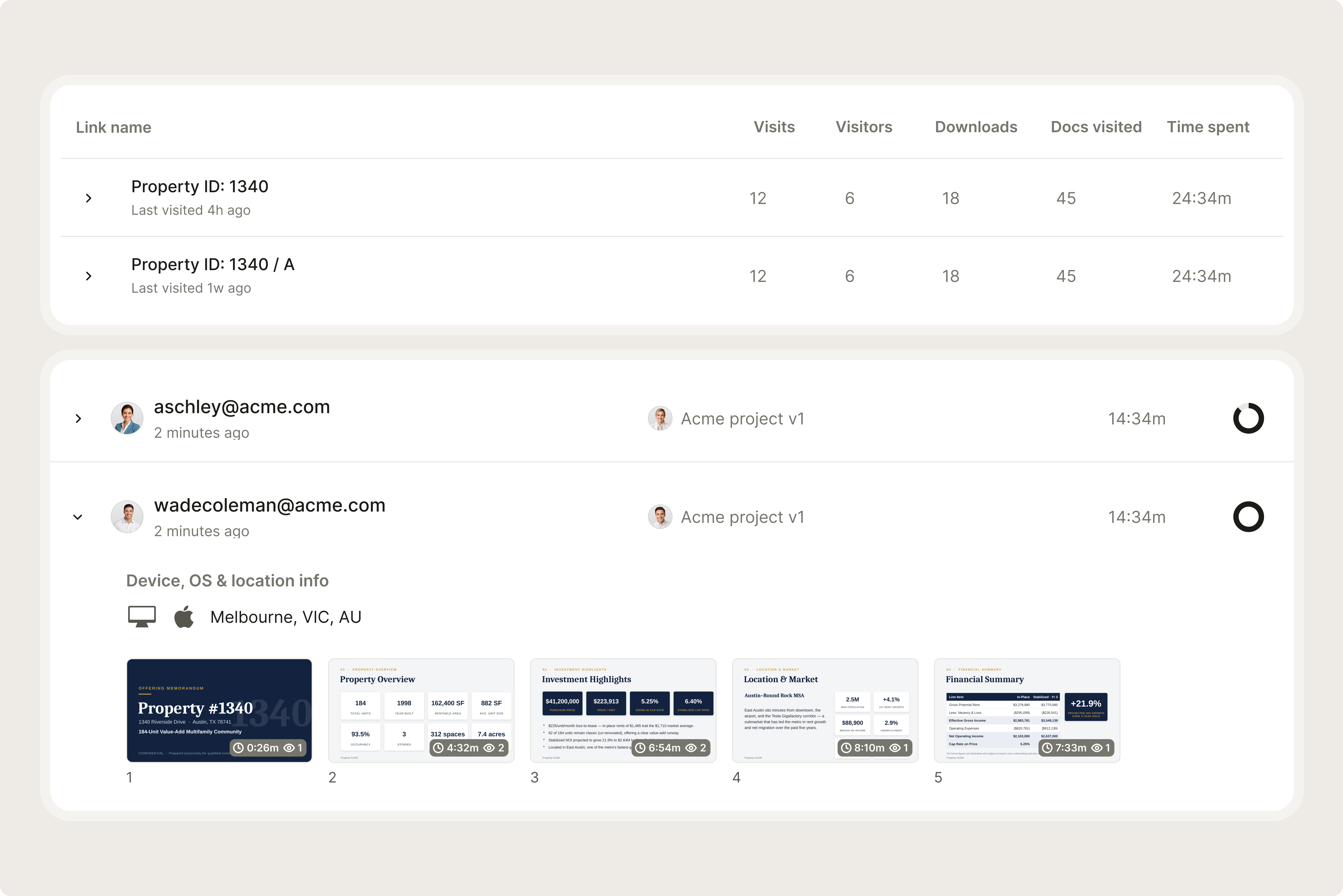
- 3.Monitor who reviews which documentsSee exactly which files each advisor opened and when. Catch water rights deficiencies or Pueblo land boundary issues before they affect deal pricing or closing.
What makes New Mexico different
Water rights in New Mexico are more complex than in Utah or Colorado because NM adds acequia community governance on top of the standard prior appropriation system. Acequias - the traditional Spanish colonial irrigation ditch communities that have managed water across the Rio Grande Valley for 400 years - hold water rights in trust for their members and govern their own water allocation internally. Commercial properties in the Rio Grande Valley that were historically agricultural may have acequia membership rights, acequia easements crossing the parcel, or water rights held through an acequia association rather than a directly certificated individual right. The OSE recognizes acequia water rights, but acequia governance (controlled by the mayordomo and parciantes of each individual acequia) adds a layer of community consensus to water right transfers that pure OSE certificate review won't reveal. Commission an acequia-specific water rights review from NM water rights counsel for any northern or central NM commercial property with Rio Grande Valley agricultural history.
The Kirtland AFB PFAS contamination plume is one of the largest documented PFAS groundwater contamination situations in the Mountain West. AFFF used at Kirtland's fire training area contaminated the underlying aquifer; the plume has migrated eastward beneath the southeast Albuquerque residential and commercial area. NMED and the Air Force have been conducting active monitoring and remediation, but the plume remains a concern for commercial properties in southeast Albuquerque - particularly any commercial with well water access or within a few miles of the base. Commission a Phase I ESA with PFAS addendum and review EPA's PFAS site locator before finalizing Phase I scope for southeast Albuquerque commercial.
Santa Fe's H Historic District architectural controls are unique in the Southwest and have no close parallel in Phoenix, Albuquerque, Tucson, or most other western cities. The requirement to maintain Pueblo Revival or Territorial exterior character affects not just the appearance of commercial buildings but their cost economics. Santa Fe historic commercial renovation typically costs 30-50% more than comparable renovation of non-historic commercial buildings because of approved material requirements (real stucco or approved substitute, not EIFS), skilled labor availability constraints, and Historic Preservation Division review requirements. Buyers modeling a Santa Fe historic commercial acquisition at non-historic renovation cost assumptions will underestimate the cost-to-stabilize. Commission a detailed cost estimate from a contractor with a track record in Santa Fe historic commercial before the bid is finalized.
New Mexico water law is based on the prior appropriation doctrine, codified in NMSA 1978 §§ 72-1-1 et seq. All waters of New Mexico belong to the public, and the right to use water is obtained through appropriation for beneficial use under permits from the NM Office of the State Engineer. Water rights are personal property separate from real property; they are attached to the land only by contract or custom, not by operation of law. A water right changes hands through a separate assignment filed with the Office of the State Engineer. A change in point of diversion, place of use, or purpose of use requires a formal change application to the State Engineer, published for objection by downstream and competing appropriators, with public hearing if objected. The New Mexico acequia system (traditional Spanish colonial irrigation communities) is recognized under NMSA 1978 § 73-2-1 et seq.; acequia associations hold water rights for member parciantes and are governed by an elected mayordomo and commissioners.
Timeline and cost in New Mexico
Weeks 1-2 cover kickoff: ALTA title commitment order, NM OSE water rights search (parallel), NMED LEUST and contaminated sites database search, NM OCD well records check (Permian Basin), BLM land status maps (rural), Kirtland PFAS plume check (southeast Albuquerque), Santa Fe H Historic District confirmation, Phase I ESA commission (NMED databases), mineral abstract (Permian Basin, if needed), Pueblo land boundary review (northern NM), zoning confirmation, and lease abstraction. Legal fees in this phase: USD 5,000-20,000.
Load all files into Ellty before advisors engage. Standard NM commercial: 45-60 days. NMED VCP brownfield: 12-24 months for NFA. OSE water right change: 6-36 months.
Weeks 2-6 cover deep review: Phase I ESA delivery, NMED VCP status confirmation, OSE water rights analysis completion, acequia review, mineral abstract delivery (Permian Basin), BLM ROW permit confirmation, Santa Fe Historic Preservation Certificate of Appropriateness timeline confirmation, Pueblo land boundary analysis, zoning compliance review, lease abstraction, and flood zone review (Albuquerque Rio Grande). Costs in this phase: USD 10,000-30,000.
Weeks 6-10 handle resolution: Phase II ESA (if triggered), NMED VCP enrollment (brownfield), OSE water right change application (if use change needed), Santa Fe historic renovation cost estimate, title exception clearance, and closing preparation.
NM total buyer acquisition costs for commercial: ALTA title insurance + water rights research + legal/advisory + environmental (Phase I/II) + mineral abstract (Permian Basin) + no transfer tax + nominal recording fees. Total acquisition overhead is among the lowest in the Southwest from a transfer tax standpoint.
Running a New Mexico property deal from one room
Hold ALTA title, NM OSE water rights, NMED VCP records, oil and gas docs, and lease files in one secure, tracked Ellty data room.
Start free 14-day trialCommon questions about due diligence on New Mexico commercial property
- Standard New Mexico commercial deals take 45-60 days. NMED Voluntary Cleanup Program (VCP) brownfield clearance: 12-24 months for a No Further Action determination. NM Office of the State Engineer water right change application (if change in use or diversion is needed): 6-36 months. Santa Fe historic district Certificate of Appropriateness for commercial renovation: 2-6 months. Permian Basin mineral rights abstract: 2-4 weeks in addition to surface title timeline.
- No. New Mexico has no state real estate transfer tax. County clerk recording fees are nominal (based on page count, typically a few hundred dollars for commercial deeds). NM trust deed recording fees are also nominal. Total transfer-related closing cost from taxes is effectively zero - one of the lowest commercial transfer cost structures in the Southwest.
- No. Water rights are personal property in New Mexico under the prior appropriation doctrine and do not automatically transfer with a real property deed. The purchase agreement must specifically include any appurtenant water rights, and assignment must be filed with the NM Office of the State Engineer (OSE). Changes in point of diversion, place of use, or purpose of use require formal OSE change applications and approval - a 6-36 month process. Research water rights at NM OSE (wrrs.ose.state.nm.us) as a parallel track alongside ALTA title research.
- Acequias are traditional Spanish colonial irrigation ditch communities that have managed water across the Rio Grande Valley for approximately 400 years. They are recognized under NM law (NMSA 1978 § 73-2-1 et seq.) as legal entities governed by elected commissioners. Acequia associations hold water rights for member parciantes. Commercial properties with historical agricultural ties in the Rio Grande Valley may have acequia membership, acequia easements crossing the parcel, or water rights held through an acequia association. Acequia easements may be prescriptive rather than recorded. Commission a specific acequia review from NM water rights counsel for any northern or central NM commercial with Rio Grande Valley agricultural history.
- New Mexico has 19 federally recognized Pueblo tribes. Commercial properties in Sandoval, Rio Arriba, Taos, Santa Fe, Bernalillo, and other northern NM counties may be adjacent to or within Pueblo land grant boundaries with complex title and jurisdictional issues. The Pueblo Lands Act of 1924 and subsequent legislation adjudicated conflicting land claims, but checkerboard areas of tribal and non-tribal land exist in some counties. Commercial development near Pueblo boundaries may involve tribal jurisdiction for access, water rights, and environmental review. Engage NM title counsel familiar with northern NM Spanish land grant and Pueblo land boundary issues.
- Santa Fe's H Historic District overlay requires commercial buildings to maintain Pueblo Revival or Territorial architectural character. All exterior modifications, additions, signage, and new construction require a Certificate of Appropriateness from the Santa Fe Historic Preservation Division. Review typically adds 2-6 months to commercial renovation projects. Santa Fe historic district commercial renovation typically costs 30-50% more than comparable non-historic renovation due to approved material requirements and skilled labor constraints. Commission a detailed renovation cost estimate from a Santa Fe historic-experienced contractor before finalizing deal economics.