Arizona bans state transfer tax outright - but water rights and two new zoning laws effective 2026 add layers that catch out-of-state buyers fast.
Property diligence on an Arizona asset typically runs 30-60 days for a stabilized commercial deal. A mid-market transaction pulls 80-130 documents into the data room before you're done. Arizona's Active Management Areas require a 100-year assured water supply certificate for new development - a requirement with no equivalent in most other states. Miss a water designation gap, a new HB 2721 middle-housing overlay, or a county recorder indexing issue and you own the problem after closing.
Where Arizona deals actually go wrong
Arizona prohibits state transfer tax under ARS 33-442 - but buyers who skip county-level cost modeling still get surprised. Maricopa and Pima counties charge $30 flat per recorded document. Multi-document closings add up faster than buyers expect when they budget for zero transfer tax.
Water is the structural risk that moves or kills Arizona deals. Properties in Active Management Areas must carry a certificate of assured water supply from ADWR confirming a 100-year supply. Development parcels without that certificate can't be entitled. Buyers who treat water as a utility line item miss it entirely.
Two laws took effect January 2026 and changed the zoning baseline statewide. HB 2721 requires cities over 75,000 to allow middle housing within one mile of a central business district. HB 2110 requires cities over 150,000 to open 10% of commercial parcels to multifamily. Both affect how you underwrite repositioning scenarios on commercial assets.
| Area | Documents to pull | Arizona red flag | Matters most for | Tier | |
|---|---|---|---|---|---|
| Title and ownership | Title and ownership | County recorder chain-of-title, deed history, recorded easements | Older rural parcels with indexing gaps in smaller Arizona counties | All buyers | Dealbreaker |
| Water rights | Water rights | ADWR certificate of assured water supply, AMA designation search | Development parcel in AMA with no 100-year water certificate | Land, development, industrial | Dealbreaker |
| Zoning and 2026 laws | Zoning and 2026 laws | Zoning confirmation, HB 2721 and HB 2110 overlay analysis | Commercial parcel in city over 150k now subject to multifamily mandate | Retail, industrial, land, repositioning | Dealbreaker |
| Environmental | Environmental | Phase I ESA, ADEQ records, underground storage tank search | Industrial corridor RECs in Phoenix, Tucson, and Mesa markets | Industrial, retail, mixed-use | Dealbreaker |
| Easements and CC&Rs | Easements and CC&Rs | Survey, title commitment Schedule B, CC&R search | Private transfer fees and CC&Rs on older master-planned parcels | Retail, industrial, land | Dealbreaker |
| Leases and rent roll | Leases and rent roll | All leases, amendments, guarantees, rent roll, estoppels | CAM reconciliation errors on Phoenix retail and flex-industrial leases | Multifamily, retail, industrial | Price-adjuster |
| Physical condition | Physical condition | PCA, roof and MEP records, HVAC load reports | HVAC deferred maintenance from extreme Phoenix summer heat loads | All asset types in Phoenix, Scottsdale, Mesa | Price-adjuster |
| Income and expenses | Income and expenses | 3 years P&L, county tax bills, utility statements | High cooling costs inflate opex on non-metered Phoenix assets | All income-producing assets | Price-adjuster |
| Survey and boundaries | Survey and boundaries | ALTA/NSPS survey, prior surveys, legal description | Lot splits and shared access easements in older Scottsdale parcels | All | Standard check |
| Property taxes | Property taxes | County assessor bills, class ratio, special assessment search | Arizona class ratios assess commercial at 18% vs 10% residential | All | Standard check |
| Recording fees | Recording fees | County recorder fee calculation, affidavit of value | $30 per doc in Maricopa/Pima; no state transfer tax applies | All deals | Standard check |
| Insurance | Insurance | Current policies, loss run history, wildfire zone confirmation | Wildfire zone risk on outlying parcels in Prescott and Flagstaff | Assets outside Phoenix metro | Standard check |
Running due diligence on an Arizona property?
Load title docs, water rights, zoning, and leases into one data room before the request list lands.
Start free 14-day trialThe full Arizona property due diligence checklist
Set up an Ellty data room before diligence opens and load every category below. When the buyer's request list arrives, you're organized instead of tracking down county recorder copies across 15 Arizona counties.
Title and ownership
- Order a full chain-of-title search through the Arizona county recorder covering the parcel
- Pull the current deed, all prior deeds, and any recorded easements or restrictions
- Review the title commitment Schedule B exceptions before the inspection period closes
- Confirm no unreleased mortgages, mechanic's liens, or judgment liens are outstanding
- Verify the legal description matches the ALTA/NSPS survey exactly
Water rights
- Confirm whether the parcel falls within an Active Management Area under ADWR jurisdiction
- Obtain a copy of the current certificate of assured water supply if the parcel is in an AMA
- Verify the municipal water provider has an assured water supply designation for existing hookups
- Review any recorded water rights, well permits, or surface water claims on the parcel
- For development parcels: confirm 100-year supply certificate is in place before proceeding
- Use Ellty to store ADWR certificates and water legal opinions in a tracked data room
Zoning and 2026 law overlays
- Request written zoning confirmation from the relevant city or county planning department
- Analyze whether HB 2721 middle-housing overlay applies within one mile of the CBD
- Confirm whether HB 2110 commercial-to-multifamily mandate affects your parcel's city
- Check for variances, special use permits, or non-conforming use status
- Pull all building permits, open permit searches, and certificates of occupancy
Environmental
- Commission a Phase I ESA per ASTM E1527-21 for all commercial acquisitions
- Review ADEQ records for the site and surrounding parcels with industrial history
- Run an underground storage tank search - high frequency on former gas station sites
- Confirm no wetlands or floodplain designations requiring Army Corps permits
- Budget for Phase II testing if RECs are identified - add $5,000-$20,000 and 4-8 weeks
Leases and tenancy
- Collect all leases, amendments, side letters, and guarantees from the seller
- Review rent roll and cross-reference against 3 months of bank receipts
- Audit CAM reconciliations on retail and flex-industrial leases for billing errors
- Check for below-market leases, unusual renewal options, or co-tenancy clauses
- Confirm tenant estoppel certificates are obtainable before closing
Survey and physical condition
- Order an ALTA/NSPS survey - flag lot splits and shared-access easements on older parcels
- Commission a Property Condition Assessment covering all systems over 15 years old
- Inspect HVAC systems thoroughly - extreme Phoenix summer heat accelerates wear cycles
- Review roof, electrical, and plumbing with desert climate performance in mind
- Confirm ADA compliance on all customer-facing retail or office space
Financial and tax
- Pull 3 years of operating statements and reconcile against actual receipts
- Review county assessor records and confirm commercial class ratio (18% assessed)
- Check for special assessments or improvement district charges on the parcel
- Confirm recording fees ($30 per doc in Maricopa/Pima) are modeled in closing costs
- Verify no outstanding utility liens or municipal code violations are open
How property due diligence in Arizona works
Step 1 - Title search
Start with a full chain-of-title search through the Arizona county recorder system. Arizona has 15 counties and each maintains its own recording system - Maricopa and Pima are well-indexed, but smaller counties carry more gaps on rural and older parcels.
Your title attorney needs to flag unreleased instruments, CC&R conflicts, and easement discrepancies. Order the title commitment and review Schedule B exceptions before your inspection period expires - exceptions you don't negotiate become your liability at closing.
Step 2 - Survey and inspection
An ALTA/NSPS survey is standard for commercial acquisitions and should be ordered early. In Arizona, lot splits and shared access easements on older Scottsdale and Tempe parcels surface in surveys and get missed in title searches alone.
Pair the survey with a full Property Condition Assessment. Phoenix-area commercial stock carries significant HVAC deferred maintenance from extreme cooling loads. Private equity buyers managing Arizona portfolios should factor replacement reserves into underwriting at the PCA stage.
Step 3 - Leases and income review
Arizona has no standard commercial lease template and CAM reconciliation practices vary across Phoenix, Tucson, and Scottsdale landlords. Billing errors on CAM are common and move price in multi-tenant retail deals.
Get every lease, amendment, and side letter in writing before proceeding. Review leases for renewal options, early termination clauses, and landlord maintenance obligations. Cross-reference the rent roll against 3 months of bank statements to confirm actual collections.
Step 4 - Environmental and water
Commission a Phase I ESA early - it's the most common source of timeline delays on Arizona commercial deals. Confirm ADEQ records for the site and run a UST search before you price the deal. Advisors managing investor relations should flag environmental holds early so LP updates reflect accurate timeline risk.
Water rights review runs parallel to environmental. For any development parcel, confirm ADWR assured water supply status before you proceed past preliminary underwriting. In Phoenix and Tucson AMAs, no 100-year certificate means no entitlement - full stop.
Step 5 - Closing and recording
Arizona deeds require an affidavit of legal value at recording - there is no state transfer tax under ARS 33-442. Recording fees in Maricopa and Pima counties are $30 per document flat, with additional documents adding cost on complex closings.
Attorney involvement at closing is standard. Expect $1,000-$2,000 for a straightforward commercial closing. Allow 5-10 business days for instruments to be indexed after recording at the county recorder.
How to set up your Arizona data room in Ellty.
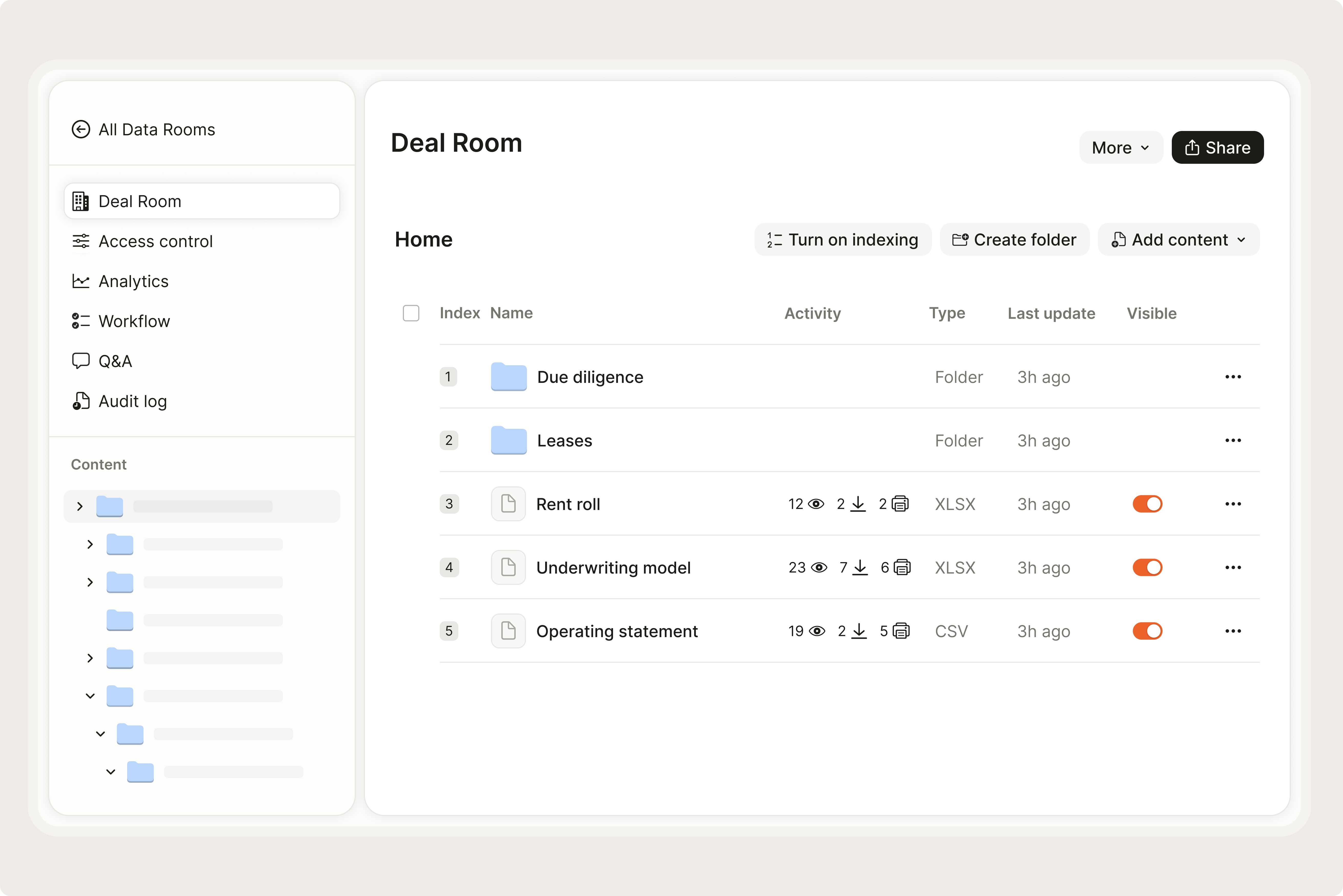
Load your Arizona deal documents before the request list lands. Give each advisor a link scoped to their role so review starts on day one.
- 1.Bulk upload your deal files by categoryUpload title docs, ADWR certificates, ESA, and leases into Ellty. Organize by diligence area so advisors find files fast.
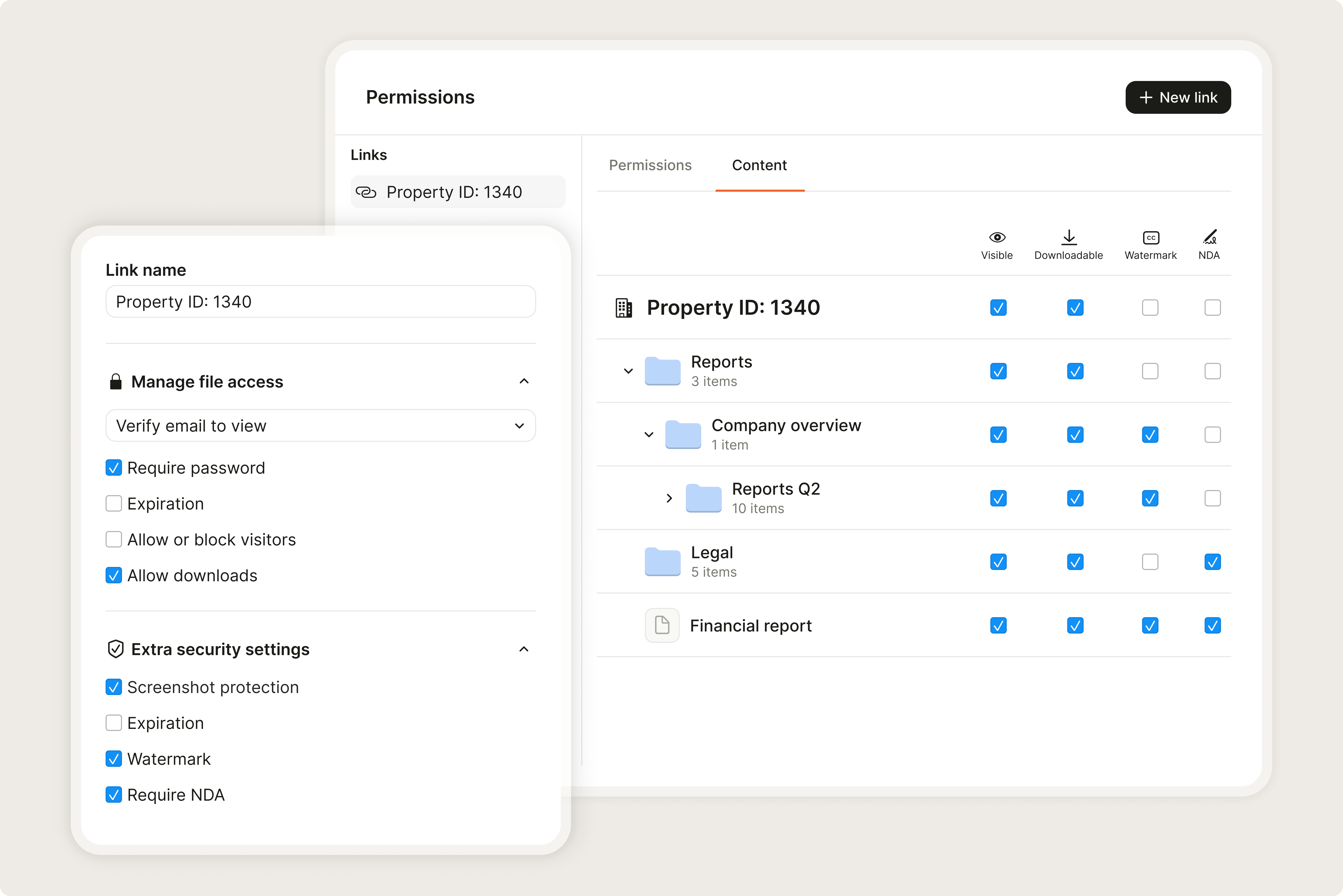
- 2.Set scoped permissions for each advisorSend your title attorney a link to title files only. Water rights counsel sees ADWR docs only. No overlap, no confusion.
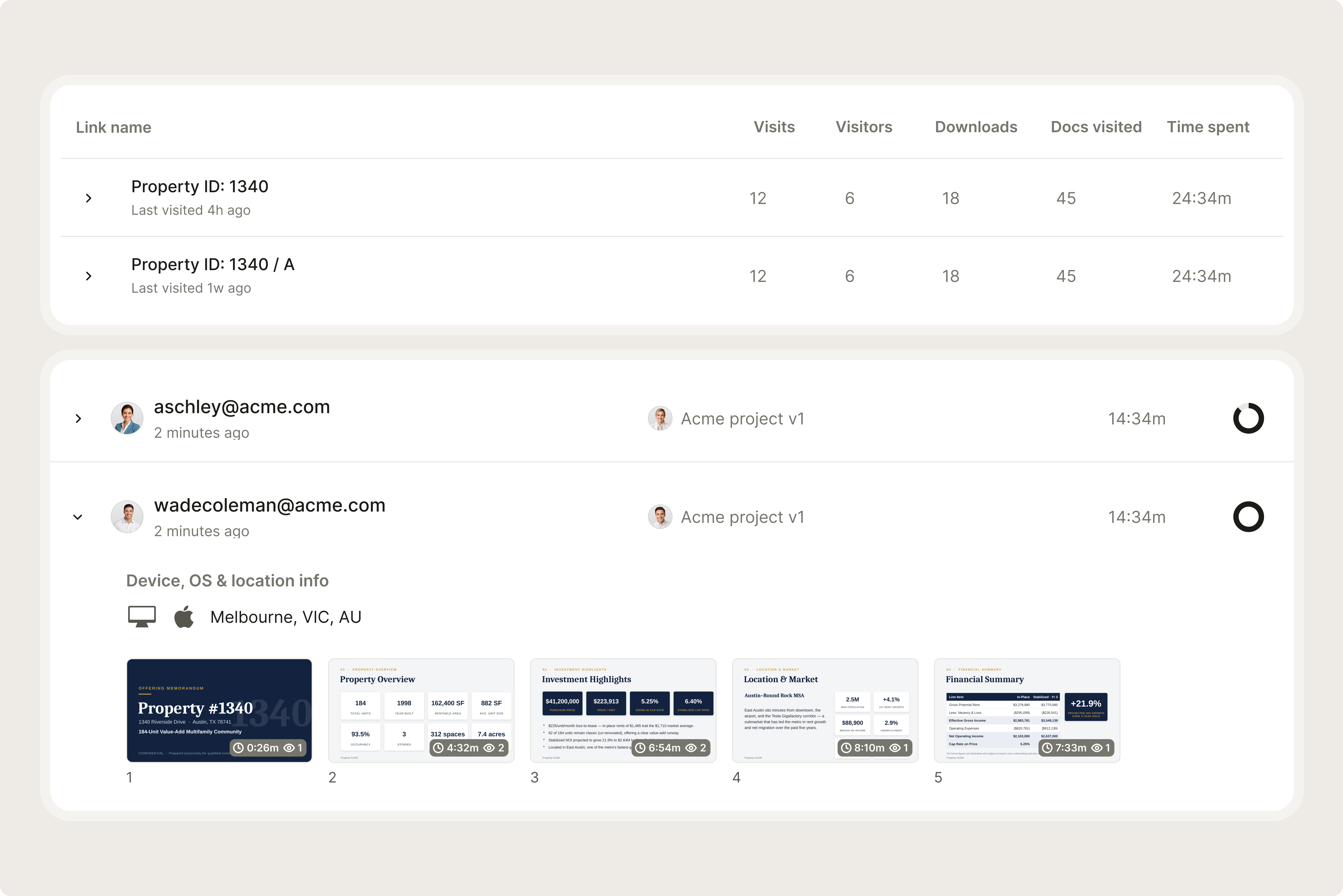
- 3.Track reviewer activity in real timeSee which documents each advisor opened and how long they spent. Spot where questions form before they delay the closing.
What makes due diligence in Arizona different
Arizona is the only state where a 100-year assured water supply certificate is a prerequisite for development entitlement in Active Management Areas. The six AMAs - covering Phoenix, Tucson, Prescott, Pinal, Santa Cruz, and Joseph City - hold most of the state's commercial real estate activity. Buyers who skip water rights review on a development parcel in an AMA face a hard stop at entitlement.
The 2026 zoning law changes add a new baseline for commercial acquisitions in Arizona's major cities. HB 2721 and HB 2110 affect repositioning underwriting on urban commercial parcels. A buyer modeling a commercial-only exit on a parcel subject to a multifamily mandate is working from a stale comp set. Legal advisors should confirm which overlays apply before LOI.
Property tax class ratios create a structural wedge that surprises buyers from other states. Arizona assesses commercial property at 18% of full cash value versus 10% for residential. The effective rate looks lower on paper - but the commercial class ratio closes the gap. Model it correctly before you underwrite net cash flow.
"Arizona's water rights framework is unlike any other state. In the AMAs, a certificate of assured water supply is not optional for development - it is a legal prerequisite. Buyers who don't engage water counsel early often discover this after the inspection period has closed." - Gottlieb Law, Arizona Water Rights and Real Estate Development Guidance
Timeline and cost in Arizona
A typical Arizona commercial deal runs in three phases. Weeks 1-2 cover initial review: county recorder title search, Phase I ESA kickoff, ALTA survey order, ADWR water rights search, and lease collection. Estimated cost: $5,000-$12,000 for title, survey, water search, and initial legal review.
Weeks 2-5 cover deep review: Phase I ESA delivery, physical inspection and PCA, lease and CAM audit, tenant estoppels, zoning overlay analysis, and ADWR water certificate review. Estimated cost: $4,000-$10,000 for Phase I, PCA, and water counsel. Load documents into your Ellty data room and track which advisors are reviewing what - if water counsel opens the ADWR search three times, that's where questions are forming.
Weeks 5-8 handle resolution: Phase II ESA if RECs found (add $5,000-$20,000 and 4-8 weeks), title exception negotiations, repair credits from PCA findings, and water rights transfer documentation. Total soft cost for a mid-market Arizona deal: $18,000-$45,000 depending on environmental complexity. Factor county recording fees into your closing model. For deals where sensitive documents go to multiple parties, Ellty's features include watermarking and permission controls that protect document integrity through the full diligence window.
Keep your Arizona deal on track from day one
One secure data room for title, water rights, ESA, and leases - with full advisor tracking.
Start free 14-day trialCommon questions about property due diligence in Arizona
- No. Arizona prohibits transfer taxes by statute under ARS 33-442. You pay county recording fees - $30 per document in Maricopa and Pima counties.
- An ADWR certificate confirming a 100-year water supply. Required for development entitlement in Active Management Areas across Phoenix, Tucson, and Prescott.
- Most deals run 30-60 days. Water rights issues or environmental Phase II testing can push the timeline to 90 days or more.
- HB 2721 allows middle housing near CBDs in cities over 75,000. HB 2110 opens 10% of commercial parcels to multifamily in cities over 150,000.
- Commercial property is assessed at 18% of full cash value in Arizona. Residential is assessed at 10%, so commercial buyers carry a higher effective tax burden.
- Ellty lets you load all diligence docs into one secure data room, give each advisor a scoped link, and track exactly who reviewed what.