Malta commercial property due diligence has four issues that catch foreign buyers off guard: a 13% combined transfer cost (5% stamp duty paid by buyer + 8% final withholding tax paid by seller); an AIP permit requirement for non-EEA buyers that can take 6-12 months; emphyteusis (ground rent) on many commercial properties that requires careful review; and a Malta Planning Authority permit system that governs every commercial use change.
Malta property transfers must be completed before a Notary Public under Maltese civil law; the Notary verifies title, prepares the final deed of sale, collects the stamp duty from the buyer, and registers the transfer. Before the final deed, parties typically sign a Promise of Sale (Konvenju) with a 10% deposit, registered with the Commissioner for Revenue, which locks in price and terms while title examination and permits are confirmed.
The Malta Land Registry (for newer registered title) and the Notarial Archives/Public Registry (for older unregistered title) hold property records; many older Malta commercial properties still have title through notarial archives rather than the Land Registry system, requiring a full notarial title search going back to the original grant.
Malta Planning Authority (PA) Development Permits are required for any change of commercial use, any external alterations in Urban Conservation Areas (UCAs), and any new development; the PA permit process for commercial applications takes 3-18 months depending on complexity, whether the property is in a UCA or heritage zone, and whether third-party objections are received.
Set up an Ellty data room before advisors engage. Load notarial title, Land Registry searches, AIP permit records, Malta PA permits, emphyteusis records, Energy Performance Certificate, and lease files.
Where Malta property deals go wrong
Not every check carries the same weight. The table below sorts risks by deal impact - dealbreakers first, then what moves the price, then basic hygiene - so your Maltese notary and legal advisor know what to clear first.
| Area | Documents to pull | Malta red flag | Matters most for | Tier | |
|---|---|---|---|---|---|
| Notarial title and Land Registry | Notarial title and Land Registry | Malta Land Registry certificate (for registered title), Notarial Archives search (for pre-registration title), full notarial title abstract, Commissioner for Revenue Konvenju registration confirmation | Malta commercial title examination must confirm whether the property is registered at the Malta Land Registry (registered title system) or only in the Notarial Archives (unregistered); for unregistered title, a full notarial search of historical deeds in the Notarial Archives is required; many older Malta commercial properties (especially in Valletta, Sliema, and other historic areas) are not yet registered; confirm freedom from hypothecs (mortgages registered under Maltese civil law), privileges, and any special liens before signing the Konvenju | All buyers | Dealbreaker |
| AIP permit - non-EEA buyers | AIP permit - non-EEA buyers | AIP application (Acquisition of Immovable Property), Ministry for Finance confirmation of SDA exemption status, EEA citizenship confirmation | Non-EEA citizens and non-EU companies purchasing Maltese property outside Special Designated Areas (SDAs) require an AIP permit from the Maltese government; AIP takes 6-12 months; EEA citizens purchasing their primary residence are exempt from AIP; Special Designated Areas (Portomaso, Pendergardens, Cottonera, Smart City, Fort Cambridge, Ta' Monita, Tigne Point) are SDA-exempt for all buyers including non-EU; confirm buyer's AIP status before any commercial deposit or Konvenju | Non-EEA foreign buyers; non-EU corporate buyers | Dealbreaker |
| Emphyteusis and ground rent | Emphyteusis and ground rent | Notarial title abstract (confirms emphyteusis status), original emphyteusis grant, Commissioner for Revenue cens records, emphyteusis redemption documents (if applicable) | Emphyteusis (known as cens or groundrent in Maltese practice) is the civil law equivalent of a leasehold land grant; many Malta commercial properties are held under emphyteusis whereby the buyer owns the buildings and improvements but pays an annual ground rent (cens) to the dominus (land owner, often the government or the Church of Malta); the emphyteusis grant may be for a fixed term (e.g. 99 years from the original grant) or perpetual; government-held emphyteusis on commercial property may be redeemable; confirm emphyteusis status and remaining term from the notarial title abstract before any commercial bid | All Malta commercial especially Valletta, Sliema, government-held land | Dealbreaker |
| Malta PA development permit | Malta PA development permit | Malta Planning Authority permit history, current PA development permit, UCA overlay map, Urban Conservation Area (UCA) design guidance, PA online permit system (PACCD) | All commercial use changes in Malta require a Malta PA Development Permit; commercial renovation in Urban Conservation Areas (UCAs) - which cover Valletta, Mdina, Rabat, Victoria Gozo, and other historic towns - requires additional PA Design and Heritage considerations; UCAs impose restrictions on facade materials, signage, openings, and external alterations; PA permit processing: 3-6 months for standard commercial; 6-18 months for UCA or heritage applications; third-party objection periods can extend timelines further | All commercial; especially UCA historic commercial | Dealbreaker |
| Transfer taxes - stamp duty and FWT | Transfer taxes - stamp duty and FWT | Commissioner for Revenue stamp duty calculation, seller FWT confirmation, first-time buyer exemption status, capital gains election documents (if applicable) | Malta commercial property transfer costs are among the highest in the EU: buyer pays 5% stamp duty on full consideration; seller pays 8% Final Withholding Tax (FWT) on full consideration (10% FWT if property held less than 3 years); combined 13% transfer cost is fully on the consideration (not on gain); seller may alternatively elect capital gains tax at 35% on profit if that is lower - rare for commercial property with high accumulated gain; first-time buyer exemptions (0% on first €200,000) do not apply to commercial commercial | All buyers - significant deal math impact | Dealbreaker |
| Urban Conservation Area heritage controls | Urban Conservation Area heritage controls | Malta PA UCA maps, Superintendence of Cultural Heritage (SCH) permits, Heritage Malta records, scheduled monument status confirmation | Malta has extraordinarily high heritage density; Urban Conservation Areas (UCAs) cover most historic town centres; scheduled monuments (megalithic temples, fortifications, historical buildings) impose additional restrictions beyond UCAs; the Superintendence of Cultural Heritage (SCH) must be consulted for any commercial development affecting a scheduled property or within a defined buffer zone; SCH objections can halt commercial development; commercial renovation costs in UCA Malta run significantly higher than equivalent non-UCA commercial due to approved material requirements, traditional craftsmanship, and PA/SCH review | Valletta, Sliema historic, Mdina, Victoria Gozo commercial | Price-adjuster |
| Leases and tenancies | Leases and tenancies | All commercial leases, Malta rent registration records (Housing Authority), rent roll, PA-confirmed commercial use of each let unit | Malta's commercial lease market has limited statutory tenant protection compared to Maltese residential tenancies; however, legacy residential tenancies under pre-1995 Maltese rent laws can have very low controlled rents that survive into commercial buildings; confirm from the notarial title and Housing Authority records whether any pre-1995 residential tenancy exists in a commercial building; commercial leases should be registered; confirm PA-approved commercial use for any tenanted unit where use has changed | Mixed-use Malta commercial with any residential floors | Price-adjuster |
| Building condition and asbestos | Building condition and asbestos | Property condition assessment, structural engineer report, asbestos survey (pre-1990 Malta commercial), Energy Performance Certificate (EPC) | Older Malta commercial buildings (pre-1980) have documented asbestos in roofing sheets, pipe lagging, and ceiling tiles; asbestos was widely used in Malta industrial and commercial construction and not fully regulated until the 1990s; commission an asbestos survey for any Malta commercial built before 1990; Malta's EPC (Energy Performance Certificate) is required for all property transactions; obtain an EPC if the seller has not provided one - commercial EPC for older Malta buildings often reveals significant energy inefficiency | Older Malta industrial and commercial pre-1990 | Price-adjuster |
| Hypothecs and encumbrances | Hypothecs and encumbrances | Malta Land Registry search for registered hypothecs, Commissioner for Revenue tax lien records, judgment hypothec search at the Law Courts of Malta | Under Maltese civil law, hypothecs (mortgages) and privileges (legal liens including tax debts, contractor claims, and court judgments) can attach to immovable property and rank in priority; a judgment hypothec registered at the Civil Court attaches to all property of the debtor including commercial real estate; confirm from the Land Registry and judicial records that the property is free of hypothecs, privileges, and judgment liens before closing | All buyers | Standard check |
| Seller KYC and AML | Seller KYC and AML | Malta Business Registry entity records, UBO register confirmation, OFAC screen, EU sanctions screens, FIAU (Financial Intelligence Analysis Unit) compliance confirmation | Malta's FIAU (Financial Intelligence Analysis Unit) regulates AML/CFT compliance in Malta property transactions; notaries are subject persons under Malta's AML law and must perform CDD on all parties; high-value Malta commercial transactions (above €15,000 or higher as applicable) trigger enhanced due diligence under Malta's AML framework; Malta's significant offshore and international investment community means sellers may be Maltese holding companies with complex UBO structures; confirm UBO at Malta Business Registry and run OFAC and EU sanctions screens on all principals | All deals, especially foreign-held Malta commercial | Standard check |
Due diligence on a Malta property?
Set up your Ellty data room before diligence starts.
Start free 14-day trialMalta commercial property due diligence checklist
The table ranked risks by severity. This is the full checklist to work through, grouped by area.
Title - notarial search and Land Registry
- Engage a Malta-licensed Notary Public (or have your Maltese lawyer engage one) on day one to commence the title search; the Notary's role in Malta is far broader than in common law jurisdictions - the Notary verifies title, prepares the deed, and registers the transfer
- Land Registry search: confirm whether the property is registered at the Malta Land Registry (registered title system introduced in 1981); for registered properties, obtain a Land Registry certificate confirming title, registered hypothecs, and any other registered encumbrances
- Notarial Archives search: for properties not yet in the Land Registry system (many older commercial properties), a notarial title search must examine historical deeds in the Notarial Archives going back to at least 1600 (for the oldest properties); this is a specialized service from a Malta notary or title search firm
- Hypothecs and privileges: Maltese civil law recognizes special hypothecs (registered against specific property) and general hypothecs (against all property of a debtor); search the Land Registry and court records for any hypothecs or judgment hypothecs registered against the property or the seller
- Confirm Freedom of Property: confirm that the seller has full title and that no third party holds any real right (jus in re) including usufruct, use rights, or real servitude affecting the commercial use of the property
Load notarial title, Land Registry certificates, hypothec search results, AIP permit records, Malta PA permits, emphyteusis records, and lease files into Ellty. Malta Notary sees title chain and hypothec records. PA specialist sees planning history. AIP adviser sees permit records. Lender sees valuation and clean title. Each party sees their scoped files.
AIP permit - non-EEA buyer clearance
- Confirm buyer's AIP status on day one before any commercial deposit; non-EEA citizens and non-EU companies need AIP unless the property is in a Special Designated Area (SDA)
- SDA confirmation: verify whether the commercial property is within a designated SDA (Portomaso, Pendergardens, Cottonera Waterfront, Smart City Malta, Fort Cambridge, Tigne Point, Ta' Monita, Mercury Towers) where all buyers including non-EU are exempt from AIP
- AIP application: submitted to the Ministry for Finance; requires personal details, property description, and purpose of acquisition; typical processing time 6-12 months; AIP must be granted before the final deed can be completed; the Konvenju can be signed before AIP but the final deed cannot be completed without the permit
- Corporate buyer AIP: EU-incorporated companies with non-EU shareholders may need AIP; obtain a written opinion from Maltese legal counsel on the AIP status of any corporate buyer structure before any commercial deposit
- EU citizen primary residence exemption: EEA citizens buying their primary and only Maltese residence are exempt from AIP; commercial property acquisition does not qualify for this exemption
Emphyteusis - ground rent and redemption
- Confirm emphyteusis status from the notarial title abstract on day one; many Malta commercial properties are held under emphyteusis (government or Church emphyteusis), and this information must come from the full title search
- Government emphyteusis: commercial properties held on government emphyteusis (Lands Authority) pay an annual cens to the government; government emphyteusis may be redeemable - contact the Malta Lands Authority to confirm redemption availability and cost; redeemable government emphyteusis is worth redeeming before a commercial sale to simplify title and remove recurring obligations
- Church emphyteusis: some Malta properties are held under emphyteusis from the Catholic Church or Church entities; Church emphyteusis terms vary and may not be redeemable on the same basis as government emphyteusis; confirm terms from the original emphyteusis grant
- Term emphyteusis: if the emphyteusis is for a fixed term (e.g. 99 years from 1950), confirm the remaining term; a short remaining term significantly affects commercial value and may affect lender willingness to finance the acquisition
- Perpetual emphyteusis: perpetual emphyteusis (dominium utile) where the buyer holds the buildings and improvements in perpetuity with an annual cens is the most common and most lender-friendly form; confirm the cens amount and any indexation or review provisions
Give each advisor a tracked link in Ellty. Malta Notary sees title chain. AIP adviser sees permit records. Malta PA specialist sees planning history and UCA maps. Heritage architect sees SCH correspondence. Lender sees EPC, title certificate, and valuation. No advisor digs through files outside their scope.
Malta PA development permit and UCA controls
- Search the Malta Planning Authority online permit system (PACCD) for all permit history on the commercial property; confirm the current approved commercial use, all previous permits, any PA enforcement notices, and any pending permit applications
- Confirm UCA status: check whether the property is within an Urban Conservation Area (Valletta, Sliema/Ta' Sliema historic part, St Paul's Bay historic, Mdina, Rabat, Vittoriosa, Senglea, Cospicua, Victoria Gozo); UCA commercial development requires additional PA consideration of heritage impact
- PA permit for current use: confirm the existing commercial use is authorized under a current PA development permit; PA-unauthorized commercial use creates enforcement risk and affects value; if the seller cannot produce a PA permit for the current commercial use, the buyer should obtain an independent PA conformity certificate before closing
- PA application for changes: if the buyer's intended commercial use differs from the current approved use, commission a pre-application feasibility assessment from a Malta architect before finalizing the bid price; PA commercial applications cost €3,000-15,000+ in professional fees and take 3-18 months; UCA heritage applications may take longer
- SCH consultation: for any Malta commercial in or near a scheduled monument, urban conservation area, or heritage zone, confirm whether SCH consultation is required before submitting any PA development permit application; SCH objections can effectively prevent certain commercial uses
Transfer taxes - stamp duty and final withholding tax
- Model the full Malta transfer cost before any binding offer: buyer pays 5% stamp duty on consideration; seller pays 8% Final Withholding Tax (FWT) on consideration; combined 13% on transfer value, not on gain
- Seller FWT rate confirmation: confirm how long the seller has held the property; if held less than 3 years, FWT rises to 10%; if the seller acquired under a Konvenju (promise of sale), the holding period starts from the Konvenju date
- First-time buyer exemption: only applies to residential primary residence; does not apply to commercial property
- Stamp duty on Konvenju: when the Konvenju (promise of sale) is registered, a 1% provisional stamp duty is paid by the buyer; this is credited against the 5% stamp duty payable at the final deed
- Alternative capital gains election: seller can elect to pay 35% capital gains tax on the profit instead of 8% FWT; this only makes sense when the gain is very small relative to the consideration (acquired at near-market value); not typically relevant for commercial property with long holding periods
Compare Italy's commercial property due diligence process for Mediterranean CRE portfolio work. Malta and Italy share civil law notarial systems and heritage-heavy commercial markets, but differ significantly on transfer taxes (Malta 13% combined vs. Italy's imposta di registro 9% on cadastral value), emphyteusis (Malta has extensive ground rent arrangements without Italian parallel), and AIP restrictions (no Italian equivalent for EU buyers).
How due diligence works in Malta
Step 1 - Title search, AIP, and emphyteusis
Day one: commission notarial title search (Land Registry + Notarial Archives), confirm AIP requirement for buyer, and obtain emphyteusis status from title abstract.
The notarial title search takes 2-6 weeks for registered properties; 4-12 weeks for unregistered (Notarial Archives). Don't sign a Konvenju before emphyteusis status and AIP requirement are confirmed.
Step 2 - PA permit, heritage, and environmental
Search Malta PA PACCD for full permit history. Confirm UCA status and whether SCH consultation is required. For pre-1990 Malta commercial: commission asbestos survey. Obtain EPC if not provided.
For any foreign corporate buyer: obtain Maltese legal counsel opinion on AIP status of the corporate structure.
Step 3 - Hypothecs, leases, and AML
Search Land Registry and court records for hypothecs and judgment liens. Abstract all commercial leases. Confirm Housing Authority records for any legacy residential tenancies in commercial buildings.
Run FIAU-compliant AML/KYC on all principals. Confirm Malta Business Registry entity records and UBO.
Step 4 - Transfer tax calculation and closing
Calculate stamp duty (5% of consideration, buyer) and confirm seller FWT rate (8% standard, 10% if held under 3 years). Model full transaction cost at 13% combined before final bid.
Load all files into Ellty. Malta Notary and legal counsel see full title file. AIP adviser sees permit. PA architect sees planning history. Lender sees Land Registry certificate, emphyteusis status, EPC, and valuation.
How to set up your Malta data room in Ellty.
Malta commercial deals involve notarial title, Land Registry records, AIP permits, Malta PA permits, emphyteusis records, SCH heritage documents, Energy Performance Certificates, and lease files.
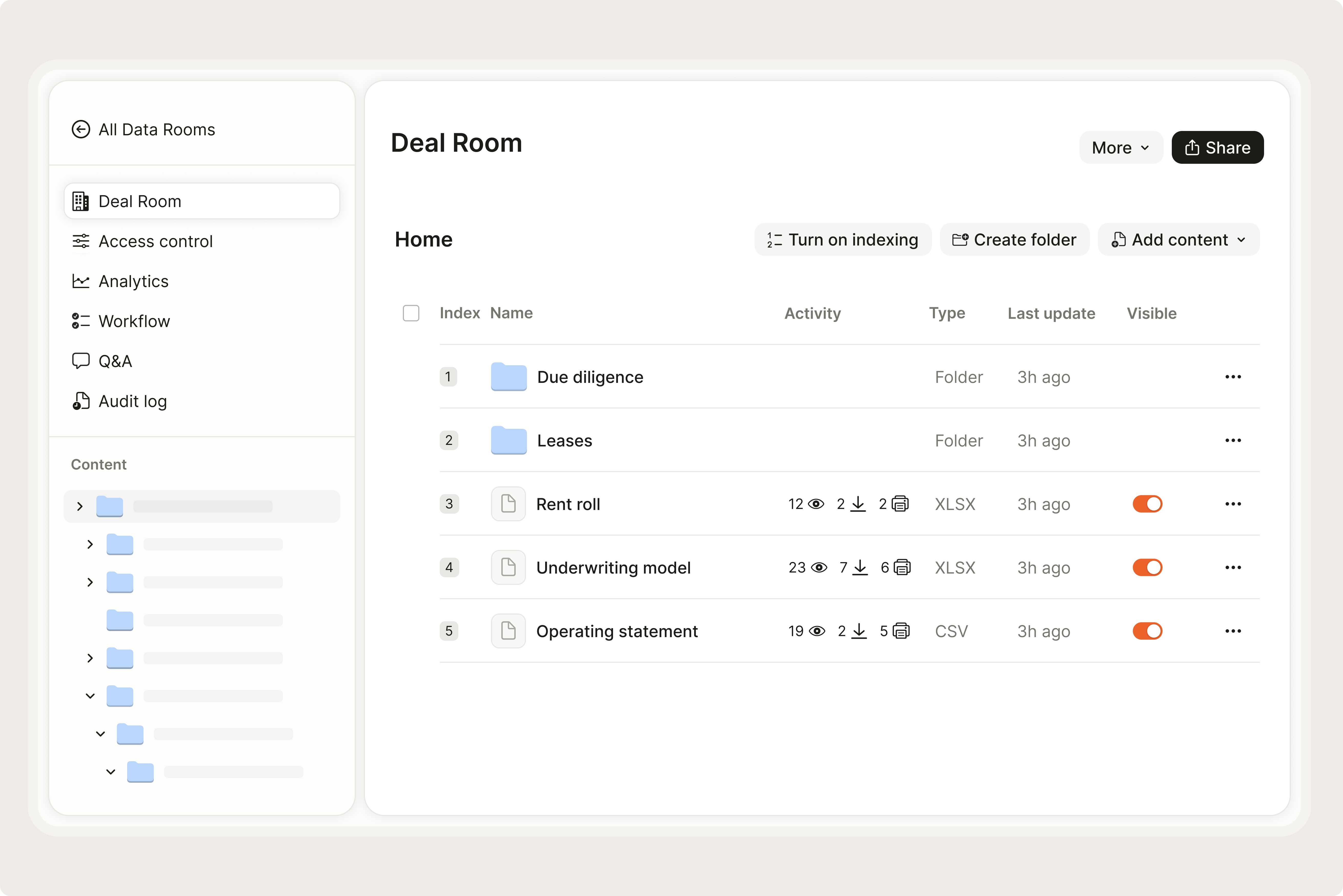
- 1.Upload Malta property files to a secure roomDrop notarial title abstract, Land Registry certificate, Notarial Archives search, AIP permit records, Malta PA permit history, emphyteusis records, SCH correspondence, EPC, lease pack, and AML/KYC files into Ellty.
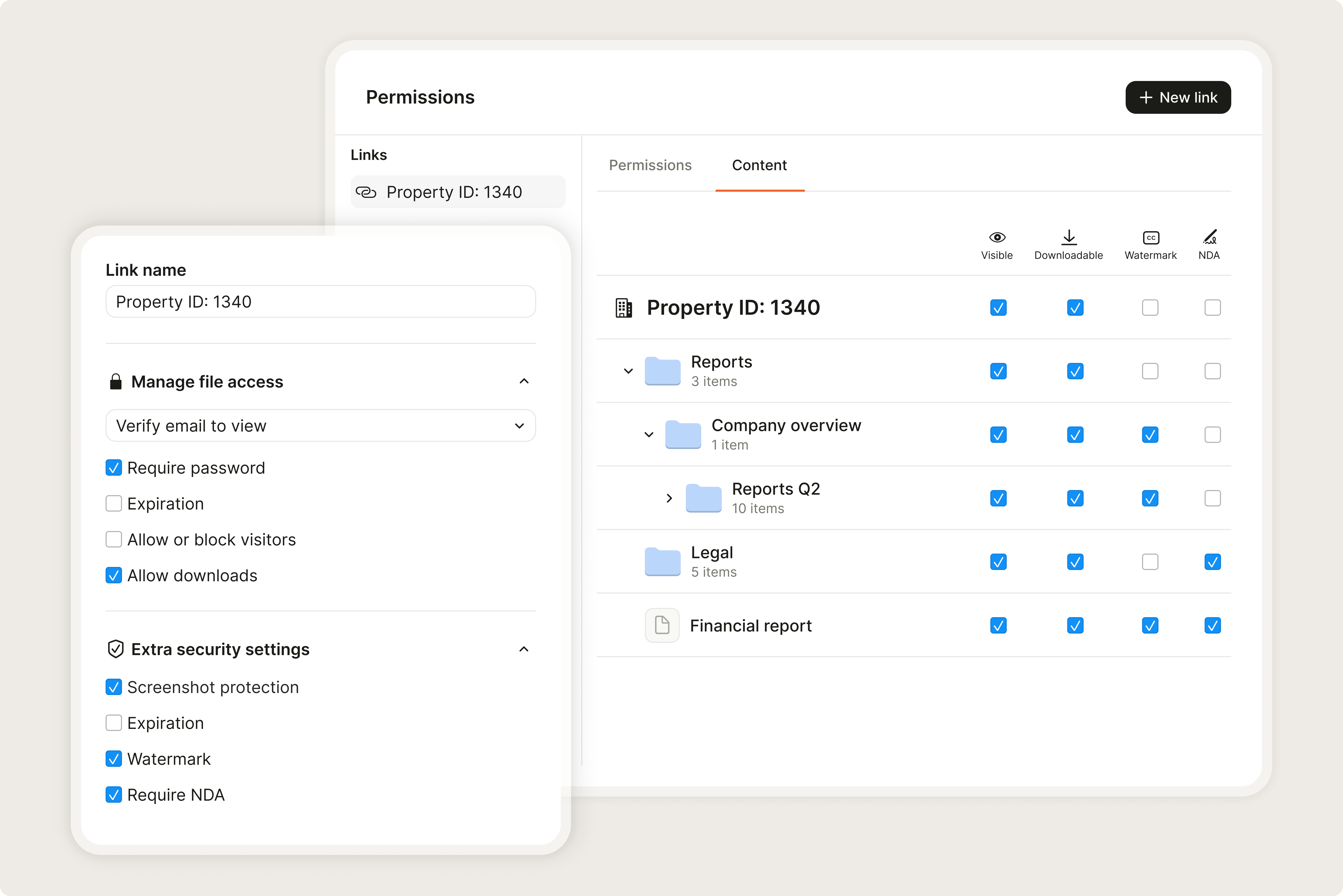
- 2.Give each advisor a scoped, tracked linkMalta Notary sees full title chain and hypothec records. AIP adviser sees permit records and non-EEA status. PA architect sees planning history. SCH heritage consultant sees scheduled monument records. Lender sees EPC, title certificate, and valuation.
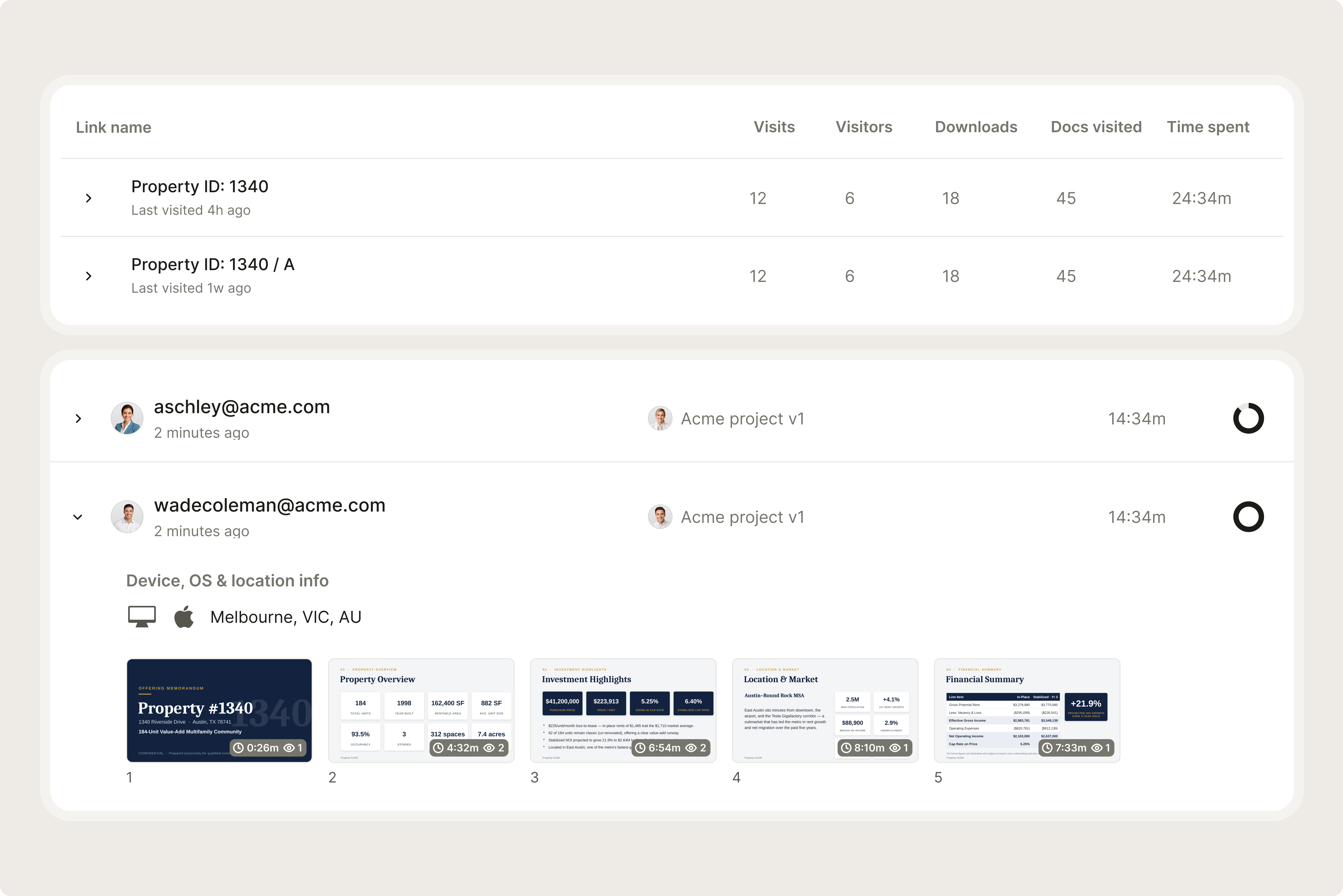
- 3.Monitor who reviews which documentsSee exactly which files each advisor opened and when. Catch emphyteusis term issues or PA enforcement notices before they affect deal pricing or closing.
What makes Malta different
Malta's combined transfer tax burden of 13% - 5% stamp duty paid by the buyer plus 8% Final Withholding Tax paid by the seller - is not a gain-based tax. It applies to the full consideration regardless of how long the seller has held the property, regardless of whether the seller made a profit, and regardless of the commercial use. In a market where commercial yields are 5-7%, a 13% transfer cost means a buyer needs more than 2 years of net yield just to cover the transfer cost before any income return begins. This moves the numbers significantly compared to lower-transfer-cost EU jurisdictions and must be modeled into underwriting from the first look. The 8% FWT is an obligation of the seller, but in practice it affects negotiated pricing because sellers price in the tax cost; buyers and sellers often model the net-of-tax economics together when agreeing the headline price.
Emphyteusis is the most structurally distinctive feature of Maltese commercial title. It is not a quirk or a historical anomaly; it is a fully functioning civil law property institution that applies to a significant portion of Maltese commercial real estate. When a commercial buyer purchases property under emphyteusis, they own the buildings and improvements - they have dominium utile - but the dominus (original grantor, often the Maltese government's Lands Authority or the Church) retains the dominium directum and receives the annual cens (ground rent). The practical implications for commercial property are: (1) the annual cens is a perpetual obligation on the buyer unless redeemed; (2) transfer of emphyteutic property may require notice to or consent from the dominus depending on the grant terms; (3) lenders treat government-redeemable emphyteusis and Church emphyteusis differently; and (4) the remaining term on a fixed-term emphyteusis directly affects commercial value. Engage a Malta notary specifically experienced in emphyteusis practice before any commercial bid on a Malta property.
Malta's Planning Authority permit system is centralized and public, which is an advantage - all permit history is searchable online in the PA PACCD database. The challenge is the density of historic designation: Malta has the highest ratio of UNESCO-listed and heritage-designated area per square kilometer of any EU member state. The Valletta historic area is a UNESCO World Heritage site; so is the Hal Saflieni Hypogeum and the seven megalithic temples. Urban Conservation Areas (UCAs) cover most of the historic fabric of Malta and Gozo. Any commercial renovation in a UCA triggers PA heritage design guidance which can restrict facade materials, window profiles, signage, and external plant; SCH must be consulted for any change to scheduled monuments or their buffer zones. Build UCA compliance costs into the commercial renovation underwriting before bidding on any historic-area Malta commercial.
Under the Immovable Property (Acquisition by Non-Residents) Act (Cap. 246 of the Laws of Malta), a permit (commonly called an AIP permit - Acquisition of Immovable Property) is required from the Minister responsible for Finance for any person who is not a citizen of the EU/EEA, or who is an EU/EEA citizen not residing in Malta for the preceding five years, to acquire immovable property in Malta, unless the property is situated within a Special Designated Area. Companies incorporated outside the EU or EU-incorporated companies whose ultimate beneficial ownership is non-EU may also require an AIP permit regardless of where incorporated. EEA citizens acquiring property for use as their primary and only residence are exempt. AIP applications are processed by the Office of the Commissioner for Revenue on behalf of the Ministry. Failure to obtain a required AIP permit before completing a property acquisition can result in legal invalidity of the title transfer and criminal sanctions under Cap. 246.
Timeline and cost in Malta
Weeks 1-2 cover kickoff: confirm AIP requirement for buyer structure, commission Malta notarial title search (Land Registry + Notarial Archives), emphyteusis status confirmation, Malta PA PACCD permit history search, UCA status confirmation, SCH consultation requirement check, asbestos survey commission (pre-1990 commercial), EPC confirmation, lease abstraction, and AML/KYC on all principals. Legal fees in this phase: EUR 3,000-10,000.
Load all files into Ellty before advisors engage. Standard Malta commercial: 45-90 days. AIP permit (if required): 6-12 months additional. NDEE VCP brownfield: not applicable (use Malta Lands Authority process).
Weeks 2-6 cover deep review: notarial title examination completion (4-12 weeks for unregistered properties), hypothec and privilege search results, PA permit history review, UCA design guidance analysis, emphyteusis terms review, asbestos survey delivery, EPC review, lease abstraction completion, AML/KYC completion, and stamp duty / FWT modeling. Costs in this phase: EUR 5,000-20,000.
Weeks 6-12 handle resolution: AIP application filing and monitoring (if required), PA permit application for planned use (if current permit insufficient), emphyteusis redemption process (Lands Authority, if redeemable), hypothec clearance negotiations, SCH consultation (if heritage-affected), and closing preparation including Konvenju (1% provisional stamp duty) then final deed (4% balance stamp duty).
Malta total buyer acquisition costs: 5% stamp duty (1% at Konvenju + 4% at final deed) + notary fees (approximately 1.5-2.5% of consideration) + legal fees. Total buyer closing overhead: approximately 7-8% of consideration plus VAT on professional fees. Seller pays 8% FWT; combined transaction overhead including seller FWT is approximately 15-16% of consideration in professional and tax costs.
Running a Malta property deal from one room
Hold notarial title, AIP records, Malta PA permits, emphyteusis records, and lease files in one secure, tracked Ellty data room.
Start free 14-day trialCommon questions about due diligence on Malta commercial property
- Standard Malta commercial property deals take 45-90 days. AIP permit processing for non-EEA buyers: 6-12 months (the Konvenju can be signed before AIP but the final deed cannot close without the permit). Malta PA Development Permit for commercial use: 3-6 months standard; 6-18 months for UCA or heritage applications. Notarial Archives title search for unregistered property: 4-12 weeks. Emphyteusis redemption with Lands Authority: 3-12 months.
- The Acquisition of Immovable Property (AIP) permit is required under Cap. 246 of the Laws of Malta for any non-EEA citizen or non-EU company purchasing Maltese property outside a Special Designated Area (SDA). AIP applications are processed by the Office of the Commissioner for Revenue and take 6-12 months. SDAs (Portomaso, Pendergardens, Cottonera Waterfront, Smart City, Fort Cambridge, Tigne Point, Ta' Monita, Mercury Towers) are AIP-exempt for all buyers. EEA citizens buying their primary and only Maltese residence are exempt. All other non-EEA buyers must obtain AIP before the final deed can be completed.
- Emphyteusis (cens in Maltese) is a civil law land tenure system whereby the buyer owns the buildings and improvements (dominium utile) but pays an annual ground rent (cens) to the original grantor (dominus), often the Maltese government's Lands Authority or the Church. Many Malta commercial properties are held under emphyteusis. The annual cens is a perpetual obligation unless redeemed. Government emphyteusis may be redeemable through the Malta Lands Authority; Church emphyteusis terms vary. Fixed-term emphyteusis (e.g. 99 years from the original grant date) significantly affects commercial value and lender appetite as the remaining term shortens. Confirm emphyteusis status from the notarial title abstract before any commercial bid.
- Malta property transfer costs are among the highest in the EU: the buyer pays 5% stamp duty on the full consideration (1% provisional at Konvenju/Promise of Sale + 4% balance at the final deed); the seller pays 8% Final Withholding Tax (FWT) on the full consideration (10% if the property was held less than 3 years). Both are applied to the consideration, not the gain. Combined transfer tax burden: 13% of consideration. Add notary fees (approximately 1.5-2.5%) for total buyer closing overhead of approximately 7-8% and seller FWT of 8-10%. First-time buyer exemptions (0% on first €200,000) apply to residential primary residence only, not commercial property.
- The Malta Planning Authority (PA) requires a Development Permit for any change of commercial use, external alterations to buildings, new construction, and most significant renovation works in Malta. Properties in Urban Conservation Areas (UCAs) - including Valletta, Mdina, Rabat, Sliema historic, Victoria Gozo, and the Three Cities - have additional heritage design requirements. PA standard commercial applications take 3-6 months; UCA/heritage applications take 6-18 months. Third-party objection periods can further extend processing. All Malta commercial buyers should search the PA PACCD online database for the full permit history and confirm the current approved use matches the intended commercial purpose.
- Malta notaries are 'subject persons' under Malta's Prevention of Money Laundering Act and must perform Customer Due Diligence (CDD) on all parties to a property transaction. Malta's Financial Intelligence Analysis Unit (FIAU) supervises notary AML compliance. High-value commercial transactions trigger enhanced due diligence. All parties must be identified, UBOs confirmed at the Malta Business Registry, and OFAC/EU sanctions screens run on all principals. Malta's significant offshore and international investor base means sellers frequently hold through Maltese or other EU holding companies with multiple ownership layers; UBO confirmation may require tracing through multiple entities.