Italy CRE deals have two traps non-Italian buyers consistently walk into: commercial tenants under Law 392/1978 have a 6+6 year minimum term and a right of first refusal on any sale - which means the sitting tenant must be formally notified before you close; and unauthorized building works (abusivismo edilizio) are so common in Italian commercial property that checking for them is non-negotiable, not optional.
Italian property transfers require a notaio (civil law notary). Title only passes on the date the rogito (notarial deed) is signed and the deed is inscribed in the Italian property registry.
Italy has two separate registries that must be searched: the Catasto (cadastral registry at the Agenzia delle Entrate) and the Conservatoria dei Registri Immobiliari (mortgage and encumbrance registry). A title check requires both.
The certificato di agibilità (occupancy and habitability certificate) is legally required for all Italian commercial buildings. Many older buildings lack it. Without it, the building can't legally be used and utilities can be restricted.
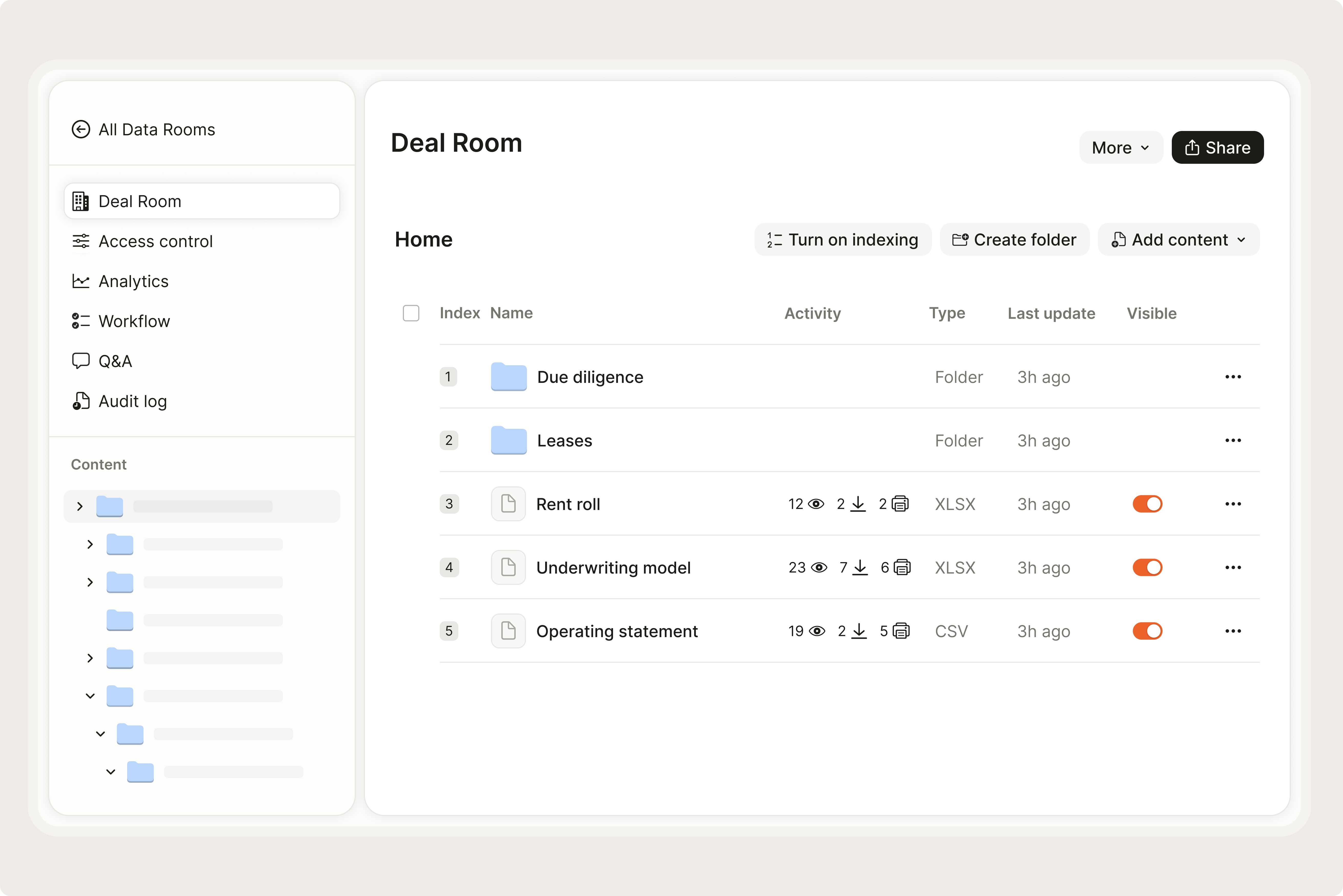
Set up an Ellty data room before diligence opens. Load visura searches, building permits, agibilità certificates, and lease files before advisors arrive.
Where Italian deals actually go wrong
Not every check carries the same weight. The table below sorts risks by deal impact - dealbreakers first, then what moves the price, then basic hygiene - so your notaio, avvocato, and technical advisor know what to clear first.
| Area | Documents to pull | Italy red flag | Matters most for | Tier | |
|---|---|---|---|---|---|
| Title - visura catastale and ipotecaria | Title - visura catastale and ipotecaria | Visura catastale, visura ipotecaria, planimetria catastale, chain of title deeds | Italy requires two separate registry searches: Catasto (cadastral) and Conservatoria (mortgage and encumbrances); both are needed for a clean title check | All buyers | Dealbreaker |
| Abusivismo edilizio | Abusivismo edilizio | Permesso di costruire history, CILA/SCIA filings, condono certificate, municipal building file | Unauthorized construction (abusivismo edilizio) is endemic in Italian CRE; non-condonated works make the sale legally voidable | All buildings - especially South Italy | Dealbreaker |
| Certificato di agibilità | Certificato di agibilità | Certificato di agibilità, fine lavori certificate, building permit chain | The certificato di agibilità is legally required for all Italian commercial buildings; many older buildings lack it and can't legally be used without one | All commercial buildings | Dealbreaker |
| Commercial tenant rights - Law 392/1978 | Commercial tenant rights - Law 392/1978 | All commercial leases, tenant notification of sale, diritto di prelazione exercise period, indennità di avviamento | Italian commercial tenants have a statutory right of first refusal (diritto di prelazione) on any sale; failure to notify is a ground to annul the transaction | All income-producing assets | Dealbreaker |
| Environmental - siti contaminati | Environmental - siti contaminati | Phase I ESA, regional contaminated sites register (anagrafe), SIN (Siti di Interesse Nazionale) check | Italy has 42 National Interest Sites (SIN) including Porto Marghera, Taranto, Brindisi, and Milan industrial areas with severely contaminated soil | Industrial, logistics, port | Dealbreaker |
| Urbanistica and zoning | Urbanistica and zoning | PRG/PGT extract, certificato di destinazione urbanistica, variante permit | Italian zoning (PRG or PGT) is managed at the municipality; confirm the destinazione d'uso (permitted use) for the property | Development, repositioning | Price-adjuster |
| IVA vs imposta di registro | IVA vs imposta di registro | Seller VAT status, IVA election, imposta di registro rate (3% or 9%), cadastral value confirmation | If seller is a VAT-registered company: 22% IVA (recoverable) + 3% registro. If private seller: 9% registro. Tax analysis before contract is essential | All commercial deals | Price-adjuster |
| Seismic risk and building condition | Seismic risk and building condition | Seismic zone classification, NTC 2018 compliance check, structural engineer report, PCA | Large parts of Italy are in seismic zones 1 and 2; central and southern Italy saw significant earthquake events in 2009 and 2016 | All - especially central and southern Italy | Price-adjuster |
| APE - energy performance certificate | APE - energy performance certificate | APE (Attestato di Prestazione Energetica), energy audit, renovation cost estimate | APE is mandatory for all Italian property transactions; missing APE voids the deed; older Italian commercial buildings often need significant energy upgrades | All | Price-adjuster |
| Insurance and valuation | Insurance and valuation | Current policies, loss run, earthquake coverage, flood zone check, RICS/Tecnoborsa appraisal | Italian commercial policies often exclude earthquake damage by default; confirm earthquake coverage in seismic zone 1 and 2 areas | All | Standard check |
| Seller KYC and AML | Seller KYC and AML | CCIAA company extract, visura camerale, UBO identification, notaio AML compliance | Italian notai are subject to AML law and perform independent KYC on both buyer and seller before signing the rogito | All deals | Standard check |
Due diligence on an Italy property?
Set up your Ellty data room before diligence starts.
Start free 14-day trialItaly CRE checklist
The table ranked risks by severity. This is the full list to work through, grouped by area.
Title - visura catastale and ipotecaria
- Pull the visura catastale (cadastral extract) from the Agenzia delle Entrate on day one
- Pull the visura ipotecaria from the Conservatoria dei Registri Immobiliari; this is where mortgages, liens, and encumbrances are registered
- Confirm the dati catastali (cadastral data: foglio, particella, subalterno) matches all sale and deed documents exactly
- Check the planimetria catastale (cadastral floor plan) against the physical property; any discrepancy indicates unauthorized works
- Run the full chain of title through all previous rogito deeds to identify gaps or disputed transfers
- For condominio (strata) assets: pull the regolamento condominiale and last 3 years of condominio meeting minutes
Abusivismo edilizio - unauthorized works
- Pull the full building permit (permesso di costruire) history from the local Comune (municipality)
- Check for any CILA (Comunicazione Inizio Lavori Asseverata) and SCIA (Segnalazione Certificata di Inizio Attività) filings for minor works
- Confirm all works are either permitted or amnestied (condonati) under a condono edilizio (1985, 1994, or 2003 condono laws)
- Non-condonated unauthorized works make the sale legally voidable under Italian law; buyers have 10 years to bring a claim
- For southern Italy commercial properties: unauthorized works are extremely common; assume they exist and investigate proactively
- Obtain a municipio building file (pratica edilizia) for the full permit history going back to original construction
Certificato di agibilità
- Confirm the certificato di agibilità is current and on file from the Comune
- Pull the certificato di fine lavori (works completion certificate) from the original builder or current owner
- If the agibilità is missing: assess the cost and timeline to obtain from the Comune; some older buildings cannot practically regularize
- A building without agibilità cannot legally be occupied or used for commercial purposes in Italy
- For buildings with partial agibilità: confirm which areas are covered; older Italian buildings sometimes have agibilità covering only parts
Commercial tenant rights - Law 392/1978
- Identify all commercial tenants subject to Italian Law 392/1978 (Legge Equo Canone)
- Confirm the tenants have been formally notified of the pending sale per Law 392/1978 notification requirements
- Italian commercial tenants have a 60-day diritto di prelazione (right of first refusal) from the date of formal notification
- If the tenant exercises prelazione, they can acquire the property at the same price and conditions as the buyer
- On lease expiry: tenants who vacate due to landlord non-renewal are entitled to indennità di avviamento (goodwill compensation; typically 18 months rent for commercial)
- Confirm lease terms, renewal rights, and any waivers of statutory protection in writing
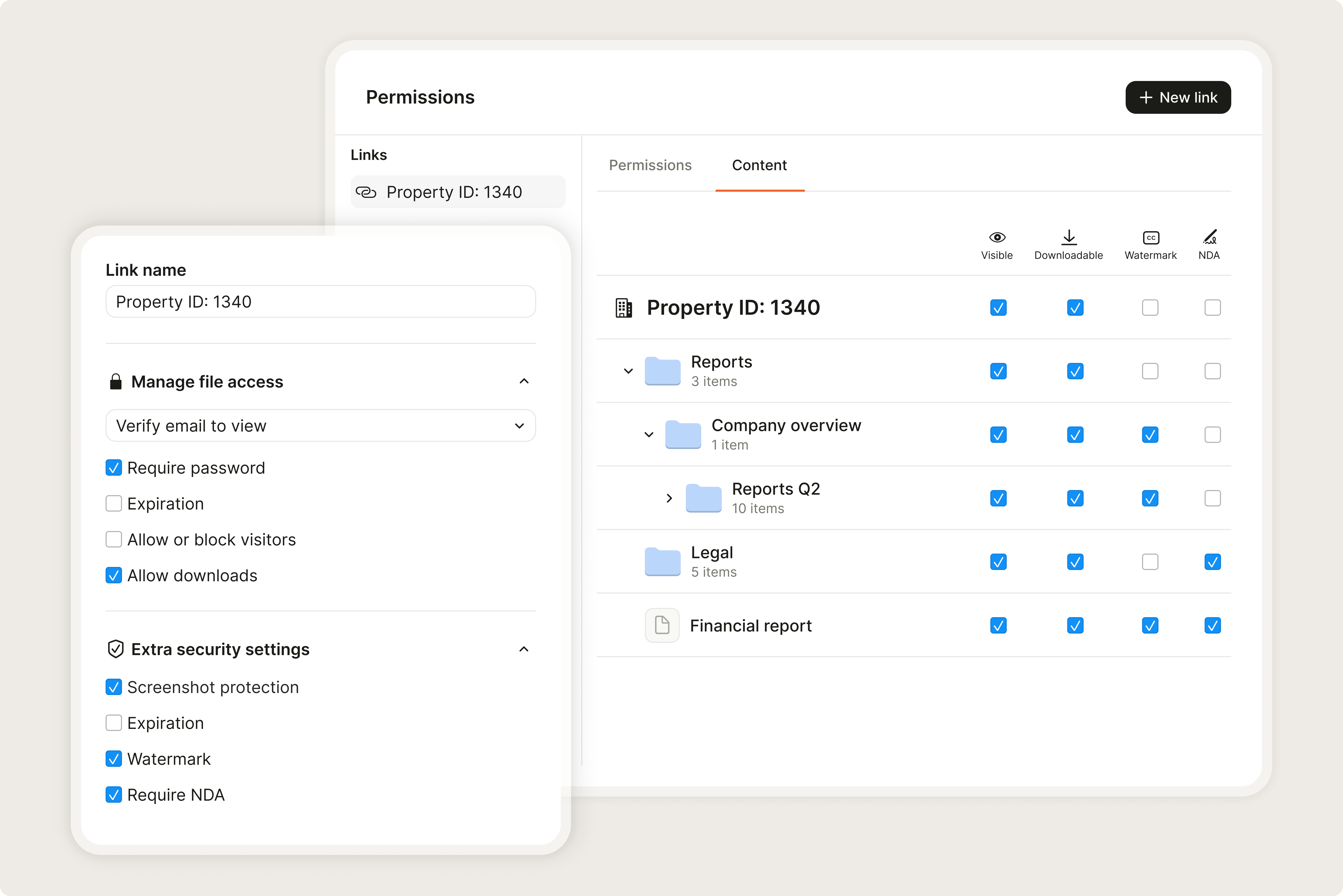
Give each advisor a scoped link in Ellty. The notaio sees title documents. The environmental consultant sees contamination reports. Lease lawyers see the lease pack including tenant notification records. No advisor accesses files they don't need.
Environmental - siti contaminati
- Commission a Phase I ESA per Italian environmental law (D.Lgs. 152/2006)
- Check the national SIN register (Siti di Interesse Nazionale); 42 SIN sites exist across Italy
- Search the regional contaminated sites register (anagrafe dei siti contaminati) at the regional environmental authority
- For Lombardy (Milan hinterland), Porto Marghera (Venice), Taranto, Brindisi, and Gela: order Phase II immediately
- Budget Phase II (analisi di caratterizzazione) at EUR 20,000-80,000 for former industrial or petrochemical sites
- Contaminated site remediation in Italy is subject to Ministero dell'Ambiente procedure; timelines are long
Urbanistica and zoning
- Pull the certificato di destinazione urbanistica from the Comune; this confirms the permitted use (destinazione d'uso)
- Confirm the property is classified as commerciale or direzionale (commercial or directional/office) in the PRG or PGT
- Check for any piano particolareggiato (area plan) or variante (plan amendment) pending at the Comune
- For development sites: confirm the edificabilità (building right) in the current piano regolatore
IVA vs imposta di registro
- Confirm the seller's VAT (IVA) status; if the seller is a VAT-registered company (soggetto passivo IVA), the sale is subject to IVA
- For IVA-subject sales: the buyer pays 22% IVA (recoverable) + 3% imposta di registro on cadastral value (non-recoverable)
- For private seller or IVA-exempt sales: the buyer pays 9% imposta di registro on the higher of agreed price or cadastral value
- Add imposta ipotecaria (2% on cadastral if private; EUR 200 fixed if IVA) and imposta catastale (1% on cadastral if private; EUR 200 fixed if IVA)
- Confirm the valore catastale (cadastral value) used for tax calculations; in Italy this is often 30-60% of market value
Seismic risk and building condition
- Check the seismic zone classification (Zone 1 to 4) for the property location via the official Italian seismic hazard map
- For zones 1 and 2 (Calabria, Campania, Lazio, Umbria, Marche, Emilia-Romagna, parts of Sicilia): commission a seismic structural assessment
- Confirm the building meets NTC 2018 (Norme Tecniche per le Costruzioni) seismic standards
- For pre-1980 construction: seismic vulnerability is high; older Italian commercial buildings were not built to modern seismic standards
- Budget seismic retrofit costs (EUR 200-600/m2) if the structural assessment identifies significant deficiencies
APE - energy performance certificate
- Confirm the APE (Attestato di Prestazione Energetica) is current and attached to all sale documents
- Missing APE voids the notarial deed; Italian law requires APE to be physically delivered to the buyer at signing
- Check the energy class (A4 to G); Italian commercial buildings are often class E, F, or G
- Commission a detailed energy audit if the APE class indicates significant energy upgrading will be needed
Insurance and valuation
- Pull current insurance policies and 3-year loss run from the seller
- Confirm earthquake coverage explicitly; Italian commercial insurers often exclude seismic damage by default
- Check flood risk via PAI (Piano per l'Assetto Idrogeologico) regional maps; Po Valley and coastal Adriatic areas carry significant flood risk
- Order an independent appraisal from a certified Italian valuer (perito estimatore) for lender requirements
Seller KYC and AML
- Pull a visura camerale (CCIAA chamber of commerce extract) confirming the selling entity is in good standing
- Confirm all UBOs; Italian AML Decree 231 requires notai and avvocati to verify beneficial ownership before the rogito
- Italian notai independently perform AML client due diligence before signing; they can refuse to proceed if AML concerns arise
- Run a PEP and sanctions check against the seller and all identified UBOs before committing to the deal
How due diligence in Italy works
Step 1 - Visura searches and abusivismo check
Pull the visura catastale and visura ipotecaria simultaneously with the request for the municipal building file (pratica edilizia). All three are essential on day one.
Compare the planimetria catastale (cadastral floor plan) against the physical building immediately. Any difference - a partition wall, a mezzanine, an extension - is either a permitted work or unauthorized. Unauthorized works that haven't been amnestied (condonati) make the sale legally voidable.
Step 2 - Agibilità and building permits
Confirm the certificato di agibilità before any price negotiation. If it's missing, get a Comune pre-check and cost estimate before you bid. Obtaining a new agibilità on an older Italian commercial building can take 12-24 months and cost EUR 20,000-100,000 depending on the scope of regularization required.
Confirm all works are either permitted (permesso di costruire) or covered by a condono. CILA and SCIA filings for minor works must also be on file and properly documented.
Step 3 - Commercial tenant notification
Notify all commercial tenants subject to Law 392/1978 as soon as a price is agreed. The notification triggers the 60-day prelazione period. Until that period expires (or the tenant formally waives prelazione), the transaction cannot safely close.
Some institutional investors include the tenant waiver of prelazione as a condition precedent in the contratto preliminare. That's the right approach - don't wait until the notarial deed appointment to discover the tenant plans to exercise first refusal.
Step 4 - Environmental review
Commission the Phase I ESA and check the SIN register in parallel. Italy has 42 National Interest Sites with the highest contamination levels; a site adjacent to or within a SIN zone requires mandatory remediation if contamination is confirmed.
Load all Phase I ESA findings, SIN and regional contaminated site searches, and ISPRA register extracts into Ellty. Lenders, environmental advisors, and the buyer's avvocato each get tracked, watermarked access.
Step 5 - Rogito and registration
Italian closings occur at the notaio's office. The rogito (notarial deed of sale) must include the APE energy certificate, the agibilità confirmation, and the full chain of title. The notaio independently verifies all registry records before the deed is signed.
Tax payment occurs on the rogito date. The notaio calculates and collects imposta di registro, imposta ipotecaria, and imposta catastale (or confirms IVA is invoiced separately), and remits to the Agenzia delle Entrate.
How to set up your Italy data room in Ellty.
Italian CRE deals involve the Catasto, Conservatoria, notaio, and municipal Comune across multiple weeks. Load files into Ellty before diligence opens. Each advisor gets a scoped, tracked link from day one.
- 1.Upload Italian property files to a secure roomDrop visura catastale, visura ipotecaria, building permits, agibilità, APE certificate, leases, and Phase I ESA into Ellty.
- 2.Give each advisor a scoped, tracked linkYour notaio sees title and deed chain docs. Environmental consultants see contamination reports. Lease lawyers see leases and tenant notification records. Ellty enforces the scope.
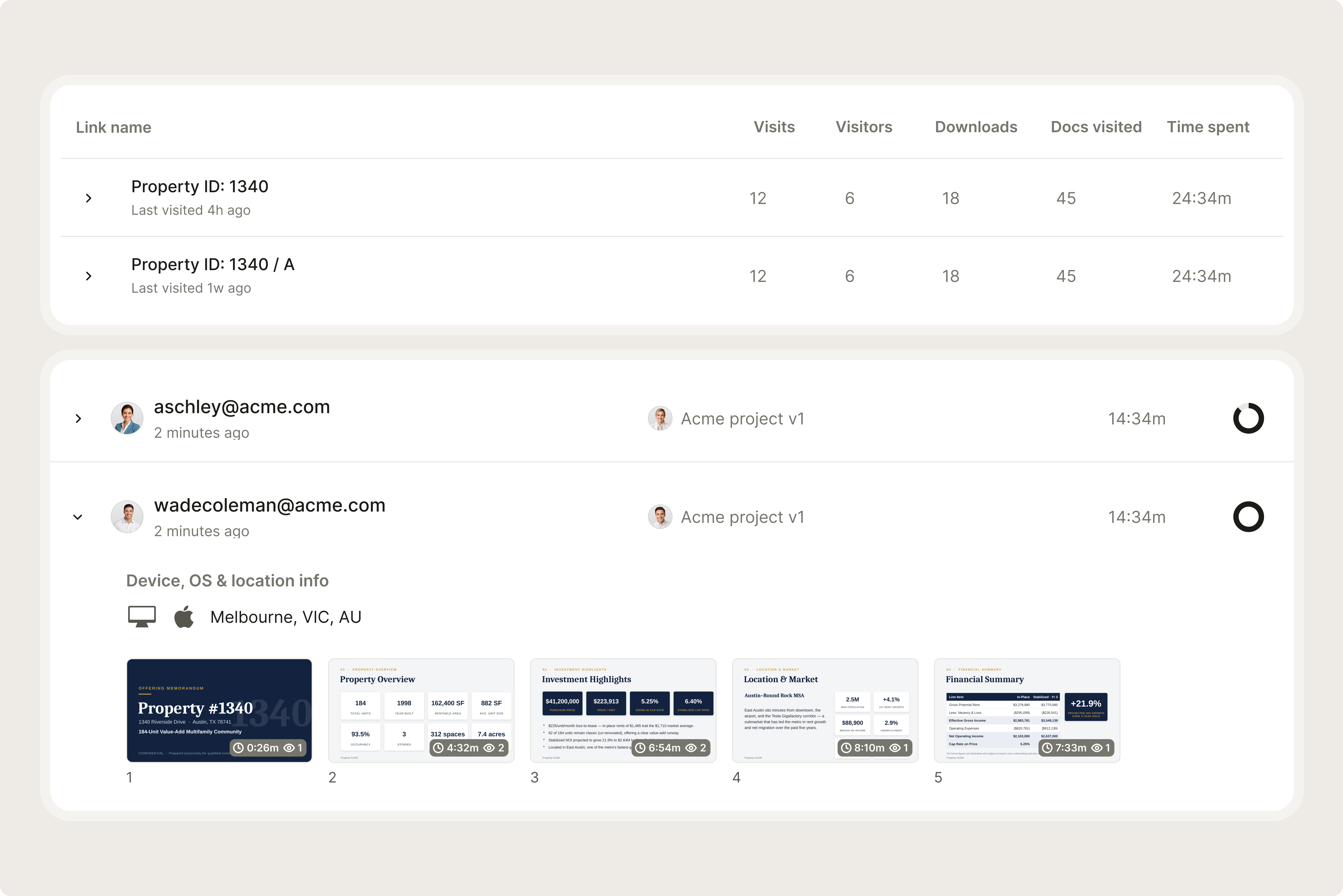
- 3.Monitor who reviews which documentsSee exactly which files each advisor opened and when. Catch delays before they affect the prelazione period or the rogito date.
What makes Italy different
Abusivismo edilizio is not a peripheral risk in Italian CRE - it's a default assumption in older buildings and in southern regions. Unauthorized works that weren't amnestied under one of Italy's condono laws make the sale legally voidable for 10 years. Physical inspection and a full comparison of the cadastral planimetria against the actual building are non-negotiable.
The diritto di prelazione (tenant right of first refusal under Law 392/1978) is a transaction risk, not just a formality. If the seller fails to formally notify the tenant before closing, the tenant can apply to a court to be substituted as the buyer at the same price - years after the transaction closed. The notification and 60-day waiting period must happen before the rogito.
Italy's two-registry system confuses non-Italian buyers. The Catasto shows ownership and cadastral data. The Conservatoria shows mortgages, liens, and encumbrances. Neither alone gives a complete picture. Both must be searched and reconciled before the preliminary contract.
Seismic risk is underestimated in Italian commercial real estate outside the immediate post-earthquake period. Italy's seismic zones 1 and 2 cover large portions of the country. Older Italian commercial buildings were not built to modern NTC 2018 standards; the cost to retrofit can be substantial.
Under Article 38 of Italian Law No. 392 of 1978, when the owner of a commercial property intends to sell, they must notify the commercial tenant in writing of the intended sale price and conditions. The tenant has 60 days to exercise their right of pre-emption (diritto di prelazione) at the same price. If the owner proceeds to sell without providing this notification, or sells at a different price than that communicated to the tenant, the tenant may apply to a court to be substituted as the buyer within 6 months of the date of the deed of sale.
Timeline and cost in Italy
Weeks 1-2 cover kickoff: visura catastale, visura ipotecaria, pratica edilizia from the Comune, agibilità certificate check, IVA/registro tax structure analysis, and Phase I ESA engagement. Budget EUR 4,000-12,000 for this phase.
Load all files into Ellty before advisors arrive. Scoped, tracked links for each party remove at least one week of document request emails from a standard Italian CRE diligence process.
Weeks 2-4 cover deep review: Phase I ESA, SIN register check, abusivismo edilizio detailed audit, tenant prelazione notification and waiting period, seismic zone assessment, APE certificate confirmation, and lease abstraction. Cost runs EUR 8,000-25,000 depending on complexity.
The 60-day tenant prelazione notification period is often the critical path item for income-producing commercial assets. Don't underestimate it - formal written notification must be sent before the preliminary contract, or the closing timeline extends by 60+ days.
Weeks 4-8 handle resolution: Phase II if triggered, abusivismo regularization if needed, prelazione period expiry, IVA invoicing if applicable, notarial deed preparation and rogito signing. Italian Conservatoria registration completes within 20-30 working days of deed filing.
Italy total acquisition cost: 3% or 9% imposta di registro on cadastral value + imposta ipotecaria + imposta catastale + notaio fee (0.5-1.5%) + legal fees EUR 15,000-50,000. Since Italian cadastral value is typically 30-60% of market value, the headline percentage understates the effective rate less than it appears.
Running an Italy property deal from one room
Hold visura docs, building permits, and lease files in one secure, tracked Ellty data room.
Start free 14-day trialCommon questions about due diligence on Italy property
- Most Italy CRE deals complete in 4-8 weeks. The tenant prelazione notification period (60 days) and Phase I ESA are often the critical path items. Abusivismo edilizio investigations add time for older southern Italy commercial buildings.
- Abusivismo edilizio is unauthorized building construction in Italy. It covers any construction, extension, or alteration done without a building permit (permesso di costruire). Works that haven't been amnestied under an Italian condono edilizio law make the property sale legally voidable for 10 years. Physical inspection and full permit history review are essential for all Italian commercial buildings.
- The diritto di prelazione (right of pre-emption) under Law 392/1978 gives commercial tenants the right to buy the property at the same price as any third-party buyer. The seller must formally notify the tenant in writing before closing. The tenant has 60 days to exercise this right. Failure to notify allows the tenant to go to court to substitute as the buyer within 6 months of the deed.
- Imposta di registro is 9% of the higher of agreed price or cadastral value when the seller is a private individual. When the seller is a VAT-registered company, it's 3% imposta di registro (on cadastral value) plus 22% IVA - the IVA is recoverable by a VAT-registered buyer. Italian cadastral values are typically 30-60% of market value, so the effective tax is lower than the headline rate suggests.
- The certificato di agibilità (formerly certificato di abitabilità) is the Italian occupancy and habitability certificate confirming a building meets legal standards for use. It's required for all Italian commercial buildings. Many older buildings lack it. Without it, the building cannot legally be used for commercial purposes and utilities can be restricted.
- If the seller is a VAT-registered company (soggetto passivo IVA), the sale is subject to 22% IVA (which a VAT-registered buyer can recover) plus a reduced 3% imposta di registro on cadastral value (non-recoverable). If the seller is a private individual or the IVA exemption is not waived, the buyer pays 9% imposta di registro on the higher of agreed price or cadastral value with no VAT.