Malaysia commercial property due diligence runs on a Torrens title system under the National Land Code 1965, which is reliable but has Malaysia-specific traps: Malay Reserve Land restrictions that prevent non-Malay buyers from purchasing, EPU approval requirements for foreign acquisitions above MYR 20 million, title conditions specifying permitted use, and leasehold titles with renewal and restriction considerations.
Malaysia property transfer costs: Stamp Duty on Memorandum of Transfer (MOT) at progressive rates - 1% on first MYR 100,000, 2% on the next MYR 400,000, 3% on MYR 500,001 to MYR 1 million, 4% above MYR 1 million; effective stamp duty on a MYR 10 million commercial deal: approximately 3.5-4% of consideration; Stamp Duty on Loan Agreement: 0.5% of facility amount; Real Property Gains Tax (RPGT) applies to the seller on any gain from disposal: foreign sellers pay 30% on gains from properties sold within 5 years and 15% after 5 years; Malaysian company sellers pay 30% within 3 years, scaling down to 10% after 5 years; RPGT is withheld by the buyer from the purchase price and remitted to the Inland Revenue Board (LHDN).
Malaysia's Torrens system guarantees registered title through the land registry maintained by state Pejabat Tanah dan Galian (PTG - Land and Mines Offices); each state has its own PTG; title documents (geran) identify the property by lot number and mukim (sub-district); the geran shows: registered owner, land area, land use category, express conditions (Syarat Nyata), restriction in interest (Sekatan Kepentingan), encumbrances (caveats/kaveat, charges/gadaian), and whether the land is freehold (Hak Milik Kekal) or leasehold (Hak Milik Pajakan) with remaining term.
Set up a data room before advisors engage. Load the geran, search results from PTG, building certificate (CCC or CFO), express conditions documentation, EPU approval (if applicable), and lease files.
Where Malaysia property deals go wrong
Not every check carries the same weight. The table below sorts them by deal impact - dealbreakers first, then what moves the price, then basic hygiene - so your Malaysian solicitor and advisor know what to clear first.
| Area | Documents to pull | Malaysia red flag | Matters most for | Tier | |
|---|---|---|---|---|---|
| Land title (geran) and PTG search | Land title (geran) and PTG search | Land title document (geran or pajakan/leasehold title), PTG official search results (carian rasmi) from state Land and Mines Office, Land Search (Carian Persendirian or Carian Rasmi) showing all encumbrances and conditions | Request a Carian Rasmi (official search) from the state PTG for the lot number and mukim; the official search shows: registered owner (pemilik berdaftar), land category (kategori tanah: bangunan, pertanian, perindustrian), express conditions (syarat nyata or syarat nyata yang ditetapkan), restriction in interest (sekatan kepentingan), all registered interests including charges (gadaian) and caveats (kaveat); confirm the registered owner matches the seller precisely; confirm the land category (bangunan/building or perindustrian/industrial) matches the intended commercial use - land with agricultural category (pertanian) cannot be used commercially without conversion; confirm freehold vs. leasehold; for leasehold: note the remaining term (tempoh pajakan) and confirm whether state consent is needed for the transfer; a private caveat (kaveat persendirian) registered by a third party creates a 6-year block against dealing in the land and must be resolved before any transfer can occur | All buyers - foundational check | Dealbreaker |
| Malay Reserve Land (Tanah Rizab Melayu) | Malay Reserve Land (Tanah Rizab Melayu) | Geran (Restriction in Interest section / Sekatan Kepentingan), state gazette notifications for Malay Reserve status, Malaysian solicitor Malay Reserve land status confirmation | Malay Reserve Land (Tanah Rizab Melayu) is gazetted under state Malay Reservation Enactments; only Malays (as defined under each state's legislation) and certain Bumiputera-owned companies can own, buy, or hold Malay Reserve Land; a non-Malay Malaysian or any foreign buyer cannot purchase Malay Reserve Land; the restriction appears in the Sekatan Kepentingan (restriction in interest) section of the geran or in the PTG official search; some Malay Reserve designations do not appear prominently in the title document and require a specific state gazette check; confirm Malay Reserve status of any commercial property in Malaysia through the official PTG search and solicitor confirmation before any offer is made; a failed acquisition attempt due to undiscovered Malay Reserve status wastes significant due diligence cost | Non-Malay Malaysian and all foreign buyers | Dealbreaker |
| EPU approval for foreign buyers | EPU approval for foreign buyers | Economic Planning Unit (EPU) approval application documentation, MIDA (Malaysian Investment Development Authority) confirmation for relevant industrial acquisitions, Malaysian legal counsel EPU compliance opinion | Malaysia's Economic Planning Unit (EPU) under the Prime Minister's Department requires approval for foreign acquisitions of commercial property above MYR 20 million; the EPU approval requirement also applies to acquisitions of commercial land and property in specific regulated sectors; EPU approval is also required for mergers and acquisitions that result in dilution of Bumiputera interest in property-holding companies above certain thresholds; EPU processing time is typically 1-4 months for straightforward commercial acquisitions; the application requires submission of detailed information about the buyer (foreign company details, ownership structure, UBO), the property, the purpose of acquisition, and employment and economic benefit projections; EPU approval conditions can include requirements on Bumiputera employee targets or local content; for foreign institutional investors in Malaysian commercial: build EPU timeline into the deal schedule from day one; a conditional SPA subject to EPU approval is the standard approach | All foreign buyers of Malaysian commercial above MYR 20M | Dealbreaker |
| Title conditions and permitted use | Title conditions and permitted use | Geran (express conditions section / Syarat Nyata), state land rules on permitted use, land use conversion application history | Malaysian land titles under the NLC have express conditions (Syarat Nyata) specifying the permitted category of use: Bangunan (building/commercial), Pertanian (agricultural), Perindustrian (industrial); also specific conditions may restrict the type of building, FAR, building height, or building use; failure to comply with express conditions is a breach of the NLC and the state can forfeit the title in extreme cases; confirm the express conditions in the geran match the current and intended commercial use; for any change of use or intensification that doesn't comply with current express conditions: a land use conversion (Tukar Syarat) must be applied for from the state PTG; Tukar Syarat applications take months to years and their outcome is not guaranteed; any commercial acquisition involving a change of use or title category conversion must budget for this approval risk | All Malaysia commercial; development sites; agricultural-to-commercial conversion | Dealbreaker |
| Leasehold title and renewal | Leasehold title and renewal | Geran Pajakan (leasehold title document), remaining lease term, state land rules on leasehold renewal, premium for leasehold renewal | A significant portion of Malaysian commercial property is held on leasehold title (typically 99-year or 60-year from state government); the geran (Geran Pajakan) shows the original lease term and expiry date; for leasehold commercial: calculate the remaining term and confirm it is adequate for the intended investment period plus any loan term (lenders typically require the remaining leasehold term to exceed the loan term plus a buffer of 20-30 years); leasehold renewal in Malaysia requires an application to the state authority and payment of a land premium (premium tanah); renewal is not automatic and the premium amount is at the state's discretion; state consent for leasehold transfer is often required under the lease terms; for leasehold commercial with less than 50 years remaining: financing may be difficult or require specific lender approval; for foreign buyers: confirm whether state consent is required for the specific leasehold transfer | All leasehold Malaysian commercial; especially logistics and industrial on leasehold | Price-adjuster |
| Building certificate (CCC or CFO) | Building certificate (CCC or CFO) | Certificate of Completion and Compliance (CCC, post-2007) or Certificate of Fitness for Occupation (CFO, pre-2007), building plan approvals from local authority (PBT) | Malaysia replaced the Certificate of Fitness for Occupation (CFO) with the Certificate of Completion and Compliance (CCC) in 2007 under amendments to the Street, Drainage and Building Act 1974; the CCC is self-certified by the Principal Submitting Person (PSP, typically the project architect) rather than issued by the local authority - this is a key difference from the CFO system; for buildings completed before 2007: request the CFO issued by the local authority; for buildings completed after 2007: request the CCC signed by the PSP; also request building plan approvals from the local authority (Pihak Berkuasa Tempatan, PBT - e.g., Dewan Bandaraya Kuala Lumpur (DBKL) for KL, Majlis Bandaraya Petaling Jaya (MBPJ) for PJ); for strata commercial: confirm the Strata Title has been issued by PTG - some Malaysian stratified commercial buildings have been occupied for years without the strata title being formally issued to individual unit owners | All Malaysia commercial buildings | Price-adjuster |
| Charges and caveats | Charges and caveats | PTG official search (Carian Rasmi) showing all charges (gadaian) and caveats (kaveat), charge holder discharge confirmation | Under the NLC, charges (gadaian, the Malaysian equivalent of mortgages) are registered in the land title; all registered charges must be discharged before a clean transfer can occur; also check for registered caveats: a private caveat (kaveat persendirian) registered by a third party (e.g., a prior buyer, a creditor, a party claiming an interest) creates a statutory bar against any dealing in the land for 6 years from registration; a private caveat cannot be removed by the landowner without the caveator's consent or a court order; the existence of a private caveat is a serious complication; confirm from the PTG official search that no caveats are registered; also check for trust caveats (kaveat amanah) and official caveats (kaveat pendaftar) which may be less common but also affect dealing ability | All buyers | Price-adjuster |
| Quit rent and assessment tax | Quit rent and assessment tax | Quit rent certificate (cukai tanah, from state PTG), local authority assessment tax certificate (cukai taksiran, from PBT), utility clearance letters | Malaysian land is subject to two annual land-related taxes: quit rent (cukai tanah) paid to the state PTG, and assessment tax (cukai taksiran) paid to the local authority (PBT); both must be fully paid and up to date before the PTG will process a transfer; a presentation of the MOT (Memorandum of Transfer) to PTG for registration requires production of quit rent and assessment certificates showing no arrears; request quit rent and assessment tax payment receipts or clearance certificates from the seller as part of pre-closing due diligence; arrears of quit rent create a legal encumbrance on the title that blocks registration | All Malaysia commercial | Standard check |
| RPGT and tax compliance | RPGT and tax compliance | Malaysian tax counsel RPGT calculation and withholding confirmation, Inland Revenue Board (LHDN) clearance for seller | Real Property Gains Tax (RPGT) applies to the seller on gains from Malaysian property disposal; the buyer is required to withhold the RPGT amount from the purchase price and remit it to LHDN within 60 days of the disposal date; the withholding rate depends on the seller's category and holding period: for foreign companies or individuals selling within 5 years: 30% withholding on gross disposal price (not just the gain); the seller can subsequently claim refund from LHDN if the actual RPGT is lower; for Malaysian companies: 10% withholding rate applies; the buyer's legal obligation to withhold and remit RPGT makes the RPGT calculation and remittance mechanics a closing condition in Malaysian commercial SPA; confirm RPGT position with Malaysian tax counsel before signing | All buyers; foreign sellers especially important (30% withholding) | Standard check |
| Seller KYC and AML | Seller KYC and AML | Companies Commission of Malaysia (SSM, Suruhanjaya Syarikat Malaysia) company search, UBO confirmation, OFAC/UN sanctions screens | Malaysia's AML framework (Anti-Money Laundering, Anti-Terrorism Financing and Proceeds of Unlawful Activities Act 2001, AMLATFPUAA) designates real estate lawyers as reporting institutions; confirm seller entity at SSM (Companies Commission of Malaysia, ssm.com.my); identify UBOs; run OFAC, UN, and EU sanctions screens; for foreign sellers: confirm the seller's home country AML status; for Bumiputera ownership requirement verification: confirm whether the property or the holding company has Bumiputera ownership conditions that affect transferability | All deals; corporate sellers | Standard check |
Due diligence on a Malaysia property?
Set up your Ellty data room before diligence starts.
Start free 14-day trialMalaysia commercial property due diligence checklist
The table ranked risks by severity. This is the full checklist to work through, grouped by area.
Land title search and Malay Reserve check
- Day one: confirm the property's lot number and mukim with Malaysian solicitor; request a Carian Rasmi (official PTG search) from the state Land and Mines Office (PTG) for the specific lot number; this is the primary title search in Malaysia; online searches available in some states but a certified official search from PTG is the diligence standard
- Confirm from the Carian Rasmi: registered owner, land category (bangunan/building, pertanian/agricultural, perindustrian/industrial), remaining leasehold term (if leasehold), all registered charges (gadaian), all registered caveats (kaveat), express conditions (syarat nyata), and restriction in interest (sekatan kepentingan)
- Malay Reserve Land check: review the Sekatan Kepentingan section of the geran and PTG search result for any Malay Reserve designation; if any Malay Reserve notation appears: non-Malay and foreign buyers cannot proceed; this check must be done before any deposit or binding offer
- For leasehold: calculate remaining term from the geran Pajakan; confirm state consent requirement for leasehold transfer; assess remaining term adequacy for investment period and financing tenor
Give each advisor a scoped link in Ellty. Malaysian solicitor sees geran, Carian Rasmi, CCC/CFO, and express conditions. Building inspector sees CCC and building plan approvals. Tax counsel sees RPGT calculation and LHDN clearance. Lender sees title, CCC, valuation, and lease pack. Each party sees only their files.
EPU approval process for foreign buyers
- Determine whether EPU approval is required: confirm buyer nationality/domicile; if a foreign company or individual: confirm whether the acquisition value exceeds MYR 20 million (which triggers EPU requirement); also check whether the specific commercial property or industry sector has additional EPU requirements regardless of value threshold
- Apply to EPU under the Prime Minister's Department of Malaysia with a complete application including: buyer entity details and ownership structure, acquisition purpose, economic benefit projections, employment plan, property details, and any supporting documents for Bumiputera interest considerations; EPU applications require significant preparation time
- EPU timeline: typically 1-4 months from complete application; incomplete applications are returned and restart the clock; build EPU approval as a condition precedent in the Sale and Purchase Agreement (SPA) with a realistic timeline; the vendor must be willing to grant an adequate SPA conditional period; 6 months from SPA signing is typically the minimum buffer for EPU approval
- Post-EPU approval: EPU conditions attached to the approval (if any) must be reviewed by Malaysian legal counsel; conditions can include minimum equity requirements, employee targets, or use restrictions; confirm compliance plan before closing
Load all files into Ellty before advisors engage. Malaysian solicitor sees geran, Carian Rasmi, EPU approval application, and EPU conditional letter. Tax counsel sees RPGT withholding calculation. Lender sees title document and EPU approval. Monitor who reviews EPU approval conditions - these often require separate compliance planning.
Building certificate and strata title
- Request CCC (for post-2007 buildings) or CFO (for pre-2007 buildings) from seller; for post-2007 buildings: the CCC must be signed by the licensed PSP (architect) who certified completion; request the original CCC and verify the PSP is licensed; for pre-2007 buildings: request the CFO issued by the local authority (PBT)
- Request building plan approvals from the local authority (PBT) for the relevant municipality; confirm approved plan matches the as-built building; compare building plans with the current physical layout for any unauthorized alterations or additions
- For strata commercial (individual commercial units in a stratified development such as an office building or shopping centre where individual units are sold): confirm the Strata Title has been issued; request the individual strata title (Geran Strata) from the seller; some Malaysian commercial buildings have been occupied for years without strata titles being issued; if strata title is not yet issued: confirm the developer's or management corporation's timetable for strata title application; without strata title, the unit cannot be individually registered, mortgaged as strata, or freely transferred in the strata system
- Confirm there are no outstanding notices from the local authority or fire department requiring rectification works on the building
Compare Singapore's commercial property due diligence process for Southeast Asian portfolio strategy. Malaysia and Singapore are geographically adjacent markets with historical links but diverge significantly on property investment structure: Singapore (no foreign ownership restrictions for commercial, efficient SLA title system, high transaction volumes, strict strata management) vs. Malaysia (EPU approval for foreign buyers above MYR 20M, Malay Reserve Land restrictions, state-level title system variation, Johor-Singapore corridor activity); Johor Bahru commercial benefits from Singapore proximity and has attracted significant Singapore-linked real estate development particularly in the Iskandar Malaysia economic zone.
How due diligence works in Malaysia
Step 1 - Title search and buyer eligibility
Day one: PTG official Carian Rasmi for the lot. Confirm Malay Reserve Land status. If non-Malay or foreign buyer: confirm EPU requirement. Start EPU application preparation immediately for foreign buyers above MYR 20M.
Check leasehold remaining term. Check all registered charges and caveats.
Step 2 - Building certificate and conditions
Request CCC or CFO from seller. Verify with local authority (PBT). Check for violation notices. Confirm express conditions match intended commercial use. For strata: confirm Strata Title issuance status.
Request quit rent (cukai tanah) and assessment tax (cukai taksiran) clearance certificates.
Step 3 - RPGT, leases, and AML
Calculate RPGT with Malaysian tax counsel and confirm buyer's withholding obligation. Abstract all commercial leases. Check leasehold transfer consent requirement. Confirm seller at SSM. Identify UBOs. Run OFAC and sanctions screens.
Step 4 - Memorandum of Transfer and PTG registration
Malaysian commercial property transfer: executed through a Memorandum of Transfer (MOT, Form 14A under NLC) signed by both parties and presented to the state PTG for registration; Stamp Duty on MOT is assessed by the Inland Revenue Board (LHDN/IRBM) before PTG registration; PTG requires production of: current year quit rent certificate (cukai tanah), assessment tax clearance (cukai taksiran), and RPGT clearance from LHDN; upon registration by PTG, the buyer's name is entered as registered owner on the geran and title passes.
Load closing documents into Ellty before the presentation to PTG. Malaysian solicitor sees signed MOT, stamp duty payment receipt, quit rent certificate, assessment tax clearance, RPGT clearance, and any EPU approval conditional letter. Lender sees post-closing geran extract with buyer registered as owner.
How to set up your Malaysia data room in Ellty.
Malaysia commercial deals involve land title (geran), PTG Carian Rasmi, CCC or CFO, building plan approvals, express conditions documentation, EPU approval (for foreign buyers), quit rent certificate, assessment tax clearance, RPGT calculation, and all commercial leases.
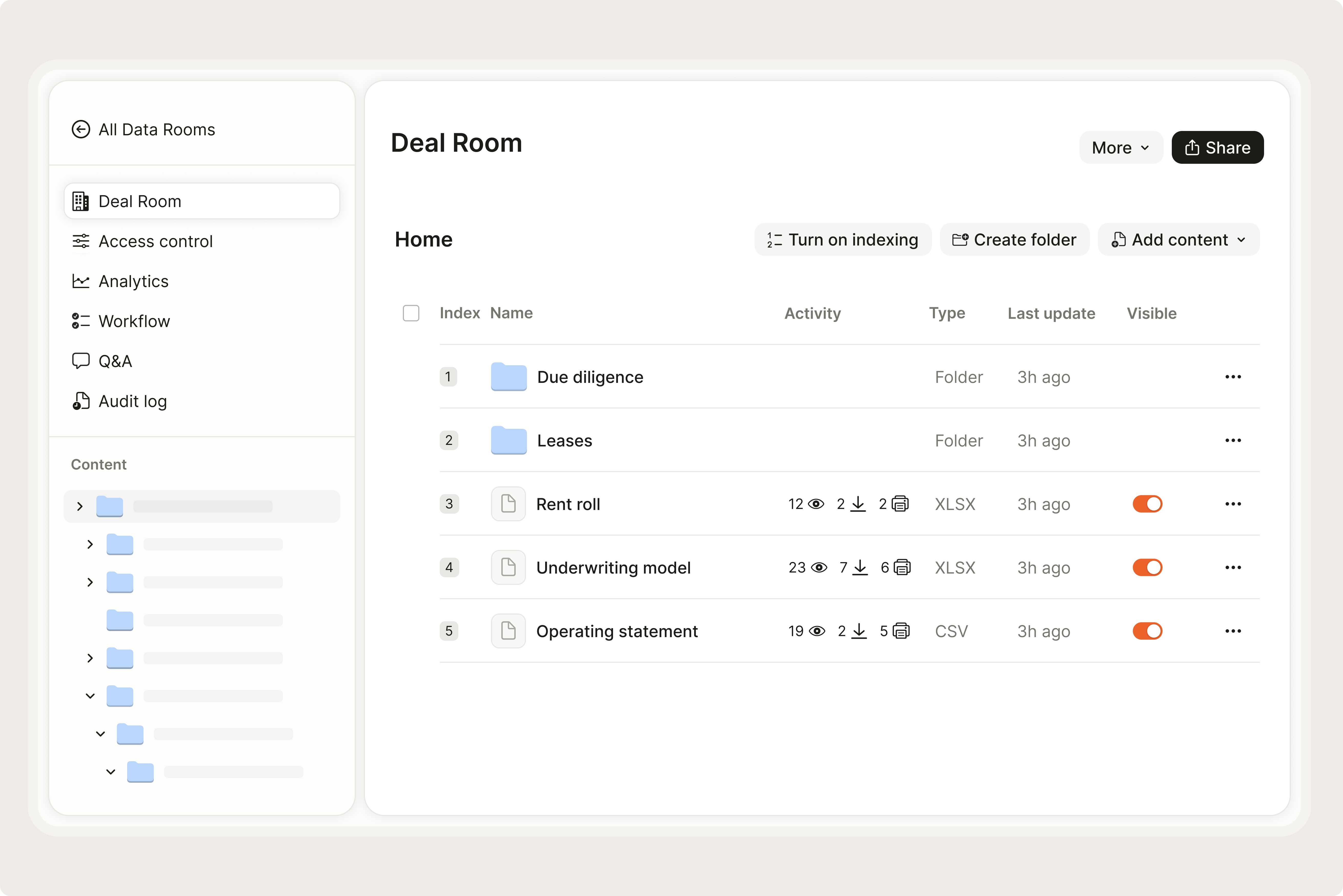
- 1.Upload Malaysia property files to a secure roomDrop land title (geran or Geran Pajakan), PTG official search (Carian Rasmi), CCC or CFO, local authority building plan approvals, express conditions documentation, EPU approval application and conditional letter (if applicable), quit rent certificate, assessment tax clearance, RPGT withholding calculation, and commercial lease pack into Ellty.
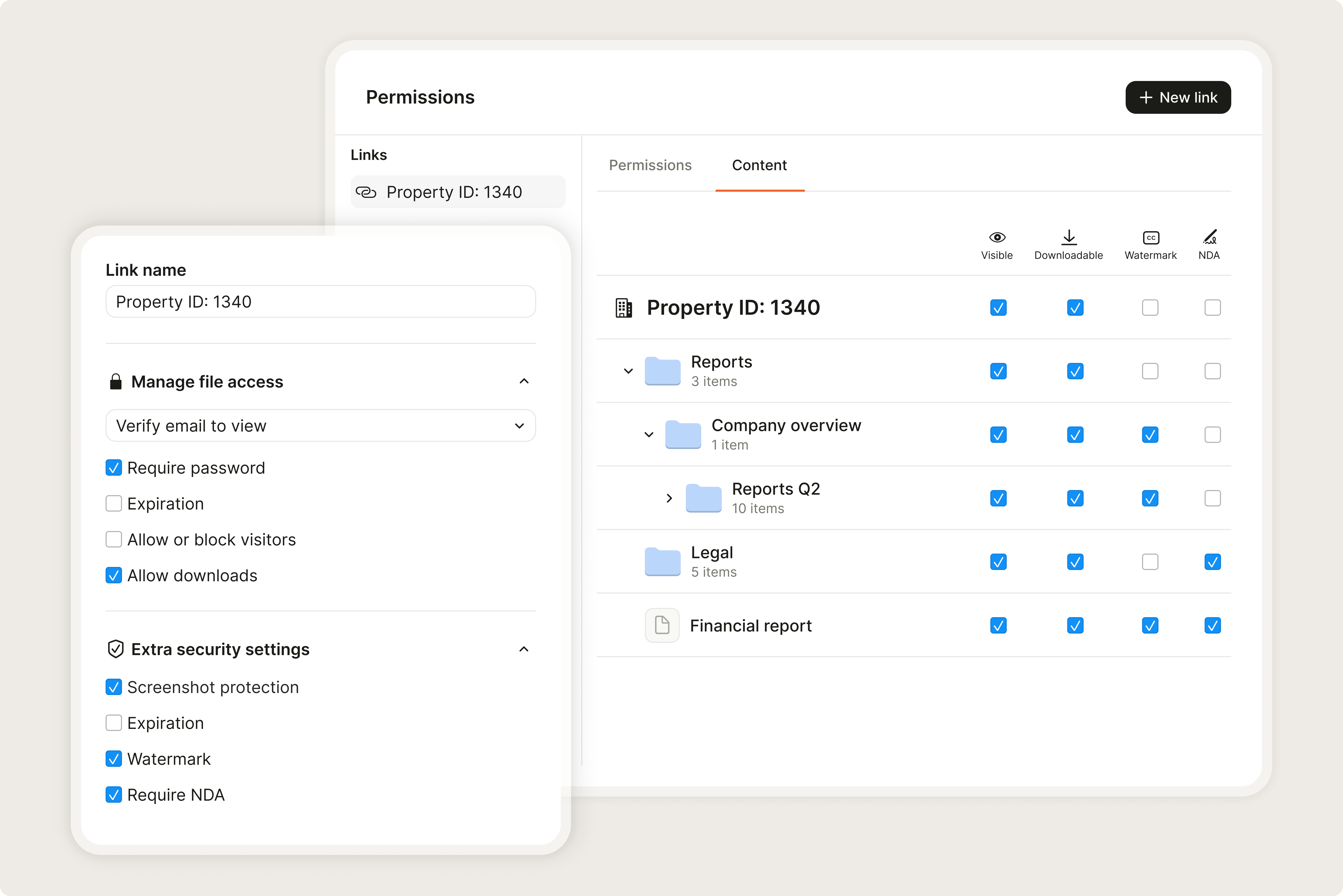
- 2.Give each advisor a scoped, tracked linkMalaysian solicitor sees geran, Carian Rasmi, CCC, and express conditions. Building inspector sees CCC and building plan approvals. Tax counsel sees RPGT withholding calculation and LHDN clearance. EPU consultant sees EPU application and approval docs. Lender sees title, CCC, and leases.
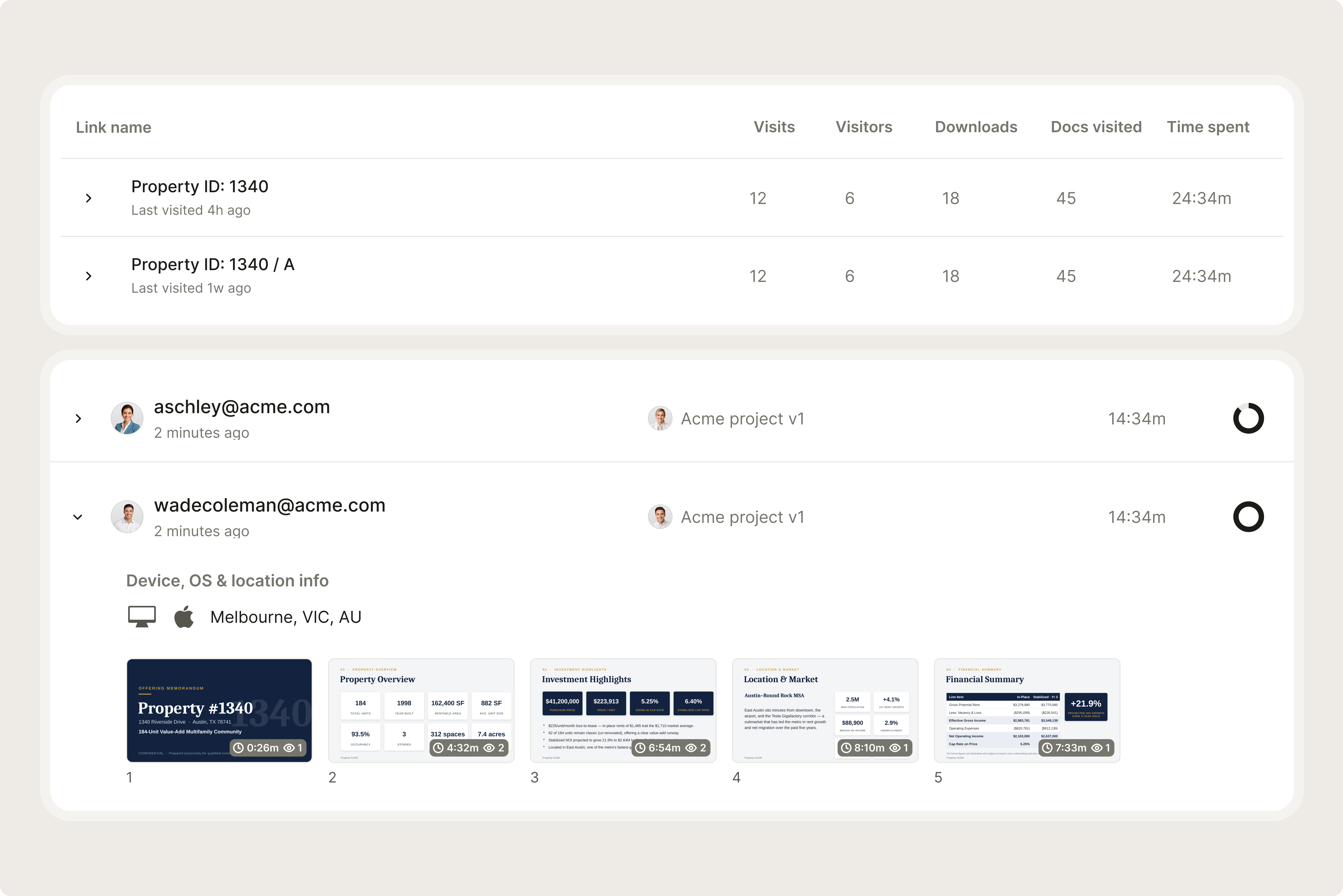
- 3.Monitor who reviews which documentsSee exactly which files each advisor opened and when. Catch Malay Reserve Land issues or EPU approval conditions before they stall deal closing.
What makes Malaysia different
Malay Reserve Land (Tanah Rizab Melayu) is Malaysia's most commercially impactful land ownership restriction and the one most frequently overlooked by foreign institutional investors approaching Malaysia for the first time. The restriction has constitutional and statutory roots - the Malay Reservation Enactments (state-level legislation predating Malaysian independence in some cases) designate specific land parcels as Malay Reserve Land that can only be owned, bought, or held by Malays as defined under each state's legislation, and by certain Bumiputera-owned companies. The definition of who qualifies as a Malay varies slightly by state enactment but follows the federal Constitution's definition for most purposes. The practical consequence is binary: a non-Malay Malaysian individual, a non-Bumiputera Malaysian company, or any foreign buyer cannot legally acquire Malay Reserve Land, period. There is no approval process to overcome this restriction for these buyer categories - it is not like EPU approval which is a regulatory hurdle that can be cleared. The restriction appears in the Sekatan Kepentingan (restriction in interest) section of the land title (geran) or in the PTG official search results, but it is sometimes described ambiguously or requires cross-referencing with state gazette notifications to be definitively confirmed. The standard approach for any non-Malay or foreign buyer is to specifically instruct Malaysian solicitors to confirm Malay Reserve status as the first step in due diligence, before any deposit or Letter of Intent is signed. Discovering Malay Reserve Land status after a binding SPA has been signed - which has happened in transactions where junior staff conducted only a cursory title check - creates a contract that the buyer cannot legally complete.
The EPU approval process for foreign buyers is the main timeline risk in Malaysian commercial acquisitions, and its management is what separates experienced Malaysia CRE practitioners from first-time entrants to the market. The Economic Planning Unit (EPU) under Malaysia's Prime Minister's Department reviews acquisitions by foreign interests above MYR 20 million to assess economic benefit, employment impact, and Bumiputera equity considerations. The EPU approval process involves a formal application, document submission, and EPU committee review. EPU processing times range from 1 to 4 months for straightforward commercial acquisitions, but applications with incomplete documentation, unusual corporate structures, or acquisitions in sensitive sectors can take longer. The EPU is not a rubber stamp: conditions are frequently attached to approvals including requirements on Bumiputera employee percentage, Malaysian supplier usage, or maximum foreign equity percentage in the holding company. For a foreign fund entering Malaysia CRE for the first time: the EPU timeline must be built into the SPA conditional period, typically with a 6-month window from signing to allow for application preparation, EPU review, and condition satisfaction; the alternative is a pre-SPA EPU application which some sophisticated transactions use to de-risk the conditional period.
Malaysia's two-tier land tax system - quit rent (cukai tanah, state) and assessment tax (cukai taksiran, local authority) - creates a specific closing risk that regularly catches buyers who haven't transacted in Malaysia before. Both quit rent and assessment tax must be fully paid and a current clearance certificate obtained before PTG will register a transfer. The PTG physically requires production of the quit rent certificate and the PBT assessment tax clearance as conditions for accepting a MOT for registration. If the seller has outstanding arrears on either (which can accumulate quietly, particularly in estates or corporate property portfolios where annual payments are not actively monitored), the closing will be blocked until arrears are cleared. For commercial properties that have changed hands or been through corporate restructuring, arrears can span multiple ownership periods. The buyer's solicitors should request production of quit rent and assessment tax receipts for the current and prior year as a standard pre-SPA condition, and a fresh clearance certificate should be obtained within 3 months of the presentation of the MOT to PTG.
Section 76(1) of the National Land Code 1965 (Act 56) provides that no land shall be alienated, disposed of or dealt with in any way except in accordance with the provisions of the Code. The Sekatan Kepentingan (restriction in interest) endorsed on the register document of title and shown in the register of titles constitutes a restriction on the dealing and disposition of land as provided by Section 340 and Part Fifteen of the Code. No instrument of dealing may be registered under the Code in contravention of any restriction in interest affecting the land, and any purported dealing contrary to such restriction is void and of no effect. Malay Reservation Enactments operating in conjunction with the relevant provisions of the Code restrict the alienation or transfer of Malay Reserve Land to persons who are not Malays within the meaning of those Enactments.
Timeline and cost in Malaysia
Weeks 1-2 cover kickoff: PTG Carian Rasmi for all lot numbers, Malay Reserve Land status confirmation, leasehold remaining term review, CCC or CFO request from seller and local authority confirmation, building plan approvals check with PBT, strata title status (if applicable), EPU eligibility assessment (for foreign buyers), EPU application preparation commission, quit rent and assessment tax payment history check, SSM company search for seller, UBO identification, OFAC and sanctions screens, RPGT calculation with Malaysian tax counsel, lease abstraction. Malaysian solicitor fees: MYR 20,000-100,000 (approx. USD 4,000-22,000) for this phase.
Load all files into Ellty before advisors engage. Standard Malaysia commercial for domestic buyers: 30-60 days. For foreign buyers requiring EPU approval: 90-180 days total. Leasehold state consent applications (if required): 1-3 months additional.
Weeks 2-8 cover deep review: title encumbrance clearance, charge discharge plan, caveat investigation, building plan vs. CCC vs. physical layout comparison, strata title application status, EPU application submission and monitoring, RPGT withholding amount confirmation, lease assignment provisions and state consent requirements (leasehold leases may require state consent for assignment), PBT defect or violation notice review. Costs: MYR 30,000-150,000 (approx. USD 6,500-33,000).
Weeks 8-16 (or longer for EPU): EPU approval receipt, compliance with EPU conditions, charge discharge, caveat withdrawal, MOT preparation, stamp duty assessment and payment to LHDN, quit rent and assessment tax clearance certificates, MOT presentation to PTG, PTG registration, and post-registration geran extract confirming buyer ownership.
Malaysia total buyer-side transaction costs: stamp duty on MOT (progressive, approximately 3.5-4% on commercial above MYR 1M); stamp duty on loan agreement (0.5% of facility); RPGT withholding responsibility (buyer remits to LHDN on behalf of seller); Malaysian solicitor fees (typically 0.5-1% of transaction value for commercial, based on Bar Council scale fee or negotiated); EPU filing fees (nominal); local authority and PTG registration fees (nominal). Total effective buyer cost: 4-6% of transaction value excluding RPGT (which is seller's liability borne at closing).
Running a Malaysia property deal from one room
Hold land title, CCC, EPU approval docs, and lease files in one secure, tracked Ellty data room.
Start free 14-day trialCommon questions about due diligence on Malaysia commercial property
- Malay Reserve Land (Tanah Rizab Melayu) is gazetted land under state Malay Reservation Enactments that can only be owned, bought, or held by Malays (as defined under each state's legislation) and certain Bumiputera-owned companies. Non-Malay Malaysians and all foreign buyers are prohibited from acquiring Malay Reserve Land - there is no approval process to overcome this restriction. The restriction appears in the Sekatan Kepentingan section of the land title or PTG official search. Confirm Malay Reserve status with Malaysian solicitors before any deposit or Letter of Intent.
- Foreign buyers need Economic Planning Unit (EPU) approval for commercial property acquisitions above MYR 20 million. EPU approval may also be required for acquisitions in regulated sectors or where Bumiputera equity thresholds in the holding company are affected. EPU processing takes 1-4 months for straightforward applications. Build EPU as a condition precedent in the SPA with a 6-month conditional period. EPU approval may include conditions on Bumiputera employment, Malaysian supplier usage, or holding company equity structure.
- Stamp Duty on Memorandum of Transfer (MOT) at progressive rates: 1% on first MYR 100,000, 2% on MYR 100,001-500,000, 3% on MYR 500,001-1 million, 4% above MYR 1 million; effective rate approximately 3.5-4% on commercial transactions above MYR 1 million. Stamp Duty on Loan Agreement: 0.5% of facility. RPGT applies to the seller on gains from disposal and is withheld by the buyer. Foreign sellers: 30% RPGT withholding on gross disposal price for disposals within 5 years; 15% after 5 years.
- Freehold title (Hak Milik Kekal) is permanent ownership with no expiry. Leasehold title (Hak Milik Pajakan) is typically 99-year or 60-year from the state government. For leasehold commercial: check remaining term, state consent requirement for transfer, and leasehold renewal terms (renewal is not automatic and requires application and premium payment to the state). Lenders require the remaining leasehold term to exceed the loan term plus a buffer (typically 20-30 years). Leasehold with less than 50 years remaining may face financing difficulties.
- The Certificate of Completion and Compliance (CCC) replaced the Certificate of Fitness for Occupation (CFO) in Malaysia in 2007. The key difference: the CFO was issued by the local authority (PBT) after inspection; the CCC is self-certified by the Principal Submitting Person (PSP - the project architect) who certifies compliance without local authority sign-off. For buildings completed before 2007: the CFO applies. For post-2007 buildings: the CCC applies. For strata commercial: also confirm the Strata Title has been formally issued - some Malaysian commercial buildings have been occupied for years without strata titles being individually issued to unit owners.
- Standard Malaysia commercial for domestic Malaysian buyers: 30-60 days. For foreign buyers requiring EPU approval: 90-180 days total (EPU alone takes 1-4 months). PTG official Carian Rasmi search: 3-7 days. CCC verification with local authority: 1-3 weeks. Leasehold state consent (if required for transfer): 1-3 months. PTG registration of MOT after closing (once all clearance certificates are in order): approximately 2-6 weeks depending on state PTG workload.