Kuwait commercial property has two points that stop most non-Kuwaiti buyers before diligence even starts: Kuwait is the most restrictive GCC country for foreign ownership, with no general foreign property ownership rights, and there is no VAT - making Kuwait one of the few remaining VAT-free commercial real estate markets in the region.
Non-Kuwaiti, non-GCC foreign nationals generally cannot own property in Kuwait. This is a statutory prohibition, not a zoning limitation. Foreign investors who want commercial real estate exposure in Kuwait typically structure via a Kuwaiti majority-owned entity, a long-term lease (ijara), or a Kuwait-domiciled real estate investment fund.
Kuwait has no VAT as of 2026. Kuwait remains the only GCC state that has not implemented VAT. All commercial lease income, property-related services, and transactions are genuinely VAT-free. This is a meaningful structural advantage for Kuwait commercial assets compared to other GCC markets.
Title registration in Kuwait is managed by the Department of Registration and Authentication (Idarat al-Tasjeel wal-Tawtheeq) under the Ministry of Justice. The process is more manual than UAE DLD or Saudi MOJ electronic systems; registration can take days to weeks.
Set up an Ellty data room before diligence opens. Load title deeds, KDIPA documents, building permits, and lease files before advisors arrive. Each advisor gets a scoped link from day one.
Where Kuwait deals go wrong
Not every check carries the same weight. The table below sorts risks by deal impact - dealbreakers first, then what moves the price, then basic hygiene - so your Kuwait legal counsel and technical advisor know what to clear first.
| Area | Documents to pull | Kuwait red flag | Matters most for | Tier | |
|---|---|---|---|---|---|
| Foreign ownership eligibility | Foreign ownership eligibility | Buyer nationality confirmation, KDIPA investment license (if applicable), Kuwaiti partner structure documents | Non-Kuwaiti, non-GCC nationals cannot own property in Kuwait under current law; foreign investors must structure via Kuwaiti majority-owned entity, long-term lease, or real estate fund | All non-Kuwaiti buyers | Dealbreaker |
| Waqf land status | Waqf land status | Ministry of Justice title deed, Ministry of Awqaf records, Waqf encumbrance search | Kuwait has Waqf (Islamic endowment) land that cannot be transferred to private ownership; Waqf status on a title is a permanent dealbreaker | All buyers | Dealbreaker |
| Title and Department of Registration | Title and Department of Registration | Original title deed, Ministry of Justice registration record, mortgage and lien search | Kuwait's title registration is manual (Department of Registration and Authentication); confirm the current registered owner and all encumbrances via a lawyer-assisted manual registry search | All buyers | Dealbreaker |
| Kuwaiti partner structure | Kuwaiti partner structure | Kuwaiti company CR, partner shareholders agreement, KDIPA approval, Ministry of Commerce license | For foreign commercial investment via Kuwaiti entity: the Kuwaiti majority partner holds controlling rights; document the partnership terms and exit mechanics clearly | All non-GCC foreign investors | Dealbreaker |
| Environmental - Gulf War contamination | Environmental - Gulf War contamination | Kuwait EPA records, Phase I ESA, historical site maps from 1991 oil fire areas | Southern Kuwait and areas near the Burgan oil field have documented hydrocarbon contamination from the 1990/1991 Gulf War oil fires; industrial sites near Shuaiba carry similar risk | Industrial, southern Kuwait | Dealbreaker |
| Leases and tenancy agreements | Leases and tenancy agreements | All lease contracts, rent roll, payment receipts, trade license of each commercial tenant | Kuwait has no formal lease registration system equivalent to Dubai Ejari; commercial lease enforceability relies entirely on the contract terms and Kuwaiti court jurisdiction | Income-producing assets | Price-adjuster |
| Building permits and municipality compliance | Building permits and municipality compliance | Municipality of Kuwait building permit, use license, occupancy certificate | Kuwait Municipality requires valid building permits and occupancy certificates for all commercial structures; unauthorized construction or change of use creates compliance liability | All commercial buildings | Price-adjuster |
| Zoning and Kuwait Municipal Plan | Zoning and Kuwait Municipal Plan | Kuwait Municipal Plan zoning extract, permitted use confirmation, development restrictions | Kuwait's zoning framework separates residential, commercial, and industrial uses; confirm permitted use for the specific plot before committing | All assets | Price-adjuster |
| Insurance and valuation | Insurance and valuation | Current policies, loss run, RICS appraisal, MEW utility account status | Kuwait insurance penetration is lower than UAE or Saudi; confirm commercial building insurance covers the full replacement cost and includes business interruption | All | Standard check |
| Utilities - MEW connection | Utilities - MEW connection | MEW (Ministry of Electricity and Water) account, connection status, arrears confirmation | Kuwait MEW (Ministry of Electricity and Water) provides utilities at subsidized rates; confirm the account is active, properly metered, and in the correct entity name | All | Standard check |
| Seller KYC and AML | Seller KYC and AML | Ministry of Commerce company extract, FATF compliance, UBO identification, sanctions screen | Kuwait's AML law (Law No. 106 of 2013) requires KYC on real estate transactions; lawyers must identify UBOs and report suspicious transactions to the FIU | All deals | Standard check |
Due diligence on a Kuwait property?
Set up your Ellty data room before diligence starts.
Start free 14-day trialKuwait CRE checklist
The table ranked risks by severity. This is the full list to work through, grouped by area.
Foreign ownership eligibility
- Confirm buyer nationality and eligibility before any commercial discussion; Kuwaiti law generally prohibits non-Kuwaiti, non-GCC nationals from owning property
- GCC nationals (UAE, Saudi Arabia, Bahrain, Qatar, Oman) have limited reciprocal ownership rights under GCC agreements; confirm the specific applicable provisions with Kuwait legal counsel
- For foreign (non-GCC) investors seeking Kuwait commercial exposure: the available structures are:
- Kuwaiti majority-owned company (at least 51% Kuwaiti ownership); the foreign investor holds a minority stake - Long-term lease (ijara) structure; the foreign company leases without ownership - Kuwait-domiciled real estate fund with appropriate licensing from Capital Markets Authority (CMA) - Contact KDIPA (Kuwait Direct Investment Promotion Authority) for confirmation of available structures for specific investor profiles - Document the Kuwaiti partner relationship and exit rights carefully; the partner structure creates ongoing dependency
Waqf land status
- Request the Ministry of Justice title deed and confirm no Waqf encumbrance
- Search the Ministry of Awqaf and Islamic Affairs records for any Waqf designation on the property or surrounding parcels
- Waqf land is held perpetually for religious or charitable purposes; it cannot be sold or transferred under any circumstances
- Any Waqf encumbrance in the title chain - even historical - is a permanent dealbreaker for acquisition
Title and Department of Registration
- Engage a Kuwait-licensed lawyer to conduct a manual registry search at the Department of Registration and Authentication
- Confirm the current registered owner matches the seller on all documentation
- Search for all encumbrances (mortgages, liens, court orders) registered against the property
- For properties held in company name: confirm the company is the registered title holder and that no court proceedings or creditor claims affect the company's title
- Kuwait's registration process is slower than UAE or Saudi Arabia; factor 2-4 weeks for manual title confirmation
Kuwaiti partner structure
- For any structure involving a Kuwaiti majority partner: document all shareholder rights, profit sharing, voting, and exit mechanics in a robust shareholders' agreement
- Confirm the Kuwaiti company's commercial registration (CR) and Ministry of Commerce license are current and cover the property investment activities
- Confirm KDIPA approval if required for the specific foreign investment structure
- Run full KYC and due diligence on the Kuwaiti partner entity and its beneficial owners; the partner relationship is an ongoing exposure
Environmental - Gulf War contamination
- For any site in southern Kuwait, near the Burgan oil field, or along the Shuaiba Industrial Area: commission Phase I ESA using post-1991 aerial photography and Kuwait EPA records
- The 1990/1991 Gulf War included deliberate oil well fires and oil spills; contamination in southern Kuwait is documented and ongoing
- For Shuaiba Industrial Area (Kuwait National Petroleum Company refineries, petrochemical plants): Phase I ESA is mandatory regardless of the specific site location
- Engage an environmental consultant with Kuwait or GCC experience; generic international ESA consultants may not have access to the specific Kuwait EPA contamination database
Leases and tenancy agreements
- Collect all commercial lease contracts and confirm they are governed by Kuwait law with Kuwait court jurisdiction
- Kuwait has no formal lease registration system; enforceability depends entirely on the written contract
- Check the payment terms: Kuwait commercial leases often use annual or bi-annual post-dated cheques
- Cross-reference the rent roll against 12 months of actual receipts
- For large commercial anchors: confirm the tenant trade license (commercial registration) from the Ministry of Commerce is current
Give each advisor a scoped link in Ellty. Legal counsel sees title and partner structure documents. Environmental consultants see Phase I reports. Lease advisors see tenancy documentation. No overlap.
Building permits and municipality compliance
- Request the building permit and occupancy certificate from the Kuwait Municipality for each structure on the property
- Confirm the occupancy certificate covers the current commercial use
- For buildings with unauthorized extensions or use changes: assess the municipality enforcement risk and budget regularization cost
- Check for any outstanding municipality fines or enforcement orders against the property
Zoning and Kuwait Municipal Plan
- Confirm the property's zoning designation under the Kuwait Municipal Plan
- Confirm the permitted use (commercial, industrial, or residential commercial) covers the current and intended use
- For any change of use or development: confirm the zoning supports it before any offer is made
- Shuwaikh and Fahaheel industrial zones have specific restrictions on permitted activities; confirm the buyer's intended use is permissible
Environmental and utilities
- For all commercial assets: confirm MEW (Ministry of Electricity and Water) account status, connection capacity, and outstanding arrears
- Kuwait electricity is heavily subsidized; confirm the subsidy treatment is correctly reflected in any operating cost model
- For industrial assets: check Kuwait EPA records and confirm no pending enforcement orders or investigation notices
- Phase I ESA for any industrial or logistics asset is standard; Phase II for any site with Gulf War proximity or Shuaiba adjacency
Load all Phase I ESA, EPA records, and title documents into Ellty. Environmental advisors, lenders, and technical consultants each get tracked, watermarked access from one secure link.
Insurance and valuation
- Confirm the commercial building insurance covers replacement cost; Kuwait commercial building insurance coverage levels are sometimes below replacement cost
- Commission an independent valuation from a RICS-qualified valuer or locally licensed appraiser for any financing requirement
- Confirm the policy covers regional risks including fire, sandstorm, and business interruption
Seller KYC and AML
- Pull a Ministry of Commerce company extract for the selling entity
- Identify all beneficial owners; Kuwait AML law requires KYC on all property transactions
- Run full OFAC, UN, EU, and US sanctions check on all parties
- Kuwait's FIU (Financial Intelligence Unit) requires suspicious transaction reporting; confirm your Kuwait lawyer is meeting this obligation
How due diligence in Kuwait works
Step 1 - Ownership eligibility and structure
The first call with Kuwait legal counsel must address ownership eligibility. For non-GCC buyers, direct ownership is not available under current Kuwait law. Establish the structure - Kuwaiti majority company, long-term lease, or CMA-licensed fund - before any commercial term negotiation.
Once the structure is confirmed: run the Waqf search and title registry search simultaneously. Both require Kuwait lawyer engagement with the Ministry of Justice and Ministry of Awqaf; both take 1-2 weeks for manual processing.
Step 2 - Environmental review
For any Kuwait commercial asset with industrial adjacency or southern location: commission Phase I ESA immediately. The Gulf War hydrocarbon contamination in southern Kuwait is among the largest documented land contamination events in history; the Shuaiba industrial zone adds a petrochemical contamination layer on top.
For Kuwait City commercial assets (commercial districts, Salmiya, Hawalli): Phase I ESA is still advisable for older sites but risk levels are lower than the southern industrial zones.
Step 3 - Leases and building compliance
Collect all lease contracts and confirm Kuwait law governs each. Check the payment history via bank records or cheque receipt confirmation.
Request the municipality occupancy certificate. Kuwait Municipality enforcement of unauthorized commercial use varies by governorate and property type, but having the occupancy certificate is standard and lenders require it.
Compare Saudi Arabia's commercial property diligence process if you run GCC portfolio acquisitions. Both Kuwait and Saudi Arabia have Waqf land risk, and both prohibit or restrict foreign ownership (Saudi requires MISA license; Kuwait has a broader prohibition). The key structural difference is Saudi Arabia's 5% RETT on all commercial transfers vs. Kuwait's registration-only fee of 0.5-1%.
Step 4 - Partner structure documentation
For foreign investors entering Kuwait via a Kuwaiti majority-owned company: the shareholders' agreement with the Kuwaiti partner is the most important document in the deal. It must clearly address profit distribution, exit rights, ROFO/ROFR on shares, and dispute resolution. Kuwait courts will apply Kuwait law; confirm the chosen arbitration mechanism is enforceable.
Track all document exchange with the Kuwaiti partner, legal counsel, and technical advisors via Ellty. Every document sent and opened creates a timestamped record.
Step 5 - Registration and closing
Kuwait property transfers are registered at the Department of Registration and Authentication. Both buyer and seller (or authorized representatives) attend. The registration fee is paid at the Department on transfer day.
The process is manual and requires physical document presentation; plan for 1-3 days at the Department, not a single-day closing. The new title deed is issued by the Department after processing.
How to set up your Kuwait data room in Ellty.
Kuwait CRE deals involve Ministry of Justice title, Waqf search, KDIPA structure, municipality permits, and EPA environmental records across multiple weeks. Load files into Ellty before advisors arrive. Each party gets a scoped, tracked link from day one.
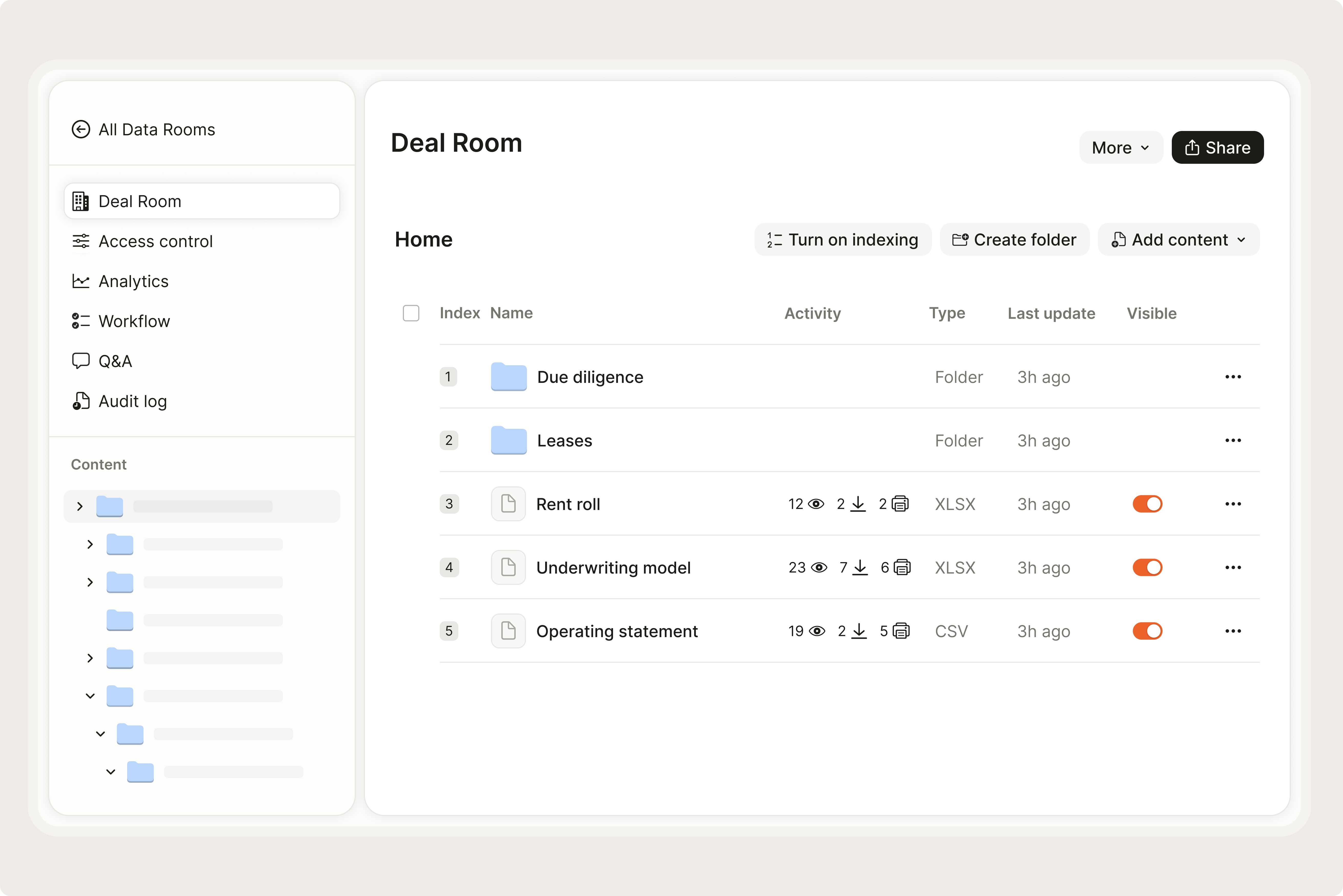
- 1.Upload Kuwait property files to a secure roomDrop title deed, Waqf clearance, KDIPA approval, building permit, occupancy certificate, and leases into Ellty.
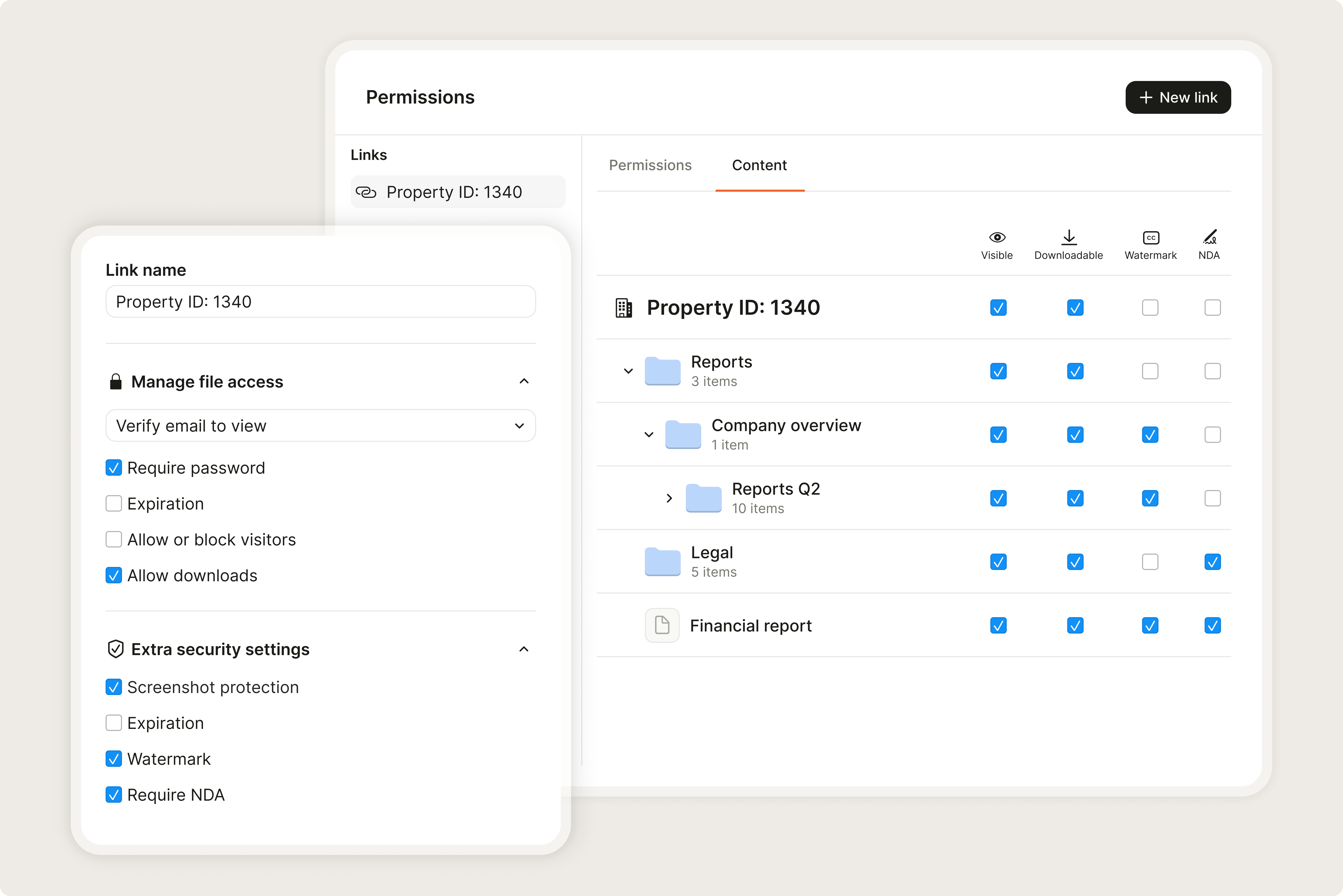
- 2.Give each advisor a scoped, tracked linkLegal counsel sees title and structure docs. Environmental consultants see Phase I reports. Lease advisors see tenancy documentation. Ellty enforces the scope.
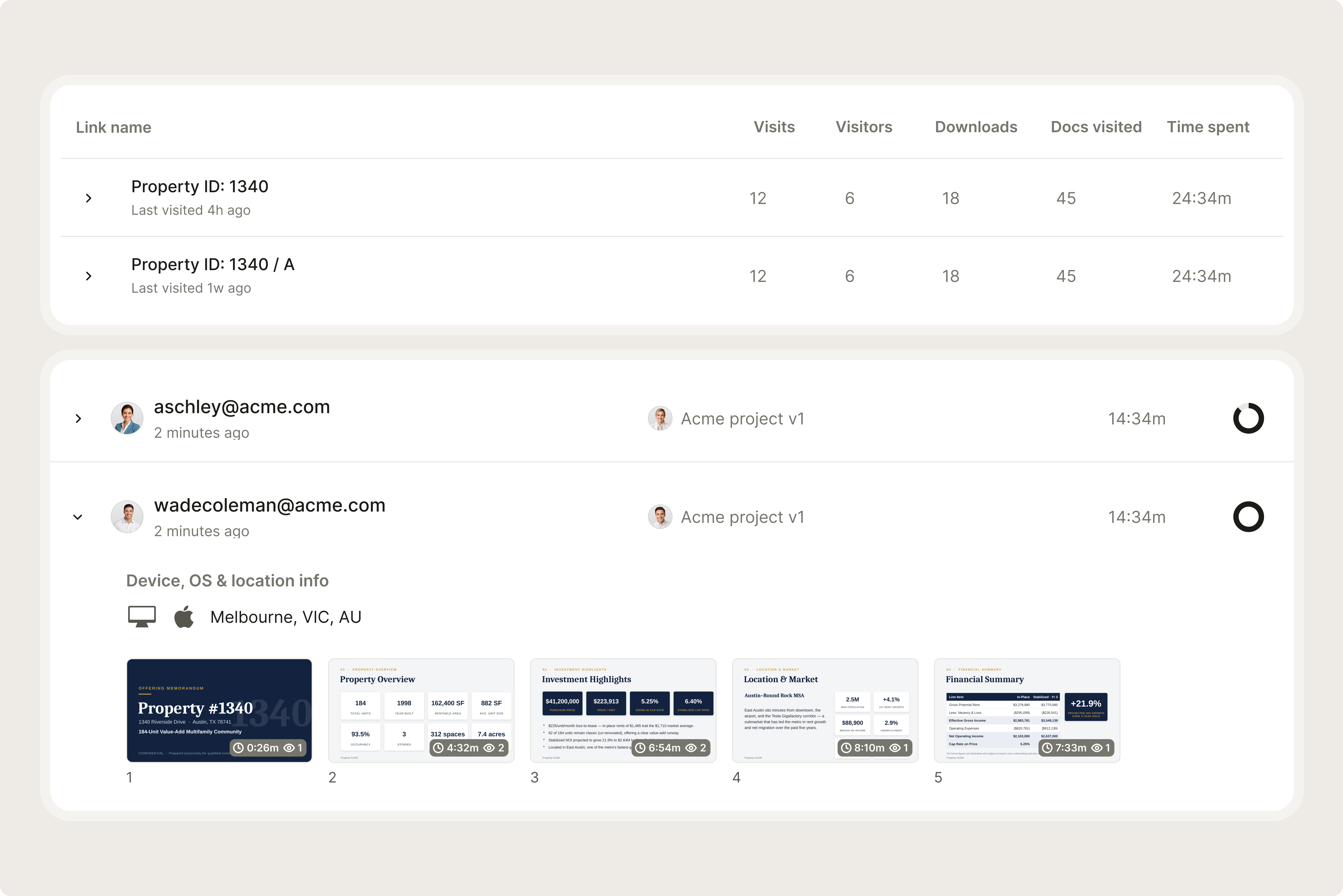
- 3.Monitor who reviews which documentsSee exactly which files each advisor opened and when. Catch delays before they affect the Department of Registration appointment date.
What makes Kuwait different
Kuwait is the most restrictive GCC country for non-Kuwaiti property ownership. Where UAE, Saudi Arabia, Qatar, and Bahrain have created freehold zones and investment license frameworks to attract foreign capital, Kuwait has maintained a broad foreign ownership prohibition. For non-GCC foreign investors, the only routes to Kuwait commercial real estate exposure are via a Kuwaiti majority company, long-term lease, or a CMA-licensed fund.
The VAT-free environment is Kuwait's standout structural advantage. As of 2026, Kuwait has not implemented the 5% VAT that all other GCC states operate under. All commercial lease income in Kuwait is genuinely VAT-free. This makes Kuwait's operating income metrics directly comparable to pre-VAT GCC numbers and materially better than the VAT-inclusive operating costs in UAE, Saudi Arabia, or Qatar.
Gulf War contamination in southern Kuwait is not a historical footnote. The deliberate burning of 700+ oil wells in 1991 and the oil lake system created documented hydrocarbon contamination that persists across large areas of southern Kuwait. For any commercial or industrial asset south of Kuwait City or near the Burgan field, Phase I ESA and post-1991 aerial photography review are non-optional.
The manual registration process is slow by regional standards. Kuwait's Department of Registration operates without the digital integration of UAE DLD or Saudi MOJ electronic deed systems. Title searches require manual access through Kuwait-licensed lawyers. Budget for this in your timeline; 2-4 weeks for title confirmation is realistic.
The Real Estate Registration Law in Kuwait (Law No. 5 of 1959 and its amendments) establishes the framework for property ownership and registration in the State of Kuwait. All property transfers must be registered with the Department of Registration and Authentication under the Ministry of Justice. Under Kuwaiti law, non-Kuwaiti individuals and foreign companies are generally prohibited from owning real property in Kuwait, with limited exceptions for GCC nationals on a reciprocity basis and for foreign investors operating through licensed Kuwaiti corporate structures approved by the relevant authorities.
Timeline and cost in Kuwait
Weeks 1-2 cover kickoff: ownership eligibility confirmation, Waqf search initiation, Ministry of Justice title search, Phase I ESA commission for any industrial or southern Kuwait asset, building permit and occupancy certificate request, and KDIPA structure confirmation if required. Budget KWD 5,000-15,000 for legal and advisory fees in this phase.
Load all files into Ellty before advisors start. Scoped, tracked links for each party centralize Kuwait CRE document management - critical given the multiple government offices (Ministry of Justice, Municipality, EPA, Ministry of Commerce) involved.
Weeks 2-5 cover deep review: lease abstraction, Kuwaiti partner due diligence if required, Phase I ESA delivery, building compliance review, and MEW utility confirmation. Cost runs KWD 8,000-25,000 depending on complexity.
Phase II ESA for Gulf War contamination sites: add 4-8 additional weeks and KWD 20,000-60,000 for subsurface investigation.
Weeks 5-8 handle resolution: all title and Waqf clearances confirmed, partner agreement finalized if applicable, and Department of Registration closing. Physical registration typically takes 1-3 days at the Department once all documents are in order.
Kuwait total acquisition cost: 0.5-1% registration fee + legal fees KWD 8,000-25,000 + Phase I ESA + technical inspection + RICS valuation. Total acquisition cost on a Kuwait commercial deal runs approximately 1-2% of purchase price - the lowest in the GCC. The structural access challenge (ownership restrictions) is the cost, not the transfer fee.
Running a Kuwait property deal from one room
Hold title docs, KDIPA approvals, and lease files in one secure, tracked Ellty data room.
Start free 14-day trialCommon questions about due diligence on Kuwait property
- Most Kuwait CRE deals complete in 6-10 weeks, including the partner structure confirmation for foreign investors. The manual title registration search at the Department of Registration and Authentication takes 2-4 weeks. Phase I ESA for industrial or southern Kuwait sites adds time.
- Generally no. Kuwait law prohibits non-Kuwaiti, non-GCC foreign nationals from owning property. Foreign investors can access Kuwait commercial real estate via a Kuwaiti majority-owned company (at least 51% Kuwaiti-owned), a long-term lease structure, or a CMA-licensed Kuwait real estate fund. GCC nationals have limited reciprocal rights.
- No. As of 2026, Kuwait has not implemented VAT. Kuwait is the only GCC state that has not introduced the 5% GCC VAT. All commercial lease income and property transactions in Kuwait are genuinely VAT-free, which is a structural advantage compared to other GCC markets.
- Kuwait has no stamp duty or transfer tax on commercial property. The cost of transfer is a registration fee of approximately 0.5-1% of the transaction value, payable at the Department of Registration and Authentication. This is one of the lowest transfer costs in the GCC.
- The 1990/1991 Gulf War resulted in deliberate burning of over 700 oil wells and significant hydrocarbon contamination across southern Kuwait. Documented contamination persists around the Burgan oil field and industrial areas. For any commercial or industrial asset in southern Kuwait or near the Shuaiba Industrial Area, Phase I ESA using post-1991 aerial imagery and Kuwait EPA records is mandatory before acquisition.
- Waqf (Islamic endowment) is land held permanently for religious or charitable purposes. Kuwait has Waqf land managed by the Ministry of Awqaf and Islamic Affairs. Waqf land cannot be sold or transferred under any circumstances. Confirm Waqf status via the Ministry of Justice title deed and Ministry of Awqaf records before any commercial commitment.