Saudi Arabia commercial property has two checks that come before everything else: Waqf status (Islamic endowment land cannot be transferred - ever) and foreign ownership eligibility (non-GCC buyers need a MISA investment license to hold commercial property in the Kingdom).
Saudi Arabia does not have stamp duty in the traditional sense. What it has is the Real Estate Transaction Tax (RETT): 5% of transaction value, introduced in October 2020. It replaced the previous VAT treatment of some real estate transactions. Budget it into every acquisition model.
Title in Saudi Arabia is managed by the Ministry of Justice (MOJ) through its notary system. All property transfers must be notarized (Katib al-'Adl). Saudi Arabia has moved to electronic deeds (Sak Iliktroni), but some properties still carry old paper deeds. Verify the deed status in the MOJ system before committing.
Saudi VAT is 15% (since July 2020). It applies to commercial leases and some property-related services. On commercial income-producing assets, model VAT as a pass-through cost on all lease income.
Set up an Ellty data room before diligence opens. Load all MOJ deed extracts, REGA registration documents, building permits, and lease files before advisors arrive. Each advisor gets a scoped link from day one.
Where Saudi Arabia deals go wrong
Not every check carries the same weight. The table below sorts risks by deal impact - dealbreakers first, then what moves the price, then basic hygiene - so your Saudi legal counsel and technical advisor know what to clear first.
| Area | Documents to pull | Saudi Arabia red flag | Matters most for | Tier | |
|---|---|---|---|---|---|
| Waqf land status | Waqf land status | MOJ title deed (Sak), Awqaf Ministry records, Waqf encumbrance search, historical title chain | Waqf (Islamic endowment) land cannot be transferred to private ownership; a Waqf encumbrance on the title is a permanent dealbreaker | All buyers | Dealbreaker |
| Foreign ownership eligibility | Foreign ownership eligibility | MISA investment license, company CR (commercial registration), buyer nationality confirmation | Non-GCC foreign buyers must hold a MISA investment license to own commercial property in Saudi Arabia; without it, title cannot transfer | All non-GCC/foreign buyers | Dealbreaker |
| Mecca and Medina restriction | Mecca and Medina restriction | Property location confirmation, Haram boundary maps, MOJ ownership eligibility check | Non-Muslim buyers cannot own property within the Haram boundaries of Mecca and Medina; this is statutory and cannot be waived | All non-Muslim buyers | Dealbreaker |
| MOJ title deed and electronic deed | MOJ title deed and electronic deed | MOJ electronic deed (Sak Iliktroni), paper deed chain if old title, notary public confirmation | Some Saudi properties still have old paper deeds not yet migrated to MOJ's electronic system; a mismatched or unregistered deed blocks the notarized transfer | All buyers | Dealbreaker |
| RETT and VAT structure | RETT and VAT structure | RETT calculation, ZATCA (tax authority) registration confirmation, VAT registration of seller | 5% RETT applies to all Saudi property sales; 15% VAT applies to commercial lease income; model both in the acquisition underwriting | All deals | Price-adjuster |
| Leases and commercial tenancies | Leases and commercial tenancies | All lease contracts, REGA Ejar lease registration, rent roll, municipal trade license of tenants | Saudi commercial leases should be registered on the Ejar platform; unregistered leases have limited enforceability in Saudi courts | Income-producing assets | Price-adjuster |
| Building permits and municipality compliance | Building permits and municipality compliance | Building permit (Rukhsa al-Bina), municipality completion certificate, building use license | Saudi municipalities require a valid building permit and completion certificate for all commercial structures; buildings without permits face demolition orders | All commercial buildings | Price-adjuster |
| Environmental - industrial zones | Environmental - industrial zones | Phase I ESA, NCEC (National Center for Environmental Compliance) records, site history | Jubail Industrial City, Yanbu Industrial City, and Jizan Economic City carry significant petrochemical contamination risk | Industrial, logistics | Price-adjuster |
| Insurance and valuation | Insurance and valuation | Current policies, loss run, Saudi Valuation Authority (SVA) appraisal, flood risk check | Saudi Valuation Authority regulates property valuers; confirm the appraiser is SVA-certified | All | Standard check |
| Utilities and SEC connection | Utilities and SEC connection | Saudi Electricity Company (SEC) account, water authority connection, utility arrears letters | Outstanding SEC electricity arrears can complicate Saudi property transfers; confirm account is current and in the correct entity name | All | Standard check |
| Seller KYC and AML | Seller KYC and AML | CR (commercial registration), MOC company extract, UBO confirmation, ZATCA tax compliance | Saudi AML regulations (AML Law 2003, amended 2017) require KYC on all real estate transactions above SAR 100,000 | All deals | Standard check |
Due diligence on a Saudi Arabia property?
Set up your Ellty data room before diligence starts.
Start free 14-day trialSaudi Arabia CRE checklist
The table ranked risks by severity. This is the full list to work through, grouped by area.
Waqf land status
- Before anything else: confirm the property is not Waqf (Islamic endowment) land via the Ministry of Justice deed and the General Authority for Awqaf records
- Waqf land is held in perpetuity for religious or charitable purposes; it cannot be sold, transferred, or encumbered
- Some Waqf land in Saudi Arabia has been leased long-term to private occupiers; confirm whether you're looking at a sale or a long-term Waqf lease arrangement
- If the deed shows Waqf origins in the title chain - even historical - seek a Saudi legal opinion before proceeding
Foreign ownership eligibility
- Non-GCC foreign buyers must hold a MISA (Ministry of Investment of Saudi Arabia) investment license to own commercial property in Saudi Arabia
- Confirm the corporate structure: a foreign-owned Saudi entity with MISA registration can own property; a foreign entity without Saudi registration generally cannot
- GCC nationals (citizens of UAE, Kuwait, Bahrain, Qatar, Oman) have broader rights to own property in Saudi Arabia
- Confirm the buyer's eligibility at the term sheet stage; MISA license applications typically take weeks to process
- The NEOM zone: special rules apply for investment in NEOM (Tabuk region); confirm the Royal Commission for NEOM requirements separately
Mecca and Medina restriction
- Confirm the property is not within the Haram boundaries of Mecca (Makkah) or Medina (Al-Madinah)
- The property restriction in Mecca and Medina applies to non-Muslim buyers; the restriction is statutory and absolute
- Even for GCC nationals who are Muslim: confirm whether the specific sub-zone within the Haram has additional ownership restrictions
- For Riyadh, Jeddah, Dammam, and other Saudi cities: no religion-based restriction applies for eligible foreign buyers
MOJ title deed and electronic deed
- Pull the MOJ electronic deed (Sak Iliktroni) via a licensed Saudi lawyer; confirm the current registered owner matches the seller exactly
- Check whether the property still has an old paper deed (Sak Waraqqi) that has not been migrated to the MOJ electronic system
- If a paper deed exists: initiate the electronic migration before contracting; this requires the seller's cooperation and a notary appointment
- Confirm all encumbrances, easements, and mortgage registrations on the MOJ system
- The Saudi Cadastre (Masaha) national survey: confirm the property coordinates and cadastral record match the deed
- All transfers must be executed before a notary public (Katib al-'Adl); confirm both parties can appear or appoint an authorized attorney
RETT and VAT structure
- Confirm the 5% RETT liability: it applies to the full transaction value; there are no regional variations
- Saudi national buying first home: RETT exemption applies up to SAR 1M of purchase price; confirm eligibility if applicable
- For commercial buildings with active leases: 15% Saudi VAT applies to all rental income; confirm the seller's VAT registration is current with ZATCA
- Confirm there are no outstanding ZATCA (tax authority) assessments against the property or the selling entity
- For off-plan commercial in Vision 2030 projects: some special economic zones have modified VAT arrangements; get a tax opinion
Leases and commercial tenancies
- Collect all lease contracts; confirm each is registered on the Ejar platform (REGA's Saudi lease registration system)
- Ejar-registered leases are enforceable through REGA and through Saudi courts; unregistered leases have reduced legal standing
- Check tenant trade licenses (CR/commercial registration) to confirm all tenants are legally operating
- Reconcile the rent roll against 12 months of actual receipts; Saudi tenants often pay rent by post-dated cheques
- Confirm 15% VAT is correctly collected on all commercial lease invoices; VAT non-compliance is the seller's liability but it signals poor financial management
Attach all lease contracts and Ejar registration certificates to Ellty. Send each party - legal counsel, lenders, potential co-investors - their own scoped, NDA-gated link. You see exactly what each one opened.
Building permits and municipality compliance
- Pull the building permit (Rukhsa al-Bina) for every structure on the site from the relevant Saudi municipality
- Confirm the municipality completion certificate covers the current built area and use
- For buildings constructed or extended in the last 10 years: check the Vision 2030 zoning reclassifications in Riyadh, Jeddah, and other major cities
- Check for any municipality enforcement orders, violation notices, or outstanding fines
- In Riyadh: confirm the property is not within any Diriyah Gate, King Salman Park, or New Murabba development zones where public acquisition powers may apply
Environmental - industrial zones
- Commission Phase I ESA for any site near Jubail Industrial City, Yanbu Industrial City, or Jizan Economic City
- Industrial contamination at these sites is predominantly petrochemical and heavy metal; background review using historical imagery and NCEC records is the starting point
- For logistics and warehouse assets near Dammam's King Abdulaziz Port: check for hydrocarbon contamination from port-adjacent operations
- Saudi environmental regulation is administered by the National Center for Environmental Compliance (NCEC); check for any enforcement history on the site
Insurance and valuation
- Confirm all current insurance policies cover the commercial use and are with a Saudi-licensed insurer
- Commission an independent valuation from an SVA (Saudi Valuation Authority) certified appraiser; lenders require SVA certification
- For Jeddah, Medina, and Red Sea coastal assets: confirm flood insurance is available and that the property is not in a designated flood-risk area from NCEC maps
Utilities and SEC connection
- Verify the Saudi Electricity Company (SEC) account is active and current; outstanding SEC arrears complicate transfers
- Confirm water connection through the relevant water utility (SWCC, local municipality, or private)
- For large commercial users: confirm the SEC contracted power capacity is sufficient for the building's current and planned load
- For developments near NEOM or Vision 2030 projects: confirm utility supply commitments from the relevant Royal Commission
Seller KYC and AML
- Pull a CR (Commercial Registration) extract from the Ministry of Commerce confirming the seller's entity is active
- Identify all beneficial owners and confirm against Saudi and international sanctions lists
- Under Saudi AML regulations (updated 2017): lawyers and real estate brokers are required to perform KYC on all property transactions above SAR 100,000
- Run OFAC, UN, EU, and UK sanctions screen on all parties before any transfer of funds or signing of binding agreements
How due diligence in Saudi Arabia works
Step 1 - Waqf check and deed verification
Pull the MOJ electronic deed and run the Waqf status check in parallel on day one. Waqf issues are rare on modern commercial assets in Riyadh and Jeddah, but they're absolute dealbreakers when they appear. Don't wait until week three.
Confirm foreign ownership eligibility the same day. If the buyer doesn't yet have a MISA investment license, start the application immediately - the MISA process takes weeks and won't stop the clock on your exclusivity period.
Step 2 - RETT, VAT, and building permits
Model the 5% RETT on the total purchase price before any offer is made. On a SAR 50M commercial asset, that's SAR 2.5M in RETT payable on transfer - non-recoverable and due at closing.
Confirm the building permit and municipality completion certificate. Saudi municipalities have tightened enforcement since Vision 2030 accelerated development activity in Riyadh and Jeddah. Missing permits are more common than buyers expect.
Step 3 - Lease and Ejar review
Confirm every commercial lease is registered on Ejar. Saudi tenants often pay rent by post-dated cheques (12 or 24 months in advance); review the cheque register and confirm all instruments are cleared or in hand.
Track each advisor's review in real time via Ellty. Legal counsel, tax advisors, and lenders each get their own access log. If the buyer's tax team is spending three sessions reviewing the ZATCA correspondence, that's the question to resolve before the board presentation.
Step 4 - Environmental and technical review
Commission Phase I ESA for any industrial or logistics asset. The big industrial zones (Jubail, Yanbu, Jizan) require Phase I regardless of the specific site, given the density of petrochemical activity. For Riyadh and Jeddah commercial offices: Phase I is lower priority but still advisable for older assets.
Compare UAE's commercial property diligence process when running GCC portfolio acquisitions. Both Saudi Arabia and the UAE have foreign ownership zone rules for non-GCC buyers, Ejar/Ejari lease registration requirements, and no capital gains tax. The key difference is KSA's 5% RETT vs. Dubai's 4% DLD transfer fee, and the Waqf risk which doesn't exist in the same form in the UAE.
Step 5 - MOJ notarization and closing
Saudi property transfers must be notarized before a Katib al-'Adl (notary public) at the MOJ. Both buyer and seller (or attorney-in-fact by power of attorney) must appear. The electronic deed is updated in the MOJ system at the time of notarization.
RETT is paid to ZATCA via the RETA (Real Estate Transaction) online system before the notary appointment. The ZATCA confirmation receipt is presented to the notary as evidence of payment.
How to set up your Saudi Arabia data room in Ellty.
Saudi CRE deals involve MOJ deeds, REGA registration, municipality permits, Ejar lease records, and ZATCA tax compliance across multiple weeks. Load files into Ellty before advisors arrive. Each party gets a scoped, tracked link from day one.
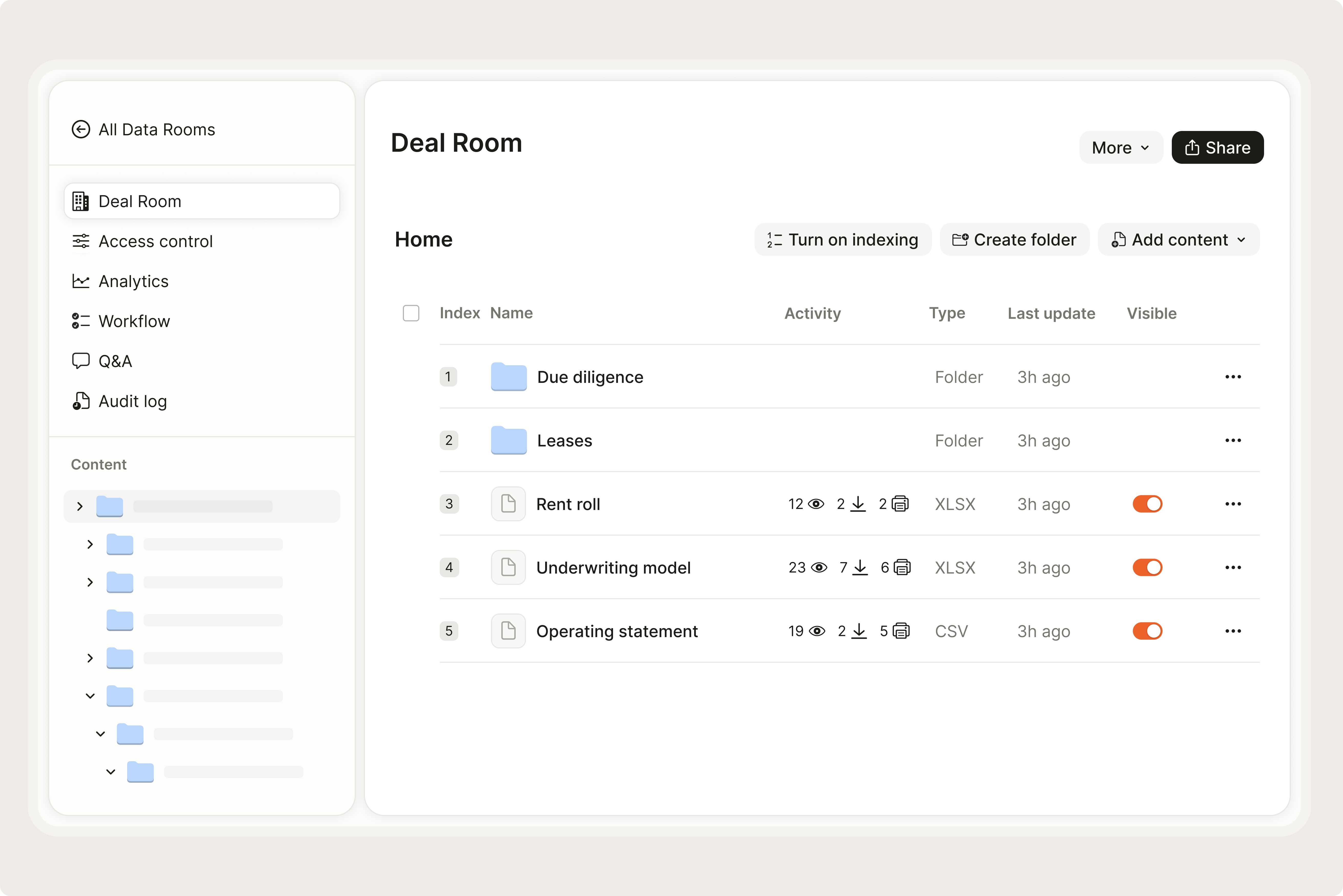
- 1.Upload Saudi property files to a secure roomDrop MOJ electronic deed, building permit, municipality certificate, Ejar lease registrations, and RETT calculation into Ellty.
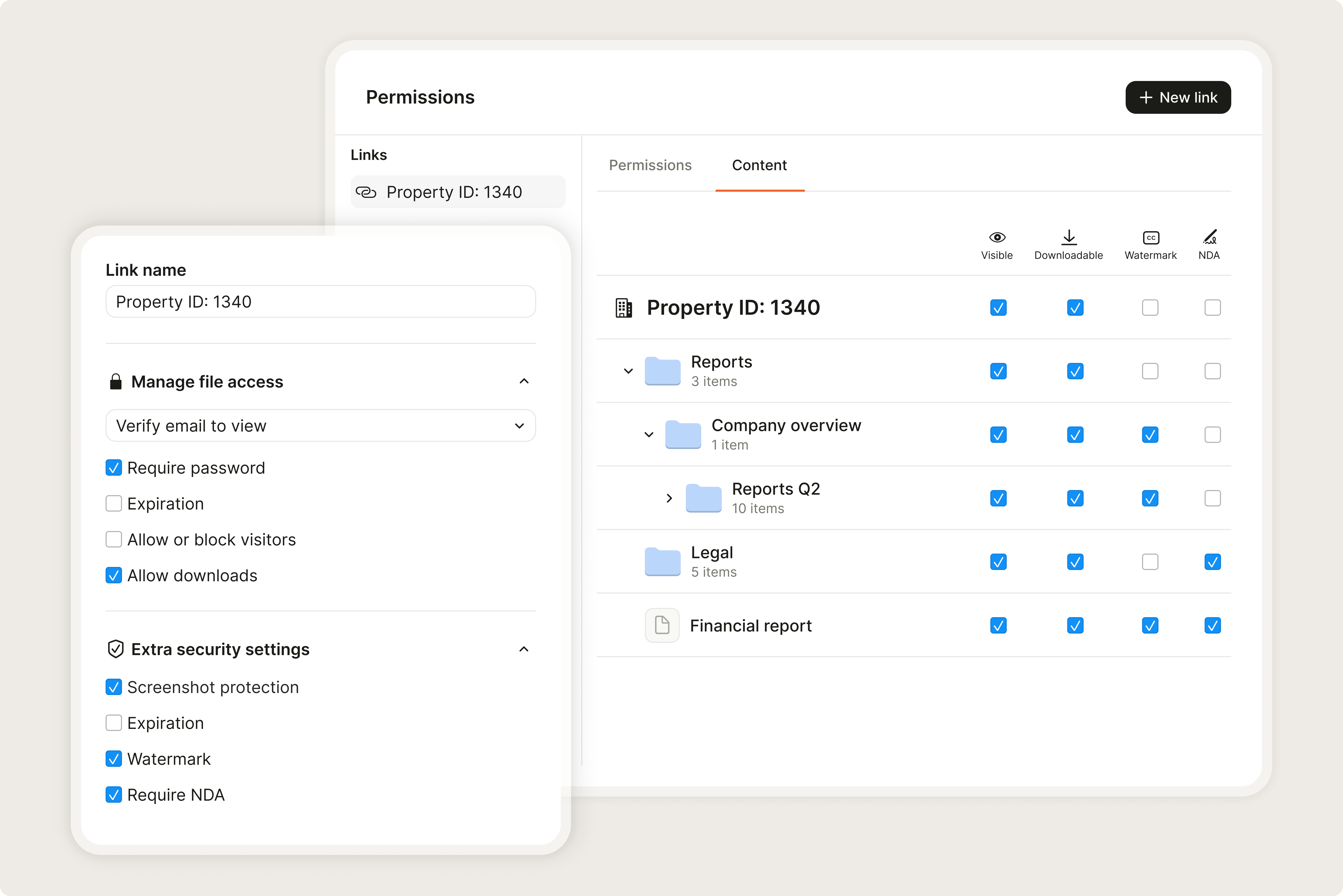
- 2.Give each advisor a scoped, tracked linkLegal counsel sees MOJ and Waqf docs. Tax advisors see ZATCA and VAT records. Technical consultants see building permits. Ellty enforces the scope.
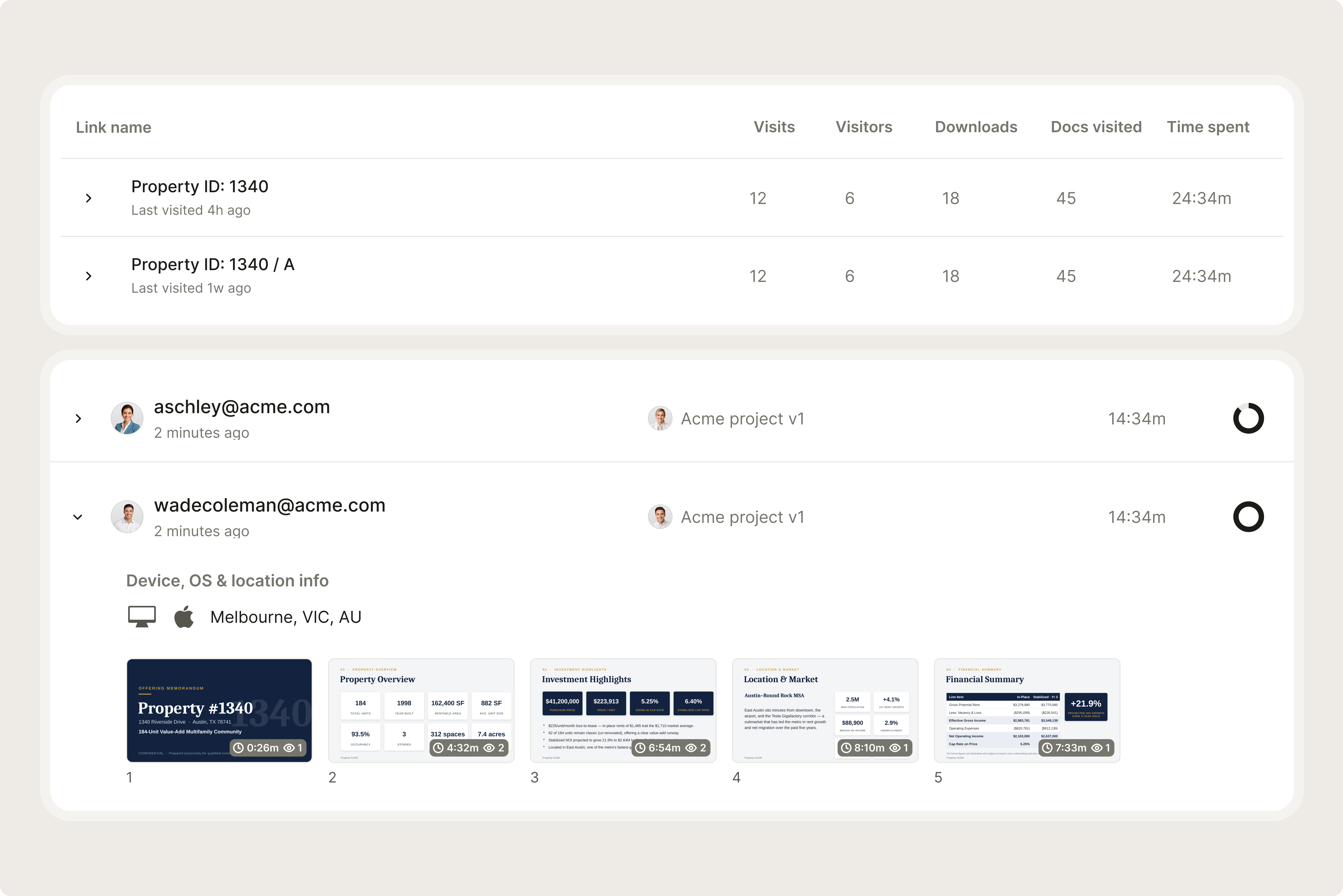
- 3.Monitor who reviews which documentsSee exactly which files each advisor opened and when. Catch delays before they affect the MOJ notary appointment and RETT payment deadline.
What makes Saudi Arabia different
Waqf land is the issue that doesn't exist in most Western real estate markets. Islamic endowment property is held permanently for religious or charitable purposes; it cannot be sold under any circumstances. A Waqf encumbrance on the title chain isn't a problem to negotiate around - it's the end of the deal. Check it first.
The 5% RETT is straightforward but significant. There are no regional variations, no size exemptions for commercial buyers, and no rollover or deferral mechanisms for portfolio reorganizations. At 5% of total consideration, it's a hard cash cost that must be in the model before any commercial discussion.
Foreign ownership requires MISA registration. This isn't a formality. The MISA license application involves submitting investment plans, financial statements, and corporate documentation to the Ministry of Investment. Start it at term sheet stage.
Vision 2030 has fundamentally changed Saudi zoning. Riyadh is being replanned at a scale not seen in any other city in the world. MOMRA zoning reclassifications, new development zones, and Royal Commission land acquisitions create a planning risk layer that requires a specific check on every Riyadh asset. What was a commercial-light industrial zone in 2020 may now be within a development authority's expansion plan.
The Real Estate Transaction Tax (RETT) was introduced by Royal Decree No. M/113 and implemented via Ministerial Decision 62 in October 2020. RETT is levied at 5% of the full consideration on all real estate transactions in the Kingdom, with limited exemptions for first residential home purchase by Saudi nationals. The tax must be calculated and paid electronically through ZATCA's RETA platform before the notarized transfer deed can be executed at the Ministry of Justice.
Timeline and cost in Saudi Arabia
Weeks 1-2 cover kickoff: MOJ deed extraction, Waqf status check, foreign ownership eligibility confirmation, RETA calculation, building permit search, Ejar lease verification, and NCEC environmental search. Budget SAR 30,000-80,000 for legal and advisory fees in this phase.
Load all files into Ellty before advisors start work. Saudi CRE deals generate significant document volume across multiple government systems (MOJ, REGA, MOMRA, ZATCA, SEC); centralizing them in one tracked data room prevents the document chase that inflates timelines.
Weeks 2-4 cover deep review: lease abstraction and Ejar compliance audit, building permit and completion certificate chain, Phase I ESA for industrial or logistics assets, RETT and VAT structure opinion from a Saudi-licensed tax advisor, and MISA license confirmation if required. Cost runs SAR 50,000-150,000 depending on asset complexity.
MISA license process: if the buyer requires a new MISA investment license, parallel-path this from week one. Applications typically take 2-4 weeks for straightforward commercial structures.
Weeks 4-8 handle resolution: outstanding municipality compliance items, Phase II ESA if triggered, RETT payment via ZATCA, and notarized transfer at MOJ. Closing itself is fast once all documents and taxes are in order; the notary appointment typically takes 1-2 hours.
Saudi Arabia total acquisition cost: 5% RETT + legal fees (SAR 30,000-80,000) + SVA appraisal + Phase I ESA. No stamp duty, no income tax, no capital gains tax. Total acquisition cost on a Saudi commercial deal runs approximately 5.5-6.5% of purchase price, dominated by the 5% RETT.
Running a Saudi Arabia property deal from one room
Hold MOJ deed docs, Ejar registrations, and lease files in one secure, tracked Ellty data room.
Start free 14-day trialCommon questions about due diligence on Saudi Arabia property
- Most Saudi CRE deals complete in 4-8 weeks. MOJ deed verification, municipality building permit checks, and MISA licensing for foreign buyers are the typical lead-time items. The notarized closing at MOJ is itself fast once all pre-conditions are satisfied.
- Non-GCC foreign buyers must hold a MISA (Ministry of Investment of Saudi Arabia) investment license to own commercial property in the Kingdom. GCC nationals have broader rights. Non-Muslim buyers cannot own any property within the Haram boundaries of Mecca or Medina.
- RETT (Real Estate Transaction Tax) is a 5% tax on the full transaction value for all Saudi property transfers, introduced in October 2020. It replaced the previous VAT treatment of some real estate transactions. RETT must be paid via ZATCA's online RETA platform before the notarized transfer deed can be executed at MOJ.
- Waqf (Islamic endowment) is land held permanently for religious or charitable purposes under Islamic law. Waqf land cannot be sold or transferred to private ownership under any circumstances. A Waqf encumbrance on a Saudi property title makes the asset untransferable. Confirm Waqf status via the MOJ deed and General Authority for Awqaf records before any commercial commitment.
- Ejar is REGA's (Real Estate General Authority) national lease registration platform. All Saudi commercial leases should be registered on Ejar to have full enforceability in REGA proceedings and Saudi courts. Unregistered leases are not void, but their legal standing is significantly reduced.
- Saudi property title is registered in the Ministry of Justice (MOJ) system via electronic deed (Sak Iliktroni). All transfers must be notarized before a Katib al-'Adl (notary public) at the MOJ. Saudi Arabia has moved to electronic deeds but some older properties still have paper deeds that must be migrated to the electronic system before transfer.