Ireland commercial property deals have two costs that aren't always in non-Irish buyers' models: 7.5% stamp duty on all commercial property transfers (one of the highest rates in Europe), and commercial rates arrears that create a first charge on the property and transfer automatically to the buyer unless cleared before closing. Both must be modeled and confirmed before signing.
Irish property title is managed by the Property Registration Authority (PRA), which operates the Land Registry (Torrens-style folio system) and the older Registry of Deeds. Urban commercial property is typically on the Land Registry; check which system applies.
Irish commercial transactions are handled by solicitors. There is no notary system. The buyer's solicitor requests a Requisitions on Title from the seller's solicitor; this is the standard Irish pre-contract enquiry process.
New commercial buildings are subject to Irish VAT (23%). For second-hand commercial buildings, the seller can waive the VAT exemption if both parties are VAT-registered. The election must be made before the contract.
Set up an Ellty data room before diligence opens. Load all PRA folio documents, planning permissions, and lease files before advisors arrive. Each advisor gets a scoped link from day one.
Where Irish deals actually go wrong
Not every check carries the same weight. The table below sorts risks by deal impact - dealbreakers first, then what moves the price, then basic hygiene - so your Irish solicitor and technical advisor know what to clear first.
| Area | Documents to pull | Ireland red flag | Matters most for | Tier | |
|---|---|---|---|---|---|
| Title and PRA folio | Title and PRA folio | PRA Land Registry folio, Registry of Deeds search, title deeds chain, burden and encumbrance search | Irish PRA Land Registry folio is the authoritative title source for registered land; confirm all burdens, mortgages, and encumbrances on the folio | All buyers | Dealbreaker |
| Commercial rates arrears | Commercial rates arrears | Commercial rates clearance certificate from local authority, rates account history, rateable valuation | Commercial rates arrears create a first charge on Irish commercial property; they transfer to the buyer automatically if not cleared before closing | All commercial property | Dealbreaker |
| Planning permissions and conditions | Planning permissions and conditions | Planning register search, Section 38 conditions register, planning permission history, fire certificate | Irish planning conditions can attach ongoing obligations to the property that run with the land; check all historic permission conditions | All assets | Dealbreaker |
| Environmental - MGP and contamination | Environmental - MGP and contamination | Phase I ESA, EPA contaminated land records, historical Ordnance Survey maps, UST records | Dublin, Cork, Limerick, and Waterford gasometer (manufactured gas plant) sites carry MGP contamination common in inner-city Irish locations | Industrial, inner-city brownfield | Dealbreaker |
| Leases and tenancies | Leases and tenancies | All leases, rent roll, Landlord and Tenant Acts compliance, break rights, lease renewal rights | Irish commercial tenants have renewal rights under the Landlord and Tenant (Amendment) Act 1980; check which leases have statutory renewal entitlements | Income-producing assets | Price-adjuster |
| Ground rent and fee simple title | Ground rent and fee simple title | Ground rent deed, fee simple acquisition status, Ground Rents Acts compliance | Older Irish commercial buildings may have historical ground rents; confirm these have been converted to fee simple or budget the conversion cost | Pre-1980 buildings | Price-adjuster |
| Stamp duty and VAT structure | Stamp duty and VAT structure | Stamp duty calculation, VAT waiver election eligibility, capital goods scheme analysis, Revenue confirmation | 7.5% stamp duty applies to all Irish commercial transfers; VAT waiver election is available for VAT-registered parties to make 23% IVA apply instead | All deals | Price-adjuster |
| Building and BER certificate | Building and BER certificate | BER certificate, SEAI register check, fire safety certificate, disability access certificate | BER (Building Energy Rating) certificate is mandatory for all Irish property transactions; the solicitor cannot complete without it | All commercial buildings | Price-adjuster |
| Insurance and valuation | Insurance and valuation | Current policies, loss run, OPW flood risk map check, subsidence risk, SCSI/RICS appraisal | OPW national flood mapping shows significant commercial flood risk in Cork city center, Shannon Estuary towns, and Dublin Tolka valley | All | Standard check |
| Utilities and services | Utilities and services | ESB electricity connection, Irish Water connection, broadband supply letter, access road | Irish Water connections in new developments can have long lead times; confirm active connection and supply capacity for the building | All | Standard check |
| Seller KYC and AML | Seller KYC and AML | CRO company extract, UBO register, Irish AML/CFT compliance by solicitor | Irish solicitors are designated persons under CJA 2010; they must perform KYC and UBO checks on all property transactions | All deals | Standard check |
Due diligence on an Ireland property?
Set up your Ellty data room before diligence starts.
Start free 14-day trialIreland CRE checklist
The table ranked risks by severity. This is the full list to work through, grouped by area.
Title and PRA folio
- Pull the PRA Land Registry folio for the property immediately on day one
- Confirm the registered owner on the folio matches the seller in all contracts and correspondence
- Check all burdens registered on the folio: mortgages, charges, easements, covenants, and notices
- For unregistered land (Registry of Deeds): confirm the full title deed chain with the seller's solicitor
- Confirm the property description, plan, and area on the folio matches the physical property
- For leasehold title: confirm the head lease terms, ground rent amount, and lessor consent for assignment
Commercial rates arrears
- Request a commercial rates clearance certificate from the local authority (Dublin City Council, Cork City Council, etc.)
- Confirm the rateable valuation from the Valuation Office and calculate the current annual rate liability
- Check all 4 years of commercial rates payments from the seller; unpaid rates create a first charge
- Confirm the local authority has no outstanding enforcement proceedings against the property for rates
- The Reval2019 revaluation process updated many Irish commercial rateable valuations; confirm the current valuation is correct
- Budget annual commercial rates as a key operating cost input; Irish commercial rates vary by local authority area
Planning permissions and conditions
- Run a planning register search for the property at the relevant local authority
- Pull the full planning permission history and all conditions attached to each permission
- Check for conditions that run with the land indefinitely (e.g., use restrictions, maintenance obligations)
- Confirm the disability access certificate and fire safety certificate are current and cover all current uses
- For development sites: check the local authority development plan and any pending Section 48 contributions
- Under the Planning and Development Act 2024: confirm the transitional arrangements and the new zoning frameworks if the property is subject to a live application
Environmental - MGP and contamination
- Commission a Phase I ESA for all commercial properties; use historical Ordnance Survey maps to identify past industrial uses
- For inner-city Dublin (Docklands, East Wall, Ringsend), Cork (Tivoli), and Limerick: check for MGP contamination from former gas works
- Search EPA records and Ordnance Survey historical maps for former industrial, petrol, or chemical activities on the site
- Budget Phase II ESA investigation (EUR 10,000-40,000) if Phase I identifies contamination indicators
- Check the EPA Integrated Pollution Control (IPC) licence register for any environmental licences held on the site
Leases and tenancies
- Collect all commercial leases and check statutory renewal rights under Landlord and Tenant (Amendment) Act 1980
- Confirm which tenants have vested statutory renewal rights (generally qualifying business tenants after 5 years)
- Check rent review clauses; Irish commercial leases historically used upward-only rent review (UORR); this was banned for new leases after 2010
- Cross-reference the rent roll against 12 months of actual receipts
- Confirm break clauses and the correct notice procedures for each lease
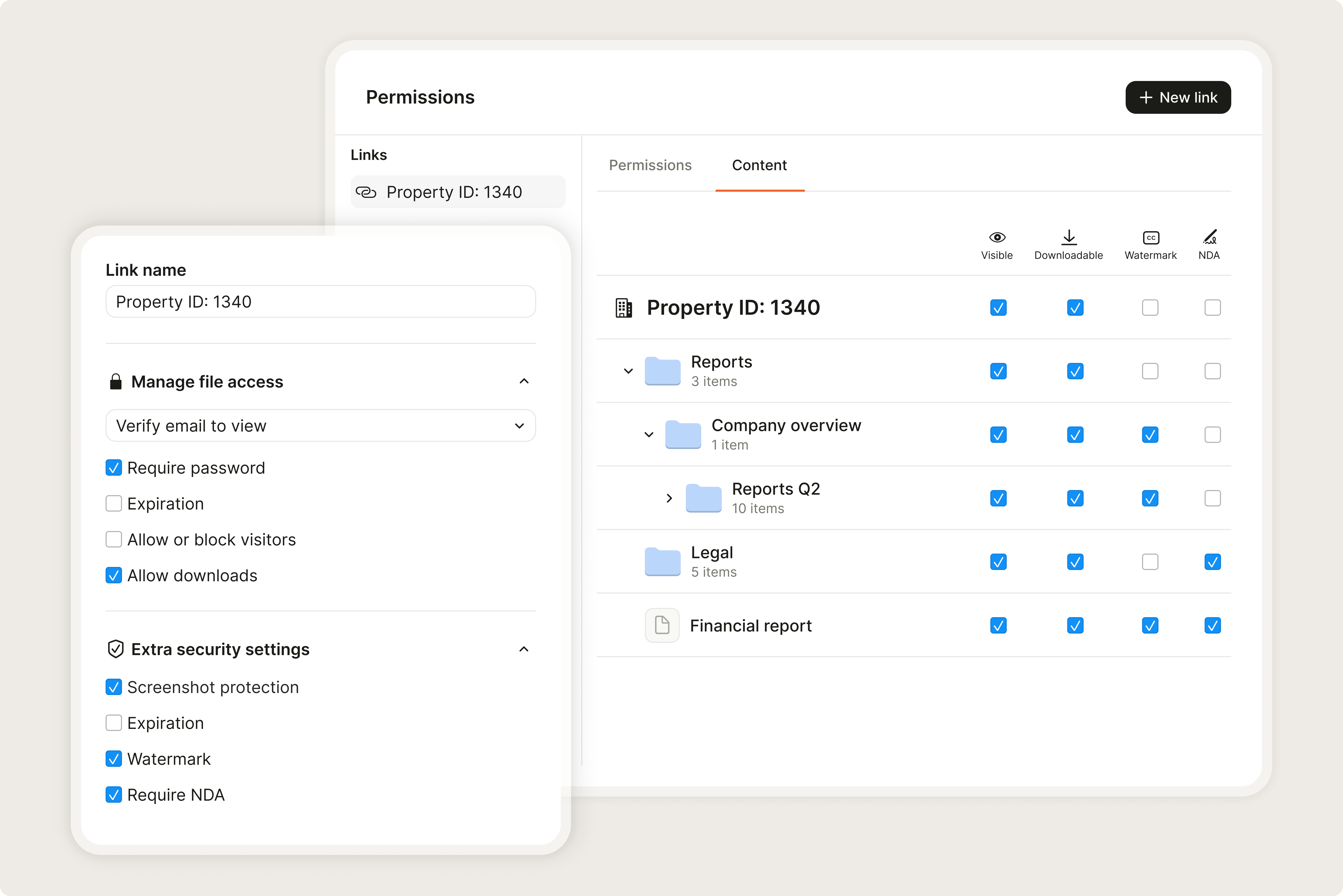
Give each advisor a scoped link in Ellty. The solicitor sees title and folio docs. Planning consultants see permission history. Environmental consultants see Phase I reports. No overlap.
Ground rent and fee simple title
- Confirm whether any historical ground rent attaches to the property
- For older Dublin, Cork, or Limerick city commercial buildings: check for annual ground rent leases under the Ground Rents Acts
- Most historical Irish ground rents can be converted to fee simple under the Landlord and Tenant (Ground Rents) Acts 1978-2019
- Check the PRA folio for any note of outstanding ground rent; if not on the folio, confirm with the seller's solicitor
- Budget the fee simple acquisition cost if a ground rent still attaches; the process is straightforward but takes 3-6 months
Stamp duty and VAT structure
- Confirm the stamp duty liability: 7.5% of consideration for all Irish commercial property transfers
- For new commercial buildings: 23% Irish VAT applies on top of stamp duty (or instead of it in some structures)
- For second-hand commercial buildings: VAT exemption applies unless the seller waives it
- Both parties must be VAT-registered for a waiver of exemption; the election must be made before the contract is signed
- Under the Capital Goods Scheme (CGS): confirm the seller's CGS adjustment obligations and any VAT clawback exposure
- For large transactions: consider the Ireland stamp duty refund scheme for construction of commercial-to-residential conversions
Building and BER certificate
- Confirm the BER (Building Energy Rating) certificate is registered with SEAI and is current
- Missing BER delays completion; the solicitor cannot close without it
- Check the energy rating (A1 to G); Irish commercial buildings often rate E or F
- For buildings where repositioning is planned: commission an energy upgrade cost estimate before bidding
- Confirm fire safety certificate, disability access certificate, and any PSDP (principal contractor) documentation for recent works
Insurance and valuation
- Pull current insurance policies and 3-year loss run from the seller
- Check OPW (Office of Public Works) national flood risk maps for the property
- Cork city center, Limerick city, and Dublin's Tolka River valley carry significant commercial flood risk; confirm coverage is available and confirm terms
- Order a SCSI (Society of Chartered Surveyors Ireland) or RICS-certified independent valuation for lender requirements
Seller KYC and AML
- Pull a CRO (Companies Registration Office) certificate of good standing for the selling entity
- Confirm all beneficial owners; Irish solicitors are required to perform UBO verification under the Criminal Justice Act 2010
- Run a sanctions and PEP check against the seller and all identified UBOs before committing to the deal
How due diligence in Ireland works
Step 1 - PRA folio and commercial rates
Pull the PRA folio and the commercial rates clearance request simultaneously on day one. Commercial rates arrears are often the last thing seller's lawyers disclose proactively; get the rates account history upfront.
The 7.5% stamp duty liability must be modeled before any offer is made. On a EUR 20M Dublin commercial deal, that's EUR 1.5M in stamp duty payable within 30 days of the deed. It's non-recoverable and has no regional variation.
Step 2 - Planning history and conditions
Request the planning register search and all condition history from the local authority. Irish planning conditions from permissions issued in the 1980s and 1990s can include annual reporting, landscaping maintenance, and access management obligations that new owners inherit.
Check the BER certificate registration with SEAI at the same time. If it's expired or was never issued, order it immediately; solicitors cannot close without a valid BER.
Step 3 - Leases and statutory renewal rights
Identify which commercial tenants have vested statutory renewal rights under the 1980 Act. These are tenants who have occupied for 5 or more years for business purposes. When their lease expires, they have a right to a new tenancy unless the landlord establishes grounds for refusal under the Act.
Compare Canada's commercial property diligence process if you hold North American and European portfolios. Both countries apply GST/VAT going concern exemptions to commercial property, and both require specific pre-contract election documentation - Ireland's VAT waiver and Canada's HST election must both be in the agreement before signing.
Step 4 - Environmental review
Commission Phase I ESA for any urban commercial site with pre-1990 industrial use. Dublin Docklands, Ringsend, and East Wall were significant industrial zones; Tivoli in Cork had major industrial port use. MGP contamination from former gas works is particularly common in inner-city Ireland.
Load all Phase I ESA, EPA register searches, and historical map overlays into Ellty. Environmental advisors, lenders, and the buyer's solicitor each get tracked, watermarked access from one secure link.
Step 5 - Closing via Irish solicitor
Irish commercial property closings are handled by solicitors. The purchaser's solicitor prepares the requisitions on title, reviews the vendor's responses, and certifies title. Closing occurs when the executed deed and funds are exchanged.
Stamp duty must be filed with Revenue online and paid within 30 days of execution. Late filing triggers interest and penalties. The purchaser's solicitor handles the stamp duty filing.
How to set up your Ireland data room in Ellty.
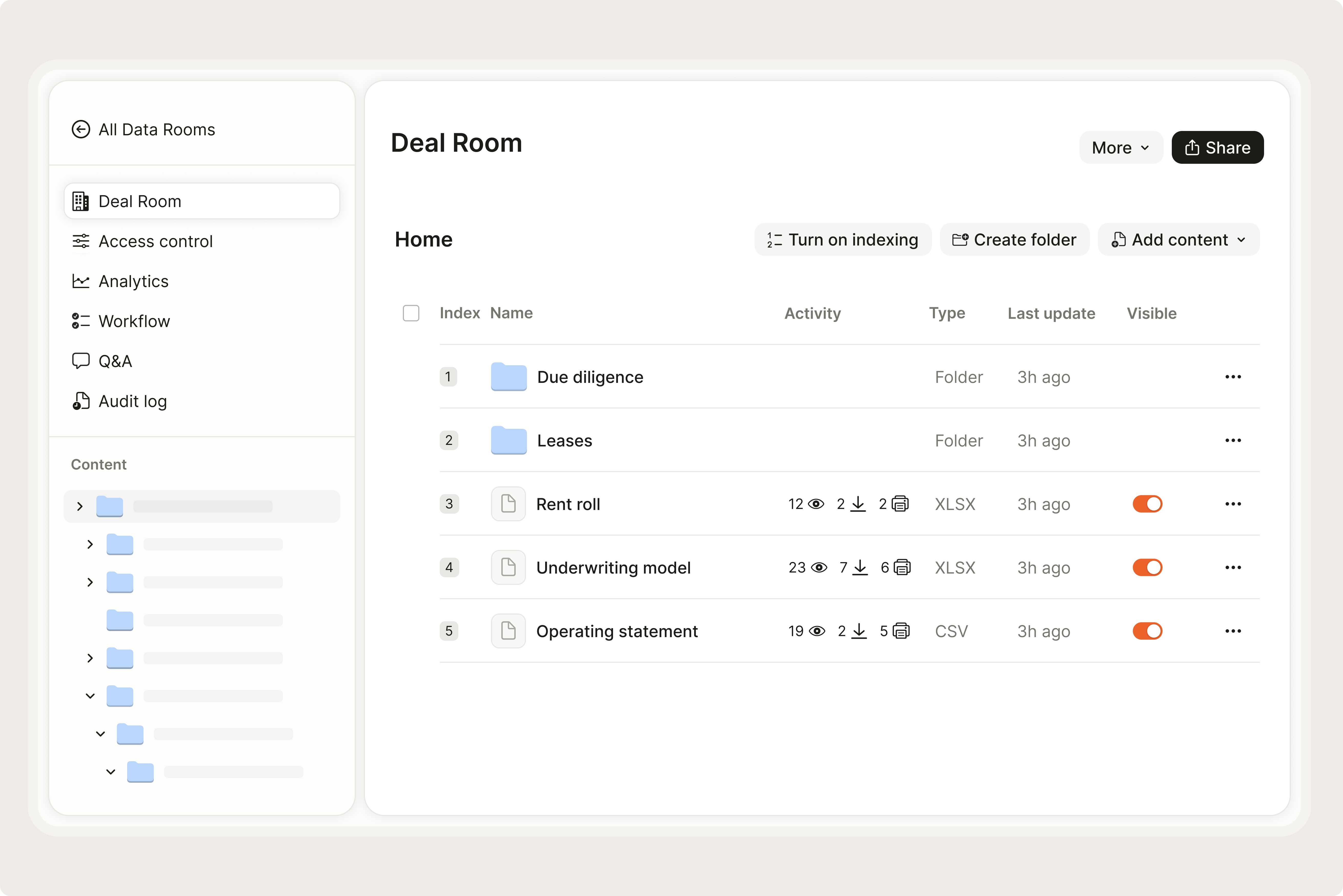
Irish CRE deals involve PRA title, local authority planning, commercial rates, and EPA records across multiple weeks. Load files into Ellty before advisors arrive. Each advisor gets a scoped, tracked link from day one.
- 1.Upload Irish property files to a secure roomDrop PRA folio, planning permissions, commercial rates certs, leases, BER certificate, and Phase I ESA into Ellty.
- 2.Give each advisor a scoped, tracked linkYour solicitor sees PRA and rates docs. Environmental consultants see Phase I reports. Lease lawyers see the full lease pack. Ellty enforces the scope.
- 3.Monitor who reviews which documentsSee exactly which files each advisor opened and when. Catch delays before they affect the deed execution and 30-day stamp duty deadline.

What makes Ireland different
The 7.5% commercial stamp duty is one of the highest in Europe. It applies to every commercial property transfer without exception. There are no regional variations, no first-time buyer relief for commercial purchasers, and no share deal structure that reliably avoids it (unlike Sweden's share deal route). For a EUR 15M Dublin office, that's EUR 1.125M in stamp duty.
Commercial rates arrears follow the property, not the seller. The local authority holds a first charge on Irish commercial property for unpaid rates. Every Irish CRE buyer should get a rates clearance certificate before any deposit is paid. If the seller's rates are in arrears, the purchase price either needs to be adjusted downward or the arrears cleared from the sale proceeds at completion.
Statutory lease renewal rights under the 1980 Act affect the value of every income-producing Irish commercial asset. Business tenants with 5+ years of continuous occupation have a right to a new tenancy. This affects lease expiry cash flow models, exit strategies, and the ability to redevelop.
MGP contamination is the most common environmental issue in Irish brownfield commercial sites. Former gas works (gasometer sites) operated in Dublin, Cork, Limerick, Waterford, and other cities up to the 1970s. Phase I ESA using historical Ordnance Survey maps is essential for any inner-city Irish site.
Commercial rates are a charge on the occupier of rateable property. However, under Irish law, where rates remain unpaid at the time of a property transfer, the local authority holds a first and paramount charge on the property itself. This charge binds the new owner regardless of whether the new owner was aware of the arrears at the time of purchase. A clearance certificate from the local authority is the only reliable protection for a purchaser against inheriting a rates liability.
Timeline and cost in Ireland
Weeks 1-2 cover kickoff: PRA folio search, commercial rates clearance certificate request, planning register search, BER certificate check, stamp duty and VAT structure analysis, and Phase I ESA engagement. Budget EUR 3,000-8,000 for this phase.
Load all files into Ellty before advisors arrive. Scoped, tracked links for each party remove at least one week of document exchange emails from a standard Irish CRE diligence process.
Weeks 2-4 cover deep review: Phase I ESA delivery, full planning condition review, lease abstraction and renewal rights check, commercial rates history, ground rent status confirmation, and BER certificate regularization if needed. Cost runs EUR 5,000-18,000 depending on complexity.
Statutory renewal rights review adds 1-2 weeks for multi-tenanted commercial assets; each tenancy must be individually assessed against the 1980 Act qualifying criteria.
Weeks 4-6 handle resolution: Phase II if triggered, Requisitions on Title exchange between solicitors, completion, and stamp duty filing with Revenue. Stamp duty must be paid within 30 days of deed execution; PRA registration follows within 4-8 weeks.
Ireland total acquisition cost: 7.5% stamp duty + legal fees EUR 15,000-40,000 + survey/PCA + BER. Total acquisition cost on an Irish commercial deal runs approximately 8-9% of purchase price. Commercial rates add an ongoing annual operating cost that must be fully reconciled from the selling date.
Running an Ireland property deal from one room
Hold PRA folio docs, planning certs, and lease files in one secure, tracked Ellty data room.
Start free 14-day trialCommon questions about due diligence on Ireland property
- Most Irish CRE deals complete in 4-8 weeks. Commercial rates clearance, planning condition review, and Phase I ESA for brownfield sites are the typical lead-time items.
- Commercial stamp duty in Ireland is 7.5% of consideration for all non-residential property transfers. It is due within 30 days of deed execution and must be filed online with Revenue. Late filing triggers interest and penalties.
- Commercial rates are an annual local authority charge on commercial property occupiers, based on the rateable valuation determined by the Valuation Office. Unpaid commercial rates create a first charge on the property that transfers to the new owner if not cleared before closing. Always request a rates clearance certificate before any deposit is paid.
- The BER (Building Energy Rating) certificate is a mandatory energy performance certificate for all Irish buildings. It rates energy performance from A1 (most efficient) to G. A solicitor cannot close a property transaction without a valid BER certificate registered with SEAI.
- Yes. Under the Landlord and Tenant (Amendment) Act 1980, commercial tenants who have been in continuous occupation for 5+ years for business purposes have a statutory right to a new tenancy when their lease expires. This right applies unless the landlord establishes specific grounds for refusal under the Act.
- Yes. New commercial buildings are subject to 23% Irish VAT. For second-hand commercial buildings, the sale is usually VAT-exempt, but the seller can waive the exemption if both parties are VAT-registered. The waiver election must be made before the contract is signed. A VAT-registered buyer who receives a VAT invoice can recover the input VAT.