Iceland commercial property due diligence has two constraints that catch foreign buyers off guard: non-EEA nationals and companies generally cannot own Icelandic real property without a special Ministry of Justice permit, and Iceland's geological risk - volcanic eruptions, earthquakes, and geothermal ground instability - is a material property risk that has no equivalent in most European commercial markets.
Iceland Stamp Duty (stimpilgjald) on commercial property transfers: 1.6% of the purchase price for legal entities (companies); 0.8% for individuals; paid to the Icelandic Treasury at the time of registration; this is Iceland's main transaction tax as there is no standalone real estate transfer tax or capital gains tax; gains from commercial property sales by companies are included in corporate income tax (CIT at 20%); gains for individuals may be taxable as income depending on holding period and other factors.
Registers Iceland (Þjóðskrá Íslands) maintains the national property register (Fasteignaskrá Íslands) covering all registered real property in Iceland. Each property has a unique property identity number (fastanúmer). The register contains: cadastral information, ownership records, building data, and all registered encumbrances (mortgages/veðbönd, rights/réttindir, restrictions/kvöð, charges/kvaðir). Property transfers in Iceland take effect against third parties only upon registration at Registers Iceland.
The 2023-2024 Reykjanes Peninsula volcanic eruptions (Grindavík) brought volcanic and lava flow risk directly into commercial property diligence discussions in Iceland for the first time since modern institutional markets developed. For commercial on the Reykjanes Peninsula or within defined lava hazard zones: geological risk assessment and review of the Iceland Met Office (Veðurstofa Íslands) lava flow hazard mapping are now standard pre-purchase checks.
Set up a real estate data room before advisors engage. Load the Registers Iceland property extract, title documentation, building permit, occupancy certificate, geological risk assessment, catastrophe insurance records, and lease files.
Where Iceland property deals go wrong
Not every check carries the same weight. The table below sorts risks by deal impact - dealbreakers first, then what moves the price, then basic hygiene - so your Icelandic attorney and advisor know what to clear first.
| Area | Documents to pull | Iceland red flag | Matters most for | Tier | |
|---|---|---|---|---|---|
| Registers Iceland property extract | Registers Iceland property extract | Property extract from Registers Iceland (Þjóðskrá Íslands) showing ownership, cadastral data, and all encumbrances; title deed (kaupsamningur or skjal) chain from seller; building details from Fasteignaskrá | Registers Iceland (Þjóðskrá Íslands) maintains the national property register (Fasteignaskrá); the extract shows: registered owner(s), property identity number (fastanúmer), lot area, building area, construction year, building use category, assessed value, and all registered encumbrances (mortgages/veðbönd, rights/réttindir, restrictions/kvöð); obtain an official extract from Registers Iceland for the specific fastanúmer; confirm the registered owner matches the seller; review all registered encumbrances; confirm property area and use category match the intended commercial use; ownership transfer takes effect against third parties only upon registration of the transfer deed at Registers Iceland | All buyers - foundational check | Dealbreaker |
| Foreign ownership - EEA vs. non-EEA | Foreign ownership - EEA vs. non-EEA | Buyer's nationality/domicile (for individuals) or place of incorporation (for companies), Ministry of Justice special permit (for non-EEA buyers), Iceland legal counsel opinion on buyer eligibility | Iceland's Act on the Right of Ownership and Use of Real Property (Act No. 19/1966, as amended) restricts foreign ownership of Icelandic real property; EEA nationals (EU/EEA citizens and companies) can own Icelandic commercial real property freely since 2002 when the EEA Agreement came into force; non-EEA nationals (including US, UK post-Brexit, Canadian, Australian, Chinese, and most other nationalities) and companies incorporated outside the EEA generally require a special permit from the Ministry of Justice (Dómsmálaráðuneytið) to acquire real property in Iceland; exceptions may exist for commercial property acquired in connection with a business operation approved under Icelandic law; confirm buyer eligibility with Icelandic counsel before any offer; non-EEA buyers should start the permit application process early as it can take 1-3 months | All non-EEA buyers of Iceland commercial | Dealbreaker |
| Volcanic and lava flow risk | Volcanic and lava flow risk | Iceland Met Office (Veðurstofa Íslands) lava hazard zone mapping, Iceland Geosurvey (ÍSOR) geological assessment for the property area, Reykjanes Peninsula volcanic risk classification | Iceland sits on the Mid-Atlantic Ridge and is one of the most volcanically active regions on Earth; the 2023-2024 series of volcanic eruptions on the Reykjanes Peninsula (near Grindavík) destroyed property in the town of Grindavík and forced repeated evacuations; this brought volcanic risk from a historical abstraction to an active CRE risk consideration; the Reykjanes Peninsula - which includes Keflavik International Airport, the Blue Lagoon, and a significant amount of light industrial and logistics commercial - is in an active volcanic zone; Iceland's Met Office publishes hazard zone maps for volcanic activity; for any commercial property on the Reykjanes Peninsula or other active volcanic zones: review the property's hazard zone classification; also confirm Catastrophe Insurance (Viðlagatrygging) coverage; Iceland's mandatory catastrophe insurance scheme covers certain categories of volcanic damage but terms must be confirmed for commercial properties | All commercial on Reykjanes Peninsula; logistics/industrial near Keflavik Airport | Dealbreaker |
| Mortgages and encumbrances | Mortgages and encumbrances | Registers Iceland extract (encumbrance section), mortgage holder (veðhafi) discharge confirmation, any registered rights of way (vegréttindi) or utility easements | All mortgages (veðbönd) and encumbrances are registered at Registers Iceland and appear in the property extract; Iceland's registration system is constitutive - encumbrances only bind third parties after registration; review all registered mortgages and confirm they will be discharged at or before closing; registered easements (kvöð) and restrictions (réttindir) on the property extract should be reviewed for any impact on commercial use; also check for any pre-registration of rights by neighboring land owners (nágrannalög, neighboring land law provisions can affect some commercial development) | All buyers | Dealbreaker |
| Building permit and occupancy certificate | Building permit and occupancy certificate | Building permit (byggingarleyfi) from municipality, final inspection certificate (lokaúttektarvottorð or vottorð um lokaúttekt), planning authority confirmation | Icelandic planning law (Skipulagslög and Mannvirkjalög) requires a building permit (byggingarleyfi) from the competent municipality for all commercial construction; after construction, a final inspection (lokaúttekt) must be carried out and a final inspection certificate (lokaúttektarvottorð) issued before the building can lawfully be used; buildings without a completed final inspection are in irregular status; confirm the building permit and final inspection certificate from seller; for older commercial buildings: records from the municipal building authority (the competent authority varies by municipality; in Reykjavik: Skipulagsfulltrúi and Byggingarfulltrúi) hold permit records | All Iceland commercial buildings | Price-adjuster |
| Seismic and geothermal ground risk | Seismic and geothermal ground risk | Iceland Met Office seismic risk zone mapping, ÍSOR (Iceland Geosurvey) geothermal hazard assessment for the location, structural engineer assessment for seismic compliance of older buildings | Iceland is in one of the world's highest seismic activity zones; the South Iceland Seismic Zone (SISZ) runs east of Reykjavik and has historically produced major earthquakes (the 2000 Suðurland earthquakes reached M6.5); the Capital Region and Reykjanes Peninsula are also seismically active; Iceland's building code requires seismic design for commercial buildings; older commercial buildings (pre-1990s) may not comply with current seismic standards; geothermal ground risk is a separate issue in areas with active geothermal fields - ground subsidence and sulfur contamination can affect foundations and structural integrity; for commercial in geothermal areas (areas east of Reykjavik, some industrial zones): geothermal ground assessment is recommended | All Iceland commercial; especially older buildings and geothermal zone commercial | Price-adjuster |
| Zoning and planning (skipulag) | Zoning and planning (skipulag) | Municipal master plan (aðalskipulag) and local plan (deiliskipulag) for the property, Skipulagsstofnun (National Planning Agency) search for any planning restrictions | Iceland's planning system: the National Planning Agency (Skipulagsstofnun) oversees planning at the national level; municipalities adopt master plans (aðalskipulag) and local detailed plans (deiliskipulag); the local plan governs permitted use, building heights, coverage, and FAR for each parcel; commercial use in a residentially designated area is not permitted without a plan amendment; for the Reykjavik Capital Region: review the current deiliskipulag for the parcel and confirm permitted commercial use and development rights; planning restrictions for areas near sensitive habitats, coastlines, lava fields, or flood plains add another dimension to Iceland planning due diligence | All Iceland commercial, development sites | Standard check |
| Leases and tenancies | Leases and tenancies | All commercial leases, rent roll, registered lease annotations at Registers Iceland (for leases over 3 years), Icelandic tenancy law provisions | Iceland commercial leases are governed by the Leases Act (Húsaleigulög); commercial leases over 3 years should be registered at Registers Iceland to be binding on a purchaser; unregistered longer-term leases may still create obligations depending on notice; confirm all commercial leases - review for term, rent review (typically indexed to Iceland's Consumer Price Index, CPI, which has been high at times), notice provisions, and any tenant rights of first refusal; Iceland has experienced periods of high inflation (CPI peaked over 10% in 2022-2023) and CPI-linked commercial leases are common; model CPI escalation history and CPI-linked rent provisions carefully when underwriting | Tenanted Iceland commercial | Standard check |
| Catastrophe insurance and mandatory coverage | Catastrophe insurance and mandatory coverage | Viðlagatrygging Íslands (Iceland Catastrophe Insurance) coverage confirmation, current insurance premium payment status, commercial property insurance policy, volcanic and earthquake damage coverage terms | Iceland has a mandatory state-backed catastrophe insurance scheme (Viðlagatrygging Íslands) funded by a levy on all insured property; the scheme provides compensation for losses from natural catastrophes including earthquakes, volcanic eruptions, landslides, and certain floods; all property owners must carry property insurance through a licensed Icelandic insurer, which includes the catastrophe levy; confirm current insurance policy is in force with no payment gaps; after the 2023-2024 Grindavík eruptions, the catastrophe insurance system was reviewed and coverage terms for volcanic risk to commercial property were updated; confirm current commercial coverage terms with the insurer for any property in active volcanic or seismic risk zones | All Iceland commercial, especially Reykjanes Peninsula | Standard check |
| Annual property tax (fasteignagjald) | Annual property tax (fasteignagjald) | Property tax payment history from municipality, assessed value from Registers Iceland, tax clearance from municipality | Iceland's annual property tax (fasteignagjald) is levied by municipalities on the assessed value of all real property; the assessed value (fasteignamat) is determined by Registers Iceland based on a mass valuation updated annually; commercial rates vary by municipality and use type; confirm current-year fasteignagjald payments are current; obtain a tax clearance from the relevant municipality before closing; also confirm the assessed value (fasteignamat) which determines the property tax base - Registers Iceland publishes the fasteignamat for all registered properties | All Iceland commercial | Standard check |
| Seller KYC and AML | Seller KYC and AML | Icelandic Company Registry (Fyrirtækjaskrá) entity confirmation, UBO confirmation, OFAC and EU/EEA sanctions screens | Iceland is an EEA member and implements EU AML directives through Icelandic legislation; confirm seller entity at Fyrirtækjaskrá (Icelandic Company Registry); identify UBOs; run OFAC and EU/EEA sanctions screens on all principals; Icelandic attorneys conducting property transactions are AML-regulated persons; Iceland's FIU (Fjármálaeftirlitið - Financial Supervisory Authority) oversees AML compliance | All deals | Standard check |
Due diligence on an Iceland property?
Set up your Ellty data room before diligence starts.
Start free 14-day trialIceland commercial property due diligence checklist
The table ranked risks by severity. This is the full checklist to work through, grouped by area.
Registers Iceland search and title
- Day one: obtain an official property extract from Registers Iceland (Þjóðskrá Íslands, fasteignaskrá.is) for the property's fastanúmer (property identity number); the extract shows registered owner, property area, building details, assessed value (fasteignamat), and all registered encumbrances
- Confirm the registered owner matches the seller's name exactly; review all registered encumbrances (mortgages/veðbönd, restrictions/kvöð, rights/réttindir); confirm all mortgages will be discharged before or at registration of the transfer
- Confirm the property's registered use category is consistent with the intended commercial use; if the use category is residential or mixed and the buyer intends commercial use: a planning use change application is required before or after purchase
- Confirm the assessed value (fasteignamat) from the Registers Iceland extract; this is the tax base for fasteignagjald (property tax) and is updated annually by Registers Iceland using a mass valuation method
Give each advisor a scoped link in Ellty. Icelandic attorney sees property extract, title deed chain, and encumbrance detail. Building inspector sees building permit and final inspection certificate. Geological risk consultant sees ÍSOR assessment and IMO hazard zone maps. Lender sees property extract, assessed value, catastrophe insurance, and valuation.
Foreign ownership check - EEA vs. non-EEA buyers
- Confirm the buyer's nationality (for individuals) or place of incorporation (for companies) before any deposit or binding offer; EEA buyers (EU plus Iceland, Liechtenstein, Norway) are unrestricted; non-EEA buyers generally need a special permit
- For non-EEA buyers: apply to the Ministry of Justice (Dómsmálaráðuneytið) for a special permit to acquire real property; permit applications require documentation of the buyer's identity, the intended use of the property, and any other information requested by the Ministry; processing time is typically 4-12 weeks; permits are generally granted for commercial property acquisitions related to business operations but are not automatic
- UK post-Brexit: UK nationals and UK-incorporated companies are non-EEA for Iceland foreign ownership purposes and generally require a permit; this affects UK-based funds and real estate companies considering Iceland commercial acquisitions
- US-based buyers: US nationals and US-incorporated companies require a permit; confirm with Icelandic counsel and start the permit process before signing any binding agreement; a purchase agreement conditional on permit receipt is the standard approach for non-EEA buyers
Volcanic and seismic risk assessment
- For any commercial property on the Reykjanes Peninsula or in areas identified as within volcanic hazard zones by the Iceland Met Office (Veðurstofa Íslands): review the current hazard zone classification from IMO; request a geological risk opinion from ÍSOR (Iceland Geosurvey, ísor.is) or a licensed Icelandic geological engineer
- The 2023-2024 Reykjanes Peninsula eruption series destroyed residential property in Grindavík and damaged infrastructure on the Peninsula; the eruptions have prompted a formal review of volcanic risk zoning and insurance coverage terms for the Peninsula; for any Reykjanes commercial (logistics near Keflavik Airport, Blue Lagoon adjacent commercial, industrial in Grindavík area): assume volcanic risk is an active due diligence item and not historical background
- Seismic risk: confirm the building's construction year and seismic design standard compliance; Icelandic building codes have included seismic design requirements for decades, but older commercial buildings may predate current standards; for commercial in the South Iceland Seismic Zone (SISZ) or near active fault systems: commission structural assessment from a licensed Icelandic structural engineer
- Geothermal ground: for commercial in areas with active geothermal fields (high-temperature geothermal areas, identified on ÍSOR maps): request ground stability assessment; geothermal areas can have ground subsidence, sulfur contamination, and hot spring activity that affects foundations
Load files into Ellty. Icelandic attorney sees property extract and title. Geological risk consultant sees ÍSOR assessment and IMO hazard maps. Building inspector sees permits and final inspection certificate. Insurance advisor sees catastrophe insurance policy and coverage terms. Catastrophe insurance terms for volcanic commercial coverage should be reviewed immediately post-2024 given policy updates.
Building permit and final inspection
- Request building permit (byggingarleyfi) from seller; verify with the competent municipal building authority (for Reykjavik: Skipulags- og byggingarfulltrúi; for other municipalities: the respective authority); Iceland's national building permit database has been expanding but verification with the local authority remains the most reliable check
- Request final inspection certificate (lokaúttektarvottorð) from seller; this is the document confirming the building was inspected after construction and is fit for its designated use; confirm from the municipal building authority that the certificate was properly issued
- For any building additions or alterations since original construction: confirm separate building permits exist for the additions; unauthorized additions to Icelandic commercial buildings are a compliance risk even though enforcement has been inconsistent historically
- Fire safety: confirm commercial buildings comply with fire safety requirements from the Administration of Occupational Safety and Health (Vinnueftirlitið) and the fire authority (slökkvilið); fire safety inspections are required for commercial buildings
Compare Norway's commercial property due diligence process for Nordic portfolio strategy. Iceland and Norway are both non-EU Nordic countries outside the EU's political framework (Norway through EEA, Iceland through EEA); both have foreign ownership rules for non-EEA buyers; but differ substantially on geological risk (Iceland: high volcanic and seismic risk vs. Norway: minimal), market size (Norway: much larger and more institutionally developed), and currency risk (both use their own currencies, not Euro - ISK and NOK both subject to exchange rate volatility for Euro-denominated investors).
How due diligence works in Iceland
Step 1 - Property extract and buyer eligibility
Day one: pull Registers Iceland property extract. Confirm buyer eligibility (EEA vs. non-EEA). If non-EEA: start Ministry of Justice permit process immediately.
For Reykjanes Peninsula or other volcanic zone commercial: treat geological risk check as parallel track 1, not a later phase.
Step 2 - Building permits and geological risk
Request building permit and final inspection certificate from seller. Verify with municipal authority. For seismically exposed or geothermally active locations: commission ÍSOR geological assessment.
Review current IMO volcanic hazard zone classification for the property. Confirm catastrophe insurance coverage terms.
Step 3 - Leases, planning, and AML
Abstract all commercial leases. Check CPI indexation terms and escalation history. Confirm lease registration status at Registers Iceland. Review deiliskipulag for planning compliance. Run OFAC and AML screens. Confirm seller at Fyrirtækjaskrá.
Step 4 - Stamp duty, registration, and closing
Transfer of commercial property in Iceland: the deed of transfer (kaupsamningur or skjal) is signed by both parties; submitted for registration at Registers Iceland together with the Stamp Duty payment (1.6% of purchase price for a company buyer); registration completes the transfer.
Load closing files into Ellty before signing. Icelandic attorney sees all title documents. Lender sees property extract with clean encumbrance record post-discharge.
How to set up your Iceland data room in Ellty.
Iceland commercial deals involve Registers Iceland property extract, title deed, building permit, final inspection certificate, ÍSOR geological assessment, IMO volcanic hazard maps, catastrophe insurance policy, and commercial lease files.
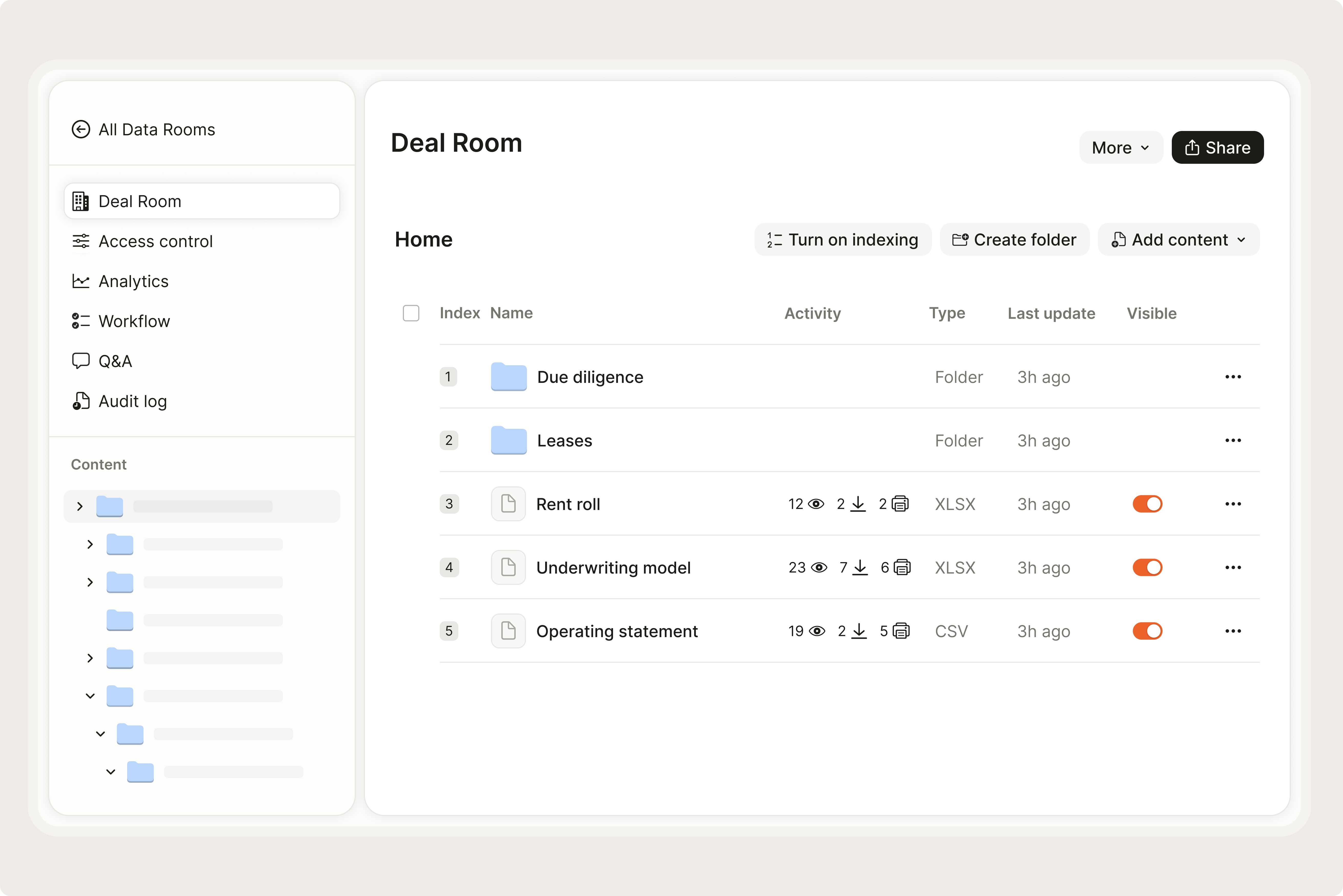
- 1.Upload Iceland property files to a secure roomDrop Registers Iceland property extract, title deed chain, building permit, final inspection certificate (lokaúttektarvottorð), ÍSOR geological assessment, IMO volcanic hazard zone map, catastrophe insurance policy, property tax clearance, planning deiliskipulag extract, and commercial lease pack into Ellty.
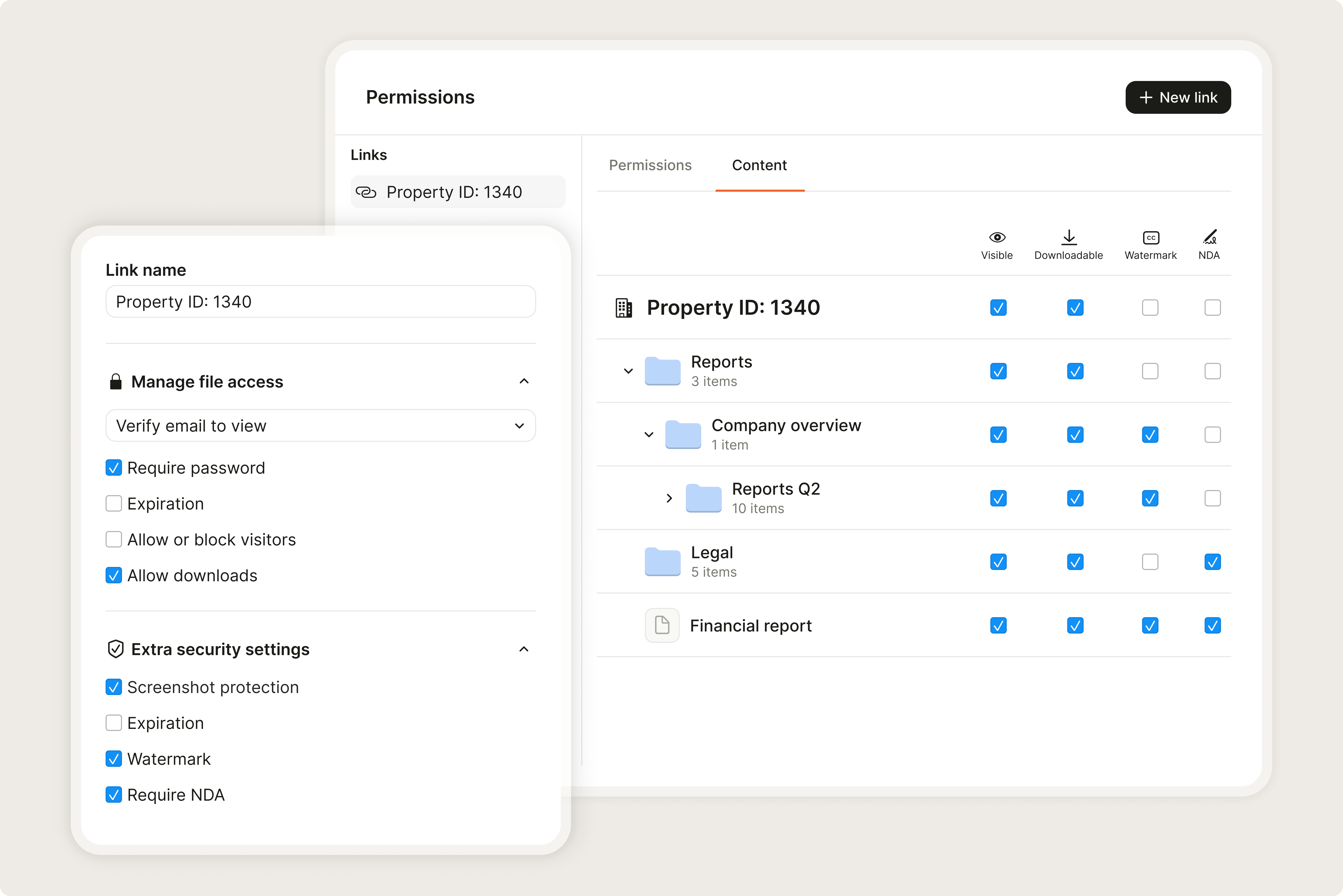
- 2.Give each advisor a scoped, tracked linkIcelandic attorney sees property extract and title deed. Building inspector sees building permit and final inspection certificate. Geological risk consultant sees ÍSOR assessment and IMO hazard maps. Insurance advisor sees catastrophe insurance terms. Lender sees property extract, valuation, and insurance. Each party sees only their files.
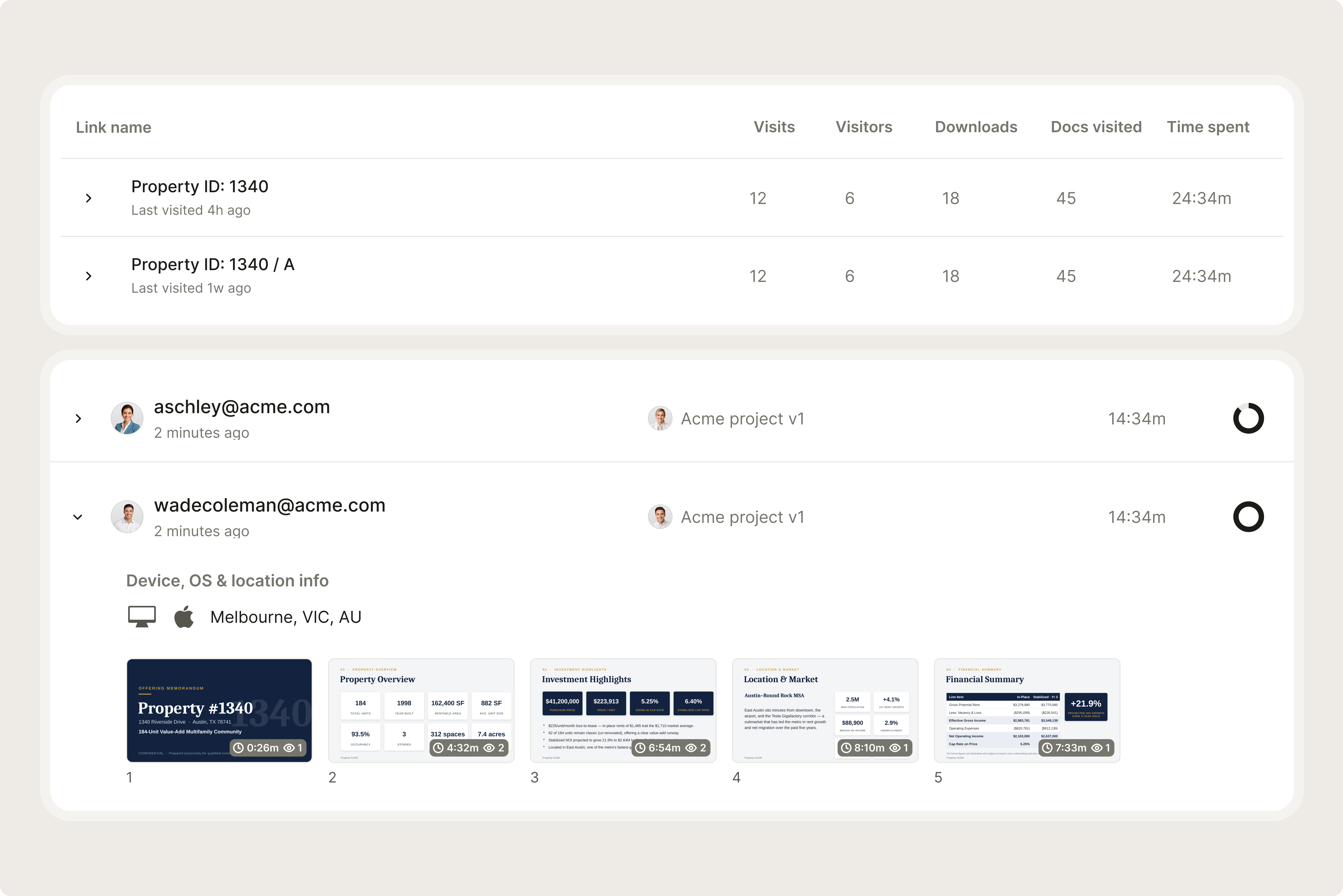
- 3.Monitor who reviews which documentsSee exactly which files each advisor opened and when. Catch geological risk gaps or foreign ownership permit requirements before they stall the deal.
What makes Iceland different
The Reykjanes Peninsula eruptions of 2023-2024 fundamentally changed how Iceland commercial real estate risk is assessed by institutional investors. Prior to 2023, Iceland's volcanic history was acknowledged as a background geological fact but treated as an insurably remote risk for most commercial property purposes - Iceland had not had a significant eruption affecting inhabited areas or commercial infrastructure in the Capital Region for decades. The Reykjanes eruptions - which included repeated lava advances toward Grindavík town, evacuation of the entire Grindavík population, destruction of residential properties, and damage to the Blue Lagoon's geothermal facilities - changed this risk perception fundamentally. Commercial real estate on the Reykjanes Peninsula, which includes significant logistics and industrial assets near Keflavik International Airport (Iceland's only commercial airport), light industrial zones, and tourist commercial around the Blue Lagoon, is now subject to active volcanic risk diligence that simply wasn't standard practice in 2020. Iceland's mandatory catastrophe insurance scheme (Viðlagatrygging Íslands) provides some protection but the coverage terms for commercial volcanic damage were under review post-2024; buyers of any Reykjanes Peninsula commercial must specifically confirm current commercial volcanic damage coverage terms with the insurer and Icelandic insurance counsel before closing.
Iceland's foreign ownership restriction is the most commonly overlooked structural issue for non-EEA commercial investors approaching Iceland for the first time. The restriction under Act No. 19/1966 is not widely publicized outside Iceland, and many non-EEA buyers (including US institutional investors, Canadian pension funds, UK post-Brexit real estate companies, and Asian institutional investors) assume that a developed OECD economy like Iceland operates like the UK or Germany in terms of open foreign property ownership. It doesn't. Non-EEA nationals and companies need a special permit from the Ministry of Justice before they can acquire real property. The permit is generally available for legitimate commercial investment but it is not automatic, it requires an application with documentation, and processing takes weeks to months. For a transaction with a defined closing timeline, the permit application timeline must be built into the deal schedule - a conditional purchase agreement with closing subject to permit receipt is the standard structure for non-EEA buyers. Icelandic legal counsel familiar with the permit process is essential; international law firms without Icelandic specialists regularly fail to identify this issue until late in diligence.
Iceland's small market size is a relevant risk factor that overlaps with all commercial due diligence conclusions. The Iceland commercial real estate market is dominated by Reykjavik Capital Region office, retail, and hospitality; logistics and industrial in the Reykjanes corridor and Hafnarfjörður area; and a tourism-driven hospitality sector in various locations. The institutional buyer universe for commercial property exits is very limited: a handful of Icelandic pension funds (lífeyrissjóður), Icelandic institutional investors, and a small number of foreign funds with dedicated Iceland mandates. This thin exit market affects cap rate underwriting (liquidity premium is real), leverage availability (Icelandic bank financing for commercial is available but terms differ from Western European markets), and timing risk (achieving a quality exit in a specific year requires active management of the sale process). Any investor targeting Iceland commercial should model the exit market depth as part of the hold-period analysis, not as an afterthought.
Act No. 19/1966 on the Right of Ownership and Use of Real Property (Lög um eignarrétt og afnotarétt fasteigna), as amended, provides in Article 2 that foreign nationals are generally prohibited from owning real property in Iceland unless they have resided in Iceland for at least 5 years. Exemptions from this restriction were established by Act No. 59/1997 for nationals of EEA states, granting EEA citizens and EEA-based companies the right to acquire real property in Iceland on the same basis as Icelandic nationals, effective when the EEA Agreement came into force for Iceland. The Ministry of Justice (Dómsmálaráðuneytið) has authority to grant special permits for real property acquisition by non-EEA nationals and companies in specific circumstances, including for commercial and industrial activities in Iceland subject to criteria set by ministerial regulation.
Timeline and cost in Iceland
Weeks 1-2 cover kickoff: Registers Iceland property extract, buyer EEA/non-EEA eligibility confirmation, Ministry of Justice permit application (if non-EEA), building permit and final inspection certificate verification with municipal authority, volcanic and seismic risk assessment commission (for Reykjanes or seismically active locations), catastrophe insurance coverage terms review, planning deiliskipulag extraction, lease abstraction, AML/KYC, and seller entity at Fyrirtækjaskrá. Icelandic counsel fees in this phase: ISK 300,000-1,000,000 (approx. EUR 2,000-7,000).
Load all files into Ellty before advisors engage. Standard Iceland commercial: 30-60 days. Non-EEA foreign ownership permit: 4-12 weeks additional. ÍSOR geological assessment: 3-6 weeks.
Weeks 2-4 cover deep review: property extract encumbrance analysis, building permit vs. registered area comparison, final inspection certificate status, geological risk assessment delivery, volcanic hazard zone classification, catastrophe insurance commercial coverage terms, lease CPI indexation review, planning compliance confirmation, stamp duty calculation, and lender pre-approval. Costs in this phase: ISK 500,000-2,000,000 (approx. EUR 3,500-14,000).
Weeks 4-8 handle resolution: mortgage discharge, geological risk mitigation assessment (if needed), insurance renewal or adjustment, lease registration confirmation, non-EEA ownership permit receipt (if applicable), stamp duty payment, deed of transfer registration at Registers Iceland.
Iceland total buyer acquisition costs: 1.6% stamp duty (on purchase price, for company buyers) + Icelandic attorney fees + registration fees (modest) + geological risk assessment fee + insurance premium adjustment. Total effective buyer-side cost: 2-4% of transaction value. No capital gains tax on investment commercial (gains included in CIT at 20%). Annual fasteignagjald (property tax) by municipality is an ongoing cost to model.
Running an Iceland property deal from one room
Hold Registers Iceland extract, volcanic risk assessment, building permits, and lease files in one secure, tracked Ellty data room.
Start free 14-day trialCommon questions about due diligence on Iceland commercial property
- Standard Iceland commercial deals take 30-60 days. Ministry of Justice foreign ownership permit for non-EEA buyers: 4-12 weeks (parallel track). ÍSOR geological risk assessment: 3-6 weeks. Building permit and final inspection certificate verification: 1-2 weeks. Registers Iceland registration of transfer after closing: typically completed within a few business days of submission.
- Generally not without a special permit. Iceland's Act No. 19/1966 restricts foreign property ownership. EEA nationals and EEA-incorporated companies (EU plus Iceland, Norway, Liechtenstein) can own Iceland commercial property freely since 2002. Non-EEA nationals and companies - including US, UK post-Brexit, Canadian, Australian, Chinese, and most others - generally need a special permit from the Ministry of Justice. Permits are available for legitimate commercial investment purposes but must be applied for and take 4-12 weeks to process. A purchase agreement conditional on permit receipt is the standard approach for non-EEA buyers.
- Iceland Stamp Duty (stimpilgjald) is 1.6% of the purchase price for company buyers (legal entities) of commercial real property. For individual buyers purchasing residential property: 0.8%. Stamp Duty is paid to the Icelandic Treasury at the time of registration of the transfer deed at Registers Iceland. There is no separate real estate transfer tax. Corporate income tax at 20% applies to gains from commercial property sales by Icelandic or foreign companies.
- Very serious for property on or near the Reykjanes Peninsula post-2023. The 2023-2024 series of eruptions on the Reykjanes Peninsula destroyed Grindavík residential property, repeatedly evacuated the town, and damaged Blue Lagoon facilities. Commercial on the Reykjanes Peninsula - including logistics near Keflavik Airport and light industrial zones - is in an active volcanic hazard zone. Iceland's Met Office publishes volcanic hazard zone maps; ÍSOR provides geological assessments. Iceland's mandatory catastrophe insurance (Viðlagatrygging) covers certain volcanic damage but coverage terms for commercial volcanic risk were under review post-2024. For Reykjanes commercial: treat geological risk as a dealbreaker-tier check.
- Iceland's annual property tax (fasteignagjald) is levied by municipalities on the assessed value (fasteignamat) of real property; the fasteignamat is determined by Registers Iceland and updated annually using a mass valuation method. Commercial property tax rates vary by municipality and use type. The fasteignamat is also used for stamp duty purposes (1.6% is applied to the purchase price, not the fasteignamat, but the fasteignamat is a reference point). Confirm current fasteignagjald payments are current and obtain municipal tax clearance before closing.
- Seismic risk applies throughout Iceland but is highest in the South Iceland Seismic Zone (SISZ) east of Reykjavik and on the Reykjanes Peninsula. The 2000 Suðurland earthquakes reached M6.5. Iceland's building code requires seismic design; older commercial buildings may not comply with current standards. Geothermal ground risk applies in areas with active geothermal fields - ground subsidence, sulfur contamination, and hot spring activity can affect building foundations. Commission structural assessment (for seismic compliance) and ÍSOR geothermal ground assessment for commercial in high-temperature geothermal zones outside established commercial areas.