Hong Kong commercial property has one structural fact that shapes every deal: there is no freehold. All land is owned by the SAR government; private 'ownership' is a government leasehold. Most leases run to 2047. The practical diligence risks are unauthorized building works (UBW), outstanding Land Registry memorials, Stamp Duty on commercial transactions up to 7.5%, and government lease modification costs.
Hong Kong Stamp Duty on commercial (non-residential) property: Ad Valorem Stamp Duty (AVD) at scale rates up to 7.5% of the higher of consideration or market value; for transactions over HKD 6 million (roughly USD 770,000 - well below any commercial deal) the effective rate is 7.5% flat; there is no Capital Gains Tax in Hong Kong; no Buyer's Stamp Duty (BSD) on commercial (BSD applies only to residential); no Additional Stamp Duty (ASD) on commercial. Total buyer acquisition cost from taxes: 7.5% of purchase price plus solicitors' fees.
Hong Kong's Land Registry (土地註冊處) maintains all registered interests in land by reference to government lease (地契). Each parcel has a series of memorials recording every registered transaction: assignments (title transfers), mortgages (charges), restrictive covenants, occupation permits, and government orders. The government lease itself is in the memorial chain. A Land Registry search pulls all memorials for a given parcel and is the primary title search tool.
All land in Hong Kong is held on government lease from the HKSAR Government (under the Basic Law, China's sovereign authority); these leases have specific expiry dates; under the Basic Law, existing leases with fewer than 50 years remaining as of July 1, 1997 were extended by 50 years (i.e., to a new expiry not earlier than 2047); most commercial leases in prime locations now expire 2047 or beyond; for institutional investors with hold periods extending toward 2047: the lease extension beyond 2047 is a policy risk that requires specific attention.
Set up a real estate data room on day one. Load the government lease, all Land Registry memorials, title deeds, occupation permit, Buildings Department search results, Deed of Mutual Covenant (if strata-title), UBW records, and lease files before solicitors engage.
Where Hong Kong property deals go wrong
Not every check carries the same weight. The table below sorts risks by deal impact - dealbreakers first, then what moves the price, then basic hygiene - so your Hong Kong solicitor and advisor know what to clear first.
| Area | Documents to pull | Red flag | Matters most for | Tier | |
|---|---|---|---|---|---|
| Land Registry search and memorial chain | Land Registry search and memorial chain | Official Land Registry search (all memorials), government lease (地契, dikei), title deeds (assignment chain), certified copies of registered memorials for material encumbrances | Hong Kong Land Registry maintains a consecutive record of all registered interests in each parcel through memorials; the search shows the government lease, every registered assignment (title transfer), every registered mortgage or charge, every registered restriction or covenant, and every government order (including UBW removal orders and requisitions); conduct an official Land Registry search on the parcel before any deposit is paid; solicitors examine the complete memorial chain to confirm the seller has good title and that no adverse interests are registered; check that the seller's name in the most recent assignment memorial matches the vendor's identity in the sale and purchase agreement | All buyers - foundational check | Dealbreaker |
| Unauthorized Building Works (UBW) | Unauthorized Building Works (UBW) | Buildings Department (BD) search (屋宇署搜查), BD orders registered in Land Registry, occupation permit (OP) from BD, approved building plans from BD records | Unauthorized Building Works (UBW) are additions or alterations to a building carried out without prior approval from the Buildings Department under the Buildings Ordinance (Cap. 123); UBW is endemic in Hong Kong commercial buildings - enclosed balconies, internal partitioning, additional floors, rooftop structures, and external projections are frequently added without BD authorization; when the BD identifies UBW, it issues a removal order (拆卸令, chaichaili) registered in the Land Registry; outstanding UBW removal orders are a registered encumbrance that transfers with the property to a buyer; request a BD search to confirm current removal orders; confirm all registered UBW orders in the Land Registry memorial chain; the cost of complying with UBW removal orders (structural work plus architect's fees) is often substantial and a major negotiating point | All HK commercial buildings, especially older strata-title | Dealbreaker |
| Government lease terms and permitted use | Government lease terms and permitted use | Government lease (地契, dikei) - full copy from Land Registry, Modification Letter (if any permitted use has been modified), Conditions of Exchange (for newer leases), government lease expiry date | The Hong Kong government lease specifies: the permitted use of the land (office, retail, industrial, mixed), the lot area, the gross floor area limit, and sometimes specific restrictions; using the property for a purpose outside the permitted use in the government lease is a breach of the lease covenant; review the government lease's permitted use clause against the intended commercial use; if the current use or intended use does not match the permitted use: a Modification Letter from the Lands Department is required; this takes time (6-12 months) and requires payment of a land premium assessed by the government; the land premium for a modification to increase GFA or change permitted use can be very substantial - model this cost before any offer on a property requiring modification | Buyers intending to change use, industrial-to-commercial conversions | Dealbreaker |
| Mortgages and charges | Mortgages and charges | Land Registry search (all registered mortgages and charges in memorial chain), discharge of mortgage confirmation from bank, corporate charges search at Companies Registry (for company sellers) | All mortgages and charges over Hong Kong commercial property must be registered at the Land Registry to be binding on a bona fide purchaser for value; an unregistered mortgage is not binding on a buyer who has no actual notice of it; always conduct the Land Registry search close to closing to catch any registrations lodged after the initial search; for corporate sellers: also search the Companies Registry (公司註冊處) for charges registered over the company's assets (which may not all be separately registered in the Land Registry); HK companies must register charges at Companies Registry within 5 weeks of creation; corporate seller's Companies Registry search confirms no floating charges or fixed charges over the property asset | All buyers, especially where seller is a HK company | Dealbreaker |
| Occupation permit and building compliance | Occupation permit and building compliance | Occupation Permit (OP) from Buildings Department records, Certificate of Compliance (CC) for government land grant conditions, approved building plans from Buildings Department | The Occupation Permit (OP) is issued by the Buildings Department after the building passes a structural and fire safety inspection confirming it can lawfully be occupied; a building without an OP cannot legally be occupied; for buildings constructed before OPs were commonly issued (pre-1970s buildings), the occupation record may be found in the predecessor document chain rather than a formal OP; request the OP from the seller and confirm it matches the building's current configuration; also confirm the Certificate of Compliance (CC) for the government land grant conditions (if a CC requirement was included in the Conditions of Exchange for the government lease) | All HK commercial buildings | Price-adjuster |
| Stamp Duty calculation and structure | Stamp Duty calculation and structure | Stamp duty calculation from HK solicitors (IRD scale rates for non-residential), buyer identity confirmation (company vs. individual HK permanent resident vs. non-permanent resident) | Hong Kong Ad Valorem Stamp Duty (AVD) on non-residential (commercial) property: calculated on a sliding scale on the higher of consideration or market value; for transactions over HKD 6 million: flat 7.5%; for deals under HKD 6 million: lower scale rates apply (minimum 1.5%); no Buyer's Stamp Duty on commercial property (BSD only applies to residential); no Additional Stamp Duty (ASD) on commercial; Stamp Duty is payable by the buyer; if the transaction is structured as a share sale of a company holding the property, Stamp Duty on shares is 0.2% of consideration (versus 7.5% on a direct property transfer) - this is why property-holding companies are a common transaction structure in HK commercial; confirm with solicitors whether a share sale structure is appropriate and the tax implications | All buyers - 7.5% is a major cost | Price-adjuster |
| Deed of Mutual Covenant - strata title | Deed of Mutual Covenant - strata title | Deed of Mutual Covenant (DMC, 公契), management fee records, owners' corporation (OC) meeting minutes, management accounts, sinking fund balance | Most Hong Kong commercial buildings are strata-titled; individual commercial units are owned separately within a multi-owner building governed by a Deed of Mutual Covenant (DMC); the DMC defines: each unit's undivided share in the building (which determines management fee contribution), permitted uses for each unit, common area management rights and obligations, owners' corporation rules, and restrictions on alterations; review the DMC to confirm the commercial use in the target unit is within the permitted use category; review management fee obligations and current payment status; review owners' corporation accounts for any pending special assessments or major repair costs (building facade, lifts, fire services) that will fall on the buyer post-closing | Strata-title commercial unit buyers in HK | Price-adjuster |
| Leases and tenancies | Leases and tenancies | All commercial leases, rent roll, Land Registry registration of leases over 3 years, Landlord and Tenant (Consolidation) Ordinance compliance | Hong Kong commercial leases for over 3 years must be registered in the Land Registry to be binding on a purchaser; unregistered leases over 3 years are not binding on a buyer with no notice of them; confirm which leases are registered; HK commercial leases commonly include break clauses, step-up rent reviews, and management fee pass-through provisions - review for any adverse clauses affecting NOI; confirm current rental amounts and next review dates; and confirm no side letters or informal agreements with tenants exist outside the formal lease document | Tenanted HK commercial | Price-adjuster |
| Environmental and contamination | Environmental and contamination | EPD (Environmental Protection Department) listed sites search, Phase I ESA from licensed environmental consultant, Environmental Permit search (for regulated processes) | Hong Kong's Environmental Protection Department (EPD) maintains a database of listed contaminated sites under the Waste Disposal Ordinance and related legislation; former industrial areas in Hong Kong (Kwun Tong, Tsuen Wan, Sham Shui Po, Tuen Mun industrial estates) have documented soil and groundwater contamination from historical manufacturing; search the EPD listed sites database before any industrial-zone or former-industrial commercial acquisition; for buildings with regulated processes (EPD Environmental Permit required for certain processes): confirm the Environmental Permit is current and transferable; Phase I ESA recommended for any industrial conversion commercial | Former industrial, Kwun Tong/Tsuen Wan/Tuen Mun commercial | Standard check |
| 2047 government lease expiry | 2047 government lease expiry | Government lease term from Land Registry (expiry date), legal advice on post-2047 extension policy, institutional lender appetite assessment for 2047-expiry leases | All Hong Kong government leases have expiry dates; under the Basic Law, leases expiring before 2047 were extended to 2047; what happens after 2047 is governed by China-HK policy, which remains uncertain; for commercial deals with a hold period extending toward 2047: institutional lenders have varying policies on lease-to-expiry; some banks begin increasing the collateral margin or reducing loan-to-value for leases with under 30 years remaining; exit risk (ability to sell close to 2047 at full price) affects cap rate underwriting for long-hold investors; the 2047 risk is not dealbreaker for most transactions today but must be modeled in any DCF analysis beyond 2035 | Institutional investors with long hold periods | Standard check |
| Seller KYC and AML | Seller KYC and AML | HK Companies Registry entity confirmation, UBO identification, OFAC/US, EU, and HKSAR sanctions screens | HK solicitors conducting property transactions are regulated persons under the Anti-Money Laundering and Counter-Terrorist Financing Ordinance (AMLO, Cap. 615) and must perform customer due diligence on all clients in property transactions; confirm seller entity at HK Companies Registry (for corporate sellers); identify UBOs; run OFAC, EU, and HKSAR-specific sanctions screens on all principals; HK has seen increased OFAC activity targeting persons and entities connected to specific HK political and business networks since 2020 - confirm screening is thorough and current | All deals, cross-border sellers | Standard check |
Due diligence on a Hong Kong property?
Set up your Ellty data room before diligence starts.
Start free 14-day trialHong Kong commercial property due diligence checklist
The table ranked risks by severity. This is the full checklist to work through, grouped by area.
Land Registry search and title chain
- Conduct an official Land Registry search on the parcel (Lot reference number) on day one; the search produces a complete memorial schedule showing every registered interest in the property in chronological order; HK solicitors can conduct this online through the Land Registry's IRIS system or in person
- Review the memorial chain from the government lease forward: confirm the chain of assignments leads unbroken to the current seller; confirm the seller named in the most recent assignment memorial matches the vendor in the sale and purchase agreement
- Check every memorial for encumbrances: registered mortgages and charges, restrictive covenants, UBW removal orders from the Buildings Department, government requisitions, lis pendens annotations, and any other adverse registrations
- Re-run the Land Registry search close to closing (within a few days of completion) to catch any memorials lodged between the initial search and the completion date; new encumbrances can be registered at any time and a fresh search is standard HK practice immediately before closing
Give each advisor a scoped link in Ellty. HK solicitors see Land Registry search, government lease, title deeds, DMC, and all registered memorials. Building surveyor sees approved building plans, occupation permit, and BD search results. Environmental consultant sees EPD listed site records and Phase I ESA. Lender sees Land Registry search, valuation, and lease files.
Unauthorized Building Works - BD search and removal orders
- Request a Buildings Department (BD) search on the building to confirm any outstanding UBW removal orders issued by BD; these are separately registered in the Land Registry but also appear in BD records; cross-reference BD records and the Land Registry memorial chain
- Engage a licensed architect or building surveyor to inspect the property and compare the as-built condition against the approved building plans on record at BD; any structure not in the approved plans that was added after initial occupation is potentially UBW and may be subject to a future removal order even if BD hasn't identified it yet
- For strata-title commercial: UBW in common areas or structural elements (unauthorized additions to the building structure or facade) are the owners' corporation's problem collectively; for an individual unit: UBW within the unit (internal partitioning added without BD approval, enclosed balcony, structural opening in walls) are the individual owner's problem; confirm both building-level and unit-level UBW status
- Outstanding UBW removal orders must be disclosed and resolved; either the seller clears them before closing (costs the seller) or the buyer takes a price reduction; carrying over unresolved removal orders creates enforcement risk and affects mortgage financing eligibility
Government lease and permitted use
- Obtain a full copy of the government lease from the Land Registry memorial chain; review the permitted use clause, lot area, and GFA limit specified in the lease
- Confirm the current use of the property matches the permitted use in the government lease; typical permitted uses: office, retail, commercial, industrial, hotel, residential; if the building has a mixed-use government lease: confirm the specific floors or areas allocated to each use category
- Government lease modification (Modification Letter from Lands Department): required if the buyer intends to change the use, increase the GFA, or redevelop beyond what the lease permits; modifications involve: an application to Lands Department, government assessment of land premium (a significant payment reflecting the market value of the additional rights being granted), and time (6-12 months for most modifications); model modification cost before any offer on industrial-to-commercial or industrial-to-office conversion commercial
- Confirm the government lease expiry date; for most prime HK commercial the lease runs beyond 2047; note the expiry date in the data room and flag for lender and DCF purposes
Stamp Duty planning
- Confirm whether the acquisition structure is a direct property transfer (7.5% AVD applies to the commercial property) or a share purchase of the property-holding company (0.2% stamp duty on shares applies to the shares)
- For direct commercial property transfer: AVD is 7.5% of the higher of the consideration or the Stamp Duty Office's assessed market value; if the Stamp Office assesses the market value higher than the agreed consideration, AVD is calculated on the higher value; confirm the Stamp Duty exposure before finalizing the acquisition structure
- Share sale structure: widely used in HK commercial to reduce stamp duty from 7.5% to 0.2% on shares; however, a share sale requires additional corporate diligence on the property-holding company (any other liabilities, deferred tax, potential group structure issues); the Inland Revenue Department can challenge share sale structures as stamp duty avoidance in certain circumstances; confirm with HK tax counsel
- No Capital Gains Tax in Hong Kong: the absence of CGT is a major advantage of HK commercial for investors; neither property appreciation nor gain on sale is taxed as capital gain; profits tax may apply if the IRD determines property trading was the taxpayer's business activity - but for investment commercial, this is generally not an issue
Load all files into Ellty before solicitors engage. HK solicitors see the Land Registry search, government lease, title deeds, and DMC. Building surveyor sees approved BD plans and occupation permit. Environmental consultant sees EPD site records. Lender sees Land Registry search, UBW status, government lease, and valuation report.
DMC and management obligations for strata title
- Request and review the Deed of Mutual Covenant (DMC) for any strata-title commercial acquisition; the DMC is registered in the Land Registry memorial chain and is binding on all owners; confirm permitted use for the target unit against the DMC use restrictions
- Management fee: confirm the monthly management fee for the unit (based on undivided shares assigned in the DMC); obtain the latest management accounts from the building's property management company or owners' corporation to confirm the building is in good financial health with no large upcoming special assessments
- Sinking fund: confirm the sinking fund balance from the management accounts; a depleted sinking fund with aging building infrastructure (lifts, fire services, external facade) means a large special assessment is likely; factor the potential special assessment into the purchase price
- Owners' corporation decisions: obtain recent owners' corporation meeting minutes; major decisions (facade repair, structural works, change of property manager) can create significant cost obligations for all unit owners; review the last 2 years of OC meeting minutes
Compare Singapore's commercial property due diligence process for Asia-Pacific commercial strategy. Hong Kong and Singapore are both major Asia-Pacific commercial hubs with leasehold land systems, no Capital Gains Tax, and common law legal frameworks - but differ on Stamp Duty (HK 7.5% AVD on commercial vs. Singapore no ABSD on commercial, only 0.2% Buyer's Stamp Duty at top rate), foreign ownership (both open, no restrictions), and the 2047 lease risk unique to HK government leases.
How due diligence works in Hong Kong
Step 1 - Land Registry search and BD search
Day one: conduct Land Registry search on the parcel to pull all memorials. Request Buildings Department search for UBW removal orders and approved building plans. Engage HK solicitors to examine the title chain and memorial schedule.
Don't pay any substantial deposit without confirming title is clear of material adverse memorials and UBW removal orders.
Step 2 - Government lease, DMC, and environmental
Obtain government lease from the memorial chain. Review permitted use clause and GFA limit. For strata-title: obtain DMC from vendor's solicitors and review management accounts.
For former industrial or Kwun Tong/Tsuen Wan commercial: commission Phase I ESA with EPD listed site search.
Step 3 - Leases, Stamp Duty structure, and AML
Abstract all commercial leases. Confirm which leases over 3 years are registered in the Land Registry. Finalize Stamp Duty structure with HK solicitors (direct property vs. share sale).
Run AMLO-compliant AML/KYC. Run OFAC and sanctions screens on all principals. Confirm Companies Registry search for corporate seller.
Step 4 - Completion and Land Registry registration
HK completion (closing) takes place at the offices of the vendor's solicitors. The vendor's solicitors hold the title deeds and execute the assignment. Stamp Duty must be paid to the Stamp Office within 30 days of the date of the assignment. The assignment is then registered at the Land Registry.
Load all files into Ellty before closing. HK solicitors see Land Registry search updated on completion day. Lender sees discharge of vendor's mortgage before completion funds are released.
How to set up your Hong Kong data room in Ellty.
Hong Kong commercial deals involve Land Registry memorial search, government lease, title deeds, BD search results, occupation permit, approved building plans, DMC, management accounts, EPD records, and lease files.
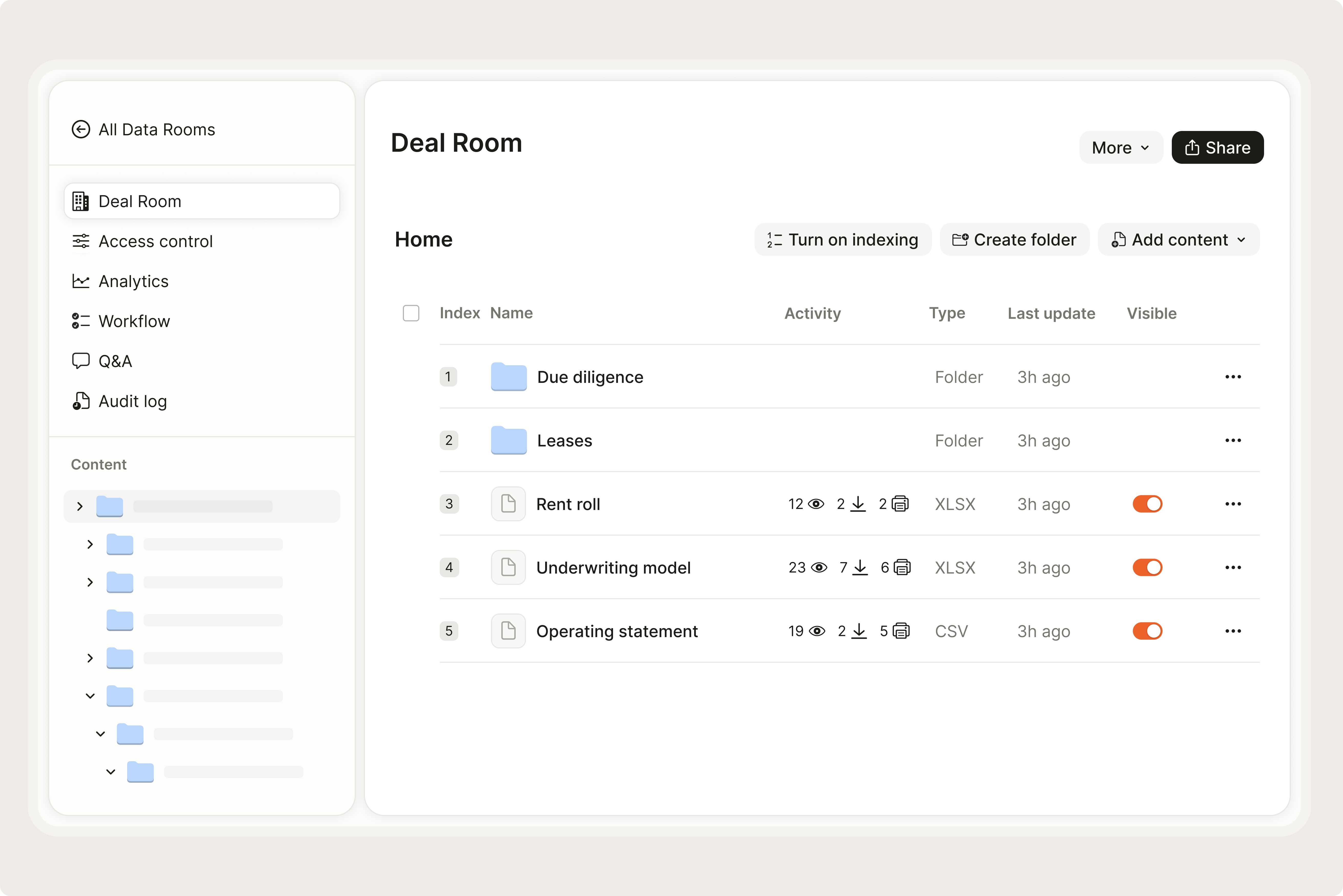
- 1.Upload Hong Kong property files to a secure roomDrop Land Registry memorial search results, government lease, title deeds, assignment chain, Buildings Department search, occupation permit, approved building plans, Deed of Mutual Covenant, management accounts, EPD site records, Phase I ESA, and commercial lease pack into Ellty.
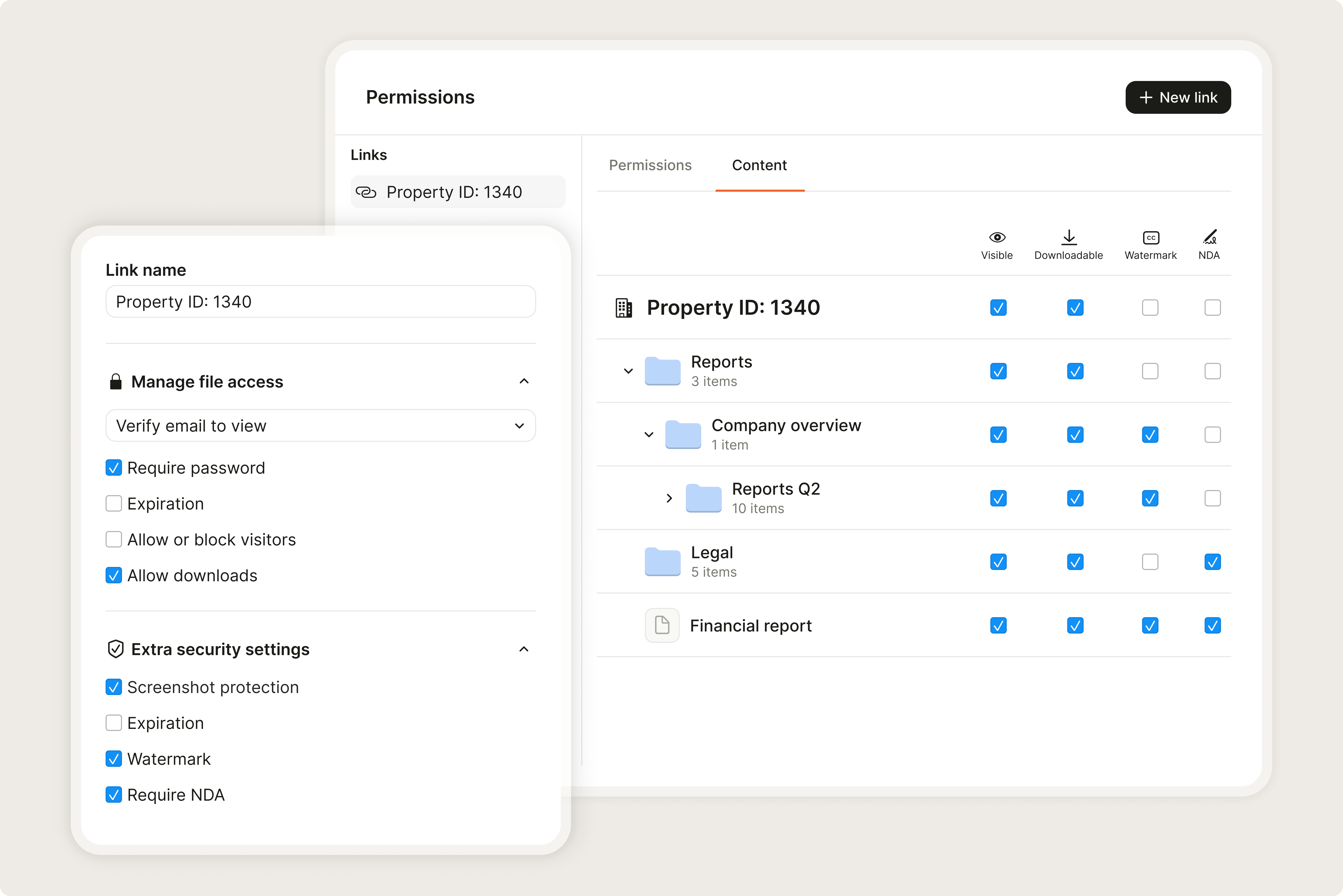
- 2.Give each advisor a scoped, tracked linkHK solicitors see Land Registry search, title deeds, and DMC. Building surveyor sees approved BD plans and occupation permit. Environmental consultant sees EPD records. Lender sees Land Registry search, UBW status, government lease, and valuation. Each party sees only their files.
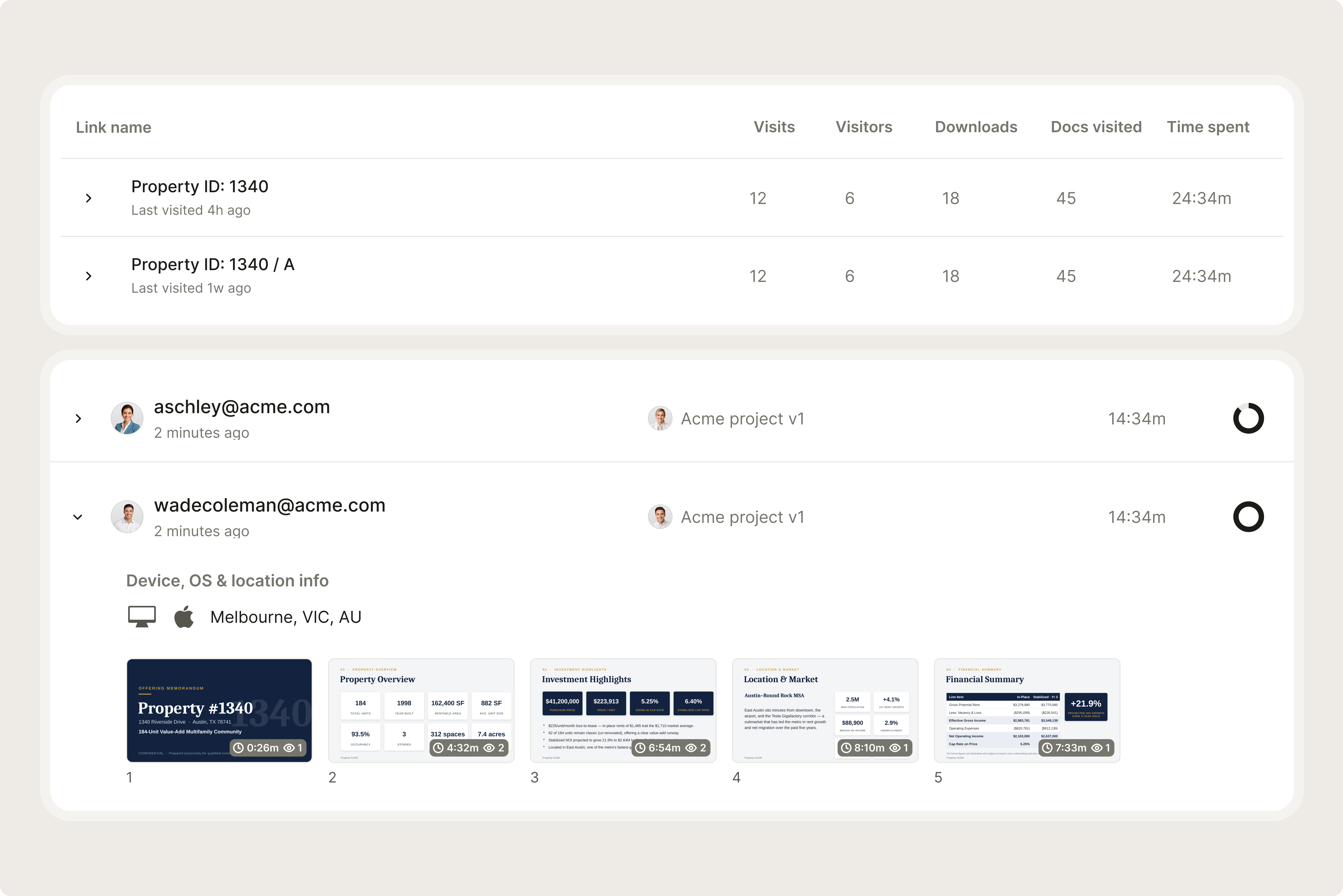
- 3.Monitor who reviews which documentsSee exactly which files each advisor opened and when. Catch UBW removal orders or government lease use conflicts before they affect deal pricing or completion.
What makes Hong Kong different
Unauthorized Building Works (UBW) is the single most pervasive structural compliance issue in Hong Kong commercial real estate, and it is persistent precisely because the enforcement backlog at the Buildings Department has historically been enormous. Hong Kong's high-density, high-pressure commercial environment has created decades of incremental additions to commercial buildings: internal walls moved, balconies enclosed, mezzanine floors added, rooftop structures built, external signage frames bolted to facades - most of it without BD authorization. The BD estimates tens of thousands of UBW removal orders are outstanding across Hong Kong at any given time. For a buyer, outstanding UBW removal orders registered in the Land Registry transfer with the property - you own the UBW problem at closing. Even UBW that has NOT been detected by BD and does not appear in the Land Registry yet is still a risk: BD can conduct inspections post-closing and issue orders after you become the owner. The practical diligence response is to engage a licensed building surveyor who will inspect the property and compare the as-built condition against the approved BD building plans - any discrepancy should be flagged and quantified for cost adjustment. For strata-title commercial: also review the building-level BD status, not just the individual unit, because building-wide removal orders affect all owners collectively.
The Stamp Duty differential between a direct property transfer (7.5% AVD on commercial) and a share sale of the property-holding company (0.2% stamp duty on shares) is the most commonly exploited commercial real estate transaction structure in Hong Kong. The math on a large commercial deal is stark: for a HKD 500 million commercial property, direct transfer AVD is HKD 37.5 million; share sale stamp duty is HKD 1 million. The HKD 36.5 million difference is more than enough to justify the additional corporate diligence work on the property-holding company. Hong Kong's Stamp Duty Ordinance does not explicitly prohibit this structure, and it is well-established in market practice. However, the Inland Revenue Department does have anti-avoidance provisions and can challenge structures in specific circumstances, and the acquisition of a company (as opposed to a direct property) means the buyer takes on any historic liabilities of the company beyond the property itself. HK tax counsel review of the specific company and transaction structure is essential before committing to a share sale structure. The share sale route is standard enough in HK commercial that solicitors and advisors are very familiar with the issues - but it is not automatic or risk-free.
The 2047 government lease expiry question sits in the background of every Hong Kong commercial acquisition and gets louder as the date approaches. Under the Sino-British Joint Declaration and the Basic Law, leases with under 50 years to run as of July 1, 1997 were extended by 50 years - so leases expiring before 2047 were extended to 2047. What happens after 2047 is a matter of China-HK policy: the expectation is that leases will continue to be extended, but this is a policy expectation, not a legal right under current instruments. For transactions today with hold periods of 10-15 years, the 2047 issue is a background risk that shows up mainly in DCF terminal value assumptions and exit market depth analysis. For institutional buyers targeting a 20-25 year hold: the 2047 uncertainty is an active risk that must be modeled and reflected in cap rate underwriting. Japanese and German pension funds investing in HK commercial have different benchmarks than HK-based investors for 2047 risk tolerance - confirm the institution's position before underwriting long-hold HK commercial.
Article 120 of the Basic Law of the Hong Kong Special Administrative Region of the People's Republic of China provides: 'All leases of land granted, decided upon or contracted before the establishment of the Hong Kong Special Administrative Region and extending beyond 30 June 1997, and all rights in relation to such leases, shall continue to be recognized and protected under the law of the Region.' Article 121 provides that such leases shall expire in accordance with their terms, or if they expire before 30 June 2047, they shall be extended to 30 June 2047. Premium shall not be charged on the extensions. The legal position post-2047 for extensions of existing government leases is to be determined by the Central People's Government in consultation with the Hong Kong SAR Government, and has not been codified in current legislation.
Timeline and cost in Hong Kong
Weeks 1-2 cover kickoff: Land Registry search (all memorials), government lease review, Buildings Department search for UBW removal orders, approved building plans request, occupation permit confirmation, DMC and management accounts (strata-title), EPD listed site search, leases abstraction, stamp duty structure analysis with HK solicitors, AMLO KYC, Companies Registry search for corporate sellers, OFAC and sanctions screens. HK solicitor fees for this phase: HKD 30,000-150,000 (approx. USD 4,000-20,000).
Load all files into Ellty before advisors engage. Standard HK commercial: 30-60 days. Government lease modification (if required): 6-12 months. BD UBW remediation works: 2-6 months.
Weeks 2-4 cover deep review: memorial chain title examination, UBW identification and cost assessment (building surveyor), government lease permitted use vs. intended use, DMC permitted use vs. intended commercial use, management fee and sinking fund analysis, registered lease review, stamp duty structure finalization, 2047 lease expiry analysis, and Phase I ESA delivery (if applicable). Costs in this phase: HKD 50,000-300,000 (approx. USD 6,500-39,000).
Weeks 4-8 handle resolution: mortgage discharge arrangements, UBW negotiation (seller remediation or price adjustment), lease registration confirmation, stamp duty payment planning, solicitor completion arrangements. Completion takes place at vendor's solicitors with simultaneous mortgage discharge and assignment; Stamp Duty paid to Stamp Office within 30 days of assignment; Land Registry registration within weeks of stamp duty payment.
Hong Kong total buyer acquisition costs: 7.5% Stamp Duty (direct property transfer) or 0.2% (share sale) + solicitor's fees (0.1-0.3% of transaction value) + Building surveyor fees + Environmental consultant fees (if applicable). No Capital Gains Tax on any property investment gain. For a HKD 200 million commercial property: Stamp Duty HKD 15 million (7.5%) or HKD 400,000 (share sale at 0.2%); solicitor fees HKD 200,000-600,000; total buyer-side cost is dominated by Stamp Duty.
Running a Hong Kong property deal from one room
Hold Land Registry search, government lease, UBW records, BD search results, and lease files in one secure, tracked Ellty data room.
Start free 14-day trialCommon questions about due diligence on Hong Kong commercial property
- Standard HK commercial deals take 30-60 days. Land Registry search: 1-3 days. Buildings Department search: 1-2 weeks. UBW building survey: 2-4 weeks. EPD Phase I ESA: 3-6 weeks. Government lease modification application (if required): 6-12 months - this is a separate timeline and is a major consideration for industrial-to-commercial conversion deals. Stamp duty must be paid to the Stamp Office within 30 days of the date of the assignment deed.
- Hong Kong Ad Valorem Stamp Duty (AVD) on non-residential (commercial) property: up to 7.5% of the higher of the consideration or Stamp Office assessed market value for transactions over HKD 6 million. No Buyer's Stamp Duty (BSD) on commercial (BSD only applies to residential). No Additional Stamp Duty (ASD) on commercial. No Capital Gains Tax in Hong Kong. For share sale structures (acquisition of the company holding the property instead of direct property purchase): stamp duty on shares is 0.2%, creating a significant saving versus direct transfer.
- Unauthorized Building Works (UBW) are additions or alterations to a building done without Buildings Department (BD) authorization under the Buildings Ordinance (Cap. 123). When the BD identifies UBW, it issues a removal order registered in the Land Registry that transfers with the property to any buyer. UBW is endemic in Hong Kong commercial buildings due to decades of unauthorized improvements. A building surveyor comparing the as-built condition against BD-approved plans is the standard diligence check. Outstanding BD removal orders create compliance costs, affect mortgage eligibility, and are major negotiating points between buyer and seller.
- All Hong Kong land is held on government lease from the HKSAR Government, not freehold. Under the Basic Law, leases expiring before 2047 were extended to 2047. What happens after 2047 is a matter of China-HK policy, not current codified law. For deals today with short hold periods, 2047 is a background risk. For institutional investors modeling 20+ year holds: the 2047 uncertainty affects terminal value assumptions, exit market depth, and long-term lender appetite for commercial assets with lease expiries approaching 2047.
- Yes. Hong Kong imposes no restrictions on foreign ownership of commercial property. Any individual or corporation, regardless of nationality or domicile, can own HK commercial property directly or through a Hong Kong or offshore company. There is no Buyer's Stamp Duty on commercial property for foreigners (BSD applies only to residential purchases by non-permanent residents). The share sale structure for property-holding companies is equally available to foreign buyers and reduces stamp duty from 7.5% to 0.2%.
- Hong Kong's main environmental risks in commercial real estate come from historical industrial use in Kowloon and the New Territories: Kwun Tong (electronics, light manufacturing), Tsuen Wan (textiles, chemicals), Tuen Mun (petrochemicals, power), and Sham Shui Po (light industrial). The Environmental Protection Department (EPD) maintains a database of listed contaminated sites. Phase I ESA with EPD listed site search is recommended for any former industrial or industrial-zone-adjacent commercial. Industrial-to-commercial conversion projects in these zones regularly uncover soil or groundwater contamination requiring remediation before redevelopment.