China commercial property due diligence starts with one fact: there is no freehold land in China. Every private commercial property is a Land Use Right (LUR) with a fixed term - typically 40 years for commercial. Diligence means confirming remaining LUR term, whether the land is granted or allocated (allocated land can't be freely sold), and the full tax stack including Land Appreciation Tax up to 60%.
China property transfer tax stack for commercial: Deed Tax (契税) 3-5% of transaction value paid by buyer; VAT (增值税) 5% of transfer consideration paid by seller (for resale commercial held under 2 years; different rates may apply for longer holds and new development); Land Appreciation Tax (LAT, 土地增值税) 30-60% of appreciation on commercial - a progressive tax on the appreciated value of the land and building, paid by seller; Corporate Income Tax (CIT) at 25% on seller's net gains from the property sale; Stamp Duty (印花税) 0.05% of transaction value, paid by both parties. Total combined tax burden on a commercial transfer can exceed 30% of the purchase price between seller and buyer taxes.
All Chinese land is owned by the state (PRC Constitution, Article 10). What's bought and sold is a Land Use Right (LUR, 土地使用权): the right to use a specific parcel of state-owned land for a specified term. Commercial LURs are typically 40 years from the date of grant; industrial LURs 50 years; residential 70 years; mixed-use 50 years. A commercial LUR granted in 2000 expires in 2040. LURs can be resold in the secondary market but the remaining term transfers to the buyer.
Since 2016, the standard title document for Chinese real property is the Real Property Certificate (不动产权证书, Bùdòngchǎn quán zhèngshū), which integrates the former House Ownership Certificate and Land Use Right Certificate into one document. Confirm the Real Property Certificate for the property at the local Real Property Registration Center (不动产登记中心). All registered mortgages (抵押权), restrictions, and annotations appear in the registration records.
Set up a due diligence data room before advisors engage. Load the Real Property Certificate, LUR grant contract, planning permit, completion acceptance record, EIA approval, VAT/LAT calculation, and lease files before the buyer's request list arrives.
Where China property deals go wrong
Not every check carries the same weight. The table below sorts risks by deal impact - dealbreakers first, then what moves the price, then basic hygiene - so your China attorney and advisor know what to clear first.
| Area | Documents to pull | China red flag | Matters most for | Tier | |
|---|---|---|---|---|---|
| Real Property Certificate and LUR registration | Real Property Certificate and LUR registration | Real Property Certificate (不动产权证书) from Real Property Registration Center, LUR grant contract (土地出让合同, Tǔdì chūràng hétóng), building ownership records, registration search at local Real Property Registration Center | China's Real Property Registration Center (不动产登记中心) in each city maintains the unified real property register; the Real Property Certificate shows: parcel number, registered owner (权利人), LUR type (granted 出让 or allocated 划拨), LUR term expiry date, building information (construction year, structure, total GFA), and all registered encumbrances (mortgages 抵押权, restrictions 限制); confirm the certificate matches the property being sold; confirm the registered owner matches the seller's legal entity name exactly; request an official registration extract (登记信息查询证明) from the Real Property Registration Center to confirm current registration status and all encumbrances in real time; note the LUR type (granted vs. allocated) and the LUR expiry date | All buyers - foundational check | Dealbreaker |
| Allocated land (划拨) - transfer restriction | Allocated land (划拨) - transfer restriction | LUR type on Real Property Certificate (划拨 or 出让), Land Use Right Grant Contract (if granted), government approval for conversion (if allocated), estimated land grant fee payable for conversion | China has two types of LUR: Granted (出让, Chūràng) - the standard LUR purchased from the government; can be freely transferred in the secondary market; and Allocated (划拨, Huàbō) - LUR allocated by the government to specific entities (historically SOEs and government institutions) without payment; allocated LURs cannot be commercially transferred without first converting to granted status, which requires: (a) government approval; (b) payment of a land grant fee (土地出让金) to the local government at a rate determined by the government's assessment of the land's value; the land grant fee can be very large - often 30-60% of market value; older SOE commercial buildings in prime urban locations (Beijing CBD, Shanghai central areas) frequently sit on allocated land; confirm the LUR type before any offer | All buyers - especially acquisitions from SOEs, government institutions | Dealbreaker |
| LUR remaining term - commercial at 40 years | LUR remaining term - commercial at 40 years | LUR grant contract (expiry date), Real Property Certificate (LUR term field), LUR renewal policy research from China counsel, lender LUR term requirements | China commercial LURs granted from 1990 onward with 40-year terms begin expiring from 2030; a commercial LUR granted in 1995 expires in 2035; the law governing LUR renewal for commercial land (as opposed to residential, where RA 2007 Property Law provides for automatic renewal) is less settled; renewal of commercial LURs requires application to and approval by the local land authority and payment of an additional land grant fee assessed at the renewal date; for commercial properties with LURs expiring within 10-15 years: institutional lenders apply significant haircuts on loan-to-value, and exit markets are affected; model the LUR remaining term into DCF analysis and confirm lender eligibility | All buyers - especially institutional long-hold investors | Dealbreaker |
| Planning permits and completion acceptance | Planning permits and completion acceptance | Construction Land Planning Permit (建设用地规划许可证), Construction Works Planning Permit (建设工程规划许可证), Construction Permit (建筑工程施工许可证), Completion Acceptance Certificate (竣工验收合格证 or 竣工验收备案表), Fire Acceptance (消防验收) | China commercial building construction requires: (1) Construction Land Planning Permit (建设用地规划许可证): confirms the land parcel can be used for the planned construction purpose; (2) Construction Works Planning Permit (建设工程规划许可证): confirms the proposed building design complies with urban planning; (3) Construction Permit (建筑工程施工许可证): construction license from housing authority; (4) Completion Acceptance Record (竣工验收备案表) filed with local housing and urban-rural development authority confirming the completed building was inspected and accepted; (5) Fire Safety Completion Acceptance (消防验收合格证) from fire authority; a building missing the completion acceptance record or fire acceptance is technically in irregular status and cannot legally obtain occupancy certificates; this is surprisingly common for older commercial buildings in China, especially those that changed ownership during the 1990s-2000s privatization era | All China commercial, especially pre-2000 SOE buildings | Dealbreaker |
| Foreign investment restrictions and MOFCOM | Foreign investment restrictions and MOFCOM | NDRC/MOFCOM Negative List for Foreign Investment, foreign investment approval status, WFOE registration documents at SAMR, State Administration of Foreign Exchange (SAFE) capital verification, China counsel legal opinion on FDI structure | Foreign direct investment in Chinese commercial real estate is subject to the Foreign Investment Law (2019) and the associated Negative List; commercial real estate is generally open to foreign investment, but some sectors (certain hotel types, specific commercial categories) have restrictions; foreign investors establish a WFOE (Wholly Foreign-Owned Enterprise) or JV entity in China to hold the LUR; WFOE establishment requires MOFCOM registration and SAMR company registration; capital contributions must be verified by SAFE (State Administration of Foreign Exchange) and are subject to capital account management rules; profit repatriation requires SAFE approval; for acquisitions from existing companies: confirm whether the transaction requires MOFCOM merger/acquisition notification under the Anti-Monopoly Law | All foreign buyers of China commercial | Dealbreaker |
| Land Appreciation Tax (LAT) and seller economics | Land Appreciation Tax (LAT) and seller economics | LAT calculation from China tax counsel (value appreciation x applicable progressive rate), original land grant contract cost confirmation, deductible items list (cost + 20% deductible), seller LAT exposure analysis | China's Land Appreciation Tax (LAT, 土地增值税) is a progressive tax on the appreciation of land and buildings between acquisition cost and transfer price; progressive rates: 30% for appreciation up to 50% of the deductible amount; 40% for 50-100% appreciation; 50% for 100-200% appreciation; 60% for appreciation over 200% of the deductible amount; deductible items include: land grant fee paid, construction cost, finance costs, and an additional 20% deduction on the first two items; for commercial properties in prime Chinese cities held for many years, the appreciation over original cost can be substantial, and LAT exposure can be 40-60% of the gain; this directly affects seller net proceeds and negotiated deal economics; buyers who don't model LAT as part of seller pricing logic misread the deal | All buyers - affects negotiated price | Price-adjuster |
| Mortgages and registered encumbrances | Mortgages and registered encumbrances | Real Property Registration Center search (encumbrance section of registration records), mortgage holder release confirmation, court enforcement orders or seizure records from registration | All China commercial property mortgages (抵押权) and restrictions are registered at the Real Property Registration Center; a formal registration search produces a certified extract showing all registered encumbrances; additionally: court-ordered seizures (司法查封, Sīfǎ cháfēng) and enforcement actions are also registered against the property; a sealed property (查封 property) cannot be transferred until the court seals are released; confirm no court seizure orders exist before closing; also check the National Enterprise Credit Information Publicity System for any enforcement judgments against the seller entity that may result in future seizure orders | All buyers | Price-adjuster |
| Leases and tenancies | Leases and tenancies | All commercial leases, rent roll, registered long-term lease records at Real Property Registration Center (for leases over 6 months in practice), tenant right of first refusal clauses in lease agreements | China commercial leases can be registered at the Real Property Registration Center for longer-term protection; unregistered leases may still be enforceable against a buyer who had actual knowledge of the lease; tenants have statutory right of first refusal (优先购买权, Yōuxiān gòumǎi quán) under Article 726 of the Civil Code when the landlord sells the property - the seller must notify all tenants of the sale and tenants have 15 days to match the offer; failure to give notice of sale to tenants in a multi-tenant commercial creates legal exposure; confirm all tenants have received proper notice of sale; review lease terms for change-of-control provisions that may allow tenant termination if ownership changes | Tenanted China commercial | Price-adjuster |
| Environmental - EIA and contaminated sites | Environmental - EIA and contaminated sites | EIA approval (环境影响评价报告) from Ministry of Ecology and Environment records, China contaminated sites list (重点监控工业企业, priority-monitored industrial enterprises), Phase I ESA from licensed environmental consultant | China's environmental regulations require EIA approval from the Ministry of Ecology and Environment (生态环境部) or its local EPB (Environmental Protection Bureau) before commercial construction; confirm EIA approval was obtained for the current building; for land conversions from industrial to commercial use: China requires mandatory soil contamination investigation under the Soil Pollution Prevention and Control Law (2018) when land use changes from industrial or mining to residential, public service, or commercial; for any former factory, chemical plant, or industrial site: mandatory Phase I and potentially Phase II ESA is now required by law before commercial development; China's former industrial land contamination legacy (especially SOE factory sites in urban redevelopment zones in Shanghai, Chongqing, Wuhan, Chengdu) is substantial | Former industrial commercial, urban redevelopment sites | Price-adjuster |
| Urban planning zone and GFA compliance | Urban planning zone and GFA compliance | Construction Works Planning Permit (建设工程规划许可证), planning zone confirmation from local Natural Resources Bureau, FAR and GFA compliance, building area survey from registered surveyor | China's urban planning system controls permitted use, FAR (Floor Area Ratio, 容积率), and building coverage ratio for each parcel through the local Natural Resources Bureau (自然资源局) zoning; confirm the property's registered GFA in the Real Property Certificate matches the permitted GFA in the Construction Works Planning Permit; buildings with GFA exceeding the permitted amount are in violation of the planning permit; excess GFA cannot be legally registered in the Real Property Certificate; some older commercial buildings in China have floor areas or modifications that exceed the approved planning permit scope - this is a material compliance defect | All China commercial | Standard check |
| Seller KYC, AML, and court judgments | Seller KYC, AML, and court judgments | SAMR entity search, National Enterprise Credit Information System, China court enforcement judgment database (失信被执行人 - Dishonest Judgment Debtors List), OFAC and relevant sanctions screens, UBO identification | Confirm seller at SAMR (State Administration for Market Regulation) company registry; search the National Enterprise Credit Information Publicity System (国家企业信用信息公示系统) for enforcement actions, administrative penalties, or listed violations; search the Supreme People's Court's Dishonest Judgment Debtors List (失信被执行人名单) for any entities or individuals associated with the seller; court enforcement orders can result in property seizure even after a sale agreement is signed if a seizure order is registered before the transfer registration completes; run OFAC and US/EU sanctions screens; for SOE sellers: confirm SASAC authorization for the asset sale | All deals, SOE sellers, cross-border transactions | Standard check |
Due diligence on a China property?
Set up your Ellty data room before diligence starts.
Start free 14-day trialChina commercial property due diligence checklist
The table ranked risks by severity. This is the full checklist to work through, grouped by area.
Real Property Registration Center search
- Day one: commission an official registration search (登记信息查询) at the Real Property Registration Center (不动产登记中心) for the city and district where the property is located; the search result is a certified Registration Extract (登记信息查询证明) showing current owner, LUR type, LUR term expiry, registered GFA, and all encumbrances including mortgages (抵押权) and court seizures (查封)
- Confirm the registered owner name matches the seller's legal entity name exactly; any discrepancy (company name after a restructuring, subsidiary vs. parent) requires explanation and potentially additional authority documentation
- Confirm the LUR type: granted (出让) vs. allocated (划拨); if allocated: an allocated-to-granted conversion is required before the property can be transferred; get China counsel estimate of the land grant fee payable for conversion and the time required (6-12 months minimum)
- Note the LUR expiry date: if the commercial LUR expires within 15 years, model the renewal process and anticipated renewal land grant fee in your DCF; confirm lender appetite for the remaining LUR term
Give each advisor a scoped link in Ellty. China real estate attorney sees Real Property Certificate, LUR grant contract, registration extract, and court judgment searches. Building inspector sees planning permits and completion acceptance records. Environmental consultant sees EIA approval and Phase I ESA. Lender sees registration extract, LUR term, and valuation.
Allocated land conversion - critical for SOE deals
- If the LUR is allocated (划拨): the property cannot be legally transferred commercially without first converting to granted status; this is a process that requires: (1) application to the local government's Natural Resources Bureau; (2) government assessment of the land grant fee (土地出让金); (3) payment of the land grant fee; (4) issuance of new LUR grant contract (土地出让合同); (5) new Real Property Certificate
- The land grant fee for allocated-to-granted conversion is assessed by the local government on a formula that approximates market value of the land; for prime commercial land in Beijing or Shanghai that was allocated to an SOE in the 1980s, the land grant fee can be enormous - sometimes exceeding the value of the building itself; model this cost before any offer on SOE-held commercial
- SOE seller process: SOE sellers often cannot sell assets without prior SASAC (State-Owned Assets Supervision and Administration Commission) approval; for provincial or municipal SOEs, the relevant local SASAC must approve the disposal; the SOE typically must obtain a state asset appraisal (资产评估) from a licensed appraisal firm registered with SASAC, and the transaction price must be at or above the appraisal value; confirm these approvals are in place before signing
- Timeline: allocated land conversion and SOE approval processes together can take 6-24 months; these are not fast processes and should be factored into the transaction timeline from the outset
Planning permits and completion records
- Request the following permit chain from seller: (1) Construction Land Planning Permit (建设用地规划许可证) from Natural Resources Bureau; (2) Construction Works Planning Permit (建设工程规划许可证) from Natural Resources Bureau; (3) Construction Permit (建筑工程施工许可证) from Housing and Urban-Rural Development Authority; (4) Completion Acceptance Filing (竣工验收备案表) from Housing Authority; (5) Fire Safety Completion Acceptance (消防验收合格证) from Fire Department
- Confirm the completion acceptance filing and fire acceptance documents exist; for China commercial buildings constructed before 2000: these records may be incomplete, lost, or never have been properly filed; buildings with incomplete completion records are in irregular status and create legal risk for buyers
- Compare the building's registered GFA in the Real Property Certificate against the GFA in the Construction Works Planning Permit; if they match: no excess GFA issue; if the registered GFA is larger than the permitted GFA: investigate whether the excess was legally approved or represents an unauthorized addition
- For fire safety: confirm the current fire safety compliance status is current (China requires annual fire inspection); for large commercial buildings: confirm the fire safety certificate is current
Load all files into Ellty before advisors engage. China real estate attorney sees registration extract, LUR contract, and planning permits. Building inspector sees planning permits and completion acceptance records. Environmental consultant sees EIA approval and Phase I ESA. Track who reviews the completion acceptance records and court judgment searches most carefully.
LAT, VAT, and full tax computation
- Engage Chinese tax counsel to compute the full seller-side tax stack before signing: LAT (Land Appreciation Tax), VAT (value-added tax on the building portion of the transfer), and CIT (corporate income tax on net gains); these must be modeled to understand the seller's net proceeds and their pricing logic
- LAT computation: appreciation = transfer price minus deductible items; deductible items include original land grant fee, construction costs, finance costs, taxes paid, and a 20% bonus deduction on land and construction costs; progressive LAT rates: 30% for appreciation rate up to 50%; 40% for 50-100%; 50% for 100-200%; 60% for over 200%; pre-pay LAT calculation and confirm with the local tax authority
- VAT on commercial property transfer: for non-residential property sold by a company: 5% of the transfer price (or the spread between acquisition and transfer price for properties held over 2 years); confirm with China tax counsel which VAT calculation method applies to the specific transaction
- Buyer's Deed Tax (契税): 3% of transfer price for most commercial; confirm local rate with China counsel as some jurisdictions have different rates
- Structure: many China commercial transactions are structured as equity transfers (购买持有物业公司的股权) rather than direct property transfers to avoid some transfer taxes; equity transfers have their own tax implications and additional corporate diligence requirements; confirm with China counsel and tax advisor which structure is more efficient
Compare Taiwan's commercial property due diligence process for cross-strait portfolio strategy. China and Taiwan both have state or government-owned land underpinning all private property (China: state-owned land with LUR system; Taiwan: private freehold land with separate land and building registration), both have significant land appreciation taxes on transfers (China LAT 30-60% vs. Taiwan LVIT 20-40% on officially assessed increment), and both have seismic risk considerations (Taiwan very high; China varies significantly by region with high risk in Sichuan, Yunnan, and coastal areas).
How due diligence works in China
Step 1 - Registration search and LUR type confirmation
Day one: commission registration search at the Real Property Registration Center. Confirm LUR type (granted vs. allocated), LUR term expiry, registered GFA, and all encumbrances. For SOE sellers: request SASAC approval documentation and state asset appraisal.
Do not pay any deposit before confirming the LUR is granted (not allocated) and no court seizures are registered. Allocated land and court seizures are dealbreakers that must be resolved before any transfer is possible.
Step 2 - Planning permits, environmental, and LAT computation
Request complete permit chain from seller. Commission China tax counsel LAT computation and full transfer tax analysis. For former industrial or SOE commercial in urban redevelopment zones: commission Phase I ESA with mandatory soil investigation under Soil Pollution Law.
Confirm EIA approval exists for the building's construction.
Step 3 - Leases, tenant notices, and AML
Abstract all commercial leases. Confirm seller has served or will serve statutory right of first refusal notice on all tenants (15-day notice required under Civil Code Article 726). Review any change-of-control provisions in major leases. Run National Enterprise Credit System search and Dishonest Judgment Debtors List search. Run OFAC and sanctions screens. Confirm MOFCOM/NDRC requirements for foreign buyers.
Step 4 - Transfer registration and closing
China property transfers must be registered at the Real Property Registration Center to complete title transfer; a signed and notarized purchase contract does not transfer title - only registration creates the new owner's title. Transfer registration requires: payment of Deed Tax, VAT clearance from seller, LAT clearance (or pre-payment arrangement), and submission of all required documents to the Registration Center.
Load all closing documents into Ellty before completion. China attorney sees registration documents, permit chain, and tax clearance certificates. Lender sees new Real Property Certificate with clean encumbrance record.
How to set up your China data room in Ellty.
China commercial deals involve Real Property Certificate, LUR grant contract, registration extract, planning permits, completion acceptance, EIA approval, Phase I ESA, LAT calculations, court judgment searches, and lease files.
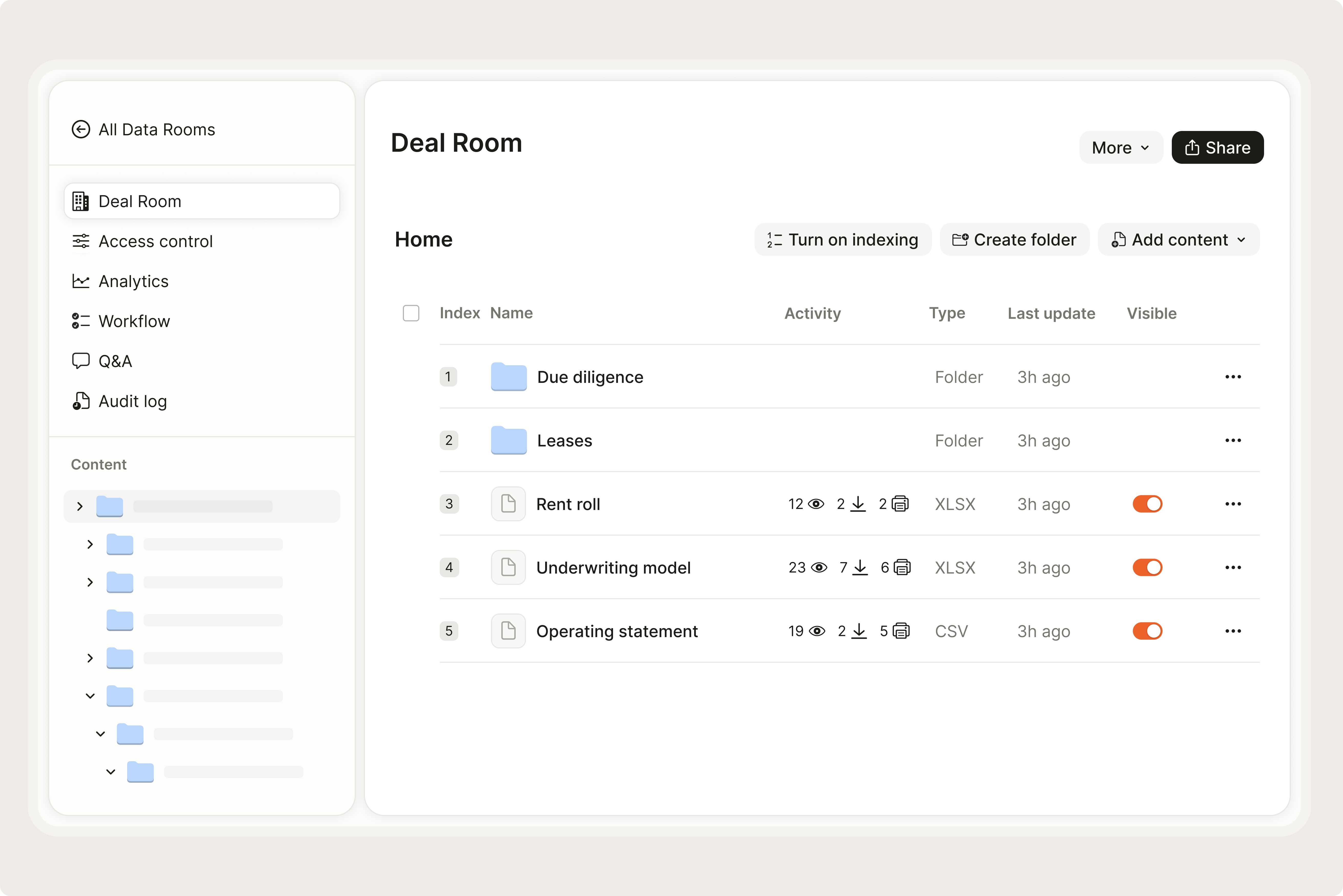
- 1.Upload China property files to a secure roomDrop Real Property Certificate, LUR grant contract, registration extract, Construction Land Planning Permit, Construction Works Planning Permit, Construction Permit, Completion Acceptance Filing, Fire Acceptance, EIA approval, Phase I ESA, LAT tax computation, and commercial lease pack into Ellty.
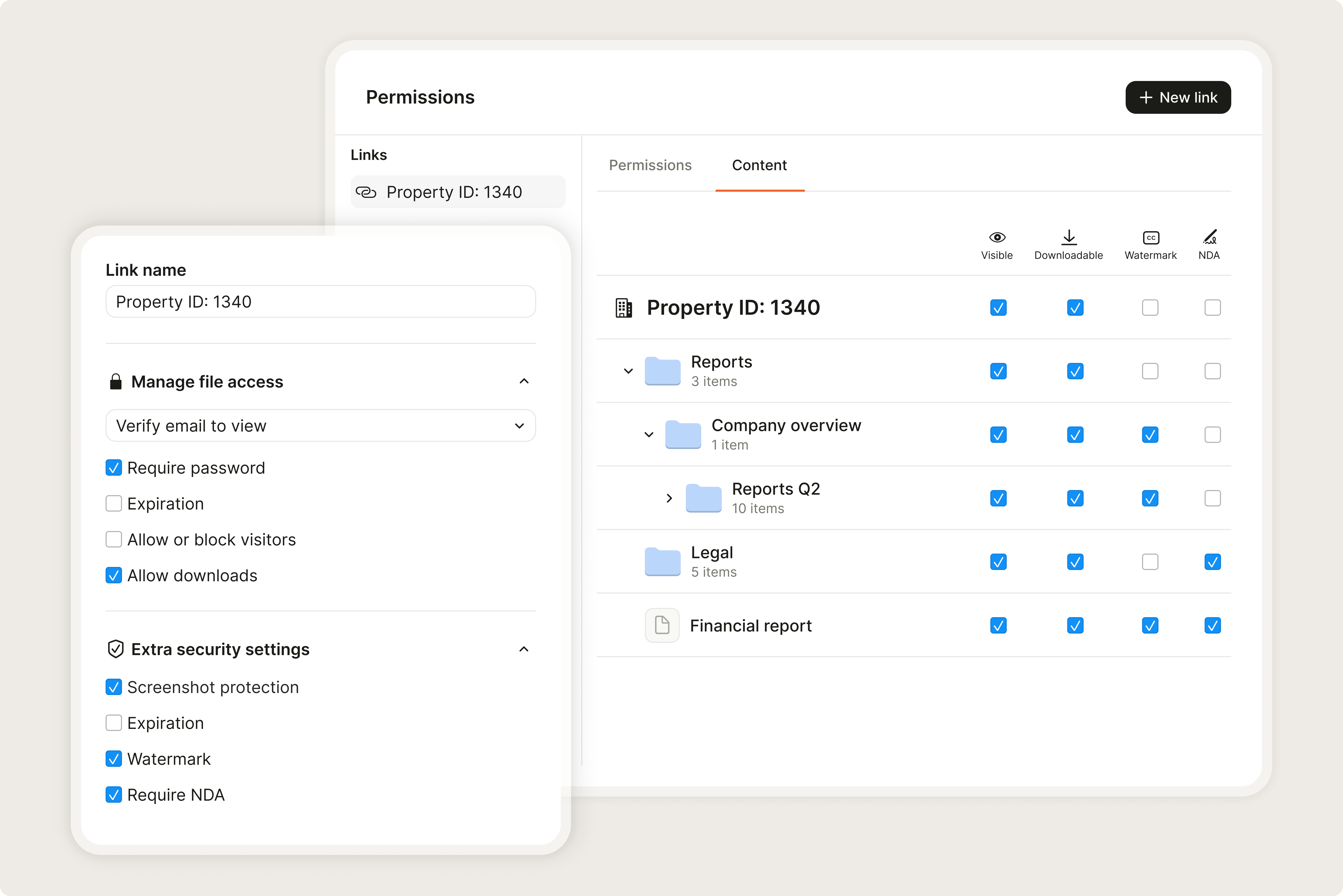
- 2.Give each advisor a scoped, tracked linkChina real estate attorney sees registration extract, LUR contract, and planning permits. Building inspector sees completion acceptance records. Environmental consultant sees EIA approval and Phase I ESA. Tax counsel sees LUR grant cost records and appreciation computation. Lender sees registration extract and valuation.
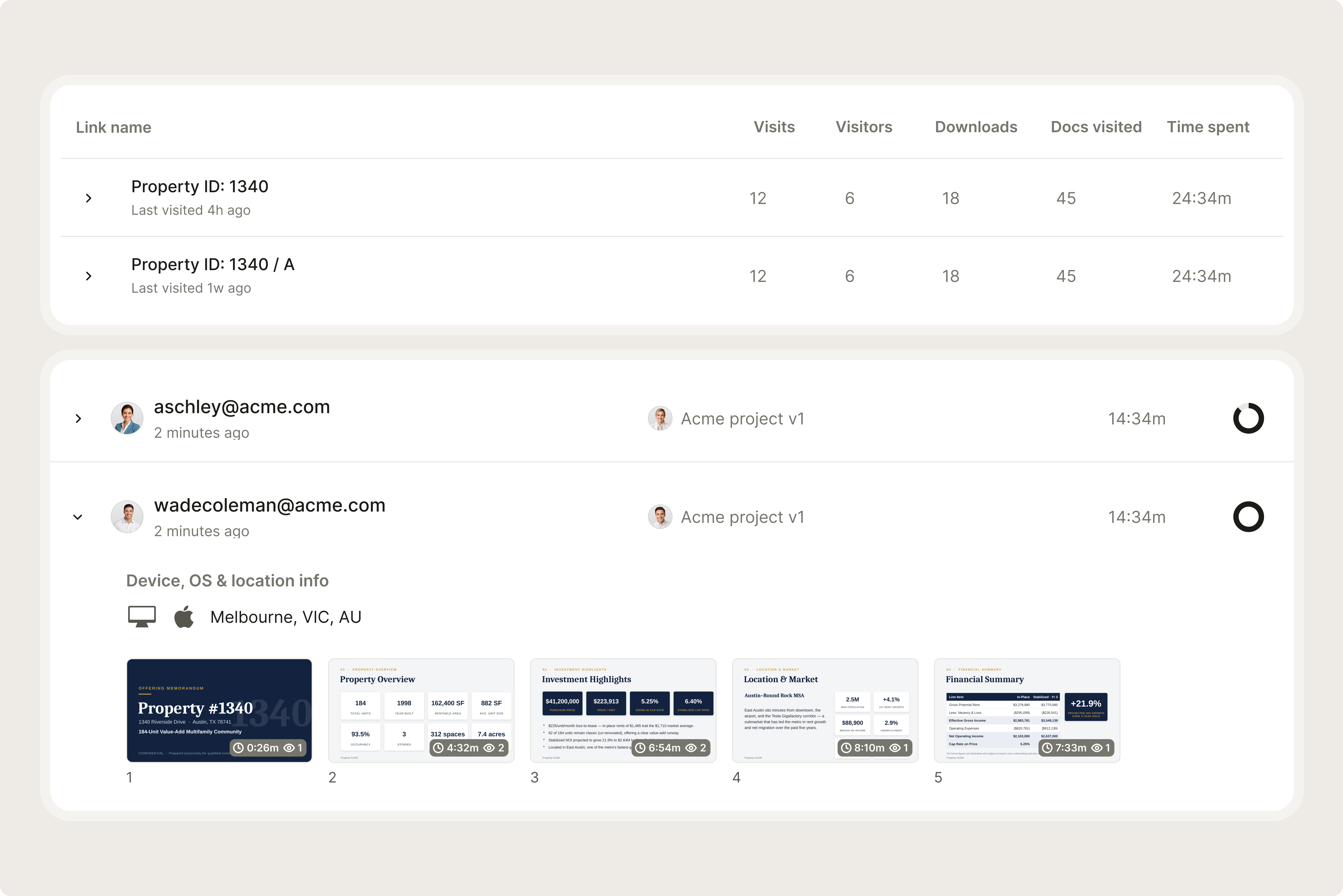
- 3.Monitor who reviews which documentsSee exactly which files each advisor opened and when. Catch allocated land issues or missing completion records before they affect deal structure and pricing.
What makes China different
The allocated land (划拨 land) issue is the most common dealbreaker-level surprise for buyers who are new to China commercial real estate. The PRC Land Administration Law and Urban Real Estate Administration Law prohibit the commercial transfer of allocated land use rights without government approval and payment of the land grant fee. In practice, this means that a significant number of commercial buildings in Chinese cities - particularly older buildings built on land originally allocated to SOEs (state-owned enterprises) or government institutions in the pre-market era - sit on allocated land that cannot be freely sold. The allocated land status is disclosed in the Real Property Certificate (the LUR type field shows 划拨), but buyers who don't check this before due diligence engagement are frequently surprised late in the process. The conversion process from allocated to granted land involves applying to the local Natural Resources Bureau for a new LUR grant, paying the land grant fee assessed by the government (which can be very large for prime commercial land in Beijing or Shanghai), and obtaining a new Real Property Certificate reflecting the granted LUR. This process takes 6-24 months and is subject to government approval that is not guaranteed. No competent China real estate counsel would let a buyer proceed to signing without confirming the LUR type, but buyers working without specialized local counsel in secondary and tertiary cities have been caught out. Confirm the LUR type before the first conversation about price.
China's Land Appreciation Tax is one of the highest effective transaction taxes on real estate in Asia, and its interaction with seller pricing is systematically misunderstood by buyers who come to China from other markets. LAT is not a tax on the total transaction value but a tax on the appreciation - specifically, the difference between the transfer price and the "deductible items" (original land cost, construction cost, finance costs, and a 20% bonus deduction). The progressive rate structure (30-60%) means that a commercial property in a prime location that has appreciated significantly since initial development may face a LAT liability equal to 40-50% of the gross appreciation. This is the seller's cost, not the buyer's, but it directly affects seller net proceeds and therefore the seller's price floor. A seller of a Shanghai Grade A office building who paid RMB 50 million for the LUR and building in 2005 and is selling at RMB 300 million in 2026 faces a LAT calculation on approximately RMB 200 million of appreciation (after deductibles) - at the 60% LAT rate, that's RMB 120 million in LAT alone, reducing the seller's net proceeds to roughly RMB 150 million after LAT and CIT. Understanding this math is essential for buyers who want to understand why China commercial sellers have the price floors they have and why the LAT burden shapes deal negotiations.
The court seizure (司法查封) risk is an underappreciated timing risk in China commercial transactions. Under China's civil enforcement system, a court can order seizure of real property to secure enforcement of a judgment against the property owner; the seizure is registered at the Real Property Registration Center and once registered, the property cannot be transferred. The problem for buyers is that a registration search conducted early in due diligence may show no seizure, but a seizure order can be registered at any time - including between the initial search and the transfer registration. Chinese litigation in civil and commercial courts involving a corporate seller creates the risk of a seizure order appearing unexpectedly. The standard China practice for managing this risk is: conduct an initial registration search at the start of diligence; re-run the search immediately before the transfer registration is submitted; if possible, coordinate the transfer registration submission to minimize the gap between the final search and registration submission. Also search the National Enterprise Credit Information System and the Supreme People's Court's Dishonest Judgment Debtors List for any enforcement proceedings against the seller entity that could result in a future seizure order.
Article 10 of the Constitution of the People's Republic of China provides that land in cities is owned by the State, and land in rural and suburban areas is owned by collectives. No organization or individual may appropriate, buy, sell or lease land or otherwise engage in the transfer of land by unlawful means. The Urban Real Estate Administration Law of the PRC (amended 2019) Article 38 provides that Real Property that meets the following conditions may be transferred: (1) The land use right has been obtained by transfer payment; (2) The real property development enterprise has invested more than 25% of the total investment in development on the land and the construction of commercial housing and has obtained a pre-sale permit. Article 40 provides that for land use rights obtained by means of allocation, transfer is restricted and requires application to, and approval from, the relevant land administration authority, with payment of land transfer fees in accordance with state regulations.
Timeline and cost in China
Weeks 1-4 cover kickoff: Real Property Registration Center search (LUR type, term, encumbrances), confirmed seller authorization (SASAC approval for SOE), court seizure and enforcement search at National Enterprise Credit System and Supreme People's Court database, planning permit chain request, completion acceptance records, EIA approval confirmation, Phase I ESA commission for former industrial, LAT/VAT/CIT computation by China tax counsel, tenant right of first refusal notice analysis, lease abstraction, MOFCOM/NDRC foreign investment assessment (if foreign buyer), and AML/KYC. China counsel fees in this phase: RMB 200,000-800,000 (approx. USD 28,000-110,000).
Load all files into Ellty before advisors engage. Standard China commercial: 60-120 days. Allocated land conversion: 6-24 months additional. SOE SASAC approval: 3-6 months. MOFCOM foreign investment approval: 1-3 months.
Weeks 4-8 cover deep review: registration search analysis, LUR conversion feasibility (if allocated), planning permit vs. as-built GFA comparison, completion acceptance status review, fire safety compliance, EIA approval review, Phase I ESA delivery, soil investigation (if land use conversion from industrial), LAT and full tax stack computation, lease right of first refusal notice process, lease change-of-control analysis, and lender pre-approval. Costs in this phase: RMB 300,000-1,500,000 (approx. USD 42,000-210,000).
Weeks 8-16 handle resolution: court seizure clearance (if any), mortgage release, SOE SASAC approval finalization, allocated land grant fee negotiation and payment (if applicable), MOFCOM foreign investment filing (if required), tenant right of first refusal notice period (15 days), LAT pre-payment arrangement with local tax authority, Deed Tax payment, and transfer registration at Real Property Registration Center.
China total buyer-side costs: Deed Tax 3-5% of consideration + registration fee (small, typically under 0.1%) + legal and advisory fees; total buyer costs: approximately 4-6% of transaction value. Seller costs: LAT (30-60% of appreciation after deductibles) + VAT 5% + CIT 25% on net gains; total seller costs can be very large for long-held appreciated commercial in prime cities. Total transaction friction (combined buyer and seller costs) in China commercial is among the highest of any major CRE market globally.
Running a China property deal from one room
Hold LUR certificates, planning permits, completion records, LAT calculations, and lease files in one secure, tracked Ellty data room.
Start free 14-day trialCommon questions about due diligence on China commercial property
- Standard China commercial deals take 60-120 days. Allocated land conversion (if required): 6-24 months. SOE seller SASAC approval: 3-6 months. MOFCOM foreign investment filing: 1-3 months. Phase I ESA and soil investigation: 4-8 weeks. Transfer registration at Real Property Registration Center: 2-4 weeks. Court seizure risk must be managed by keeping a narrow gap between the final pre-registration search and submission of the transfer registration documents.
- Allocated land (划拨 Huàbō) is a Land Use Right granted by the government to SOEs, government institutions, or other specified entities without payment of a land grant fee. Allocated LURs cannot be commercially transferred without government approval and payment of a land grant fee (土地出让金) assessed by the local Natural Resources Bureau. The land grant fee for prime commercial land in Beijing or Shanghai can be very large - sometimes exceeding the building value. Confirm the LUR type (出让 granted vs. 划拨 allocated) at the Real Property Registration Center before any offer. Allocated land requiring conversion is typically a 6-24 month process.
- China's Land Appreciation Tax (LAT, 土地增值税) is a progressive tax paid by the seller on the appreciation of commercial property. The tax base is the transfer price minus deductible items (land cost, construction, finance costs, plus 20% bonus deductible). Progressive rates: 30% for appreciation up to 50% of deductibles; 40% for 50-100%; 50% for 100-200%; 60% over 200%. For long-held prime commercial in Shanghai or Beijing, LAT can be 40-60% of the gross gain. It directly affects seller net proceeds and their price floor, which is why understanding the seller's LAT exposure is essential for modeling negotiated deal economics.
- Foreign investors can own Chinese commercial real estate, but must do so through a China-registered entity: a WFOE (Wholly Foreign-Owned Enterprise) or JV established under the Foreign Investment Law (2019). The entity must be registered with SAMR (State Administration for Market Regulation) and MOFCOM. Capital contributions must be verified by SAFE (State Administration of Foreign Exchange). Profit repatriation requires SAFE approval. Some commercial sectors are restricted or prohibited for foreign investment per the NDRC/MOFCOM Negative List - confirm the specific property category is open to FDI. Anti-monopoly filing may be required for large acquisitions.
- China courts can order seizure (司法查封) of real property to secure enforcement of a judgment against the property owner; the seizure is registered at the Real Property Registration Center. Once registered, the property cannot be transferred. A seizure can be registered at any point - including between an early title search and the transfer registration submission. To manage this risk: run an initial registration search at the start of diligence; run a fresh search immediately before transfer registration submission; minimize the gap between the final search and the registration filing; and search the Supreme People's Court Dishonest Judgment Debtors List for the seller entity.
- China's Soil Pollution Prevention and Control Law (2018) mandates soil contamination investigation when land changes use from industrial or mining to residential, public service, or commercial. For any former factory, chemical plant, or SOE industrial site being redeveloped or converted to commercial use: Phase I and Phase II ESA is legally required. EIA approval from the Ministry of Ecology and Environment (or local EPB) is required for commercial construction. For non-industrial commercial in established commercial zones: Phase I ESA is recommended but not always legally mandated. China's urban industrial redevelopment legacy (SOE factory sites in Shanghai, Chongqing, Wuhan, Chengdu) has significant contamination that has created expensive remediation liabilities for buyers who skipped Phase II ESA.